South Korea Automotive Cross-Member and Side-Member Systems Market Size & Forecast:
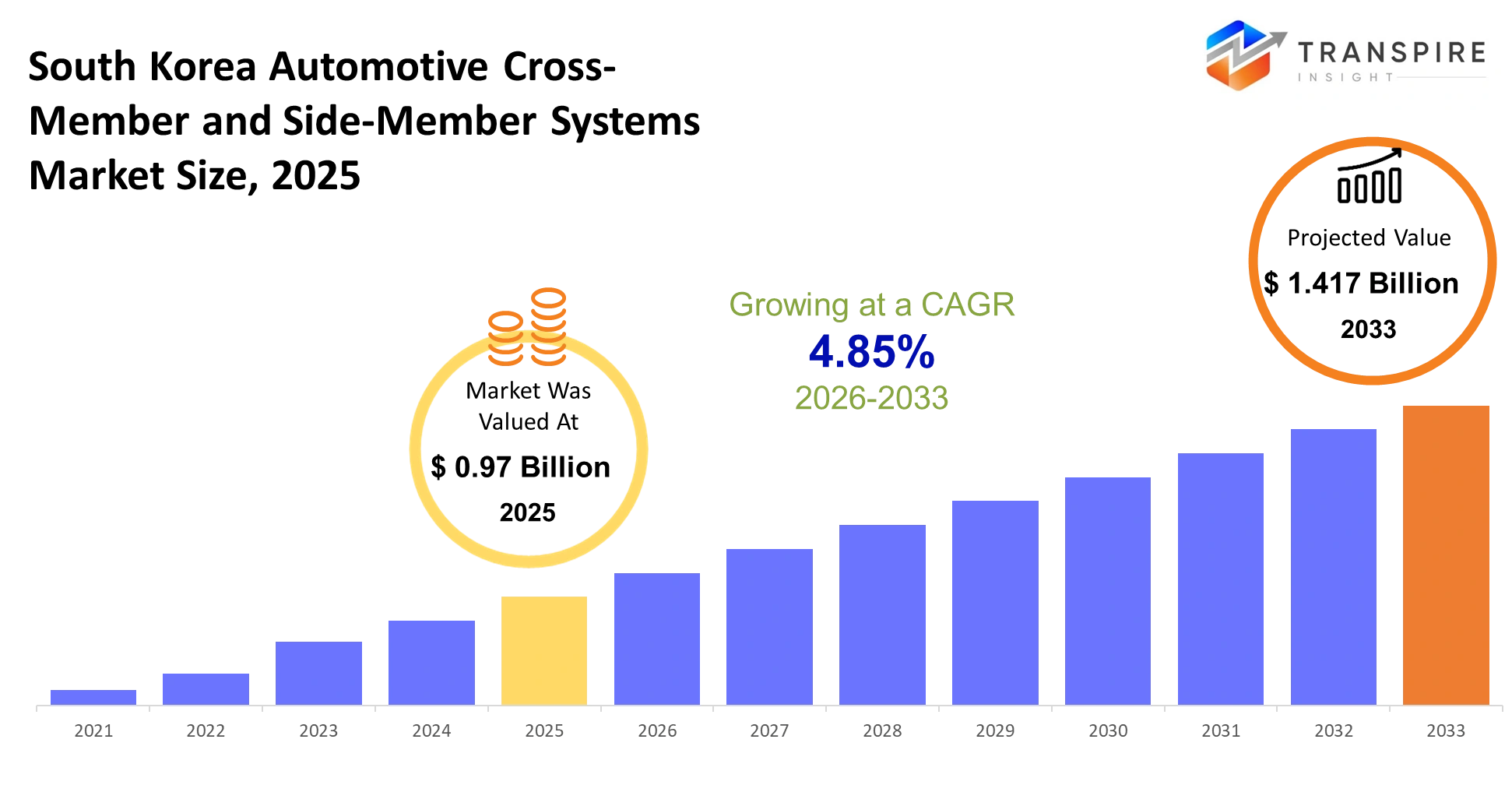
- South Korea Automotive Cross-Member and Side-Member Systems Market Size 2025: USD 0.97 Billion
- South Korea Automotive Cross-Member and Side-Member Systems Market Size 2033: USD 1.417 Billion
- South Korea Automotive Cross-Member and Side-Member Systems Market CAGR: 4.85%
- South Korea Automotive Cross-Member and Side-Member Systems Market Segments: By Product Type (Cross-Members, Side-Members, Hybrid Structural Members, Others); By Material (Steel Systems, Aluminum Systems, Composite Systems, Others); By Vehicle Type (Passenger Vehicles, Commercial Vehicles, Electric Vehicles, Others); By Application (Chassis Systems, Structural Reinforcement, Crash Protection, Others)
To learn more about this report,  Download Free Sample Report
South Korea Automotive Cross-Member and Side-Member Systems Market Summary
The South Korea Automotive Cross-Member and Side-Member Systems Market was valued at USD 0.97 Billion in 2025. It is forecast to reach USD 1.417 Billion by 2033. That is a CAGR of 4.85% over the period.
The South Korea Automotive Cross-Member and Side-Member Systems Market underpins the vehicle’s structural backbone by reinforcing crash safety, chassis rigidity, and load distribution across both passenger and commercial vehicles. In real life, these parts help determine how well a car absorbs impact energy, stays aligned under stress, and even how it holds up to electrification-heavy layouts, where battery mass adds extra structural pressure.
In the past 3–5 years, the market has been shifting toward lightweight yet high-strength steel and hybrid aluminum structures as OEMs remade platforms for electric and hybrid models. A major structural change is the shift away from standard stamped-steel assemblies toward modular, multi-material frame systems, which reduce vehicle mass while maintaining crash credibility. A major push behind this shift was the worldwide semiconductor shortage and supply chain disruptions, which prompted South Korean OEMs to standardize platforms and streamline supplier onboarding to reduce production hassles and overall complexity.
So, overall demand has increased, because automakers keep retooling manufacturing lines for EV platforms, and that raises component complexity, but also boosts content value per vehicle. That situation has improved the revenue outlook for tier-1 suppliers providing more advanced cross-member and side-member systems, and it also makes ordering more likely to stick, even when programs change.
Key Market Insights
- The South Korea Automotive Cross-Member and Side-Member Systems Market is kinda shifting toward EV ready modular chassis architectures across major OEM platforms, and honestly it feels like everyone is moving at once.
- Ulsan–Gyeongnam region still leads production, with almost 40% share in 2025. This is mostly because Hyundai and the supplier ecosystem are so concentrated there, which makes it easier to ramp up.
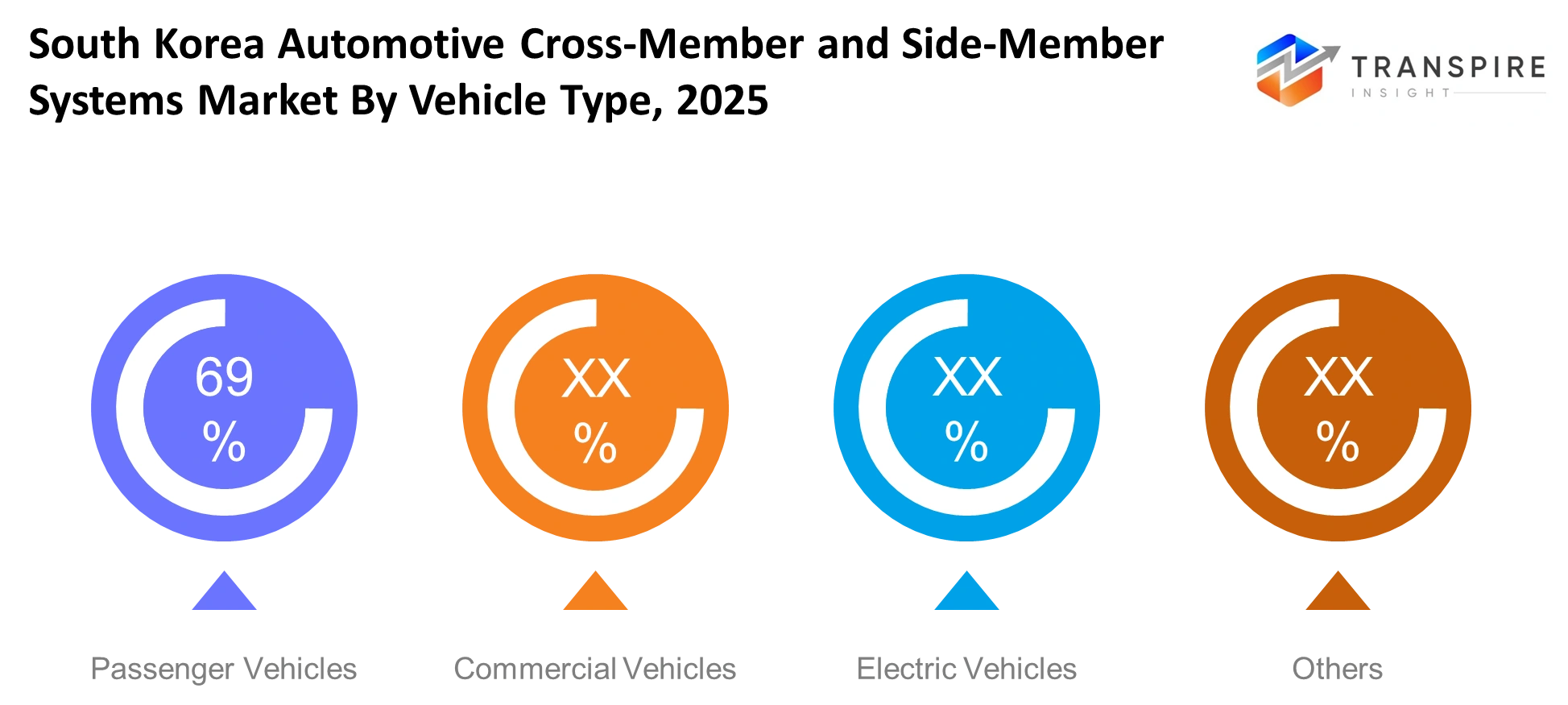
- In terms of vehicle type passenger vehicles take around 65% share, backed by high volume manufacturing of Hyundai and Kia vehicle platforms, yes even with all the schedule changes.
- Electric vehicle applications are also the quickest growing segment, and they rise strongly after 2023. That lines up with EV platform redesign initiatives.
- Even so steel cross-member systems stay dominant at about 55% share, mainly due to cost efficiency and proven crash performance, no surprises there.
- Aluminum and hybrid side-member systems are expanding fast though, growing adoption roughly 12–15% each year after 2024, sort of a steady climb.
- Modular multi-material chassis systems are replacing traditional stamped assemblies, and that helps with weight reduction along with structural rigidity, in a way that sounds simple but it is not.
- Tier-1 suppliers are seeing more outsourcing demand too as OEMs push platform standardization and EV integration strategies, which kind of forces the supply chain to reorganize.
- Hyundai Mobis and POSCO are also investing in advanced high strength steel technologies, aiming to improve lightweight vehicle efficiency.
- Overall the market is increasingly driven by EV production scaling and global safety compliance requirements, so the pace is not just local, it’s kind of everywhere.
What are the Key Drivers, Restraints, and Opportunities in the South Korea Automotive Cross-Member and Side-Member Systems Market?
The South Korea Automotive Cross-Member and Side-Member Systems Market is mostly pushed by how fast the industry is moving to electric vehicle (EV) platforms, where these structural reinforcement parts sort of matter a lot for holding up heavier battery setups and staying within crash safety rules. After the 2023 vehicle architecture refreshes done by major OEMs like Hyundai and Kia , the appetite has grown for modular, high-strength chassis systems that blend steel plus aluminum, so the car gets more rigidity but still keeps the total mass down. On top of that, stricter global safety standards and fuel efficiency regulations keep pushing adoption forward, which boosts component content value per vehicle, and it also helps lock in stronger revenue chances for Tier-1 suppliers.
Still, the market hits some structural restraints because changing from older stamped steel assemblies to advanced multi-material designs is pricey and pretty engineering-heavy. That transition means big spending on precision forming , better welding technologies, and basically reworking the supplier network, so it becomes harder for smaller Tier-2 manufacturers to join in. Meanwhile, raw material price swings in high-strength steel and aluminum keep squeezing margins and make long-range cost plans messy. Even with all that, there are openings that keep widening, especially as EV skateboard platform development goes further, as OEM–supplier co-engineering keeps getting deeper , and as hydroforming, laser welding, and AI-led structural optimization improve. These are expected to lift manufacturing efficiency and speed up future adoption.
What Has the Impact of Artificial Intelligence Been on the South Korea Automotive Cross-Member and Side-Member Systems Market?
Artificial intelligence is increasingly going , and it is reshaping the South Korea Automotive Cross-Member and Side-Member Systems Market , mostly by changing how structural parts are thought up, verified , and produced for the next-generation vehicles . Like, in real use, AI powered simulation tools are cutting down the time needed for crash assessment and structural optimization, because teams can do digital prototyping of cross member and side member shapes before any physical build . For South Korea , this lets OEMs and Tier-1 suppliers refine EV platform structures quicker, particularly when vehicle designs are moving toward lighter multi material chassis systems . So, the outcome is shorter development cycles, plus more efficient use of high-strength steel , together with aluminum combinations.
On top of that, AI is also upgrading manufacturing precision via predictive quality control and smart factory integration , sort of like it “keeps watch” during production. Machine learning systems are now being used to catch welding defects, material inconsistencies , and forming mistakes in real time, which lowers scrap ,and boosts structural dependability . In mass production settings, that matters for cost efficiency, and it helps keep alignment with tough automotive safety requirements. There is also AI enabled supply chain forecasting, which supports suppliers to line up chassis component output with shifting EV demand, so inventory pressure drops and delivery performance improves across OEM partner networks .
Looking ahead, AI driven generative design is going to be more involved in optimizing lighter structures for EV skateboard platforms. If you iterate through thousands of design variations, engineers can find those configurations that cut down weight, while still keeping crash integrity. This whole thing is making South Korean manufacturers accelerate their innovation in advanced cross member and side member systems, in a way that strengthens competitiveness across the global EV supply chain.
Key Market Trends
- The South Korea Automotive Cross-Member and Side-Member Systems Market is sorta shifting toward EV skateboard platforms , and EV adoption is expected to sit around 28–32% share of new vehicle production by 2025, give or take.
- After the 2023+ platform redesigns at Hyundai and Kia, modular chassis integration got a boost, helping component standardization across more than 60% of new EV models , overall.
- Even with the change, high-strength steel still leads at roughly 55–58% share. Meanwhile aluminum, and also hybrid-related structural approaches, are climbing at about 12–15% CAGR all the way through 2030.
- On top of that, Tier-1 supplier outsourcing has moved up nearly 20–25% since 2022, because OEMs tend to streamline chassis engineering and spend more time on platform architecture.
- AI-based crash simulation plus structural optimization is cutting prototype development time by around 25–30% , so the design process gets more efficient, faster iterations.
- Hydroforming and laser welding are also showing up more often, and that has pushed production precision up by about 15–20%, which in turn reduces material waste in big-scale chassis manufacturing.
- There’s been a post-2022 push on supply chain localization too, dropping import dependency by nearly 18–22%, and making domestic sourcing feel steadier.
- EV structural redesigns have, somewhat directly, increased cross-member content value per vehicle by 10–14%, which lifts supplier revenue per unit, not just nominally.
- POSCO and Hyundai Steel also expanded high-strength steel capacity by 20%+ across 2023–2025, to match the EV lightweighting demand that is still growing.
- So overall, the South Korea Automotive Cross-Member and Side-Member Systems Market keeps evolving toward digitally designed, lighter structural solutions , and safety-tuned systems that are easier to validate and scale.
South Korea Automotive Cross-Member and Side-Member Systems Market Segmentation
By Product Type
In the South Korea Automotive Cross- Member and Side-Member Systems Market, the main propulsion of demand sits with the cross-members, which are holding almost 50–55% share in 2025, largely because they’re crucial for chassis reinforcement, crash energy absorption, and also steadiness of structure across both ICE and EV platforms. Since 2023 the pull has gotten even stronger, mainly after OEMs adjusted their EV skateboard architectures, and suddenly the market needs tougher load distribution with better rigidity spanning the whole vehicle frame, kind of like it has to be more “stiff” everywhere, not only in one zone.
Side-members take the second biggest portion, roughly 30–35%, and that’s tied to their role in keeping side-impact protection in check while also lifting the body stiffness in general. Their presence has been climbing quietly but consistently as automakers are mixing high-strength steel and aluminum, aiming to satisfy the tighter global safety rules. Then there’s the hybrid structural members, which are the quickest movers, projected to expand at around 12–16% CAGR up to 2030. This happens because manufacturers are shifting toward multi-material chassis designs, trying to balance weight cutbacks with performance efficiency, without losing durability.
The “others” lane stays more niche, includes specialized reinforcements used in commercial types and high-performance vehicles, basically the less common but still very necessary parts. Taken together, the product segmentation shows a noticeable move toward lightweight, EV-oriented structural engineering throughout the South Korea Automotive Cross-Member and Side-Member Systems Market.
By Material
The South Korea Automotive Cross-Member and Side-Member Systems Market is now, kinda, mostly run by steel systems. In 2025 they are at about 55–60% share because the crash resistance is better, the costs stay practical, and the manufacturing ecosystem is already in place, for a long time. Steel still acts like the backbone material for both ICE and EV platforms, although its job is changing. More OEMs are moving toward high-strength plus advanced ultra-high-strength variants in order to satisfy tighter safety targets and also lightweighting demands.
Aluminum systems sit in second place, with something like 25–30% share. This is largely pushed by the quick switch to electric vehicles, where lowering vehicle mass directly helps driving range and battery efficiency. The pace picked up after 2023, since OEMs started redesigning vehicle platforms so they can fit EV needs more smoothly. Composite systems are the fastest-growing part, showing roughly 13–17% CAGR until 2030, as automakers look at carbon-fiber and blended composite structures to strip weight as far as possible while keeping rigidity, still, in a safe zone. Then there are the “others” bucket, which includes magnesium and specialty alloys. That space is smaller, but it’s slowly getting more interest, especially in high-performance and premium vehicles. Overall, what we see in material trends is a clear drift toward lightweight, multi-material engineering within the South Korea Automotive Cross-Member and Side-Member Systems Market.
By Vehicle Type
In the South Korea Automotive Cross-Member and Side-Member Systems Market, things are mostly driven by passenger vehicles, they take roughly 60–65% share in 2025 because OEMs like Hyundai and Kia keep running high volume production, not too surprisingly. These cross and side member systems really matter for crash safety, chassis rigidity, and for the overall steadiness of the vehicle, especially in mass-market sedans, SUVs, and compact cars. Even though demand has been steady, it has also moved toward lighter yet higher-strength structural designs, to satisfy tighter fuel efficiency rules and tougher safety requirements.
Commercial vehicles sit at nearly 20–25% share, mainly tied to the need for sturdy chassis structures in logistics, freight transport, plus industrial mobility uses. Meanwhile, electric vehicles are the quickest-growing segment, growing at around 18–22% CAGR through 2030, since EV platform redesign efforts push manufacturers toward more integrated, lightweight, and battery-supportive structural systems. After 2023, uptake has sped up a lot, basically as EV production scaling ramps up and government decarbonization targets start getting more force behind them.
The “others” bucket, which covers specialty and performance vehicles, stays pretty niche but it still helps with innovation in advanced structural engineering. So overall, vehicle segmentation shows a pretty clear shift toward EV-centric, lightweight chassis architecture across the South Korea Automotive Cross-Member and Side-Member Systems Market, even if the road there isn’t perfectly smooth.
To learn more about this report, Download Free Sample Report
By Application
The South Korea Automotive Cross-Member and Side-Member Systems Market is mainly pushed by chassis systems, which take up almost 45–50% of the share in 2025 because they act as the kind of structural groundwork that really matters , handling load distribution and also giving integration support for both ICE and EV platforms. Buyer interest has gotten stronger lately, as OEMs are gradually moving toward modular vehicle blueprints, where cross members and side members are basically built right into EV skateboard platform builds in a scalable way, so the whole manufacturing process is more efficient.
Structural reinforcement uses show up as the second-biggest part, roughly 25–30% share, and this is backed by the growing adoption of high-strength steel and aluminum, to make the vehicle more rigid while keeping the overall mass down. Crash protection is expanding quicker, hitting about 14–18% CAGR through 2030, since international safety rules are getting tighter and automakers are focusing more on advanced energy absorption mechanisms during vehicle design. The “others” bucket—think specialty reinforcements and performance-minded structural parts—stays fairly small, yet it still plays a role in ongoing innovation, especially for lightweight and high-performance vehicle engineering.
So when you look at the application picture, it points to a clear movement toward safety-tuned, EV-friendly structural systems in the South Korea Automotive Cross-Member and Side-Member Systems Market.
What are the Key Use Cases Driving the South Korea Automotive Cross-Member and Side-Member Systems Market?
The South Korea Automotive Cross-Member and Side-Member Systems market is pretty strongly pulled forward by structural support use cases in passenger cars and electric vehicles, because these parts are like the backbone for chassis rigidity and crash energy control. In today’s vehicle platforms, cross-members sort of spread the mechanical load across the frame, while side-members take in and then re-route impact forces when a collision happens. this job feels even more crucial now since OEMs keep moving toward lighter but also stronger body frameworks, especially for EV skateboard platforms that showed up after 2023. So, the pull for high-strength steel and aluminum systems has gone up, these have to keep the structure stiff, yet still lower the total vehicle mass.
There is also the big crash protection engineering segment, where the cross-member and side-member systems are shaped so passenger safety is better in frontal and side collisions. stricter safety rules worldwide, plus NCAP test expectations , have forced makers to improve energy absorption structures which then makes the components more intricate and, naturally raises the value per vehicle. Along the same lines, these systems are commonly included in structural reinforcement scenarios for SUVs, light commercial vehicles, and battery electric vehicles, since extra chassis strength is needed to carry heavier loads. And because vehicle platforms are turning more modular, adoption grows further as OEMs standardize structural parts across several models, this improves factory efficiency and helps keep production costs lower.
|
Report Metrics |
Details |
|
Market size value in 2025 |
USD 0.97 Billion |
|
Market size value in 2026 |
USD 1.017 Billion |
|
Revenue forecast in 2033 |
USD 1.417 Billion |
|
Growth rate |
CAGR of 4.85% from 2026 to 2033 |
|
Base year |
2025 |
|
Historical data |
2021 - 2024 |
|
Forecast period |
2026 - 2033 |
|
Report coverage |
Revenue forecast, competitive landscape, growth factors, and trends |
|
Regional scope |
South Korea |
|
Key company profiled |
Hyundai Mobis, Gestamp, Magna International, Benteler Automotive, Tower International, Martinrea International, Aisin Corporation, CIE Automotive, Thyssenkrupp Automotive, POSCO Mobility Solutions, Dura Automotive Systems, Toyotetsu, Futaba Industrial, Yorozu Corporation, JBM Group |
|
Customization scope |
Free report customization (country, regional & segment scope). Avail customized purchase options to meet your exact research needs. |
|
Report Segmentation |
By Product Type (Cross-Members, Side-Members, Hybrid Structural Members, Others); By Material (Steel Systems, Aluminum Systems, Composite Systems, Others); By Vehicle Type (Passenger Vehicles, Commercial Vehicles, Electric Vehicles, Others); By Application (Chassis Systems, Structural Reinforcement, Crash Protection, Others) |
Which Regions are Driving the South Korea Automotive Cross-Member and Side-Member Systems Market Growth?
South Korea Automotive Cross-Member and Side-Member Systems Market is basically pushed by the Ulsan–Gyeongnam industrial belt, which is expected to hold around 38–42% share in 2025 because it’s packed with automotive OEMs, steel producers, and Tier-1 chassis suppliers, ya know. Ulsan acts like a main manufacturing hub for Hyundai’s vehicle production ecosystem, where cross member and side member systems get folded into high-volume passenger car and electric vehicle platforms. And because the area already has a mature supply chain, plus its close link to port infrastructure, exports oriented automotive production can move more smoothly, faster, less hassle.
Meanwhile, the Gyeonggi Province together with the Seoul Capital Region looks like the quickest-growing cluster. It’s projected to expand in a steady way during 2024–2030 thanks to more funding into EV R&D, advanced mobility engineering, and lighter-weight structural creativity. Also, the region has strong teamwork between automotive design centers and technology companies that are building next generation chassis systems for EV platforms. On top of that, Incheon’s industrial zones are starting to function as supporting hubs for logistics and component distribution, which helps the supply chain stay responsive when demand shifts.
So overall the regional picture kind of splits in two, with the south keeping manufacturing dominance while the capital region leans more on innovation led expansion, and that ends up reinforcing the wider South Korea Automotive Cross-Member and Side-Member Systems Market ecosystem.
Who are the Key Players in the South Korea Automotive Cross-Member and Side-Member Systems Market and How Do They Compete?
The South Korea Automotive Cross-Member and Side-Member Systems Market is kind of led by vertically integrated auto makers and steel people, who feed structural chassis bits to domestic OEMs and also the global export channels. In this space, key names show up like Hyundai Mobis, Hyundai Steel, POSCO, Mando Corporation, and Kia Corporation. These players sort of go head to head by mixing material innovation, advanced forming know-how and more integrated vehicle platform engineering, so they can ship high-strength but lighter structural setups.
Lately, the competition feels more and more like EV platform integration plus multi-material chassis work, not just basic fabrication. Hyundai Mobis and Kia are leaning into modular EV architectures, where cross-member and side-member systems get embedded right into skateboard-style platforms, which helps scalability and production efficiency. Hyundai Steel and POSCO, meanwhile, are pushing ahead with advanced high-strength steel plus lightweight alloy development, with the goal of better crash performance, and also lower weight. Mando Corporation keeps building its edge via precision engineering and Tier-1 supply muscle, while also supporting suspension and chassis system integration.
Overall the differentiation is often tied to AI-enabled design optimization, hydroforming, and laser welding technologies, plus some ongoing OEM partnership moves, to lock in long-term supply contracts as the South Korea Automotive Cross-Member and Side-Member Systems Market keeps evolving.
Company List
- Hyundai Mobis
- Gestamp
- Magna International
- Benteler Automotive
- Tower International
- Martinrea International
- Aisin Corporation
- CIE Automotive
- Thyssenkrupp Automotive
- POSCO Mobility Solutions
- Dura Automotive Systems
- Toyotetsu
- Futaba Industrial
- Yorozu Corporation
- JBM Group
Recent Development News
In 2025, Hyundai Mobis accelerated development of next-generation EV platform chassis modules, focusing on integrated cross-member structures designed for skateboard EV architectures. The initiative enhances structural rigidity and modular production efficiency, supporting wider EV adoption across Hyundai and Kia platforms.
https://www.mobis.co.
In 2024, Hyundai Steel expanded its portfolio of advanced high-strength steel grades for automotive structural components, including cross-members and side-members. This development strengthens lightweighting strategies and improves crash performance for EV and hybrid vehicle platforms.
https://www.hyundai-steel.com
What Strategic Insights Define the Future of the South Korea Automotive Cross-Member and Side-Member Systems Market?
The future of the South Korea Automotive Cross-Member and Side-Member Systems Market is getting more and more shaped by the move toward EV-native vehicle architectures, where structural systems aren’t really “afterthoughts” anymore, they are kind of core enablers for platform planning. OEMs are shifting away from those older body-on-frame methods, and going into integrated skateboard platforms, and these really ask for cross-member and side-member systems that can handle better load dispersion, battery safeguarding, and crash energy control. As a result, the component value per vehicle is going up, and it is pushing OEMs and Tier-1 suppliers to work with a lot more depth on co-designed chassis blueprints, not just simple sourcing.
At the same time, another strategic direction is speeding up multi-material engineering, plus the merging of digital design workflows. In practice, manufacturers are pairing high-strength steel with aluminum, and also composite materials in a kind of balanced mix to reach better weight-to-strength outcomes, while still meeting tighter global safety plus emissions requirements. Meanwhile, AI-supported generative design together with digital twin simulation is shortening development timing and sharpening structural accuracy, which makes it easier to reconfigure and adapt to fresh EV models. That whole pattern is also building competitiveness for suppliers that can give lightweight but high-performance solutions, and at the same time cost-optimized results at manufacturing scale.
South Korea Automotive Cross-Member and Side-Member Systems Market Report Segmentation
By Product Type
- Cross-Members
- Side-Members
- Hybrid Structural Members
- Others
By Material
- Steel Systems
- Aluminum Systems
- Composite Systems
- Others
By Vehicle Type
- Passenger Vehicles
- Commercial Vehicles
- Electric Vehicles
- Others
By Application
- Chassis Systems
- Structural Reinforcement
- Crash Protection
- Others
Frequently Asked Questions
Find quick answers to common questions.
The expected South Korea Automotive Cross-Member and Side-Member Systems Market size for the market will be USD 1.417 Billion in 2033.
Key segments for the South Korea Automotive Cross-Member and Side-Member Systems Market are By Product Type (Cross-Members, Side-Members, Hybrid Structural Members, Others); By Material (Steel Systems, Aluminum Systems, Composite Systems, Others); By Vehicle Type (Passenger Vehicles, Commercial Vehicles, Electric Vehicles, Others); By Application (Chassis Systems, Structural Reinforcement, Crash Protection, Others).
Major South Korea Automotive Cross-Member and Side-Member Systems Market players are Hyundai Mobis, Gestamp, Magna International, Benteler Automotive, Tower International, Martinrea International, Aisin Corporation, CIE Automotive, Thyssenkrupp Automotive, POSCO Mobility Solutions, Dura Automotive Systems, Toyotetsu, Futaba Industrial, Yorozu Corporation, JBM Group.
The South Korea Automotive Cross-Member and Side-Member Systems Market size is USD 0.97 Billion in 2025.
The South Korea Automotive Cross-Member and Side-Member Systems Market CAGR is 4.85% from 2026 to 2033.
- Hyundai Mobis
- Gestamp
- Magna International
- Benteler Automotive
- Tower International
- Martinrea International
- Aisin Corporation
- CIE Automotive
- Thyssenkrupp Automotive
- POSCO Mobility Solutions
- Dura Automotive Systems
- Toyotetsu
- Futaba Industrial
- Yorozu Corporation
- JBM Group
Recently Published Reports
-
Apr 2026
ATV & UTV Market
ATV & UTV Market Size, Share & Analysis Report By Type (ATV, and UTV), By Variants (Less Than 400 CC, 400 CC To 800 CC, and More Than 800 CC), and Geography (North America, Europe, Asia-Pacific, Middle East and Africa, South and Central America), 2021 - 2031
-
Apr 2026
Automotive Central Gateway Module Market
Automotive Central Gateway Module Market Size, Share & Analysis Report By Type (Ethernet Central Gateway Module, CAN Central Gateway Module, LIN Central Gateway Module, and FlexRay), By Application (Powertrain Control, Body Control, Infotainment System, Advanced Driver Assistance Systems (ADAS), and Others), By End User (Passenger Vehicles, and Commercial Vehicles), and Geography (North America, Europe, Asia-Pacific, Middle East and Africa, South and Central America), 2021 - 2031
-
Apr 2026
Automotive Engine Oil Filter Market
Automotive Engine Oil Filter Market Size, Share & Analysis Report By Filter Type (Fuel Filter, Engine Oil Filter, Hydraulic Oil Filter, and Others), By Filter Media (Cellulose, Synthetic, and Micro), By Sales Channel (OEMs, and Aftermarket), By Vehicle Type (Passenger Cars, Light Commercial Vehicles, Heavy Duty Trucks, Buses and Coaches, and Off-road Vehicles), and Geography (North America, Europe, Asia-Pacific, Middle East and Africa, South and Central America), 2021 - 2031
-
Apr 2026
Automotive Parts Aluminium Die Casting Market
Automotive Parts Aluminium Die Casting Market Size, Share & Analysis Report By Production Process (Pressure Die Casting, Vacuum Die Casting, Squeeze Die Casting, Gravity Die Casting), By Application (Body Parts, Engine Parts, Transmission Parts, Battery And Related Components, Other Application Types), and Geography (North America, Europe, Asia-Pacific, Middle East and Africa, South and Central America), 2021 - 2031
Our Clients