
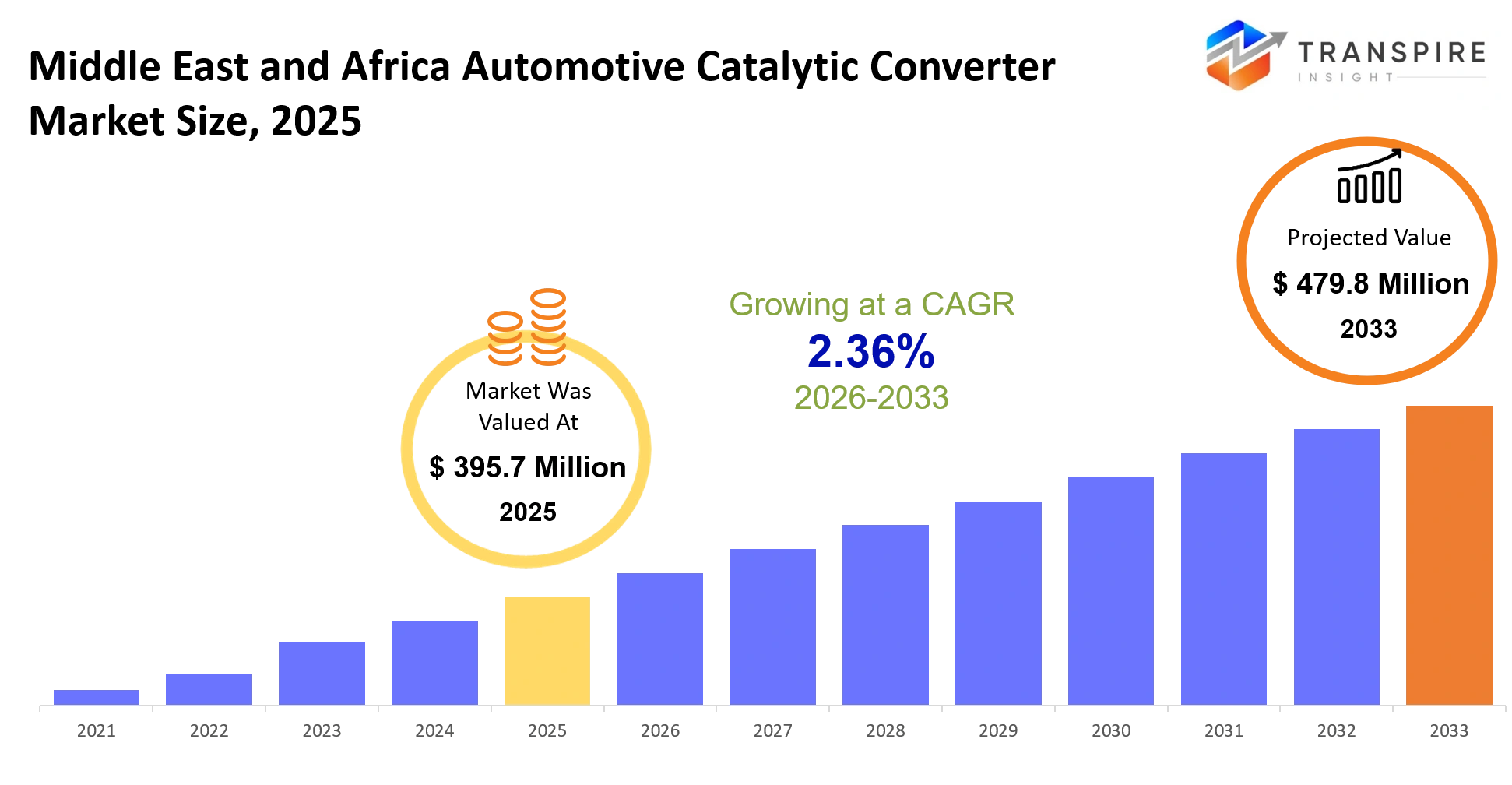
Middle East and Africa Automotive Catalytic Converter Market Size & Forecast:
- Middle East and Africa Automotive Catalytic Converter Market Size 2025: USD 395.7 Million
- Middle East and Africa Automotive Catalytic Converter Market Size 2033: USD 479.8 Million
- Middle East and Africa Automotive Catalytic Converter Market CAGR: 2.36%
- Middle East and Africa Automotive Catalytic Converter Market Segments: By Converter Type (Two-Way Catalytic Converters, Three-Way Catalytic Converters, Diesel Oxidation Catalysts, Selective Catalytic Reduction Systems, Others); By Vehicle Type (Passenger Cars, Light Commercial Vehicles, Heavy Commercial Vehicles, Others); By Material (Platinum, Palladium, Rhodium, Others); By End User (OEMs, Aftermarket, Others).
To learn more about this report,  Download Free Sample Report
Middle East and Africa Automotive Catalytic Converter Market Summary
The Middle East and Africa Automotive Catalytic Converter Market was valued at USD 395.7 Million in 2025. It is forecast to reach USD 479.8 Million by 2033. That is a CAGR of 2.36% over the period.
Automotive catalytic converters have a pretty big role in lowering dangerous exhaust emissions coming out of passenger cars, commercial vehicles ,and also off-road machines. They are basically helping vehicle makers comply with tighter air quality requirements, by changing nasty pollutants like carbon monoxide hydrocarbons and nitrogen oxides into gases that are much less harmful, before those gases get released into the air. In the Middle East and Africa these units stay really important, mainly because internal combustion engine vehicles still dominate a lot of transportation routes.
In the last five years, the whole market has shifted in a noticeable way. Tighter vehicle emission rules, and plus the spread of newer catalyst formulations , have pushed this change along. These newer setups use platinum, palladium, and rhodium more efficiently, and it kind of matters. One big trigger between 2020 and 2023 was a global supply chain disruption along with precious metal price volatility , it made manufacturers rethink how their catalyst structures get built. They also began optimizing the quantity of metal that goes into the converter. Now, as governments keep tightening emissions compliance requirements , and more vehicle fleets roll in, automakers are putting capital toward higher-performance exhaust control technologies. This path is also keeping aftermarket replacement demand fairly steady, alongside OEM installations so catalytic converter suppliers can maintain a more solid revenue base across the region.
Key Market Insights
- The market is expected to rise from USD 395.7 million in 2025 up to USD 479.8 million by 2033, with continued emissions compliance duties across different vehicle lines keeping demand steady.
- Passenger cars make up more than 55% of overall demand, so they’re basically the biggest revenue generating vehicle segment in the area.
- Three way catalytic converters take about 60% of the market, which signals how strong the gasoline powered passenger fleet really is.
- The Middle East is also around 62% of regional revenue in 2025, this is largely backed by bigger vehicle populations and stricter emissions policing.
- OEM installations are nearly 70% of total market revenue, because vehicle manufacture and factory fitted emissions control setups are, you know, still the main route.
- Since 2021, platinum replacing palladium has climbed roughly 15–20%, letting makers handle catalyst production costs even while metal prices move around.
- On the commercial side, catalyst uptake keeps expanding, especially through fleet modernisation programs in logistics, building, and industrial transport.
- Plus recycling of platinum group metals has turned into a strategic thing, improving supply security and also reducing reliance on virgin raw material.
- Meanwhile, advanced washcoat approaches are boosting catalytic conversion efficiency, while cutting precious metal loading , so compliance and profitability targets can both be met.
- Players like BASF, Umicore, Tenneco, Johnson Matthey, Faurecia, and Denso are pushing harder too, via tech updates, OEM collaborations, recycling funds and AI assisted catalyst design efforts , to strengthen their competitive standing.
What are the Key Drivers, Restraints, and Opportunities in the Middle East and Africa Automotive Catalytic Converter Market?
So, the main thing that pushes market expansion is this tightening of vehicle emissions rules across a handful of Middle Eastern and African economies. In a lot of cases, governments are rolling out standards that basically match up more closely with European emissions frameworks, which then makes vehicle manufacturers use more advanced exhaust treatment systems. And yeah, this regulatory turn directly boosts the value of catalytic converter content per vehicle, so suppliers can earn more money not only in the OEM channel but also in the replacement market. Plus, as passenger and commercial vehicle fleets keep growing , the whole effect gets even louder.
The biggest thing holding the market back is still the strong dependence on platinum group metals, like platinum, palladium, and rhodium. These substances make up a notable portion of converter production costs, and they’re concentrated in a small set of global mining regions. But the problem is, price swings, supply interruptions , and geopolitical uncertainty don’t just fade away quickly because mining capacity takes years of investment and buildout. Because of that, manufacturers get squeezed on margins and vehicle makers often hold off on procurement choices during stretches where metal prices run high.
On the opportunity side, catalyst recycling and circular supply chain development look especially promising. South Africa already has a central position in global platinum group metal production, which sets up fairly good conditions for recycling investments in the region. Firms that grow their precious metal recovery operations can cut down raw material exposure, help stabilize supply, and likely improve profitability over time. Put together, recycling know-how, stricter emissions compliance, and rising vehicle ownership make this area feel like a key future growth path.
What Has the Impact of Artificial Intelligence Been on the Middle East and Africa Automotive Catalytic Converter Market?
Artificial intelligence is gradually messing with the automotive catalytic converter value chain by nudging manufacturing efficiency along, tightening emissions compliance a bit, and even improving predictive maintenance capabilities. In the last stretch, manufacturers are more and more relying on AI-powered analytics for optimizing catalyst coating processes, checking production quality as it happens and reducing material waste during converter fabrication. Stuff like this can help producers get more stable catalyst performance, while also cutting down precious metal usage, which is kind of the whole point.
On top of that, machine learning models are being used for emissions forecasting and durability testing too. They can look at operating temperatures, fuel combustion behaviors and vehicle usage records , then predictive algorithms estimate catalyst degradation long before performance dips below regulatory thresholds. Fleet operators end up scheduling maintenance with a little more control, and that usually means fewer surprises and less unexpected downtime.
Meanwhile, advanced digital technologies keep pushing measurable operational gains. Manufacturers often mention higher production yield, inspections that go faster, and better utilization of platinum group metals overall. AI-assisted design tools are also speeding up the creation of next generation catalyst formulations, so they can hit more severe emissions regulations without too much drama.
Still, adoption is kind of stuck, mainly because integration costs stay high and access to big regional emissions datasets is limited. Lots of vehicle operators in developing markets don’t have connected infrastructure, so the real-world data needed to train highly accurate predictive models isn’t there. And with that missing input, widespread implementation keeps moving slowly.
Key Market Trends
- Since 2021, automakers have been increasing platinum substitution rates, to lower their exposure to those higher palladium prices that seem to stay elevated.
- Catalyst manufacturers then improved precious metal utilization by roughly 10–15% , using more advanced washcoat engineering techniques.
- Emissions regulations, rolled out between 2022 and 2025 have basically pushed the market toward higher-efficiency three way catalyst systems, quicker than before.
- Vehicle manufacturers are also partnering with catalyst suppliers earlier in the vehicle development cycle than they did five years ago, and it looks like that trend is sticking.
- Recycling investments expanded a lot as recovered platinum group metals started looking like a genuinely attractive feedstock source, economically speaking.
- With hybrid vehicle production growing, catalyst design has leaned toward faster light-off performance and thermal durability , instead of just squeezing out efficiency at any cost.
- Supply chain diversification sped up after pandemic disruptions, sort of revealed how dependent some companies were on concentrated material sources.
- Companies such as BASF, Umicore, Johnson Matthey, and Tenneco increased their investment in low-metal catalyst technologies , more or less in parallel.
- Digital manufacturing adoption rose across catalyst production facilities, which improved quality control and made the process feel more consistent.
- Aftermarket demand strengthened too, since older vehicle fleets needed replacement converters to stay compliant with emissions rules.
Middle East and Africa Automotive Catalytic Converter Market Segmentation
By Converter Type
The converter type segment mirrors the assorted emission control methods used across both gasoline and diesel vehicle types. Three-Way Catalytic Converters make up a notable portion, since strong effectiveness at trimming carbon monoxide, hydrocarbons, and nitrogen oxides helps explain why these units stay broadly adopted across gasoline-driven vehicles. At the same time, regulatory compliance expectations, plus the ongoing large scale passenger vehicle production, keeps demand steady for this converter category.
Two-Way Catalytic Converters still show up in certain vehicle segments where oxidation of carbon monoxide and hydrocarbons is basically the main job to be done. Diesel Oxidation Catalysts back emission reduction for diesel powered vehicles, while also helping polish the overall exhaust quality for commercial transport. Selective Catalytic Reduction Systems keep growing in relevance, because tighter nitrogen oxide boundaries push deployment in heavy-duty platforms. Other options include more specialized catalyst technologies, made for distinctive performance needs, and also for meeting specific regulatory requirements spanning multiple vehicle setups.
By Vehicle Type
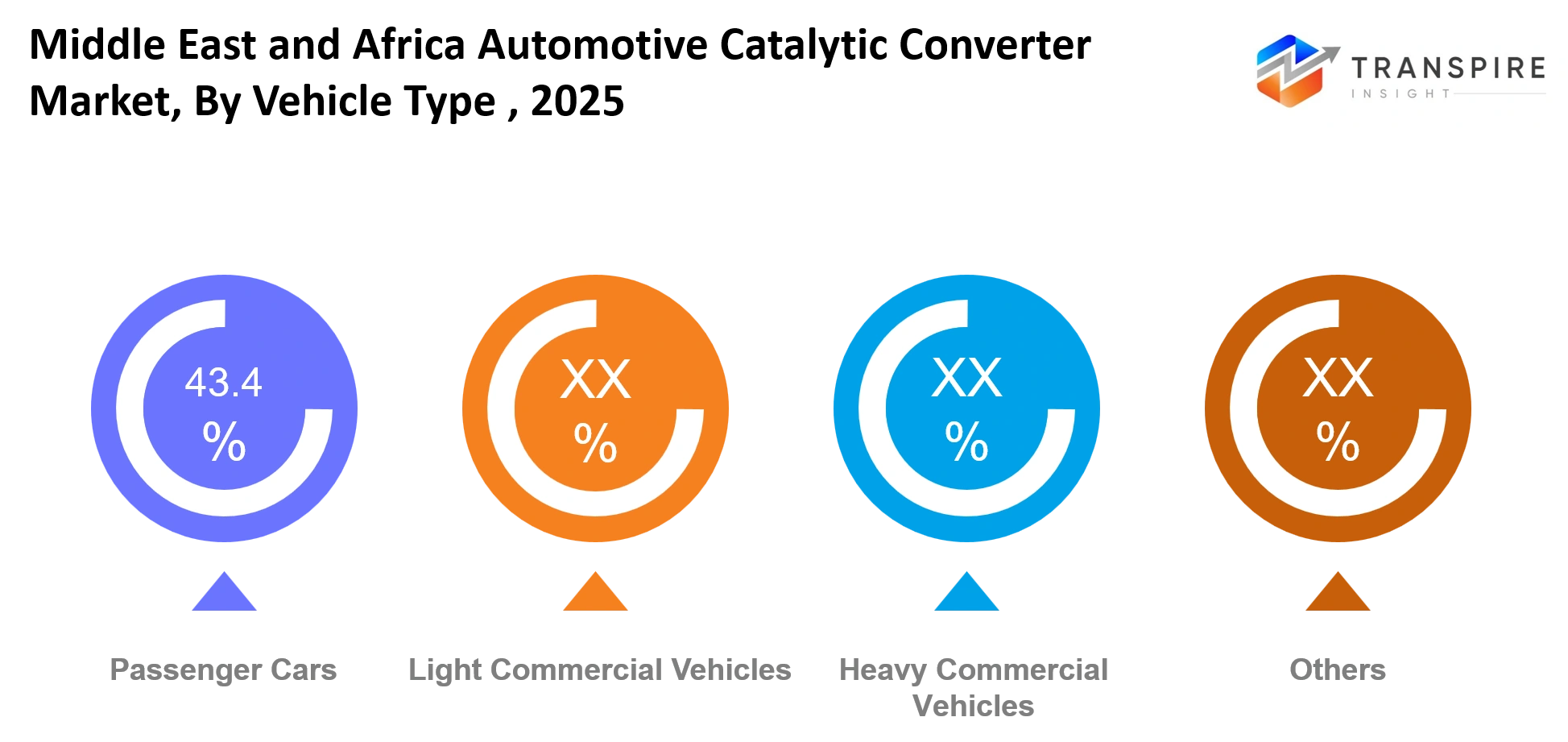
The vehicle type segment shows a big spectrum of automotive categories that use catalytic converter systems, not just one kind or another. Passenger Cars take the biggest slice because more people own them, there is still active production, and regulations keep pushing exhaust emission control. So as urban transportation keeps moving forward, demand for catalytic converter installations stays pretty steady in this category, even when conditions shift a bit.
Light Commercial Vehicles keep getting adopted at a strong pace, mainly because logistics, courier delivery, and service operations are expanding through many regional economies. Heavy Commercial Vehicles add a lot too, especially with freight hauling, construction works, and industrial operations that actually need more sophisticated emission control technologies. Others cover specialized vehicles, utility vehicles, and smaller transportation categories, they rely on catalytic converter systems to satisfy both operational expectations and environmental standards.
To learn more about this report, Download Free Sample Report
By Material
The material segment kinda zeroes in on the precious metals and also the catalyst components used in emission control systems, so the wording is still pretty focused. Platinum is still a widely used material, because its strong catalytic performance plus durability helps keep pollutant conversion working well, even when operating conditions shift. Because it’s been used across both diesel and gasoline applications it basically sustains demand for platinum over time.
Palladium, in turn, holds a pretty substantial position, mainly due to its strong effectiveness in gasoline engine catalytic converter systems. Rhodium is still essential though, even with limited availability, because its nitrogen oxide reduction capabilities really support compliance with tight emission regulations. Then there are other options too, like alternative catalyst materials and supporting compounds, that have been developed to improve efficiency, reduce material costs, and overall enhance converter performance, at least that’s the idea.
By End User
The end user segment kind of shows the organizations and channels that actually handle catalytic converter installation and replacement activities. OEMs take the leading share in this space, mainly because vehicle manufacturers slot catalytic converter systems right during the production stage, to meet emissions standards and those regulatory requirements. There are also long term supplier relationships, and the sheer vehicle production volumes that keep demand pretty steady from this category.
Meanwhile, aftermarket demand is still really important too, since older vehicle fleets eventually need replacement converters in order to stay efficient, and also remain aligned with regulatory compliance. Replacement activity tends to create this kind of repeat revenue momentum across service centers, distributors, and repair networks. Other segments include specialized vehicle operators, fleet maintenance providers, and industrial users who look for emission control solutions with more unusual transportation needs or operational requirements.
What are the Key Use Cases Driving the Middle East and Africa Automotive Catalytic Converter Market?
Passenger vehicles are, basically, the big application zone for catalytic converters in the region. Automakers depend on these systems so they can meet emissions rules while still keeping the vehicle running with good power delivery, so they end up as routine standard fitments in gasoline-powered cars plus light duty vehicles.
Then there’s commercial transport, which is slowly turning into another major use case. For logistics operators, delivery fleets , buses, and even construction vehicle owners, they increasingly ask for more advanced emission control systems, mainly to stay in line with environmental requirements and those fleet modernization efforts. On top of that, heavy-duty diesel vehicles are still leaning on oxidation catalysts to cut down nasty emissions.
Looking forward, hybrid vehicles and also specialized off-road equipment seem like real growth opportunities. As governments push cleaner mobility programs, manufacturers are working on catalysts that can handle changing engine loads smoothly and they can tolerate those frequent start-stop events. These markets are still rather small at the moment, but they should become more noticeable as the forecast period moves ahead.
|
Report Metrics |
Details |
|
Market size value in 2025 |
USD 395.7 Million |
|
Market size value in 2026 |
USD 407.4 Million |
|
Revenue forecast in 2033 |
USD 479.8 Million |
|
Growth rate |
CAGR of 2.36% from 2026 to 2033 |
|
Base year |
2025 |
|
Historical data |
2021 - 2024 |
|
Forecast period |
2026 - 2033 |
|
Report coverage |
Revenue forecast, competitive landscape, growth factors, and trends |
|
Regional scope |
Middle East and Africa (Saudi Arabia, United Arab Emirates, South Africa, Rest of Middle East and Africa) |
|
Key company profiled |
BASF, Umicore, Tenneco, Faurecia, Johnson Matthey, Eberspächer, Continental, Benteler, Bosal, Magneti Marelli, NGK Insulators, Denso, Walker Exhaust, Futaba Industrial, Katcon. |
|
Customization scope |
Free report customization (country, regional & segment scope). Avail customized purchase options to meet your exact research needs. |
|
Report Segmentation |
By Converter Type (Two-Way Catalytic Converters, Three-Way Catalytic Converters, Diesel Oxidation Catalysts, Selective Catalytic Reduction Systems, Others); By Vehicle Type (Passenger Cars, Light Commercial Vehicles, Heavy Commercial Vehicles, Others); By Material (Platinum, Palladium, Rhodium, Others); By End User (OEMs, Aftermarket, Others). |
Which Regions are Driving the Middle East and Africa Automotive Catalytic Converter Market Growth?
The Middle East still comes out as the biggest regional contributor in terms of market revenue. Things like Saudi Arabia, and the United Arab Emirates keep a sizable vehicle fleet, and they keep reinforcing their emissions monitoring frameworks, a lot more lately. High vehicle import volumes also help keep demand fairly steady for OEM installed catalytic converters. On top of that, a well established automotive distribution network sorta keeps the market leadership locked in.
Africa is smaller as a contributor, but it’s becoming more and more relevant. Instead of relying on the same kind of dynamics as the Middle East, growth there is mostly driven by rising vehicle ownership, plus the gradual adoption of cleaner fuel standards. South Africa in particular benefits from local automotive manufacturing capabilities and access to platinum group metal resources. Together, this forms a relatively steady base for both production and consumption, even when conditions shift.
Sub Saharan Africa is likely to see the strongest growth momentum by 2033. Recently, investments in transport infrastructure, logistics modernization, and vehicle fleet renewal programs have improved the overall market situation. Governments are also leaning toward stronger emissions regulation frameworks. For suppliers and investors, this can look like a window to build local partnerships and distribution networks before the market gets too mature, and before competitive intensity really ramps up.
Who are the Key Players in the Middle East and Africa Automotive Catalytic Converter Market and How Do They Compete?
Competition is still pretty moderately concentrated across global emissions tech providers, and they all seem to have strong know-how in catalyst chemistry plus precious metal handling. Most market players push against each other using tech performance, metal utilization efficiency, regulatory compliance capabilities, and those long-term OEM ties that everyone keeps talking about. Even if some established suppliers manage to hold onto market share, the catalyst formulation itself is still basically the main thing that makes a real difference.
Johnson Matthey sort of stands out with its deep know-how in platinum group metal chemistry plus huge-scale recycling operations. The focus is on getting the best catalyst efficiency possible while lowering precious metal loading, which, in turn, helps automakers keep costs more controlled.
Umicore leans hard on advanced materials engineering together with recycling strengths to deliver these more integrated supply arrangements. The big point is that it can recover and reuse precious metals, and that helps with supply security and also reduces the raw material risk they’re exposed to, sort of indirectly.
BASF, meanwhile, emphasizes catalyst innovation and emissions compliance technologies. And then Tenneco brings catalytic converter know-how, but it also mixes that with broader exhaust system integration capabilities. Tenneco keeps expanding its emissions-control product line-up, and it’s also working on advanced low-emission technologies that are supposed to line up with future regulatory expectations.
Company List
- BASF
- Umicore
- Tenneco
- Faurecia
- Johnson Matthey
- Eberspächer
- Continental
- Benteler
- Bosal
- Magneti Marelli
- NGK Insulators
- Denso
- Walker Exhaust
- Futaba Industrial
- Katcon
Recent Development News
In December 2025, Tenneco DRiV expanded its Walker CalCat catalytic converter portfolio by adding 118 CARB-compliant catalytic converters. The expansion increased coverage for more than 9 million vehicles and strengthened the company's aftermarket emissions-control position.
Source: https://www.tenneco.com
In February 2025, Johnson Matthey entered a long-term collaboration with Bosch to develop catalyst-coated membrane technologies for hydrogen fuel cell systems. The partnership expands Johnson Matthey's catalyst expertise into next-generation low-emission mobility technologies.
Source: https://www.automotiveworld.com
What Strategic Insights Define the Future of the Middle East and Africa Automotive Catalytic Converter Market?
The market feels like it's moving toward higher-value, lower-metal catalyst systems that can give better emissions results while also cutting down on reliance on pricey platinum group metals. Really, the main nudge is the combo of stricter emissions rules and this constant pressure to keep material expenses under control. Suppliers that boost catalyst efficiency, without compromising compliance, might grab more of the future revenue pie, pretty convincingly.
There’s also a risk that’s less obvious, kind of in the background. In some urban areas, battery electric vehicles are being adopted faster than before. Yes, internal combustion engines should still be the majority across most of the region for years, but a slow shift toward electrification could end up lowering catalyst demand in certain vehicle segments. And another issue is concentration risk, especially inside precious metal supply chains, where everything can get overly clustered.
Still, an opportunity is showing up as regional catalyst recycling and precious metal recovery infrastructure, and that seems especially relevant in South Africa and nearby markets. Firms that connect recycling to catalyst manufacturing can strengthen supply stability and lift margins. Market players should put focus into recycling technologies, improved catalyst chemistry, and also strategic ties with OEMs, so they stay competitive during the next decade.
Middle East and Africa Automotive Catalytic Converter Market Report Segmentation
By Converter Type
- Two-Way Catalytic Converters
- Three-Way Catalytic Converters
- Diesel Oxidation Catalysts
- Selective Catalytic Reduction Systems
- Others
By Vehicle Type
- Passenger Cars
- Light Commercial Vehicles
- Heavy Commercial Vehicles
- Others
By Material
- Platinum
- Palladium
- Rhodium
- Others
By End User
- OEMs
- Aftermarket
- Others
Frequently Asked Questions
Find quick answers to common questions.
The expected Middle East and Africa Automotive Catalytic Converter Market size for the market will be USD 479.8 Million in 2033.
Key segments for the Middle East and Africa Automotive Catalytic Converter Market are By Converter Type (Two-Way Catalytic Converters, Three-Way Catalytic Converters, Diesel Oxidation Catalysts, Selective Catalytic Reduction Systems, Others); By Vehicle Type (Passenger Cars, Light Commercial Vehicles, Heavy Commercial Vehicles, Others); By Material (Platinum, Palladium, Rhodium, Others); By End User (OEMs, Aftermarket, Others).
Major Middle East and Africa Automotive Catalytic Converter Market players are BASF, Umicore, Tenneco, Faurecia, Johnson Matthey, Eberspächer, Continental, Benteler, Bosal, Magneti Marelli, NGK Insulators, Denso, Walker Exhaust, Futaba Industrial, Katcon.
The Middle East and Africa Automotive Catalytic Converter Market size is USD 38489.2 Million in 2025.
The Middle East and Africa Automotive Catalytic Converter Market CAGR is 2.36% from 2026 to 2033.
- BASF
- Umicore
- Tenneco
- Faurecia
- Johnson Matthey
- Eberspächer
- Continental
- Benteler
- Bosal
- Magneti Marelli
- NGK Insulators
- Denso
- Walker Exhaust
- Futaba Industrial
- Katcon
About the Authors

Mayur Shinde
I am Mayur Shinde, a Senior Research Analyst at Transpire Insight, specializing in the Automotive & Transportation and Information & Communication Technology (ICT) Industry. My work focuses on analyzing emerging market trends, technological advancements, competitive landscapes, and industry developments to deliver accurate, data-driven insights. I am passionate about transforming complex market information into clear, actionable content that helps businesses, professionals, and decision-makers stay informed and make confident strategic decisions.

Chakradhar Khansole
Chakradhar serves as the Research Director at Transpire Insight, bringing over 8 years of experience in technology, innovation, and strategic market intelligence. He specializes in transforming complex market data into actionable business insights that enable organizations to make informed, growth-oriented decisions. Recognized for his strategic vision and analytical expertise, Chakradhar leads high-impact research initiatives, delivering comprehensive market assessments, competitive intelligence, and forward-looking industry analysis.
Recently Published Reports
-
Apr 2026
ATV & UTV Market
ATV & UTV Market Size, Share & Analysis Report By Type (ATV, and UTV), By Variants (Less Than 400 CC, 400 CC To 800 CC, and More Than 800 CC), and Geography (North America, Europe, Asia-Pacific, Middle East and Africa, South and Central America), 2021 - 2031
-
Apr 2026
Automotive Central Gateway Module Market
Automotive Central Gateway Module Market Size, Share & Analysis Report By Type (Ethernet Central Gateway Module, CAN Central Gateway Module, LIN Central Gateway Module, and FlexRay), By Application (Powertrain Control, Body Control, Infotainment System, Advanced Driver Assistance Systems (ADAS), and Others), By End User (Passenger Vehicles, and Commercial Vehicles), and Geography (North America, Europe, Asia-Pacific, Middle East and Africa, South and Central America), 2021 - 2031
-
Apr 2026
Automotive Engine Oil Filter Market
Automotive Engine Oil Filter Market Size, Share & Analysis Report By Filter Type (Fuel Filter, Engine Oil Filter, Hydraulic Oil Filter, and Others), By Filter Media (Cellulose, Synthetic, and Micro), By Sales Channel (OEMs, and Aftermarket), By Vehicle Type (Passenger Cars, Light Commercial Vehicles, Heavy Duty Trucks, Buses and Coaches, and Off-road Vehicles), and Geography (North America, Europe, Asia-Pacific, Middle East and Africa, South and Central America), 2021 - 2031
-
Apr 2026
Automotive Parts Aluminium Die Casting Market
Automotive Parts Aluminium Die Casting Market Size, Share & Analysis Report By Production Process (Pressure Die Casting, Vacuum Die Casting, Squeeze Die Casting, Gravity Die Casting), By Application (Body Parts, Engine Parts, Transmission Parts, Battery And Related Components, Other Application Types), and Geography (North America, Europe, Asia-Pacific, Middle East and Africa, South and Central America), 2021 - 2031
Our Clients



