

Japan Platinum Automotive Catalyst Market Size & Forecast:
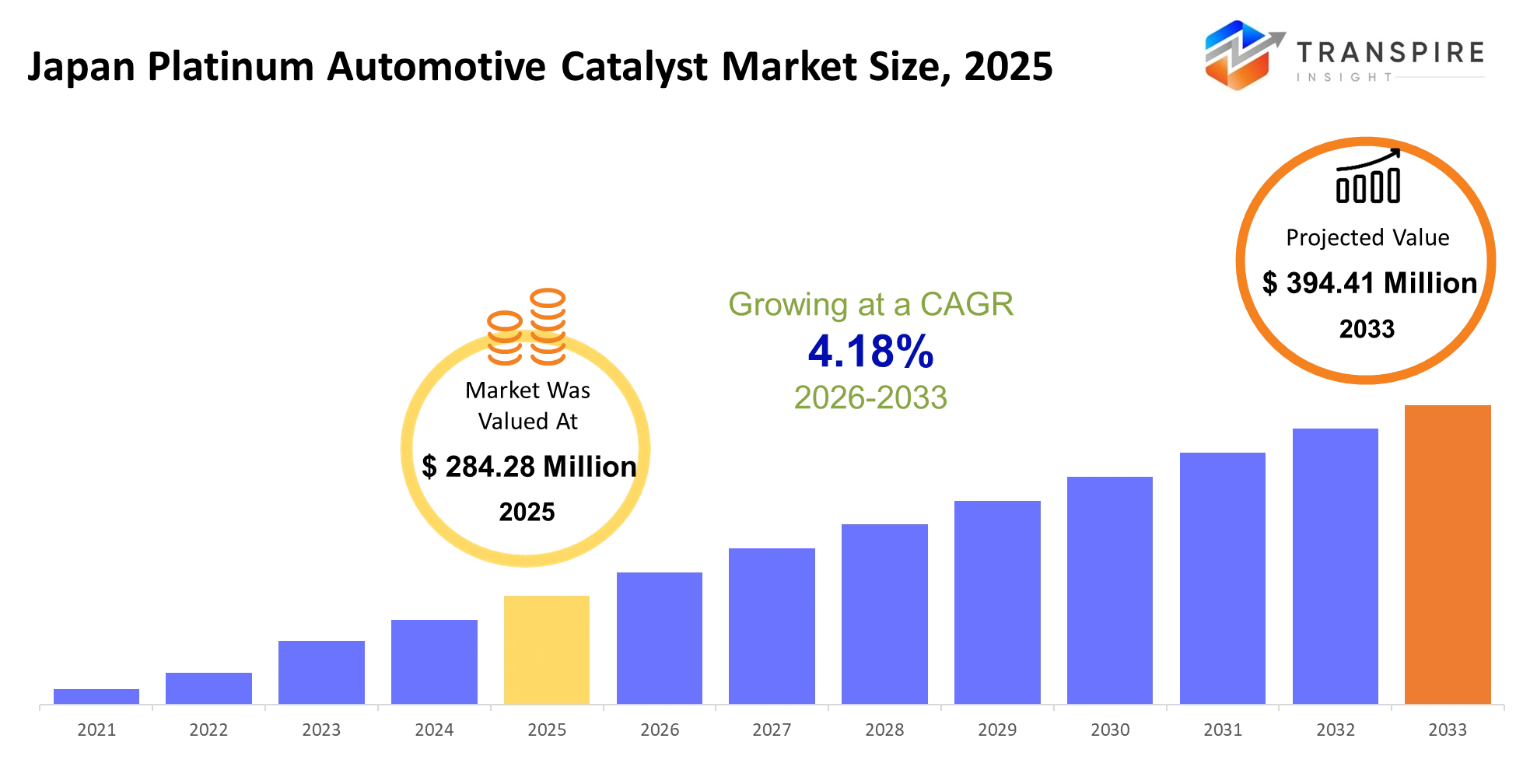
- Japan Platinum Automotive Catalyst Market Size 2025: USD 284.28 Million
- Japan Platinum Automotive Catalyst Market Size 2033: USD 394.41 Million
- Japan Platinum Automotive Catalyst Market CAGR: 4.18%
- Japan Platinum Automotive Catalyst Market Segments: By Type (Three-way Catalysts, Diesel Oxidation Catalysts, SCR Catalysts, Others); By Application (Passenger Vehicles, Commercial Vehicles, Hybrid Vehicles, Emission Control Systems, Others); By End-User (Automotive OEMs, Catalyst Manufacturers, Automotive Suppliers, Others); By Material (Platinum-based, Palladium-based, Rhodium-based, Others).
To learn more about this report,  Download Free Sample Report
Japan Platinum Automotive Catalyst Market Summary
The Japan Platinum Automotive Catalyst Market was valued at USD 284.28 Million in 2025. It is forecast to reach USD 394.41 Million by 2033. That is a CAGR of 4.18% over the period.
The Japan Platinum Automotive Catalyst Market enables vehicles to convert harmful exhaust gases through their tailpipe emissions to meet urban air quality standards while maintaining operational capabilities of internal combustion and hybrid vehicles. Hybrid vehicle production has become the dominant market force in Japan because this trend has maintained catalyst demand despite increased adoption of fully electric vehicles over the past 3-5 years.
Manufacturers have adopted platinum group metal thrifting together with advanced catalyst designs which offer better performance to respond to their growing cost challenges. The pandemic-related supply chain crisis together with the geopolitical constraints on Russian platinum and palladium production brought about a major change in industry operations. The automotive industry has implemented various initiatives for recycling and optimized loadings and system redesigning of catalyst systems which boost aftermarket business while providing stable income streams that endure through different vehicle production periods.
Key Market Insights
- The data shows that Japan has established a 35 to 40 percent market share of East Asia catalyst demand because of its strong automotive original equipment manufacturer presence and its position as a leader in emission control standards.
- The industrial zones of Japanese cities use more energy than other areas because their vehicle numbers exceed average levels and their NOx emissions control measures are implemented with high effectiveness.
- The Japan Platinum Automotive Catalyst Market shows that three-way catalysts (TWC) hold more than 50 percent market share because gasoline hybrid vehicles are the most common type of vehicle.
- The second largest market segment is diesel oxidation catalysts which receive support from the demand to retrofit commercial vehicles.
- The segment with the fastest growth rate in the market offers platinum-rich high-efficiency catalysts because original equipment manufacturers (OEMs) need to reduce their metal usage emissions to meet regulatory requirements.
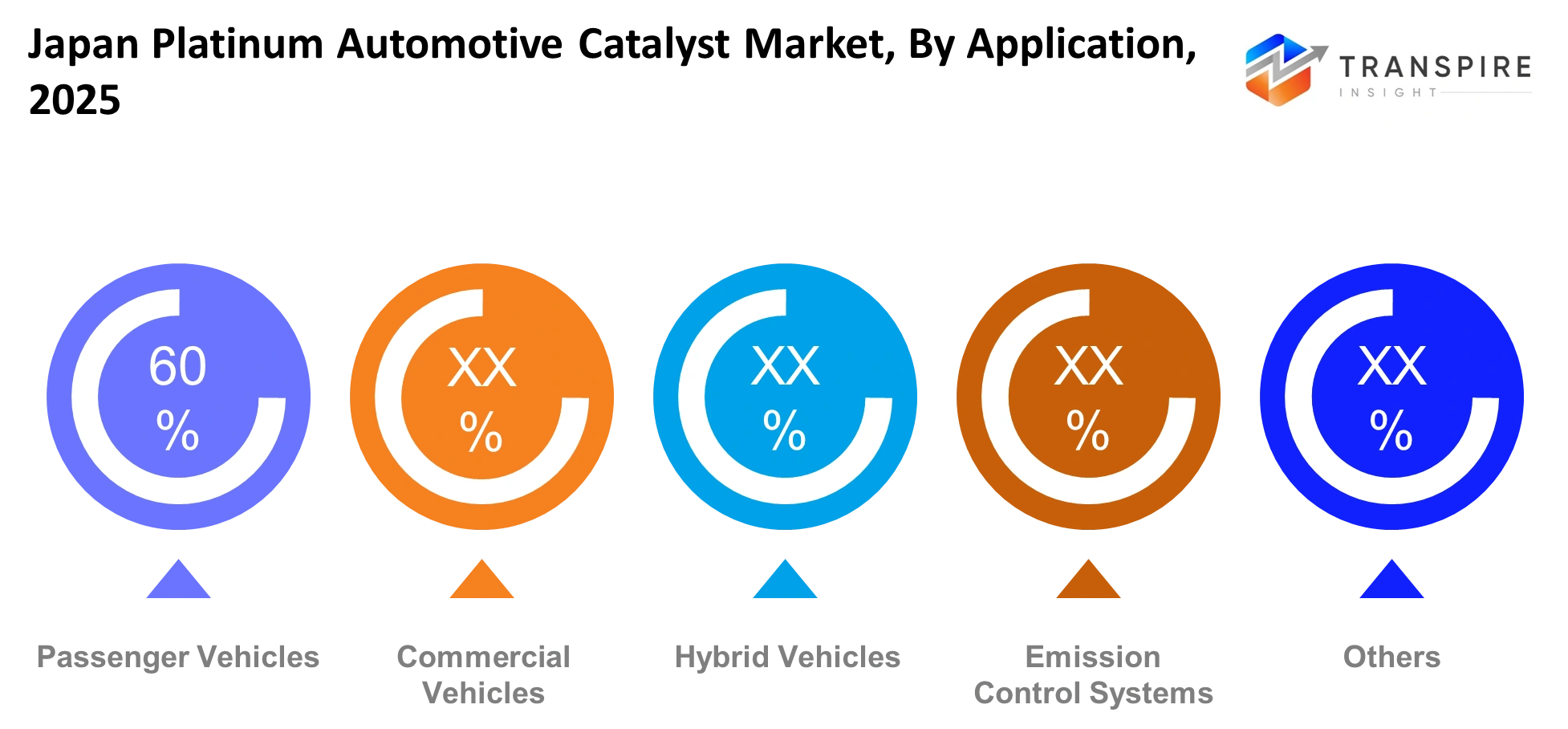
- The passenger vehicles segment leads application demand because it accounts for approximately 60% of total demand, which demonstrates Japan's preference for hybrid vehicles in its automotive market segment.
- Hybrid electric vehicles represent the fastest-growing application segment as ICE platforms persist alongside electrification transition.
- Urban freight emission regulations become more stringent, which leads to the continuous development of commercial vehicle retrofit systems.
- The Platinum Automotive Catalyst Market in Japan receives its main user base from automotive Original Equipment Manufacturers, who constitute approximately 65% of the market.
- Aftermarket recycling and replacement segments experience rapid growth because platinum recovery economics and catalyst lifecycle replacement cycles drive their expansion.
What are the Key Drivers, Restraints, and Opportunities in the Japan Platinum Automotive Catalyst Market?
The Japan Platinum Automotive Catalyst Market exists because hybrid vehicle production demands continue to exist while Japan implements stricter emission regulations from its established low-emission transportation policy. Japan's automotive industry maintains its current structure because it requires both internal combustion engines and hybrid systems which depend on platinum-based catalysts for their exhaust after-treatment requirements. The unified design of regulations together with production processes has established a regular pattern of catalyst usage throughout new vehicles which helps manufacturers maintain their consistent product acquisition schedule while generating continuous income streams for catalyst production companies.
The main limitation arises from two factors which include the unpredictable nature of platinum group metal prices and the concentrated control of supply which particularly connects to geopolitical risks stemming from South Africa and former Russia. The substitution process presents a long-term obstacle because technical limits prevent replacement; platinum maintains its superior performance for high-temperature oxidation processes which no other material can duplicate. Ongoing cost uncertainty presents manufacturers with a continuous challenge which restricts their ability to expand operations while creating a need for them to adjust catalyst loadings which subsequently hinders their capacity for profit growth.
Closed-loop recovery systems together with catalyst recycling systems create an emerging business prospect that operates within the entire Japanese automotive manufacturing industry. Denso and Umicore have developed advanced recovery technologies which enable them to extract platinum from used catalysts with exceptional efficiency. The secondary supply stream has developed into a primary growth driver for Aichi and Kanagawa industrial centers because electric vehicle adoption progresses at a slow pace and Original Equipment Manufacturers together with recycling facilities operate in close proximity.
What Has the Impact of Artificial Intelligence Been on the Japan Platinum Automotive Catalyst Market?
The Japan Platinum Automotive Catalyst Market now uses artificial intelligence together with advanced digital systems to enhance catalyst performance management and emission control operations in automotive manufacturing and fleet compliance systems. AI process control tools operate in production settings to enhance catalyst coating accuracy while controlling platinum group metal distribution and minimizing material waste during production, which leads to consistent exhaust gas conversion efficiency outcomes. Vehicle fleets use machine learning models to monitor real-time emissions data which comes from onboard diagnostic systems, so they can track compliance and identify catalyst degradation before actual regulatory limits are reached.
The market for predictive maintenance applications is expanding because algorithms use temperature data and exhaust composition and driving behavior to calculate catalyst lifespan and determine when to perform maintenance activities. The results from this process measurable operational enhancements which include two benefits the first is unplanned maintenance downtime reduction, the second is improved fuel efficiency from hybrid systems, and the third is better NOx conversion efficiency which remains constant despite changing driving patterns. Automotive OEMs report directional gains in compliance efficiency as digital monitoring reduces the risk of emissions violations during inspection cycles.
The main barrier to implementation exists because AI-enabled monitoring systems require expensive integration work to function within both legacy vehicle systems and existing fragmented fleet networks. Real-world driving behavior and emission performance variations create challenges which affect model accuracy, thus hindering full-scale predictive abilities in scrubber performance systems and exhaust gas cleaning technology implementation.
Key Market Trends
- The share of catalyst demand in Japan's vehicle manufacturing sector grew from 52% in 2022 to more than 60% in 2026 because hybrid vehicles became more popular.
- The automotive original equipment manufacturers changed their procurement approach after 2023 because price changes affected their ability to buy materials and maintain delivery agreements.
- Johnson Matthey and Umicore established closed-loop recycling operations in 2024 which recovered platinum from spent catalysts at industrial scale throughout Japan.
- The implementation of stricter 2023 emission standards pushed gasoline hybrid vehicles to use advanced three-way catalysts which provide superior energy efficiency.
- The introduction of AI-based coating control systems by catalyst manufacturers in 2025 allowed better platinum distribution results while decreasing their material waste during the manufacturing process.
- The Russian supply chain disruptions which occurred after 2022 forced Japanese OEMs to switch their platinum procurement methods toward African sources and recycled materials.
- Passenger vehicle catalysts shifted toward nano-structured designs after 2024 to improve NOx conversion efficiency under low-temperature urban driving conditions.
- Denso and BASF increased joint development programs in 2025 which focused on developing low-metal-load catalyst formulations for upcoming hybrid powertrain systems.
- The aftermarket catalyst replacement cycles after 2023 experienced shorter durations because of the implementation of stricter inspection standards and the rise in emissions compliance testing which occurred in urban areas.
Japan Platinum Automotive Catalyst Market Segmentation
By Type:
The Japan Platinum Automotive Catalyst Market exists because various catalyst types scientists developed to decrease vehicle emissions and enhance air quality standards. Three-way catalysts remain widely used in gasoline vehicles as they help reduce carbon monoxide, nitrogen oxides, and hydrocarbons in a single system. Diesel oxidation catalysts support diesel engines by lowering harmful gases and improving overall combustion output.
The implementation of SCR catalysts together with advanced systems is increasing because of tighter emission regulations and the growing demand for environmentally friendly transportation. SCR catalysts use chemical reactions to reduce nitrogen oxide emissions, especially in heavier vehicles. Continuous improvement in catalyst efficiency and durability supports steady adoption across vehicle platforms.
By Application:
The market demonstrates high utilization rates in passenger vehicles which represent the primary market segment because people own vehicles and need emission control systems to meet their ongoing requirements. The catalysts enable compliance with regulatory requirements while they help vehicles achieve optimal fuel efficiency and engine performance during regular driving in both city and highway environments. The demand for commercial vehicles and hybrid vehicles exists because commercial transport operations need advanced emission control systems to manage their long-distance and heavy-load requirements. Hybrid vehicles need improved catalyst systems that function effectively with their two energy sources. Emission control systems as a broader category continue to expand as regulations become stricter across transport sectors.
To learn more about this report, Download Free Sample Report
By End-User:
The Japan Platinum Automotive Catalyst Market depends on automotive OEMs because they install catalyst systems in their new vehicle production process. The OEMs develop both domestic and export vehicle models to achieve emission standards while they manage costs and performance and durability needs. The supply chain includes both catalyst manufacturers and automotive suppliers who maintain their strong market position.
Catalyst manufacturers create advanced formulations that use platinum group metals while suppliers handle the complete distribution and system integration process. The aftermarket service providers together with other industry participants create support mechanisms that enable replacement needs for degraded catalysts during extended vehicle operation.
By Material:
Platinum-based catalysts are commonly used because they effectively lower harmful emissions while their performance stays reliable during extreme engine temperature operations. The materials function as crucial components for gasoline and diesel systems which require extended operational life and dependable performance to meet emission standards.
Palladium-based catalysts are becoming essential for gasoline engines because they provide economical advantages and efficient conversion rates of hydrocarbons. Rhodium-based catalysts serve as the primary solution for nitrogen oxide reduction, but their usage remains limited because of their expensive nature. The combined application of these materials enables different vehicle types to achieve optimal performance levels while maintaining budget requirements and emission reduction standards.
What are the Key Use Cases Driving the Japan Platinum Automotive Catalyst Market?
The main application in the Japan Platinum Automotive Catalyst Market focuses on controlling emissions from hybrid passenger vehicles through three-way catalysts which transform NOx and carbon monoxide and hydrocarbons into less dangerous emissions. This situation drives market demand because Japan maintains strict urban air-quality regulations which require all new vehicles to have hybrid and gasoline engine systems with mandatory catalyst technology.
The existing applications now extend to commercial fleet retrofitting and light-duty logistics vehicles which operate in urban delivery networks. Fleet operators in cities like Tokyo and Osaka must comply with new inspection standards which enforce stricter regulations on their operations because noncompliance results in the loss of operating permits. Industrial mobility operators are also upgrading catalyst systems to extend vehicle life while meeting emission caps.
Hydrogen-ICE experimental platforms and hybrid marine auxiliary engines which power coastal shipping vessels represent emerging use cases. Japan currently investigates transitional combustion technologies which will create conversion pathways to solve full electrification challenges in heavy-duty and maritime transport sectors despite existing limitations on these applications.
|
Report Metrics |
Details |
|
Market size value in 2025 |
USD 284.28 Million |
|
Market size value in 2026 |
USD 296.15 Million |
|
Revenue forecast in 2033 |
USD 394.41 Million |
|
Growth rate |
CAGR of 4.18% from 2026 to 2033 |
|
Base year |
2025 |
|
Historical data |
2021 - 2024 |
|
Forecast period |
2026 - 2033 |
|
Report coverage |
Revenue forecast, competitive landscape, growth factors, and trends |
|
Country scope |
Japan |
|
Key company profiled |
Johnson Matthey, BASF, Umicore, Heraeus, Clariant, Tanaka Holdings, Dowa Holdings, Mitsui Mining, Anglo American Platinum, Sibanye Stillwater, Glencore, Norilsk Nickel, Toyota Tsusho, Sumitomo Metal Mining, Cataler. |
|
Customization scope |
Free report customization (country, regional & segment scope). Avail customized purchase options to meet your exact research needs. |
|
Report Segmentation |
By Type (Three-way Catalysts, Diesel Oxidation Catalysts, SCR Catalysts, Others); By Application (Passenger Vehicles, Commercial Vehicles, Hybrid Vehicles, Emission Control Systems, Others); By End-User (Automotive OEMs, Catalyst Manufacturers, Automotive Suppliers, Others); By Material (Platinum-based, Palladium-based, Rhodium-based, Others). |
Which Regions are Driving the Japan Platinum Automotive Catalyst Market Growth?
The Japan Platinum Automotive Catalyst Market maintains its lead which stems from Japan's strict emission standards and its complete dedication to hybrid vehicle development. The country enforces some of the world’s toughest urban air-quality regulations, which require continuous catalyst deployment across passenger and light commercial fleets. Strong OEM presence from Toyota, Honda, and Nissan supports localized production of high-efficiency platinum catalysts. Japan maintains supply security through its established recycling system for platinum group metals which decreases dependency on external sources.
The interconnected nature of regulatory frameworks and industrial systems creates a permanent state of catalyst demand which drives research-based advances. North America represents a more stable but structurally different contributor, driven by consistent regulatory enforcement under EPA Tier 3 standards and steady replacement demand from an aging vehicle fleet.
North America requires hybrid vehicles to meet consumer needs for gasoline SUVs and light trucks and for aftermarket products which satisfy emissions requirements. The United States economy enables people to keep using their vehicles because of its strong economic performance. States with strict emission inspection requirements, especially California, create a consistent need for catalyst replacement, which generates stable revenue streams that experience minimal market fluctuations.
The Asia-Pacific region without Japan exhibits its highest growth rate because China and India have increased their emission standards for urban vehicle fleets which drive up demand for catalyst technology. The introduction of China’s Stage VI emission standards together with India’s Bharat Stage VI implementation in 2023 resulted in higher usage of platinum catalysts. The demand for products has increased because manufacturers invested in local car production facilities and expanded their highway transportation systems. The region provides market entry companies with substantial growth opportunities between 2026 and 2033 because they can develop affordable catalyst solutions which suit standard passenger vehicles.
Who are the Key Players in the Japan Platinum Automotive Catalyst Market and How Do They Compete?
The Japan Platinum Automotive Catalyst Market operates with moderate market consolidation because a few international and domestic companies control advanced catalyst technologies and OEM supply contracts. The competition between companies hinges on their ability to achieve efficient platinum use while meeting regulatory requirements and maintaining long-term partnerships with automotive manufacturers. Incumbents develop new low-metal-load catalyst formulations to protect their existing market share but face increased competition because platinum group metal prices have made material efficiency more critical than production capacity.
Johnson Matthey establishes its market position through advanced technology expertise in emission control chemistry which enables the company to create high-performance catalyst products that reduce platinum use while maintaining conversion efficiency. BASF secures its market advantage through complete automotive solutions which utilize its strong relationships with worldwide OEM partners to include catalyst systems during the initial phases of vehicle development. Umicore establishes its competitive advantage through effective closed-loop recycling operations which enable the company to extract platinum from used catalysts while decreasing its dependence on raw materials, thereby achieving more accurate expense forecasting.
Denso Corporation maintains a strong domestic advantage in Japan by integrating catalyst systems directly into hybrid powertrain development which enables the company to work closely with Toyota's production system. Heraeus focuses on precious metal processing and advanced material engineering, supplying high-purity platinum components that support next-generation catalyst innovation. Clariant develops niche catalyst formulations which provide maximum efficiency for particular hybrid and low-temperature combustion emission control needs. The company uses its technology depth recycling capabilities and original equipment manufacturer partnerships as its main competitive advantages.
Company List
- Johnson Matthey
- BASF
- Umicore
- Heraeus
- Clariant
- Tanaka Holdings
- Dowa Holdings
- Mitsui Mining
- Anglo American Platinum
- Sibanye Stillwater
- Glencore
- Norilsk Nickel
- Toyota Tsusho
- Sumitomo Metal Mining
- Cataler
Recent Development News
In March 2026, Market Research Center (Japan Autocatalyst Industry Report) published a detailed forecast study on Japan’s automotive catalyst market. The report highlighted that Japan’s autocatalyst demand continues to grow steadily, supported by hybrid vehicle production and stricter emission regulations, reinforcing the long-term demand for platinum-based catalytic systems.
Source: https://newscast.jp/
In February 2025, Asahi Kasei (along with Nobian, Furuya Metal, and Mastermelt) initiated a platinum group metals recycling collaboration project aimed at improving recovery systems for precious metals used in industrial applications, including automotive catalyst supply chains in Japan.
Source: https://www.imarcgroup.com/
What Strategic Insights Define the Future of the Japan Platinum Automotive Catalyst Market?
The Japan Platinum Automotive Catalyst Market is developing into an eco-friendly system which requires less metal usage and operates at maximum efficiency because hybrid vehicles still need catalysts when electric vehicles become more popular. The upcoming 5 to 7 years will experience growth through material improvements and recycling processes instead of increasing production capacity and establishing better synchronization between original equipment manufacturer design schedules and new catalyst technologies. The current development mirrors Japan's transportation plan because it requires ongoing support to maintain compliance with internal combustion engine operations.
A hidden danger emerges from the combination of two factors which create substitution pressure for after-treatment technologies that compete with current systems while urban fleets start using electric vehicles at a higher rate. The concentration of platinum supply creates two risks for original equipment manufacturers because they face both sudden price changes and challenges to their financial planning.
Emerging opportunities arise through the development of urban catalyst recycling centers which automotive manufacturing facilities operate in Aichi and Kanagawa to achieve continuous platinum extraction processes. Businesses that implement closed-loop recovery systems within their supply agreements will establish permanent competitive advantages through cost reductions. Market participants need to establish direct control over their recycling operations while developing catalyst designs that enable complete material recovery without any performance decrease.
Japan Platinum Automotive Catalyst Market Report Segmentation
By Type
- Three-way Catalysts
- Diesel Oxidation Catalysts
- SCR Catalysts
By Application
- Passenger Vehicles
- Commercial Vehicles
- Hybrid Vehicles
- Emission Control Systems
By End-User
- Automotive OEMs
- Catalyst Manufacturers
- Automotive Suppliers
By Material
- Platinum-based
- Palladium-based
- Rhodium-based
Frequently Asked Questions
Find quick answers to common questions.
The Japan Platinum Automotive Catalyst Market size is USD 394.41 Million in 2033.
Key segments for the Japan Platinum Automotive Catalyst Market are By Type (Three-way Catalysts, Diesel Oxidation Catalysts, SCR Catalysts, Others); By Application (Passenger Vehicles, Commercial Vehicles, Hybrid Vehicles, Emission Control Systems, Others); By End-User (Automotive OEMs, Catalyst Manufacturers, Automotive Suppliers, Others); By Material (Platinum-based, Palladium-based, Rhodium-based, Others).
Major Japan Platinum Automotive Catalyst Market players are Johnson Matthey, BASF, Umicore, Heraeus, Clariant, Tanaka Holdings, Dowa Holdings, Mitsui Mining, Anglo American Platinum, Sibanye Stillwater, Glencore, Norilsk Nickel, Toyota Tsusho, Sumitomo Metal Mining, Cataler.
The Japan Platinum Automotive Catalyst Market size is USD 284.28 Million in 2025.
The Japan Platinum Automotive Catalyst Market CAGR is 4.18% from 2026 to 2033.
- Johnson Matthey
- BASF
- Umicore
- Heraeus
- Clariant
- Tanaka Holdings
- Dowa Holdings
- Mitsui Mining
- Anglo American Platinum
- Sibanye Stillwater
- Glencore
- Norilsk Nickel
- Toyota Tsusho
- Sumitomo Metal Mining
- Cataler
Recently Published Reports
-
Apr 2026
Healthcare Polymer Packaging Market
Healthcare Polymer Packaging Market Size, Share & Analysis Report By Packaging Type (Syringes, IV Bottles and Pouches, Clamshells, Blisters, Bottles & Jars, Containers, Tubes, IV Parental Packaging, Others), By Type (Regulated, Non-regulated), By Polymer Type (LDPE (Low-Density Polyethylene), HDPE (High-Density Polyethylene), Homo-polymer (Homo), Random Copolymer (Random), Block Copolymer (Block), PET, Polystyrene, Polyvinyl Chloride, Polyamide/EVOH, Others), and Geography (North America, Europe, Asia-Pacific, Middle East and Africa, South and Central America), 2021 - 2031
-
Apr 2026
Hydrophilic Tape (Waterstop) Market
Hydrophilic Tape (Waterstop) Market Size, Share & Analysis Report By Type (Bentonite-Based Hydrophilic Tape, Rubber-Based Hydrophilic Tape), By Application (Residential Buildings, Commercial Buildings, Infrastructure Projects), and Geography (North America, Europe, Asia-Pacific, Middle East and Africa, South and Central America), 2021 - 2031
-
Apr 2026
Metalens Market
Metalens Market Size, Share & Analysis Report By Type (Visible Light Metalens, and Infrared Metalens), By Application (Consumer Electronics, Automotive Electronics, Industrial, Medical, and Others), and Geography (North America, Europe, Asia-Pacific, Middle East and Africa, South and Central America), 2021 - 2031
-
Apr 2026
PBT Resin Market
PBT Resin Market Size, Share & Analysis Report By Type (Reinforced PBT Resin, Unreinforced PBT Resin), By Processing Method (Injection Molding, Extrusion, Blow Molding, Others), By End-User (Automotive, Electrical & Electronics, Consumer Appliances, Industrial Machinery, Medical Devices, Packaging, Others), and Geography (North America, Europe, Asia-Pacific, Middle East and Africa, South and Central America), 2021 - 2031