

Global Reciprocating Engine Market Size & Forecast:
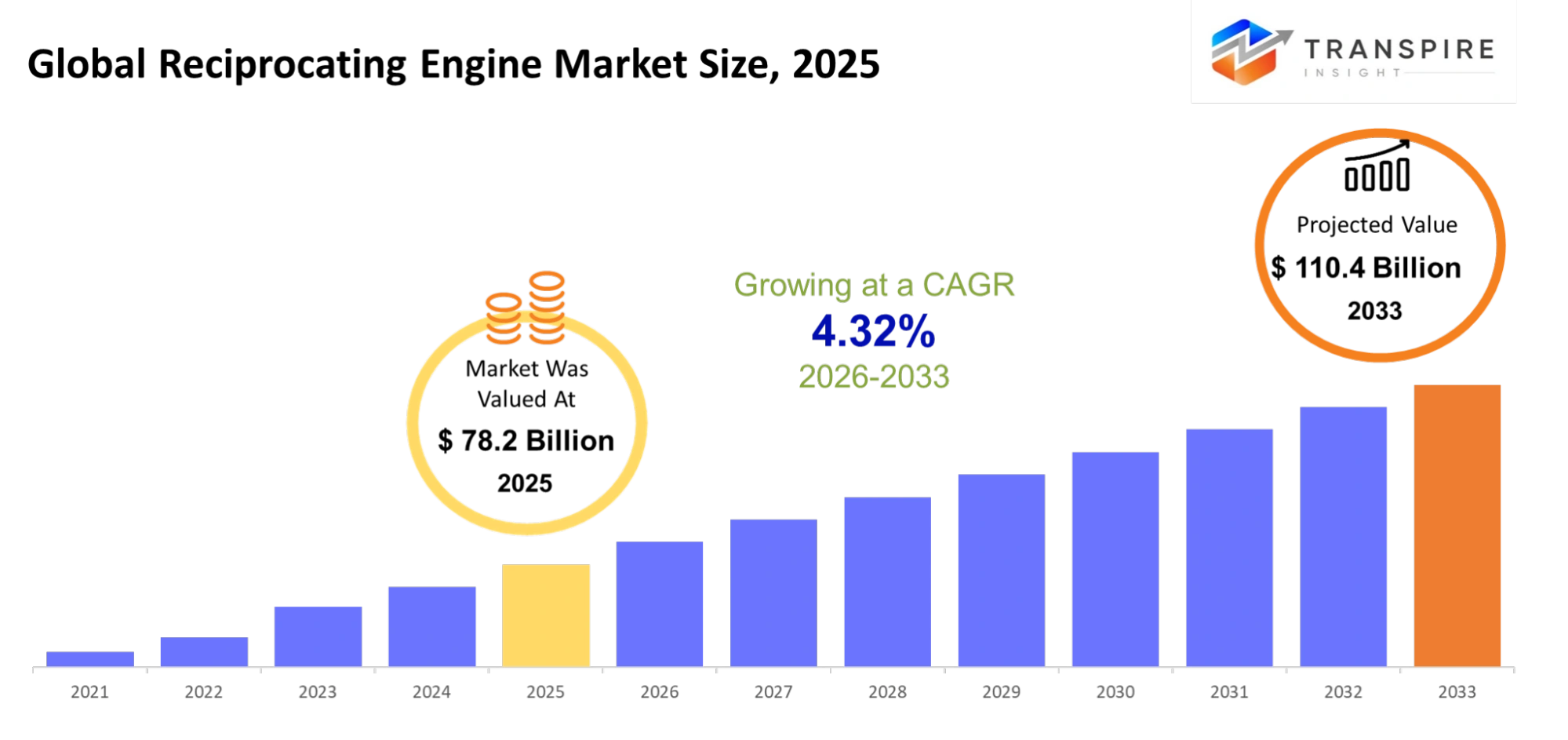
Global reciprocating engine market Size 2025: USD 78.2 Billion
Global reciprocating engine market Size 2033: USD 110.4 Billion
Global reciprocating engine market CAGR: 4.32%
Global reciprocating engine market Segments: By Fuel Type (Diesel, Gasoline, Natural Gas), By Application (Power Generation, Marine, Oil & Gas, Industrial Machinery), By Power Output (Up to 1 MW, 1–5 MW, Above 5 MW)
To learn more about this report,  Download Free Sample Report
Global Reciprocating Engine Market Summary:
The global reciprocating engine market was valued at USD 78.2 billion in 2025. It will reach USD 110.4 billion by 2033. The CAGR over this period is 4.32%.
Reciprocating engines change fuel into mechanical energy via piston movement. They have been carrying out this process for over 150 years now. The technology is very mature, proven, and quite embedded in our global infrastructure. That maturity is also why the market is so resilient. Operators really trust engines they understand well how to repair.
The market is facing a pretty pivotal moment currently. Policies aimed at energy transition are driving more investment towards renewables. However, grid reliability still relies heavily on dispatchable generation sources. Reciprocating engines really fill that gap. They can get started in less than a minute. They adapt to changing loads really fast. Wind and solar just can't match that level of instant demand.
Natural gas is stealing market share away from diesel in stationary power applications. Gas engines produce somewhat less CO2 and NOx per kilowatt-hour. Emissions laws in North America, Europe, and certain areas of Asia are forcing gas to be the more preferred fuel for brand new standby and peaking installations. A few major gas-engine platforms have been introduced recently from Caterpillar, Wärtsilä, and MAN.
The global market application is one big drive for demand. Population growth, increasing data centers, and the electrification of transportation all add up to an increased need for electricity. Grid investments aren't keeping pace all the time. That gap actually keeps reciprocating engine generators highly relevant right through into the 2030s.
Marine is the second main application. Our international shipping fleet is absolutely massive.
Slow-speed two-stroke diesel engines power most of our deep-sea vessels. These engines are designed for very long service lifespans and are regularly maintained for twenty to thirty years. Replacement cycles are quite long - yet very predictable. IMO emissions regulations are pushing marine engine buyers more and more towards dual-fuel designs.
What has the Impact of Artificial Intelligence Been on the Global Reciprocating Engine Market?
Artificial intelligence is dramatically changing the global reciprocating engine market - restructuring just how manufacturers, suppliers, and key players approach decision-making and daily operational efficiency. Integrating AI into the global reciprocating engine market has really improved market research and data analysis abilities even further by using machine learning algorithms and predictive analytics techniques.
These technologies process extremely large data sets so they can discover useful insights, allowing companies to identify new market trends, optimize their pricing strategies, and make data-driven investments with much more confidence. Moreover, AI-driven supply chain optimization plays a very significant part in increasing competitiveness within the global reciprocating engine market.
Companies are using AI tools to monitor logistics, reduce lead times, and minimize the risks associated with supply disruptions itself. This technological shift isn't only driving innovations and personalizations in engine design but also lets organizations respond very quickly to changing customer requirements, thereby securing a quite strong competitive edge in a very dynamic international landscape all over again.
Key Market Trends & Insights:
- The Global Reciprocating Engine Market is expanding due to rising demand for reliable backup power solutions across industrial, commercial, and residential sectors worldwide.
- Stringent environmental regulations are pushing manufacturers toward cleaner fuel technologies, reshaping product innovation strategies globally.
- Asia-Pacific dominates the Global Reciprocating Engine Market with ~40–45% market share in 2024, driven by infrastructure growth and rising energy demand.
- Gas-powered reciprocating engines dominate with over 55% market share in 2024, driven by environmental benefits and lower operational costs.
- Power generation dominates applications, accounting for approximately 60% market share, driven by demand for backup and off-grid electricity solutions.
- Industrial end-users dominate with over 50% share, driven by manufacturing, mining, and heavy industry demand for continuous power supply.
- Companies are focusing on product innovation, including low-emission gas engines and hybrid energy solutions to meet sustainability goals.
- Strategic partnerships and collaborations with energy providers are expanding market reach and strengthening distribution networks globally.
- Regional expansion into Asia-Pacific and Middle East markets is a key growth strategy to capture emerging demand opportunities.
- Investment in digital technologies such as IoT-enabled engines and predictive analytics is enhancing performance and competitive advantage.
- Technology advancements in fuel efficiency and emissions reduction are helping companies gain significant market share and long-term positioning.
Global Reciprocating Engine Market Segmentation
By Fuel Type:
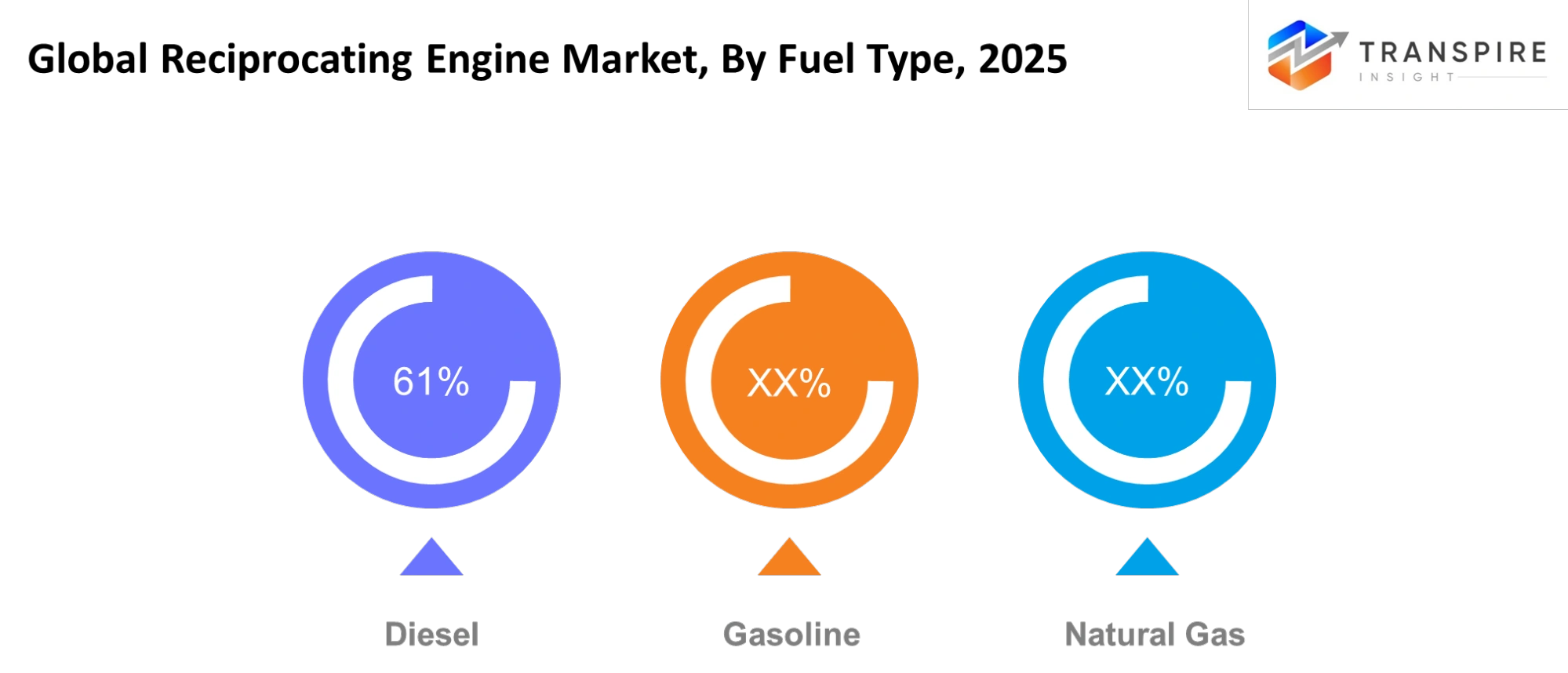
The global reciprocating engine market Segmentation really shows fuel type as a key factor - it shapes our demand and usage patterns across many industries. Diesel engines will still be very widely used because they're known for their high efficiency and reliability in the heaviest of-duty operations. Gasoline engines will still serve the lighter applications - where cost and simplicity matter so much more.
Natural gas engines are gaining a lot of attention lately - because they have lower emissions and a cleaner performance compared to traditional fuels. Industries focusing on sustainability really will start shifting towards natural gas options. This shift will really support our long-term environmental goals - whilst also maintaining our operational efficiency in very different sectors all over the world.
To learn more about this report, Download Free Sample Report
By Application:
The global reciprocating engine market Segmentation really highlights application areas - that drive the whole market's growth. Power generation will lead the way because of rising energy demand and the need for backup systems in both urban and remote areas. Reliable engines will provide a stable and continuous electricity supply - wherever grid access remains limited.
Marine, oil and gas, and industrial machinery sectors will all play a very strong role. Marine transport really depends on super-durable engines for long voyages - while oil and gas operations need robust systems for extraction and processing. Industrial machinery will rely on these engines for consistent performance in manufacturing and heavy-duty tasks all the time.
By Power Output:
The global reciprocating engine market Segmentation actually divides engines based on power output - to match the totally different operational needs. Engines up to 1 MW will be perfect for small-scale operations - including local power generation and very compact industrial use. These systems will offer the most flexibility and cost efficiency for relatively small energy demands all the time.
Engines in the 1-5 MW and above 5 MW ranges will serve much larger operations. The medium-range output will support commercial facilities and mid-sized industries, while higher output engines will take care of very large-scale power plants - and other very heavy industrial activities. This range-based classification will really make sure that we select the right engine for quite varied performance requirements every single time.
What are the Main Challenges for the Global Reciprocating Engine Market Growth?
The global reciprocating engine market really faces a lot of technical and operational problems that hold it back from growing more smoothly. Performance limitations - related to fuel efficiency, emissions control, and durability - continue to be quite a challenge.
Additionally, the complexity of engine design and integration - especially for quite advanced applications - really increases maintenance requirements and operating costs. Supply chain disruptions, particularly in sourcing some very critical components like precision-made parts, even more severely exacerbate these growth barriers and greatly reduce scalability over the regions.
Adoption difficulties still remain the biggest problem - especially in emerging countries where infrastructure and technical knowledge are quite limited. The global reciprocating engine market is also hindered by a lack of skilled labor force essential for setting up, operating, and maintaining quite sophisticated engine systems. Moreover, limited access to capital funding and inadequate supporting infrastructure greatly restricts widespread deployment, making many market limitations very apparent.
Increasing competition from other technologies - like electric propulsion systems and renewable energy solutions - really adds to the growth barriers in the global reciprocating engine market. Pricing pressure, new environmental laws, and our global shift towards sustainability even more intensify market risks, prompting industry leaders to constantly innovate so they can stay very competitive indeed.
Regional Insights
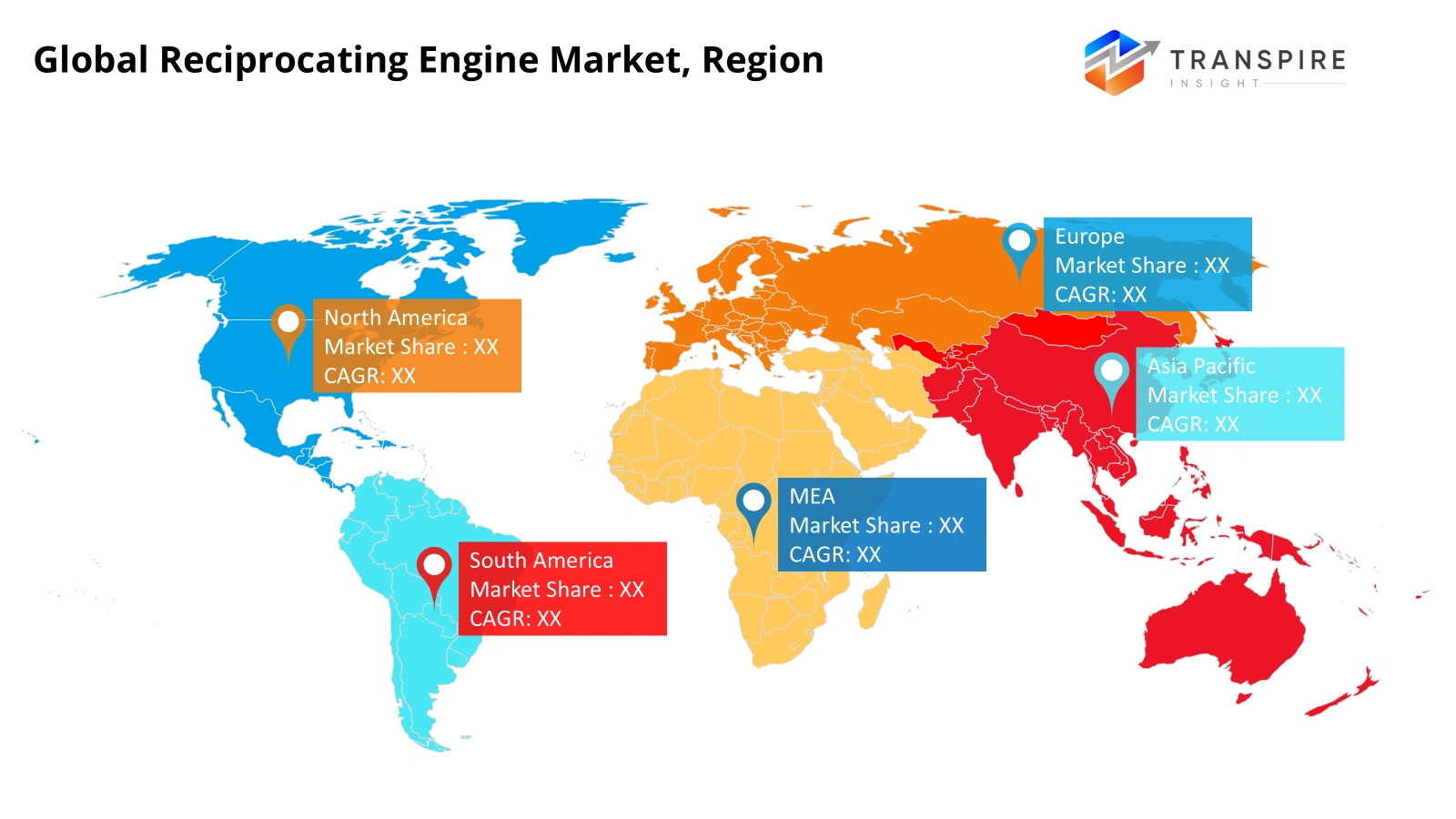
The United States really is the biggest national market ever. Data center construction is rapidly spreading all over the country. Each new data center requires standby diesel generators. That has created pretty much constant demand for some very large generator sets - and the engines right in them. Oil and gas compression demands from shale production also quite sustain engine purchases in Texas, Pennsylvania, and the Permian Basin.
China is the second biggest market in terms of volume. Its engine manufacturers constantly compete on price in domestic and foreign markets. Chinese OEMs have taken over a lot of share in Southeast Asia and Africa by offering lower-cost alternatives to Western and Japanese brands. Domestic emissions regulations really are getting tighter, pushing Chinese engine makers to significantly upgrade their platforms.
Germany is at the center of European marine and power generation engine development. MAN Energy Solutions and MTU, part of Rolls-Royce Power Systems, both operate very large facilities there. Germany's industrial export strength means its engine manufacturers really have a global presence far exceeding the size of its local market.
India is a rapidly growing market. Power outages remain rather common in many states. Diesel genset penetration is relatively high. Kirloskar is definitely the leading domestic brand. Increasing industrial activity and data center investments are both really driving demand. Emissions standards are becoming quite stringent under the CPCB IV norms, which is accelerating engine technology upgrades across the entire market quite a bit.
South Korea hosts Hyundai Heavy Industries and its engine business. Korean shipbuilders are among the most efficient in the whole world. They are some of the major buyers of quite large slow-speed and medium-speed marine engines. South Korea is also an active market for LNG-fueled and dual-fuel marine engines as Korean yards build even more LNG carriers and dual-fuel container ships.
To learn more about this report, Download Free Sample Report
Recent Development News
In April 2026, Aerospace aftermarket firms expand engine maintenance and turbine conversion businesses amid aircraft delivery delays, boosting demand for reciprocating and legacy engine services.
Source: https://www.investors.com/
In March 2026, Rising AI-driven data center demand accelerates deployment of fast-start reciprocating engine power plants, with companies launching high-efficiency gas engines for rapid grid response.
Source: https://www.powermag.com/
Report Metrics
|
Report Metrics |
Details |
|
Market size value in 2025 |
USD 78.2 Billion |
|
Market size value in 2026 |
USD 82.1 Billion |
|
Revenue forecast in 2033 |
USD 110.4 Billion |
|
Growth rate |
CAGR of 4.32% from 2026 to 2033 |
|
Base year |
2025 |
|
Historical data |
2021 - 2024 |
|
Forecast period |
2026 - 2033 |
|
Report coverage |
Revenue forecast, competitive landscape, growth factors, and trends |
|
Regional scope |
United States; Canada; Mexico; United Kingdom; Germany; France; Italy; Spain; Denmark; Sweden; Norway; China; Japan; India; Australia; South Korea; Thailand; Brazil; Argentina; South Africa; Saudi Arabia; United Arab Emirates |
|
Key company profiled |
Caterpillar Inc., Cummins Inc., Rolls-Royce Holdings plc, Wärtsilä Corporation, MAN Energy Solutions SE, Mitsubishi Heavy Industries Ltd., General Electric Company, Yanmar Holdings Co. Ltd., Volvo Penta AB, Deutz AG, Perkins Engines Company Ltd., Kirloskar Oil Engines Ltd., Hyundai Heavy Industries Co. Ltd., Kohler Co., Scania AB. |
|
Customization scope |
Free report customization (country, regional & segment scope). Avail customized purchase options to meet your exact research needs. |
|
Report Segmentation |
By Fuel Type (Diesel, Gasoline, Natural Gas), By Application (Power Generation, Marine, Oil & Gas, Industrial Machinery), By Power Output (Up to 1 MW, 1–5 MW, Above 5 MW) |
How Can New Companies Establish a Strong Foothold in the Global Reciprocating Engine Market?
Newcomers to the global reciprocating engine market can really get going by concentrating on niche targeting and offering distinct value propositions. Instead of competing head-to-head with well-established competitors, start-ups should find under-served sectors - such as decentralised power generation, back-up systems for hospitals, or engines optimised for smart city infrastructure.
Innovation strategies form the core of creating a competitive footing in the global reciprocating engine market. Companies should invest in advanced materials, improving fuel efficiency, and digital integration - like IoT-enabled monitoring systems. Leveraging predictive maintenance and performance analytics can greatly enhance product reliability and the whole lifecycle value of your product. For instance, emerging players like Achates Power are all about designing highly efficient engines while LiquidPiston is innovating with smaller, more fuel-efficient engine architectures, showing us very clearly how technological differentiation propels market entry.
Finally, new firms must put scalability and adaptability to local areas at a top priority so that they can get over those initial barriers to entry. Expanding into emerging markets with localised solutions, cost-effective manufacturing, and very good after-sales support can really boost our reputation. By combining innovative technologies, targeted marketing, and forming key alliances, emerging players can quite effectively navigate the competition and establish a truly sustainable presence in the global reciprocating engine market.
Key Global Reciprocating Engine Company Insights
The market essentially has two wide competitive tiers. The first encompasses big, diverse manufacturers competing all around the world for all sorts of fuel types, power ranges, and applications in a really very broad way indeed. Caterpillar, Cummins, and Wärtsilä can be found in this group. They have really global service networks, a huge aftermarket parts business, and engineering teams constantly developing new platforms still.
Caterpillar really holds the number one spot by revenue in this market. Its Cat-branded engines handle power generation, oil and gas, marine, and industrial machinery all. The dealer network is truly a highly competitive asset itself. Cat dealers can really service an engine in really quite remote locations where competitors hardly have any local presence at all.
Cummins focuses rather closely on medium-duty engines for commercial vehicles and industrial equipment. Its North American market position is quite robust. Cummins has indeed invested more than most in alternative fuel engines, including hydrogen and natural gas platforms. That puts it right on target for demand driven by emissions regulations over the course of the next decade itself.
Wärtsilä and MAN Energy Solutions really hold sway over the very large marine and power plant engine segments. Both are from Europe, and both really compete quite aggressively in the multi-megawatt range where really few other manufacturers even exist. Their aftermarket service contracts on very large marine and power plant engines generate revenue for many years even long after the sale itself.
Yanmar, Deutz, and Perkins really compete in the sub-1 MW industrial and agricultural segment. These brands sell mostly through equipment manufacturers who actually install the engines in their products themselves. Brand recognition with end users is a lot lower. Relationships with OEM customers who really integrate the engines are the main commercial tool itself.
Kirloskar really holds the number one spot in the Indian market. It really competes on local manufacturing cost, established dealer infrastructure, and actual understanding of local operating conditions itself. Its very strong position in India really makes it difficult for international brands to take it down at price-sensitive applications ever again.
Company List
- Caterpillar Inc.
- Cummins Inc.
- Rolls-Royce Holdings plc
- Wärtsilä Corporation
- MAN Energy Solutions SE
- Mitsubishi Heavy Industries Ltd.
- General Electric Company
- Yanmar Holdings Co. Ltd.
- Volvo Penta AB
- Deutz AG
- Perkins Engines Company Ltd.
- Kirloskar Oil Engines Ltd.
- Hyundai Heavy Industries Co. Ltd.
- Kohler Co.
- Scania AB
What are the Key Use-Cases Driving the Growth of the Global Reciprocating Engine Market?
The global reciprocating engine market is growing very quickly - all because of its really important role in producing reliable power all over various industries. One of the main applications is backup and decentralized power systems in health care facilities, data centers, and commercial buildings - places where a continuous supply of electricity is absolutely crucial. Hospitals, for example, depend greatly on reciprocating engines for emergency power, ensuring that everything stays operational even when the grid fails. This increasing need for more reliable energy is a huge factor in the market's expansion.
In the automotive and transportation sector, the global reciprocating engine market continues to be driven by a demand for internal combustion engines in passenger cars, commercial fleets, and off-road machines. Despite the rapid growth of electric vehicles, reciprocating engines remain quite dominant in very heavy-duty applications such as trucks, boats, and agricultural machinery - thanks to their extremely durable design and extremely high power output. This continued dependence really helps support steady adoption - and a long-term market equilibrium situation.
Manufacturing is another key area where the global reciprocating engine market comes into play. Industries like oil & gas, mining, and construction really rely on these engines for mechanical drive applications, air compressors, and even onsite power generation. They're able to work in very remote - and very harsh environments - making them absolutely essential, while ongoing innovations in fuel efficiency and emissions reduction really enhance their practicality.
Newer applications in decentralized energy systems - and even hybrid energy solutions - are opening up whole new areas of growth. Reciprocating engines are being combined much more often with renewable energy sources so as to give us grid stability and help with load balancing. This evolving use-case really highlights a lot of scalability potential - and also reinforces its value in the future energy systems altogether.
Global Reciprocating Engine Market Report Segmentation
By Fuel Type
- Diesel
- Gasoline
- Natural Gas
By Application
- Power Generation
- Marine
- Oil & Gas
- Industrial Machinery
By Power Output
- Up to 1 MW
- 1–5 MW
- Above 5 MW
By Regional Outlook
- North America
- U.S.
- Canada
- Mexico
- Europe
- UK
- Germany
- France
- Italy
- Spain
- Denmark
- Sweden
- Norway
- Asia Pacific
- Japan
- China
- India
- Australia
- South Korea
- Thailand
- Latin America
- Brazil
- Argentina
- Middle East & Africa
- South Africa
- Saudi Arabia
- UAE
- Kuwait
Frequently Asked Questions
Find quick answers to common questions.
The global reciprocating engine market is expected to reach approximately USD 110.4 billion by 2033.
Key segments include Fuel Type (Diesel, Gasoline, Natural Gas), Application (Power Generation, Marine, Oil & Gas, Industrial Machinery), and Power Output (Up to 1 MW, 1–5 MW, Above 5 MW).
Major players include Caterpillar Inc., Cummins Inc., Rolls-Royce Holdings plc, Wärtsilä Corporation, MAN Energy Solutions SE, Mitsubishi Heavy Industries Ltd., General Electric Company, Yanmar Holdings Co. Ltd., Volvo Penta AB, Deutz AG, Perkins Engines Company Ltd., Kirloskar Oil Engines Ltd., Hyundai Heavy Industries Co. Ltd., Kohler Co., and Scania AB.
The global reciprocating engine market size is approximately USD 78.2 billion in 2025.
The global reciprocating engine market is expected to grow at a CAGR of 4.32% from 2026 to 2033.
- Caterpillar Inc.
- Cummins Inc.
- Rolls-Royce Holdings plc
- Wärtsilä Corporation
- MAN Energy Solutions SE
- Mitsubishi Heavy Industries Ltd.
- General Electric Company
- Yanmar Holdings Co. Ltd.
- Volvo Penta AB
- Deutz AG
- Perkins Engines Company Ltd.
- Kirloskar Oil Engines Ltd.
- Hyundai Heavy Industries Co. Ltd.
- Kohler Co.
- Scania AB
Recently Published Reports
-
Apr 2026
Active Power Filter Market
Active Power Filter Market Size, Share & Analysis Report By Type (Shunt Active Power Filters, Series Active Power Filter, Hybrid Active Power Filter), By Application (Harmonics Mitigation, Reactive Power Compensation, Voltage Regulation, Power Factor Correction), By Phase (Single Phase, Three Phase), By End-User Industry (Manufacturing, Healthcare, Commercial, Automotive, Oil and Gas, Others), and Geography (North America, Europe, Asia-Pacific, Middle East and Africa, South and Central America), 2021 - 2031
-
Apr 2026
Electrical Transformer Market
Electrical Transformer Market Size, Share & Analysis Report By Core (Closed, Shell, and Berry), By Insulation (Gas, Oil, Solid, Air, and Other), By Phase (Single, and Three), By Rating (100 MVA to 500 MVA, 501 MVA to 800 MVA, and 801 MVA to 1200 MVA), and Geography (North America, Europe, Asia-Pacific, Middle East and Africa, South and Central America), 2021 – 2031
-
Apr 2026
Hydraulic Piston Pumps Market
Hydraulic Piston Pumps Market Size, Share & Analysis Report By Type (Axial Piston Pumps, Radial Piston Pumps), By Operating Pressure (Low Pressure, Medium Pressure, High Pressure), By Application (Construction, Mining, Agriculture, Automotive, Oil & Gas, Industrial Machinery, Others), By End-User (OEMs, Aftermarket), and Geography (North America, Europe, Asia-Pacific, Middle East and Africa, South and Central America), 2021 – 2031
-
Apr 2026
Laboratory Gas Generators Market
Laboratory Gas Generators Market Size, Share & Analysis Report By Product (Nitrogen Gas Generator, Hydrogen Gas Generator, Zero Air Gas Generator, Purge Gas Generator, TOC Gas Generators, Others), By Application (Gas Chromatography, Liquid Chromatography-mass Spectrometry (LC-MS), Gas Analyzers, Others), By End-user (Life Science, Chemical & Petrochemical, Food & Beverage, Others), and Geography (North America, Europe, Asia-Pacific, Middle East and Africa, South and Central America), 2021 – 2031