

Middle East and Africa Automated Dispensing Machines Market Size & Forecast:
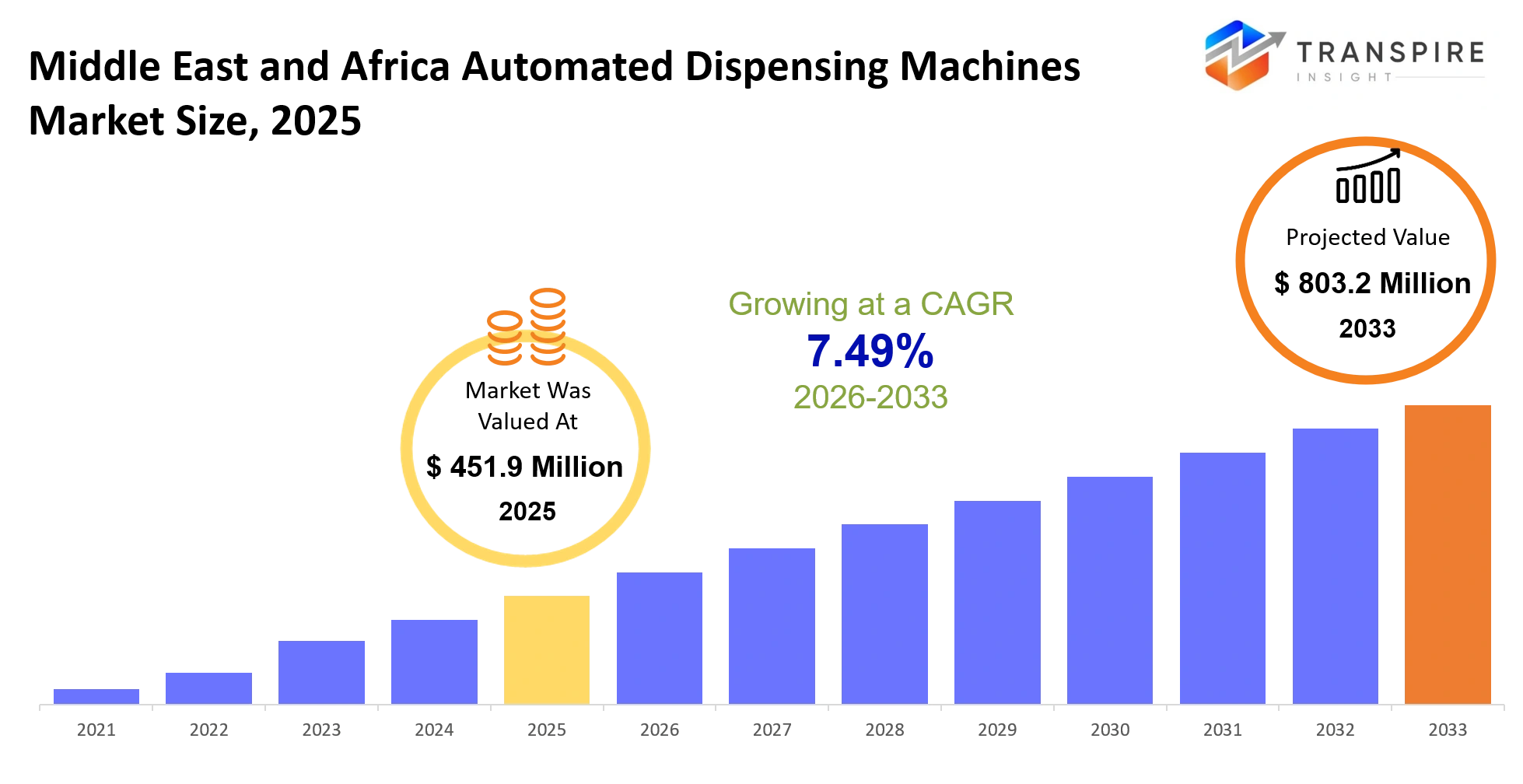
- Middle East and Africa Automated Dispensing Machines Market Size 2025: USD 451.9 Million
- Middle East and Africa Automated Dispensing Machines Market Size 2033: USD 803.2 Million
- Middle East and Africa Automated Dispensing Machines Market CAGR: 7.49%
- Middle East and Africa Automated Dispensing Machines Market Segments: By Product Type (Medication Dispensing Machines, Retail Dispensing Machines, Industrial Dispensing Machines, Fuel Dispensing Machines, Others); By End User (Hospitals, Pharmacies, Retail Stores, Manufacturing Facilities, Others); By Technology (Automated, Semi-Automated, Smart Dispensing Systems, Others); By Application (Medication Management, Inventory Control, Self-Service Sales, Others).
To learn more about this report,  Download Free Sample Report
Middle East and Africa Automated Dispensing Machines Market Summary
The Middle East and Africa Automated Dispensing Machines Market was valued at USD 451.9 Million in 2025. It is forecast to reach USD 803.2 Million by 2033. That is a CAGR of 7.49% over the period.
The Middle East and Africa Automated Dispensing Machines Market sort of plays a major role in how hospitals, pharmacies, and other healthcare facilities manage medication storage, dispensing, and inventory control with more accuracy and speed, not just “better efficiency” in theory. In practice, these systems seem to cut down on medication errors a lot, they boost patient safety and also let healthcare providers handle staffing shortages while everything stays kind of smooth, especially for pharmaceutical workflows even when workloads get heavy. The market was valued at USD 451.9 million in 2025, and it’s projected to reach USD 803.2 million by 2033.
Over the past five years, it looks like the market moved away from standalone dispensing cabinets and more into integrated medication management platforms. These platforms link with electronic health records and hospital information systems, and yes that matters because it changes how the whole process is tracked and verified. The COVID-19 pandemic basically acted as a catalyst, it highlighted weaknesses in manual medication handling and then accelerated investment in automation across healthcare facilities. This change has brought operational benefits you can measure, like lower medication wastage, better inventory visibility, and faster dispensing times. And as governments plus private healthcare operators keep expanding hospital infrastructure, and digitizing healthcare services, automated dispensing technologies are turning into a core part of modern pharmacy operations. That supports revenue growth ,and also wider adoption across the region, generally speaking.
Key Market Insights
- The Middle East and Africa Automated Dispensing Machines Market is starting to move (a bit) toward cloud connected dispensing setups that let teams do centralized inventory tracking across several facilities, at once and maybe not always in the same way.
- Gulf Cooperation Council countries are expected to make up around 42% of regional revenue in 2025, mostly because of continued healthcare infrastructure investments, and you can see it in the build out.
- Hospital based automated dispensing cabinets still lead, taking nearly 58% of the market share, driven by medication safety expectations and workflow streamlining requirements, rather than just convenience.
- Pharmacy automation systems sit as the second largest segment, supported by rising prescription volumes and day to day inventory management needs.
- Cloud enabled dispensing platforms are projected to grow above 9% per year through 2033 since healthcare providers are adopting connected technologies in a steady rhythm.
- For applications, inpatient medication management brings in roughly 48% of the revenue, which matches the high medication handling intensity in acute care environments.
- Meanwhile, outpatient and ambulatory care dispensing solutions are showing quick momentum as healthcare systems push further into decentralized care models.
- Big hospitals account for more than 55% of market demand because their medication workflows are complicated, plus they must meet regulatory compliance expectations.
- Private healthcare networks are also among the fastest growing end users, helped by strategic expansion across Saudi Arabia, UAE , and South Africa.
- Key players such as Omnicell, BD, Swisslog, ScriptPro, ARxIUM, and Baxter are putting money into AI enabled inventory management, cloud integration, and regional collaborations , to improve their competitive position.
What are the Key Drivers, Restraints, and Opportunities in the Middle East and Africa Automated Dispensing Machines Market?
So the main thing pushing market growth is this fast digitization of healthcare systems across the Middle East and Africa. Governments in places such as Saudi Arabia, the UAE and South Africa are putting a lot of money into hospital modernization programs, plus electronic health record integration. And because healthcare providers are dealing with more patients than before and workforce constraints too, automated dispensing machines end up being useful. They can help reduce medication errors, boost inventory precision, and also streamline pharmacy workflows. In practice these operational tweaks lead to clear cost savings and they also motivate healthcare facilities to keep putting money into automation investments, not just a one time thing.
Now the biggest restraint, well it’s the steep upfront capital requirement linked with automated dispensing infrastructure. Hospitals don’t only buy hardware, they also have to handle software integration, cybersecurity frameworks, maintenance services and staff training. This is kind of structural, since many healthcare facilities in developing African markets work with tight budgets and fragmented healthcare systems. So adoption stays mostly in larger hospitals and urban healthcare networks. That slows down broader market penetration, and it means the market’s ability to generate revenue is limited for a while.
But there’s a real opportunity as well, especially with the expansion of cloud connected medication management ecosystems. Healthcare providers are looking more often for centralized platforms that bring together dispensing cabinets, inventory management systems, and patient records. For instance, AI-enabled dispensing solutions that can predict medication demand and automate replenishment workflows are getting more traction. And as digital healthcare infrastructure matures across emerging markets, those advanced systems could open up a new phase of market expansion, plus more service based recurring revenue models.
What Has the Impact of Artificial Intelligence Been on the Middle East and Africa Automated Dispensing Machines Market?
Artificial intelligence is kinda transforming medication management, by letting automated decision making run in the background, plus doing inventory optimization and predictive analytics across different healthcare facilities. A lot of modern dispensing platforms now lean on AI algorithms, to look at prescription patterns, inventory levels, and medication utilization rates all at once, in real time. That means pharmacies can more or less automate stock replenishment decisions, and in turn reduce the chances of shortages, or the other side overstocking too.
Machine learning models are also quietly making predictive maintenance way better. When these systems analyze equipment performance data they can spot potential hardware failures before they actually happen, so downtime drops, and overall system availability improves. Hospitals with more advanced dispensing platforms often end up with stronger inventory accuracy, less medication wastage, and quicker dispensing workflows. Some AI enabled systems even back up demand forecasting, which helps healthcare providers fine tune procurement decisions, and improve operational efficiency. More recent automated dispensing innovations, they even blend cloud based intelligence, for predictive inventory management and some workflow optimization features.
Of course AI adoption still runs into friction. The integration costs are still high, especially for facilities still tied to legacy hospital information systems. Also, many healthcare organizations don’t yet have the big, high quality datasets needed to really maximize predictive model accuracy. On top of that, connectivity limitations plus cybersecurity worries in some emerging markets, make rollout slower. Even with all that, AI driven medication management is expected to become a central competitive differentiator, over the coming decade.
Key Market Trends
- Since 2021, cloud-connected dispensing platforms have been picking up serious momentum, a lot of hospitals are basically asking for centralized inventory visibility across several facilities at once.
- AI-enabled medication forecasting tools have helped tighten inventory planning, somewhere around 15% to 25% better in more mature healthcare networks, at least according to a few reported deployments.
- In the Gulf region, healthcare providers started pushing pharmacy automation investments more aggressively after big hospital expansion programs ran from 2022 to 2025.
- And in private hospital groups, automated dispensing adoption climbed by more than 20% across the last three years, mostly tied to operational scale and reduced manual handling.
- Vendors are also bundling software subscriptions, analytics and maintenance services right alongside hardware sales, to turn it into recurring revenue not just one-off orders.
- After 2023, integration with electronic health records became a standard purchasing requirement, not really an “optional extra” anymore, at least for most buyers.
- In 2025, Omnicell rolled out Titan XT, it blends dispensing automation with cloud-based intelligence, plus predictive inventory capabilities, kinda like one bigger system instead of separate pieces.
- RFID-enabled medication tracking solutions gained traction too, as providers leaned into inventory transparency and medication traceability, rather than treating it as a side concern.
- Also, the competition vibe has shifted away from hardware performance alone, now it’s more about platform interoperability, analytics maturity, and enterprise-wide medication management.
- Meanwhile, regional healthcare operators are increasingly betting on scalable setups, systems that can support future AI integration and centralized pharmacy management without turning the whole stack into a rewrite.
Middle East and Africa Automated Dispensing Machines Market Segmentation
By Product Type
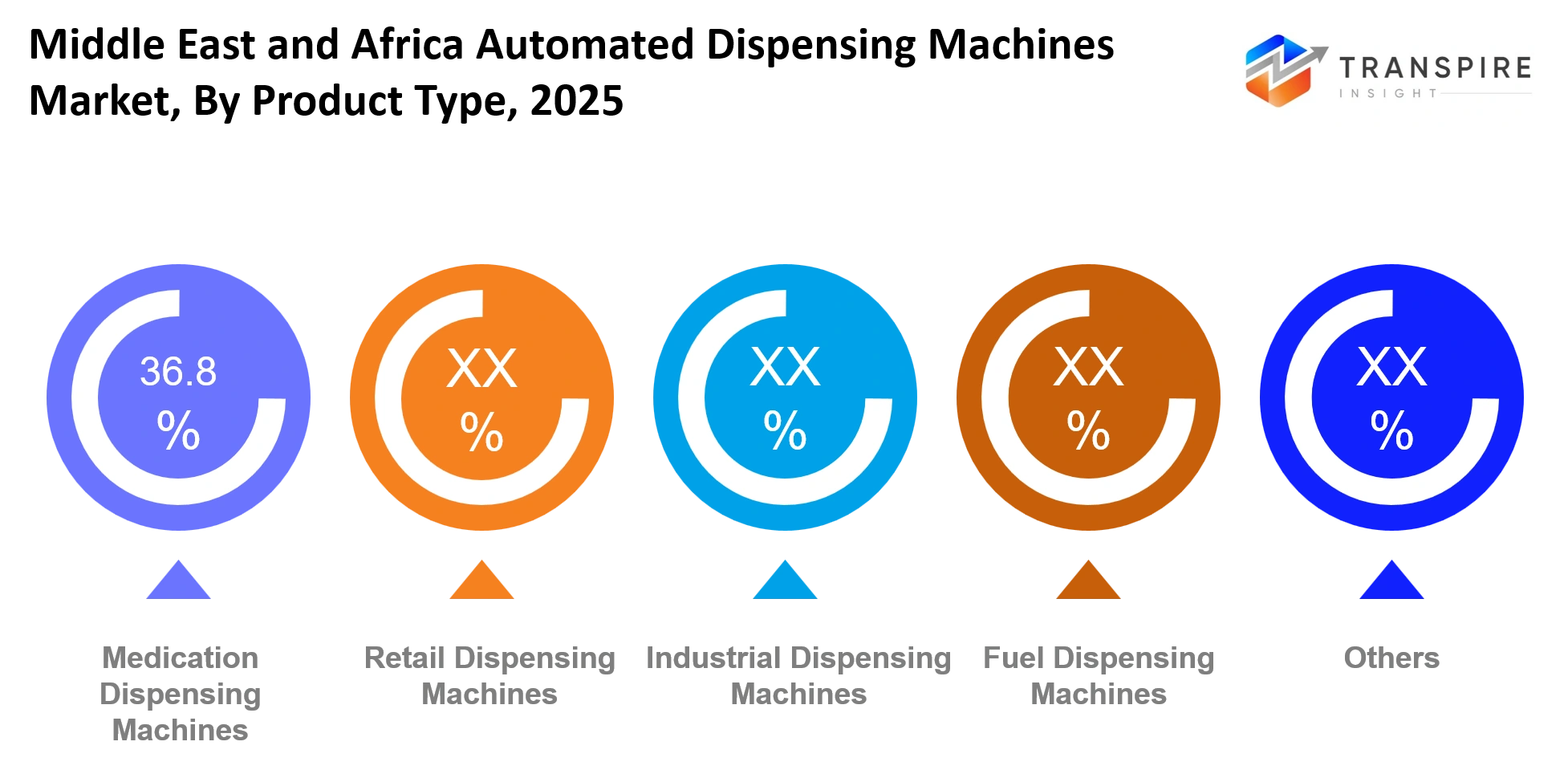
The product type segment shows the different kinds of dispensing solutions that are used across healthcare, retail, industrial, and commercial environments. Medication Dispensing Machines make up a notable portion of the market, mainly because healthcare facilities need accurate medication storage, plus tracking, and also distribution. There is a strong focus on patient safety, and on workflow efficiency, which keeps helping adoption across hospitals and pharmacies. When the dispensing processes are reliable, errors are less likely, and inventory visibility tends to improve too.
Retail Dispensing Machines help enable automated product distribution in convenience retail settings, including self-service environments. Industrial Dispensing Machines support production sites by governing access to tools, supplies, and consumable items, while also cutting down waste. Fuel Dispensing Machines are still a must for fuel stations, and commercial fueling operations, where accuracy, and operational speed, are both really critical. The “others” group includes specialized dispensing systems, built for unique operational needs, and for industry specific use cases.
To learn more about this report, Download Free Sample Report
By End User
The end user segment shows how automated dispensing solutions, kind of like they are, support various industries and day to day operational contexts. Hospitals take up a large portion because medication oversight inventory tracking and patient safety still stay as the most critical priorities. Automated setups help simplify pharmacy routines and back swifter healthcare delivery. Ongoing investment in healthcare infrastructure, it really boosts the rollout across hospital networks, especially when systems need to scale.
Pharmacies keep moving toward dispensing technologies to make prescription fulfillment faster, while also improving inventory precision. Retail Stores use these dispensing systems to elevate customer convenience and enable self service purchasing models that feel smoother. Manufacturing Facilities depend on dispensing equipment to handle supplies better, raise accountability, and curb operational costs. Others, meanwhile, can mean organizations with special dispensing requirements, where automation plus inventory control functions as a practical fit.
By Technology
The technology segment shows how different degrees of automation affect dispensing operations across many industries, a lot depends on workflow and cost. Automated systems still hold a big share because advanced automation boosts efficiency, improves precision, and keeps operational consistency steadier than before. Many organizations choose fully automated solutions , to reduce manual involvement and to optimize how resources get used. Also ongoing digital transformation programs support further investment in automation technologies, even when budgets are tight.
Semi-Automated systems are still a key option especially where operational flexibility matters and cost management plays a role in the buying decisions. Smart Dispensing Systems keep drawing more interest , thanks to capabilities like real-time monitoring, connectivity, analytics , and integrated inventory management. With these tools organizations can make better operational choices while also gaining clearer visibility across dispensing activities. Other approaches include emerging technologies created to handle specific industry needs and specialized dispensing tasks, sometimes they’re more niche and targeted than the mainstream ones.
By Application
The application segment kind of centers on the main functions that actually drive the implementation of dispensing technologies across end-use sectors, you know. Medication Management is a big deal for adoption, because healthcare providers need precise dispensing, ongoing inventory monitoring and regulatory compliance support. When medication handling is done efficiently it helps lift operational performance, and also patient care outcomes. There is a strong emphasis on safety and precision that keeps pushing investments toward more advanced dispensing solutions, still.
Inventory Control remains essential too, since organizations want improved sight into stock levels usage trails and when to replenish. Self-Service Sales keeps growing through retail environments, as businesses aim for convenience, easy access, and quicker customer interactions. Other areas include specialized applications made for industry-specific dispensing needs, plus tailored operational procedures. With automation initiatives expanding, it will keep opening up chances for wider adoption of dispensing technologies across a range of sectors.
What are the Key Use Cases Driving the Middle East and Africa Automated Dispensing Machines Market?
The biggest use case is basically inpatient medication management inside hospitals, where automated dispensing machines assist healthcare providers with secure storage, consistent tracking, and timely dispensing of medicines, and at the same time they cut down on human error. Because patient volumes are so high and the medication safety rules are strict, this scenario becomes the main driver behind market demand.
After inpatient care, many healthcare organizations now also roll out dispensing systems in outpatient clinics, specialty pharmacies, and ambulatory care centers. In these settings, the key advantage is smarter inventory control, assistance with prescription fulfillment workflows, and stronger medication traceability, which lets facilities handle larger patient loads more efficiently, without getting tangled in manual processes.
What’s starting to appear next includes remote dispensing of medications in underserved areas, and also AI-assisted pharmacy inventory management. Healthcare providers are even looking at centralized medication distribution models that tie multiple facilities together through cloud based dispensing networks. As healthcare digitization keeps advancing across the region, these newer directions should slowly turn into something with more commercial weight over the whole forecast period.
|
Report Metrics |
Details |
|
Market size value in 2025 |
USD 451.9 Million |
|
Market size value in 2026 |
USD 484.6 Million |
|
Revenue forecast in 2033 |
USD 803.2 Million |
|
Growth rate |
CAGR of 7.49%from 2026 to 2033 |
|
Base year |
2025 |
|
Historical data |
2021 - 2024 |
|
Forecast period |
2026 - 2033 |
|
Report coverage |
Revenue forecast, competitive landscape, growth factors, and trends |
|
Regional scope |
Middle East and Africa (Saudi Arabia, United Arab Emirates, South Africa, Rest of Middle East and Africa) |
|
Key company profiled |
Omnicell, BD, Capsa Healthcare, Swisslog, Parata Systems, ScriptPro, Yuyama, Talyst, ARxIUM, McKesson, AmerisourceBergen, Pearson Medical, MedAvail, TouchPoint Medical, Baxter. |
|
Customization scope |
Free report customization (country, regional & segment scope). Avail customized purchase options to meet your exact research needs. |
|
Report Segmentation |
By Product Type (Medication Dispensing Machines, Retail Dispensing Machines, Industrial Dispensing Machines, Fuel Dispensing Machines, Others); By End User (Hospitals, Pharmacies, Retail Stores, Manufacturing Facilities, Others); By Technology (Automated, Semi-Automated, Smart Dispensing Systems, Others); By Application (Medication Management, Inventory Control, Self-Service Sales, Others). |
Which Regions are Driving the Middle East and Africa Automated Dispensing Machines Market Growth?
The Gulf region stays the main market for automated dispensing machines, you know, it just keeps rolling. Saudi Arabia and the UAE are still putting a lot into healthcare infrastructure, smart hospitals and digital health initiatives. With strong regulatory oversight and big healthcare modernization plans, hospitals feel more comfortable moving toward automated medication management technologies. It also helps that there’s a solid ecosystem of healthcare providers, technology vendors, and government support, so the region keeps its leading position basically, without much interruption.
South Africa sits as the second biggest regional contributor. But here, growth is a bit different from the Gulf states: it is supported by a mature healthcare sector and steady investment from both public and private healthcare providers. The country has established hospital networks and an overall, fairly advanced pharmaceutical distribution system. Together, these conditions form a fairly stable setup for long-term uptake of pharmacy automation technologies, even when budgets shift a little.
Across the broader African region, the expectation is the fastest growth through 2033. Investments in healthcare infrastructure, hospital construction efforts, and digital health initiatives have ramped up across several emerging economies. A stronger emphasis on medication safety, inventory transparency, and healthcare efficiency is pushing fresh procurement activity forward. For market entrants and investors, this is where chances appear early, meaning you can build partnerships sooner and then capture growth before the market consolidates and competition gets tougher, all at once.
Who are the Key Players in the Middle East and Africa Automated Dispensing Machines Market and How Do They Compete?
The competitive landscape is kind of moderately concentrated, with big international healthcare technology providers going at it through software capabilities, system integration know-how, and those long-running service contracts. Lately, competition has moved past just dispensing hardware, more toward an entire medication management ecosystem that stitches together automation, analytics, inventory intelligence, and cloud connectivity. Vendors are also, you know, increasingly trying to stand out via platform interoperability and recurring software based service models.
Omnicell keeps pushing autonomous medication management through connected dispensing platforms and cloud based intelligence. Its Titan XT platform blends dispensing automation with predictive inventory management plus AI enabled workflow optimization, and the differentiation really comes from having integrated software capabilities.
BD leans hard on its medication management portfolio and its long standing hospital relationships to deliver end-to-end pharmaceutical workflow solutions. Their competitive edge is the broad integration across clinical work and pharmacy operations.
Swisslog is more about hospital logistics automation, and robotic medication distribution systems. Their main strength is in large scale hospital automation projects that also bring pharmacy operations together with wider healthcare logistics networks.
ScriptPro differentiates itself using prescription fulfillment automation and workflow optimization technologies, while ARxIUM concentrates on centralized pharmacy automation and medication packaging systems. Both firms are continuing to expand via software upgrades and healthcare system partnerships that, in practice, reinforce operational efficiency for pharmacy operators.
Company List
- Omnicell
- BD (Becton, Dickinson and Company)
- Capsa Healthcare
- Swisslog
- Parata Systems
- ScriptPro
- Yuyama
- Talyst
- ARxIUM
- McKesson
- AmerisourceBergen
- Pearson Medical
- MedAvail
- TouchPoint Medical
- Baxter International Inc.
Recent Development News
In December 2025, Omnicell announced the launch of Titan XT, a next-generation automated dispensing system. The platform combines cloud-based medication management, AI-enabled inventory intelligence, and enterprise-wide workflow optimization, strengthening the shift toward autonomous medication management.
Source: https://ir.omnicell.com
In November 2025, Omnicell expanded its partnership with Gollmann Kommissioniersysteme GmbH to strengthen connected pharmacy automation capabilities. The collaboration supports predictive analytics, centralized data management, and intelligent medication distribution workflows.
Source: https://www.omnicell.fr
What Strategic Insights Define the Future of the Middle East and Africa Automated Dispensing Machines Market?
Over the next five to seven years the market is expected to shift, from automation that is mainly hardware-driven toward a more fully connected medication management setup, kinda powered by cloud platforms AI analytics, and predictive inventory intelligence. The thing driving this change is basically the pressure on healthcare providers to boost operational efficiency while also dealing with workforce shortages, plus those more and more complex medication workflows.
There’s also a less obvious risk, market concentration around only a handful of technology providers. When hospitals get more dependent on integrated software ecosystems, switching costs can quietly rise and that’s where vendor lock-in worries show up, also it can narrow procurement flexibility. Meanwhile there’s an opportunity growing too, particularly in mid-sized hospitals and healthcare networks across emerging African markets. In those places digital health infrastructure is starting to reach a level of maturity that can actually support advanced automation deployments, not just basic digitization.
For everyone in the market, the approach that tends to work best is to put interoperable platforms first, ones that work with existing hospital information systems. Companies that bundle automation hardware together with analytics, predictive inventory management, and recurring software services will likely be the ones that capture long-term value, and hold onto market share in a more durable way.
Middle East and Africa Automated Dispensing Machines Market Report Segmentation
By Product Type
- Medication Dispensing Machines
- Retail Dispensing Machines
- Industrial Dispensing Machines
- Fuel Dispensing Machines
- Others
By End User
- Hospitals
- Pharmacies
- Retail Stores
- Manufacturing Facilities
- Others
By Technology
- Automated
- Semi-Automated
- Smart Dispensing Systems
- Others
By Application
- Medication Management
- Inventory Control
- Self-Service Sales
- Others
Frequently Asked Questions
Find quick answers to common questions.
The expected Middle East and Africa Automated Dispensing Machines Market size for the market will be USD 803.2 Million in 2033.
Key segments for the Middle East and Africa Automated Dispensing Machines Market are By Product Type (Medication Dispensing Machines, Retail Dispensing Machines, Industrial Dispensing Machines, Fuel Dispensing Machines, Others); By End User (Hospitals, Pharmacies, Retail Stores, Manufacturing Facilities, Others); By Technology (Automated, Semi-Automated, Smart Dispensing Systems, Others); By Application (Medication Management, Inventory Control, Self-Service Sales, Others).
Major Middle East and Africa Automated Dispensing Machines Market players are Omnicell, BD, Capsa Healthcare, Swisslog, Parata Systems, ScriptPro, Yuyama, Talyst, ARxIUM, McKesson, AmerisourceBergen, Pearson Medical, MedAvail, TouchPoint Medical, Baxter.
The Middle East and Africa Automated Dispensing Machines Market size is USD 451.9 Million in 2025.
The Middle East and Africa Automated Dispensing Machines Market CAGR is 7.49% from 2026 to 2033.
- Omnicell
- BD (Becton, Dickinson and Company)
- Capsa Healthcare
- Swisslog
- Parata Systems
- ScriptPro
- Yuyama
- Talyst
- ARxIUM
- McKesson
- AmerisourceBergen
- Pearson Medical
- MedAvail
- TouchPoint Medical
- Baxter International Inc.
About the Authors

Pankaj Ghogare Patil
I am Pankaj Ghogare Patil, a Senior Research Analyst at Transpire Insight, specializing in the Pharmaceutical, Chemicals & Materials, Healthcare IT, and Biotechnology industry. My expertise lies in conducting comprehensive market research, analyzing industry trends, evaluating competitive landscapes, and translating complex data into actionable insights. At Transpire Insight, I closely follow emerging technologies, regulatory developments, and market innovations to create accurate, well-researched, and informative content that helps businesses and professionals make informed decisions. I am committed to producing credible, evidence-based articles that reflect industry best practices while making technical topics accessible and valuable for a broad audience.

Chakradhar Khansole
Chakradhar serves as the Research Director at Transpire Insight, bringing over 8 years of experience in technology, innovation, and strategic market intelligence. He specializes in transforming complex market data into actionable business insights that enable organizations to make informed, growth-oriented decisions. Recognized for his strategic vision and analytical expertise, Chakradhar leads high-impact research initiatives, delivering comprehensive market assessments, competitive intelligence, and forward-looking industry analysis.
Recently Published Reports
-
Apr 2026
AI in Diabetic Retinopathy Market
AI in Diabetic Retinopathy Market Size, Share & Analysis Report By Type (Screening AI Systems, Diagnostic AI Systems, and Predictive AI Models), By Application Segment (Hospitals, Ophthalmology Clinics, Diagnostic Centers, and Research and Development), and Geography (North America, Europe, Asia-Pacific, Middle East and Africa, South and Central America), 2021 - 2031
-
Apr 2026
Psychometric Tests Market
Psychometric Tests Market Size, Share & Analysis Report By Type (Personality Tests, Ability/Aptitude Tests, Skill/Knowledge Tests, and Others), By Application (Talent Acquisition and Talent Management), and Geography (North America, Europe, Asia-Pacific, Middle East and Africa, South and Central America), 2021 – 2031
-
Apr 2026
Rare Biological Sample Collection Market
Rare Biological Sample Collection Market Size, Share & Analysis Report By Type (Isolation Kits & Reagent, Blood Collection Tubes, and Others), By Application (Oncology, Transcriptomics, Pharmacogenomics, and Others), and Geography (North America, Europe, Asia-Pacific, Middle East and Africa, South and Central America), 2021 – 2031
-
Jul 2026
Diabetic Retinopathy Market
Diabetic Retinopathy Market Size, Share & Analysis Report By Type (Proliferative Diabetic Retinopathy, and Diabetic Macular Edema (DME)), By Treatment Type (Anti VEGF Drug, Steroid Implants, Laser Surgeries, and Vitrectomy), and Geography (North America, Europe, Asia-Pacific, Middle East and Africa, South and Central America), 2021 – 2031
Our Clients







