

Italy Bunker Fuel Market Size & Forecast:
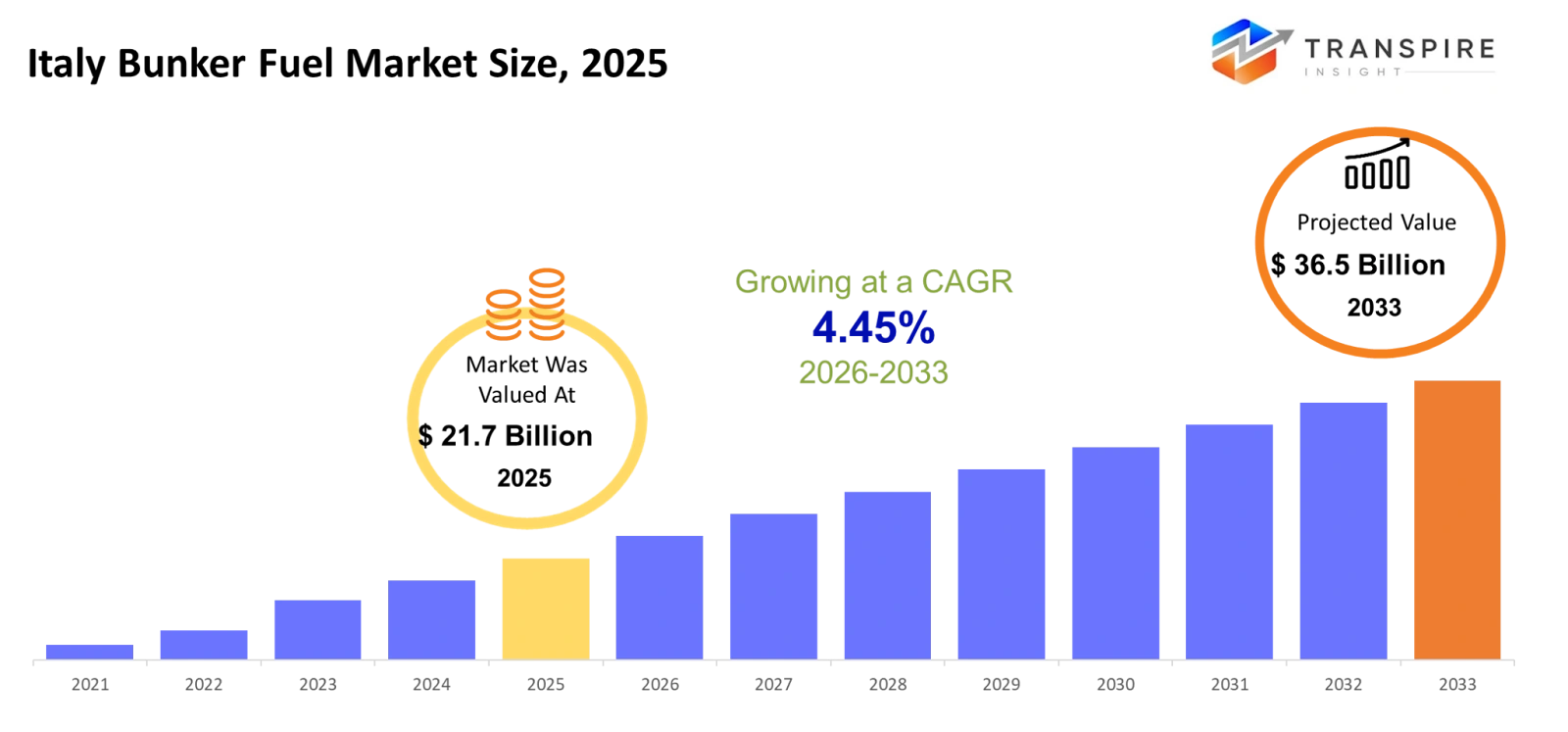
- Italy Bunker Fuel Market Size 2025: USD 21.7 Billion
- Italy Bunker Fuel Market Size 2033: USD 36.5 Billion
- Italy Bunker Fuel Market CAGR: 4.45%
- Italy Bunker Fuel Market Segments: By Fuel Type (High Sulfur Fuel Oil, Very Low Sulfur Fuel Oil, Marine Gas Oil, Liquefied Natural Gas), By Vessel Type (Container Ships, Tankers, Bulk Carriers, Cruise Ships), By Application (Commercial Shipping, Defense).
To learn more about this report,  Download Free Sample Report
Italy Bunker Fuel Market Summary:
The Italy Bunker Fuel Market size was estimated at USD 21.7 Billion in 2025 and is anticipated to reach USD 36.5 Billion by 2033, growing at a CAGR of 4.45% from 2026 to 2033. The Italian and American bunker fuel market within the marine energy sector will undergo changes because of two main factors: changing fuel preferences and increasing environmental regulations. Shipping operators will increasingly prefer cleaner-burning alternatives because emission rules will become stricter at major ports. The industry will experience a demand shift from heavy residual fuels toward fuel blends which contain lower sulfur content. The refining processes will develop new methods to achieve compliance with industry standards while digital monitoring systems will enhance both fuel efficiency and tracking capabilities. Buyers will expect transparency in sourcing and pricing, which will lead to changes in supplier business operations. The regions will modify their trade routes and port facilities to accommodate the requirements of emerging fuel types and their associated handling processes.
Key Market Trends & Insights:
- The current situation in Italy and the shows that increased worldwide shipping operations create demand for fuel in their main ports. Bunker fuel consumption between North America and Mediterranean maritime trade routes remains at stable levels. The Italy Bunker Fuel Market will experience changes because shipping companies use fuel efficiently while they manage their expenses.
- The Italy Bunker Fuel Market shows a key trend which states that more stringent environmental regulations for marine emissions create an impact on fuel selection processes used in both Italy and the . Shipping operators shift toward low-sulfur fuels and cleaner alternatives to meet compliance standards. The regulatory pressure will drive fuel selection trends that emerge throughout the Italy bunker fuel market.
- The Italy bunker fuel market shows a major development through the construction of port facilities at important locations which include the Genoa and Rotterdam connecting routes and the Gulf Coast terminals. The installation of advanced bunkering systems enables vessels to complete their refueling process at an increased speed while achieving better logistical operation results. The upcoming infrastructure enhancements will lead to better operational performance within the Italy bunker fuel market.
- The Italian bunker fuel market operates under a main trend which shows that changes in crude oil prices directly impact both bunker fuel prices and freight costs. The price fluctuations directly impact how shipping companies between Italy and the handle their fuel purchase methods and their agreements for future fuel delivery. The Italy bunker fuel market will maintain its equilibrium according to the trends which show crude oil prices.
- The Italian bunker fuel market shows a main trend which shows that more companies are implementing digital fuel management systems to enhance their ability to monitor fuel usage and greenhouse gas emissions. The shipping industry uses data-based tools which enable them to maximize their fuel savings while decreasing their operational expenditures. The implementation of technology will enhance decision-making capabilities throughout the Italian bunker fuel market.
Italy Bunker Fuel Market Segmentation
By Fuel Type
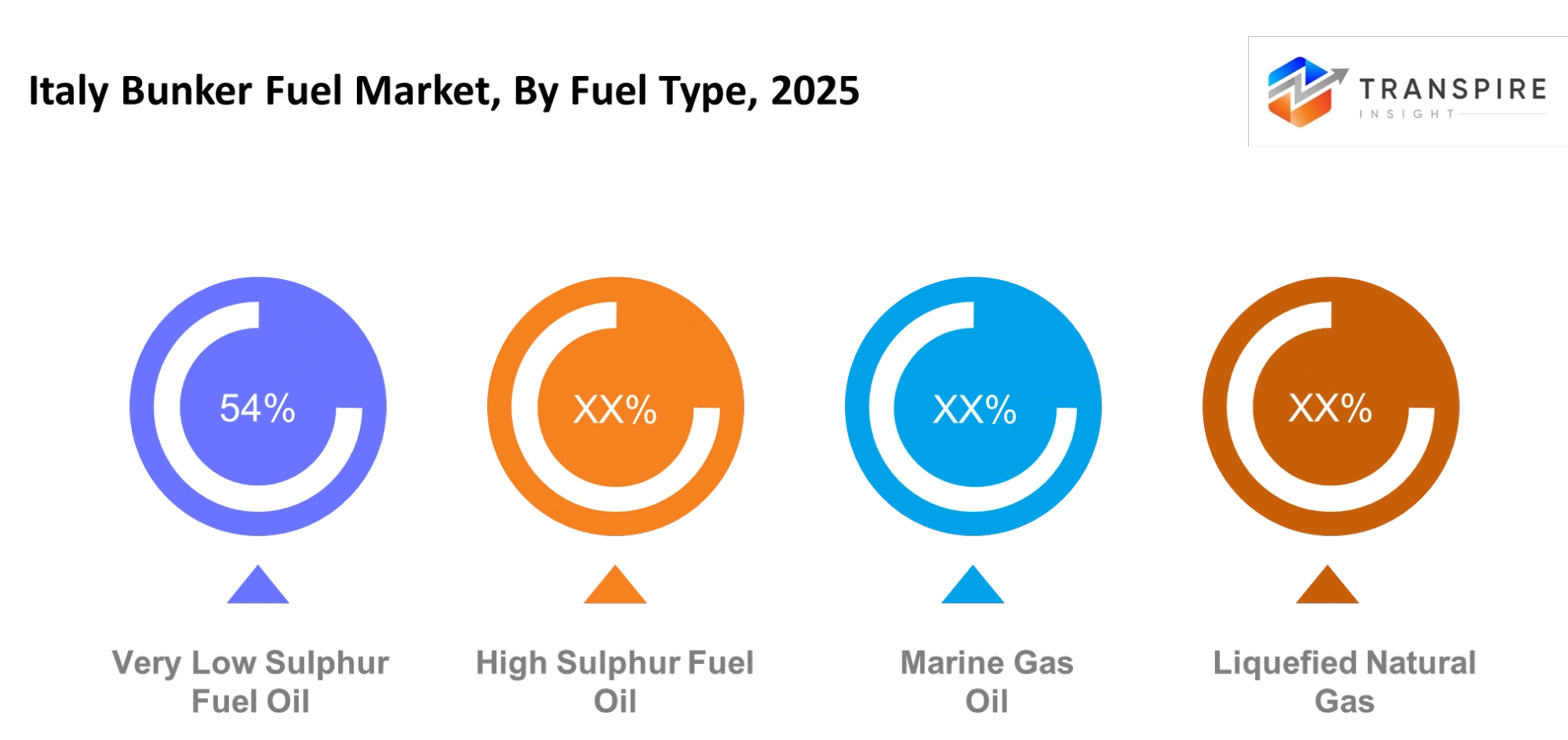
High Sulphur Fuel Oil : The Italian and American bunker fuel market distribution shows High Sulfur Fuel Oil as a historical marine fuel which became less common after governments established emission restrictions. The demand remains in areas which permit emission control while cost benefits support continuation of operations. The usage will remain restricted because environmental regulations exist and people increasingly choose environmentally friendly fuel options.
Very Low Sulphur Fuel Oil : The international maritime regulations require shipping operations to use Very Low Sulfur Fuel Oil which shows increasing demand in the Italian and American bunker fuel market. The shipping industry will use this fuel type to meet international maritime regulations. The shipping industry will continue to use this technology because it helps them achieve their emissions reduction goals while they operate their vessels across international trade routes.
Marine Gas Oil : The Italian and American bunker fuel market uses Marine Gas Oil as a cleaner fuel which contains low sulfur emissions. The emission control areas will see increased usage among vessels which need higher fuel quality. This segment will receive advantages from regulatory backing and growing efforts to decrease environmental damage caused by maritime operations.
Liquefied Natural Gas : The Italian and American bunker fuel market uses Liquefied Natural Gas as a sustainable fuel option which leads to decreased greenhouse gas emissions. The environmental advantages of this technology together with its future cost savings will drive its adoption in the market. Although starting financial commitments will affect how shipping fleets accept new technologies, the development of infrastructure together with ship compatibility will create prospects for market expansion.
To learn more about this report, Download Free Sample Report
By Vessel Type
Container ships : The Italy Bunker Fuel Market operates as major market segment for container ships because container ships use large amounts of fuel during their worldwide trade activities. The shipping industry will maintain its current fuel requirements as shipping activities continue to grow. The large-scale container transport networks will experience changes in fuel usage because of fuel efficiency advancements and routing improvements.
Tankers : The Italy Bunker Fuel Market includes tankers that transport oil, chemicals, and liquefied gases. The demand for fuel will remain high because energy trade operations will continue without interruption. The choice of fuel will depend on the operational routes and the nature of the cargo, which will result in a higher preference for fuels that meet regulations and provide better environmental performance.
Bulk Carriers : The Italy Bunker Fuel Market operates for bulk carriers that transport raw materials including coal and iron ore and grains. The demand for fuel will depend on global commodity trade levels. The segment will base its fuel consumption choices on efficiency initiatives and cost factors.
Cruise Ships : The Italy Bunker Fuel Market includes cruise ships that use cleaner fuels because of rising environmental regulations and new tourism industry standards. The travel industry will see a demand increase because travel activities will start to recover. Operators will adopt low-emission fuels to meet sustainability targets and improve environmental performance.
By Application
Commercial shipping : The Bunker fuel Market in Italy operates through its commercial shipping sector which uses the most substantial portion of fuel resources. The demand for goods will remain constant because international trade continues to grow. Shipping companies will select their fuels based on three factors, which include price and regulatory requirements and the efficiency of their shipping operations through various shipping routes and different types of vessels.
Defence : The Bunker fuel Market in Italy serves defense purposes through its requirement for naval operations to have dependable and safe fuel supplies. The demand for the product will maintain its current level because of the vital maritime operations that require defense. The military will use fuel standards and operational readiness requirements to determine which products to buy and how they will operate their fleets.
Country Insights
The Italy Bunker Fuel Market analysis shows that shipping operations between Italy and the create ongoing demand for bunker fuel which major ports require. The two regions experience fuel consumption because of their active maritime trade routes and container operations and energy transportation needs. The Italian U.S. bunker fuel market operates at a stable rate because port infrastructure upgrades and fuel quality standards create better operational efficiency.The Mediterranean shipping trade shows Italy as a leading maritime power because of its major ports which include Genoa, Trieste, and Naples. The ports serve as essential refueling stations which enable ships to travel between Europe and North America. Customers make fuel selection choices based on their need for environmentally friendly fuels and their obligation to follow international emission regulations.
The Italy Bunker Fuel Marketmaintains its long-term stability because refineries and fuel suppliers adjust their production processes to meet rising marine fuel needs.
The functions as a major global maritime center because it operates important ports which include New York and Houston and Los Angeles according to country insights. Bunker fuel consumption remains steady because of the continuous flow of cargo and energy exports and transatlantic shipping activities. Environmental protection regulations which include sulfur limit restrictions promote the adoption of low-sulfur fuel mixtures. The Italy Bunker Fuel Marketexperiences consistent growth because regulatory and trade elements operate together to create stability.
Recent Development News
Shipping activity between Italy and the shows steady demand for marine fuel used in long-distance cargo transport. Ports such as Genoa, Naples, and Trieste continue to supply bunker fuel for international vessels. Increased focus on lower-emission marine fuels and cleaner combustion standards will influence operational changes across the Italy Bunker Fuel Marketas shipping companies adjust to environmental rules and fuel efficiency requirements.
Global shipping fuel demand continues to shift with regulatory pressure from international maritime bodies. According to the International Maritime Organization, stricter emission rules such as IMO 2020 continue to shape fuel quality standards and sulphur limits for marine fuels used in transatlantic routes. These rules influence bunker fuel supply chains connected to Italy and the .
|
Report Metrics |
Details |
|
Market size value in 2025 |
USD 21.7 Billion |
|
Market size value in 2026 |
USD 22.61 Billion |
|
Revenue forecast in 2033 |
USD 36.5 Billion |
|
Growth rate |
CAGR of 4.45% from 2026 to 2033 |
|
Base year |
2025 |
|
Historical data |
2021 – 2024 |
|
Forecast period |
2026 – 2033 |
|
Report coverage |
Revenue forecast, competitive landscape, growth factors, and trends |
|
Country scope |
Italy |
|
Key company profiled |
ExxonMobil Corporation, Chevron Corporation, BP Plc, Royal Dutch Shell Plc, TotalEnergies SE, Valero Energy Corporation, Marathon Petroleum Corporation, Phillips 66 Company, World Fuel Services Corporation, Bunker Holding A/S, Gazprom Neft PJSC, Sinopec Group, Petrobras, Indian Oil Corporation Ltd., Lukoil PJSC. |
|
Customization scope |
Free report customization (country, regional & segment scope). Avail customized purchase options to meet your exact research needs. |
|
Report Segmentation |
By Fuel Type (High Sulfur Fuel Oil, Very Low Sulfur Fuel Oil, Marine Gas Oil, Liquefied Natural Gas), By Vessel Type (Container Ships, Tankers, Bulk Carriers, Cruise Ships), By Application (Commercial Shipping, Defense). |
Key Italy Bunker Fuel Market Company Insights
The Bunker Fuel Market in Italy shows that major marine fuel suppliers and logistics operators maintain ongoing operations across international shipping routes between Italy and the . Commercial shipping operations together with cargo transportation will keep driving their impact on supply chain activities. Maritime companies develop their operations through establishing fuel quality standards while maintaining efficient delivery systems and following environmental protection rules. Investment in low-sulfur fuel options and cleaner fuel alternatives will maintain market stability throughout marine transportation systems.
The Bunker Fuel Market in Italy operates through a competitive structure which consists of established energy companies, marine service providers and port-based suppliers who control fuel distribution at major shipping terminals. The companies operate bunkering terminals and storage facilities together with marine fueling infrastructure to enable ship operations. Fuel suppliers work together with shipping companies to establish fuel supply systems which provide essential resources to major port locations. Companies which operate in this market will base their future plans on two main aspects through which they will manage their emission reduction objectives and their exploration of alternative marine fuel technologies.
Company List
- ExxonMobil Corporation
- Chevron Corporation
- BP Plc
- Royal Dutch Shell Plc
- TotalEnergies SE
- Valero Energy Corporation
- Marathon Petroleum Corporation
- Phillips 66 Company
- World Fuel Services Corporation
- Bunker Holding A/S
- Gazprom Neft PJSC
- Sinopec Group
- Petrobras
- Indian Oil Corporation Ltd.
- Lukoil PJSC.
Italy Bunker Fuel Market Report Segmentation
By Fuel Type
- High Sulfur Fuel Oil
- Very Low Sulfur Fuel Oil
- Marine Gas Oil
- Liquefied Natural Gas
By Vessel Type
- Container Ships
- Tankers
- Bulk Carriers
- Cruise Ships
By Application
- Commercial Shipping
- Defense
Frequently Asked Questions
Find quick answers to common questions.
The approximate Italy Bunker Fuel Market size for the market will be USD 36.5 Billion in 2033.
The key segments of the Italy Bunker Fuel Market are By Fuel Type (High Sulfur Fuel Oil, Very Low Sulfur Fuel Oil, Marine Gas Oil, Liquefied Natural Gas), By Vessel Type (Container Ships, Tankers, Bulk Carriers, Cruise Ships), By Application (Commercial Shipping, Defense).
Major players in the Italy Bunker Fuel Market are ExxonMobil Corporation, Chevron Corporation, BP Plc, Royal Dutch Shell Plc, TotalEnergies SE, Valero Energy Corporation, Marathon Petroleum Corporation, Phillips 66 Company, World Fuel Services Corporation, Bunker Holding A/S, Gazprom Neft PJSC, Sinopec Group, Petrobras, Indian Oil Corporation Ltd., Lukoil PJSC.
The current market size of the Italy Bunker Fuel Market is USD 21.7 Billion by 2025.
The Italy Bunker Fuel Market CAGR is 4.45%.
- ExxonMobil Corporation
- Chevron Corporation
- BP Plc
- Royal Dutch Shell Plc
- TotalEnergies SE
- Valero Energy Corporation
- Marathon Petroleum Corporation
- Phillips 66 Company
- World Fuel Services Corporation
- Bunker Holding A/S
- Gazprom Neft PJSC
- Sinopec Group
- Petrobras
- Indian Oil Corporation Ltd.
- Lukoil PJSC.
Recently Published Reports
-
Apr 2026
Active Power Filter Market
Active Power Filter Market Size, Share & Analysis Report By Type (Shunt Active Power Filters, Series Active Power Filter, Hybrid Active Power Filter), By Application (Harmonics Mitigation, Reactive Power Compensation, Voltage Regulation, Power Factor Correction), By Phase (Single Phase, Three Phase), By End-User Industry (Manufacturing, Healthcare, Commercial, Automotive, Oil and Gas, Others), and Geography (North America, Europe, Asia-Pacific, Middle East and Africa, South and Central America), 2021 - 2031
-
Apr 2026
Electrical Transformer Market
Electrical Transformer Market Size, Share & Analysis Report By Core (Closed, Shell, and Berry), By Insulation (Gas, Oil, Solid, Air, and Other), By Phase (Single, and Three), By Rating (100 MVA to 500 MVA, 501 MVA to 800 MVA, and 801 MVA to 1200 MVA), and Geography (North America, Europe, Asia-Pacific, Middle East and Africa, South and Central America), 2021 – 2031
-
Apr 2026
Hydraulic Piston Pumps Market
Hydraulic Piston Pumps Market Size, Share & Analysis Report By Type (Axial Piston Pumps, Radial Piston Pumps), By Operating Pressure (Low Pressure, Medium Pressure, High Pressure), By Application (Construction, Mining, Agriculture, Automotive, Oil & Gas, Industrial Machinery, Others), By End-User (OEMs, Aftermarket), and Geography (North America, Europe, Asia-Pacific, Middle East and Africa, South and Central America), 2021 – 2031
-
Apr 2026
Laboratory Gas Generators Market
Laboratory Gas Generators Market Size, Share & Analysis Report By Product (Nitrogen Gas Generator, Hydrogen Gas Generator, Zero Air Gas Generator, Purge Gas Generator, TOC Gas Generators, Others), By Application (Gas Chromatography, Liquid Chromatography-mass Spectrometry (LC-MS), Gas Analyzers, Others), By End-user (Life Science, Chemical & Petrochemical, Food & Beverage, Others), and Geography (North America, Europe, Asia-Pacific, Middle East and Africa, South and Central America), 2021 – 2031