

Middle East and Africa Artificial Hip And Knee Joints Market Size & Forecast:
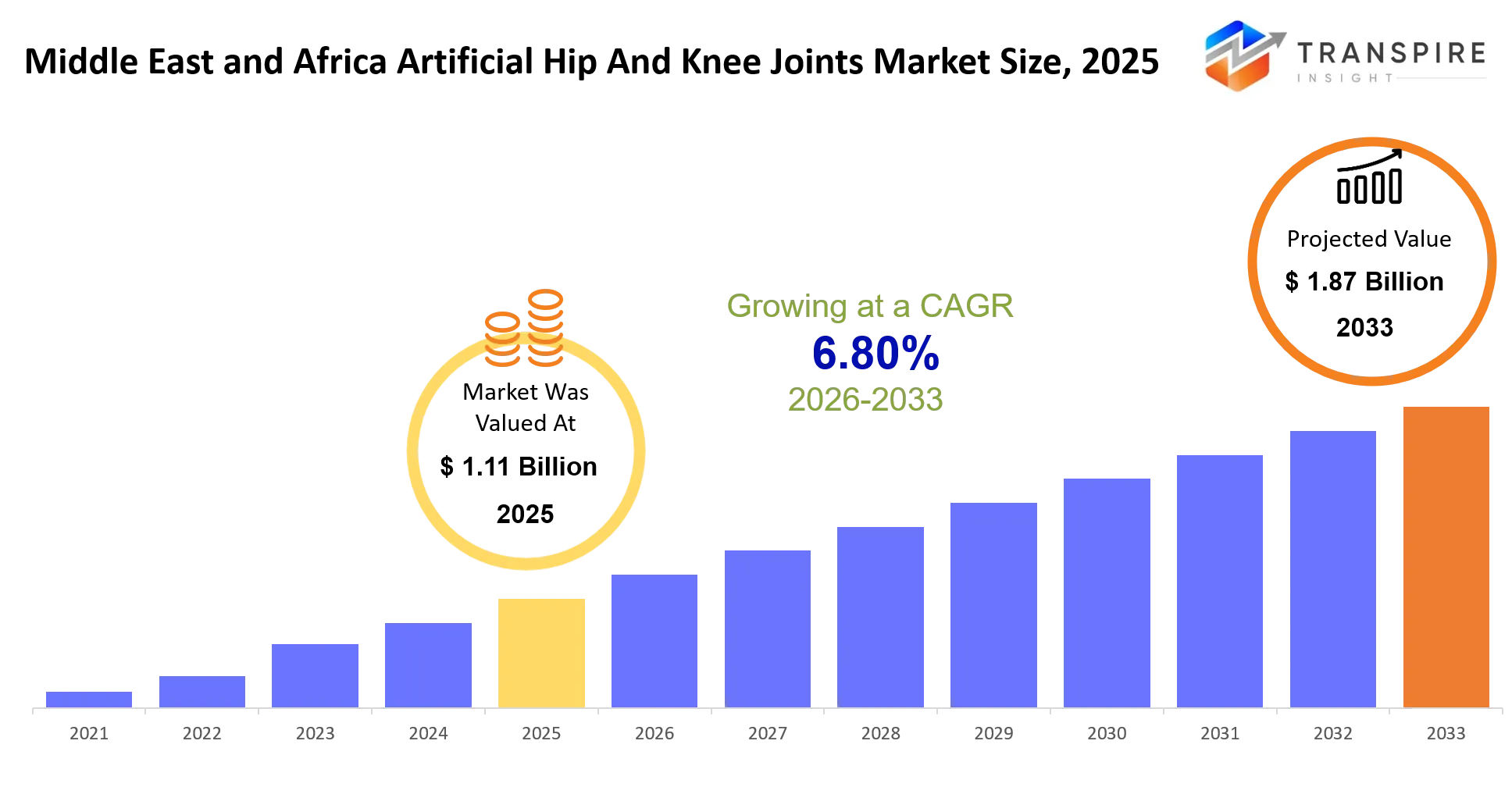
- Middle East and Africa Artificial Hip And Knee Joints Market Size 2025: USD 1.11 Billion
- Middle East and Africa Artificial Hip And Knee Joints Market Size 2033: USD 1.87 Billion
- Middle East and Africa Artificial Hip And Knee Joints Market CAGR: 6.80%
- Middle East and Africa Artificial Hip And Knee Joints Market Segments: By Product Type (Artificial Hip Joints, Artificial Knee Joints, Revision Implants, Partial Joint Replacements, Others); By Material (Titanium, Cobalt-Chromium, Ceramic, Polyethylene, Others); By Fixation Type (Cemented, Cementless, Hybrid, Others); By End User (Hospitals, Orthopedic Clinics, Ambulatory Surgical Centers, Others)
Middle East and Africa Artificial Hip And Knee Joints Market Summary
The Middle East and Africa Artificial Hip And Knee Joints Market was valued at USD 1.11 Billion in 2025. It is forecast to reach USD 1.87 Billion by 2033. That is a CAGR of 6.80%over the period.
Artificial hip and knee joints help patients regain movement when severe arthritis, trauma, or age related joint degeneration starts to really mess things up, by swapping out damaged bone structures with long-lasting orthopedic implants. In the Middle East and Africa, more hospitals are leaning on these implants, partly to cut down long term disability and also to support smoother recovery right after surgery, in particular when orthopedic care is slowly spreading beyond the main urban hubs.
In the past 3–5 years, the market seems to have changed its shape toward cementless, and minimally invasive implant methods. This happened as biomaterials got better, like ceramic and titanium alloys, which can stretch implant lifespan. One major push behind the adoption has been the post pandemic backlog recovery, since surgical departments had to catch up fast, so elective orthopedic procedures were scaled up. Meanwhile, supply chain disruptions changed procurement behavior too, and that encouraged hospitals to look for more suppliers, while also favoring long life implant systems. Put together, these shifts in how procedures are performed plus the backlog driven need, have helped manufacturers get steadier revenue expectations, and at the same time they improve surgical throughput across healthcare systems in the region.
Key Market Insights
- The Middle East and Africa Artificial Hip And Knee Joints Market is showing a real pull forward, with a strong expansion fueled by more orthopedic surgeries and older populations in urban hospitals, kinda simultaneously. Also, hospitals, and I mean the big urban ones, seem to be the main engine.
- Cementless fixation systems still grab close to 52% adoption share in 2025, mainly because patients can regain function quicker and the chance of revision surgery drops.
- Hospitals, meanwhile, hold more than 61% of the overall demand share in the Middle East and Africa, largely due to better surgical infrastructure and more specialized teams.
- In terms of product mix, the artificial knee joints segment sits at around 58% share, driven by osteoarthritis prevalence and high surgical throughput across regional centers.
- For materials, titanium-based implants land at roughly 45% of preference because they offer long term durability, good biocompatibility, and fewer rejection related complications.
- Looking region by region, South Africa is leading with nearly 28% regional share, supported by orthopedic care networks that keep expanding and stronger insurance penetration. T
- he GCC countries are also growing the quickest subregion, with medical tourism inflows rising and private hospital investments increasing, bit by bit.
- Ambulatory surgical centers are becoming more common too, mostly because outpatient joint replacement can be cost efficient and still clinically effective. On the competitive side, Stryker, Zimmer Biomet, and Smith & Nephew collectively take a major chunk, thanks to innovation-led portfolios and ongoing product updates.
- And finally, 2024–2026 modernization programs across hospital infrastructure are basically speeding everything up, so next generation implant systems are getting faster and faster across the region.
What are the Key Drivers, Restraints, and Opportunities in the Middle East and Africa Artificial Hip And Knee Joints Market?
The main push behind the Middle East and Africa Artificial Hip and Knee Joints Market is basically the rising volume of degenerative joint disorders that comes with aging populations, plus the obesity rates that keep climb ing. At the same time, orthopedic specialty hospitals are expanding and elective surgeries are getting easier to access. All that together has helped strengthen procedural capacity. Governments and private healthcare providers also keep widening reimbursement coverage for joint replacement surgeries, which makes it more affordable for patients and speeds up implant adoption. So overall surgical throughput goes up, and demand increases for implant systems that offer longer durability while also supporting quicker rehabilitation results.
Still, there’s a restraint that matters, and it’s kind of uneven orthopedic infrastructure across the region. This is especially noticeable in low income and rural healthcare systems. In those areas, access to specialized surgeons is limited, and implant costs are high, so adoption of advanced joint replacement procedures doesn’t happen as fast. There’s also import dependency for high end implants, which can create pricing pressure and stretch procurement timelines. That slows down treatment accessibility and it reduces how far the market reaches in smaller healthcare facilities where budgets are tighter.
On the opportunity side, medical tourism in Gulf Cooperation Council countries is expanding, and that’s creating momentum. Hospitals there are putting money into robotic assisted orthopedic surgery platforms. This shift supports precision implantation, and it also attracts international patients who want high quality care, but at competitive costs. As hospital networks bring in digital surgical planning alongside advanced biomaterials, manufacturers can tap new revenue streams. Think premium implant systems, and bundled surgical solutions that fit into hospital workflows.
What Has the Impact of Artificial Intelligence Been on the Middle East and Africa Artificial Hip And Knee Joints Market?
Artificial intelligence is reshaping orthopedic implant planning, and surgical precision, particularly across the Middle East and Africa, in the Artificial Hip and Knee Joints Market. By using image-based preoperative planning and patient-specific implant alignment, AI is changing how teams think about accuracy, even down to the alignment decisions.
AI driven diagnostic platforms review CT and MRI scans, then suggest an ideal implant size and positioning, which helps boost surgical accuracy while also lowering revision rates. At the same time many hospitals are starting to integrate AI-assisted navigation during orthopedic procedures, this kind of assist improves intraoperative precision and it can shorten recovery periods.
Beyond that, predictive analytics are being used to anticipate implant wear patterns, and also flag patients who may be at higher risk for postoperative complications. These tools guide surgeons in choosing materials and fixation approaches that can support better long term outcomes. Operationally, AI-enabled hospital management systems streamline operating room scheduling, so orthopedic units see better throughput and less wasted idle time.
Still, adoption isn’t fully widespread because the integration costs can be high, and because structured patient datasets are not consistently available across regional health systems. On top of that, imaging quality can vary a lot between facilities, and smaller hospitals may not have standardized digital infrastructure, which can reduce algorithm accuracy in real-world clinical settings. Even with those hurdles, AI keeps improving decision making efficiency and backs the shift toward more personalized orthopedic care models across the region.
Key Market Trends
- From 2022 to 2025 cementless implant use jumped by about 12% , mostly because orthopedic centers started running quicker recovery pathways, and it sort of helped patients bounce back sooner or so.
- At the same time, titanium-ceramic hybrid implants got more attention as makers kept refining wear resistance, plus the overall longevity performance looked more solid.
- In South Africa, orthopedic surgical capacity went up around 18% in 2024, helped by public-private hospital collaborations , which made scheduling and staffing feel less tight.
- Over in the GCC region, hospitals increased robotic-assisted joint replacement volumes by more than 20% across 2023–2025, and yeah, that pace was noticeable.
- Stryker also pushed its digital navigation systems across Middle East hospitals, and alignment accuracy in the OR improved as surgeons used the tools more regularly.
- Meanwhile, medical tourism into the UAE and Saudi Arabia lifted orthopedic procedure demand by nearly 15% in 2025, not just for one type of case but broadly.
- Revision implant demand increased too , largely tied to more first-generation implant replacement situations showing up in older patient groups.
- Private hospital networks moved toward bundled surgery pricing models, and that made the overall cost feel more manageable, which improved access to procedures.
- Smith & Nephew rolled out improved biomaterial coatings aimed at lowering infection risks, while also extending implant lifespan in day to day clinical use.
- Finally, expanding insurance coverage across urban Africa supported better patient access to elective joint replacement procedures, and that shift helped many people who previously delayed care.
Middle East and Africa Artificial Hip And Knee Joints Market Segmentation
By Product Type
Artificial hip and knee joints are basically the big names when it comes to orthopedic implant demand across surgical centers, mostly pushed by degenerative joint problems and trauma related cases. Artificial knee joints usually see more procedures, because osteoarthritis shows up a lot in aging populations, and well, that kind of prevalence really adds up over time. Revision implants then come in for secondary surgeries, where earlier implants start failing or have to be swapped out, sometimes from wear and sometimes from infection complications, you know.
Partial joint replacements handle early stage degeneration, so the intervention tends to be less invasive, and recovery can be quicker , compared with full replacements. Other implant types also exist, like customized orthopedic solutions for complicated anatomic situations and unusual biomechanics. Hospitals and orthopedic clinics are increasingly using product diversification approaches, basically to tune the options to each patient specific requirements and help increase surgical success rates, in a more consistent way.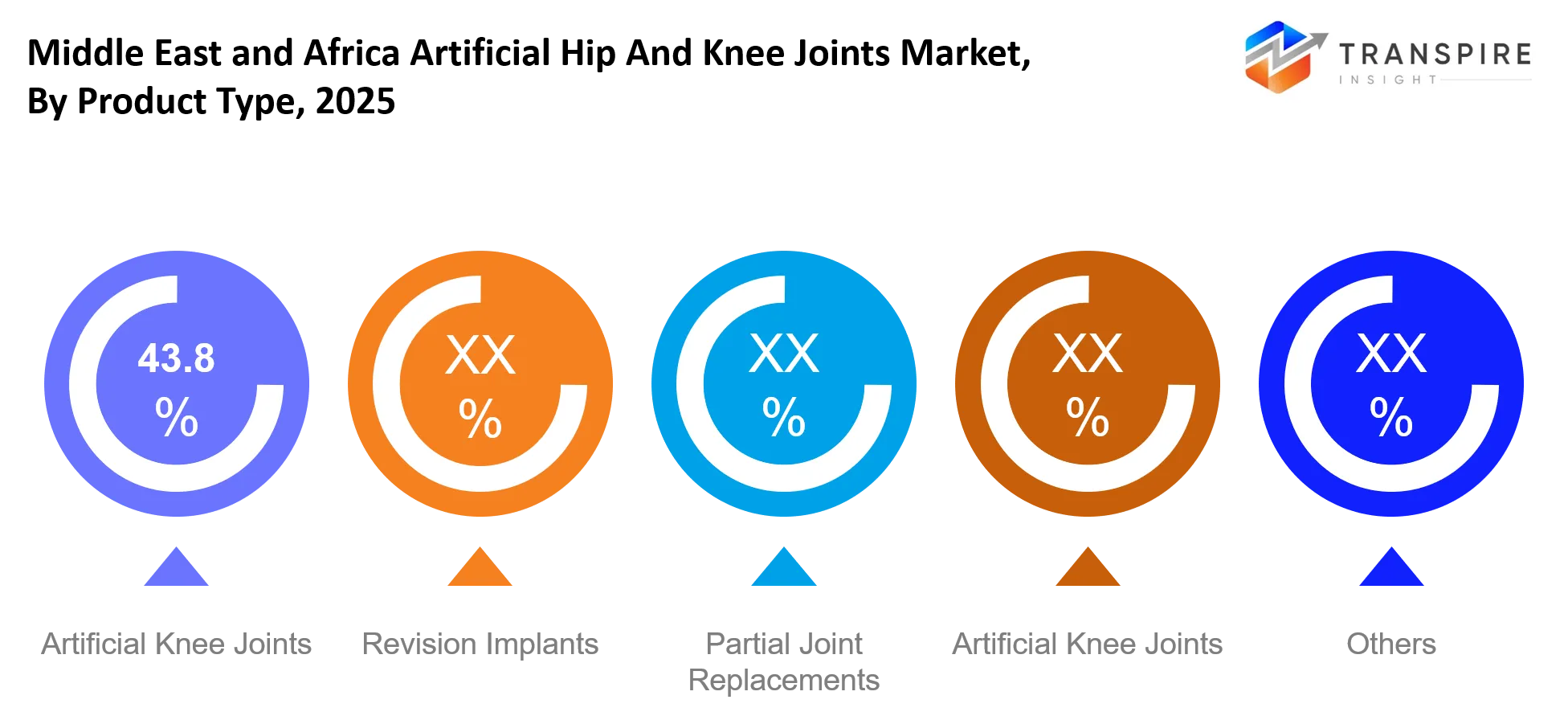
By Material
Titanium tends to take over material usage, mainly because it shows stronger biocompatibility and also long term staying power in load bearing joints. Meanwhile, cobalt chromium alloys tend to bring impressive strength for high stress knee situations. Ceramic materials kind of help too, because they lower friction and wear, so the implant lifetime improves especially for younger patient groups.
Polyethylene parts act like key articulating surfaces, they help the joint move in a smooth way, and they can also reduce inflammation risks. Other newer composite materials are coming up for tailored orthopedic solutions, sort of like custom builds. In general, material selection is guided more and more by patient age, the activity level, and the surgical complexity needs, which changes case by case.
By Fixation Type
Cemented fixation still remains pretty common in elderly patients, especially when they need immediate implant stability and something more predictable with the results. On the other hand cementless systems are being chosen more often these days, mainly because biological bone integration seems to help, plus the long term durability benefits are a big deal. There’s also hybrid fixation , which is basically mixing both approaches, to squeeze out better stability and healing in those more complex situations.
Other options involve advanced porous coatings that help with osseointegration performance. Surgeons are increasingly leaning toward cementless techniques for younger and active patients. Overall, adoption patterns are slowly shifting, toward optimizing long term performance and lowering the chances of revision surgery needs, even if the path isn’t perfectly straightforward.
By End User
Hospitals kind of dominate implant procedures because there’s advanced surgical infrastructure, plus the staff is already there—specialized orthopedic teams and all that. At the same time, orthopedic clinics give more focused attention for elective joint replacement work, and then the follow up treatments too, not just the procedure and then done. Meanwhile ambulatory surgical centers are quietly expanding, partly because the outpatient surgery models tend to be cost-efficient, and also because patient turnover can be a bit faster, which makes scheduling easier.
Other end users, like rehabilitation centers, are also in the mix, mainly for post-surgical recovery support and physiotherapy. Hospitals keep leading though, mostly due to their ability to manage complex cases, and that kind of stuff. On top of that, healthcare investments are growing, so access is getting better across secondary care facilities, slowly but steadily.
What are the Key Use Cases Driving the Middle East and Africa Artificial Hip And Knee Joints Market?
The primary use case is really about total hip and knee replacement surgeries for people with osteoarthritis in hospital settings, where joint degeneration basically makes walking and everyday life much harder. It stays the main demand driver, mainly because there are so many operations and then the patient still needs long term pain management.
Secondary use cases cover trauma related reconstruction procedures inside orthopedic clinics, plus revision surgeries in specialized surgical centers. These situations often show up after sports injuries, road accidents, or when an implant shows wear and needs that more advanced corrective step.
Newer use cases are starting to appear with robotic assisted joint replacement procedures and also with patient specific implant customization, which is enabled by digital imaging technologies. These options are gradually moving into high end hospitals and premium orthopedic facilities, and they tend to help with better surgical accuracy, and in turn, smoother recovery outcomes.
|
Report Metrics |
Details |
|
Market size value in 2025 |
USD 1.11 Billion |
|
Market size value in 2026 |
USD 1.18 Billion |
|
Revenue forecast in 2033 |
USD 1.87 Billion |
|
Growth rate |
CAGR of6.80%from 2026 to 2033 |
|
Base year |
2025 |
|
Historical data |
2021 - 2024 |
|
Forecast period |
2026 - 2033 |
|
Report coverage |
Revenue forecast, competitive landscape, growth factors, and trends |
|
Regional scope |
Middle East and Africa (Saudi Arabia, United Arab Emirates, South Africa, Rest of Middle East and Africa) |
|
Key company profiled |
Zimmer Biomet, Stryker, DePuy Synthes, Smith & Nephew, Exactech, DJO Global, Medacta, MicroPort, Corin Group, B. Braun, Conformis, Arthrex, Aesculap, Kinamed, LimaCorporate |
|
Customization scope |
Free report customization (country, regional & segment scope). Avail customized purchase options to meet your exact research needs. |
|
Report Segmentation |
By Product Type (Artificial Hip Joints, Artificial Knee Joints, Revision Implants, Partial Joint Replacements, Others); By Material (Titanium, Cobalt-Chromium, Ceramic, Polyethylene, Others); By Fixation Type (Cemented, Cementless, Hybrid, Others); By End User (Hospitals, Orthopedic Clinics, Ambulatory Surgical Centers, Others) |
Which Regions are Driving the Middle East and Africa Artificial Hip And Knee Joints Market Growth?
South Africa, kind of leads the Middle East and Africa Artificial Hip and Knee Joints Market because of its pretty advanced orthopedic infrastructure, plus a solid private hospital web, and also insurance coverage systems that are already well established. In practice the country gets a lot of advantage from having many specialized surgeons clustered in key areas and from the continuous spend on medical technologies, which helps keep surgical volumes fairly consistent and speeds up implant adoption.
The Gulf Cooperation Council countries form a stable kind of second region, mainly pushed by high healthcare spending, steady medical tourism arrivals, and the rapid expansion of private healthcare facilities. Still, unlike South Africa, GCC growth feels more linked to premium orthopedic services, and to investments in robotic-assisted surgery, not so much to a wider public healthcare expansion. So revenue tends to stay steady, especially from higher-value procedures.
North and East Africa show up as the fastest-growing area, largely because of recent improvements in healthcare infrastructure, and because governments are putting more emphasis on expanding specialty care. New hospital builds and international collaborations have sped up access to orthopedic surgeries. That ongoing momentum then opens up longer term opportunities for implant manufacturers that want to target emerging healthcare systems, roughly between 2026 and 2033.
Who are the Key Players in the Middle East and Africa Artificial Hip And Knee Joints Market and How Do They Compete?
The Middle East and Africa Artificial Hip and Knee Joints Market is kind of moderately consolidated, and honestly the global orthopedic giants are mostly taking the lead in the high value implant segments. The competition seems to run more on product innovation, surgical precision systems, and biomaterial improvements, not just plain price. Hospitals and surgical centers generally lean toward vendors who bring integrated packages , like implants plus instruments and also digital surgical planning tools, so it feels more like a full workflow rather than “one product”.
Stryker is heavily into robotic assisted knee replacement setups and navigation technologies, these things help surgical accuracy and supposedly lower revision rates. Their main edge is that they tie together implants and a digital surgical ecosystem , kind of like one connected solution.
Zimmer Biomet highlights patient specific implant design and builds solid ties with hospitals across emerging markets, which supports more procedural customization in practice. Smith & Nephew is pushing ahead using advanced surface coating technologies that aim to reduce infection risk while improving overall implant durability. DePuy Synthes leans on broad global distribution channels and ongoing product updates across hip and knee platforms.
Medacta differentiates by focusing on muscle sparing surgical approaches and surgeon training programs, which then translates into better postoperative recovery results. MicroPort keeps expanding by offering cost efficient implant systems and moving deeper into emerging healthcare markets , so they can secure more traction over time.
Company List
- Zimmer Biomet
- Stryker
- DePuy Synthes
- Smith & Nephew
- Exactech
- DJO Global
- Medacta
- MicroPort
- Corin Group
- B. Braun
- Conformis
- Arthrex
- Aesculap
- Kinamed
- LimaCorporate
Recent Development News
In March 2025, Stryker launched the next generation of its Mako SmartRobotics platform and introduced Mako Total Hip with Advanced Primary and Revision capabilities. The launch expanded robotic-assisted hip and knee replacement procedures, supporting greater surgical precision and workflow efficiency for orthopedic providers globally, including Middle East and Africa healthcare systems.https://www.stryker.com
In January 2026, Smith+Nephew announced the acquisition of Integrity Orthopaedics in a transaction valued at up to USD 450 million. The acquisition strengthened Smith+Nephew’s orthopedic portfolio and expanded access to innovative musculoskeletal technologies, enhancing long-term growth opportunities across joint reconstruction markets.https://www.reuters.com
What Strategic Insights Define the Future of the Middle East and Africa Artificial Hip And Knee Joints Market?
The Middle East and Africa Artificial Hip and Knee Joints Market is moving toward premium , technology assisted orthopedic procedures , backed by expanding hospital infrastructure and more and more adoption of minimally invasive surgical techniques. The growth is getting concentrated in urban healthcare hubs, where robotic surgery, advanced biomaterials, and digital preoperative planning are slowly turning into the usual routine.
There is also a quieter risk, not super visible at first, from reliance on imported implants. That dependency creates exposure to currency volatility , plus supply chain disruptions that can postpone elective procedures. For hospitals this turns into procurement uncertainty, and for providers it makes cost predictability hard to pin down.
Meanwhile a solid emerging opportunity sits in localized manufacturing partnerships across GCC countries. Healthcare investment policies there are pushing medical device localization, so early movers can gain leverage. Market players that put money into regional distribution networks, and also support surgeon training ecosystems, will likely improve their long-term position. Firms that bundle AI assisted surgical planning with reliable implant portfolios , should be better placed to capture higher value segments during the 2026–2033 timeframe.
Middle East and Africa Artificial Hip And Knee Joints Market Report Segmentation
-
By Product Type
Artificial Hip Joints
Artificial Knee Joints
Revision Implants
Partial Joint Replacements
Others -
By Material
Titanium
Cobalt-Chromium
Ceramic
Polyethylene
Others -
By Fixation Type
Cemented
Cementless
Hybrid
Others -
By End User
Hospitals
Orthopedic Clinics
Ambulatory Surgical Centers
Others
Frequently Asked Questions
Find quick answers to common questions.
The Expected Middle East and Africa Artificial Hip And Knee Joints Market size for the market will be USD 1.87 Billion in 2033.
Key segments for the Middle East and Africa Artificial Hip And Knee Joints Market are By Product Type (Artificial Hip Joints, Artificial Knee Joints, Revision Implants, Partial Joint Replacements, Others); By Material (Titanium, Cobalt-Chromium, Ceramic, Polyethylene, Others); By Fixation Type (Cemented, Cementless, Hybrid, Others); By End User (Hospitals, Orthopedic Clinics, Ambulatory Surgical Centers, Others)
Major Middle East and Africa Artificial Hip And Knee Joints Market players are Zimmer Biomet, Stryker, DePuy Synthes, Smith & Nephew, Exactech, DJO Global, Medacta, MicroPort, Corin Group, B. Braun, Conformis, Arthrex, Aesculap, Kinamed, LimaCorporate
The Current Middle East and Africa Artificial Hip And Knee Joints Market size is USD 1.11 Billion in 2025.
The Middle East and Africa Artificial Hip And Knee Joints Market CAGR is 6.80% from 2026 to 2033.
- Zimmer Biomet
- Stryker
- DePuy Synthes
- Smith & Nephew
- Exactech
- DJO Global
- Medacta
- MicroPort
- Corin Group
- B. Braun
- Conformis
- Arthrex
- Aesculap
- Kinamed
- LimaCorporate
About the Authors

Pankaj Ghogare Patil
I am Pankaj Ghogare Patil, a Senior Research Analyst at Transpire Insight, specializing in the Pharmaceutical, Chemicals & Materials, Healthcare IT, and Biotechnology industry. My expertise lies in conducting comprehensive market research, analyzing industry trends, evaluating competitive landscapes, and translating complex data into actionable insights. At Transpire Insight, I closely follow emerging technologies, regulatory developments, and market innovations to create accurate, well-researched, and informative content that helps businesses and professionals make informed decisions. I am committed to producing credible, evidence-based articles that reflect industry best practices while making technical topics accessible and valuable for a broad audience.

Chakradhar Khansole
Chakradhar serves as the Research Director at Transpire Insight, bringing over 8 years of experience in technology, innovation, and strategic market intelligence. He specializes in transforming complex market data into actionable business insights that enable organizations to make informed, growth-oriented decisions. Recognized for his strategic vision and analytical expertise, Chakradhar leads high-impact research initiatives, delivering comprehensive market assessments, competitive intelligence, and forward-looking industry analysis.
Recently Published Reports
-
Jul 2026
Alopecia Treatment Market
Alopecia Treatment Market Size, Share & Analysis Report By Disease Type (Alopecia Areata, Cicatricial Alopecia, Traction Alopecia, Alopecia Totalis, Androgenetic Alopecia, Alopecia Universalis, and Other Disease Types), By Treatment Type (Topical Treatments, Oral Medications, Injectable Therapies, and Hair Transplantation), By Gender (Male, and Female), By Distribution Channel (Hospitals and Clinics, Retail Pharmacies, and Online Retailers), and Geography (North America, Europe, Asia-Pacific, Middle East and Africa, South and Central America), 2021 - 2031
-
Jul 2026
Medical Ultrasound Probe Market
Medical Ultrasound Probe Market Size, Share & Analysis Report By Type (Linear Type, Convex Type, Endocavitary Probe, Phased Array/Cardiac Probe, Transesophageal (TEE) Probe, and Others), By Application (Ophthalmology, Cardiology, Musculoskeletal, Oncology, Obstetrics & Gynecology, General Imaging, and Others), By End User (Hospitals & Clinics, Diagnostic Centers, Ambulatory Surgical Centers, and Others), and Geography (North America, Europe, Asia-Pacific, Middle East and Africa, South and Central America), 2021 – 2031
-
May 2026
Biosimilars Market
Biosimilars Market By Product Type (Monoclonal Antibodies, Recombinant Hormones, Erythropoietin, G-CSF, Others), By Indication (Oncology, Autoimmune Diseases, Blood Disorders, Diabetes, Others), By Manufacturing Type (In-House Manufacturing, Contract Manufacturing), By Distribution Channel (Hospital Pharmacies, Retail Pharmacies, Online Pharmacies), By Industry Analysis, Size, Share, Growth, Trends, and Forecasts 2021-2033
-
Apr 2026
Gastrointestinal Endoscopy Market
Gastrointestinal Endoscopy Market By Type (Rigid Gastrointestinal Endoscope, Flexible Gastrointestinal Endoscopes, Disposable Gastrointestinal Endoscope), By Procedure Type (Colonoscopy, Gastroscopy, Duodenoscopy, Enteroscopy, Flexible Sigmoidoscopy, Others), By Application (Diagnosis, Treatment), By End-Users (Hospitals, Ambulatory Surgical Centers, Specialty Clinics, Laboratories, Others), By Industry Analysis, Size, Share, Growth, Trends, and Forecasts 2021-2033