

Middle East and Africa Architectural Engineering And Construction Services Market Size & Forecast:
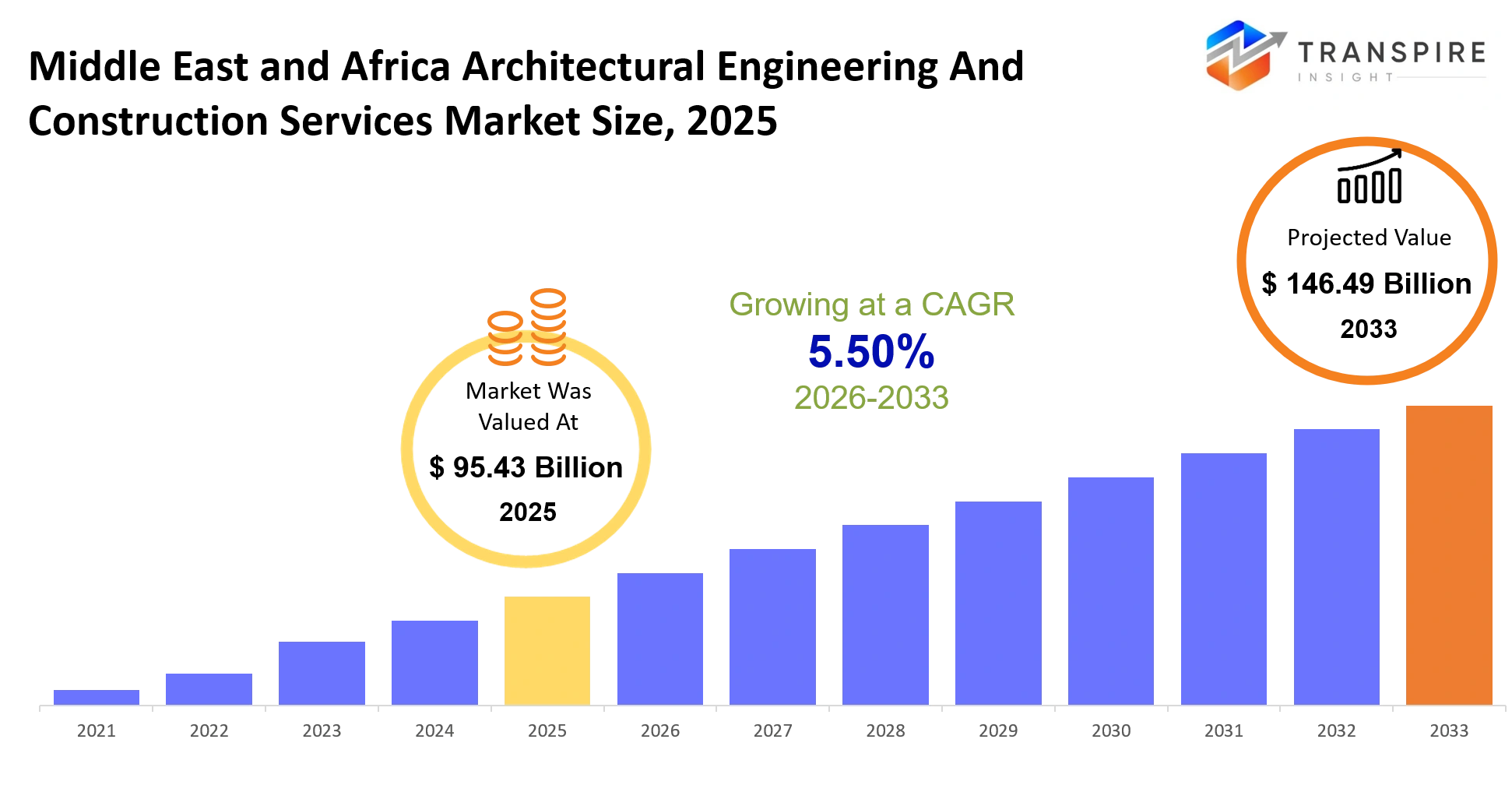
- Middle East and Africa Architectural Engineering And Construction Services Market Size 2025: USD 95.43 Billion
- Middle East and Africa Architectural Engineering And Construction Services Market Size 2033: USD 146.49 Billion
- Middle East and Africa Architectural Engineering And Construction Services Market CAGR: 5.50%
- Middle East and Africa Architectural Engineering And Construction Services Market Segments:By Service Type (Architectural Design, Engineering Services, Construction Management, Project Planning, Others); By Project Type (Residential, Commercial, Industrial, Infrastructure, Others); By Deployment (New Construction, Renovation, Others); By End User (Government, Private Developers, Industrial Clients, Others).
Middle East and Africa Architectural Engineering And Construction Services Market Summary
The Middle East and Africa Architectural Engineering And Construction Services Market was valued at USD 95.43 Billion in 2025. It is forecast to reach USD 146.49 Billion by 2033. That is a CAGR of 5.50%over the period.
The Middle East and Africa Architectural Engineering and Construction (AEC) Services Market kind of sits at the center of how infrastructure ideas turn into something real and operational, like transportation networks and industrial facilities, plus commercial developments, healthcare centers, even smart city plans. In practice, architectural firms, engineering consultants, and construction service providers assist governments and private backers to handle design work, feasibility studies , build execution and lifecycle performance, while also trying to keep cost overruns low and delivery risks from creeping up too much.
In the last five years, the whole space has moved more decisively toward digital project delivery, with Building Information Modeling (BIM), digital twins, and integrated project management platforms becoming more common. One big nudge behind this shift was the push from large national development programs across Gulf economies, especially where diversification strategies redirected attention toward infrastructure spending that goes beyond oil related income. As project portfolios grew larger and more complicated, developers leaned harder on advanced engineering services to sharpen planning accuracy and make resource use more efficient. That change has helped recurring consulting revenue stay steadier, boosted demand for multidisciplinary project management skills, and encouraged long term relationships between public entities and international engineering firms, which in turn keeps the market expanding across the region.
Key Market Insights
- The Middle East and Africa Architectural Engineering And Construction Services Market, kind of benefits from these multi billion dollar infrastructure programs rolling across GCC economies through 2033 , though of course the scale varies.
- Gulf countries make up more than 60% of the regional construction project value, so the Middle East ends up being the big dominant contributor in the area. Also, Building Information Modeling adoption surpassed 70% among major mega-projects in GCC markets by 2025.
- Saudi Arabia is still the largest national market , backed by NEOM, Red Sea Global, and those transport corridor developments that keep stacking up. Meanwhile, commercial and mixed use development services hold close to 35% of total engineering consulting revenue across the region.
- Project management and integrated engineering services, in general, are the fastest growing service category through the forecast period. Healthcare and education infrastructure projects even showed investment growth above 12% each year from 2022 to 2025.
- Then there is the data center side, demand accelerated as cloud investment expanded across the UAE, Saudi Arabia, and South Africa.
- Digital twin deployment also rose among major developers, mainly to chase lifecycle cost reductions and better asset performance. Finally, strategic expansion by AECOM, Jacobs, WSP, AtkinsRealis, Bechtel, and Parsons is basically tightening competition across high value infrastructure programs.
- If you look at the split, the Middle East leads overall revenue with an estimated 68% market share in 2025, driven by broad infrastructure and urban development spending.
- Africa, on the other hand, looks like the fastest-growing region during 2026–2033, with transportation, energy, and industrial corridor investments supporting that momentum.
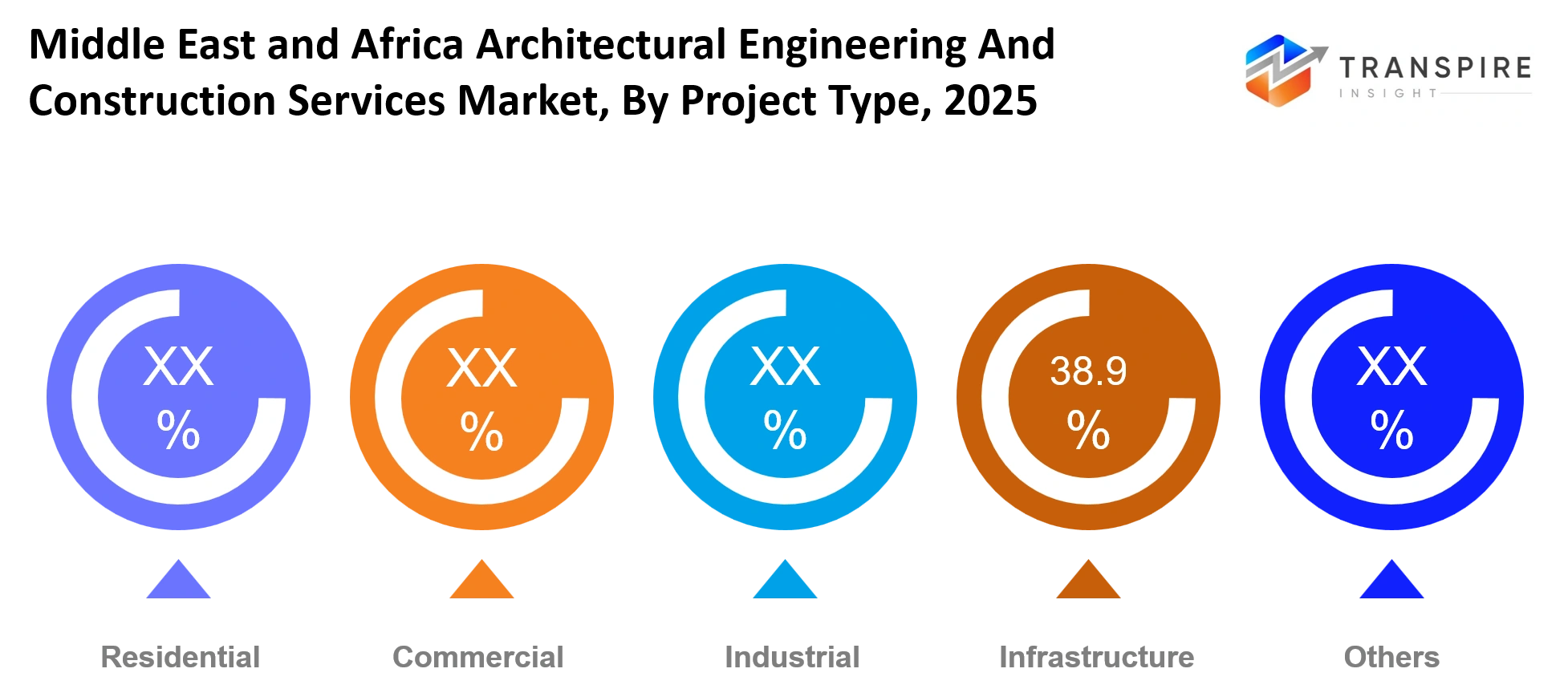
- Infrastructure engineering services themselves lead the market with roughly a 38% share of total service revenues, which is pretty much the main takeaway.
What are the Key Drivers, Restraints, and Opportunities in the Middle East and Africa Architectural Engineering And Construction Services Market?
The strongest growth driver is, well the expansion of national infrastructure diversification programs across Gulf economies. Governments have committed substantial capital to transportation systems, smart cities, renewable energy facilities , industrial zones and tourism developments, basically the whole package. This investment wave has boosted the volume of complex projects that call for advanced architectural design, engineering consulting, project management , and even construction supervision services. As project pipelines expand , engineering firms end up getting longer contract durations and larger service scopes, which directly supports revenue growth, kind of like a steady engine.
The most meaningful restraint still is skilled labor and technical talent shortages. Complex infrastructure programs need experienced architects, engineers, project managers, plus digital construction specialists. Training and growing this workforce takes years , so the issue feels structural rather than just temporary. When talent is short it tends to raise project costs, push execution schedules out, and it also limits the speed at which service providers can scale operations. These constraints reduce project delivery efficiency , and suppress the possible market revenue.
A major opportunity sits in digital engineering ecosystems, especially BIM, digital twins, AI assisted design, and predictive asset management. Governments and developers increasingly prefer lifecycle-focused infrastructure delivery rather than standalone construction. Saudi Arabia, the UAE, and South Africa are pushing ahead with investments in smart infrastructure platforms that stitch together planning, construction, and operations.
What Has the Impact of Artificial Intelligence Been on the Middle East and Africa Architectural Engineering And Construction Services Market?
Artificial intelligence is sort of reshaping architectural engineering and construction services, by making project planning a lot more, uh, efficient and improving design accuracy resource allocation, plus even day to day operational flow. Engineering firms are increasingly leaning on AI-driven design optimization tools, to scan through thousands of design alternatives, and then pick out solutions that kinda balance cost , sustainability, and constructability. On top of that, machine learning algorithms support scheduling optimization too, so project teams can reduce delays and use the workforce more wisely, not just in a rigid way but in a more adaptive one.
Predictive analytics has become especially useful for infrastructure and industrial projects. Basically AI models ingest equipment performance signals, maintenance records, environmental conditions, and construction progress data, then flag likely failures before they actually show up. With that, downtime goes down, asset reliability gets better, and maintenance spending tends to drop. There are also digital twin platforms that are integrated with AI, and those let operators simulate asset behavior and test different operational scenarios prior to real world rollout.
Advanced computer vision systems are improving construction site monitoring as well, with automated inspections, safety compliance tracking, and progress verification. This reduces the need for constant manual oversight while keeping reporting more accurate. A handful of large-scale projects have even reported measurable cuts in rework , and fewer project delays, after AI-assisted monitoring systems were put in place.
Key Market Trends
- BIM utilization went up from around 45% in 2020, to like, above 70% across the biggest GCC projects by 2025. Not just that, digital twins really took off too, since developers chased lifecycle cost reductions, and operational efficiency improvements in a kind of steady way.
- Saudi Arabia has been pushing giga-project development faster and faster, and that made demand for multidisciplinary engineering plus consulting services feel almost unprecedented, honestly.
- Meanwhile infrastructure spending tied to economic diversification programs has run into the hundreds of billions across GCC markets, so yeah it’s been large scale.
- AECOM, AtkinsRealis, Jacobs and WSP also started ramping up investment in AI-driven design and project delivery tools and capabilities, more and more.
- After 2022 sustainability certifications became the norm, kind of a standard requirement for lots of commercial and public-sector developments.
- Data center construction became a notable growth spot too, mainly after the quick cloud infrastructure expansion around the region.
- Project owners then started leaning into integrated delivery contracts, to strengthen accountability and raise schedule certainty, because timing matters.
- On the other side renewable energy facilities created fresh openings for engineering consulting firms across Africa and the Middle East.
- And cross-border partnerships kept growing, as local firms looked for specialized know-how for big, technically complex developments.
Middle East and Africa Architectural Engineering And Construction Services Market Segmentation
By Service Type
Architectural design sort of becomes the base of construction work, because it takes the early development idea and turns it into something workable, and also visually engaging, depending on the needs. Engineering services meanwhile, step in for the technical side, structural, mechanical, electrical, and civil expertise, to make sure the whole thing stays safe, runs efficiently, and still fits the required project specs . Construction management is the one that ties it all together, coordinating resources, timetables , budgets and contractors during the actual execution part, so nothing falls apart midway. In the end, these services create a more organized way of delivering work, across many different sectors , not just one.
When it comes to project planning, it leans hard on feasibility checks , then assigning resources, evaluating risk , and handling scheduling before anything actually starts on site. Good planning tends to cut down delays, keeps costs more controlled , and makes it easier for project stakeholders to coordinate without too much friction. The others category covers additional , specialized consulting , environmental assessment , sustainability advisory , and support services, which collectively help elevate project performance. Growth in complicated infrastructure and ongoing urban development, will keep pushing demand up across the service categories , even as projects get more demanding.
By Project Type
Residential work forms a pretty big chunk of the whole development effort, largely because cities keep stretching outward and the population keeps growing in a bunch of regional markets. On the commercial side you typically see office blocks, shopping precincts, hospitality facilities and also mixed use developments, which really help both business activity and everyday consumer traffic. Industrial projects are more about manufacturing plants, warehouses, processing operations, and logistics centers, all of which feed into broader economic progress. Every one of these categories calls for careful planning , plus engineering and construction know how, to hit the needed performance targets and keep day to day operations running smoothly.
Infrastructure projects are another major investment lane. They cover transport corridors, utilities, power facilities, and public works, so they tend to be broad in scope. When the infrastructure push is large, it usually means lots of coordination between government bodies , consultants, and contractors. The “others” bucket kind of catches the remaining items like institutional facilities, healthcare campuses, educational buildings, and specialized developments that answer a mix of community needs and industry requirements. If investment keeps moving across these segments, it should keep backing up long term market expansion.
By Deployment
New construction is still the biggest deployment category, as governments and private investors keep putting money into residential communities, commercial premises, industrial facilities, and infrastructure assets. A lot of these efforts bring up chances for end to end design, engineering, and project management support, from the early planning stage through the last completion phase. There’s ongoing demand for modern buildings and improved infrastructure, so activity here stays fairly consistent. Because of that, new construction will keep mattering for regional economic aims and overall urban development work.
On the other side, renovation projects are mostly about upgrading what already exists, so functionality, efficiency, safety, and regulatory compliance get better. Refurbishment work can be a more cost effective option than full redevelopment, while also extending the useful life of an asset and raising its day to day operational value. The others slice covers restoration, expansions, retrofitting, and adaptive reuse type projects, which handle shifting user expectations. More and more attention toward asset optimization plus sustainability targets should help these deployment activities keep growing.
By End User
Government entities are a major end-user category, mostly because they keep putting serious capital into transport systems, utilities, health care spaces, education infrastructure, and public development programs. A lot of public sector projects come with long-term planning timeframes, and huge implementation frameworks that are not exactly simple. At the same time private developers really matter too, since they build residential, commercial, hospitality, and mixed-use properties meant to keep pace with shifting market demands. And yeah, both sides end up generating a steady need for professional design, engineering, as well as construction services, in a pretty consistent way.
Industrial clients tend to ask for specialized capabilities for manufacturing sites, processing plants, energy developments, logistics centers, and operational infrastructure. There is often technical complexity, plus strict performance expectations, so it naturally pushes demand toward advanced engineering and project management know-how. Then there’s the “others” category, which covers institutional organizations, non-profit entities, and specialized investors backing particular development efforts, sometimes with unusual requirements. If service providers expand across these different end-user groups, that should open up more opportunities during the whole forecast period.
What are the Key Use Cases Driving the Middle East and Africa Architectural Engineering And Construction Services Market?
Transportation infrastructure is still the biggest use case, especially for highways , rail networks , airports , seaports , and city transit systems. Bigger national development drives really rely on engineering know-how and construction labor to pull projects in on time, and still keep to the planned budget. That’s what drives a lot of the need for consulting support plus project management services, consistently, even when conditions shift.
Industrial facilities and energy infrastructure are also growing, and they keep showing up in new places. Renewable power parks, petrochemical complexes , manufacturing zones , and logistics hubs need specialized engineering design, environmental assessments , and construction supervision. More and more private developers are looking for integrated delivery approaches, because managing complicated investments efficiently is kind of the point, at least from their side.
Newer use cases are starting to show up too, like smart city ecosystems, digital infrastructure programs, and larger data center campuses. Those efforts typically need digital engineering skills, real time asset monitoring frameworks, and sustainability-minded design methods. They’re expected to matter even more as the forecast period moves along, not just at the beginning.
|
Report Metrics |
Details |
|
Market size value in 2025 |
USD 95.43 Billion |
|
Market size value in 2026 |
USD 100.68 Billion |
|
Revenue forecast in 2033 |
USD 146.49 Billion |
|
Growth rate |
CAGR of 5.50% from 2026 to 2033 |
|
Base year |
2025 |
|
Historical data |
2021 - 2024 |
|
Forecast period |
2026 - 2033 |
|
Report coverage |
Revenue forecast, competitive landscape, growth factors, and trends |
|
Regional scope |
Middle East and Africa (Saudi Arabia, United Arab Emirates, South Africa, Rest of Middle East and Africa) |
|
Key company profiled |
AECOM, Jacobs, WSP, Arcadis, Stantec, Fluor, Bechtel, AtkinsRealis, HDR, Gensler, KEO International, Dar Al-Handasah, Hill International, Parsons, Turner Construction. |
|
Customization scope |
Free report customization (country, regional & segment scope). Avail customized purchase options to meet your exact research needs. |
|
Report Segmentation |
By Service Type (Architectural Design, Engineering Services, Construction Management, Project Planning, Others); By Project Type (Residential, Commercial, Industrial, Infrastructure, Others); By Deployment (New Construction, Renovation, Others); By End User (Government, Private Developers, Industrial Clients, Others). |
Which Regions are Driving the Middle East and Africa Architectural Engineering And Construction Services Market Growth?
The Middle East, you know, is still the most dominant regional market overall. Big infrastructure budgets, kind of ambitious economic diversification efforts, and a lot of government backing for urban development projects keep pushing investment forward. You can see steady demand for engineering and construction know-how across transportation networks, tourism hotspots, industrial parks, and those smart city initiatives. On top of that, mature regulatory rules and well-worn project financing channels, really add more weight to the region leadership position
Africa comes next, as the second-largest contributor but it has a slightly different growth rhythm. Here, market expansion seems tied to better transportation links, wider energy access, industrialization actions, and the sheer movement of people into cities. Development finance institutions, public-private collaborations, and multilateral funding initiatives also matter a lot, and they help sustain project pipelines in practice. So in the end, it turns into a fairly stable stream of engineering and advisory work across many countries
Sub-Saharan Africa shows the strongest growth momentum, lately. Investments in renewable energy, logistics corridors, telecommunications infrastructure, and urban development have been lifting project activity across the board. Meanwhile, governments are focusing on modernization programs, to support economic growth, and to raise competitiveness too. Taken together, these changes should open up good opportunities for engineering consultants ,construction managers ,and infrastructure investors over the 2026–2033 timeframe
Who are the Key Players in the Middle East and Africa Architectural Engineering And Construction Services Market and How Do They Compete?
Competition is still kind of moderately fragmented, with global engineering consultancies going head to head with regional specialists, and also with local project management firms. Winning is mostly about having solid technical knowledge, strong digital engineering skills, good relationships in the region and, frankly, the ability to deliver those involved projects in an efficient way. More and more, technology enabled project delivery plus multidisciplinary service offerings are what make the difference between competitors.
AECOM keeps leaning into integrated infrastructure consulting, backed by digital engineering tools and sustainability know how. They also keep broadening advisory services that link planning, design, and asset management. Jacobs, on the other hand, stands out with advanced digital transformation services and lifecycle infrastructure solutions aimed at helping customers boost day to day operational performance.
WSP uses multidisciplinary engineering capabilities across transportation, environmental services, and urban development projects. AtkinsRealis stresses smart city planning, digital twins, and innovation driven urban development strategies. Parsons stays especially positioned in transportation systems, defense infrastructure, and intelligent mobility undertakings. Overall, these companies are continuing to expand via strategic partnerships, continued digital technology investments, and their involvement in major national development programs.
Company List
- AECOM
- Jacobs
- WSP
- Arcadis
- Stantec
- Fluor
- Bechtel
- AtkinsRéalis
- HDR
- Gensler
- KEO International
- Dar Al-Handasah
- Hill International
- Parsons
- Turner Construction
Recent Development News
In May 2026, AtkinsRéalis entered a partnership with Dubai Future Solutions – Prototypes for Humanity. The collaboration aims to accelerate deployment of advanced technologies for urban development and built-environment innovation across the UAE, strengthening digital engineering capabilities in regional construction markets.
Source: https://www.atkinsrealis.com
In February 2026, AECOM released the 20th edition of its Middle East Property & Construction Handbook. The publication highlights infrastructure investment trends, technology adoption, and future opportunities shaping construction activity across the region, reinforcing AECOM's strategic market presence.
Source: https://design-middleeast.com
What Strategic Insights Define the Future of the Middle East and Africa Architectural Engineering And Construction Services Market?
The market is moving toward a digitally connected infrastructure ecosystem where engineering, design, construction, and asset operations kind of blend more and more, via data platforms, AI, BIM, and digital twin technologies. This whole shift is being pushed by project complexity, sustainability requirements ,and the constant push to improve asset performance across operational lifecycles.
There’s also a less obvious risk, where a lot of project activity concentrates inside a limited number of mega-programs or mega-project pipelines. If those developments see delays, policy revisions, or changes in capital allocation, the impact on engineering service revenues can become… a bit disproportionate. Then there is another issue, more competition for specialized talent ,so even when the project pipeline looks strong, execution capacity might get squeezed a fair amount.
At the same time, a major emerging opportunity sits in lifecycle asset intelligence platforms ,because they can unite engineering services with operational analytics. If a company can deliver both infrastructure design and long-term digital asset management, they should be positioned to win recurring revenue streams. So market players should make digital engineering a priority, and also build strategic partnerships that widen access to smart infrastructure programs and sustainable development projects.
Middle East and Africa Architectural Engineering And Construction Services Market Report Segmentation
By Service Type
- Architectural Design
- Engineering Services
- Construction Management
- Project Planning
- Others
By Project Type
- Residential
- Commercial
- Industrial
- Infrastructure
- Others
By Deployment
- New Construction
- Renovation
- Others
By End User
- Government
- Private Developers
- Industrial Clients
- Others
Frequently Asked Questions
Find quick answers to common questions.
The expected Middle East and Africa Architectural Engineering And Construction Services Market size for the market will be USD 146.49 Billion in 2033.
Key segments for the Middle East and Africa Architectural Engineering And Construction Services Market are By Service Type (Architectural Design, Engineering Services, Construction Management, Project Planning, Others); By Project Type (Residential, Commercial, Industrial, Infrastructure, Others); By Deployment (New Construction, Renovation, Others); By End User (Government, Private Developers, Industrial Clients, Others).
Major Middle East and Africa Architectural Engineering And Construction Services Market players are AECOM, Jacobs, WSP, Arcadis, Stantec, Fluor, Bechtel, AtkinsRealis, HDR, Gensler, KEO International, Dar Al-Handasah, Hill International, Parsons, Turner Construction.
The Middle East and Africa Architectural Engineering And Construction Services Market size is USD 95.43 Billion in 2025.
The Middle East and Africa Architectural Engineering And Construction Services Market CAGR is 5.50% from 2026 to 2033.
- AECOM
- Jacobs
- WSP
- Arcadis
- Stantec
- Fluor
- Bechtel
- AtkinsRéalis
- HDR
- Gensler
- KEO International
- Dar Al-Handasah
- Hill International
- Parsons
- Turner Construction
About the Authors

Kartik bhong
I am Kartik Bhong, a Senior Research Analyst at Transpire Insight, specializing in the Packaging, Manufacturing, and Construction industry. My work focuses on analyzing market trends, emerging technologies, industry regulations, and competitive landscapes to deliver accurate, data-driven insights. I am passionate about transforming complex industry information into clear, practical content that helps businesses, professionals, and decision-makers stay informed and make confident strategic decisions. Through continuous research and a strong commitment to accuracy, I strive to create reliable, well-researched content that reflects the latest developments across these dynamic industries and supports the vision of Transpire Insight in delivering valuable market intelligence.

Chakradhar Khansole
Chakradhar serves as the Research Director at Transpire Insight, bringing over 8 years of experience in technology, innovation, and strategic market intelligence. He specializes in transforming complex market data into actionable business insights that enable organizations to make informed, growth-oriented decisions. Recognized for his strategic vision and analytical expertise, Chakradhar leads high-impact research initiatives, delivering comprehensive market assessments, competitive intelligence, and forward-looking industry analysis.
Recently Published Reports
-
Apr 2026
Handling and Lifting Equipment Market
Handling and Lifting Equipment Market Size, Share & Analysis Report By Product (Cranes and Hoists, Forklifts, Conveyor Systems, Aerial Work Platforms, Others), By Application (E-Commerce, Automotive and Railway, Food and Beverages, Aviation, Others), and Geography (North America, Europe, Asia-Pacific, Middle East and Africa, South and Central America), 2021 - 2031
-
Apr 2026
HVAC Equipment Market
HVAC Equipment Market Size, Share & Analysis Report By Heating Equipment Type (Boilers and Furnaces, Heat Pumps, and Unitary Heaters), By Ventilation Equipment (Air Handling Units, Humidifiers and Dehumidifiers, Air Filters, and Fan Coiling Units), By Air Conditioning Equipment (Unitary Air Conditioners, Room Air Conditioners, Packaged Terminal Air Conditioners, and Chillers), By End User (Commercial, Residential, Industrial, and others), and Geography (North America, Europe, Asia-Pacific, Middle East and Africa, South and Central America), 2021 – 2031
-
Apr 2026
Refrigeration Valves Market
Refrigeration Valves Market Size, Share & Analysis Report By Type (Solenoid Valves, Expansion Valves, Check Valves, Service Valves, Others), By Application (Commercial Refrigeration, Industrial Refrigeration, Transport Refrigeration, Residential Refrigeration, Air Conditioning Systems), By End User (Food and Beverage Industry, Pharmaceutical Industry, HVAC Industry, Chemical Industry, Others), and Geography (North America, Europe, Asia-Pacific, Middle East and Africa, South and Central America), 2021 – 2031
-
Apr 2026
E-Commerce Packaging Materials Market
E-Commerce Packaging Materials Market By Material Type (Corrugated Boxes, Paper & Paperboard, Foam & Cushioning Materials, Plastic Packaging, Flexible Packaging, Protective Packaging, Others), By Product(Primary Packaging, Secondary Packaging, Tertiary Packaging), By Packaging Function (Protective Packaging, Branding & Presentation Packaging, Transit & Logistic Packaging, Sustainable Packaging, Tamper Evidence Packaging), By End-User (Retail & Consumer Goods, Electronic Appliances, Food & Beverages, Healthcare & Pharmaceutical, Fashion & Apparel, Home & Furnishing, Others); By Industry Analysis, Size, Share, Growth, Trends, and Forecasts 2021-2033