
Asia Pacific Architectural, Engineering, And Construction Services Market Size & Forecast:
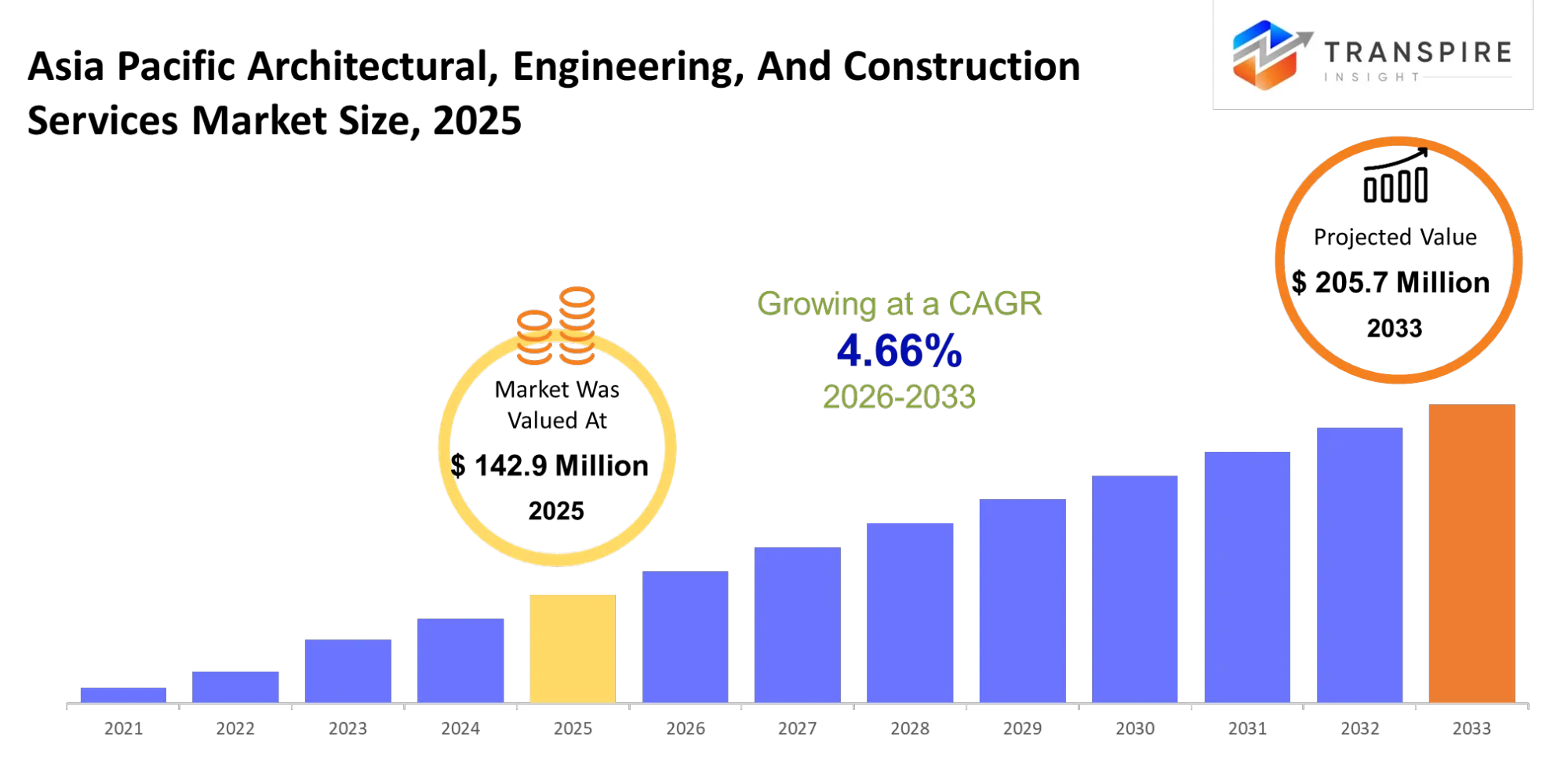
- Asia Pacific Architectural, Engineering, And Construction Services Market Size 2025: USD 142.9 Million
- Asia Pacific Architectural, Engineering, And Construction Services Market Size 2033: USD 205.7 Million
- Asia Pacific Architectural, Engineering, And Construction Services Market CAGR: 4.66%
- Asia Pacific Architectural, Engineering, And Construction Services Market Segments: By Service Type (Architectural Design, Engineering Consulting, Construction Management, Project Management, Interior Design, Urban Planning, Others); By Project Type (Residential, Commercial, Industrial, Infrastructure, Institutional, Mixed-Use, Others); By Deployment (Traditional, BIM-Based, Digital Construction, Others); By End User (Government, Developers, Corporates, Others)
Asia Pacific Architectural, Engineering, And Construction Services Market Summary
The Asia Pacific Architectural, Engineering, And Construction Services Market was valued at USD 142.9 Million in 2025. It is forecast to reach USD 205.7 Million by 2033. That is a CAGR of 4.66% over the period.
The Asia Pacific Architectural, Engineering, and Construction (AEC) Services Market sort of sits right in the middle of how cities, factories, ports, and transport networks are planned , designed and built . But it’s not only about dropping materials in the right place. AEC firms also deal with a tough coordination puzzle, they take investment intentions and turn them into technically workable, regulation friendly, and cost-wise assets, you know . In the last few years there’s been a noticeable structural shift toward digital project delivery, where building information modeling, digital twins, and AI enabled design tools are now basically part of the everyday execution of projects. The COVID-19 pandemic, along with later supply chain disruptions, made this move faster, because developers wanted clearer cost sightlines and easier remote teamwork.
Now, most growth is coming from governments and private investors who are pushing infrastructure resilience, energy-efficient buildings, and industrial modernization. That change is widening the advisory plus engineering service coverage, which means projects get more layered and involved. And as a result, firms are seeing higher-value, longer-term revenue opportunities across the whole region.
Key Market Insights
- East Asia kinda dominates the Asia Pacific Architectural, Engineering, And Construction Services Market, taking in more than 45% share , backed by big infrastructure and urban redevelopment projects that just keep rolling.
- Southeast Asia is the fastest-growing region through the forecast period as transport corridors, industrial parks, and smart city investments ramp up, not slowly either.
- India keeps gaining market share because public infrastructure spending is rising , along with manufacturing expansion and urban housing initiatives that have a lot of momentum.
- Engineering services lead the market with nearly 40% share since the requirements get tricky, like complex infrastructure, transportation systems, and industrial development needs all at once.
- Construction management services show up as the second-largest segment, because owners really lean into cost control and smooth project execution efficiency, basically.
- Digital engineering plus BIM-based consulting are the fastest-growing services through 2032 , as firms shift toward data-driven project delivery and more measurable outcomes.
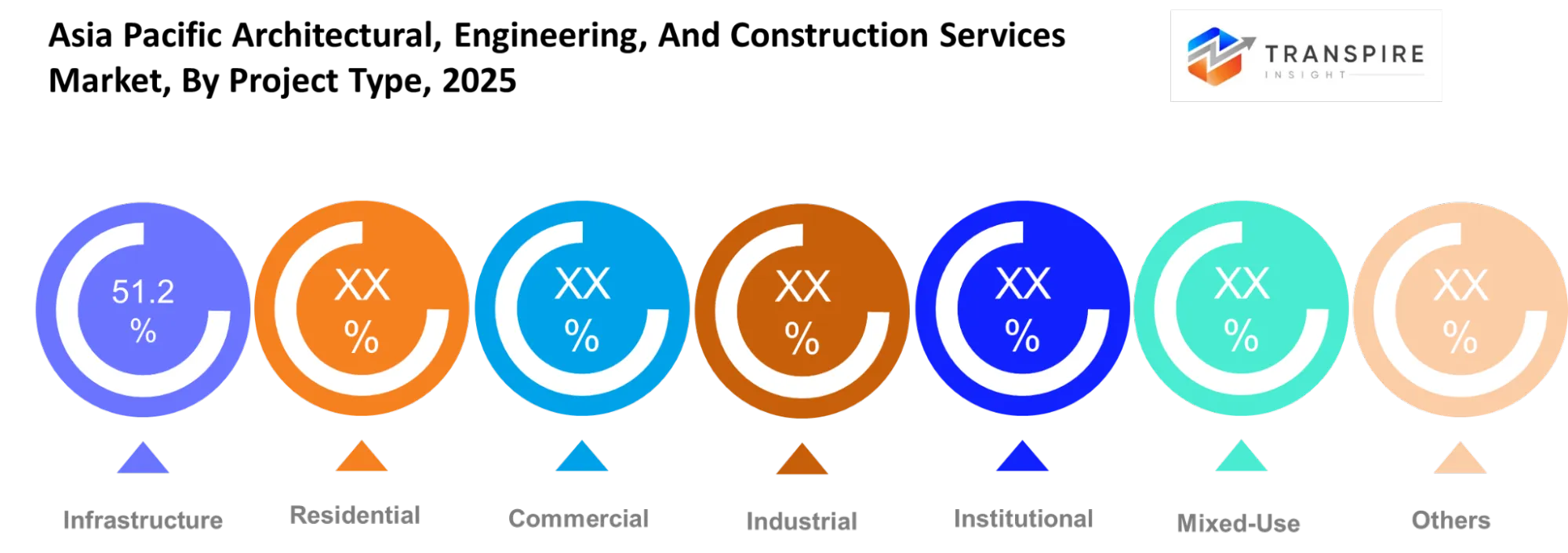
- Infrastructure projects are the main focus, grabbing over 35% share , pushed by rail, highways, airports, ports, and energy investments.
- Industrial and manufacturing facilities are the fastest-growing application segment, since supply chain diversification is reshaping where regional investments go.
- Government and public sector agencies hold the largest share, supported by long-term infrastructure modernization programs, ongoing and planned.
- Private industrial developers are emerging as the fastest-growing end-user group due to factory expansion and logistics investments, more than before.
What are the Key Drivers, Restraints, and Opportunities in the Asia Pacific Architectural, Engineering, And Construction Services Market?
The biggest driver of growth in the Asia Pacific Architectural, Engineering And Construction Services Market are huge amounts of investment into new and existing infrastructure assets in emerging and developed economies. States have re-allocated their investments from general state expenditure to transport networks, renewable power plants, semiconductor factories and urban regeneration plans that seek to increase overall economic resilience and improve industrial competitiveness. This has led to the undertaking of a higher volume of bigger and more complex contracts requiring design consultation, engineering and project management services and sustained demand. This also contributes to higher values of contracts and recurring revenues, forcing service providers to increasingly invest in digital services and to broaden their offering.
The biggest restraint to growth in this market are ongoing shortages of high skilled engineers, architects and digital construction specialists. This constraint is structurally entrenched due to the length of time and training that employees need to reach high competency and therefore suppress revenues by slowing down the pace of contract delivery and increasing overheads for companies who struggle to roll out new technologies to the workforce.
The biggest opportunity in this market comes from the use of digital engineering ecosystems such as building information modeling, digital twins and AI based design applications. Singapore and South Korea are among the leading countries attempting to integrate smart construction throughout their systems thereby giving rise to new contract based revenue opportunities with new service-oriented models such as life cycle management.
What Has the Impact of Artificial Intelligence Been on the Asia Pacific Architectural, Engineering, And Construction Services Market?
AI is transforming the market of Architectural, Engineering, and Construction services in the Asia Pacific region as it automates design processes, enhances project delivery, and improves the management of projects. In this domain, engineering companies leverage AI algorithms for automatic design optimization and for detecting clashes within building information models and for automated decision-making concerning the construction schedule, which used to take large number of hours of review. ML models have already helped engineers to predict equipment breakdown, estimate maintenance activities and identify the potential risks involved in the construction activity in a time-bound manner.
Emerging digital technologies are the other factors driving efficiency on construction sites as well. AI powered computer vision technologies are widely adopted for safety monitoring, material usage verification and productivity bottleneck detection on the site on the fly. Building information models are translated into digital twins for simulating the building behavior, for evaluating the energy usage and for assessing the building's structural response, which enables reduction in project time, cost overruns on rework and building performance in the long run.
But one challenge associated with AI use in the construction industry. Integrating new AI tools with older design software and fragmented data takes huge amount of capital. Lack of uniformity of data across various contractors can also lower down accuracy of the building information models and consequently hinder large scale adoption in the regional construction value chain.
Key Market Trends
- Since 2020, Building Information Modeling has become widespread in the building sector, with government mandates for digital processes being introduced in public works projects by both Singapore and South Korea.
- Developers have switched to integrated design and construction contracts instead of piecemeal procurement contracts, in an attempt to restrict cost and time overruns.
- Design optimization powered by artificial intelligence emerged as a competitive differentiator for 2022 onwards, with leading firms slashing design time for complex projects by 30%.
- Introduction of net-zero building laws in several Asia Pacific regions meant engineering companies were expanding to offer expertise in energy modeling and sustainability consulting.
- Material procurement plans became more resilient, with distributed regional manufacturing sourcing adopted by contractors in 2020-21 to mitigate supply chain disruptions and concentrate manufacturing away from densely populated regions.
- The use of modular and pre-fabricated construction became increasingly popular over the last 5 years as developers sought to expedite completion and better control labor costs.
- Digital twin solutions have been further developed by large firms, including AECOM, Jacobs and WSP, helping clients better monitor asset performance over time.
- Clients redirected their capital toward semiconductor plants, data centers and advanced manufacturing facilities post-2021, resulting in a more technically challenging portfolio of engineering projects.
- Collaboration between international consultants and local firms in the region increased significantly in post-2022 with a view to circumvent existing regulations, and expand their footprint in the region.
- Buyers increasingly analyze contractors on lifecycle value and carbon footprint reduction rather than solely the cheapest initial building costs, the trend over the preceding five years.
Asia Pacific Architectural, Engineering, And Construction Services Market Segmentation
By Service Type:
The areas of Architectural Design relate to plans, building appearance and uses of space in homes, offices and public building developments. Engineering consulting can assist in areas of safety of structure, mechanical systems and environments. Construction management is dealing with the plans, cost and purchasing during construction.
Project management covers the management of the entire building from plan to completion, interior design is the design and planning of interiors, whereas urban planning covers the development of a town and land use planning. Surveying, landscaping and sustainability are also among other services.
By Project Type:
Residential developments include apartment complexes, homes, and villas which is a result of rapid urbanization. Commercial projects include offices, shopping malls, hotels and business centers. Industrial development covers factors such as factories and warehouses.
Infrastructure projects include roads, bridges, airports and railways, which serve as important to any country. Institutional projects cover schools, colleges and hospitals, Mixed use development are the residential, commercial and leisure development; Other types of projects include repair or reconstruction, renovations, and historic architecture work.
By Deployment:
The Traditional Deployment uses traditional methods for design, papers to produce drawings and then subsequent works for each phase. Construction companies are not switching to this deployment method due to familiarity, standardized construction processes and also established operational flows, in most parts of Asia Pacific and developing economies.
BIM-Based Deployment using Building Information Model (BIM) for cooperation in design, visualization, as well as whole lifecycle management of the project. Digital Construction using AI, cloud-based system, drone and digital twin for project monitoring and optimization. Then there is hybrid deployment.
By End User:
The government still is one of the major end-users for the government to develop transportation infrastructure, smart city, public housing as well as public utilities infrastructure. The government has a huge volume for such public sector development and architecture and construction service providers would have many long-term work in Asia Pacific.
Developers also have a big proportion of the end-users by developing houses and buildings. Corporates would invest for offices, plants, warehousing, etc. While higher educational institutes, health services, and non-profitable organizations are other end-users as well.
What are the Key Use Cases Driving the Asia Pacific Architectural, Engineering, And Construction Services Market?
The development of infrastructure still stands out as the largest use case in APEC's AEC services.Governments are making sizable expenditures on highways, rail corridors, airports, ports and energy facilities in efforts to sustain urbanization and the growth of their industries. The scope of large-scale projects, rigorous safety protocols and long project development times translate into steady demand for specialized design and engineering expertise, as well as project management services.
Commercial real estate development and industrial construction are picking up speed as secondary use cases. Developers are increasing the allocation of their capital to the construction of integrated mixed-use developments, data centers and logistics parks, while industrial firms are directing their investments toward semiconductor factories and advanced manufacturing facilities in an effort to bolster regional supply chain capabilities.
Other up and coming use cases comprise smart city infrastructure and net-zero buildings, which incorporate technologies such as digital twins, AI-enabled design and energy management systems. Green hydrogen production facilities and carbon neutral industrial parks similarly have a bright long-term outlook with ever increasing levels of regulatory action being taken regarding environmental concerns across the region.
|
Report Metrics |
Details |
|
Market size value in 2025 |
USD 142.9 Million |
|
Market size value in 2026 |
USD 149.5 Million |
|
Revenue forecast in 2033 |
USD 205.7 Million |
|
Growth rate |
CAGR of 4.66% from 2026 to 2033 |
|
Base year |
2025 |
|
Historical data |
2021 - 2024 |
|
Forecast period |
2026 - 2033 |
|
Report coverage |
Revenue forecast, competitive landscape, growth factors, and trends |
|
Regional scope |
Asia Pacific (India, China, Japan, Australia, South Korea, Rest of Asia Pacific) |
|
Key company profiled |
AECOM, Jacobs, WSP, HDR, Stantec, Tetra Tech, Arup, AtkinsRealis, Turner Construction, Bechtel, L&T, Tata Projects, Samsung C&T, Obayashi, Kajima |
|
Customization scope |
Free report customization (country, regional & segment scope). Avail customized purchase options to meet your exact research needs. |
|
Report Segmentation |
By Service Type (Architectural Design, Engineering Consulting, Construction Management, Project Management, Interior Design, Urban Planning, Others); By Project Type (Residential, Commercial, Industrial, Infrastructure, Institutional, Mixed-Use, Others); By Deployment (Traditional, BIM-Based, Digital Construction, Others); By End User (Government, Developers, Corporates, Others) |
Which Regions are Driving the Asia Pacific Architectural, Engineering, And Construction Services Market Growth?
The East Asia region continues to lead the Asia Pacific Architectural, Engineering, and Construction Services Market due to high government spending, established construction infrastructure, and the prevalent adoption of digitalization. Continued investment by China, Japan, and South Korea in transport infrastructure, smart cities, renewable energy facilities and industrial development projects has helped in driving demand for advanced engineering services. Stringent building codes and an established infrastructure of Building Information Modeling have improved efficiencies and boosted innovation in construction value chains. A well-established network of contractors, technology service providers, materials suppliers, and engineering consultants is what ensures its future market leadership while guaranteeing a constant project flow in the coming years.
Oceania plays a modest role in market growth with predictable investment trends and high adoption rates in the sustainable construction sector. With priorities for energy-efficient buildings, healthcare facilities and transportation infrastructure upgrades, Australia and New Zealand maintain transparent building regulations and practices. Though project volumes are much lower than in the East Asian regions, the standards are considerably high and private sector participation is persistent, ensuring stable market revenues throughout the given prediction years due to stable economic conditions and predictable long-term strategies in the infrastructure segment.
Southeast Asia region emerges as the most rapidly growing region due to accelerated investment in urban transit, industrial parks, and logistics infrastructure by the respective governments. Countries such as Indonesia, Vietnam, and the Philippines have increased their public spending in infrastructure, alongside introducing effective policies that attract foreign investment to their manufacturing and real estate sectors. With urbanization on the rise and a need to diversify supply chains, new opportunities have emerged for engineering consultants, digital construction companies, and project managers, driving market growth. Expansion between the forecast period of 2026 and 2033 is projected to necessitate that new market entrants form local partnerships and establish specialized capabilities catering to regional demands so as to take full advantage of the burgeoning project pipeline.
Who are the Key Players in the Asia Pacific Architectural, Engineering, And Construction Services Market and How Do They Compete?
The competitive environment of the Asia Pacific Architectural, Engineering, And Construction Services market is moderately fragmented. Both global consulting giants as well as engineering groups and local construction specialists, exist within this market environment and the technology penetration will be a key differentiator for each player as consumers want integrated design-related services like digital engineering, sustainability consulting, asset management throughout the lifecycle, etc. Competitive landscape is no longer solely based on the cost but value in terms of speed of project delivery, risk mitigation, and data-informed decision making. While new players are entering into the digital construction space, existing companies are trying to maintain their positions through acquisition and specialized services.
AECOM aims to provide holistic infrastructure solutions with its engineering, environmental consulting, and project management capabilities in one service offering. AECOM's integrated approach in the market focuses on digital delivery and smart infrastructure capabilities. The company has expanded their presence in the Asia Pacific region through strategic partnerships and investment in sustainable technologies and design services. Jacobs is focused on technology-driven engineering, particularly through strong expertise in areas like data centers, advanced manufacturing, and energy transition projects. Jacobs' presence in Asia Pacific has been a key feature, supporting the region's rapid growth in critical sectors.
WSP Global competes on the strength of its multi-disciplinary consulting capabilities, strong expertise in green buildings, transportation, and climate resilient project developments. Arup has been differentiating itself through a strong focus on advanced structural engineering and its digital twin and urban planning capabilities and sustainability expertise. The two companies continue to expand their footprints by undertaking and managing smart city and infrastructure projects by partnering with government bodies and private clients.
Company List
- AECOM
- Jacobs
- WSP
- HDR
- Stantec
- Tetra Tech
- Arup
- AtkinsRealis
- Turner Construction
- Bechtel
- L&T
- Tata Projects
- Samsung C&T
- Obayashi
- Kajima
Recent Development News
In June 2026, AECOM entered a partnership with the Urban Land Institute to launch the Asia Pacific Infrastructure Innovation Index 2026. The initiative provides data-driven benchmarks on infrastructure innovation priorities across the region and is expected to influence investment decisions and digital project delivery strategies in the AEC market.
Source: https://aecom.com/
In January 2026, Jacobs announced acquisition of the remaining stake in PA Consulting for approximately £1.216 billion. The transaction strengthens Jacobs' advisory and digital consulting capabilities, allowing the company to offer more integrated infrastructure, engineering, and technology services across Asia Pacific and other key markets.
Source: https://www.jacobs.com/
What Strategic Insights Define the Future of the Asia Pacific Architectural, Engineering, And Construction Services Market?
The Asia Pacific Architectural, Engineering, And Construction Services Market is moving toward a digitally enabled and sustainability-focused operating model in which design, construction, and asset management will increasingly operate as an integrated service ecosystem. The demand is fueled not only by infrastructure expenditure but by the push to increase productivity within the cost-overrun, labor-shortage, and fragmented industry. Over the next 5–7 years, engineering firms that also offer AI, digital twin and lifecycle advisory services will take a greater proportion of project value.
The less obvious threat is market concentration in terms of a limited talent pool and digital technology provider market. Projects may experience costs escalating faster than expected and a margin squeeze as talent acquisition and retention becomes competitive. The emerging opportunity is net-zero industrial parks in Southeast Asia, especially in Vietnam and Indonesia, which are supported by developing government regulations and the injection of foreign capital. Players would be best positioned if they are able to develop their digital engineering competencies and local partners in anticipation of gaining sustainable competitive advantages.
Asia Pacific Architectural, Engineering, And Construction Services Market Report Segmentation
By Service Type
- Architectural Design
- Engineering Consulting
- Construction Management
- Project Management
- Interior Design
- Urban Planning
By Project Type
- Residential
- Commercial
- Industrial
- Infrastructure
- Institutional
- Mixed-Use
By Deployment
- Traditional
- BIM-Based
- Digital Construction
By End User
- Government
- Developers
- Corporates
Frequently Asked Questions
Find quick answers to common questions.
The Asia Pacific Architectural, Engineering, And Construction Services Market size is USD 205.7 Million in 2033.
Key segments for the Asia Pacific Architectural, Engineering, And Construction Services Market are By Service Type (Architectural Design, Engineering Consulting, Construction Management, Project Management, Interior Design, Urban Planning, Others); By Project Type (Residential, Commercial, Industrial, Infrastructure, Institutional, Mixed-Use, Others); By Deployment (Traditional, BIM-Based, Digital Construction, Others); By End User (Government, Developers, Corporates, Others).
Major Asia Pacific Architectural, Engineering, And Construction Services Market players are AECOM, Jacobs, WSP, HDR, Stantec, Tetra Tech, Arup, AtkinsRealis, Turner Construction, Bechtel, L&T, Tata Projects, Samsung C&T, Obayashi, Kajima.
The Asia Pacific Architectural, Engineering, And Construction Services Market size is USD 142.9 Million in 2025.
The Asia Pacific Architectural, Engineering, And Construction Services Market CAGR is 4.66% from 2026 to 2033.
- AECOM
- Jacobs
- WSP
- HDR
- Stantec
- Tetra Tech
- Arup
- AtkinsRealis
- Turner Construction
- Bechtel
- L&T
- Tata Projects
- Samsung C&T
- Obayashi
- Kajima
About the Authors

Mayur Shinde
I am Mayur Shinde, a Senior Research Analyst at Transpire Insight, specializing in the Automotive & Transportation and Information & Communication Technology (ICT) Industry. My work focuses on analyzing emerging market trends, technological advancements, competitive landscapes, and industry developments to deliver accurate, data-driven insights. I am passionate about transforming complex market information into clear, actionable content that helps businesses, professionals, and decision-makers stay informed and make confident strategic decisions.

Chakradhar Khansole
Chakradhar serves as the Research Director at Transpire Insight, bringing over 8 years of experience in technology, innovation, and strategic market intelligence. He specializes in transforming complex market data into actionable business insights that enable organizations to make informed, growth-oriented decisions. Recognized for his strategic vision and analytical expertise, Chakradhar leads high-impact research initiatives, delivering comprehensive market assessments, competitive intelligence, and forward-looking industry analysis.
Recently Published Reports
-
Apr 2026
3D Optical Profiler Market
3D Optical Profiler Market Size, Share & Analysis Report By Type (Desktop 3D Optical Profiler, and Portable 3D Optical Profiler), By Technology (Confocal Technology, and White Light Interference), By End-Use Industry (Manufacturing, Research Institutions, Automotive, Aerospace and Defense, Medical Devices, and Other), and Geography (North America, Europe, Asia-Pacific, Middle East and Africa, South and Central America), 2021 - 2031
-
Apr 2026
Depth Sensor Market
Depth Sensor Market Size, Share & Analysis Report By Type (Infrared Depth Sensors, Time-of-Flight (ToF) Sensors, Stereo Vision Sensors, Structured Light Sensors, Ultrasonic Depth Sensors), By Application (Automotive, Robotics, Gaming, Consumer Electronics, Industrial Automation, Healthcare, Security & Surveillance, Others), By End Users (Automotive Manufacturers, Consumer Electronics Companies, Healthcare Providers, Industrial Companies, Security Agencies, Gaming Companies, Robotics Companies, Others), and Geography (North America, Europe, Asia-Pacific, Middle East and Africa, South and Central America), 2021 – 2031
-
Apr 2026
Digital Manufacturing Market
Digital Manufacturing Market Size, Share & Analysis Report By Component (Hardware, Software, and Services), By Technology (Robotics, 3D Printing, Internet of Things (IoT), and Others), By Application (Automotive and Transportation, Aerospace and Defense, Consumer Electronics, Industrial Machinery, and Others), By Process Type (Computer-Based Designing, Computer-Based Simulation, Computer 3D Visualization, Analytics, and Others), and Geography (North America, Europe, Asia-Pacific, Middle East and Africa, South and Central America), 2021 – 2031
-
Apr 2026
Digital Visa Services Market
Digital Visa Services Market Size, Share & Analysis Report By Type (Individual Travelers, Group Travelers), By Application (Tourism, Business Travel, Others), and Geography (North America, Europe, Asia-Pacific, Middle East and Africa, South and Central America), 2021 – 2031