
Asia Pacific 3D Printing Construction Market Size & Forecast:
- Asia Pacific 3D Printing Construction Market Size 2025: USD 195.7 Million
- Asia Pacific 3D Printing Construction Market Size 2033: USD 1963.3 Million
- Asia Pacific 3D Printing Construction Market CAGR:33.40%
- Asia Pacific 3D Printing Construction Market Segments: By Material Type (Concrete, Metal, Plastic, Composite Materials, Geopolymer, Others); By Construction Type (Residential Buildings, Commercial Buildings, Infrastructure Projects, Industrial Structures, Others); By Technology (Extrusion-Based Printing, Powder Bonding, Robotic Construction, Others); By End User (Construction Companies, Government Agencies, Developers, Others)
Asia Pacific 3D Printing Construction Market Summary
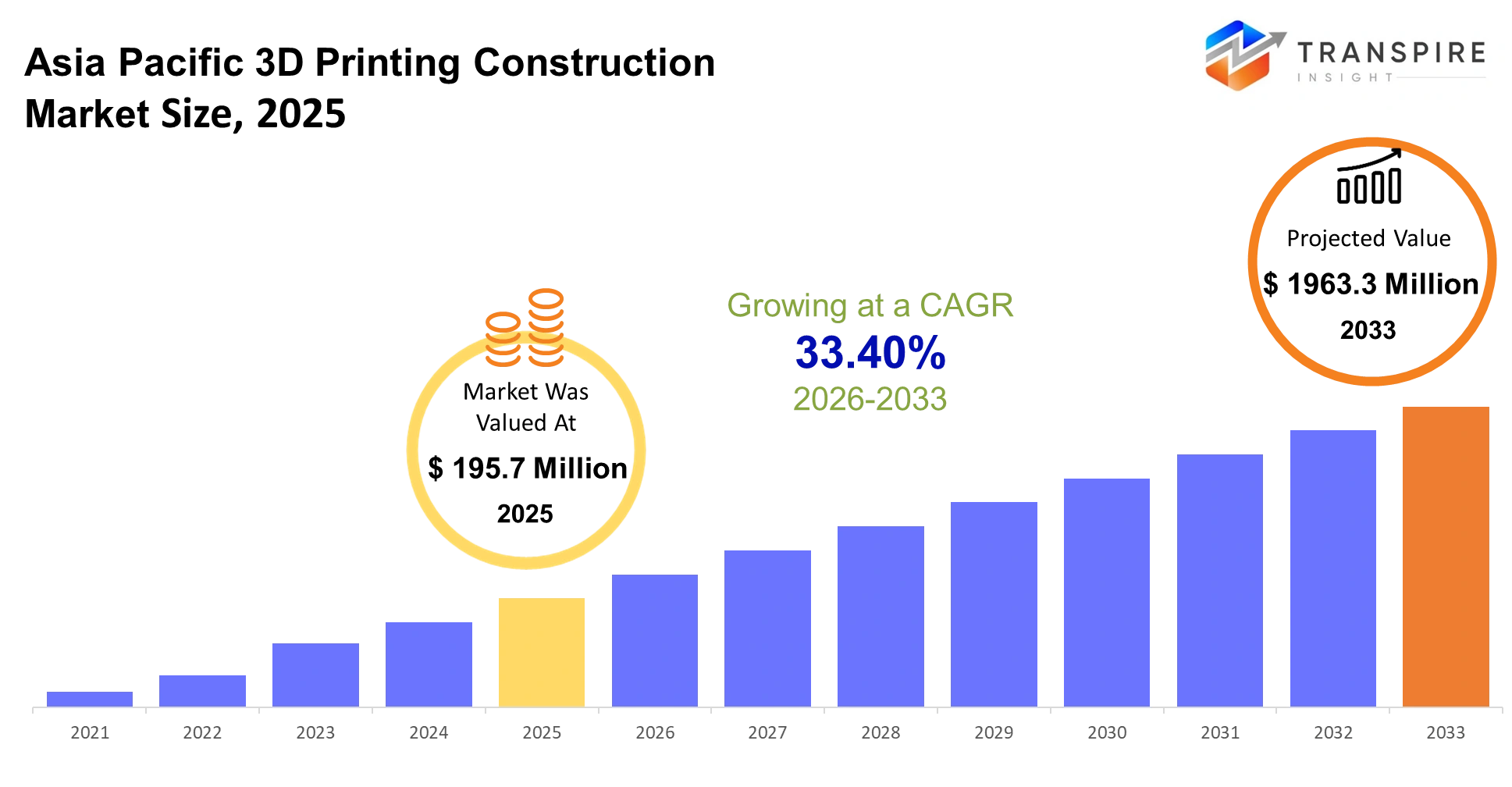
The Asia Pacific 3D Printing Construction Market was valued at USD 195.7 Million in 2025. It is forecast to reach USD 1963.3 Million by 2033. That is a CAGR of 33.40% over the period.
The Asia Pacific 3D Printing Construction Market is about making building parts and complete buildings using special machines that help reduce the need for labor and cut down on wasted materials. This way of doing things helps solve problems like delays in building projects, high labor costs and issues with designs especially when it comes to homes, roads and industrial buildings. The Asia Pacific 3D Printing Construction Market makes it possible to finish projects faster and create custom designs that're hard to make using traditional methods.
In the few years the Asia Pacific 3D Printing Construction Market has seen a big change towards using automated systems and software to build things. Builders have started using the Asia Pacific 3D Printing Construction Market to make walls, bridges and housing units on a scale. One of the reasons for this change was that there were problems with getting materials, which made builders look for new ways to construct buildings. The Asia Pacific 3D Printing Construction Market helps builders make what they need right where they are which reduces the need for materials from places and makes projects go faster. As a result companies are putting money into big machines that can print buildings and special mixtures of concrete that are good for the environment, which is helping the Asia Pacific 3D Printing Construction Market grow steadily in both commercial and residential building projects.
Key Market Insights
- The Asia Pacific 3D Printing Construction Market is moving towards using automated systems that print things on site. This will reduce the need for people to do the work by more than 30 percent in projects that will happen in 2025. The Asia Pacific 3D Printing Construction Market is getting better at this.
- If we look at what's happening in the Asia Pacific 3D Printing Construction Market we can see that people are using more concrete to print things. This makes the things that are printed stronger and lasts longer. It also reduces the amount of waste that is made when we construct things. The Asia Pacific 3D Printing Construction Market is using concrete to print things that're stronger and this is reducing waste by almost 25 percent.
- When we look at what will happen in the future, the Asia Pacific 3D Printing Construction Market will grow the fastest in the area of making houses that're like blocks. This is because many people are moving to cities and we need to build houses and other things. The Asia Pacific 3D Printing Construction Market will keep growing until 2030.
- If we look at the parts of the Asia Pacific 3D Printing Construction Market we can see that big cities have almost 45 percent of the market in 2025. This is because these cities started using this technology. The Asia Pacific 3D Printing Construction Market is doing well in cities.
- Other parts of the Asia Pacific 3D Printing Construction Market are also growing. They are growing by more than 18 percent every year. This is because the government is helping to make houses that people can afford. The Asia Pacific 3D Printing Construction Market is growing in areas.
- The Asia Pacific 3D Printing Construction Market is used the most to build things like roads and bridges. Then it is used to build houses and factories. The Asia Pacific 3D Printing Construction Market is used to build things.
- The Asia Pacific 3D Printing Construction Market is growing the fastest when it is used to build houses. This is because people want to build houses and they want to spend less money. The Asia Pacific 3D Printing Construction Market is helping people to build houses quickly.
- Big companies and construction firms are the ones that use the Asia Pacific 3D Printing Construction Market the most. They are spending money on machines that can print things automatically. The Asia Pacific 3D Printing Construction Market is used by companies.
- Some of the companies in the Asia Pacific 3D Printing Construction Market are COBOD, ICON, Apis Cor, Winsun, CyBe Construction and XtreeE. They are making things and helping the Asia Pacific 3D Printing Construction Market to grow. The Asia Pacific 3D Printing Construction Market has big companies.
- These companies are working with the companies that make the materials to print things. They want to make buildings that're good for the earth. The Asia Pacific 3D Printing Construction Market is getting better because companies are working together.
- The companies in the Asia Pacific 3D Printing Construction Market are also making products. They are making machines that can print things and they are making special concrete that is very strong. The Asia Pacific 3D Printing Construction Market is making things.
- The companies in the Asia Pacific 3D Printing Construction Market are also expanding to areas. They are making cities that are like tests and they are working with the government to make old things new again. The Asia Pacific 3D Printing Construction Market is growing in areas.
What are the Key Drivers, Restraints, and Opportunities in the Asia Pacific 3D Printing Construction Market?
Drivers
The Asia Pacific 3D Printing Construction Market is mainly driven by the move to automated construction methods. This is because these methods can reduce the need for labor and get projects done faster. The Asia Pacific 3D Printing Construction Market is growing because of the cost of construction and the lack of workers for urban infrastructure projects. This is why developers are using 3D printing to build houses and industrial structures. As a result the Asia Pacific 3D Printing Construction Market is making money by using 3D printed walls, housing units and other parts that help build things faster and reduce waste.
Restraints
One thing that is limiting the growth of the Asia Pacific 3D Printing Construction Market is the cost of industrial-grade 3D printing systems and special materials. This is a problem because small and medium-sized construction companies cannot afford to invest in these systems without being sure they will get projects. Also the process of getting approval from regulators for printed parts is not consistent which slows down the use of these systems and reduces the potential for making money. The Asia Pacific 3D Printing Construction Market is affected by this.
Opportunities
There is a chance for the Asia Pacific 3D Printing Construction Market to grow with government programs that make housing affordable using automated construction technologies. Some projects are already using 3D printers to build houses quickly in areas where cities are growing. The Asia Pacific 3D Printing Construction Market can benefit from this because there is a demand for low-cost housing. This means that companies that provide technology for the Asia Pacific 3D Printing Construction Market can get long-term contracts and make their production systems better, for building houses. The Asia Pacific 3D Printing Construction Market is likely to grow because of this.
What Has the Impact of Artificial Intelligence Been on the Asia Pacific 3D Printing Construction Market?
The Asia Pacific 3D Printing Construction Market is really changing because of intelligence and advanced digital technologies. These things are making designs accurate and they are also making the construction process faster and more efficient. Artificial intelligence is helping to design buildings by looking at how weight's distributed, how materials are used and what the environment is like before anything is even printed. This means that less material is wasted and the planning process is shorter so construction companies can start building than they used to.
Machine learning is being used more and more to predict when 3D printing equipment needs to be maintained. It looks for signs of wear and tear on the arms, the parts that squeeze out the material and the systems that deliver the concrete. This helps to prevent breakdowns and allows for maintenance to be scheduled before anything goes wrong. There is also something called twin technology that helps to optimize performance in real time by simulating the layers of the print and checking for any problems with the structure as it is being built. This makes big construction projects more accurate.All of these advancements have made a difference including making construction projects faster by 20 to 30 percent and reducing the cost of materials by finding the best way to print things. However there is still a problem with adopting this technology because it is expensive to set up and there is no standardized training data for complex construction projects. This makes it hard for sized construction companies to use this technology consistently even though it could be really beneficial in the long run. The Asia Pacific 3D Printing Construction Market is still. Artificial intelligence and digital technologies are playing a big role in this growth.
Key Market Trends
- The Asia Pacific 3D Printing Construction Market is changing from testing out 3D printing to using it for big construction projects since 2024.
- Construction companies are using machines less manual labor, which cuts project time by about 25% in 2025.
- Researchers are making stronger concrete for 3D printing, which makes buildings more reliable and allows for taller structures.
- Governments are giving money to test 3D printing for affordable housing, which is helping 3D printing become more popular in city construction projects.
- After supply chain problems in 2023 more people wanted construction, which showed that old building methods were not working well.
- Companies like Winsun and ICON are using 3D printers to build homes and commercial buildings faster.
- In 2025 a new technology called twin started being used which helps monitor if the 3D printing is accurate, in real-time.
- New design tools are helping reduce waste by around 20% making construction projects more sustainable and eco-friendly.
- More mid-sized contractors are using AI-powered printing systems even though they cost a lot to set up and the Asia Pacific 3D Printing Construction Market is growing.
- In addition to these trends, another important development is the increasing collaboration between construction technology firms and material science companies to create low-carbon, high-strength printable cement alternatives, which is helping the market move toward sustainability-focused construction standards while meeting stricter environmental regulations in urban infrastructure projects.
Asia Pacific 3D Printing Construction Market Segmentation
By Material Type:
Concrete is still the material used in the Asia Pacific 3D Printing Construction Market. This is because it is strong, easy to find and works well for structural projects. Construction companies are now using concrete mixes that last longer and dry faster. Some are also using materials for certain structural parts that need to be flexible and light. Geopolymer materials are becoming more popular because they produce carbon and are better for the environment in infrastructure projects.Metal and plastic materials are used for structural parts and reinforcement where precision and light weight are important. More construction companies are using these materials as they try out printing methods. New materials are making printing more stable and reducing waste in projects. This change will keep happening as builders try to balance cost with long-term reliability.
By Construction Type:
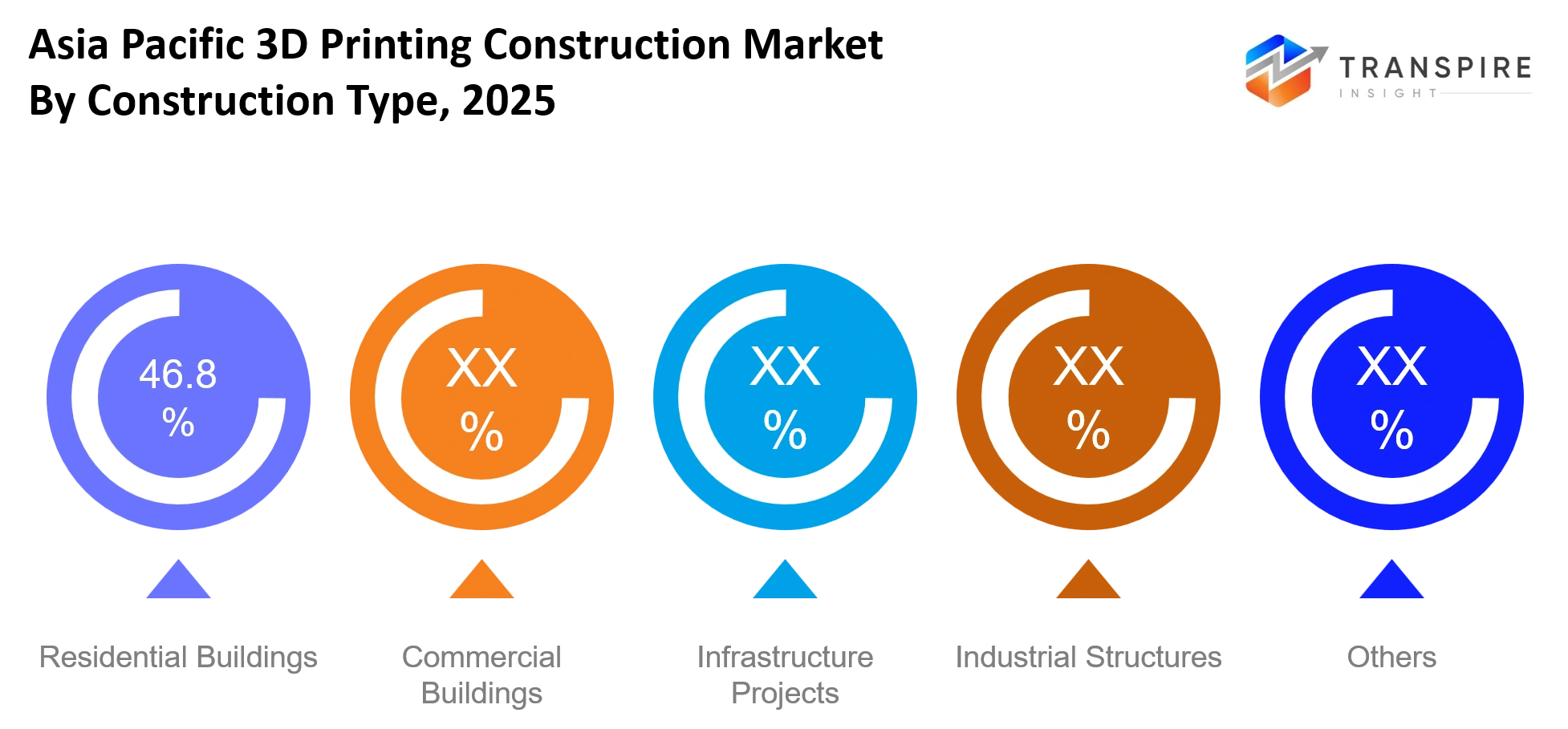
Residential buildings are leading the way in the Asia Pacific 3D Printing Construction Market. This is because there is a demand for fast and affordable housing. Urban development plans include printed housing units to deal with population growth and lack of infrastructure. Commercial buildings are also growing as businesses use construction for offices and retail spaces. Infrastructure projects use 3D printing for bridges, roads and emergency structures.Industrial structures are slowly adopting 3D printing where custom layouts and quick deployment are needed. Construction companies are moving towards automated building methods to reduce delays. Governments are supporting infrastructure printing projects with pilot programs and funding. This trend will continue as construction efficiency becomes a priority in urban planning.
By Technology:
Extrusion-based printing is the popular technology in the Asia Pacific 3D Printing Construction Market. This is because it can make structural components quickly. Robotic construction systems are being used more for building tasks and automated layering. Powder bonding technologies are still new. Show promise for complex designs. These technologies reduce the need for labor and improve accuracy.Technology upgrades have made printing and reduced waste in big infrastructure projects. Robotic systems integrated with design tools have improved precision. Construction companies are adopting hybrid technology systems for scalability and flexibility. Future advancements will focus on speed, cost and structural consistency.
By End User:
Construction companies are the users of 3D printing in the Asia Pacific. This is because of the demand for infrastructure. These companies are adopting automated printing systems to deal with labor shortages and project delays. Government agencies support this adoption through modernization and affordable housing initiatives. Developers focus on project completion to meet urban demand.Other end users include contractors working on industrial and custom projects. More developers are adopting printing because it reduces costs and turnaround times. Government-backed pilot projects are helping to spread awareness of large-scale printing. Market growth will continue as end users shift towards automated and sustainable construction methods.
What are the Key Use Cases Driving the Asia Pacific 3D Printing Construction Market?
The Asia Pacific 3D Printing Construction Market is really big on housing construction. This is because it helps with housing shortages and makes building houses a lot faster. A lot of people are moving to cities and land is getting really expensive so builders are using automated printing to make houses quickly and cheaply. This is a popular way of building houses because it means you need fewer workers and the whole project takes less time.Governments are also starting to use 3D printing to build things like bridges, emergency shelters and parts of roads. Building facilities like warehouses and factories is another area where 3D printing is being used especially when you need to build something quickly. The companies and government agencies that are building these projects are the main ones using 3D printing because they want to get things done fast and cheaply.There are some ways that 3D printing is being used, like building houses for people after a disaster or building in places that are really hard to get to. The military and mining companies are also looking at using 3D printing to make buildings that can be taken apart and moved. These new ways of using 3D printing are really promising especially as the technology gets better at being moved and used on site.
Other people who are using 3D printing include contractors who work on industrial and customized construction projects. More and more developers are using 3D printing because it saves them money and gets the job done faster. The government is also helping to spread the word about how useful 3D printing can be for construction projects. The Asia Pacific 3D Printing Construction Market is going to keep growing, as more people start using automated and sustainable ways of building things. The Asia Pacific 3D Printing Construction Market will see a lot of growth in the future because of this.
|
Report Metrics |
Details |
|
Market size value in 2025 |
USD 195.7 Million |
|
Market size value in 2026 |
USD 261.1 Million |
|
Revenue forecast in 2033 |
USD 1963.3 Million |
|
Growth rate |
CAGR of 33.40% from 2026 to 2033 |
|
Base year |
2025 |
|
Historical data |
2021 - 2024 |
|
Forecast period |
2026 - 2033 |
|
Report coverage |
Revenue forecast, competitive landscape, growth factors, and trends |
|
Regional scope |
Asia Pacific (India, China, Japan, Australia, South Korea, Rest of Asia Pacific) |
|
Key company profiled |
COBOD, ICON, Apis Cor, CyBe Construction, Winsun, XtreeE, Holcim, Heidelberg Materials, Sika, Cemex, PERI, LafargeHolcim, Contour Crafting, Tvasta, L&T Construction |
|
Customization scope |
Free report customization (country, regional & segment scope). Avail customized purchase options to meet your exact research needs. |
|
Report Segmentation |
By Material Type (Concrete, Metal, Plastic, Composite Materials, Geopolymer, Others); By Construction Type (Residential Buildings, Commercial Buildings, Infrastructure Projects, Industrial Structures, Others); By Technology (Extrusion-Based Printing, Powder Bonding, Robotic Construction, Others); By End User (Construction Companies, Government Agencies, Developers, Others) |
Which Regions are Driving the Asia Pacific 3D Printing Construction Market Growth?
East Asia is leading the Printing Construction Market in Asia Pacific because of its strong policies for industrial automation and being one of the first to adopt advanced construction technologies.The region has large infrastructure projects and government smart city initiatives that have helped in the use of additive construction systems.It also has an established manufacturing sector that helps in producing hardware creating new materials and integrating robotics.The collaboration between construction companies and technology providers in East Asia is strong. Continues to maintain its leading position.Southeast Asia is seeing growth in the 3D Printing Construction Market.
This growth is driven by urban development and a rising need for affordable housing.Unlike East Asia Southeast Asia's growth is more about cost efficiency. Finding scalable housing solutions.Governments in Southeast Asia are slowly introducing construction methods through pilot programs and modernizing infrastructure.There is investment in residential and commercial development in the region, which supports steady market participation.South Asia is experiencing the growth in the 3D Printing Construction Market.This is due to increased investment in infrastructure and a high demand for housing in growing cities.Recent advancements in construction technology and government housing initiatives have accelerated market entry in South Asia.There is a shift towards cost and high-speed building methods creating a strong demand for 3D printing systems.This growth indicates opportunities for technology providers especially for large-scale affordable housing and infrastructure projects from 2026, to 2033.
Who are the Key Players in the Asia Pacific 3D Printing Construction Market and How Do They Compete?
The Asia Pacific 3D Printing Construction Market shows a moderately fragmented competitive structure, where a few global technology developers operate alongside many regional construction firms and material suppliers. Competition is driven mainly by technology performance, including printing speed, structural strength, and material efficiency. Companies also compete on project execution capability, especially the ability to scale from pilot projects to full infrastructure deployment. New entrants continue to disrupt traditional construction players by offering faster and more cost-efficient building solutions.
COBOD focuses on large-scale construction printers designed for residential and infrastructure projects, with a strong emphasis on modular system scalability. ICON differentiates through advanced robotic printing systems optimized for rapid housing delivery, enabling faster deployment in urban development projects. Winsun applies specialized concrete printing techniques for customized architectural structures and expands through collaboration with infrastructure developers for large housing projects.CyBe Construction strengthens its position through mobile 3D printing
systems that support on-site flexibility and faster project setup. XtreeE focuses on digital design integration and customized architectural printing solutions, enabling high-precision structural output. These companies expand through partnerships with construction firms, pilot smart city projects, and regional collaborations aimed at scaling industrial adoption of additive construction technologies.
Company List
- COBOD
- ICON
- Apis Cor
- CyBe Construction
- Winsun
- XtreeE
- Holcim
- Heidelberg Materials
- Sika
- Cemex
- PERI
- LafargeHolcim
- Contour Crafting
- Tvasta
- L&T Construction
Recent Development News
- In December 2025, Tvasta Manufacturing Solutions entered a partnership with CEPT University to build a national 3D construction technology platform in India.
The collaboration established an advanced additive manufacturing workshop equipped with robotic concrete printing systems to accelerate research in automated and sustainable construction, strengthening India’s 3D-printed infrastructure ecosystem.https://apacnewsnetwork.com - In September 2025, Indocement Tunggal Prakarsa partnered with Modula3D to introduce 3D construction printing technology in Indonesia.
The joint initiative led to the development of a 3D-printed Collaborative Hub facility at Indocement’s Citeureup plant, demonstrating faster, more sustainable construction methods and signaling industrial-scale adoption of additive building technologies in Southeast Asia.https://www.indocement.co.id - In February 2026, Domoa Private Limited launched a strategic initiative to mainstream 3D-printed real estate across Singapore and Southeast Asia.
The initiative focuses on accelerating commercial adoption of 3D concrete printing in residential development projects, aiming to scale additive construction from pilot projects to mainstream real estate delivery across the region.https://www.mediaboost.press
What Strategic Insights Define the Future of the Asia Pacific 3D Printing Construction Market?
Over the next 5–7 years, the Asia Pacific 3D printing construction market is likely to shift from pilot-driven deployments toward standardized, code-compliant modular construction ecosystems, primarily driven by acute urban housing shortages, rising labor costs, and government-backed smart city infrastructure programs. This transition will gradually reposition 3D printing from a niche engineering solution to a scalable construction method integrated into mainstream procurement frameworks. However, a less visible risk lies in regulatory fragmentation and certification inertia, where inconsistent building codes across APAC countries could slow cross-border scalability even if the technology proves commercially viable. At the same time, an emerging opportunity is forming around hybrid construction models that combine 3D-printed structural cores with prefabricated interiors, particularly in fast-urbanizing secondary cities in India and Southeast Asia. Market participants should prioritize early engagement with municipal regulators and invest in certified material libraries to accelerate approvals, as regulatory alignment will become the primary competitive moat rather than printing speed or hardware capability.
Asia Pacific 3D Printing Construction Market Report Segmentation
By Material Type
- Concrete
- Metal
- Plastic
- Composite Materials
- Geopolymer
- Others
By Construction Type
- Residential Buildings
- Commercial Buildings
- Infrastructure Projects
- Industrial Structures
- Others
By Technology
- Extrusion-Based Printing
- Powder Bonding
- Robotic Construction
- Others
By End User
- Construction Companies
- Government Agencies
- Developers
- Others
Frequently Asked Questions
Find quick answers to common questions.
The expected Asia Pacific 3D Printing Construction Market size for the market will be USD 1963.3 Million in 2033.
Key segments for the Asia Pacific 3D Printing Construction Market are By Material Type (Concrete, Metal, Plastic, Composite Materials, Geopolymer, Others); By Construction Type (Residential Buildings, Commercial Buildings, Infrastructure Projects, Industrial Structures, Others); By Technology (Extrusion-Based Printing, Powder Bonding, Robotic Construction, Others); By End User (Construction Companies, Government Agencies, Developers, Others).
Major Asia Pacific 3D Printing Construction Market players are COBOD, ICON, Apis Cor, CyBe Construction, Winsun, XtreeE, Holcim, Heidelberg Materials, Sika, Cemex, PERI, LafargeHolcim, Contour Crafting, Tvasta, L&T Construction.
The Asia Pacific 3D Printing Construction Market size is USD 195.7 Million in 2025.
The Asia Pacific 3D Printing Construction Market CAGR is 33.40% from 2026 to 2033.
- COBOD
- ICON
- Apis Cor
- CyBe Construction
- Winsun
- XtreeE
- Holcim
- Heidelberg Materials
- Sika
- Cemex
- PERI
- LafargeHolcim
- Contour Crafting
- Tvasta
- L&T Construction
About the Authors

Kartik bhong
I am Kartik Bhong, a Senior Research Analyst at Transpire Insight, specializing in the Packaging, Manufacturing, and Construction industry. My work focuses on analyzing market trends, emerging technologies, industry regulations, and competitive landscapes to deliver accurate, data-driven insights. I am passionate about transforming complex industry information into clear, practical content that helps businesses, professionals, and decision-makers stay informed and make confident strategic decisions. Through continuous research and a strong commitment to accuracy, I strive to create reliable, well-researched content that reflects the latest developments across these dynamic industries and supports the vision of Transpire Insight in delivering valuable market intelligence.

Chakradhar Khansole
Chakradhar serves as the Research Director at Transpire Insight, bringing over 8 years of experience in technology, innovation, and strategic market intelligence. He specializes in transforming complex market data into actionable business insights that enable organizations to make informed, growth-oriented decisions. Recognized for his strategic vision and analytical expertise, Chakradhar leads high-impact research initiatives, delivering comprehensive market assessments, competitive intelligence, and forward-looking industry analysis.
Recently Published Reports
-
Apr 2026
Handling and Lifting Equipment Market
Handling and Lifting Equipment Market Size, Share & Analysis Report By Product (Cranes and Hoists, Forklifts, Conveyor Systems, Aerial Work Platforms, Others), By Application (E-Commerce, Automotive and Railway, Food and Beverages, Aviation, Others), and Geography (North America, Europe, Asia-Pacific, Middle East and Africa, South and Central America), 2021 - 2031
-
Apr 2026
HVAC Equipment Market
HVAC Equipment Market Size, Share & Analysis Report By Heating Equipment Type (Boilers and Furnaces, Heat Pumps, and Unitary Heaters), By Ventilation Equipment (Air Handling Units, Humidifiers and Dehumidifiers, Air Filters, and Fan Coiling Units), By Air Conditioning Equipment (Unitary Air Conditioners, Room Air Conditioners, Packaged Terminal Air Conditioners, and Chillers), By End User (Commercial, Residential, Industrial, and others), and Geography (North America, Europe, Asia-Pacific, Middle East and Africa, South and Central America), 2021 – 2031
-
Apr 2026
Refrigeration Valves Market
Refrigeration Valves Market Size, Share & Analysis Report By Type (Solenoid Valves, Expansion Valves, Check Valves, Service Valves, Others), By Application (Commercial Refrigeration, Industrial Refrigeration, Transport Refrigeration, Residential Refrigeration, Air Conditioning Systems), By End User (Food and Beverage Industry, Pharmaceutical Industry, HVAC Industry, Chemical Industry, Others), and Geography (North America, Europe, Asia-Pacific, Middle East and Africa, South and Central America), 2021 – 2031
-
Apr 2026
E-Commerce Packaging Materials Market
E-Commerce Packaging Materials Market By Material Type (Corrugated Boxes, Paper & Paperboard, Foam & Cushioning Materials, Plastic Packaging, Flexible Packaging, Protective Packaging, Others), By Product(Primary Packaging, Secondary Packaging, Tertiary Packaging), By Packaging Function (Protective Packaging, Branding & Presentation Packaging, Transit & Logistic Packaging, Sustainable Packaging, Tamper Evidence Packaging), By End-User (Retail & Consumer Goods, Electronic Appliances, Food & Beverages, Healthcare & Pharmaceutical, Fashion & Apparel, Home & Furnishing, Others); By Industry Analysis, Size, Share, Growth, Trends, and Forecasts 2021-2033