

Japan Soft Robotics Market Size & Forecast:
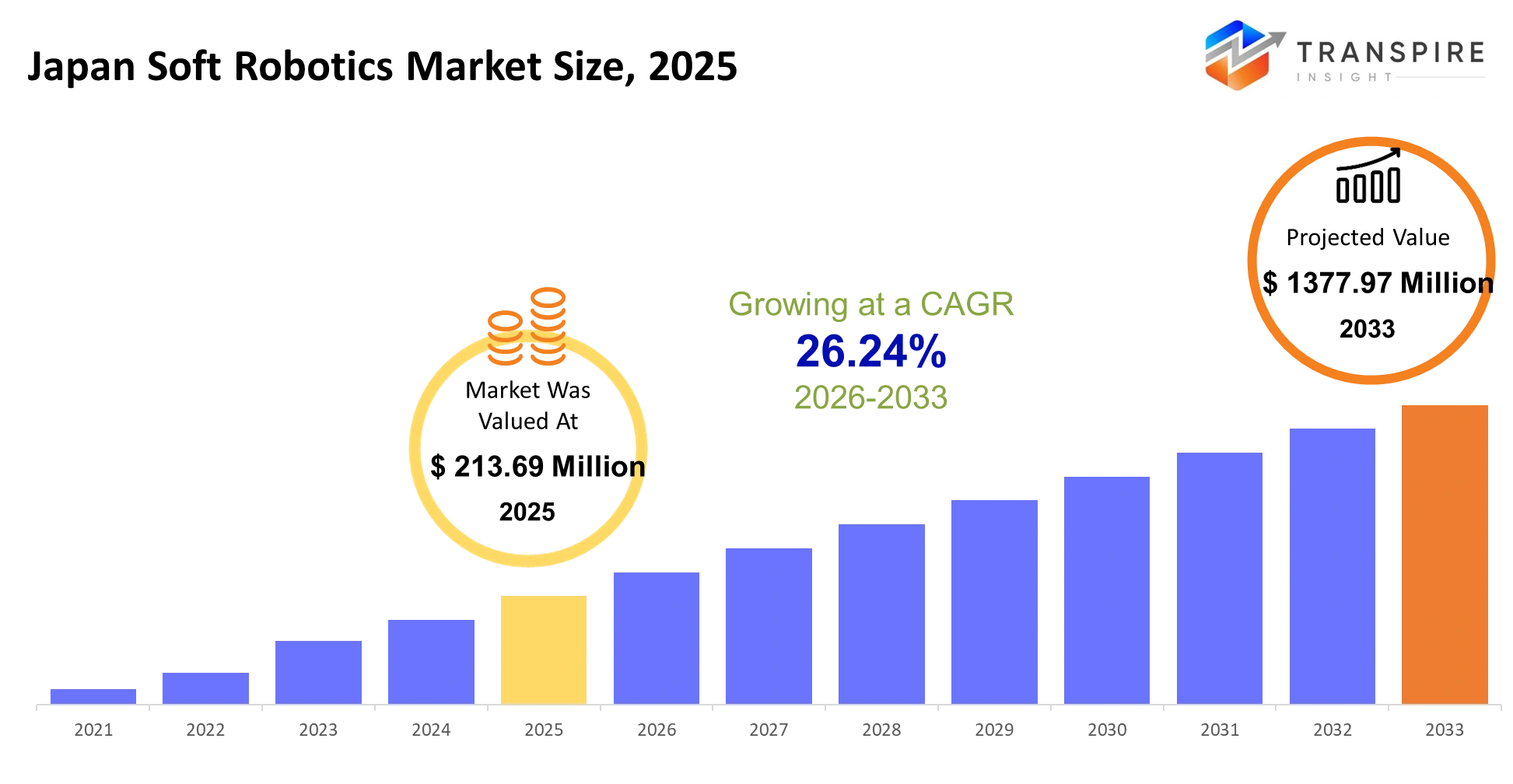
- Japan Soft Robotics Market Size 2025: USD 213.69 Million
- Japan Soft Robotics Market Size 2033: USD 1377.97 Million
- Japan Soft Robotics Market CAGR: 26.24%
- Japan Soft Robotics Market Segments: By Type (Grippers, Actuators, Wearable Robots, Others); By Application (Industrial Automation, Healthcare, Food Processing, Logistics, Agriculture, Others); By End-User (Manufacturing, Healthcare Providers, Food Industry, Logistics Companies, Research Institutes, Others); By Technology (Pneumatic, Hydraulic, Electric, Others)
To learn more about this report,  Download Free Sample Report
Japan Soft Robotics Market Summary
The Japan Soft Robotics Market was valued at USD 213.69 Million in 2025. It is forecast to reach USD 1377.97 Million by 2033. That is a CAGR of 26.24% over the period.
Japan uses soft robotics systems in industrial operations to perform delicate work in food processing and electronics assembly and underwater inspection because standard automation cannot handle delicate and uneven materials. The systems help aquaculture operations and subsea maintenance activities in maritime and coastal areas because they increase safety and operational accuracy inside narrow working spaces. The market has transitioned during the past three years from using complex mechanical systems which require operators to control operations to systems which use AI-based tactile feedback together with sensor-equipped flexible materials.
Japan experiences severe labor shortages because its workforce grows older and COVID-related disruptions affected supply chains, which forces manufacturing and logistics companies to accelerate their technology adoption efforts. Product damage reduction through human-friendly automation systems became the main goal for companies that faced these operational pressures. Robotics vendors now achieve greater revenue visibility through their technology deployments which extend from large manufacturers to mid-sized companies that need to automate their operations.
Key Market Insights
- The Kanto region controls almost 38% of the Japan Soft Robotics Market because its manufacturing and robotics research and development facilities create multiple industrial zones.
- The Coastal industrial zones demonstrate increasing implementation of maritime inspection systems and aquaculture automation technologies.
- In 2025, grippers and soft manipulators will hold 41% market share because they receive widespread use in assembly processes.
- The soft robotic sensors market segment stands as the second largest segment which customers use in precision control systems and tactile feedback systems.
- The market for AI-integrated soft robotic systems represents the most rapidly expanding sector which experts predict will continue to grow until 2030.
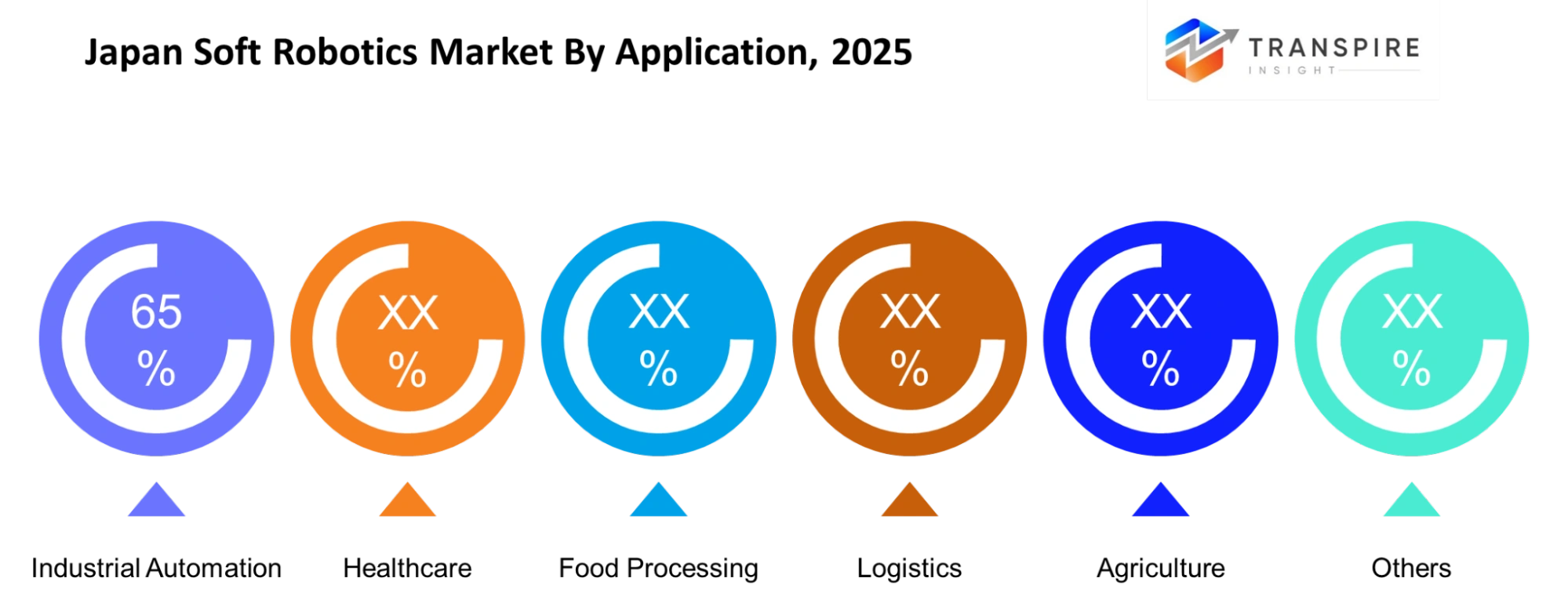
- Industrial automation controls almost 45% of the Japan Soft Robotics Market which mainly serves the electronics and automotive manufacturing sectors.
- Healthcare robotics becomes the most rapidly expanding field of application because the need for rehabilitation and surgical support rises.
- Maritime inspection applications are becoming more popular for both underwater maintenance tasks and offshore infrastructure monitoring activities.
- The manufacturing sector holds the largest market share with 48% since businesses use automation to improve their operational efficiency.
- The healthcare and life sciences sector shows the highest growth rate among end-user categories because Japan's aging population requires medical services.
What are the Key Drivers, Restraints, and Opportunities in the Japan Soft Robotics Market?
Japané labor shortages and an aging workforce which lead to automation development create the primary economic growth driver for the country. The manufacturing sector needs to use soft robotics because this technology allows safe human interaction while it handles delicate electronic and automotive assembly parts. The trigger escalated because the pandemic production shutdowns showed businesses need to depend less on their manual workforce. The development of AI-powered soft robotic systems enables companies to enhance their production capacity while decreasing their business risks which lets them implement these systems throughout their mid-sized manufacturing plants and increase their equipment-based revenue streams.
The industrial sector faces its main challenge because soft robotics systems require high technical expertise which makes it hard to connect with current industrial automation solutions. Many factories still rely on legacy rigid robotic infrastructure that is not easily compatible with compliant, sensor-driven systems. The process needs a long time because it requires both system changes and employee retraining programs. The structural nature of this limitation prevents large-scale usage while it stops manufacturers from making short-term profits because cost-sensitive manufacturers need to postpone their equipment upgrades until they reach permanent efficiency improvements.
Japan's offshore infrastructure and aquaculture industry offer substantial future growth potential through underwater and maritime automation development. The market for subaquatic inspection and marine handling through AI-powered soft grippers has grown because pilot tests at coastal industrial centers support this technology development.
What Has the Impact of Artificial Intelligence Been on the Japan Soft Robotics Market?
The Japan Soft Robotics Market experiences substantial transformation through artificial intelligence which enhances robotic systems that operate in manufacturing and maritime environments through improved sensing and adaptive capabilities and their ability to perform intricate physical operations. The industrial sector employs AI-powered vision systems together with machine learning frameworks to enhance the efficiency of soft robotic systems that execute gripping and assembly tasks which require them to handle different object shapes and fragile items with enhanced accuracy and reduced operational faults. The production process in electronics and automotive facilities has reached greater stability because even tiny error reductions result in actual cost savings and increased production capacity.
AI enables scrubber performance systems and exhaust gas cleaning technology to automate their monitoring and control functions through its ability to process real-time sensor data for operational parameter adjustments. The maintenance forecasting process uses predictive models to detect early wear signs in compliant robotic actuators which enables organizations to minimize unexpected downtime. The systems have achieved operational uptime improvements which resulted in better fuel efficiency optimization for marine emission control platforms that operate as integrated systems.
The inability to obtain high-quality real-world training data creates a significant constraint because underwater environments and areas with high humidity present challenges for soft robotics training. The capacity of sea-bound operations to maintain model updates decreases because of connectivity limitations which leads to reduced predictive algorithm accuracy and delays in full-scale AI implementation throughout the Japan Soft Robotics Market.
Key Market Trends
- Since 2022, manufacturers shifted from rigid industrial robots toward soft robotics due to severe labor shortages and aging workforce pressure.
- Since 2023, AI vision systems became essential components of electronics assembly lines, which enhanced their ability to identify defects and decreased their need for rework.
- After 2023, mid-sized Japanese factories began to implement soft robotics technology, which ended the previous period when only large automotive and electronics companies controlled the market.
- From 2024, maritime and aquaculture pilots expanded along Japan’s coastal regions using soft robotic grippers for underwater inspection tasks.
- Machine learning-based predictive maintenance systems reduced unexpected robotic downtime across manufacturing plants between 2023 and 2025 deployments.
- Japan’s robotics supply chain gradually localized post-2022 disruptions, which resulted in decreased reliance on imported actuator and sensor components.
- The safety regulations which were updated in 2024 enabled greater human-robot collaboration between workers and robots which accelerated the adoption of soft robotics technology in industrial spaces.
- The three companies FANUC Yaskawa Electric and Mitsubishi Electric boosted their development of AI-based soft grippers which created more competition for Japan's robotics industry in 2025.
Japan Soft Robotics Market Segmentation
By Type :
The field of soft robotics in Japan emerges through various systems which enable robots to move flexibly while they protect their complete safety during human interaction. Industries such as food and electronics rely on grippers to handle delicate products because they require operators to use light pressure which will not cause any damage. Actuators enable soft robotic systems to achieve both flexible movement and precise motion control.
Healthcare and support services have started to adopt wearable robots as their new technology. Users of these devices receive assistance with their lifting and walking activities while they engage in physical recovery tasks, which helps to minimize bodily strain. The category of hybrid soft robotic tools includes other types of robotic systems which industrial and research centers use to fulfill their operational needs according to safety standards.
By Application :
The field of industrial automation employs soft robotics technology to enhance both operational safety and task accuracy throughout repetitive work procedures. Soft robotic systems enable operators to handle fragile materials while they protect machines from damage and safeguard workers against injuries. The healthcare industry utilizes these systems to deliver rehabilitation services and patient support while they operate surgical support equipment with precision movements.
Food processing operations use soft robotic grippers to handle soft or irregular food items which need protection from damage. The logistics sector uses automated systems to handle sorting and packing operations while they ensure safe handling of goods that have different shapes. The agriculture field uses soft robotic systems to harvest crops that need careful handling. Research laboratories and experimental systems use flexible robotic design testing functions for their operational purposes.
To learn more about this report, Download Free Sample Report
By End-User :
Manufacturing industries utilize soft robotics to enhance both production safety and operational efficiency when they handle delicate materials. The systems operators use three systems to decrease their manual work while they keep product standards intact. Healthcare providers use soft robotics to develop patient care systems and rehabilitation devices and movement assistive solutions which enhance recovery results.
Soft robotic systems enable food industry personnel to safely handle and sort and package their perishable products. The systems help logistics companies by enhancing their warehouse functions and decreasing product damage during operations. Research institutes work on creating advanced soft robotic technologies while they test new materials and enhance existing technologies for future commercial applications.
By Technology :
Soft robotics technologies depend on pneumatic systems and hydraulic systems and electric systems and various hybrid systems which enable robots to move and adjust their operations. The technologies allow soft robotic systems to operate at multiple force levels while maintaining accurate control and adaptable movement capabilities which enable them to work safely in areas where conventional robots find operational challenges.
The industry will continue to use pneumatic systems because they offer both straightforward design and adaptive movement capabilities. Hydraulic systems will support higher force applications, while electric-based systems will gain adoption for precision tasks and energy efficiency. Hybrid technologies will experience ongoing development which will enhance their ability to achieve performance results through improved safety and capacity to respond to operational demands.
What are the Key Use Cases Driving the Japan Soft Robotics Market?
The Japan Soft Robotics Market exists because industrial automation in electronics and automotive manufacturing serves as its main application. Soft robotic grippers and compliant manipulators enable manufacturers to protect delicate components because they need to operate accurately during fast-paced assembly work. The existing demand exists because factories need to switch their repeated manual operations to robotic systems which can work together with human staff members who operate factory equipment.
New healthcare and logistics systems develop because of increasing operational requirements. Japanese hospitals use soft robotic systems for rehabilitation devices and minimally invasive support systems because the country's aging population and rising patient care requirements create greater demand for medical services. Warehouse operators in logistics use flexible robotic picking systems to handle various product shapes while they boost order fulfillment efficiency especially during e-commerce distribution operations.
The maritime inspection and aquaculture industries are developing new use cases. Coastal operators use soft robotic systems to test underwater infrastructure monitoring and delicate marine handling tasks which rigid robots cannot perform. The offshore energy sector and fishery automation will see continued growth throughout the projected period because equipment needs to meet environmental standards and operational safety requirements.
|
Report Metrics |
Details |
|
Market size value in 2025 |
USD 213.69 Million |
|
Market size value in 2026 |
USD 269.76 Million |
|
Revenue forecast in 2033 |
USD 1377.97 Million |
|
Growth rate |
CAGR of 26.24% from 2026 to 2033 |
|
Base year |
2025 |
|
Historical data |
2021 - 2024 |
|
Forecast period |
2026 - 2033 |
|
Report coverage |
Revenue forecast, competitive landscape, growth factors, and trends |
|
Country scope |
Japan |
|
Key company profiled |
Festo, Soft Robotics Inc, ABB, KUKA, FANUC, Yaskawa, Universal Robots, Boston Dynamics, Shadow Robot, RightHand Robotics, Piab, OnRobot, SCHUNK, SMC Corporation, Zimmer Group |
|
Customization scope |
Free report customization (country, regional & segment scope). Avail customized purchase options to meet your exact research needs. |
|
Report Segmentation |
By Type (Grippers, Actuators, Wearable Robots, Others); By Application (Industrial Automation, Healthcare, Food Processing, Logistics, Agriculture, Others); By End-User (Manufacturing, Healthcare Providers, Food Industry, Logistics Companies, Research Institutes, Others); By Technology (Pneumatic, Hydraulic, Electric, Others) |
Which Regions are Driving the Japan Soft Robotics Market Growth?
Kanto leads the Japan Soft Robotics Market because of its dense arrangement of advanced manufacturing facilities and robotics research and development centers. The Tokyo metropolitan area together with its adjacent prefectures contains numerous electronics and automotive and precision engineering companies which utilize soft robotic systems for their high-accuracy assembly operations. The combination of strong industry support from government entities and national automation and robotics programs enables organizations to enhance their technological capabilities through ongoing development activities. The region achieves advantages through its established supply networks and assessment centers which support rapid market entry of AI-powered robotic solutions.
Kansai functions as a reliable second foundation which depends on its broad industrial sector that includes chemical and machinery and automotive component manufacturing. The R&D-focused environment of Kanto contrasts with Kansai's capability to maintain industrial activities through continuous investment in manufacturing facilities by companies that operate between small and large sizes. The businesses which operate in Osaka and Hyogo prefectures prefer to implement their automation upgrades through incremental improvements instead of using complete system replacements. The manufacturing sector requires soft robotics which operates at steady demand because production facilities need to sustain their operations throughout all periods while maintaining budget efficiency.
Kyushu has become the fastest expanding area because of recent investments in semiconductor manufacturing and port modernization projects. The advanced fabrication facilities have been attracted to government-supported industrial relocation programs because these facilities need flexible automation systems. The demand for adaptive robotic technologies has increased because of the expansion of coastal logistics infrastructure and offshore engineering activities. The newly constructed facilities in Kyushu provide market entrants and investors with a high-growth corridor which offers long-term integration opportunities until 2033.
Who are the Key Players in the Japan Soft Robotics Market and How Do They Compete?
The Japan Soft Robotics Market shows a market structure which allows existing robotics companies to dominate most market share while new businesses create unique market disruptions through their specialized products. The existing market players are protecting their market position through soft robotics development which they combine with artificial intelligence control systems and their current industrial automation systems. Competition between companies depends primarily on their ability to deliver accurate results together with system interoperability and their commitment to providing enduring maintenance services. Companies that implement soft robotic systems into their production processes without causing operational interruptions will experience increased use of their technology in factories that serve electronics and automotive and maritime industries.
FANUC develops comprehensive factory systems that depend on its CNC expertise and AI-powered robotic arms and soft gripping solutions to enhance high-volume electronics manufacturing processes. Yaskawa Electric sets itself apart in the market by providing advanced motion control systems and servo systems that enhance soft robotic technology used in automotive assembly operations. Mitsubishi Electric uses its complete factory automation systems and edge AI technology for semiconductor manufacturing to establish enduring business relationships with customers. ABB develops its business operations through the creation of sophisticated robotic grippers and international industrial collaborations which enhance its ability to operate globally. Kawasaki Heavy Industries develops specialized robotic systems for inspection purposes that operate in dangerous work environments and maritime settings. Soft Robotics Inc expands its market presence through its specialized soft gripper technologies and its licensing agreements with Japanese manufacturers which focus on food handling and flexible material handling solutions.
Company List
- Festo
- Soft Robotics Inc
- ABB
- KUKA
- FANUC
- Yaskawa
- Universal Robots
- Boston Dynamics
- Shadow Robot
- RightHand Robotics
- Piab
- OnRobot
- SCHUNK
- SMC Corporation
- Zimmer Group
Recent Development News
In April 2026, SoftBank Group announced the formation of Roze AI and outlined plans for a major robotics-focused IPO. The venture integrates AI and robotics to automate physical infrastructure such as data center construction, signaling a significant push into advanced robotics ecosystems in Japan. Source https://www.wsj.com/
In April 2026, SoftBank Corp., NEC Corp., Sony Group Corp., and Honda Motor Co. announced the formation of a joint venture “Nihon AI Foundation Model Development.” This initiative focuses on building a sovereign AI system designed to power advanced robotics and physical AI applications, including robots operating in industrial and service environments, strengthening Japan’s domestic robotics intelligence ecosystem.Source https://api.finexus.net/
What Strategic Insights Define the Future of the Japan Soft Robotics Market?
The Japan Soft Robotics Market is developing toward automated systems which use artificial intelligence to create complete operational networks that include soft robotics as an essential component of their intelligent manufacturing and industrial service systems. This shift occurs because companies face ongoing workforce shortages while needing to develop safe robotic systems for delicate work in the electronics and healthcare and advanced logistics industries. The creation of value will shift during the next five to seven years because organizations will need to rely more on software intelligence and system interoperability than on their existing hardware systems.
Organizations that rely too much on proprietary control systems will encounter hidden dangers because these systems restrict their ability to operate with different platforms. The mid-tier manufacturers will experience adoption delays because they need systems that can work with different types of automated operations.
The development of soft robotics for offshore maintenance and subsea infrastructure servicing creates new business opportunities as Japan increases its investment in coastal energy and maritime resilience projects. Companies that partner with maritime engineering contractors and port automation systems will achieve first-mover benefits. The open-architecture platforms should be used by market participants because they provide industrial system integration capabilities that allow business operations to expand without creating long-term implementation challenges.
Japan Soft Robotics Market Report Segmentation
By Type
- Grippers
- Actuators
- Wearable Robots
By Application
- Industrial Automation
- Healthcare
- Food Processing
- Logistics
- Agriculture
By End-User
- Manufacturing
- Healthcare Providers
- Food Industry
- Logistics Companies
- Research Institutes
By Technology
- Pneumatic
- Hydraulic
- Electric
Frequently Asked Questions
Find quick answers to common questions.
The Japan Soft Robotics Market size is USD 1377.97 Million in 2033.
Key segments for the Japan Soft Robotics Market are By Type (Grippers, Actuators, Wearable Robots, Others); By Application (Industrial Automation, Healthcare, Food Processing, Logistics, Agriculture, Others); By End-User (Manufacturing, Healthcare Providers, Food Industry, Logistics Companies, Research Institutes, Others); By Technology (Pneumatic, Hydraulic, Electric, Others).
Major Japan Soft Robotics Market players are Festo, Soft Robotics Inc, ABB, KUKA, FANUC, Yaskawa, Universal Robots, Boston Dynamics, Shadow Robot, RightHand Robotics, Piab, OnRobot, SCHUNK, SMC Corporation, Zimmer Group.
The Japan Soft Robotics Market size is USD 213.69 Million in 2025.
The Japan Soft Robotics Market CAGR is 26.24% from 2026 to 2033.
- Festo
- Soft Robotics Inc
- ABB
- KUKA
- FANUC
- Yaskawa
- Universal Robots
- Boston Dynamics
- Shadow Robot
- RightHand Robotics
- Piab
- OnRobot
- SCHUNK
- SMC Corporation
- Zimmer Group
Recently Published Reports
-
Apr 2026
3D Optical Profiler Market
3D Optical Profiler Market Size, Share & Analysis Report By Type (Desktop 3D Optical Profiler, and Portable 3D Optical Profiler), By Technology (Confocal Technology, and White Light Interference), By End-Use Industry (Manufacturing, Research Institutions, Automotive, Aerospace and Defense, Medical Devices, and Other), and Geography (North America, Europe, Asia-Pacific, Middle East and Africa, South and Central America), 2021 - 2031
-
Apr 2026
Depth Sensor Market
Depth Sensor Market Size, Share & Analysis Report By Type (Infrared Depth Sensors, Time-of-Flight (ToF) Sensors, Stereo Vision Sensors, Structured Light Sensors, Ultrasonic Depth Sensors), By Application (Automotive, Robotics, Gaming, Consumer Electronics, Industrial Automation, Healthcare, Security & Surveillance, Others), By End Users (Automotive Manufacturers, Consumer Electronics Companies, Healthcare Providers, Industrial Companies, Security Agencies, Gaming Companies, Robotics Companies, Others), and Geography (North America, Europe, Asia-Pacific, Middle East and Africa, South and Central America), 2021 – 2031
-
Apr 2026
Digital Manufacturing Market
Digital Manufacturing Market Size, Share & Analysis Report By Component (Hardware, Software, and Services), By Technology (Robotics, 3D Printing, Internet of Things (IoT), and Others), By Application (Automotive and Transportation, Aerospace and Defense, Consumer Electronics, Industrial Machinery, and Others), By Process Type (Computer-Based Designing, Computer-Based Simulation, Computer 3D Visualization, Analytics, and Others), and Geography (North America, Europe, Asia-Pacific, Middle East and Africa, South and Central America), 2021 – 2031
-
Apr 2026
Digital Visa Services Market
Digital Visa Services Market Size, Share & Analysis Report By Type (Individual Travelers, Group Travelers), By Application (Tourism, Business Travel, Others), and Geography (North America, Europe, Asia-Pacific, Middle East and Africa, South and Central America), 2021 – 2031