

France Service Robotics Market Size & Forecast:
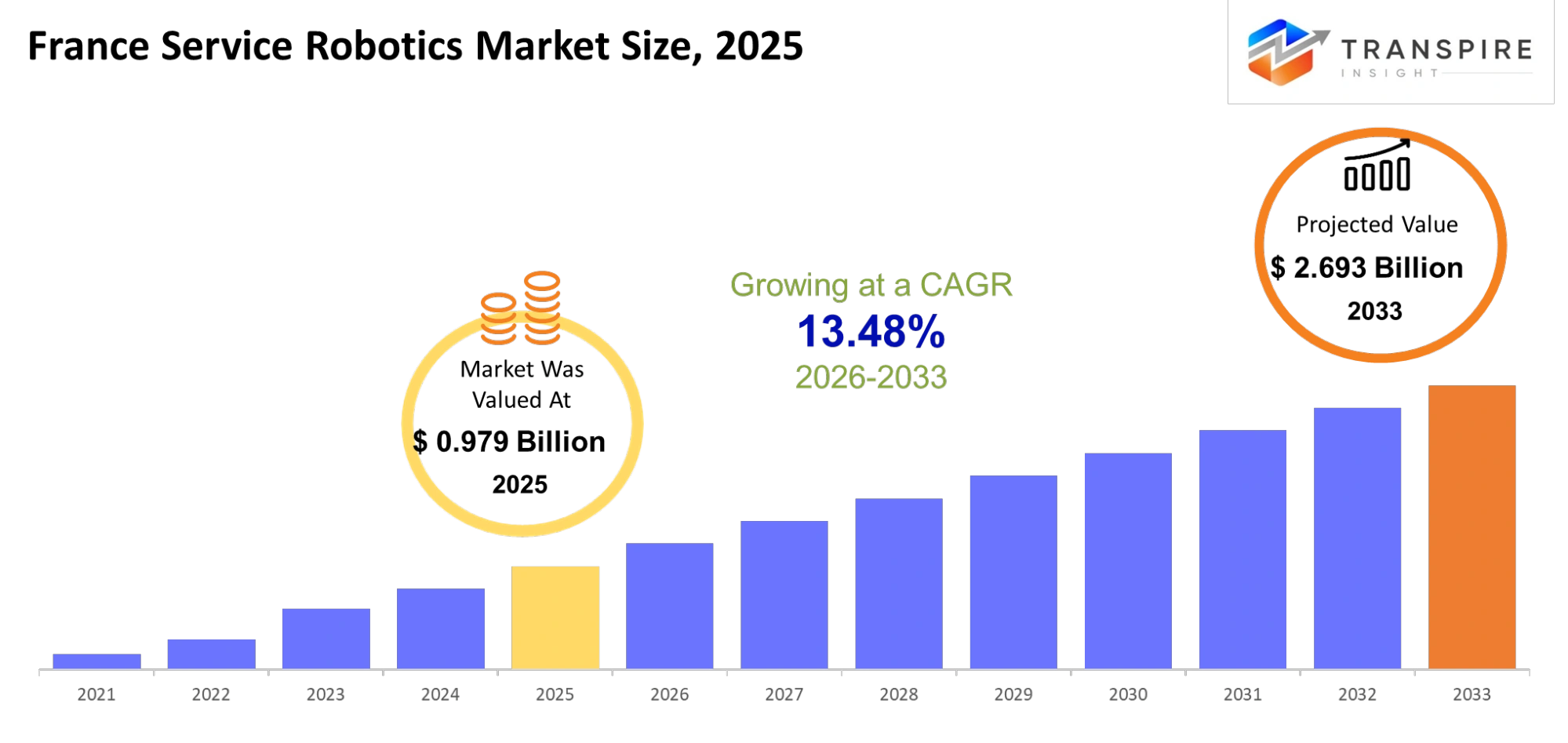
- France Service Robotics Market Size 2025: USD 0.979 Billion
- France Service Robotics Market Size 2033: USD 2.693 Billion
- France Service Robotics Market CAGR: 13.48%
- France Service Robotics Market Segments:By Type (Professional Service Robots, Personal Service Robots, Collaborative Robots, Others); By Application (Healthcare, Logistics, Domestic Tasks, Hospitality, Agriculture, Others); By End-User (Enterprises, Households, Healthcare Providers, Hotels, Industrial Firms, Others); By Technology (AI-enabled, Autonomous Navigation, Machine Learning, Others)
To learn more about this report,  Download Free Sample Report
France Service Robotics Market Summary
The France Service Robotics Market was valued at USD 0.979 Billion in 2025. It is forecast to reach USD 2.693 Billion by 2033. That is a CAGR of 13.48% over the period.
The France Service Robotics Market delivers practical automation across logistics, healthcare, agriculture, and public services, where robots handle repetitive, hazardous, or precision-driven tasks that human labor cannot scale efficiently. Autonomous mobile robots facilitate material transportation in warehouses and ports whereas service robots in hospitals execute disinfection and delivery and patient assistance tasks to alleviate operational demands.
The market has transformed during the last 3-5 years to prefer AI-based software robotics systems which function as integrated components within enterprise systems instead of operating as independent units. The COVID-19 pandemic emerged as the main catalyst because it revealed vulnerabilities in the workforce and medical settings and touchless service areas needed rapid technological implementation. Organizations developed new buying habits which lasted because they started to value business resilience and operational stability more than before.
The process of expansion occurs through measurable productivity enhancements and labor expense reductions and quicker return on investment which drives organizations to extend their use of technology from initial testing into complete business operations that produce income
Key Market Insights
- The France Service Robotics Market sees its dominant presence from Île-de-France which will achieve a 35% market share in 2025 due to its industrial centers and technological progress.
- The Auvergne-Rhône-Alpes region will experience its most rapid expansion during the period from 2025 to 2033 which will result from increased manufacturing automation and the establishment of robotics startups.
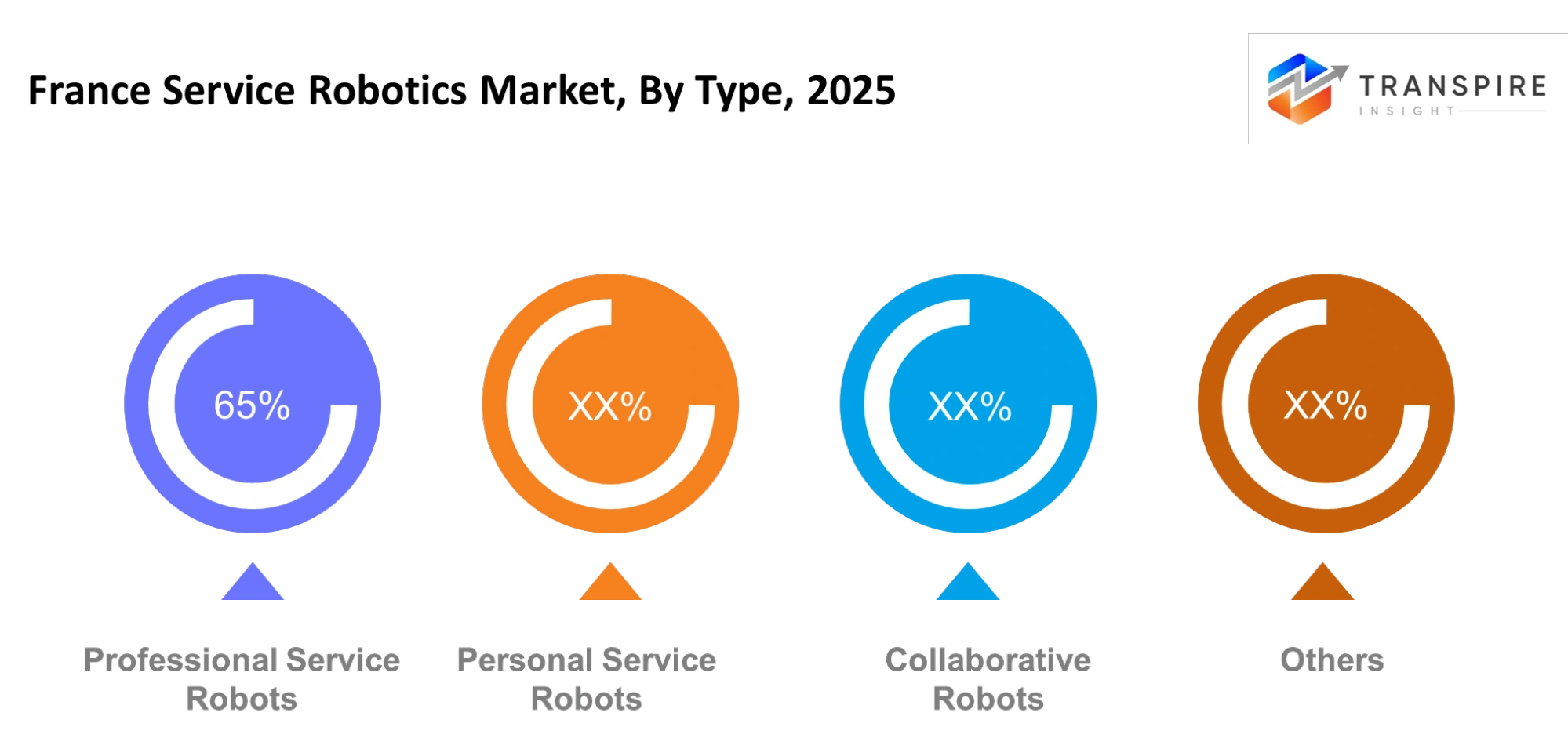
- The market for professional service robots will reach 60% market share in 2025 because of the deployment of logistics and healthcare and inspection robotics.
- The second-largest market share belongs to personal service robots which receive support from applications that assist with domestic tasks and provide care for elderly individuals.
- The market expansion of autonomous mobile robots proceeds through their application in warehouse automation and last-mile delivery systems.
- The logistics and warehousing industry will control 40% of the market in 2025 which results from e-commerce fulfillment needs and supply chain efficiency demands.
- The field of healthcare robotics experiences the highest growth rate because hospitals implement automation systems and disinfection technologies and develop patient support systems.
- The end-user demand in healthcare institutions leads to their market share of almost 30% because they need to improve operational processes and prevent infections.
- The retail and hospitality industries experience rapid growth because they use service robots to engage customers and deliver services without physical contact.
- The major companies operating in the France Service Robotics Market include ABB Ltd. KUKA AG SoftBank Robotics iRobot Corporation and Daifuku Co. Ltd.
- Companies focus on product development using AI technology which enables their products to provide real-time navigation and predictive maintenance and human-robot interaction capabilities.
- The deployment process receives acceleration through strategic partnerships and collaborations which include healthcare providers and logistics companies because these partnerships extend market access.
What are the Key Drivers, Restraints, and Opportunities in the France Service Robotics Market?
The France Service Robotics Market experiences its main growth because companies shift their operations to use AI-based automated systems which they developed after the pandemic because their labor costs increased in the logistics and healthcare sectors. The organizations experienced continuous staffing shortages which persisted throughout 2020 because hospitals and warehouse operations required personnel to maintain their essential business activities. The industry started using autonomous systems which needed less human staff because organizations faced difficulty implementing their manual tasks. The development of AI and machine vision systems together with navigation software became essential for robotic systems which progressed from experimental use to operational use in key business functions. The new system created higher adoption rates because businesses could show their investment returns through improved production levels and decreased mistake occurrences and speedier product delivery which helped vendors achieve their revenue targets.
The main obstacle to progress occurs because organizations need to spend money for initial system costs while facing challenges with their system development procedures. Service robots need to connect with existing IT systems and physical building elements and industry-specific regulations which include healthcare regulatory requirements in their system design. The projects require specific development work together with user instruction and long-term technical support which results in extended financial recovery periods. Small and mid-sized enterprises struggle to justify these costs, delaying adoption cycles and limiting market penetration beyond large enterprises, thereby suppressing near-term revenue expansion.
Robotics-as-a-service model development presents a significant opportunity for growth in urban logistics and smart city development programs. Subscription-based deployment reduces capital barriers and aligns costs with usage. The cities which implement digital mobility systems will achieve faster development of autonomous delivery robots because these systems enable urban areas to use their robots as a new recurring revenue source.
What Has the Impact of Artificial Intelligence Been on the France Service Robotics Market?
Robots in France now operate as data-based systems because artificial intelligence technology has changed how service robots operate. AI-based control systems for logistics and facility management use real-time robot fleet management to achieve optimal task distribution and route planning and energy efficiency. Hospitals use AI-enabled service robots for automated disinfection and internal delivery, where computer vision and sensor fusion improve navigation accuracy and reduce human intervention. The system records all operational activities to control compliance while maintaining safety and hygiene standards.
Machine learning models create predictive functions through their ability to examine sensor data which helps them forecast when equipment will fail and determine the right time to perform maintenance activities. The system reduces repair costs and increases equipment availability rates for operations that maintain high utilization levels which are common in warehouse environments. Performance optimization algorithms track system performance to improve both movement patterns and workload distribution until they achieve actual increases in throughput and lower energy usage.
AI-based robotic systems provide operational benefits through improved equipment usage, decreased operational interruptions, and more dependable service delivery. The main obstacle to this process remains integration. Most deployments need to operate with existing systems while maintaining stable network connections because they depend on both factors to function properly in unpredictable real-world settings.
Key Market Trends
- The period since 2021 has seen companies transition their operations from testing robots through pilot programs to developing complete robotic systems which resulted in more than 30% increase of robots used at each warehouse location.
- The introduction of AI-based navigation systems into healthcare and logistics operations in 2022 has replaced traditional rule-based systems to achieve higher task accuracy while decreasing the need for human operators.
- The current robotics procurement practices now operate under the Robotics-as-a-Service model which enables mid-sized companies to implement automation technologies without needing to make costly initial investments.
- The French hospital system adopted disinfection robots and delivery robots after 2020 while using automated systems to manage infection control and patient transportation.
- The growth of e-commerce since 2021 has forced logistics companies to build new fulfillment centers which use autonomous mobile robots together with real-time inventory management technologies.
- The manufacturing industry has increased its collaborations with AI software companies since 2023 to develop advanced robot capabilities which include predictive maintenance and adaptive learning features.
- The rise of regulatory workplace safety requirements has led companies to implement more collaborative robots especially in locations where employees work with robots after 2022.
- Global competition has changed because ABB Ltd. and KUKA AG have developed localized solutions which meet the industrial and healthcare needs of French customers.
- The urban mobility projects which Paris has implemented have led to the testing of last-mile delivery robots which will become part of smart city systems that use robotic technology.
France Service Robotics Market Segmentation
By Type
The France Service Robotics Market shows professional service robots as the leading segment because large-scale operations in logistics, healthcare and inspection require continuous high-efficiency automation. Hospitals and warehousing networks depend on these systems to sustain operations and service delivery because they experienced labor shortages after 2020. AI-enabled robots with fleet management and real-time analytics functions became the primary strength of manufacturers. The combination of operational needs and software-based performance systems establishes professional robots as the main source of revenues.
The domestic implementation of personal service robots which assist with household tasks and support elderly individuals needs to increase because of demographic changes and the rising demand for products that enable senior citizens to maintain their independent living. The market expansion remains restricted because of two factors which include customer resistance to product prices and the restricted capabilities of products when compared to enterprise solutions. The rapid growth of collaborative robots occurs because companies now consider workplace safety when designing environments for employees who need to work together with machines. Small and mid-sized enterprises now adopt new technologies because of their improved sensor capabilities and their ability to meet established workplace safety regulations. Precision and risk reduction capabilities drive organizations to purchase inspection and security robots which operate in specialized roles.
To learn more about this report, Download Free Sample Report
By Application
Logistics applications continue to dominate because distribution centers require efficient and precise systems which can handle large volumes of materials that need to be moved throughout their facilities. The combination of autonomous mobile robots and sorting systems provides businesses with the ability to track their inventory movements throughout the entire process while achieving faster delivery times and enhanced order accuracy. After 2021 e-commerce expansion created a new market demand which required businesses to build their facilities for operations with robotic technology. The logistics system implementations within their operations create continuous revenue streams which maintain strong financial performance.
Robotic systems for disinfection and delivery and patient assistance now experience rapid growth in hospitals which implement them within their healthcare applications. The systems enable infection control procedures while they decrease staff requirements for work in demanding situations. The hospitality industry and domestic tasks experience growth because urban customers want better service and more efficient solutions. Robotics technology now supports agriculture and various new fields through its ability to perform precise operations which will keep growing because automated systems manage resources and conduct agricultural tasks.
By End-User
The primary market sector for service robots which large groups of people use in their business operations to fulfil their logistical needs and their retail activities and their facility management work. The first factor which drives companies to adopt new technology is their ability to invest while the second factor depends on their need to maintain ongoing business operations because their operational efficiency and system availability determine their income earnings. The segment maintains its market dominance because enterprise software systems and data management platforms enable organizations to oversee operations from one location while monitoring system efficiency.
Industrial firms follow closely, using robotics for inspection, material handling, and safety-critical tasks where precision and risk reduction matter. Hospitals use robots for disinfection and internal logistics and patient support which makes healthcare providers the fastest growing market segment. Hotels are gradually increasing adoption to enhance guest services and streamline operations such as room delivery and cleaning. Households show steady but slower growth due to cost sensitivity, while other niche users maintain selective demand based on specialized operational needs.
By Technology
The modern technology landscape sees AI systems emerging as the primary solution because robots require intelligent systems that can make decisions and adapt to changing situations. The systems generate value through their ability to allocate tasks between different activities while streamlining operational processes and enabling organizations to forecast maintenance needs. Organizations began to implement data-driven automation systems for operational efficiency improvements and risk management initiatives after 2021, which resulted in increased adoption rates.
The market segment for autonomous navigation technologies functions as an essential and rapidly expanding field that enables robots to navigate and function in unpredictable environments. Machine learning supports this growth by enhancing object recognition, route optimization, and system learning over time. The present development of technologies will continue to progress, but upcoming work will concentrate on developing stronger connections between AI systems and navigation technologies, which will enable robots to operate with enhanced independence and operational accuracy in various real-world settings.
What are the Key Use Cases Driving the France Service Robotics Market?
Logistics and warehouse automation represent the core use case, generating the highest demand as operators rely on autonomous mobile robots for their operations which include picking and sorting and internal transport activities. Companies use robotic fleets to achieve greater accuracy and shorter delivery times because they need to handle high order volumes with strict delivery deadlines.
Hospitals use robots for disinfection and internal delivery while hotels use service robots for room service and cleaning which creates new applications in healthcare and hospitality. Healthcare providers and service-sector enterprises use these applications to optimize their operations while delivering consistent service quality to their customers.
Autonomous robots currently perform parcel distribution and precision farming tasks through their application in urban last-mile delivery and agricultural field support. Smart city initiatives together with labor shortages will drive increased use of these applications throughout the upcoming forecast period.
|
Report Metrics |
Details |
|
Market size value in 2025 |
USD 0.979 Billion |
|
Market size value in 2026 |
USD 1.111 Billion |
|
Revenue forecast in 2033 |
USD 2.693 Billion |
|
Growth rate |
CAGR of 13.48% from 2026 to 2033 |
|
Base year |
2025 |
|
Historical data |
2021 - 2024 |
|
Forecast period |
2026 - 2033 |
|
Report coverage |
Revenue forecast, competitive landscape, growth factors, and trends |
|
Regional scope |
France |
|
Key company profiled |
ABB, KUKA, FANUC, Yaskawa, iRobot, Intuitive Surgical, Daifuku, SoftBank Robotics, Omron, Universal Robots, DJI, Boston Dynamics, Ecovacs, Samsung, LG |
|
Customization scope |
Free report customization (country, regional & segment scope). Avail customized purchase options to meet your exact research needs. |
|
Report Segmentation |
By Type (Professional Service Robots, Personal Service Robots, Collaborative Robots, Others); By Application (Healthcare, Logistics, Domestic Tasks, Hospitality, Agriculture, Others); By End-User (Enterprises, Households, Healthcare Providers, Hotels, Industrial Firms, Others); By Technology (AI-enabled, Autonomous Navigation, Machine Learning, Others) |
Which Regions are Driving the France Service Robotics Market Growth?
The adoption rate in Île-de-France shows high numbers because the region contains many hospitals and research institutions and logistics headquarters which use service robotics technology for extensive operations. The transition from pilot programs to full implementation in healthcare automation and smart infrastructure development receives support from public funding programs together with innovation clusters.
The region of Auvergne-Rhône-Alpes serves as a stable industrial area which contains both its manufacturing facilities and its robotics engineering capabilities. The region's growth depends more on private companies increasing their automation spending than on government policies which shape development in the capital region. Industrial firms use service robots to perform inspection tasks and material handling functions and safety applications which results in constant robot deployment throughout their operations. The region maintains stable operations which make it a dependable source of revenue for extended periods.
The fastest-growing region in France is Provence-Alpes-Côte d'Azur because of its smart city projects and urban mobility initiatives that began after 2022. The deployment of autonomous delivery robots and public service robots by municipalities has established new operational areas for these technologies. The need for services in tourism areas drives both hospitality and urban service providers to use new technologies. The period between 2026 and 2033 will create strong expansion possibilities for vendors and investors who want to enter the rising market of city-based robotics solutions.
Who are the Key Players in the France Service Robotics Market and How Do They Compete?
The France Service Robotics Market shows moderate competitive fragmentation because multiple international automation enterprises together with specialized robotics companies and new market entrants maintain their operations in separate application areas. Established companies protect their market share through their extensive technological expertise and complete solution offerings while emerging companies bring market disruption through their adaptable business models and software-based breakthroughs. The primary basis of competition has shifted toward AI capability, system interoperability, and lifecycle service models, which compete with upfront cost calculations, for market dominance. Buyers now assess vendor performance based on two criteria: their capacity to deliver continuous performance and their ability to integrate data across multiple locations.
ABB Ltd. competes through technology integration, which combines robotics with industrial automation platforms to provide centralized control and predictive maintenance capabilities. This method enables customers to implement their solution in complicated industrial settings, which enables the business to provide services to major organizations. KUKA AG differentiates through flexible automation systems and strong engineering customization, which appeals to manufacturers requiring tailored robotics solutions. The company drives its expansion strategy through partnerships with software vendors, which deliver AI-based capabilities to its operations.
SoftBank Robotics designs human-interactive robots for service environments which serve retail and healthcare and hospitality sectors. The company distinguishes itself through its simple user interfaces and interactive customer features, which assist employees in performing their work tasks. Daifuku Co., Ltd. specializes in logistics automation through its development of high-throughput robotic systems, which connect with warehouse management software to improve efficiency at large distribution centers. The companies grow through strategic partnerships and on-site deployments, which enable them to expand their product availability
Company List
- ABB
- KUKA
- FANUC
- Yaskawa
- iRobot
- Intuitive Surgical
- Daifuku
- SoftBank Robotics
- Omron
- Universal Robots
- DJI
- Boston Dynamics
- Ecovacs
- Samsung
- LG
Recent Development News
In October 2025, SoftBank Group announced acquisition of ABB’s robotics division. The $5.4 billion deal strengthens AI-driven robotics capabilities and accelerates large-scale automation deployment across service robotics markets.https://www.reuters.com
In April 2026, SoftBank Group announced plans to launch and list a new AI robotics venture, Roze. The initiative targets autonomous infrastructure development and signals increased investment momentum in AI-powered robotics systems.https://www.reuters.com
What Strategic Insights Define the Future of the France Service Robotics Market?
The France Service Robotics Market is moving toward complete software-based automation systems that use integrated systems to control robot operations through their enterprise connections. Organizations need to maintain operational efficiency and make instant decisions which forces vendors to transition their business model from hardware distribution toward service-based systems that utilize data and artificial intelligence.
Interoperability problems between different systems present a hidden threat which requires investigation. The introduction of robots from various vendors creates challenges for organizations which ultimately results in higher switching expenses while creating incomplete systems that restrict their ability to grow and establish links with other platforms. The risk might lead to market power becoming concentrated among a few companies which possess complete solution control.
The growing field of urban infrastructure robotics creates new possibilities which smart city programs use to run autonomous delivery systems and public service automation. Cities which spend on digital mobility solutions and connected infrastructure systems develop new spaces for equipment deployment which reach beyond their standard industrial areas.
To achieve long-lasting service revenue growth market participants must focus on developing open architecture platforms while establishing partnerships with software companies and infrastructure providers to create system interoperability.
France Service Robotics Market Report Segmentation
By Type
- Professional Service Robots
- Personal Service Robots
- Collaborative Robots
- Others
By Application
- Healthcare
- Logistics
- Domestic Tasks
- Hospitality
- Agriculture
- Others
By End-User
- Enterprises
- Households
- Healthcare Providers
- Hotels
- Industrial Firms
- Others
By Technology
- AI-enabled
- Autonomous Navigation
- Machine Learning
- Others
Frequently Asked Questions
Find quick answers to common questions.
The confirmed 2033 market size figure is USD 2.693 Billion.
Key segments for the France Service Robotics Market are By Type (Professional Service Robots, Personal Service Robots, Collaborative Robots, Others); By Application (Healthcare, Logistics, Domestic Tasks, Hospitality, Agriculture, Others); By End-User (Enterprises, Households, Healthcare Providers, Hotels, Industrial Firms, Others); By Technology (AI-enabled, Autonomous Navigation, Machine Learning, Others).
Major France Service Robotics Market players are ABB, KUKA, FANUC, Yaskawa, iRobot, Intuitive Surgical, Daifuku, SoftBank Robotics, Omron, Universal Robots, DJI, Boston Dynamics, Ecovacs, Samsung, LG.
The France Service Robotics Market size is USD 0.979 Billion in 2025.
The France Service Robotics Market CAGR is 13.48% from 2026 to 2033.
- ABB
- KUKA
- FANUC
- Yaskawa
- iRobot
- Intuitive Surgical
- Daifuku
- SoftBank Robotics
- Omron
- Universal Robots
- DJI
- Boston Dynamics
- Ecovacs
- Samsung
- LG
Recently Published Reports
-
Apr 2026
Fiber Optic Faceplates Market
Fiber Optic Faceplates Market Size, Share & Analysis Report By Type (< 300 mm2, 300-350 mm2, and > 350 mm2, By Application (Night Vision, Holographic Imaging, Medical, and Others), and Geography (North America, Europe, Asia-Pacific, Middle East and Africa, South and Central America), 2021 - 2031
-
Apr 2026
High Temperature Superconductors Market
High Temperature Superconductors Market Size, Share & Analysis Report By Type (1G HTS, and 2G HTS), By Application (Power Cable, Fault Current Limiter, and Transformer), and Geography (North America, Europe, Asia-Pacific, Middle East and Africa, South and Central America), 2021 - 2031
-
Apr 2026
Industrial Plugs and Socket Market
Industrial Plugs and Socket Market Size, Share & Analysis Report By Type (Industrial Plugs, Industrial Sockets), By Current (Up to 32 A, 32 to 125 A, Above 125 A), By Protection (Dustproof and Splash Proof, Waterproof, Explosion Proof), By End User (Heavy Industries, Oil and Gas, Chemicals and Pharmaceuticals, Power Generation, Others), and Geography (North America, Europe, Asia-Pacific, Middle East and Africa, South and Central America), 2021 - 2031
-
Apr 2026
InGaAs Avalanche Photodiodes Market
InGaAs Avalanche Photodiodes Market Size, Share & Analysis Report By Type (1100 - 1700 nm, and 1000 - 1600 nm), By Application (Missile Warning System, Muzzle Flash Detection, Wafer Defect Inspection, Laser Rangefinders, and Others), and Geography (North America, Europe, Asia-Pacific, Middle East and Africa, South and Central America), 2021 - 2031