
Asia Pacific Concrete Plasticizer And Super Plasticizer Market Size & Forecast:
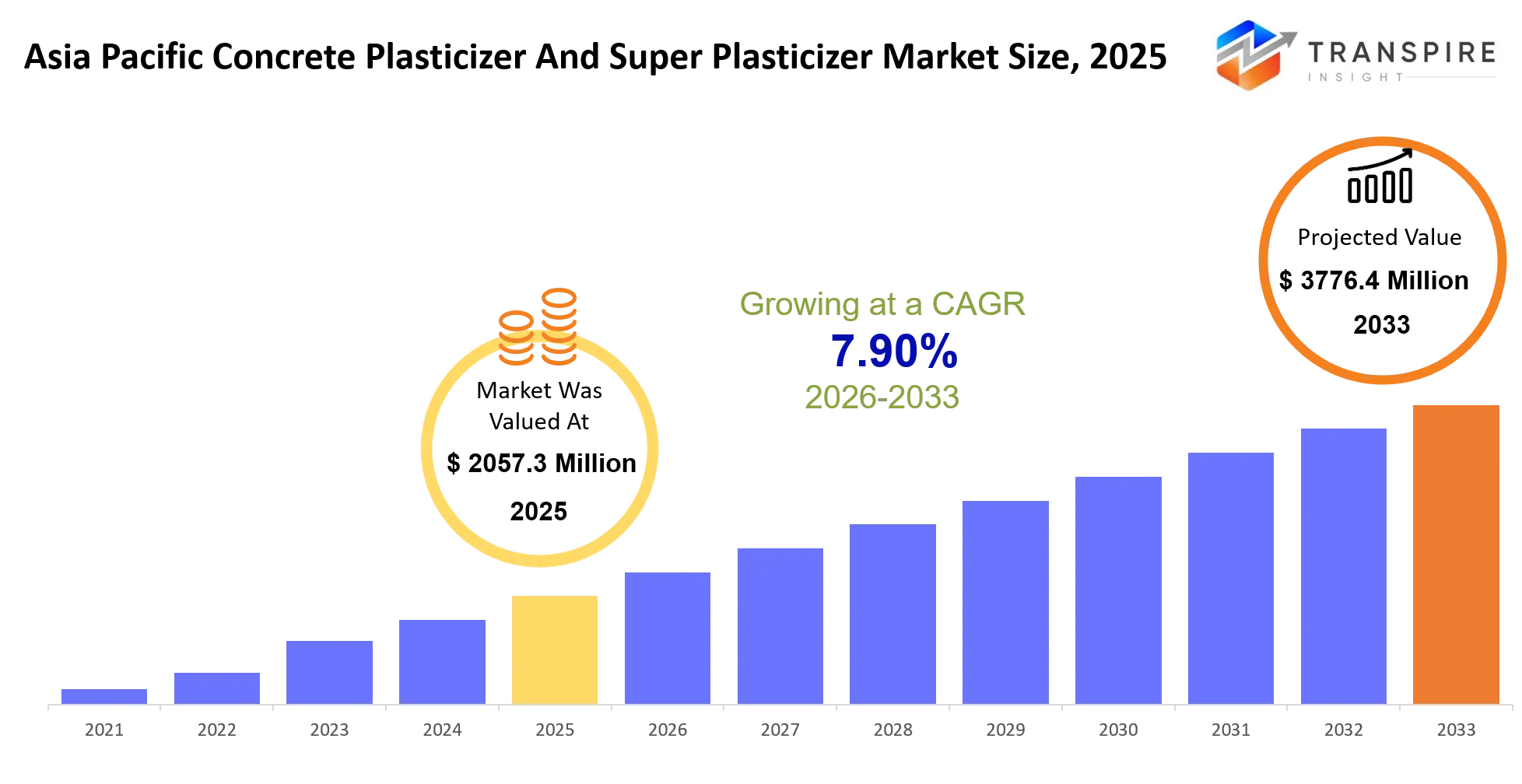
- Asia Pacific Concrete Plasticizer And Super Plasticizer Market Size 2025: USD 2057.3 Million
- Asia Pacific Concrete Plasticizer And Super Plasticizer Market Size 2033: USD 3776.4 Million
- Asia Pacific Concrete Plasticizer And Super Plasticizer Market CAGR: 7.90%
- Asia Pacific Concrete Plasticizer And Super Plasticizer Market Segments: By Product Type (Lignosulfonates, Sulfonated Naphthalene Formaldehyde, Polycarboxylate Ether, Sulfonated Melamine Formaldehyde, Others); By Application (Residential Construction, Commercial Construction, Infrastructure Projects, Precast Concrete, Others); By End User (Construction Companies, Infrastructure Developers, Ready-mix Concrete Producers, Others)
To learn more about this report,  Download Free Sample Report
Asia Pacific Concrete Plasticizer And Super Plasticizer Market Summary
The Asia Pacific Concrete Plasticizer And Super Plasticizer Market was valued at USD 2057.3 Million in 2025. It is forecast to reach USD 3776.4 Million by 2033. That is a CAGR of 7.90% over the period.
In practice, concrete plasticizers along with superplasticizers help contractors get better workability and pumpability for concrete, while also pushing water content down. That tends to let crews move material longer distances, pack denser reinforcement, and reach stronger structural results in big jobs think marine works, high rise towers, and other major infrastructure efforts across the Asia Pacific region, and so on.
Over the past three to five years, the market has sort of turned more decisively toward high performance polycarboxylate ether based admixture formulations, plus a more performance minded approach to mix design. This shift has gradually replaced the older lignosulfonate and naphthalene type systems. At the same time, COVID-19 disruptions in supply chains and swings in petrochemical feedstock pricing made producers and contractors adjust, they started to localize raw material sourcing and then rework admixtures so availability stayed reliable and costs were less erratic. The result is kind of a double effect, adoption has sped up, because contractors now push for quicker curing, lower cement usage, and improved durability in general all to hit compressed project schedules and tighter sustainability demands in urban infrastructure programs.
Key Market Insights
- Asia Pacific really dominates the Asia Pacific Concrete Plasticizer And Super Plasticizer Market, and China is holding roughly 40–45% share it seems, mostly because of huge infrastructure builds and megacity scale development, you know.
- Southeast Asia too is showing faster adoption lately, with backing from industrial corridor expansion and those cross-border logistics infrastructure investments that keep stacking up.
- For Polycarboxylate Ether (PCE) superplasticizers , they lead across Asia Pacific with an estimated 55–60% share , mainly due to strong water reduction efficiency, and the way it supports better performance.
- PCE formulations are also the fastest-moving segment from 2024 to 2030, largely tied to sustainability concerns and the increasing demand for high-strength concrete, which is being pushed by many builders.
- When it comes to concrete type, ready-mix concrete looks like it dominates, with nearly 45% share. That’s driven by rapid urban construction cycles and time-sensitive delivery needs.
- Precast concrete is the fastest-growing application segment though, supported by modular construction approaches and infrastructure standardization trends going on right now.
- Also, high-rise and marine construction are increasingly relying on more advanced admixtures, mainly for workability improvements and structural durability over time.
- In terms of what’s driving the market most, infrastructure projects lead the Asia Pacific Concrete Plasticizer And Super Plasticizer Market with about 38–42% share, thanks to government-funded development programs, and long-term planning.
- Residential construction is the fastest-growing end-user category, fueled by urban migration patterns and affordable housing initiatives that keep expanding.
- Commercial construction demand rises in a steady way too, with growing industrial parks plus smart city development, so the usage keeps climbing.
What are the Key Drivers, Restraints, and Opportunities in the Asia Pacific Concrete Plasticizer And Super Plasticizer Market?
The main growth driver is this pretty rapid shift toward high-performance infrastructure builds, backed by government led urbanization efforts, and also stricter standards for structural durability. Big spending on metro rail systems, highways, and high rise developments in China, India, and across Southeast Asia has pulled up the need for advanced admixtures that lower the water-cement ratio while still boosting compressive strength. Honestly, this momentum started to really pick up after 2020, since contractors had less time on project schedules, and they were expected to use materials more efficiently. That situation directly pushed wider adoption of polycarboxylate ether based superplasticizers, and it also helped chemical suppliers realize stronger revenue.
One major structural restraint is the volatility you see in petrochemical derived raw materials that go into admixture production, especially naphthalene and acrylic acid derivatives. Since these inputs basically track crude oil pricing cycles, manufacturers deal with ongoing cost unpredictability, and they cannot fully neutralize it by adjusting prices, especially when construction markets stay competitive. As a result, margin stability gets harder, procurement decisions slow down for infrastructure projects that are extremely cost sensitive, and this can mean delayed specification upgrades. It also makes it tougher for premium products to penetrate the market through smaller contractors, where adoption tends to be more cautious.
There is a real future opening here with low-carbon concrete compositions backed by carbon reduction rules tied to city infrastructure purchasing. Places like India and Japan are now putting more money into test projects where they combine more precise admixture dosing with supplementary cementitious ingredients such as fly ash, and slag. This, in turn, points toward next generation plasticizer systems that boost workability along with cutting cement usage, and it really opens up extra value streams for greener, larger scale projects in sustainable megaproject development.
What Has the Impact of Artificial Intelligence Been on the Asia Pacific Concrete Plasticizer And Super Plasticizer Market?
Artificial intelligence and advanced digital technologies are, bit by bit, reshaping how operational efficiency works across the Asia Pacific Concrete Plasticizer And Super Plasticizer Market, especially when it comes to concrete production and admixture dosing systems, you know, the whole dosing routine. Construction chemical suppliers, and ready-mix operators too, are now relying on AI-enabled batching plant controls to change superplasticizer dosing on the fly, based on real-time moisture content, aggregate variability and temperature conditions. With this kind of automation, mix consistency gets better, and there’s less risk from manual calibration errors, particularly during large infrastructure pours, where accuracy really ties to structural performance.
At the same time, machine learning models are being used to forecast slump retention, setting time, and even long-term compressive strength by looking at prior mix records plus environmental factors. Alongside that, predictive maintenance setups keep an eye on dosing pumps and mixing equipment, so wear patterns get anticipated before they turn into problems, which means fewer unexpected shutdowns. This helps equipment stay online more often across high-volume concrete plants. In practice, these digital optimizations have supported real reductions in cement overuse and, overall, better operational cost efficiency in bigger construction efforts.
Still, adoption is not uniform. It’s partly held back by fragmented data infrastructure and only limited digitization among small and mid-sized contractors. There are also high integration expenses for sensor networks and AI-enabled control systems, and that delays deployment, especially in price sensitive parts of the construction industry. So, advanced companies might gain clear efficiency advantages, but wider market penetration stays uneven across the region.
Key Market Trends
- After 2021 the Asia Pacific Concrete Plasticizer and Super Plasticizer Market sort of shifted away from naphthalene based systems, and more toward PCE admixtures. in doing so it boosted water reduction efficiency by almost 30% across some big project portfolios.
- China’s infrastructure push started to level off in 2024, but India’s quick metro rollouts and housing build outs changed how and where people actually consumed these products, quite a lot in the region.
- From 2022 to 2025 contractors started using digital batching systems more and more, which improved dosage accuracy and also cut down on material wastage in major concrete plants, especially the larger ones.
- Sustainability rules coming in Japan and South Korea encouraged cement optimization plays, and that then sped up low carbon concrete adoption on public infrastructure jobs. it felt like the compliance timeline mattered, even for procurement.
- During 2020–2022 supply chain disruptions, manufacturers like Sika and Fosroc had to regionalize production, so they could keep pricing volatility steadier, and it wasn’t a small change.
- Competition got more intense. Firms such as Mapei and Chryso expanded their R and D into high performance admixture formulations, trying to get ahead on performance curves rather than just cost.
- Ready mix concrete producers also moved toward real time quality monitoring, lowering slump variability and making structural consistency more reliable for urban infrastructure work.
- In Southeast Asia, precast construction adoption jumped after 2023, driven by modular building trends and the need for faster project execution, basically faster turnarounds.
- And raw material price swings linked to petrochemical cycles pushed formulators to rethink admixture chemistry. that improved resilience in practice, but it also raised R and D spending a fair amount.
Asia Pacific Concrete Plasticizer And Super Plasticizer Market Segmentation
By Product Type :
Lignosulfonates and sulfonated naphthalene formaldehyde products are still widely used in cost sensitive construction jobs , because they help with water reduction and keep concrete workable in everyday placements. For smaller projects and the more traditional building approaches, these materials do the job without much fuss, at least most of the time.
Polycarboxylate ether and sulfonated melamine formaldehyde products see stronger use in high performance construction, since they tend to bring higher strength along with improved slump retention, and they can reduce water cement ratios too. Some other options also exist, like blended chemical systems that are picked for more niche needs in specialized concrete mixes, where the formulation fits the demand better.
By Application :
In residential construction plasticizers are used to make the mix more manageable in housing projects, where pace and cost control really matter. In commercial construction , the focus is on keeping concrete quality steady for buildings, malls, and office structures, so performance stays consistent even when site conditions vary.
For infrastructure projects and precast concrete applications , advanced admixtures are adopted more often. Infrastructure work needs durability for bridges, highways, and metro systems. Meanwhile precast plants operate in controlled environments, and plasticizers help the concrete keep flowing well, reduce defects, and support faster mold turnover cycles.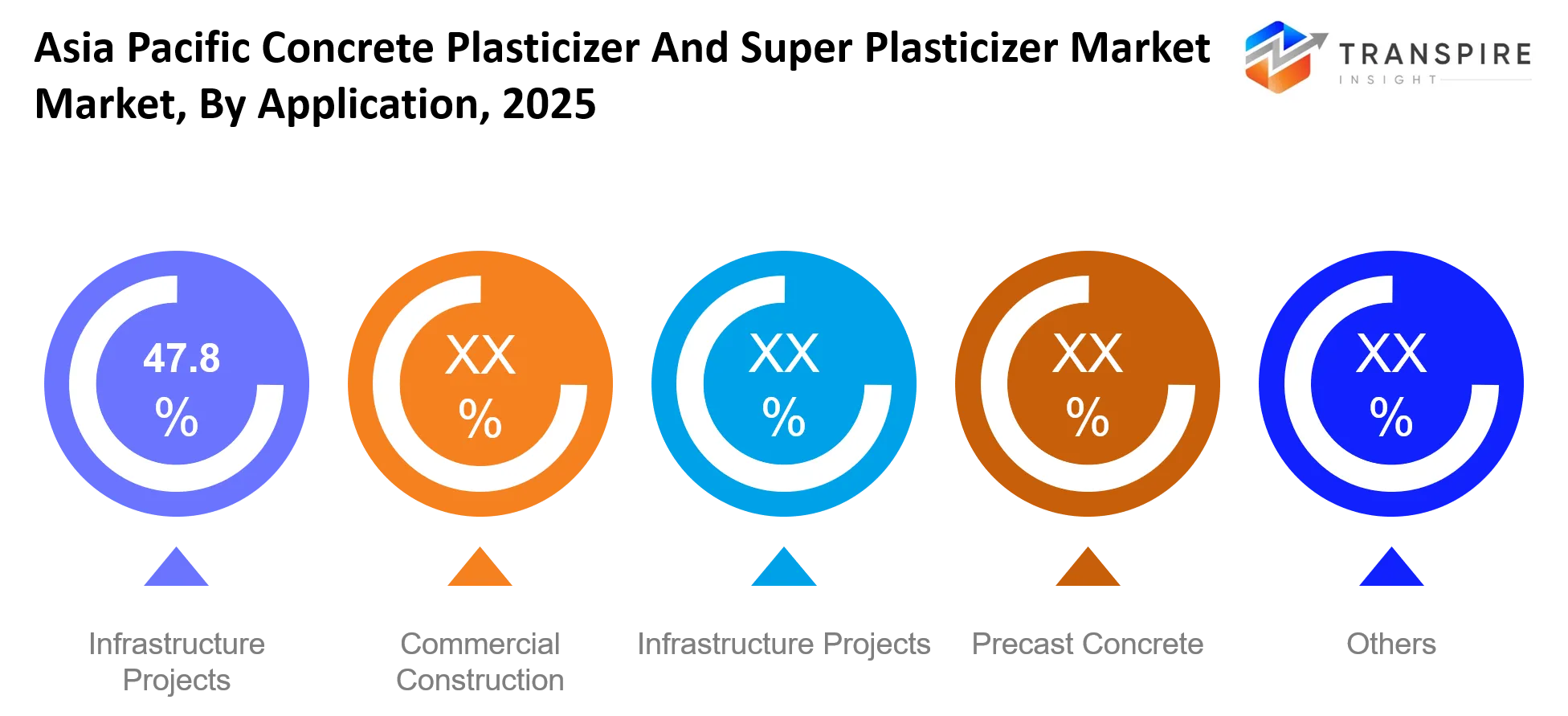
To learn more about this report, Download Free Sample Report
By End User :
Construction companies tend to use plasticizers to help steer on site concrete performance, and keep mixes workable even when the weather shifts, plus when site conditions feel unpredictable. So for infrastructure developers it’s more about big picture durability needs, where material strength, and an extended service life, stay pretty much non negotiable.
Meanwhile, ready mix concrete producers are a major user group because batching happens in a more centralized way, and then it’s delivered according to the schedule or delivery based supply setup. There are also smaller contractors, and specialty builders who apply admixtures, sort of for their particular job demands, like restoration work, high strength casting, or concrete formulations that are tailored.
What are the Key Use Cases Driving the Asia Pacific Concrete Plasticizer And Super Plasticizer Market?
In the Asia Pacific Concrete Plasticizer And Super Plasticizer Market, the most dominant use case kind of sits with high volume infrastructure work plus ready-mix concrete production. Basically, huge transport schemes, metro lines, and highway builds need a steady flow, longer workable performance, and higher strength overall, so superplasticizers get used a lot in bulk batching operations. This is most intense in regions where urban expansion is moving fast, and it kind of forces teams to build quicker while still holding up structural durability.
After that, secondary adoption is growing in precast concrete production and various commercial construction initiatives. Precast plants tend to lean on carefully measured dosing, so they get a uniform surface finish and faster mold release, while commercial developers lean on admixtures to cope with tight construction timelines in tall buildings and industrial facilities. Construction firms and ready-mix producers are the main users, and they are really the ones backing this growth.
On the newer side, there are emerging use cases tied to low carbon concrete blends, where plasticizers are combined with supplementary cement materials to cut back cement consumption. Infrastructure stakeholders are also trialing more advanced admixture systems for marine and coastal jobs where resistance against chloride attack matters a lot for long service life cycles.
|
Report Metrics |
Details |
|
Market size value in 2025 |
USD 2057.3 Million |
|
Market size value in 2026 |
USD 2217.7 Million |
|
Revenue forecast in 2033 |
USD 3776.4 Million |
|
Growth rate |
CAGR of 7.90% from 2026 to 2033 |
|
Base year |
2025 |
|
Historical data |
2021 - 2024 |
|
Forecast period |
2026 - 2033 |
|
Report coverage |
Revenue forecast, competitive landscape, growth factors, and trends |
|
Regional scope |
Asia Pacific (India, China, Japan, Australia,South Korea, Rest of Asia Pacific) |
|
Key company profiled |
Sika AG, BASF, Fosroc, Mapei, Arkema, CICO Technologies, GCP Applied Technologies, Chryso, Dow, RPM International, Kao Corporation, Ashland, W.R. Grace, Rhein-Chemotechnik, Cemex |
|
Customization scope |
Free report customization (country, regional & segment scope). Avail customized purchase options to meet your exact research needs. |
|
Report Segmentation |
By Product Type (Lignosulfonates, Sulfonated Naphthalene Formaldehyde, Polycarboxylate Ether, Sulfonated Melamine Formaldehyde, Others); By Application (Residential Construction, Commercial Construction, Infrastructure Projects, Precast Concrete, Others); By End User (Construction Companies, Infrastructure Developers, Ready-mix Concrete Producers, Others) |
Which Regions are Driving the Asia Pacific Concrete Plasticizer And Super Plasticizer Market Growth?
China is basically leading the Asia Pacific Concrete Plasticizer and Super Plasticizer Market because of its huge-scale infrastructure pipeline and that continuous, sort of relentless urban expansion program. The government money keeps flowing into highways, rail corridors, and big mega cities, so the demand for high performance concrete admixtures stays steady. Also there is a strong cement production base plus a connected chemical supply chain, which backs up large volume consumption and keeps pricing more stable than you would expect. and then you have major contractors, along with centralized procurement systems, that just keep pushing wider use of advanced plasticizer formulations across nationwide projects.
Japan looks more mature, and more stability driven than China, with demand shaped by very strict construction quality rules and seismic safety needs. Infrastructure renewal works, like bridge rehabilitation, and urban retrofitting, keep usage consistent for those high grade admixtures. Unlike the volume-led expansion story in China, Japan tends to emphasize durability, precision engineering, and overall lifecycle performance. Long term backing from established construction firms means demand stays predictable, even if physical expansion of new infrastructure networks is not as fast.
India is moving the fastest, driven by aggressive modernization of infrastructure and rapid urban housing development. Since 2023, government led efforts in metro rail expansion, smart cities, and industrial corridors have pushed concrete consumption up noticeably, it is kind of hard to ignore. Recent policy support for affordable housing and logistics infrastructure has also sped up demand for cost efficient but still high performance admixtures. This upward trend signals solid opportunities for new entrants and investors between 2026 and 2033, especially if they set up localized manufacturing and distribution networks, rather than relying purely on distant supply.
Who are the Key Players in the Asia Pacific Concrete Plasticizer And Super Plasticizer Market and How Do They Compete?
In the Asia Pacific Concrete Plasticizer And Super Plasticizer Market the competitive landscape looks moderately fragmented, but there is a solid mix of big multinational firms, plus some regional formulators too. What really matters day to day is mostly polycarboxylate ether know-how, pricing structures that can swing with demand, and how dependable local supply is . The incumbents usually try to keep their slice by dialing in their formulations and then sending on site technical help to ready-mix producers. At the same time, newer companies still manage to squeeze margins, especially when budgets are tight in cost-sensitive infrastructure builds.
Sika is leaning hard into advanced PCE admixtures, and also rolling in digital dosing integration so ready-mix plants can run more consistently. They are also expanding manufacturing in India and China, aimed at faster delivery, and more tailored project support. Mapei meanwhile puts a lot of weight on polymer chemistry innovation, especially for precast and high-strength concrete, and they back it with contractor relationships that help push specification driven adoption. Chryso expands by developing low-carbon admixtures and then going after infrastructure growth pockets across Southeast Asia.
Saint-Gobain plays a different angle, by using its construction material distribution network to push bundled solutions in big infrastructure programs across the region, which also helps their cross-selling inside the broader materials portfolio. Fosroc focuses on technical service-led differentiation, and they try to lock in longer-term supply agreements, particularly with highway and metro contractors in India and parts of Southeast Asia.
Company List
- Sika AG
- BASF
- Fosroc
- Mapei
- Arkema
- CICO Technologies
- GCP Applied Technologies
- Chryso
- Dow
- RPM International
- Kao Corporation
- Ashland
- W.R. Grace
- Rhein-Chemotechnik
- Cemex
Recent Development News
In January 2026, Sika announced the expansion and deployment of its ViscoCrete®-7000 AE high-performance superplasticizer across hot-climate ready-mix concrete applications in Asia-Pacific markets. The product enhances slump retention and strength development, improving performance in infrastructure projects under tropical conditions and supporting higher durability standards in regional construction. Sourcehttps://gcc.sika.com/
In December 2025, Sika advanced its PCE-based ViscoCrete® product line including RM and SKY series superplasticizers for high-performance and self-compacting concrete applications across Asia-Pacific precast and infrastructure segments. The expanded portfolio supports improved workability retention and lower water–cement ratios, aligning with rising demand for high-strength sustainable concrete in fast-urbanizing APAC markets.Source https://gcc.sika.com/
What Strategic Insights Define the Future of the Asia Pacific Concrete Plasticizer And Super Plasticizer Market?
The Asia Pacific Concrete Plasticizer And Super Plasticizer market is moving, kind of unevenly, toward high efficiency low water concrete systems that also tie into digital batching and construction standards based on real performance. This shift is pushed by stricter infrastructure quality requirements and the fact that urban development now leans harder on quicker project delivery cycles. Over the next 5 to 7 years, you can expect adoption to cluster more around polycarboxylate ether technologies, these help with strength tuning and cement reduction at scale, mainly for metro areas and high rise construction ecosystems.
There’s also a less obvious risk that people sometimes miss. It’s the dependence on petrochemical linked raw materials, which can bring cyclical cost shocks. Even if construction demand stays strong those shocks can still squeeze margins, pretty quickly. And if pricing keeps moving, technology upgrades may get delayed especially by smaller contractors, since they usually cannot absorb frequent changes in cost. On the other side, there’s an emerging chance too: low carbon concrete certification frameworks are starting to blend into India and parts of Southeast Asia, where policy backed procurement is beginning to reward verified emission reductions in construction materials.
Market participants should likely focus on localized production, plus admixture development tailored to specific applications, so supply risks don’t snowball and products fit local infrastructure expectations. Companies that can blend technical support with consistent regional manufacturing should take, in a practical sense, more value, because procurement is becoming more performance driven.
Asia Pacific Concrete Plasticizer And Super Plasticizer Market Report Segmentation
By Product Type
- Lignosulfonates
- Sulfonated Naphthalene Formaldehyde
- Polycarboxylate Ether
- Sulfonated Melamine Formaldehyde
By Application
- Residential Construction
- Commercial Construction
- Infrastructure Projects
- Precast Concrete
By End User
- Construction Companies
- Infrastructure Developers
- Ready-mix Concrete Producers
Frequently Asked Questions
Find quick answers to common questions.
The Asia Pacific Concrete Plasticizer And Super Plasticizer Market size is USD 3776.4 Million in 2033.
Key Segments for the Asia Pacific Concrete Plasticizer And Super Plasticizer Market are By Product Type (Lignosulfonates, Sulfonated Naphthalene Formaldehyde, Polycarboxylate Ether, Sulfonated Melamine Formaldehyde, Others); By Application (Residential Construction, Commercial Construction, Infrastructure Projects, Precast Concrete, Others); By End User (Construction Companies, Infrastructure Developers, Ready-mix Concrete Producers, Others).
Major Asia Pacific Concrete Plasticizer And Super Plasticizer Market players are Sika AG, BASF, Fosroc, Mapei, Arkema, CICO Technologies, GCP Applied Technologies, Chryso, Dow, RPM International, Kao Corporation, Ashland, W.R. Grace, Rhein-Chemotechnik, Cemex.
The Current Asia Pacific Concrete Plasticizer And Super Plasticizer Market size is USD 2057.3 Million in 2025.
The Asia Pacific Concrete Plasticizer And Super Plasticizer Market CAGR is 7.90% from 2026 to 2033.
- Sika AG
- BASF
- Fosroc
- Mapei
- Arkema
- CICO Technologies
- GCP Applied Technologies
- Chryso
- Dow
- RPM International
- Kao Corporation
- Ashland
- W.R. Grace
- Rhein-Chemotechnik
- Cemex
About the Authors

Pankaj Ghogare Patil
I am Pankaj Ghogare Patil, a Senior Research Analyst at Transpire Insight, specializing in the Pharmaceutical, Chemicals & Materials, Healthcare IT, and Biotechnology industry. My expertise lies in conducting comprehensive market research, analyzing industry trends, evaluating competitive landscapes, and translating complex data into actionable insights. At Transpire Insight, I closely follow emerging technologies, regulatory developments, and market innovations to create accurate, well-researched, and informative content that helps businesses and professionals make informed decisions. I am committed to producing credible, evidence-based articles that reflect industry best practices while making technical topics accessible and valuable for a broad audience.

Chakradhar Khansole
Chakradhar serves as the Research Director at Transpire Insight, bringing over 8 years of experience in technology, innovation, and strategic market intelligence. He specializes in transforming complex market data into actionable business insights that enable organizations to make informed, growth-oriented decisions. Recognized for his strategic vision and analytical expertise, Chakradhar leads high-impact research initiatives, delivering comprehensive market assessments, competitive intelligence, and forward-looking industry analysis.
Recently Published Reports
-
May 2026
Healthcare Polymer Packaging Market
Healthcare Polymer Packaging Market Size, Share & Analysis Report By Packaging Type (Syringes, IV Bottles and Pouches, Clamshells, Blisters, Bottles & Jars, Containers, Tubes, IV Parental Packaging, Others), By Type (Regulated, Non-regulated), By Polymer Type (LDPE (Low-Density Polyethylene), HDPE (High-Density Polyethylene), Homo-polymer (Homo), Random Copolymer (Random), Block Copolymer (Block), PET, Polystyrene, Polyvinyl Chloride, Polyamide/EVOH, Others), and Geography (North America, Europe, Asia-Pacific, Middle East and Africa, South and Central America), 2021 - 2031
-
Apr 2026
Hydrophilic Tape (Waterstop) Market
Hydrophilic Tape (Waterstop) Market Size, Share & Analysis Report By Type (Bentonite-Based Hydrophilic Tape, Rubber-Based Hydrophilic Tape), By Application (Residential Buildings, Commercial Buildings, Infrastructure Projects), and Geography (North America, Europe, Asia-Pacific, Middle East and Africa, South and Central America), 2021 - 2031
-
Apr 2026
Metalens Market
Metalens Market Size, Share & Analysis Report By Type (Visible Light Metalens, and Infrared Metalens), By Application (Consumer Electronics, Automotive Electronics, Industrial, Medical, and Others), and Geography (North America, Europe, Asia-Pacific, Middle East and Africa, South and Central America), 2021 - 2031
-
Apr 2026
PBT Resin Market
PBT Resin Market Size, Share & Analysis Report By Type (Reinforced PBT Resin, Unreinforced PBT Resin), By Processing Method (Injection Molding, Extrusion, Blow Molding, Others), By End-User (Automotive, Electrical & Electronics, Consumer Appliances, Industrial Machinery, Medical Devices, Packaging, Others), and Geography (North America, Europe, Asia-Pacific, Middle East and Africa, South and Central America), 2021 - 2031