
Asia Pacific Cellular Lightweight Concrete Market Size & Forecast:
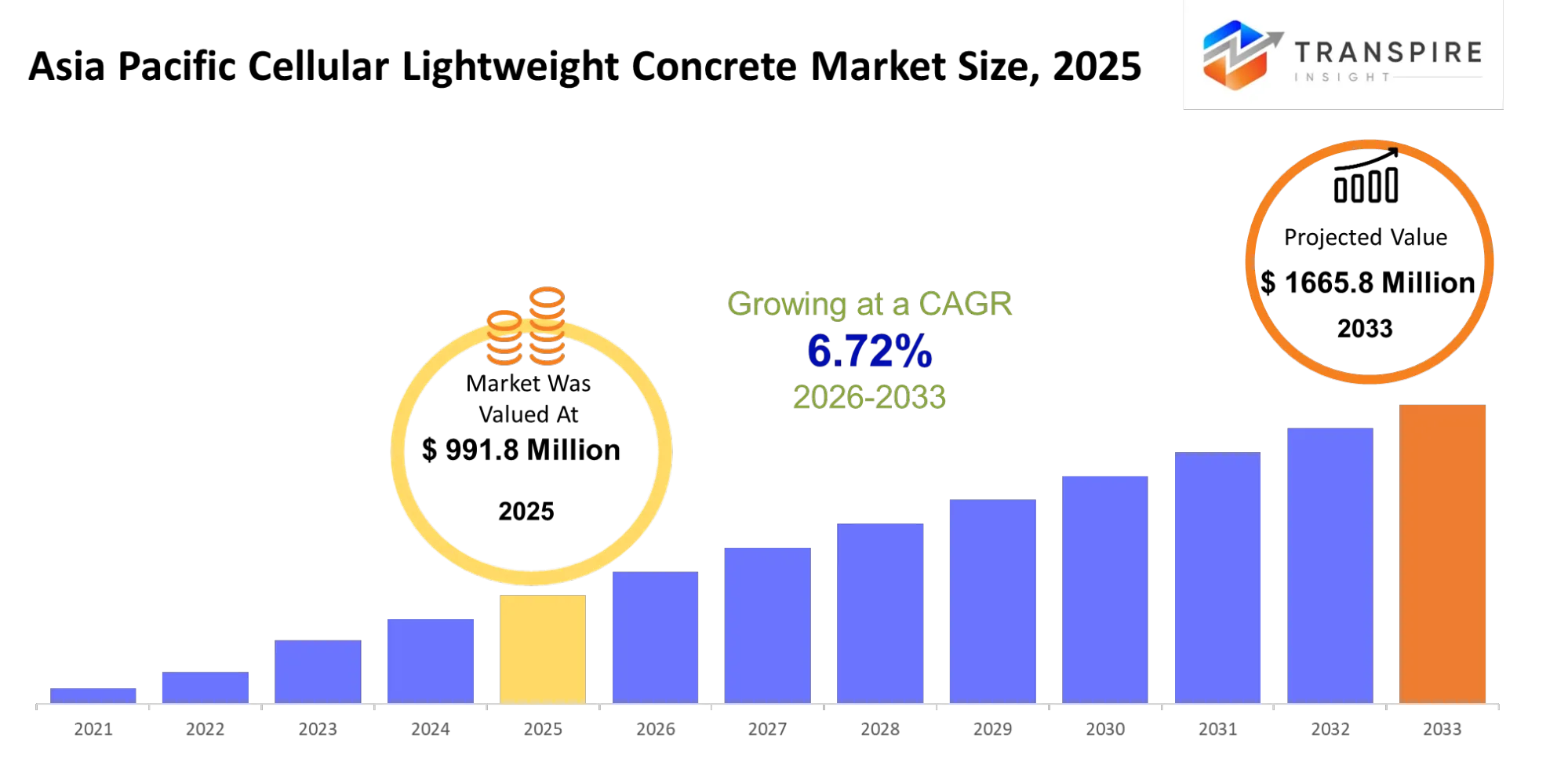
- Asia Pacific Cellular Lightweight Concrete Market Size 2025: USD 991.8 Million
- Asia Pacific Cellular Lightweight Concrete Market Size 2033: USD 1665.8 Million
- Asia Pacific Cellular Lightweight Concrete Market CAGR: 6.72%
- Asia Pacific Cellular Lightweight Concrete Market Segments: By Type (Foamed Concrete, Autoclaved Aerated Concrete, Others); By Application (Residential Construction, Commercial Construction, Infrastructure, Insulation, Others); By End-User (Construction Companies, Real Estate Developers, Government, Industrial Firms, Others); By Form (Blocks, Panels, Ready Mix, Others)
To learn more about this report,  Download Free Sample Report
Asia Pacific Cellular Lightweight Concrete Market Summary
The Asia Pacific Cellular Lightweight Concrete Market was valued at USD 991.8 Million in 2025. It is forecast to reach USD 1665.8 Million by 2033. That is a CAGR of 6.72% over the period.
In the Asia Pacific region, builders use cellular lightweight concrete for two main functions. The material helps to decrease the weight of building materials which builders use to construct buildings and bridges and road embankments and port facilities. The material provides better thermal insulation properties because it allows engineers to fill empty spaces more quickly during construction of large civil engineering projects. The solution provides a better alternative to heavy fill materials because it meets three needs which include maintaining ground stability and reducing construction costs and enhancing building efficiency in areas that experience rapid urban development.
The construction industry has progressed during the previous three years by adopting foam-based production systems and prefabricated systems which provide better product quality while decreasing resource waste compared to traditional manual mixing methods. The process of implementing new technology received acceleration because multiple countries established strict river sand mining regulations which disrupted traditional concrete supply networks and pushed construction companies to use engineered lightweight materials as replacements. The climate-resilient infrastructure programs which operate in urban areas that face flood threats have created a need for materials which help decrease structural stress while enhancing performance in soft soil conditions, which enables broader implementation across transport and industrial operations.
Key Market Insights
- China holds the dominant position in the Asia Pacific Cellular Lightweight Concrete Market with its market share ranging between 35 and 40 percent because of its extensive infrastructure development and urban renewal efforts.
- India will become the fastest expanding market during the period from 2026 until 2030 because of its development of smart cities and metro rail systems.
- The demand for flood-resistant infrastructure and coastal construction projects drives Southeast Asia to increase its adoption of new technologies.
- The Asia Pacific Cellular Lightweight Concrete Market identifies preformed foam concrete as its leading product which holds a market share of about 45 percent because it delivers consistent quality and enables quicker project execution.
- The construction sector uses on-site mixed cellular concrete as its second most popular option for projects that need to work in remote areas and require budget-friendly solutions.
- The brickwork system of prebuilt blocks functions as the most rapidly expanding market segment because of the increasing popularity of modular construction methods.
- The majority of applications use road sub-bases and embankments which account for almost 30% of total usage because of their need for soil stabilization.
- The two main applications of void filling and bridge abutments experience rapid growth because of the need to improve infrastructure safety standards.
- The Asia Pacific Cellular Lightweight Concrete Market sees infrastructure contractors control approximately 50% of market share.
- The industrial construction sector experiences its most rapid growth through the development of logistics parks and warehouses.
What are the Key Drivers, Restraints, and Opportunities in the Asia Pacific Cellular Lightweight Concrete Market?
The large-scale transition toward soil stabilization and load reduction methods for transport and coastal infrastructure projects serves as the main factor driving market expansion. Geotechnical safety standards became more stringent after infrastructure failures occurred multiple times in areas affected by floods and earthquakes. The governments of China, India and Southeast Asia increasingly require lightweight fill materials for their metro rail corridors, bridge approaches and road embankments projects. The application of cellular lightweight concrete by contractors enables them to decrease foundation stress while completing projects faster which results in increased material consumption and enhanced revenue streams from project work.
The primary constraint exists because secondary cities lack equal access to both standardized production systems and qualified personnel who can implement them. The structural barrier exists because cellular lightweight concrete performance requires exact foam density control combined with specific mix design measurements which need specialized equipment and skilled personnel to maintain proper control. Smaller infrastructure projects experience slow adoption of new technologies which results in slower revenue growth for businesses operating outside Tier-1 urban areas and restricts their capacity to access new markets.
The industrial corridor developments of India and the logistics parks of Southeast Asia present a significant business opportunity through their implementation of prefabricated modular construction with foam-based lightweight panels. Factory-controlled production unit investments drive consistent production at scale which allows Asia Pacific Cellular Lightweight Concrete Market to expand beyond infrastructure use toward more efficient building systems.
What Has the Impact of Artificial Intelligence Been on the Asia Pacific Cellular Lightweight Concrete Market?
Artificial intelligence together with sophisticated digital technologies creates new ways for companies in the Asia Pacific Cellular Lightweight Concrete Market to enhance their production processes while achieving better quality control results because these technologies enable better material monitoring.
Advanced digital systems which use artificial intelligence technology now control manufacturing operations at batching plants to manage foam density and mix ratios and curing conditions throughout the production process. The system prevents human mistakes while delivering consistent results because it handles large infrastructure projects which need high-performance standards to maintain structural safety. Machine learning models function as predictive maintenance tools for foam generators and compressors and mixing equipment because they enable operators to identify equipment wear patterns in advance which helps increase equipment availability while reducing unexpected equipment failures.
Digital monitoring systems which use IoT sensors offer contractors operational support by enabling them to monitor material movement and batch precision and energy use throughout their manufacturing facilities. The tools help organizations reduce material waste while increasing their cost efficiency, particularly in projects that handle large quantities of materials through the Asia Pacific Cellular Lightweight Concrete Market and its high-volume road and embankment projects. AI-based forecasting systems help several extensive cement-related supply networks achieve better demand forecasting results while minimizing their excess production cycles.
The adoption of lightweight concrete applications stays restricted because there exists insufficient actual training data which hinders the development of accurate models that operate under various humidity and temperature conditions. The challenge exists together with the expensive integration requirements that mid-sized contractors must meet which prevents them from achieving complete digital transformation even though they see clear operational improvements.
Key Market Trends
- The regulatory bans on river sand mining which started in 2021 led contractors to use engineered fill materials which increased the usage of cellular concrete.
- China required lightweight embankment solutions for its infrastructure upgrades after 2022 because the country needed to avoid using traditional earth-fill methods of construction.
- The metro rail expansion projects in India which began in 2023 required the use of foam-based concrete systems for tunnel backfilling and load reduction layers.
- The Southeast Asian flood mitigation programs which started after 2022 created a higher need for lightweight concrete in coastal road and drainage infrastructure projects.
- LafargeHolcim and other manufacturers developed automated batching systems which they started using in 2023 to achieve better mix results while decreasing their mixing problems that happened during construction.
- The period from 2022 to 2025 saw the industry change from manual foam generation methods to systems that used digital control which resulted in better production results while decreasing material waste.
- The construction industry started using cellular lightweight concrete for soil stabilization after 2023 because of its faster curing process and more efficient deployment methods.
- The industrial parks adopted prefabrication methods which became common practice after 2024 because these methods allowed them to produce lightweight structural components at remote locations for their logistics facilities.
- Saint-Gobain and other companies developed new competitive strategies which involved them constructing regional production facilities that would help cut down their supply chain expenses.
Asia Pacific Cellular Lightweight Concrete Market Segmentation
By Type :
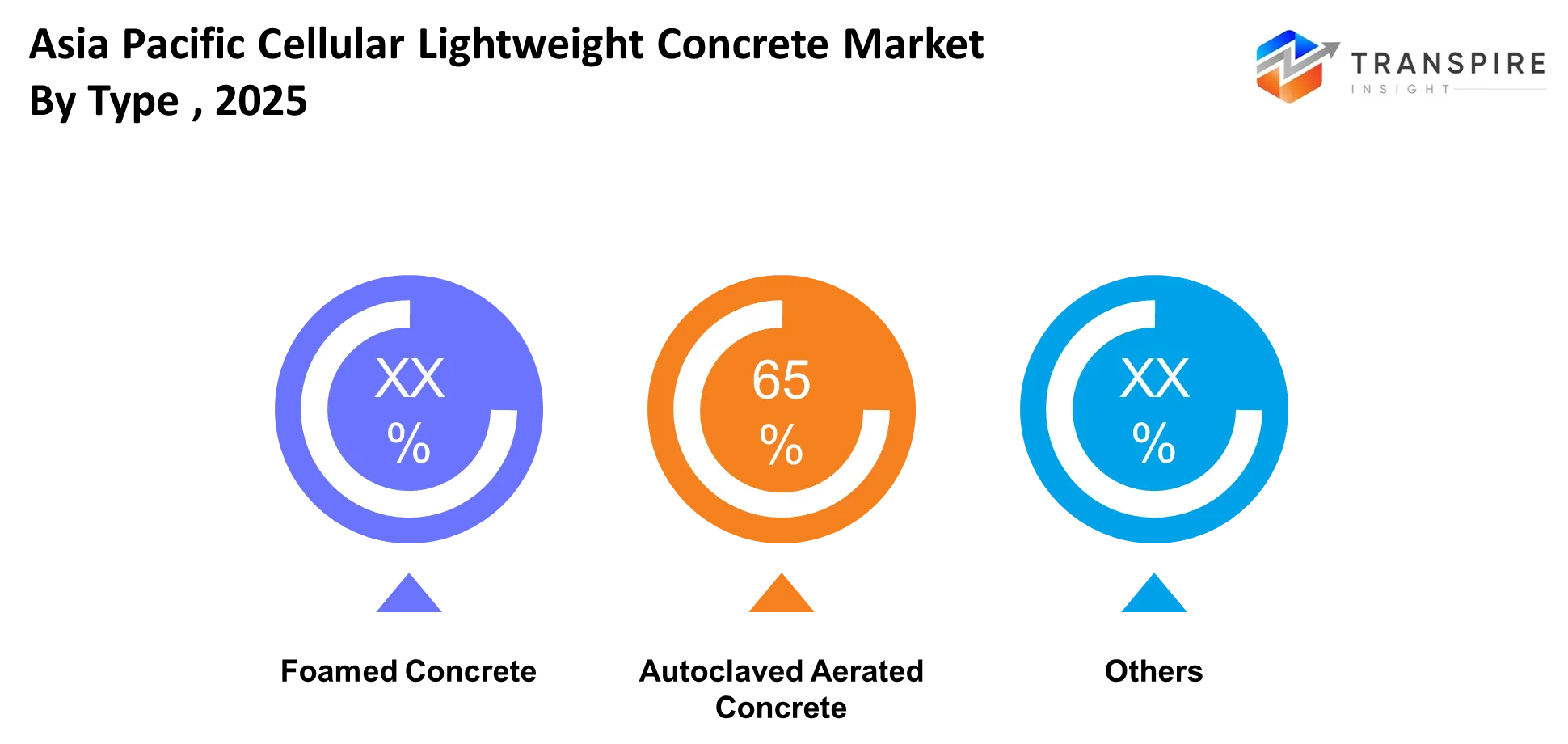
The Asia Pacific Cellular Lightweight Concrete Market maintains constant demand for various material types. The construction industry will prefer foamed concrete because its mixing process is simple and it provides lower cost advantages. Builders will use autoclaved aerated concrete because it delivers faster construction times while providing greater structural strength and thermal insulation properties. The construction industry requires different types of materials which will meet specific project requirements.
Foamed concrete will continue to expand in residential and small-scale projects due to easy placement and reduced structural load. Autoclaved aerated concrete will remain preferred for large construction works where durability and insulation are important. The site demands complex conditions which require other materials to fulfill specialized functions because standard materials will not provide sufficient performance.
To learn more about this report, Download Free Sample Report
By Application :
The Asia Pacific Cellular Lightweight Concrete Market will serve multiple industries through its various applications. The demand for residential construction will increase because of the rapid growth of urban housing development in cities. Commercial construction will support usage in modern buildings. Infrastructure projects will adopt lightweight concrete for reduced load on structures. Insulation use will increase due to thermal efficiency benefits.
The demand for residential construction will remain high because urban areas continue to expand and there is a need for affordable housing. Commercial construction will use lightweight concrete for faster project completion and improved structural efficiency. Infrastructure development will include bridges and roads requiring load reduction. Buildings will increase their insulation applications because organizations now concentrate on saving energy.
By End-User :
The Asia Pacific Cellular Lightweight Concrete Market will experience growth through various customer segments who require construction services. The construction sector will primarily utilize the material because they need to complete their ongoing work. Real estate developers will adopt lightweight concrete for cost control and faster delivery. Government projects will support large-scale infrastructure adoption. Facilities will be constructed by industrial companies through its usage.
The construction sector requires constant residential and commercial project work which leads to construction companies becoming primary material users. Real estate developers will focus on efficient materials that reduce overall building cost and time. Government bodies will invest in infrastructure expansion using lightweight materials for durability. Industrial firms will apply it in factories and warehouses for structural efficiency.
By Form :
Construction processes will use different product forms which will determine the development of the Asia Pacific Cellular Lightweight Concrete Market. Blocks will remain widely used for wall construction due to easy handling. Panels will support modular building systems with faster installation. The use of ready mix will become more important because it enables flexible on-site operations while delivering consistent material standards.
Blocks will continue to be preferred in standard building construction due to simple usage and cost efficiency. The construction industry will use panels to support modern building practices which require both fast construction methods and precise structural analysis. The use of ready mix solutions will increase in large projects because they offer consistent quality while enabling efficient building processes and decreasing manual work requirements.
What are the Key Use Cases Driving the Asia Pacific Cellular Lightweight Concrete Market?
The main application of Cellular Lightweight Concrete in Asia Pacific markets, which dominates the market, functions as road sub-base material and embankment filling solution because it decreases weight on unstable soils while providing better control of long-term ground movement. The infrastructure authorities select this material for highway corridors and metro approach roads because it shortens building times and improves ground stability in areas experiencing high urban development.
Bridge abutment backfilling and void filling applications inside tunneling and underground utility networks show growth as secondary applications. The infrastructure contractors and industrial construction companies are adopting these materials because governments are accelerating metro rail development and upgrading their existing transportation systems. The material is becoming more common in airport runway rehabilitation projects because it provides essential weight reduction and drainage capabilities.
The emerging applications of the product provide thermal insulation solutions for large-scale logistics parks and lightweight flooring systems for prefabricated industrial buildings. Engineers are currently assessing the material for use in coastal flood defense structures because it serves as a testing ground for levee reinforcement and erosion control through climate resilience programs that span Southeast Asia.
|
Report Metrics |
Details |
|
Market size value in 2025 |
USD 991.8 Million |
|
Market size value in 2026 |
USD 1056.3 Million |
|
Revenue forecast in 2033 |
USD 1665.8 Million |
|
Growth rate |
CAGR of 6.72% from 2026 to 2033 |
|
Base year |
2025 |
|
Historical data |
2021 - 2024 |
|
Forecast period |
2026 - 2033 |
|
Report coverage |
Revenue forecast, competitive landscape, growth factors, and trends |
|
Regional scope |
Asia Pacific (India, China, Japan, Australia,South Korea, Rest of Asia Pacific) |
|
Key company profiled |
Xella Group, H+H International, Saint-Gobain, CSR Limited, Aercon AAC, UltraTech Cement, JK Lakshmi Cement, CLC Blocks, Siporex, ACICO, Bauroc, Biltech Building Elements, Magicrete, SOLBET, Ytong |
|
Customization scope |
Free report customization (country, regional & segment scope). Avail customized purchase options to meet your exact research needs. |
|
Report Segmentation |
By Type (Foamed Concrete, Autoclaved Aerated Concrete, Others); By Application (Residential Construction, Commercial Construction, Infrastructure, Insulation, Others); By End-User (Construction Companies, Real Estate Developers, Government, Industrial Firms, Others); By Form (Blocks, Panels, Ready Mix, Others) |
Which Regions are Driving the Asia Pacific Cellular Lightweight Concrete Market Growth?
The Asia Pacific Cellular Lightweight Concrete Market in Asia Pacific operates under Chinese leadership because the country develops its infrastructure through extensive building projects and massive city redevelopment initiatives. The persistent need for lightweight fill materials in geotechnically challenging areas stems from government-backed construction projects which include metro rail systems and expressways and coastal protection infrastructure. The domestic cement industry maintains strong production capabilities while its integrated supply networks enable efficient project delivery through affordable manufacturing methods. The established contractors together with state-owned infrastructure builders drive uniform project implementation throughout the transport and municipal engineering sectors.
Japan exhibits a stable mature presence in the market because its strict seismic safety requirements together with its infrastructure maintenance needs create demand for construction projects which extend beyond immediate needs. Japan requires engineering solutions which prioritize material reliability and precise measurements for urban areas that face earthquake threats while China uses volume-based demands to drive its operations. The ongoing need to strengthen aging bridges and tunnels and rail networks establishes a consistent requirement for cellular lightweight concrete which will be used in their repair and retrofitting work. The combination of conservative procurement methods with high-quality compliance standards leads to a systematic yet gradual adoption process throughout civil engineering projects.
India is the fastest-growing region, which receives support through its metro system development and industrial corridor creation and increased public funding for durable transportation networks. The recent policy changes which focus on smart cities and flood mitigation efforts have led to increased adoption of lightweight fill materials in urban and coastal development projects. Highway construction projects and logistics park development work together to create a demand for materials that require shorter curing times and generate lighter weight solutions. India will experience major volume growth from 2026 to 2033, which will create several business expansion opportunities for both investors and new market entrants through contractor partnerships and local production facilities.
Who are the Key Players in the Asia Pacific Cellular Lightweight Concrete Market and How Do They Compete?
The Asia Pacific Cellular Lightweight Concrete Market shows a moderately fragmented competitive landscape where global construction material giants compete alongside regional and project-specific producers. Competitive advantages depend not only on pricing strategies but also on the effectiveness of mix technologies and foam stability control and their compatibility with large infrastructure contractors. Established players defend their position through long-term supply contracts with government-backed infrastructure projects, while smaller entrants focus on localized production advantages and lower logistics costs. The main distinguishing factors for companies now stem from their ability to maintain consistent technology delivery because projects require companies to meet stricter quality standards.
LafargeHolcim strengthens its position through automated batching systems and low-carbon concrete solutions that improve production consistency across large infrastructure sites in India and China. The company establishes its expansion through manufacturing facilities that enable immediate project response while decreasing transportation expenses. Saint-Gobain focuses on lightweight construction and prefabrication materials, integrating insulation and cellular systems to serve energy-efficient building projects across urban Asia. The specialization enables the company to enter markets that require high-density commercial construction.
BASF creates unique market position through its development of innovative foam agents and chemical additives which enhance both air-void stability and material performance during different weather conditions. Cemex expands its digital presence through two initiatives which include supply chain optimization and project-based delivery systems for infrastructure contractors. Xella Group develops aerated concrete and modular block systems to meet the needs of industrial and residential developers who require standard lightweight construction products.
Company List
- Xella Group
- H+H International
- Saint-Gobain
- CSR Limited
- Aercon AAC
- UltraTech Cement
- JK Lakshmi Cement
- CLC Blocks
- Siporex
- ACICO
- Bauroc
- Biltech Building Elements
- Magicrete
- SOLBET
- Ytong
Recent Development News
In April 2026, Pacific Lime and Cement Ltd advanced construction of its Central Lime Project in Papua New Guinea, moving into the civil and structural phase with kiln foundation concrete works underway, strengthening regional supply of lime-based inputs critical for cement and cellular lightweight concrete production across Asia Pacific infrastructure projects.
Source https://www.pngbusinessnews.com/
In February 2026, Boral Ltd completed development of a next-generation low-carbon concrete incorporating calcined clay, advancing sustainable concrete innovation for infrastructure applications in Australia and strengthening the company’s position in low-emission construction materials. Source https://www.cemnet.com/
What Strategic Insights Define the Future of the Asia Pacific Cellular Lightweight Concrete Market?
The Asia Pacific Cellular Lightweight Concrete Market is moving toward a future which construction processes will use technological and material specifications, while performance testing will determine material acceptance for construction needs. The need for standardized lightweight fill solutions arises from three factors, including infrastructure modernization, climate-resilient urban planning, and geotechnical safety requirement enforcement, which engineers use in their transport and coastal engineering work. The upcoming 5 to 7 years will see high demand for public infrastructure projects, which will focus on maintaining system performance throughout their lifespan while completing work at an expedited rate.
The industry faces an unrecognized danger because companies depend on a small number of certified foam agents and admixture suppliers, which leads to supply chain problems for local manufacturers. The production process will be disrupted by any chemical input interruption or new environmental standards which will restrict foaming agent use. Industry experts often fail to recognize this risk because it exists at an earlier stage in the production process compared to finished product needs.
The development of integrated prefabricated infrastructure systems presents a major business opportunity in India and Southeast Asia, which are currently expanding their modular transport and logistics networks. Developers are beginning to combine lightweight concrete with factory-controlled precast systems to reduce on-site construction risks. Market participants should establish local production facilities and adopt certified mix technologies to obtain government infrastructure contracts and protect themselves from supply chain disruptions.
Asia Pacific Cellular Lightweight Concrete Market Report Segmentation
By Type
- Foamed Concrete
- Autoclaved Aerated Concrete
By Application
- Residential Construction
- Commercial Construction
- Infrastructure
- Insulation
By End-User
- Construction Companies
- Real Estate Developers
- Government
- Industrial Firms
By Form
- Blocks
- Panels
- Ready Mix
Frequently Asked Questions
Find quick answers to common questions.
The Asia Pacific Cellular Lightweight Concrete Market size is USD 1665.8 Million in 2033.
Key segments for the Asia Pacific Cellular Lightweight Concrete Market are By Type (Foamed Concrete, Autoclaved Aerated Concrete, Others); By Application (Residential Construction, Commercial Construction, Infrastructure, Insulation, Others); By End-User (Construction Companies, Real Estate Developers, Government, Industrial Firms, Others); By Form (Blocks, Panels, Ready Mix, Others).
Major Asia Pacific Cellular Lightweight Concrete Market players are Xella Group, H+H International, Saint-Gobain, CSR Limited, Aercon AAC, UltraTech Cement, JK Lakshmi Cement, CLC Blocks, Siporex, ACICO, Bauroc, Biltech Building Elements, Magicrete, SOLBET, Ytong.
The Asia Pacific Cellular Lightweight Concrete Market size is USD 991.8 Million in 2025.
The Asia Pacific Cellular Lightweight Concrete Market CAGR is 6.72% from 2026 to 2033.
- Xella Group
- H+H International
- Saint-Gobain
- CSR Limited
- Aercon AAC
- UltraTech Cement
- JK Lakshmi Cement
- CLC Blocks
- Siporex
- ACICO
- Bauroc
- Biltech Building Elements
- Magicrete
- SOLBET
- Ytong
Recently Published Reports
-
Apr 2026
Healthcare Polymer Packaging Market
Healthcare Polymer Packaging Market Size, Share & Analysis Report By Packaging Type (Syringes, IV Bottles and Pouches, Clamshells, Blisters, Bottles & Jars, Containers, Tubes, IV Parental Packaging, Others), By Type (Regulated, Non-regulated), By Polymer Type (LDPE (Low-Density Polyethylene), HDPE (High-Density Polyethylene), Homo-polymer (Homo), Random Copolymer (Random), Block Copolymer (Block), PET, Polystyrene, Polyvinyl Chloride, Polyamide/EVOH, Others), and Geography (North America, Europe, Asia-Pacific, Middle East and Africa, South and Central America), 2021 - 2031
-
Apr 2026
Hydrophilic Tape (Waterstop) Market
Hydrophilic Tape (Waterstop) Market Size, Share & Analysis Report By Type (Bentonite-Based Hydrophilic Tape, Rubber-Based Hydrophilic Tape), By Application (Residential Buildings, Commercial Buildings, Infrastructure Projects), and Geography (North America, Europe, Asia-Pacific, Middle East and Africa, South and Central America), 2021 - 2031
-
Apr 2026
Metalens Market
Metalens Market Size, Share & Analysis Report By Type (Visible Light Metalens, and Infrared Metalens), By Application (Consumer Electronics, Automotive Electronics, Industrial, Medical, and Others), and Geography (North America, Europe, Asia-Pacific, Middle East and Africa, South and Central America), 2021 - 2031
-
Apr 2026
PBT Resin Market
PBT Resin Market Size, Share & Analysis Report By Type (Reinforced PBT Resin, Unreinforced PBT Resin), By Processing Method (Injection Molding, Extrusion, Blow Molding, Others), By End-User (Automotive, Electrical & Electronics, Consumer Appliances, Industrial Machinery, Medical Devices, Packaging, Others), and Geography (North America, Europe, Asia-Pacific, Middle East and Africa, South and Central America), 2021 - 2031