
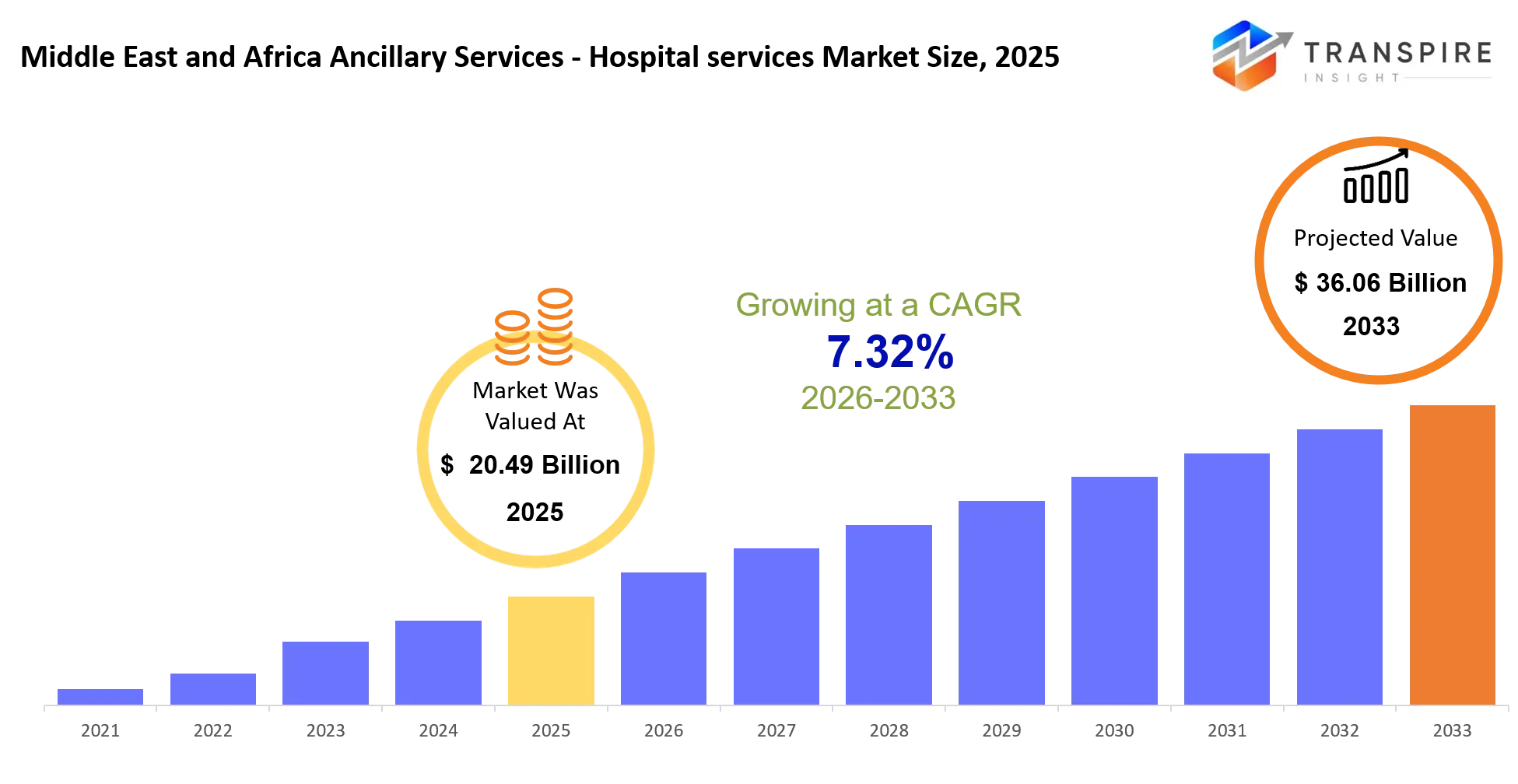
Middle East and Africa Ancillary Services - Hospital services Market Size & Forecast:
- Middle East and Africa Ancillary Services - Hospital services Market Size 2025: USD 20.49 Billion
- Middle East and Africa Ancillary Services - Hospital services Market Size 2033: USD 36.06 Billion
- Middle East and Africa Ancillary Services - Hospital services Market CAGR: 7.32%
- Middle East and Africa Ancillary Services - Hospital services Market Segments:By Service Type (Diagnostic Services, Laboratory Services, Radiology Services, Pharmacy Services, Rehabilitation Services, Ambulance Services, Others); By Hospital Type (Public Hospitals, Private Hospitals, Specialty Hospitals, Multi-specialty Hospitals, Teaching Hospitals, Others); By Application (Inpatient Care, Outpatient Care, Emergency Care, Critical Care, Surgical Support, Others); By End User (Hospitals, Clinics, Diagnostic Centers, Healthcare Networks, Others)
To learn more about this report,  Download Free Sample Report
Middle East and Africa Ancillary Services - Hospital services Market Summary
The Middle East and Africa Ancillary Services - Hospital services Market was valued at USD 20.49 Billion in 2025. It is forecast to reach USD 36.06 Billion by 2033. That is a CAGR of 7.32% over the period.
The Middle East and Africa Ancillary Services - Hospital Services Market plays a crucial role in keeping hospital operations running, not just the direct clinical treatment. These services cover diagnostic testing, medical imaging, dialysis, pharmacy management, health information systems, patient monitoring and a few other support tasks, all of which help hospitals deliver care that is faster, safer and more efficient. In day to day practice, ancillary services cut down on treatment delays, support better diagnostic precision, and let healthcare teams manage rising patient volumes without losing their operational efficiency.
Over the past five years, the market has moved through a pretty noticeable digital transformation, with hospitals leaning more and more on electronic medical records, cloud based healthcare platforms, AI powered diagnostics, and connected medical devices. The COVID-19 pandemic kind of sped things up, it showed the weak spots in infrastructure, and it encouraged investment in laboratory networks, imaging abilities, and digital healthcare systems across the Middle East and Africa. At the moment, as healthcare providers are trying to raise patient outcomes while also keeping day to day costs controlled, ancillary service providers are getting more and more blended into hospital workflows. This shift is pushing overall service consumption higher, lifting the level of technology adoption, and even creating new revenue windows across both public and private healthcare ecosystems.
Key Market Insights
- The Middle East and Africa Ancillary Services – Hospital Services market is expected to grow, from about USD 20.49 billion in 2025 to around USD 36.06 billion by 2033.
- Gulf Cooperation Council countries are estimated to make up roughly 45%+ of the regional market revenue ,mostly because of big, healthcare infrastructure investments that keep getting bigger.
- Meanwhile the Middle East still remains the leading regional market, backed by ongoing hospital expansion programs in Saudi Arabia, UAE and Qatar ,so it’s pretty steady.
- Africa is the quickest mover through 2033, supported by digital health investments, plus efforts focused on healthcare accessibility, access to care in other words.
- Diagnostic and laboratory services take the biggest share, and they contribute close to 35% of ancillary services revenues.
- Medical imaging sits second , benefiting from AI-assisted radiology and the broader shift toward advanced imaging platforms.
- Digital health, plus hospital information systems, are projected to grow at more than 9% per year across the forecast period and that pace looks pretty consistent.
- Inpatient hospital services account for over 55% of ancillary service use, mainly because the treatments are often complex and require more steps.
- Private healthcare networks are expanding faster than public ones ,especially across UAE, Saudi Arabia, and South Africa.
- Some companies, like Quest Diagnostics, Labcorp, Siemens Healthineers, GE HealthCare, and Oracle Health, are working to strengthen their market positions through AI , cloud environments and strategic partnerships.
What are the Key Drivers, Restraints, and Opportunities in the Middle East and Africa Ancillary Services - Hospital services Market?
The strongest force pushing market expansion is basically the fast modernization of healthcare infrastructure across the Middle East and some chosen African economies, where, you know, the pace keeps getting faster. Government healthcare transformation programs , especially in Saudi Arabia, the UAE, and Qatar have sped up spending on diagnostic laboratories, imaging centers, electronic health records, and also specialty treatment locations. With these kinds of investments, hospitals can handle more patients while still raising clinical efficiency. And as providers keep growing service capacity , demand climbs for outsourced and technology-enabled ancillary services, which then turns into recurring revenue possibilities for diagnostic, imaging, and healthcare IT players.
At the same time, one major structural challenge remains uneven access to healthcare infrastructure, and to trained professionals as well, across the whole region. A lot of African countries are still dealing with a shortage of trained laboratory technicians, radiologists, biomedical engineers, plus healthcare IT specialists. Fixing this isnt quick , because building those capabilities takes long-term education investment and real institutional development, so swift change becomes hard. Because of that, ancillary service deployment tends to lag in underserved markets , which restricts market penetration and also delays when revenue actually shows up.
Looking ahead, one of the best future openings is AI-enabled diagnostics along with linked digital health ecosystems. Healthcare providers are increasingly interested in platforms that combine imaging, lab outcomes, patient records, and predictive analytics into one shared environment. You can see the direction clearly in the large-scale electronic medical record deployments and cloud-based hospital management platforms rolling out across Gulf countries.
What Has the Impact of Artificial Intelligence Been on the Middle East and Africa Ancillary Services - Hospital services Market?
Artificial intelligence is kind of transforming ancillary hospital services, not in a small way, by boosting operational efficiency, diagnostic accuracy, and how resources get allocated. More and more hospitals are using AI powered imaging platforms to sort through urgent cases faster, kind of triage them first, and to smooth out workflow management. That same approach also tends to cut radiologist reporting times. Machine learning algorithms then chew on diagnostic images, lab signals, and patient records, to help clinicians notice abnormalities earlier and make treatment planning feel more precise, or at least more guided.
At the same time, advanced predictive analytics are helping healthcare providers get a better grip on equipment use and even maintenance cycles. In other words, AI models can forecast equipment failures before the actual breakdown happens, so downtime drops for crucial imaging systems, laboratory analyzers, and patient monitoring devices. Healthcare organizations that roll out AI driven workflow solutions often say they see better patient throughput, shorter waiting periods, and more efficient clinical resource use. GE HealthCare’s AI focused hospital operations efforts and imaging collaborations, show a movement where technology providers are heading toward predictive and more automated healthcare environments.
AI adoption also supports compliance, resource forecasting, and hospital capacity planning, which sounds straightforward but it’s actually a big deal. Still, one major limitation keeps coming back: the high cost of integrating AI systems with older, legacy hospital infrastructure. Many providers run into fragmented data systems, limited interoperability, and shortages of specialists who can manage these advanced AI platforms. Those barriers continue to slow down broad deployment, especially across emerging African healthcare markets.
Key Market Trends
- Since 2021, hospitals have sped up adoption of cloud based health information platforms, to make patient data more reachable and also to boost operational efficiency, you know.
- Between 2023 and 2026 AI-assisted imaging use rose sharply across big healthcare networks, and that cut down reporting turnaround times a lot.
- In Saudi Arabia and the UAE, healthcare modernization programs have pushed double digit investments in diagnostic infrastructure since 2022, kind of steadily.
- Private hospital groups grew their diagnostic and specialty service capability by more than 20% across major Gulf markets, not just a little.
- Electronic medical record rollouts moved away from small pilot projects and now show up as enterprise-wide implementations across regional healthcare networks.
- Providers are increasingly leaning toward integrated service contracts that bundle diagnostics, imaging, upkeep, and digital health solutions in one deal, more convenient.
- Partnerships between technology companies and hospital operators surged during 2025, aiming to accelerate digital transformation initiatives faster.
- Predictive maintenance tools are starting to replace the older reactive servicing model, which improves the utilization of high value diagnostic assets.
- Cross-border telehealth, plus remote diagnostic services, has expanded rapidly across underserved African healthcare markets, actually.
- Competition has shifted too, moving from standalone equipment sales toward recurring software, analytics, and managed service revenue models.
Middle East and Africa Ancillary Services - Hospital services Market Segmentation
By Service Type
The service type segment mirrors the broad variety of support roles that help healthcare facilities keep things running smoothly, still efficient patient care and operational results. Diagnostic Services take up a noticeable slice , since precise disease detection keeps being crucial for treatment planning and those clinical choices doctors make. Laboratory Services back up ongoing testing needs across several medical fields and they help speed up diagnosis too. Radiology Services keep strong usage levels thanks to imaging procedures that help physicians assess medical conditions and also keep track of how treatment is going.
Pharmacy Services are important for medication management, inventory control , and patient safety within healthcare settings. Rehabilitation Services support recovery programs that focus on bringing back physical function and improving longer-term health outcomes. Ambulance Services provide rapid patient transport during medical emergencies , and other critical situations. Others include specialized support activities that reinforce healthcare delivery and help facilities adjust as patient care requirements keep changing.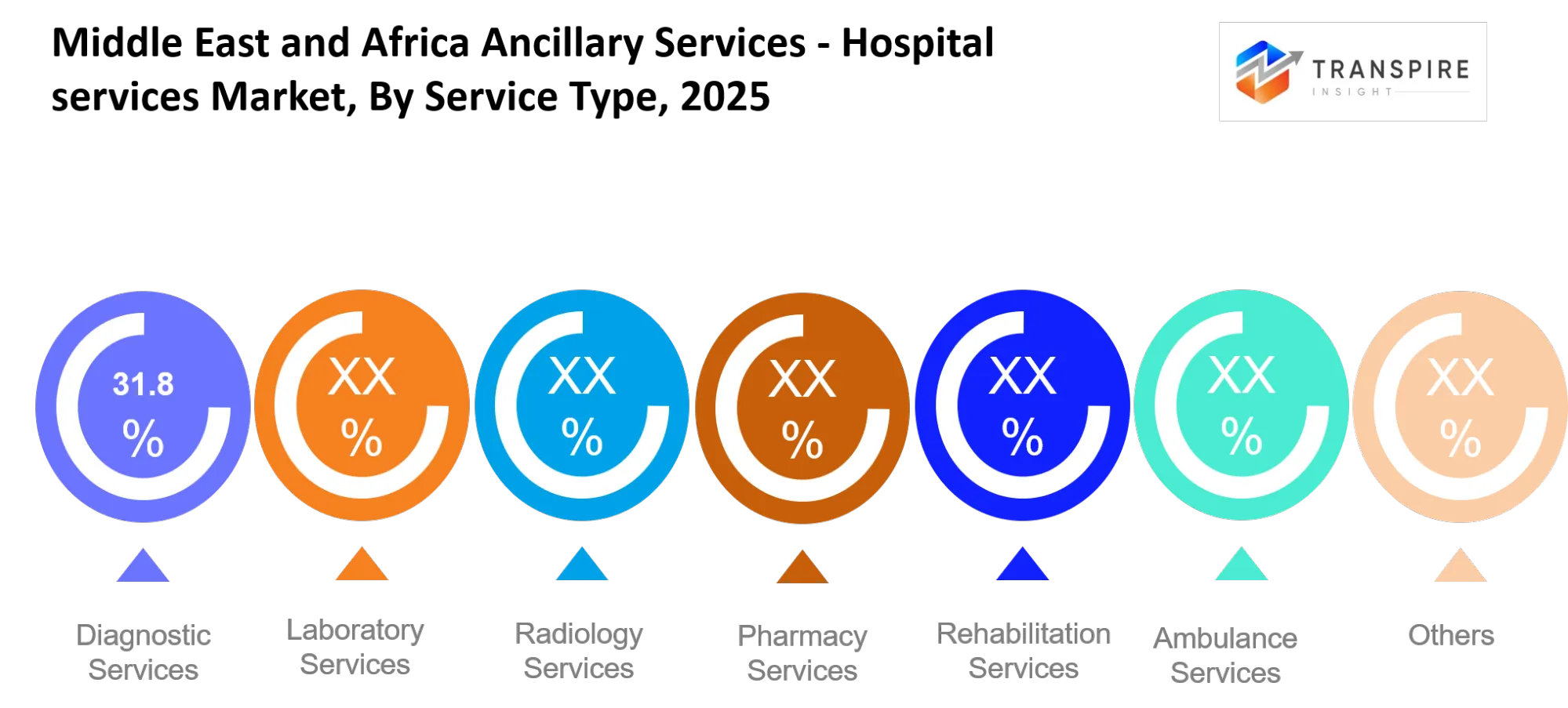
To learn more about this report, Download Free Sample Report
By Hospital Type
Hospital type segmentation basically shows how healthcare is delivered in different ways, with varying service capacity, and also patient groups served across the area, kind of. Public Hospitals make up a big share of service use since access is generally wider and there are government backed treatment programs in place. Private Hospitals are still pushing forward, they expand their service capabilities by putting money into advanced technologies and some quite specific healthcare offerings. Specialty Hospitals, in contrast, are tied to particular treatment areas and they end up supporting the demand for focused medical expertise, plus those more advanced care pathways.
Multi-specialty Hospitals stay visible in the market because they can offer a lot of healthcare services within one facility structure. Teaching Hospitals add value through clinical training, research work, and advanced treatment programs, but these usually need extensive support services too. “Others” covers healthcare institutions that run under alternative management structures and service models. Demand across hospital categories stays shaped by healthcare spending, infrastructure development, and what the region wants in terms of service quality objectives.
By Application
Application segmentation shows, in a way, indirectly how support services end up contributing through the different stages of patient care and actual treatment delivery, not just one moment. Inpatient Care makes up a big portion, simply because patients that are hospitalized usually need a lot of diagnostic testing, imaging procedures , medication handling, and ongoing clinical monitoring. Outpatient Care keeps on expanding too, as healthcare providers try to build more efficient treatment pathways that cut down on hospital stays while still keeping quality care standards in place. Emergency Care also stays pretty steady in usage, driven by urgent diagnostic work and prompt treatment needs tied to acute medical conditions.
Critical Care really depends on advanced support services, because intensive treatment environments demand constant observation and fast access to diagnostic info. Surgical Support remains essential for pre-operative evaluation, in-theater assistance, and then post-operative recovery management. Others cover additional healthcare activities that call for dedicated support functions, tuned to particular clinical needs, though the names can vary. Service utilization patterns keep shifting along with treatment advancements and improvements in how care gets delivered overall.
By End User
End user segmentation points to the organizations that, sort of rely on support services to make healthcare delivery work better, boost operational efficiency, and improve patient outcomes. Hospitals show up as the biggest end user group, because full scale healthcare facilities need a wide collection of support functions across diagnostic, treatment, and recovery steps. Clinics still bring steady demand through routine patient check ups, preventive care initiatives , and outpatient treatment activities. Diagnostic Centers, in turn, keep seeing high use of specialized testing plus imaging services that help clinicians run more accurate medical evaluations.
Healthcare Networks are also starting to pull support services into more than one facility at a time, mainly to improve coordination, set up uniform care delivery, and optimize resource utilization. This model helps healthcare organizations raise efficiency, while still keeping consistent service quality standards in place. Other categories include specialized healthcare providers and medical organizations that operate inside specific service environments. In general, end user demand tracks closely with healthcare infrastructure expansion, digital transformation efforts, and the changing expectations of patient care.
What are the Key Use Cases Driving the Middle East and Africa Ancillary Services - Hospital services Market?
Diagnostic testing and laboratory services stay like the main thing across most of the market. Hospitals lean on laboratory networks for disease diagnosis, treatment monitoring, pathology analysis ,and also preventive screening programs. The demand stays huge because nearly every clinical specialty sort of depends on timely and accurate diagnostic insight, in practice.
Medical imaging and specialized treatment support services are also big adjacent uses. Radiology departments increasingly rely on more advanced imaging systems, AI supported reporting tools, and even outsourced interpretation services. Meanwhile dialysis centers, pharmacy management services, and patient monitoring programs are growing too, mainly since healthcare providers are managing more people with long-term chronic conditions.
Newer ideas are showing up as well, like AI-assisted clinical decision support systems, predictive healthcare analytics, and remote diagnostic services. These options feel especially appealing in regions dealing with specialist physician shortages. They kind of stretch healthcare capacity while also improving access to advanced medical expertise, overall.
|
Report Metrics |
Details |
|
Market size value in 2025 |
USD 20.49 Billion |
|
Market size value in 2026 |
USD 21.99 Billion |
|
Revenue forecast in 2033 |
USD 36.06 Billion |
|
Growth rate |
CAGR of 7.32% from 2026 to 2033 |
|
Base year |
2025 |
|
Historical data |
2021 - 2024 |
|
Forecast period |
2026 - 2033 |
|
Report coverage |
Revenue forecast, competitive landscape, growth factors, and trends |
|
Regional scope |
Middle East and Africa (Saudi Arabia, United Arab Emirates, South Africa, Rest of Middle East and Africa) |
|
Key company profiled |
Quest Diagnostics, Labcorp, Sonic Healthcare, Fresenius Medical Care, Siemens Healthineers, GE HealthCare, Philips Healthcare, Medtronic, Cardinal Health, McKesson, Oracle Health, Cerner, Baxter, B. Braun, HCA Healthcare |
|
Customization scope |
Free report customization (country, regional & segment scope). Avail customized purchase options to meet your exact research needs. |
|
Report Segmentation |
By Service Type (Diagnostic Services, Laboratory Services, Radiology Services, Pharmacy Services, Rehabilitation Services, Ambulance Services, Others); By Hospital Type (Public Hospitals, Private Hospitals, Specialty Hospitals, Multi-specialty Hospitals, Teaching Hospitals, Others); By Application (Inpatient Care, Outpatient Care, Emergency Care, Critical Care, Surgical Support, Others); By End User (Hospitals, Clinics, Diagnostic Centers, Healthcare Networks, Others) |
Which Regions are Driving the Middle East and Africa Ancillary Services - Hospital services Market Growth?
The Middle East kinda represents the largest regional market, and, yes it’s not subtle. Countries like Saudi Arabia, United Arab Emirates, and Qatar keep investing heavily in hospital infrastructure, digital health systems, and also specialized medical services. There is strong government healthcare spending, supportive regulatory frameworks, plus a lot of private sector participation, so ancillary service providers end up with a pretty favorable environment. The region also gets a real boost from modern hospital networks, and from advanced healthcare technology adoption, which feels like the big driver.
South Africa is the second most significant contributor. Unlike the Gulf countries, growth there is more supported by a mature private healthcare sector and established diagnostic service networks. Continuous investment in healthcare modernization, together with relatively developed medical infrastructure, gives stability for ancillary service providers. In practice, that means dependable long-term revenue opportunities even when broader economic conditions start to wobble a bit.
Then the rest of Africa, honestly, looks like the fastest-growing opportunity. Countries such as Kenya, Rwanda, and Nigeria are putting money into healthcare digitization, expanding diagnostic capacity, and building public-private healthcare partnerships. More recently, investments in AI-enabled healthcare systems and digital health infrastructure have sped up modernization efforts. For investors and market entrants, these changes create attractive opportunities between 2026 and 2033 since healthcare accessibility, along with infrastructure, keeps improving.
Who are the Key Players in the Middle East and Africa Ancillary Services - Hospital services Market and How Do They Compete?
Market competition is pretty moderately fragmented, sort of, where global healthcare technology businesses, diagnostics providers and healthcare service organizations are competing across multiple service lines. What really sets them apart now is technology innovation, service integration, digital health capabilities, and geographic reach. Instead of it being only equipment sales, companies are leaning more toward recurring service contracts, software platforms, and those long-term healthcare relationships that are a bit more “stickier” than before.
GE HealthCare tries to stand out with AI enabled imaging, cloud based healthcare platforms, and also integrated hospital operations solutions. It has expanded its digital healthcare ecosystem using strategic partnerships and AI centered collaborations, which help with workflow automation and patient management, more smoothly.
Siemens Healthineers leans into advanced diagnostics, imaging innovation, and digital healthcare integration. The core idea is basically to pair diagnostic equipment with data driven clinical decision support tools. Oracle Health, on the other hand, is boosting its position through big electronic medical record rollouts, plus healthcare data management solutions aimed at improving interoperability and operational efficiency.
Quest Diagnostics and Labcorp compete by leaning hard on laboratory depth, testing expertise, and diagnostic innovation. Their edge is delivering scalable diagnostic services, to back hospitals that are trying to get clinical workflows moving faster and with less friction, even if they have to redesign processes a little.
Company List
- Quest Diagnostics
- Labcorp
- Sonic Healthcare
- Fresenius Medical Care
- Siemens Healthineers
- GE HealthCare
- Philips Healthcare
- Medtronic
- Cardinal Health
- McKesson
- Oracle Health
- Cerner
- Baxter
- B. Braun
- HCA Healthcare
Recent Development News
"In February 2025, Oracle Health and Burjeel Holdings launched one of the Middle East's largest electronic medical record platforms. The implementation strengthened AI adoption, improved data-driven clinical decision-making, and enhanced operational efficiency across Burjeel's healthcare network.https://www.oracle.com
"In March 2025, GE HealthCare expanded its collaboration with NVIDIA to develop autonomous imaging technologies for X-ray and ultrasound systems. The partnership aims to automate clinical workflows and improve healthcare productivity through advanced AI capabilities.https://investor.gehealthcare.com
What Strategic Insights Define the Future of the Middle East and Africa Ancillary Services - Hospital services Market?
The market is sliding toward more tightly knit healthcare ecosystems where diagnostics, imaging, patient records, predictive analytics, and hospital operations all get tied together via digital platforms. You can sort of see it being pushed along by healthcare modernization initiatives , workforce shortages, and also the constant push to raise clinical efficiency while keeping costs in check. Over the next seven years, the organizations that can fuse healthcare services with advanced digital capabilities are likely to grab a bigger chunk of market value.
There’s also a less obvious risk, not talked about as much. It’s the growing dependence on a comparatively small set of healthcare technology providers. Since hospitals are becoming more and more reliant on integrated software platforms plus connected devices, having too much vendor concentration could bring interoperability headaches and quietly make switching costlier, and harder.
Then there is a newer opening, especially around AI enabled healthcare services across underserved African markets. Funding into digital health infrastructure, along with cloud based healthcare systems, is setting up the conditions for scalable ancillary service delivery. Market participants should really focus on interoperable digital platforms and build strategic partnerships with regional healthcare providers , so they can lock in long term competitive standing and stronger recurring revenue growth.
Middle East and Africa Ancillary Services - Hospital services Market Report Segmentation
By Service Type
- Diagnostic Services
- Laboratory Services
- Radiology Services
- Pharmacy Services
- Rehabilitation Services
- Ambulance Services
- Others
By Hospital Type
- Public Hospitals
- Private Hospitals
- Specialty Hospitals
- Multi-specialty Hospitals
- Teaching Hospitals
- Others
By Application
- Inpatient Care
- Outpatient Care
- Emergency Care
- Critical Care
- Surgical Support
- Others
By End User
- Hospitals
- Clinics
- Diagnostic Centers
- Healthcare Networks
- Others
Frequently Asked Questions
Find quick answers to common questions.
The Expected Middle East and Africa Ancillary Services - Hospital services Market size for the Market will be USD 36.06 Billion in 2033.
Key Segments for the Middle East and Africa Ancillary Services - Hospital services Market are By Service Type (Diagnostic Services, Laboratory Services, Radiology Services, Pharmacy Services, Rehabilitation Services, Ambulance Services, Others); By Hospital Type (Public Hospitals, Private Hospitals, Specialty Hospitals, Multi-specialty Hospitals, Teaching Hospitals, Others); By Application (Inpatient Care, Outpatient Care, Emergency Care, Critical Care, Surgical Support, Others); By End User (Hospitals, Clinics, Diagnostic Centers, Healthcare Networks, Others).
Major Middle East and Africa Ancillary Services - Hospital services Market Players are Quest Diagnostics, Labcorp, Sonic Healthcare, Fresenius Medical Care, Siemens Healthineers, GE HealthCare, Philips Healthcare, Medtronic, Cardinal Health, McKesson, Oracle Health, Cerner, Baxter, B. Braun, HCA Healthcare.
The Current Middle East and Africa Ancillary Services - Hospital services Market size is USD 20.49 Billion in 2025.
The Middle East and Africa Ancillary Services - Hospital services Market CAGR is 7.32% from 2026 to 2033.
- Quest Diagnostics
- Labcorp
- Sonic Healthcare
- Fresenius Medical Care
- Siemens Healthineers
- GE HealthCare
- Philips Healthcare
- Medtronic
- Cardinal Health
- McKesson
- Oracle Health
- Cerner
- Baxter
- B. Braun
- HCA Healthcare
About the Authors

Pankaj Ghogare Patil
I am Pankaj Ghogare Patil, a Senior Research Analyst at Transpire Insight, specializing in the Pharmaceutical, Chemicals & Materials, Healthcare IT, and Biotechnology industry. My expertise lies in conducting comprehensive market research, analyzing industry trends, evaluating competitive landscapes, and translating complex data into actionable insights. At Transpire Insight, I closely follow emerging technologies, regulatory developments, and market innovations to create accurate, well-researched, and informative content that helps businesses and professionals make informed decisions. I am committed to producing credible, evidence-based articles that reflect industry best practices while making technical topics accessible and valuable for a broad audience.

Chakradhar Khansole
Chakradhar serves as the Research Director at Transpire Insight, bringing over 8 years of experience in technology, innovation, and strategic market intelligence. He specializes in transforming complex market data into actionable business insights that enable organizations to make informed, growth-oriented decisions. Recognized for his strategic vision and analytical expertise, Chakradhar leads high-impact research initiatives, delivering comprehensive market assessments, competitive intelligence, and forward-looking industry analysis.
Recently Published Reports
-
Jul 2026
Alopecia Treatment Market
Alopecia Treatment Market Size, Share & Analysis Report By Disease Type (Alopecia Areata, Cicatricial Alopecia, Traction Alopecia, Alopecia Totalis, Androgenetic Alopecia, Alopecia Universalis, and Other Disease Types), By Treatment Type (Topical Treatments, Oral Medications, Injectable Therapies, and Hair Transplantation), By Gender (Male, and Female), By Distribution Channel (Hospitals and Clinics, Retail Pharmacies, and Online Retailers), and Geography (North America, Europe, Asia-Pacific, Middle East and Africa, South and Central America), 2021 - 2031
-
Jul 2026
Medical Ultrasound Probe Market
Medical Ultrasound Probe Market Size, Share & Analysis Report By Type (Linear Type, Convex Type, Endocavitary Probe, Phased Array/Cardiac Probe, Transesophageal (TEE) Probe, and Others), By Application (Ophthalmology, Cardiology, Musculoskeletal, Oncology, Obstetrics & Gynecology, General Imaging, and Others), By End User (Hospitals & Clinics, Diagnostic Centers, Ambulatory Surgical Centers, and Others), and Geography (North America, Europe, Asia-Pacific, Middle East and Africa, South and Central America), 2021 – 2031
-
May 2026
Biosimilars Market
Biosimilars Market By Product Type (Monoclonal Antibodies, Recombinant Hormones, Erythropoietin, G-CSF, Others), By Indication (Oncology, Autoimmune Diseases, Blood Disorders, Diabetes, Others), By Manufacturing Type (In-House Manufacturing, Contract Manufacturing), By Distribution Channel (Hospital Pharmacies, Retail Pharmacies, Online Pharmacies), By Industry Analysis, Size, Share, Growth, Trends, and Forecasts 2021-2033
-
Apr 2026
Gastrointestinal Endoscopy Market
Gastrointestinal Endoscopy Market By Type (Rigid Gastrointestinal Endoscope, Flexible Gastrointestinal Endoscopes, Disposable Gastrointestinal Endoscope), By Procedure Type (Colonoscopy, Gastroscopy, Duodenoscopy, Enteroscopy, Flexible Sigmoidoscopy, Others), By Application (Diagnosis, Treatment), By End-Users (Hospitals, Ambulatory Surgical Centers, Specialty Clinics, Laboratories, Others), By Industry Analysis, Size, Share, Growth, Trends, and Forecasts 2021-2033