North America Malaria Diagnostic Market Size & Forecast:
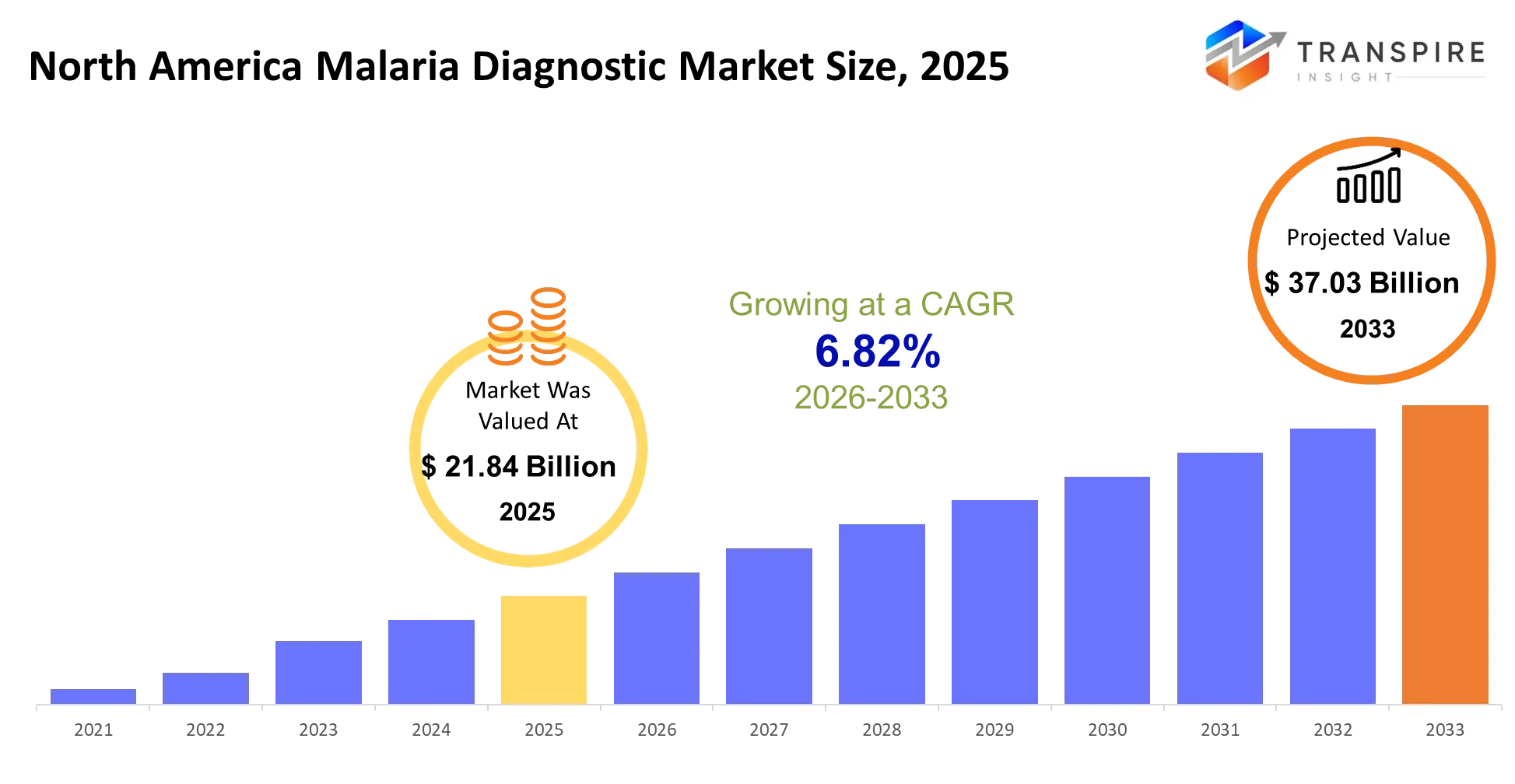
- North America Malaria Diagnostic Market Size 2025: USD 21.84 Billion
- North America Malaria Diagnostic Market Size 2033: USD 37.03 Billion
- North America Malaria Diagnostic Market CAGR: 6.82%
- North America Malaria Diagnostic Market Segments: By Type (Rapid Diagnostic Tests, Microscopy, PCR, Serology, Others), By Application (Screening, Diagnosis, Monitoring, Others), By End-User (Hospitals, Labs, Clinics, NGOs, Others), By Technology (Immunoassay, Molecular, Microscopy, Others).
To learn more about this report,  Download Free Sample Report
North America Malaria Diagnostic Market Summary:
The North America Malaria Diagnostic Market size is estimated at USD 21.84 Billion in 2025 and is anticipated to reach USD 37.03 Billion by 2033, growing at a CAGR of 6.82% from 2026 to 2033. The North America malaria diagnostics market kind of plays a huge role for hospitals, border health authorities, military medical units, and travel clinics, you know… in getting malaria identified quickly so complications don’t ramp up and so imported cases don’t move around unnoticed. Basically, in day to day practice, this market helps clinicians make faster calls for travelers, migrant groups and also people who come in from endemic areas where late diagnosis can really jack up treatment costs plus the risk of being hospitalized.
Over the past three to five years, things have been moving away from the older, microscopy focused routines, and more toward rapid diagnostic tests along with molecular solutions that give quicker and more standardized outcomes, even in decentralized care environments. This change sort of sped up after the COVID-19 pandemic, when lab capacity shortcomings became more visible , and the need for portable diagnostic infrastructure felt more urgent. At the same time, more international travel, plus climate related mosquito surveillance efforts, boosted screening volumes across North America. And since healthcare teams are pushing for earlier detection and also more automated reporting, diagnostic companies are now seeing steadier uptake from emergency care networks and public health labs. That’s leading to stronger ongoing income streams from consumables, test kits, and those combined diagnostic systems, all together.
Key Market Insights
- In 2024 , the United States pretty much takes over the North America malaria diagnostic market with close to 82% market share, mainly thanks to its more advanced lab infrastructure which kinda keeps things moving.
- Canada is seen as the fastest-growing regional market through 2032, fueled by broader infectious disease monitoring, plus more screening needs tied to migration flows.
- Also, cross-border healthcare cooperation between U.S. and Canadian public health agencies has helped tighten regional malaria testing norms while making reporting feel a lot more efficient.
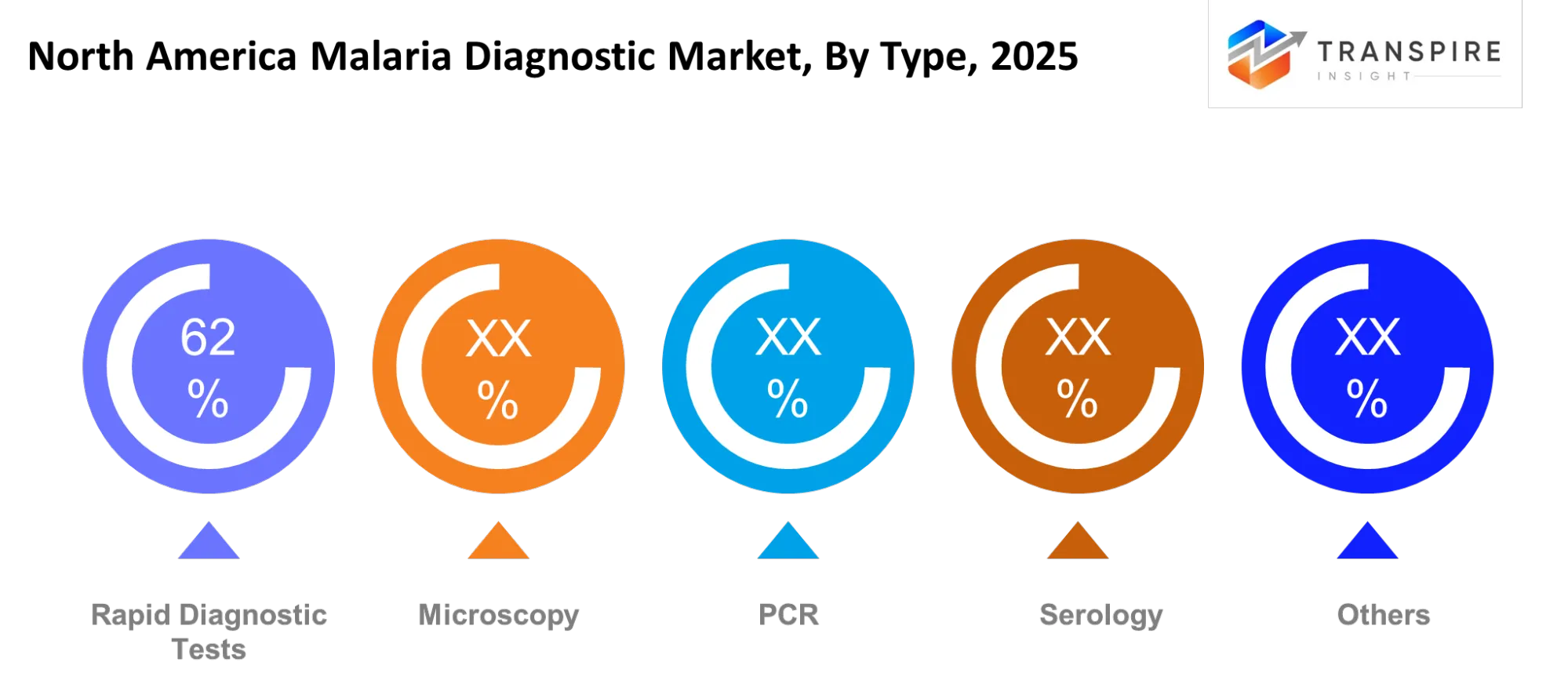
- Rapid Diagnostic Tests , or RDTs, brought in around 46% of the revenue share in 2024 since hospitals are looking for fast and portable malaria screening options, not just slower workflows.
- Microscopy-based diagnostics stayed as the second-largest segment, mostly due to cost effectiveness and the fact that reference laboratories and university- based institutes kept using it.
- Looking ahead, PCR and other molecular diagnostic platforms are expected to grow the quickest during the forecast period, because healthcare players seem to bet on diagnostic accuracy.
- Clinical diagnostics dominated the North America malaria diagnostic market with nearly 58% share in 2024. That’s largely linked to the rise in imported malaria case detection.
- Meanwhile, research and epidemiological surveillance applications are picking up emerging demand as governments strengthen preparedness programs for vector-borne illnesses.
- Military and travel medicine use-cases show steady growth as overseas deployment and international movement really demand rapid infectious disease evaluation, basically on a tight schedule.
- For end users, hospitals and diagnostic laboratories held the leading market share of about 61% in 2024, driven by higher patient testing volumes across the region.
- And travel clinics are turning into a quickly expanding end-user group, because outbound tourism along with immigration screening keeps increasing across North America, kind of nonstop.
What are the Key Drivers, Restraints, and Opportunities in the North America Malaria Diagnostic Market?
The strongest force pushing the North America malaria diagnostic market forward is the fast merging of molecular testing and point of care tools into everyday infectious disease routines. This movement really picked up after the COVID-19 period, when many folks noticed delays tied to centralized lab systems, and then healthcare providers felt compelled to put money into more decentralized diagnostic capacity. Now, hospitals as well as travel clinics tend to make rapid malaria screening a priority for international travelers, migrant populations, and urgent admissions since a late diagnosis tends to raise intensive care costs plus makes treatment more complicated. Because of this, companies behind PCR platforms , rapid diagnostic kits, and automated microscopy systems are seeing more steady pay coming in from ongoing items—consumables and reagent renewals , and also broader multi disease testing agreements.
Still, the market’s biggest structural problem stays with the comparatively low malaria endemic burden in North America. Since the number of cases is lower than many regions, quite a lot of hospitals cannot really justify heavy spending on dedicated malaria testing setups, or on focused lab training programs. And that issue is hard to untangle quickly because procurement choices usually follow long term patient volume economics, not short term outbreak patterns. So adoption becomes uneven across smaller healthcare facilities, and advanced diagnostic platforms move more slowly outside major city health systems.
Some kind of major growth opportunity is starting to come up through AI assisted digital microscopy , and also multiplex tropical disease diagnostics that are a bit more streamlined. In healthcare systems, people are putting more and more investment into platforms that can detect malaria, dengue , and other vector-borne infections at the same time, from what is basically one single sample. You can really see this happening in U.S. public health laboratories, and also in border screening programs where speed matters. The faster pathogen identification helps with real time disease surveillance, and it also strengthens outbreak preparedness, in a more or less practical way.
What Has the Impact of Artificial Intelligence Been on the North America Malaria Diagnostic Market?
Artificial intelligence plus advanced digital tools are kind of reshaping the North America malaria diagnostic market, mostly by boosting diagnostic accuracy, speeding up lab operations, and strengthening outbreak tracking abilities. A lot of hospitals and public health labs now lean on AI assisted digital microscopy platforms to help automate parasite detection from blood smear images, which cuts down the time spent on manual review and also lowers the chance of human interpretation mistakes. Several diagnostic offerings have started to bring in computer vision routines that can flag malaria parasites within minutes, so labs can handle more test volume, without needing staffing to rise in the same way.
On top of that, machine learning models are improving predictive disease surveillance across the region. Public health groups often stitch together travel information, climate signals, and infection reporting, to estimate imported malaria risks and then redirect testing capacity more efficiently. These forecasting approaches support preparedness for seasonal increases tied to international travel and migration patterns. In everyday operations, cloud connected diagnostic platforms help with quicker reporting, they automate compliance paperwork, and they make it easier to share updates between labs and infectious disease monitoring networks. Overall, this digital kind of blending has shortened turnaround times, and it reduces the lag before treatment begins for patients considered high risk.
Still, AI adoption has a key hurdle. Malaria cases in North America are relatively low, so there is less high quality regional training material available for algorithm building. Smaller facilities can also struggle with the integration costs, like digital imaging infrastructure, laboratory software upgrades, and workforce training needs.
Key Market Trends
- Since 2020, hospitals kind of moved away from microscopy heavy workflows, and went more toward PCR based malaria testing platforms that give faster diagnostic results but also feel a bit more standardized overall.
- After 2022, AI-assisted digital microscopy showed up more often, partly because labs were stuck with technician shortages and they wanted steadier parasite detection across different facilities, not just one-off outcomes.
- Then between 2021 and 2025, travel clinics expanded their malaria screening capacity, mainly because there was more international movement and more imported tropical disease cases, you know how it goes.
- Public health agencies also bumped up vector borne disease surveillance budgets after COVID-19 highlighted gaps in decentralized infectious disease diagnostic infrastructure, like there were weaknesses they could no longer ignore.
- On the commercial side, diagnostic manufacturers , including Abbott Laboratories and Thermo Fisher Scientific, expanded multiplex testing options—sort of combining malaria with dengue and Zika detection, into one workflow or portfolio.
- Cloud connected reporting systems gained momentum after 2023, because regulators pushed for quicker cross border infectious disease monitoring and centralized lab reporting… which is basically easier to supervise from one place.
- Meanwhile, Canadian healthcare systems increased purchases of portable rapid diagnostic kits as remote healthcare networks needed faster point of care malaria assessment tools, and not just lab based turnaround.
- Automated sample processing technologies also helped lower lab turnaround times by nearly 30% in high volume infectious disease testing centers since 2022 , so operations felt smoother, at least in these settings.
- Manufacturers began partnering more with public health laboratories to lock in recurring reagent supply agreements, and to improve the odds of long term diagnostic platform adoption.
- And finally, competition shifted toward integrated tropical disease testing ecosystems rather than standalone malaria diagnostics, which helped consumable sales, and also supported customer retention rates over time.
North America Malaria Diagnostic Market Segmentation
By Type
Rapid Diagnostic Tests still kind of lead the way in this segment, mainly because hospitals as well as travel clinics need quick malaria checking with almost no lab setup. The uptake really picked up after healthcare teams put more emphasis on decentralized infectious disease testing , this was especially noticeable in the period after COVID-19. Microscopy keeps a meaningful role too, because it stays inexpensive to run and has been used for years in reference laboratories, even if the reliance on trained lab technicians slows down scaling at smaller facilities. PCR based diagnostics are the category that's growing fastest, since the molecular approach tends to give stronger sensitivity and more precise parasite identification, notably for imported malaria situations.
Meanwhile serology testing and some other narrow methods are mostly kept for surveillance and research tasks rather than day to day clinical diagnosis. Going forward, competition in this space will likely revolve around portable molecular instruments, multiplex capability, and automated workflows that don't require as much hands-on work. Diagnostic manufacturers that focus on faster processing and cloud linked reporting infrastructure should be positioned for better steady revenue from reagents and consumables, plus integrated testing platforms that get reused often.
To learn more about this report, Download Free Sample Report
By Application
Diagnosis applications end up dominating the market because healthcare systems kind of insist on swift confirmation of malaria infections among travelers, migrants, and people showing up in emergency care settings. Screening tools also keep growing, more or less, after international mobility picked up again across North America especially around airports, border health initiatives, and travel medicine clinics. Monitoring applications stay at a middle adoption level, not tiny, but not runaway either, since public health agencies lean on repeat checks and disease tracking to back surveillance programs and outbreak readiness methods. Research-oriented and other niche applications still get steady backing from academic groups looking at how tropical disease spreads, and how the pathogen evolves, in more specialized ways.
Each category shows its own demand behavior. Diagnostic testing tends to rely on rapid turnaround and lab throughput, while screening programs care a lot about being portable and easy to reach broadly. Monitoring options, meanwhile, depend on consistent data integration and reliable reporting across many healthcare networks. Looking ahead, the market direction points toward all-in-one platforms that mix screening with diagnosis, so they can support surveillance, electronic notifications, and multi-disease testing at once. Investment activity should increase for systems that bundle malaria detection together with dengue monitoring and vector borne disease management, not just malaria alone.
By End-User
Hospitals kind of stand out as the biggest end user section, since emergency rooms plus infectious disease wards end up handling the largest volume of malaria related checks across North America. Big hospital groups keep putting money into automated molecular platforms, and also these AI assisted microscopy tools, which should cut down the waiting time for results, plus help lab output. Diagnostic laboratories still hold a strong slice of the market too, mostly because they run centralized testing operations and they’ve got that focused knowledge for spotting tropical disease. Travel clinics were expanding fast when international trips picked back up, and when clinicians started leaning harder into pre travel plus post travel screening routines.
Non governmental organizations and public health authorities have a smaller role, but it’s still pretty key in a strategic sense, through surveillance schemes, migrant health efforts, and co working arrangements for tracking outbreaks. The way these buyers purchase is also a little different. Hospitals usually go for linked testing ecosystems, and they care a lot about operational efficiency, while clinics tend to prefer portability and faster rollout. Looking ahead, growth will probably lean toward end users who can support more decentralized testing, and digital results handoff systems too, which opens the door for makers that offer diagnostic solutions that are scalable and interoperable.
By Technology
Molecular technology is sort of emerging as the strongest long-term growth lane, partly because healthcare providers increasingly see value in high sensitivity, automation, and quick pathogen differentiation. PCR-based systems really picked up steam after healthcare institutions expanded their molecular testing capacity during the pandemic period, so yeah that momentum carried on. At the same time, immunoassay technologies keep leading routine rapid testing, mainly due to affordability, portability, and the general ease of use across decentralized care sites. Microscopy still holds a meaningful position in specialized laboratories, because clinicians tend to depend on direct parasite visualization for confirmation, and for species identification too. Still, the labor heavy workflows and technician shortages keep making it hard to scale microscopy more widely.
Other approaches, including AI-assisted digital imaging and automated sample preparation systems, are slowly moving into mainstream infectious disease diagnostics, even if it’s not everywhere yet. Each technology category feels its own operational pressure. Molecular platforms usually ask for greater upfront capital investment but then they can produce more durable consumable revenue over time, whereas immunoassays lean on scale, and on accessibility. The industry direction ahead seems to point toward hybrid systems that mix rapid screening with automated interpretation, plus cloud connected surveillance features, all inside one diagnostic workflow.
What are the Key Use Cases Driving the North America Malaria Diagnostic Market?
Hospitals and emergency departments kinda end up being the main use case for malaria diagnostics across North America, because imported malaria cases have to be found right away and treatment should start fast. In the meantime travel related infections coming in through airports and international transit hubs keep creating steady demand for rapid diagnostic tests, and also for molecular screening platforms—so the cycle sort of never really stops.
Also, travel clinics and public health labs are growing their malaria testing efforts for migrant health screening, military deployment checks, and general tropical disease surveillance. At the academic side, research centers have been leaning more into advanced molecular systems to look at parasite resistance patterns and those vector borne disease transmission trends.
More newer and emerging use cases are now showing up too, like AI assisted digital microscopy and multiplex infectious disease testing platforms that can detect malaria together with dengue and Zika from just one sample. Meanwhile border health agencies and remote healthcare networks are looking at portable cloud connected diagnostic systems, to improve outbreak preparedness and make decentralized disease monitoring feel a bit more reliable.
|
Report Metrics |
Details |
|
Market size value in 2025 |
USD 21.84 Billion |
|
Market size value in 2026 |
USD 23.33 Billion |
|
Revenue forecast in 2033 |
USD 37.03 Billion |
|
Growth rate |
CAGR of 6.82% from 2026 to 2033 |
|
Base year |
2025 |
|
Historical data |
2021 - 2024 |
|
Forecast period |
2026 - 2033 |
|
Report coverage |
Revenue forecast, competitive landscape, growth factors, and trends |
|
Country scope |
North America (Canada, The United States, and Mexico) |
|
Key company profiled |
Abbott, Roche, Siemens Healthineers, Thermo Fisher, Bio-Rad, Danaher, Qiagen, Hologic, Cepheid, Sysmex, Mindray, Agilent, PerkinElmer, BioMerieux, Ortho Clinical |
|
Customization scope |
Free report customization (country, regional & segment scope). Avail customized purchase options to meet your exact research needs. |
|
Report Segmentation |
By Type (Rapid Diagnostic Tests, Microscopy, PCR, Serology, Others), By Application (Screening, Diagnosis, Monitoring, Others), By End-User (Hospitals, Labs, Clinics, NGOs, Others), By Technology (Immunoassay, Molecular, Microscopy, Others) |
Which Regions are Driving the North America Malaria Diagnostic Market Growth?
The United States basically leads the regional market, largely because big hospital networks, more advanced molecular laboratory infrastructure, and well organized infectious disease surveillance programs help keep malaria testing demand steady. Federal agencies like the Centers for Disease Control and Prevention, did boost imported disease monitoring after the pandemic , so that has pushed more funding into rapid diagnostic systems along with digital reporting platforms. You can also see concentrated activity around major international airports, military healthcare systems, and academic medical centers, where tropical disease screening and research kind of cluster together. And that ongoing kind of cooperation between diagnostic manufacturers, public health laboratories, and travel medicine clinics keeps reinforcing the long term market pull across the country.
Canada shows up as the second-largest regional contributor, though its growth is not identical to the United States, mainly because the whole market leans more on public healthcare coordination and centralized laboratory systems. The provincial health authorities keep fairly steady procurement cycles for infectious disease diagnostics, which means testing suppliers and molecular platform providers get predictable revenue. Also, in the far northern regions, remote healthcare access remains tricky, and that tends to increase demand for portable and rapid malaria testing technologies. On top of that, steady immigration flows plus long-term investment in national disease preparedness programs makes Canada a dependable and financially solid market for diagnostic manufacturers.
Mexico feels like it’s becoming the fastest-growing regional market, mostly because healthcare modernization programs are expanding pretty quickly, and the vector-borne disease monitoring initiatives were rolled out more firmly after 2022. In other words, government spending on regional lab infrastructure, plus border health surveillance, has helped a lot with diagnostic accessibility, especially in those high-mobility population corridors. Meanwhile private healthcare providers have been picking up pace too, adopting rapid diagnostic tests and molecular screening systems, largely as international travel and medical tourism keeps coming back. So yeah, this push should translate into real, attractive chances for diagnostic companies, digital health providers, and laboratory equipment manufacturers who want regional expansion from 2026 to 2033.
Who are the Key Players in the North America Malaria Diagnostic Market and How Do They Compete?
The competitive landscape in North America malaria diagnostic market is still kinda moderately consolidated, mostly because the big diagnostics companies control the higher value molecular testing platforms plus their distribution networks, while smaller companies end up battling it out using more niche rapid testing solutions. These days the real competition feels less about price alone and more about diagnostic precision, turnaround velocity, how well automation works, and whether the testing can plug into infectious disease surveillance systems. The established players are usually holding their ground by growing multiplex tropical disease testing portfolios, and also by locking in longer laboratory contracts. Meanwhile newer tech outfits keep pushing AI assisted microscopy, and they add cloud linked reporting tools that, honestly, disrupt the older manual diagnostic routines .
Abbott Laboratories, for example, shows up with portable rapid diagnostic technologies that help decentralized infectious disease testing happen across travel clinics and emergency care setups. Their particular strong point is the point-of-care distribution capability, so Abbott benefits in higher mobility healthcare spaces where screening has to be quick, not slow. F. Hoffmann-La Roche Ltd leans heavily into automated molecular diagnostics and a more integrated lab ecosystem, which helps improve workflow efficiency for high volume hospital systems. Roche differentiates by offering a scalable PCR backbone and advanced data integration options, supporting centralized infectious disease surveillance, in a way that fits large organizations.
Thermo Fisher Scientific really pushes for high-sensitivity molecular assays and kind of research-first partnerships with public health labs working on vector-borne diseases , like you know malaria, dengue and Zika. With the expansion into multiplex testing platforms. Thermo Fisher can cover several targets in a single workflow . Danaher Corporation meanwhile improves its market stance using lab automation tech and a consumables-first revenue approach, which basically supports long lasting contracts over time. Bio-Rad Laboratories stands out by focusing on infectious disease quality control systems that are specialized and by using digital PCR capabilities , built for reference laboratories as well as for more advanced clinical research uses .
Company List
- Abbott
- Roche
- Siemens Healthineers
- Thermo Fisher
- Bio-Rad
- Danaher
- Qiagen
- Hologic
- Cepheid
- Sysmex
- Mindray
- Agilent
- PerkinElmer
- BioMerieux
- Ortho Clinical
Recent Development News
In April 2026, Quest Diagnostics Raises 2026 Outlook on Strong Diagnostic Testing Demand: Quest Diagnostics raised its full-year 2026 revenue and profit guidance after reporting stronger-than-expected quarterly testing demand. The development signals continued investment momentum in infectious disease and specialized diagnostic capabilities across North America, indirectly benefiting malaria diagnostic infrastructure and laboratory networks.
Source: https://www.reuters.com
In February 2026, Labcorp Forecasts Strong 2026 Diagnostic Segment Growth: Labcorp projected 5%–6% growth for its diagnostics business in 2026, supported by sustained testing demand and expanded laboratory services. The announcement highlights how major North American diagnostic firms are strengthening testing capacity and operational scale, factors relevant to tropical disease and malaria testing preparedness.
Source: https://www.reuters.com
What Strategic Insights Define the Future of the North America Malaria Diagnostic Market?
The North America malaria diagnostic market is kind of structurally leaning toward integrated infectious disease intelligence platforms , not just standalone malaria testing systems. In the next five to seven years , it’s the ability to merge molecular diagnostics , AI-assisted picture scrutiny, and cloud-based surveillance into one kind of unified healthcare workflow that will really shape growth. The main “pull” behind all this is the bigger move toward real time outbreak readiness , especially since climate variability, global travel, and migration patterns make vector borne disease tracking much more complicated across North America.
There is also a less obvious risk, basically market concentration around a relatively small set of molecular diagnostics suppliers and reagent manufacturers. If labs end up depending too much on specialized consumables and proprietary testing platforms, they can get exposed to procurement hiccups, pricing pressure, and even slower improvement cycles, mainly if supply chain constraints start to tighten up even further. Still, an opportunity is also showing up , portable multiplex diagnostic systems aimed at border health programs and remote healthcare networks , particularly across less served regions in Mexico and northern Canada.
So market players should really focus on interoperable diagnostic ecosystems that can handle multiple tropical diseases, enable automated reporting, and allow decentralized rollout, rather than leaning only on a single disease strategy.
North America Malaria Diagnostic Market Report Segmentation
By Type
- Rapid Diagnostic Tests
- Microscopy
- PCR
- Serology
- Others
By Application
- Screening
- Diagnosis
- Monitoring
- Others
By End-User
- Hospitals
- Labs
- Clinics
- NGOs
- Others
By Technology
- Immunoassay
- Molecular
- Microscopy
- Others
Frequently Asked Questions
Find quick answers to common questions.
The approximate North America Malaria Diagnostic Market size for the market will be USD 37.03 Billion in 2033.
The key segments of the North America Malaria Diagnostic Market are By Type (Rapid Diagnostic Tests, Microscopy, PCR, Serology, Others), By Application (Screening, Diagnosis, Monitoring, Others), By End-User (Hospitals, Labs, Clinics, NGOs, Others), By Technology (Immunoassay, Molecular, Microscopy, Others).
Major players in the North America Malaria Diagnostic Market are Abbott, Roche, Siemens Healthineers, Thermo Fisher, Bio-Rad, Danaher, Qiagen, Hologic, Cepheid, Sysmex, Mindray, Agilent, PerkinElmer, BioMerieux, Ortho Clinical.
The current market size of the North America Malaria Diagnostic Market is USD 21.84 Billion in 2025.
The North America Malaria Diagnostic Market CAGR is 6.82%.
- Abbott
- Roche
- Siemens Healthineers
- Thermo Fisher
- Bio-Rad
- Danaher
- Qiagen
- Hologic
- Cepheid
- Sysmex
- Mindray
- Agilent
- PerkinElmer
- BioMerieux
- Ortho Clinical
Recently Published Reports
-
Apr 2026
AI in Diabetic Retinopathy Market
AI in Diabetic Retinopathy Market Size, Share & Analysis Report By Type (Screening AI Systems, Diagnostic AI Systems, and Predictive AI Models), By Application Segment (Hospitals, Ophthalmology Clinics, Diagnostic Centers, and Research and Development), and Geography (North America, Europe, Asia-Pacific, Middle East and Africa, South and Central America), 2021 - 2031
-
Apr 2026
Psychometric Tests Market
Psychometric Tests Market Size, Share & Analysis Report By Type (Personality Tests, Ability/Aptitude Tests, Skill/Knowledge Tests, and Others), By Application (Talent Acquisition and Talent Management), and Geography (North America, Europe, Asia-Pacific, Middle East and Africa, South and Central America), 2021 – 2031
-
Apr 2026
Rare Biological Sample Collection Market
Rare Biological Sample Collection Market Size, Share & Analysis Report By Type (Isolation Kits & Reagent, Blood Collection Tubes, and Others), By Application (Oncology, Transcriptomics, Pharmacogenomics, and Others), and Geography (North America, Europe, Asia-Pacific, Middle East and Africa, South and Central America), 2021 – 2031
-
May 2026
Patient Lift Pendant Market
Patient Lift Pendant Market By Product Type (Wired Pendants, Wireless, Programmable), By Operation Type(Manual, Electric), By End-Users (Healthcare Professionals, Patients), By Application (Hospitals, Homecare, Rehabilitation Centers, Others), By Industry Analysis, Size, Share, Growth, Trends, and Forecasts 2021-2033
Our Clients
.jpg)