

Middle East and Africa All-terrain Vehicle Market Size & Forecast:
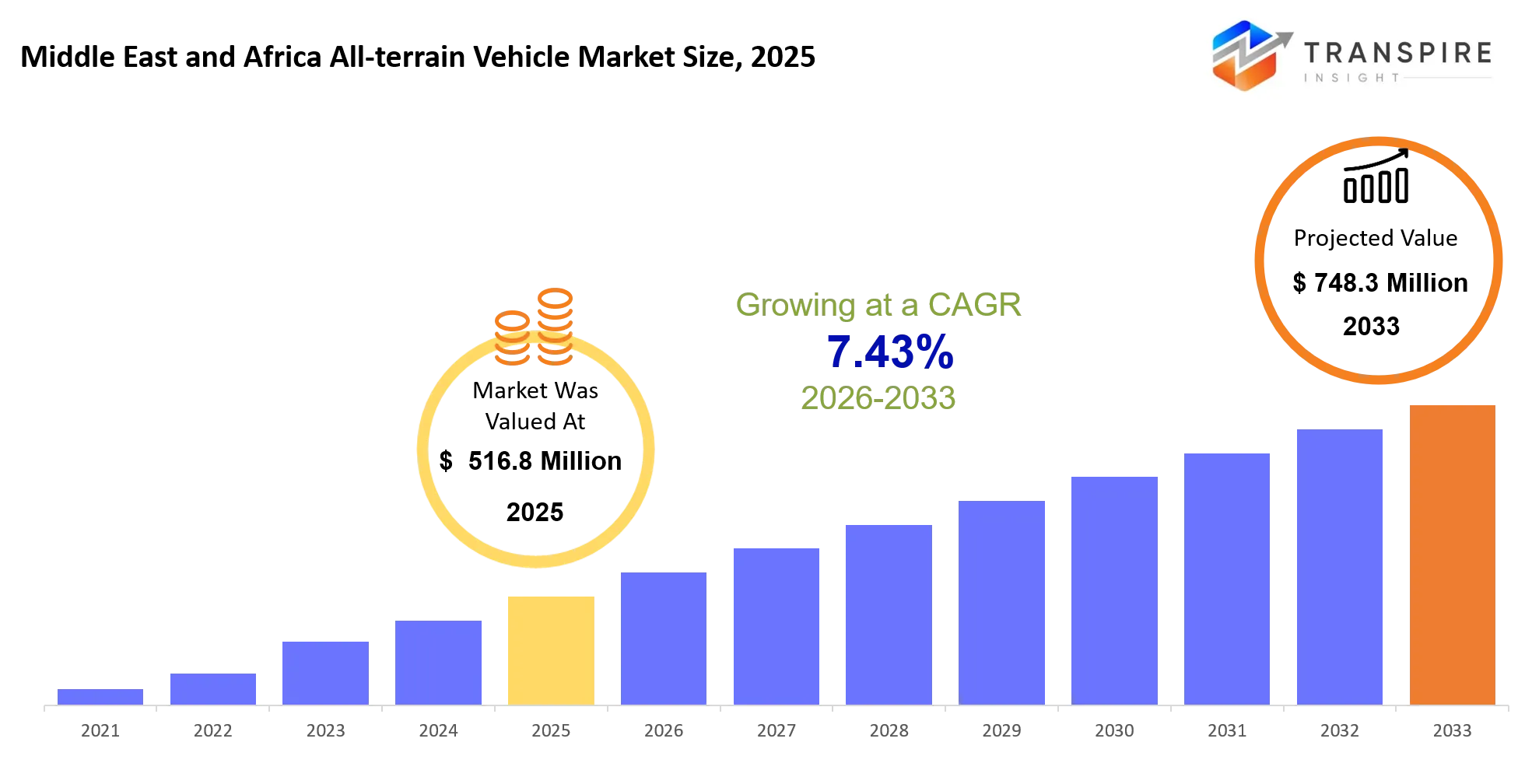
- Middle East and Africa All-terrain Vehicle Market Size 2025: USD 516.8 Million
- Middle East and Africa All-terrain Vehicle Market Size 2033: USD 748.3 Million
- Middle East and Africa All-terrain Vehicle Market CAGR: 7.43%
- Middle East and Africa All-terrain Vehicle Market Segments: By Vehicle Type (Sport ATV, Utility ATV, Recreational ATV, Youth ATV, Others); By Fuel Type (Gasoline, Electric, Hybrid, Others); By Application (Agriculture, Military, Recreation, Forestry, Others); By End User (Individuals, Commercial Users, Defense Sector, Others)
To learn more about this report,  Download Free Sample Report
Middle East and Africa All-terrain Vehicle Market Summary
The Middle East and Africa All-terrain Vehicle Market was valued at USD 516.8 Million in 2025. It is forecast to reach USD 748.3 Millionby 2033. That is a CAGR of 7.43% over the period.
The Middle East and Africa all-terrain vehicle (ATV) market basically serves those transportation utility and mobility needs that pop up in really rugged environments where normal vehicles, you know, just don't handle it all that well. ATVs are used a lot in agriculture, mining, oil and gas projects, tourism activities, desert patrol efforts, and also recreational off-road use. They can move across rough ground while carrying equipment and people, so they end up being pretty useful for both commercial teams and government programs.
Over the last five years, the market has shifted in a more structural way toward multi-purpose utility vehicles that come with better suspension systems, digital screens, telematics, and stronger towing ability. More mining activity, bigger infrastructure programs, and growing desert tourism have pushed fleet buying across Gulf countries and select areas in Africa. During the pandemic, supply chain disruptions also made distributors rethink things, so they diversified sourcing plans and built wider regional inventories, kinda quickly. With operators now looking for sturdy machines that cut down on maintenance downtime and boost output in remote places, ATV adoption keeps climbing across industrial, and yes recreational, segments. That supports steady revenue growth across the region.
Key Market Insights
- Utility ATVs kind of dominate the market, with more than 55% share, mostly because people use them everywhere across farming agriculture, mining, construction,and industrial operations, they just seem to fit.
- On the recreational side, ATV adoption rose about 20% from 2021 to 2025, backed by desert tourism growth and adventure activity programs that keep expanding.
- Saudi Arabia brings close to 30% of the regional demand, pushed by infrastructure projects, tourism development efforts, and these outdoor recreation investments that keep coming.
- Mining and construction end up taking over 35% of commercial ATV deployments, and it shows the growing need for trustworthy off-road mobility, not just “nice to have”.
- Commercial buyers make up more than 60% of total demand, while agriculture, mining, and utility service providers keep leading fleet purchases.
- For the Gulf Cooperation Council countries, it’s estimated around 45%+ of the regional market share, mainly tied to strong industrial activity and also a lot of recreational vehicle usage.
- After 2024, electric and hybrid ATV development really accelerated, since manufacturers started rolling out lower-emission models for worksite use and for tourism customers.
- Fleet operators are increasingly putting in GPS tracking, telematics platforms, and predictive maintenance systems, so they can improve vehicle utilization, and also cut down on downtime .
- Even youth and entry-level ATV categories are getting more traction, because brands expand product portfolios to lure first time riders and younger consumers.
- Polaris, Honda, Yamaha, BRP, CFMOTO, and Kawasaki keep building their competitive standing via dealer network expansion, product innovation, and off-road technologies that feel more advanced than before.
What are the Key Drivers, Restraints, and Opportunities in the Middle East and Africa All-terrain Vehicle Market?
The most compelling force behind market expansion is this kind of rapid growth, of utility-focused applications in agriculture, mining construction, and energy. Big infrastructure projects in Gulf nations, along with more intensive mineral extraction in Africa, push demand for transportation solutions that can handle rough ground and long distances without acting up. When project operators start looking for equipment that helps workforce mobility and cuts down travel time across remote areas, ATV purchases stop being “maybe later” and become almost a required operational move rather than a discretionary expense. That shift, in turn, supports more fleet procurement and a steady rhythm of recurring replacements.
Still, the biggest obstacle is the high overall cost of ownership linked to premium ATV models, plus the extra supporting infrastructure that comes with them. Import duties, shipping and logistics, routine maintenance, and the fact that local manufacturing capacity is limited all stack up, so acquisition costs stay elevated in many African markets. The issue is structural, too, because supply chains, dealer networks and domestic production capabilities don’t just appear overnight— they take years to build and mature. So, a lot of smaller operators either postpone buying or they keep using more conventional utility vehicles, even if the day to day efficiency isn’t as strong.
One of the longer-term opportunities, however, sits in blending electric powertrains with smart vehicle technologies. Governments and industrial operators are increasingly assessing lower-emission equipment for tourism operations, mining work, and conservation-linked activities. Electric ATV platforms, paired with GPS tracking, remote diagnostics, and fleet management software, can lower operating costs while also improving how well assets are utilized.
What Has the Impact of Artificial Intelligence Been on the Middle East and Africa All-terrain Vehicle Market?
Artificial intelligence and advanced digital technologies are, bit by bit, changing ATV operations across commercial and industrial uses across the Middle East and Africa, like more and more. Fleet operators increasingly rely on AI enabled telematics systems to watch vehicle condition, follow location information, and basically tune route planning, plus manage asset utilization across big working areas. These functions seem especially useful in places like mining, construction, and oilfield settings, where equipment reliability really, directly, impacts productivity.
Also, machine learning models are backing predictive maintenance efforts by looking at engine performance, vibration patterns, battery condition, and component wear and tear. Instead of only sticking to planned servicing, teams can spot likely faults before they turn into breakdowns. That helps cut down unplanned stoppage time and tends to raise fleet readiness. AI assisted analytics can then help curb fuel usage, improve how vehicles are assigned across a schedule, and shape maintenance plans, so operating costs drop in a measurable way.
Then there are digital fleet management platforms, they’re improving safety compliance via automated reporting, monitoring driver conduct, and tracking operational performance. In certain large industrial programs, these tools have apparently delivered double digit gains in equipment utilization and maintenance effectiveness, too, which is not small.
Still, adoption keeps getting slowed down. The integration expense can be high, connectivity is often weak in remote operating zones, and there’s not enough historical information to train predictive models well. Because of this, large scale rollout across parts of the region stays slower than it might otherwise be.
Key Market Trends
- Utility ATV purchases went up around 18% from 2021 to 2025, which, like, happened mainly because mining and agriculture operators started modernizing their field mobility fleets.
- Also, desert tourism operators grew their ATV fleets by well over 20% since 2022, just to keep adventure tourism programs running smoother I guess.
- After 2023, the manufacturers rolled out digital dashboards, smartphone connectivity, and GPS-based monitoring systems, especially across the premium models.
- Electric ATV development kinda sped up during 2024 and 2025, as BRP launched the Outlander Electric platform.
- Then in 2026, CFMOTO showed next-generation CFORCE ATV models, with efficiency upgrades, better connectivity, and usability improvements.
- Polaris also expanded its 2026 off-road lineup, bringing new utility-minded vehicles and rider-assistance tech that feels pretty advanced.
- In general, buyers seem to prefer multi purpose vehicles—ones that can cover work, transport, and recreational tasks on one platform, not separate things all the time.
- Dealer networks across Africa have broadened service and spare-parts availability, to deal with ownership worries, and boost overall fleet uptime.
- Connected fleet management solutions gained traction among commercial operators, who want predictive maintenance plus asset tracking capabilities.
- And yeah, competition is getting tighter too, because value-oriented manufacturers are challenging the premium brands with feature heavy vehicles but at lower price points.
Middle East and Africa All-terrain Vehicle Market Segmentation
By Vehicle Type
The vehicle type segment shows this broad mix of all-terrain vehicles that are built for recreational use, practical utility work, and specialized mobility needs across harsh locations. Sport ATV still holds a strong spot, mainly because performance minded design, higher speed capacity, and better maneuvering support really help recreational riding as well as competitive off-road activities. Demand is also kept steady by outdoor adventure programs and organized motorsport events happening in multiple countries, too.
Utility ATV takes a big piece of the market, mostly due to its regular presence in agriculture, construction, mining, and land management tasks, where reliable off-road travel matters. Recreational ATV keeps pulling in people who want outdoor downtime and tourism linked experiences. Youth ATV helps the entry level riders, with smaller vehicle dimensions and safety first features aimed at younger age brackets. Others, sort of like specialized options, cover models made for specific operational needs and custom off-road purposes.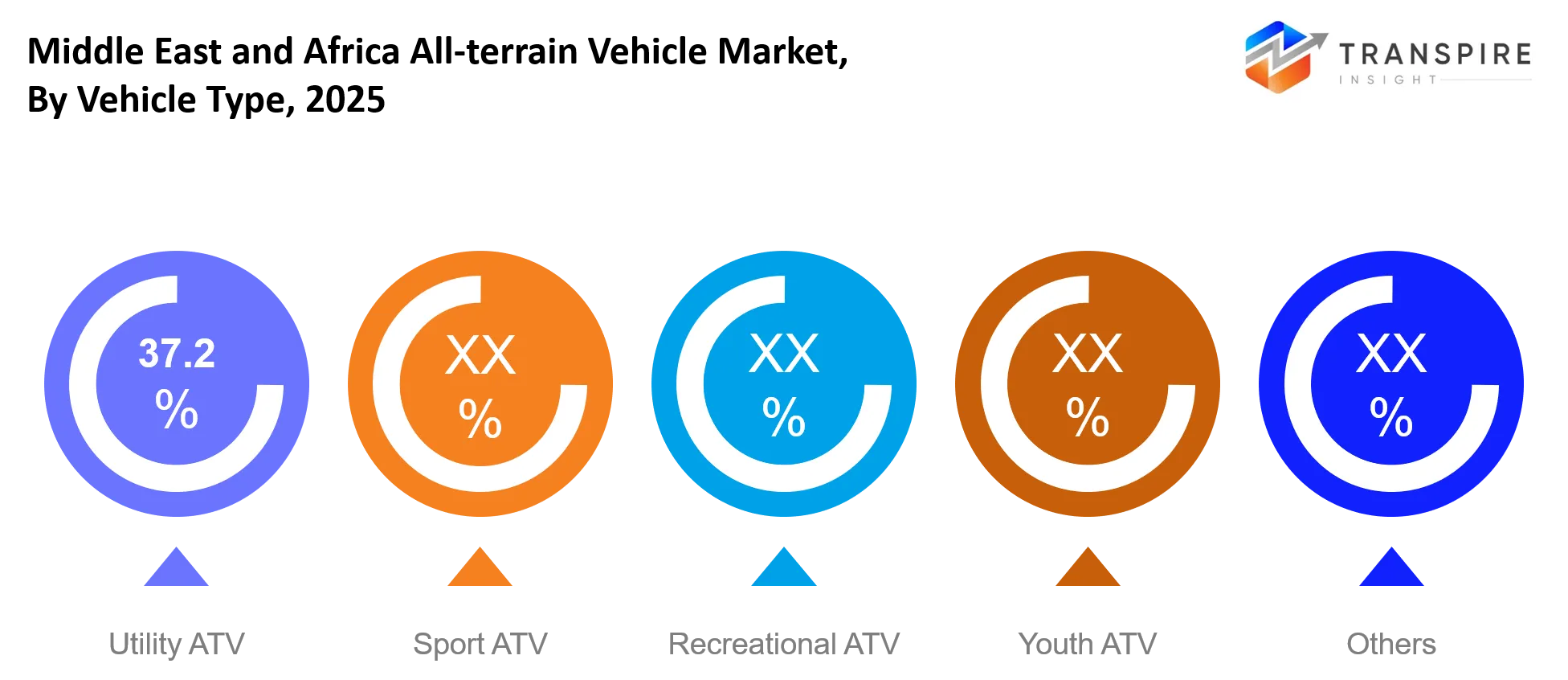
To learn more about this report, Download Free Sample Report
By Fuel Type
Fuel type segment kind of underlines the different power sources that end up powering performance, efficiency, and day to day operational flexibility, across a range of ATV categories. Gasoline still feels like it has the leading role, mainly because the fueling infrastructure is already in place, the engine performance is well proven, and the sheer breadth of models keeps pushing strong market acceptance. That steady power output plus the longer operating range also helps explain why it keeps getting adopted in both commercial and recreational settings
Electric models are also getting more attention, since some manufacturers keep rolling out battery powered alternatives meant to lower operating costs and keep noise levels comparatively smaller during use. Hybrid vehicles then sit in between, mixing conventional fuel systems with electric tech, so you get better efficiency but you don’t lose the operational flexibility part. “Others” is sort of everything else here, like alternative propulsion methods and specialized powertrain configurations, put together to meet unusual performance needs and these newer mobility trends that are popping up more and more.
By Application
The application segment shows, kinda the broad sweep of industries and activities where all terrain vehicles get used for mobility, operational efficiency, and getting to that sort of difficult terrain. Agriculture is a big category,of course because most farms need dependable transportation for field checks, moving gear around, livestock management, and those everyday operational chores. Strong vehicle performance plus versatility keeps helping adoption across different farming settings.
Military use still matters as well, mostly for patrol work, reconnaissance missions, logistics support, and mobility needs when locations are remote. Recreation keeps producing consistent demand too, through off-road experiences, tourism activities, and outdoor sporting events, where specialized vehicles are kind of a requirement. Forestry operations lean on ATVs for reaching wooded areas, resource oversight, and maintenance type work. Other uses cover construction, conservation, emergency response, and industrial applications where dependable off-road transportation solutions are critical.
By End User
The end user segment shows the wider customer base that buys and runs all-terrain vehicles for personal, commercial and institutional purposes. People are a big slice of that, mainly because of recreational riding, outdoor exploration, and also everyday personal utility needs, especially across rural areas as well as suburban neighborhoods. The product lineup, plus performance‑minded features still pull buyers who want adaptable off-road mobility, not just raw power but that overall reach.
Commercial Users take a meaningful portion of the market, since sectors like agriculture, mining, construction, tourism, and utilities lean on ATVs for operational support and workforce movement. The defense side stays steady too, supported by tactical transport, surveillance work and mission‑critical operations, all the time even when the terrain gets rough. Other buyers include government agencies, conservation groups, schools and training programs, plus niche service providers who use all-terrain vehicles for specific operational requirements, sometimes very particular ones.
What are the Key Use Cases Driving the Middle East and Africa All-terrain Vehicle Market?
The biggest share of demand mostly comes from utility operations in agriculture, mining, construction, and energy industry segments. In practice operators end up using ATVs to move personnel, tools and supplies across far away locations where regular vehicles hit mobility limits. Because they’re built strong plus they turn and handle well, they end up being kind of a daily requirement for field work.
Also, tourism and recreation show up as a pretty major secondary use. Desert safari operators, adventure tourism providers, and outdoor recreation businesses are leaning more and more on ATV fleets to run guided experiences. On top of that, government entities and security organizations use these vehicles too, for patrol and monitoring routines in hard terrain.
Newer uses keep appearing as well, like wildlife conservation efforts, inspections at renewable energy sites, and smart agriculture initiatives. As remote monitoring tech becomes more widespread, ATV platforms with digital connectivity features are expected to take on wider operational roles across industrial, environmental, and management activities.
|
Report Metrics |
Details |
|
Market size value in 2025 |
USD 516.8 Million |
|
Market size value in 2026 |
USD 541.5 Million |
|
Revenue forecast in 2033 |
USD 748.3 Million |
|
Growth rate |
CAGR of 7.43% from 2026 to 2033 |
|
Base year |
2025 |
|
Historical data |
2021 - 2024 |
|
Forecast period |
2026 - 2033 |
|
Report coverage |
Revenue forecast, competitive landscape, growth factors, and trends |
|
Regional scope |
Middle East and Africa (Saudi Arabia, United Arab Emirates, South Africa, Rest of Middle East and Africa) |
|
Key company profiled |
Polaris, Honda, Yamaha, BRP, Kawasaki, Suzuki, CFMOTO, Arctic Cat, Textron, Kubota, John Deere, Kymco, Hisun, Can-Am, Segway Powersports |
|
Customization scope |
Free report customization (country, regional & segment scope). Avail customized purchase options to meet your exact research needs. |
|
Report Segmentation |
By Vehicle Type (Sport ATV, Utility ATV, Recreational ATV, Youth ATV, Others); By Fuel Type (Gasoline, Electric, Hybrid, Others); By Application (Agriculture, Military, Recreation, Forestry, Others); By End User (Individuals, Commercial Users, Defense Sector, Others) |
Which Regions are Driving the Middle East and Africa All-terrain Vehicle Market Growth?
The Gulf region keeps leading the Middle East and Africa ATV market, mostly because there’s solid investment in tourism, infrastructure, and industrial development. Places like Saudi Arabia and the United Arab Emirates still run huge off-road recreation areas, while also working on large construction and energy projects at the same time, so it all kinda feeds into each other. Tourism programs backed by the government are still stretching outward and that keeps pulling demand for recreational ATV fleets. Plus there’s a pretty mature dealer, service, and parts ecosystem which adds extra pressure for the region to stay on top.
Southern Africa is the second biggest contributor to market revenue, though it feels a bit different. Instead of tourism being the main driver like in the Gulf, the market’s growth is tied more tightly to mining, agriculture, and resource extraction activities. Big mining sites need dependable off-road transportation, not just for the workforce, but also for equipment support. And because the industrial investment picture stays fairly steady, it gives the market a reliable base for ATV buys and replacement cycles.
Meanwhile, Sub-Saharan Africa looks like the fastest-growing regional market right now. Agricultural mechanization programs, infrastructure investments, and new mining efforts are creating fresh openings for off-road vehicle use. At the same time, distribution networks are improving, and product availability is getting broader, so commercial buyers can actually reach the vehicles more easily. For manufacturers and investors, this region basically reads like a long game win through 2033, since industrial development keeps speeding up.
Who are the Key Players in the Middle East and Africa All-terrain Vehicle Market and How Do They Compete?
Competition across the Middle East and Africa ATV market is somewhat moderately consolidated, like there are big players, global manufacturers actually do control a meaningful slice of both premium and commercial vehicle sales. In the end, technology, durability, dealer support, plus pricing still seem to drive most of the competition. Established brands keep trying to hold their ground via product upgrades, (product innovation) and at the same time they, well they defend market share. Emerging manufacturers, on the other hand, show up very aggressively with value offers, and feature availability that feels more “grab and go”.Polaris sort of stands out because it brings a broad set of products, plus advanced connectivity options, and specialized utility vehicles aimed at industrial users. The firm has also expanded its 2026 lineup with new utility and performance models, while layering in digital rider technologies, and even improving the vehicle interfaces. It’s like they’re trying to make everything feel more responsive.\
BRP competes with innovation as a core theme. Its electric ATV platforms and semi-active suspension tech, are basically a clear sign of a strategy built around performance differentiation and being seen as tech leaders.CFMOTO has grown fast, by pushing feature-rich vehicles at competitive prices. It rolled out new CFORCE ATV models in 2026, and keeps tightening its global distribution approach.Meanwhile, Honda and Yamaha still sit in strong positions, mainly from reliability, broad dealer networks and long-running brand recognition among both commercial and recreational users.
Company List
- Polaris
- Honda
- Yamaha
- BRP
- Kawasaki
- Suzuki
- CFMOTO
- Arctic Cat
- Textron
- Kubota
- John Deere
- Kymco
- Hisun
- Can-Am
- Segway Powersports
Recent Development News
In April 2026, CFMOTO and Horsepower Financial Services launched a nationwide off-road vehicle leasing program. The initiative lowers acquisition barriers for ATV and ORV buyers while strengthening dealer sales conversion and customer retention.https://powersportsbusiness.com
In March 2026, CFMOTO unveiled the new CFORCE C4, C5, and C6 PRO ATV range during a global launch event in France. The redesigned lineup introduces enhanced performance, connectivity features, and utility-focused improvements that strengthen the company's position in the global ATV segment.https://www.cfmoto.com
What Strategic Insights Define the Future of the Middle East and Africa All-terrain Vehicle Market?
The Middle East and Africa ATV market is slowly moving toward a more tech-driven but also utility minded future. The big structural force pushing this change is the rising need for efficient mobility answers across industrial projects, big tourism places, mining operations,and even more modern agricultural activity. Over the next five to seven years connected vehicles, predictive maintenance systems,and electrified powertrains are likely to become key competitive tools, not just “nice to have” premium extras.
There’s also a quieter risk that doesn’t get as much attention, like how the market can become concentrated around imported vehicles and critical parts. Stuff like supply chain disruptions, currency swings, or trade policy shifts can impact pricing and vehicle supply fast, across multiple African markets at once. Meanwhile electric utility ATVs for industrial and tourism use are turning into a meaningful opportunity, especially in Gulf countries that are chasing broad sustainability goals and larger tourism plans.
So manufacturers and investors should focus on local distribution, after-sales support strength, and digital fleet oversight platforms. The firms that blend technology innovation with solid regional service networks should end up best placed to win longer term market share.
Middle East and Africa All-terrain Vehicle Market Report Segmentation
By Vehicle Type
- Sport ATV
- Utility ATV
- Recreational ATV
- Youth ATV
- Others
By Fuel Type
- Gasoline
- Electric
- Hybrid
- Others
By Application
- Agriculture
- Military
- Recreation
- Forestry
- Others
By End User
- Individuals
- Commercial Users
- Defense Sector
- Others
Frequently Asked Questions
Find quick answers to common questions.
The Expected Middle East and Africa All-terrain Vehicle Market size for the Market will be USD 748.3 Million in 2033.
Key Segments for the Middle East and Africa All-terrain Vehicle Market are By Vehicle Type (Sport ATV, Utility ATV, Recreational ATV, Youth ATV, Others); By Fuel Type (Gasoline, Electric, Hybrid, Others); By Application (Agriculture, Military, Recreation, Forestry, Others); By End User (Individuals, Commercial Users, Defense Sector, Others).
Major Middle East and Africa All-terrain Vehicle Market players are Polaris, Honda, Yamaha, BRP, Kawasaki, Suzuki, CFMOTO, Arctic Cat, Textron, Kubota, John Deere, Kymco, Hisun, Can-Am, Segway Powersports.
The Current Middle East and Africa All-terrain Vehicle Market size is USD 516.8 Million in 2025.
The Middle East and Africa All-terrain Vehicle Market CAGR is 7.43% from 2026 to 2033.
- Polaris
- Honda
- Yamaha
- BRP
- Kawasaki
- Suzuki
- CFMOTO
- Arctic Cat
- Textron
- Kubota
- John Deere
- Kymco
- Hisun
- Can-Am
- Segway Powersports
About the Authors

Mayur Shinde
I am Mayur Shinde, a Senior Research Analyst at Transpire Insight, specializing in the Automotive & Transportation and Information & Communication Technology (ICT) Industry. My work focuses on analyzing emerging market trends, technological advancements, competitive landscapes, and industry developments to deliver accurate, data-driven insights. I am passionate about transforming complex market information into clear, actionable content that helps businesses, professionals, and decision-makers stay informed and make confident strategic decisions.

Chakradhar Khansole
Chakradhar serves as the Research Director at Transpire Insight, bringing over 8 years of experience in technology, innovation, and strategic market intelligence. He specializes in transforming complex market data into actionable business insights that enable organizations to make informed, growth-oriented decisions. Recognized for his strategic vision and analytical expertise, Chakradhar leads high-impact research initiatives, delivering comprehensive market assessments, competitive intelligence, and forward-looking industry analysis.
Recently Published Reports
-
Apr 2026
ATV & UTV Market
ATV & UTV Market Size, Share & Analysis Report By Type (ATV, and UTV), By Variants (Less Than 400 CC, 400 CC To 800 CC, and More Than 800 CC), and Geography (North America, Europe, Asia-Pacific, Middle East and Africa, South and Central America), 2021 - 2031
-
Apr 2026
Automotive Central Gateway Module Market
Automotive Central Gateway Module Market Size, Share & Analysis Report By Type (Ethernet Central Gateway Module, CAN Central Gateway Module, LIN Central Gateway Module, and FlexRay), By Application (Powertrain Control, Body Control, Infotainment System, Advanced Driver Assistance Systems (ADAS), and Others), By End User (Passenger Vehicles, and Commercial Vehicles), and Geography (North America, Europe, Asia-Pacific, Middle East and Africa, South and Central America), 2021 - 2031
-
Apr 2026
Automotive Engine Oil Filter Market
Automotive Engine Oil Filter Market Size, Share & Analysis Report By Filter Type (Fuel Filter, Engine Oil Filter, Hydraulic Oil Filter, and Others), By Filter Media (Cellulose, Synthetic, and Micro), By Sales Channel (OEMs, and Aftermarket), By Vehicle Type (Passenger Cars, Light Commercial Vehicles, Heavy Duty Trucks, Buses and Coaches, and Off-road Vehicles), and Geography (North America, Europe, Asia-Pacific, Middle East and Africa, South and Central America), 2021 - 2031
-
Apr 2026
Automotive Parts Aluminium Die Casting Market
Automotive Parts Aluminium Die Casting Market Size, Share & Analysis Report By Production Process (Pressure Die Casting, Vacuum Die Casting, Squeeze Die Casting, Gravity Die Casting), By Application (Body Parts, Engine Parts, Transmission Parts, Battery And Related Components, Other Application Types), and Geography (North America, Europe, Asia-Pacific, Middle East and Africa, South and Central America), 2021 - 2031
Our Clients



