

Asia Pacific Infantry Fighting Vehicle Market Size & Forecast:
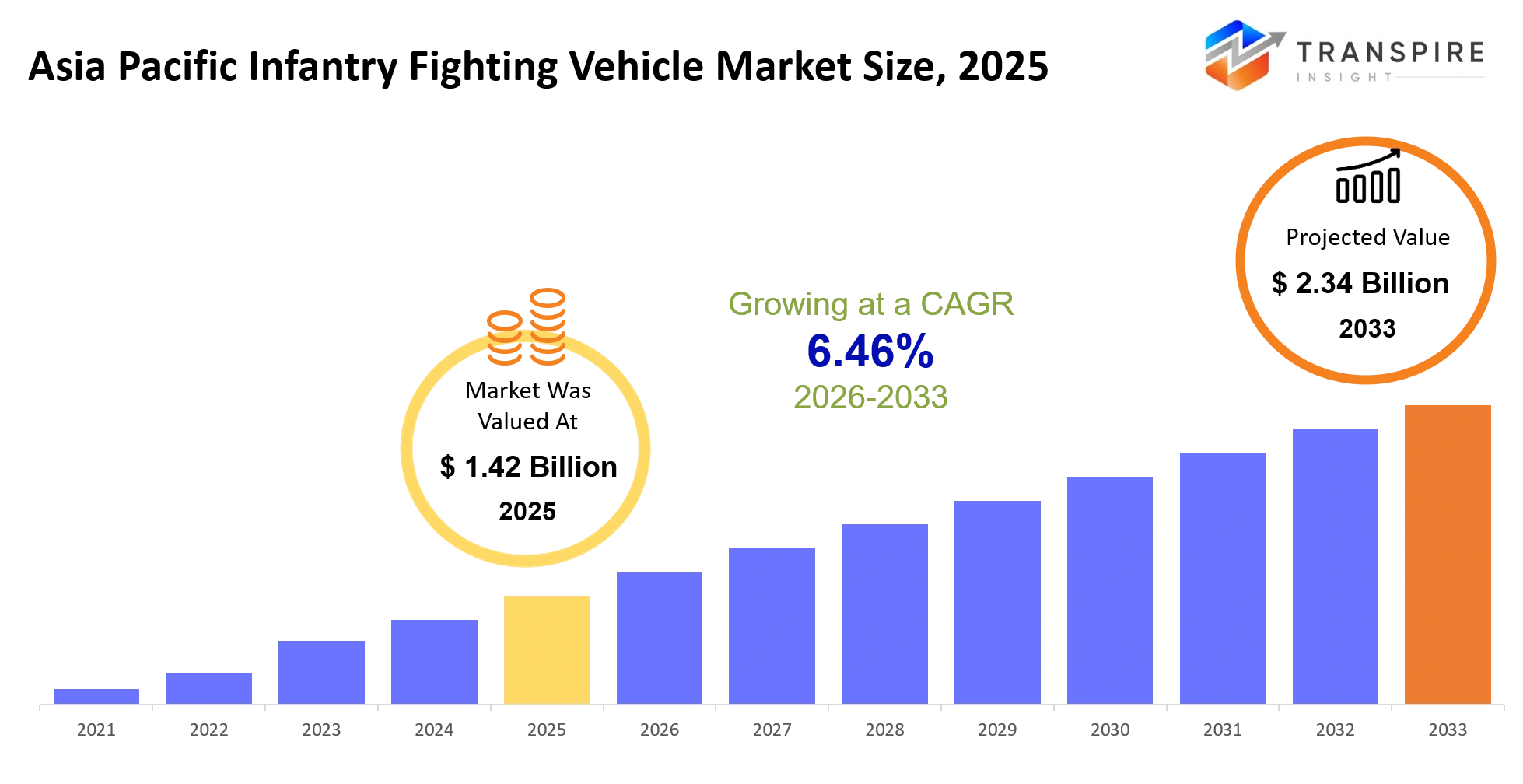
- Asia Pacific Infantry Fighting Vehicle Market Size 2025: USD 1.42 Billion
- Asia Pacific Infantry Fighting Vehicle Market Size 2033: USD 2.34 Billion
- Asia Pacific Infantry Fighting Vehicle Market CAGR: 6.46%
- Asia Pacific Infantry Fighting Vehicle Market Segments: By Vehicle Type (Tracked Infantry Fighting Vehicles, Wheeled Infantry Fighting Vehicles, Amphibious IFVs, Others); By Application (Combat Operations, Border Security, Peacekeeping Missions, Others); By End User (Defense Forces, Homeland Security Agencies, Others).
To learn more about this report,  Download Free Sample Report
Asia Pacific Infantry Fighting Vehicle Market Summary
The Asia Pacific Infantry Fighting Vehicle Market was valued at USD 1.42 Billion in 2025. It is forecast to reach USD 2.34 Billion by 2033. That is a CAGR of 6.46% over the period.
In the Asia Pacific Infantry Fighting Vehicle (IFV) market, armored platforms kind of move infantry through contested terrain while still delivering protected fire support vs anti armor threats , so coordinated maneuver stays possible in high intensity ground operations across different geographies. Over the last five years , the whole market seems to be leaning more toward digitized, networked and survivability focused designs, with active protection systems sensor fusion and modular turret architectures replacing the older configurations, while domestic production abilities grow across several key regional manufacturers.
This shift kind of got sped up by the Ukraine conflict, it altered how people see survivability in armored fighting, plus there is this ongoing bump in geopolitical tensions in the South China Sea and on the India–China border. Meanwhile, supply chain problems in semiconductors and also in advanced materials meant schedules got tangled up pretty quickly . Because of all that, regional militaries are leaning toward quick fleet modernization, more local build partnerships, and interoperability improvements, so in the end procurement choices tend to stress battlefield resilience , maneuvering ability, and less reliance on imported subsystem pieces.
Key Market Insights
- Asia Pacific basically dominates the Asia Pacific Infantry Fighting Vehicle Market, with almost 42% share in 2025 , and it is kind of led by China, India , South Korea and Australia procurement efforts.
- In the meanwhile, Southeast Asia looks like the fastest-growing sub-region through 2030 . Mainly because defense budgets keep rising and cross-border security modernization things are getting more attention these days.
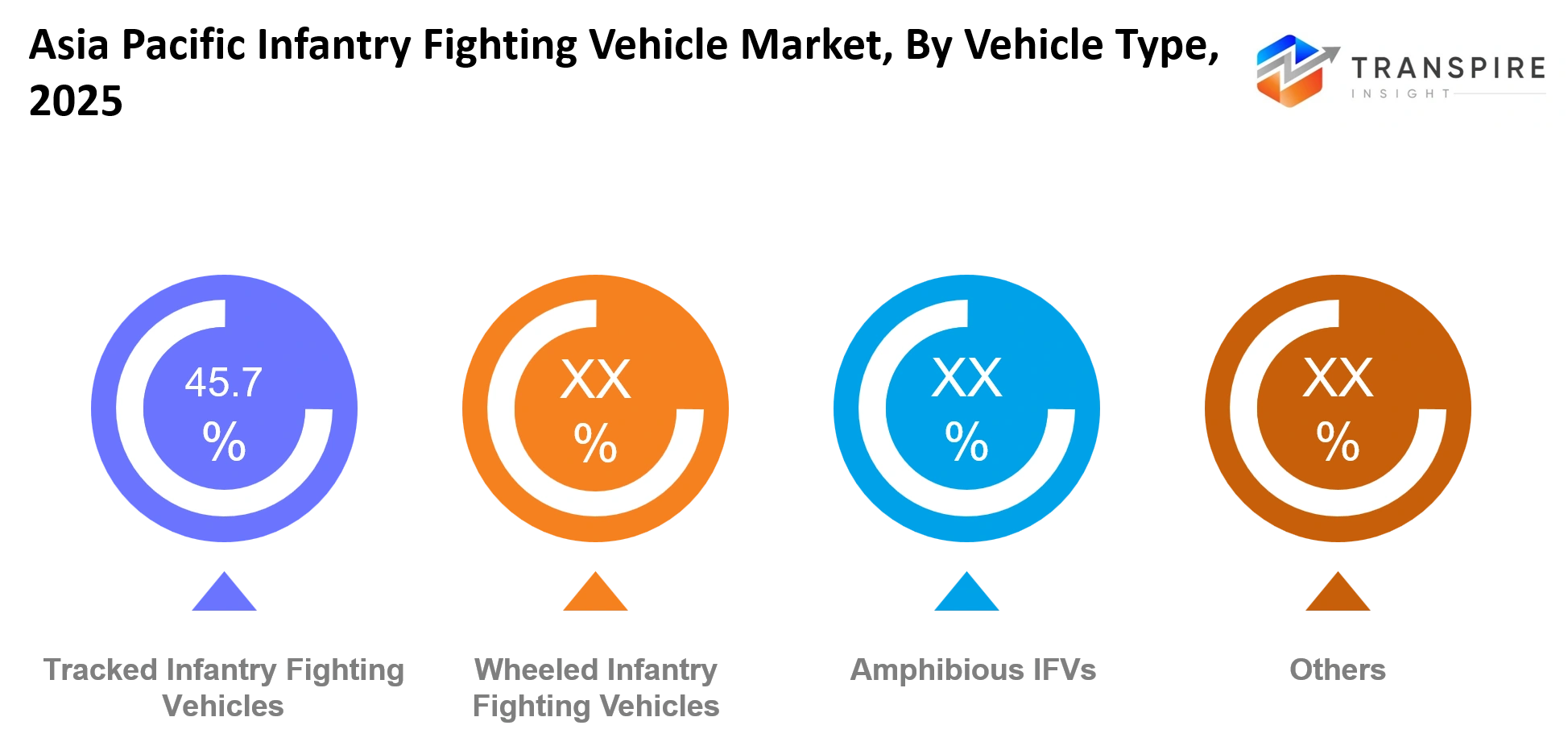
- Tracked Infantry Fighting Vehicles take the leading spot, about 58% share, mainly for superior mobility across different terrain, and combat environments.
- Wheeled IFVs sit as the second biggest chunk, since they tend to be more cost-efficient and support rapid deployment, especially in urban warfare zones.
- Hybrid and network-enabled IFVs are the fastest-growing segment across 2026–2032, with an emphasis on digital battlefield integration.
- Mechanized infantry transport stays dominant, around 60% share, helping frontline armored maneuver operations for a lot of Asia Pacific defense forces.
- For applications, reconnaissance and surveillance seem to be moving fastest. That’s linked to sensor upgrades and unmanned systems integration.
- National defense forces account for more than 85% share, largely pushed by sovereign procurement programs, while paramilitary and border security agencies are emerging as a quick-growing end user segment, due to internal security modernization initiatives.
What are the Key Drivers, Restraints, and Opportunities in the Asia Pacific Infantry Fighting Vehicle Market?
The Asia Pacific Infantry Fighting Vehicle Market is being shaped by three interconnected forces that, kind of, steer procurement cycles, platform design, and long-range modernization plans across regional defense forces.
First of all , the biggest push is accelerated force modernization , but it’s kind of driven by regional security tensions and also by lessons pulled from recent high intensity conflicts like the Ukraine war . Militaries across India , China , South Korea, and Australia are slowly shifting procurement away from legacy armored carriers , and more toward digitally enabled infantry fighting vehicles . These newer platforms have active protection systems , more effective armor composites and integrated battlefield networking, like you know , a more connected way of fighting .The whole movement kind of started after a survivability gap was spotted in conventional armored formations operating in precision-guided weapon environments. So, as a consequence, defense budgets are being more and more directed to next-generation IFVs, which boosts contract value per unit and also improves manufacturers long-term revenue visibility.
The main constraint is still the high lifecycle cost alongside stretched procurement cycles tied to IFV programs. These vehicles usually need multi-year development, complex integration of sensors and weapon systems, plus tough testing standards, which slows fielding and delays when revenue actually comes in. Because of that, the structural barrier can especially weigh on adoption by smaller Southeast Asian nations that have constrained defense budgets, and it ends up suppressing wider market penetration even though interest is growing.
There is a big chance, more or less, in Indigenous manufacturing and modular upgrade ecosystems, specially in India and South Korea. Things like India’s Future Infantry Combat Vehicle initiative, and also South Korea’s K21 upgrade pathways, show how making parts locally, plus plug and play digital subsystems, can cut down import dependence, and then help modernization scale up. In the end this kind of approach supports the Asia Pacific Infantry Fighting Vehicle Market, sort of opening wider pathways for faster and more repeatable upgrades.
What Has the Impact of Artificial Intelligence Been on the Asia Pacific Infantry Fighting Vehicle Market?
Artificial intelligence is getting more and more involved in reshaping the Asia Pacific Infantry Fighting Vehicle Market, not just as a buzzword but because it helps armored platforms get monitored, controlled, and kept in shape during actual combat-like situations. Today’s infantry fighting vehicles tend to rely on AI enabled battle management systems that kinda automate sensor fusion and add target tracking support, plus onboard diagnostics to reduce the crew burden and speed up the reaction window. On top of that, automated fleet monitoring tools let defense teams follow vehicle health across big armored units, so they can form readiness views in real time and cut down on those tedious manual reporting mistakes, that happen more often than people admit
Machine learning is also getting used for predictive maintenance, where engine performance signals, thermal readings and drivetrain vibration patterns are examined so component problems can be spotted before they turn into real failures. In practice this helps mission readiness and may lower unexpected downtime by something like 15–20 percent, while also stretching platform lifecycle efficiency overall. Then there’s AI driven logistics optimization, which supports spare parts forecasting and keeps maintenance timing in better order, that allows defense organizations to manage long term operational spending in the Asia Pacific Infantry Fighting Vehicle Market and lift fleet availability performance
Still, uptake is not fully smooth, because training data is limited in both quantity and quality from real combat contexts, and battlefield connectivity can be spotty. It becomes even harder in far flung or contested areas, which then drags down model accuracy and prevents decision-support systems from reaching true autonomy levels. Another blocker is the integration cost, especially when teams need to retrofit older armored platforms with advanced digital architectures, this slows deployment, particularly for mid tier defense budgets across Southeast Asia
Key Market Trends
- After the 2022 Ukraine conflict, Asian militaries started swapping out old school armored carriers faster than before with digitally networked infantry fighting vehicles, kind of aiming for more survivability and that whole survivable thing.
- India and South Korea, after 2023, pushed harder on indigenous IFV output. That reduced import dependence some and kinda boosted domestic defense manufacturing ecosystems too.
- Between 2022–2026, adoption of active protection systems really climbed. You can see it in things like China’s Type 08 and South Korea’s K21 upgrade paths, and the battlefield survivability metrics went up, not subtly either.
- Still, semiconductor supply chain disruptions from 2021–2024 messed with advanced sensor integration timelines so several programs ended up doing a phased rollout of digital fire-control systems, step by step.
- Also, AI-enabled maintenance analytics showed up more, and in 2025 trials it increased fleet readiness by about 15–20 percent across mechanized brigades in Australia and Japan, during the exercises.
- Modular turret architectures got more momentum after 2024. This helped armies upgrade weapon systems without doing a full platform redesign every single time, across multiple Asian defense efforts.
- Japan and Australia have increased joint procurement cooperation since 2023, and they aligned IFV interoperability standards with US-led Indo-Pacific defense frameworks, more than earlier planning.
- Meanwhile, from 2022 through 2025, Southeast Asia moved more toward wheeled IFVs. The reasons were cost efficiency and extra urban deployment flexibility requirements, which is where they were focusing.
Asia Pacific Infantry Fighting Vehicle Market Segmentation
By Vehicle Type :
Tracked infantry fighting vehicles keep leading , mainly because strong armor and off-road mobility back heavy battlefield tasks across rough terrain, especially through the Asia Pacific Infantry Fighting Vehicle Market. Defense organizations like them for front line clashes, where protection and fire support really weigh in during fast changing conflict conditions , not just steady ones.
Wheeled infantry fighting vehicles are getting more notice , since some military units want quicker on-site arrival and a more manageable day to day operating effort. There are also amphibious versions, used in coastal zones and river focused areas where crossing water matters, giving more operational flexibility plus rapid troop movement.
To learn more about this report, Download Free Sample Report
By Application :
When it comes to use, combat operations stay the biggest lane. Infantry fighting vehicles back armored assaults, move infantry as transport platforms , and help with direct engagement support in high-risk sectors. At the same time, growing regional tensions have nudged defense forces to refresh older fleets, so they gain stronger mobility plus upgraded protection systems.
Border security is also expanding as countries strengthen surveillance and response setups near sensitive lines. Peacekeeping missions likewise rely on these vehicles for safer troop relocation in unstable regions, where protection and measured mobility are needed to keep order, and support ongoing field activities.
By End User :
Defense forces take the biggest portion because national armies tend to drive procurement and modernization programs across the region, it feels like they kind of pull everything together. These forces usually concentrate on improving armored capabilities so battlefield readiness goes up and so risks to infantry units get reduced during combat operations.
At the same time, homeland security agencies are putting more emphasis on infantry fighting vehicles for internal security, counter-terror assistance and rapid response requirements. Some other users are specialized paramilitary units; they need protected mobility for missions in sensitive or higher risk settings, even when things are moving fast.
What are the Key Use Cases Driving the Asia Pacific Infantry Fighting Vehicle Market?
In the Asia Pacific Infantry Fighting Vehicle market, the core use case revolves around mechanized combat operations , where armored infantry vehicles move troops, give direct fire support, and also boost survivability in those high intensity clashes across mixed landscapes and contested areas.
Then there are the expanding use cases like border security patrols and counter insurgency missions, where defense and homeland security agencies send infantry fighting vehicles for fast reaction, surveillance backing, and controlled mobility in sensitive or far away regions, that are dealing with shifting security risks.
More emerging use cases lean toward AI assisted battlefield networking, plus unmanned reconnaissance integration and urban warfare tuning, meaning next generation platforms help improve situational awareness and coordination between field units, even when they’re spread out, inside modernization programs across Asia Pacific defense forces.
|
Report Metrics |
Details |
|
Market size value in 2025 |
USD 1.42 Billion |
|
Market size value in 2026 |
USD 1.51 Billion |
|
Revenue forecast in 2033 |
USD 2.34 Billion |
|
Growth rate |
CAGR of 6.46% from 2026 to 2033 |
|
Base year |
2025 |
|
Historical data |
2021 - 2024 |
|
Forecast period |
2026 - 2033 |
|
Report coverage |
Revenue forecast, competitive landscape, growth factors, and trends |
|
Regional scope |
Asia Pacific (India, China, Japan, Australia,South Korea, Rest of Asia Pacific) |
|
Key company profiled |
BAE Systems, Rheinmetall, General Dynamics, Hanwha Aerospace, ST Engineering, Elbit Systems, Lockheed Martin, Oshkosh Defense, KNDS, NORINCO, Tata Advanced Systems, Mitsubishi Heavy Industries, Bharat Forge, FNSS, Patria. |
|
Customization scope |
Free report customization (country, regional & segment scope). Avail customized purchase options to meet your exact research needs. |
|
Report Segmentation |
By Vehicle Type (Tracked Infantry Fighting Vehicles, Wheeled Infantry Fighting Vehicles, Amphibious IFVs, Others); By Application (Combat Operations, Border Security, Peacekeeping Missions, Others); By End User (Defense Forces, Homeland Security Agencies, Others). |
Which Regions are Driving the Asia Pacific Infantry Fighting Vehicle Market Growth?
In the Asia Pacific Infantry Fighting Vehicle Market, the leading region is China, because of large-scale defense modernization programs and a very integrated domestic production base. There are strong state-backed purchase cycles coming from the People’s Liberation Army, and they keep pushing steady demand for both tracked and wheeled vehicles. Also the fact that defense makers like Norinco are already well established really helps local supply chains and, in practice, it lowers dependence on imported components. With this kind of ecosystem, it becomes easier to push quicker design upgrades, and run large-volume output. That’s a big reason China stays ahead in terms of how many units get deployed, and how fast the technology keeps iterating.
India is more like a steady contributor, and it feels strategically important too, but the demand here is guided by long-term modernization planning ,not by quick procurement cycles. The Make in India initiative has pushed local assembly and also joint ventures, so the country can build more internal competence while trimming reliance on foreign suppliers. Procurement efforts tend to center on swapping out older armored fleets, mainly for better protection plus improved mobility that works across different kinds of terrain. This more even investment style generates predictable revenue streams, and it also supports gradual growth across the Asia Pacific Infantry Fighting Vehicle Market, over time.
Southeast Asia ,on the other hand, is the fastest-growing area. This is largely due to rising defense budgets and stronger security worries, especially around maritime border regions. Nations such as Indonesia, Vietnam, and the Philippines are ramping up spend on wheeled infantry fighting vehicles for mobility ,and for better cost efficiency. There have also been procurement changes that lean more toward imported and co-produced platforms, and these shifts reflect a faster modernization wave that really gained momentum after 2022. Overall this expansion hints at solid entry prospects for global suppliers and joint venture teams during the 2026–2033 period.
Who are the Key Players in the Asia Pacific Infantry Fighting Vehicle Market and How Do They Compete?
In the Asia Pacific Infantry Fighting Vehicle Market, competition is only moderately consolidated at the top level, in the sense that a small pack of global defense primes plus a bunch of state- backed manufacturers kind of steer most of the big ticket deals. A lot of the rivalry is not really about pure unit cost, it is more about technology integration, localization know-how, and the whole life cycle support story. Buyers are also becoming more picky, they increasingly look at digital battlefield systems, modular upgrade potential, and whether a supplier can set up local production arrangements that match national defense policies, sometimes even before pricing discussions.
Hanwha Aerospace tries to stand out by leaning hard into tech, especially with the K21 platform upgrades, where improved armor systems and digital fire-control suites get stitched in more thoroughly. It also seems to lock in momentum by partnering with regional defense agencies, plus expanding production cooperation across Asia, so the platform fits local procurement requirements, like it actually matches what the buyer wants on paper and in practice.
Rheinmetall, on the other hand, builds leverage using modular vehicle architectures and more advanced turret systems, which makes it easier to reconfigure the platform for different operational roles without too much delay. In Asia, it pushes growth through joint ventures and technology transfer arrangements, aiming for localized assembly and—this part matters—faster procurement approvals.
General Dynamics Land Systems tends to win on platform reliability that is already proven, plus interoperability with NATO standard systems, which is a strong draw for allies like Australia. Their emphasis is more on lifecycle support contracts and upgrade paths, not just selling brand new vehicles and calling it done.
Norinco leans into scale, it benefits from large domestic production capacity and cost-efficient design standardization across its armored vehicle family. It strengthens its position by supplying integrated solutions to domestic forces, while also expanding a selective export approach into defense markets in Southeast Asia that are still developing, where procurement teams often want quick availability and predictable production.
Company List
- BAE Systems
- Rheinmetall
- General Dynamics
- Hanwha Aerospace
- ST Engineering
- Elbit Systems
- Lockheed Martin
- Oshkosh Defense
- KNDS
- NORINCO
- Tata Advanced System
- Mitsubishi Heavy Industries
- Bharat Forge
- FNSS
- Patria
Recent Development News
In January 2026, ST Engineering secured a Ministry of Defence (MINDEF) contract for the production of next-generation Infantry Fighting Vehicles based on the Terrex s5 platform. The program marks a major modernization push for Singapore’s mechanized forces, emphasizing digitally integrated, survivable IFVs with deliveries scheduled from 2028 onward.
Source: https://www.stengg.com/
In April 2026, India’s Defence Research and Development Organisation (DRDO), in partnership with Bharat Forge Limited and Tata Advanced Systems Limited, unveiled an indigenous Advanced Armoured Platform as a potential replacement for the BMP-2 Infantry Fighting Vehicle fleet. The program strengthens India’s domestic IFV manufacturing base with up to 90% indigenous content and integrated 30mm turreted combat systems.
Source: https://thedefensepost.com/
What Strategic Insights Define the Future of the Asia Pacific Infantry Fighting Vehicle Market?
The Asia Pacific Infantry Fighting Vehicle Market is basically leaning, in a kind of gradual way, toward very networked digitally enabled armored ecosystems where survivability , real-time data exchange and modular upgrade ability kinda set the buying focus. In the next 5–7 years, defense modernization cycles across India, China, Japan, and Southeast Asia will keep pushing spending toward platforms that bring AI-assisted aiming support, sensor fusion and active protection systems under one umbrella. This momentum is fueled by continued geopolitical tension and also by the need for quicker battlefield decision-making in multi-domain operations.
There is also a less obvious risk that doesn’t get discussed enough, supply chain concentration in advanced electronics and precision optics. If a country relies on a small number of global suppliers, then any geopolitical disruption , or even stricter export control rules could create real bottlenecks. In practice, that can slow down upgrade timelines and lift lifecycle costs for a few programs across the region.
On the opportunity side, you can see more retrofit modernization programs for older armored fleets. Especially in Southeast Asia, where budget limits make upgrade kits more attractive than full vehicle replacement. So it ends up forming a kind of parallel aftermarket world for sensor packages, communications suites, and defense protection layers.
For market players, the priority should be modular design approaches that let upgrades happen step by step. That also helps in signing longer term deals that run past the first buy, and it can secure recurring revenue as modernization phases roll forward.
Asia Pacific Infantry Fighting Vehicle Market Report Segmentation
By Vehicle Type
- Tracked Infantry Fighting Vehicles
- Wheeled Infantry Fighting Vehicles
- Amphibious IFVs
By Application
- Combat Operations
- Border Security
- Peacekeeping Missions
By End User
- Defense Forces
- Homeland Security Agencies
Frequently Asked Questions
Find quick answers to common questions.
The Asia Pacific Infantry Fighting Vehicle Market size is USD 2.34 Billion in 2033.
Key segments for the Asia Pacific Infantry Fighting Vehicle Market are By Vehicle Type (Tracked Infantry Fighting Vehicles, Wheeled Infantry Fighting Vehicles, Amphibious IFVs, Others); By Application (Combat Operations, Border Security, Peacekeeping Missions, Others); By End User (Defense Forces, Homeland Security Agencies, Others).
Major Asia Pacific Infantry Fighting Vehicle Market players are BAE Systems, Rheinmetall, General Dynamics, Hanwha Aerospace, ST Engineering, Elbit Systems, Lockheed Martin, Oshkosh Defense, KNDS, NORINCO, Tata Advanced Systems, Mitsubishi Heavy Industries, Bharat Forge, FNSS, Patria.
The Asia Pacific Infantry Fighting Vehicle Market size is USD 1.42 Billion in 2025.
The Asia Pacific Infantry Fighting Vehicle Market CAGR is 6.46% from 2026 to 2033.
- BAE Systems
- Rheinmetall
- General Dynamics
- Hanwha Aerospace
- ST Engineering
- Elbit Systems
- Lockheed Martin
- Oshkosh Defense
- KNDS
- NORINCO
- Tata Advanced System
- Mitsubishi Heavy Industries
- Bharat Forge
- FNSS
- Patria
About the Authors

Tejashri Dhatrak
I am Tejashri Dhatrak, a Senior Research Analyst at Transpire Insight, specializing in the Aerospace and Defence sector. My work focuses on analyzing industry trends, defence technologies, market developments, and emerging innovations that shape the global aerospace and security landscape. At Transpire Insight, I research complex topics, evaluate credible sources, and transform technical insights into accurate, well-structured, and easy-to-understand content for industry professionals and decision-makers. My goal is to provide reliable, research-backed information that helps readers stay informed about defence capabilities, aerospace advancements, strategic developments, and the evolving dynamics of the global defence ecosystem.

Chakradhar Khansole
Chakradhar serves as the Research Director at Transpire Insight, bringing over 8 years of experience in technology, innovation, and strategic market intelligence. He specializes in transforming complex market data into actionable business insights that enable organizations to make informed, growth-oriented decisions. Recognized for his strategic vision and analytical expertise, Chakradhar leads high-impact research initiatives, delivering comprehensive market assessments, competitive intelligence, and forward-looking industry analysis.
Recently Published Reports
-
Apr 2026
Aerospace Fluoropolymers Market
Aerospace Fluoropolymers Market Size, Share & Analysis Report By Type (PTFE, FEP, PFA, ETFE, and Others), By Application (Electrical Insulation, Seals & Gaskets, Coatings, and Others), By End User (Commercial Aviation, Military Aviation, General Aviation, and Others), and Geography (North America, Europe, Asia-Pacific, Middle East and Africa, South and Central America), 2021 - 2031
-
Apr 2026
Airborne SATCOM System Market
Airborne SATCOM System Market Size, Share & Analysis Report By Type (SATCOM Terminals, Transceivers, Airborne Radio, Modems and Routers, SATCOM Radomes, and Other), By Application (Government and Defense and Commercial), and Geography (North America, Europe, Asia-Pacific, Middle East and Africa, South and Central America), 2021 – 2031
-
Apr 2026
Ship Leasing Market
Ship Leasing Market Size, Share & Analysis Report By Vessel Type (Container Ships, Bulk Carriers, Tankers, and Specialized Vessels), By Lease Duration (Short-Term Lease (Less than 1 year), Medium-Term Lease (1-5 years), and Long-Term Lease (More than 5 years)), By Lease Type (Bareboat Charter, Time Charter, Financial Lease, and Others), By End-User Industry (Oil and Gas, Manufacturing and Industrial, Automotive, Agriculture and Food, Retail and Consumer Goods, and Others), and Geography (North America, Europe, Asia-Pacific, Middle East and Africa, South and Central America), 2021 – 2031
-
Apr 2026
Thread Rolling Dies Market
Thread Rolling Dies Market Size, Share & Analysis Report By Type (Flat Thread Rolling Dies, Circular (Cylindrical) Dies, Tangential Thread Rolling Dies, Planetary Thread Rolling Dies, and Other Types), By Material Type (High-Speed Steel (HSS), Carbide, Tool Steel, Alloy Steel, and Other Specialized Alloys), By Distribution Channel (Direct Sales, Distributors and Dealers, and Online Platforms), By Application (Automotive Industry, Aerospace and Defense, Construction and Infrastructure, Industrial Machinery, Electronics and Electrical Components, Medical Devices, and Fastener Production), and Geography (North America, Europe, Asia-Pacific, Middle East and Africa, South and Central America), 2021 – 2031
Our Clients





