
Middle East and Africa Aircraft Gears Market Summary
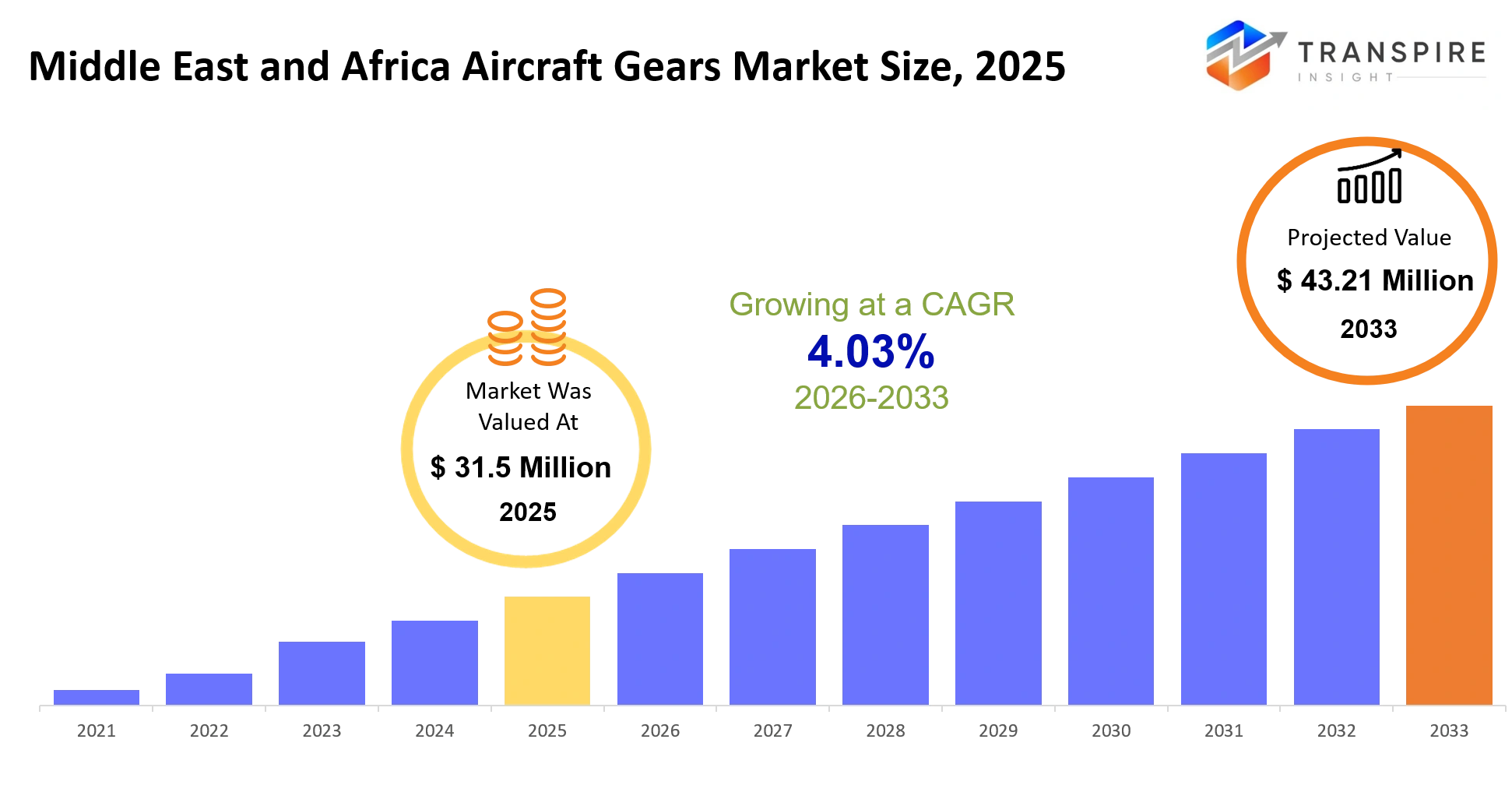
As per Transpire Insight Analysis the Middle East and Africa Aircraft Gears Market size is estimated at USD 31.5 Million in 2025 and is anticipated to reach USD 43.21 Million by 2033, growing at a CAGR of 4.03% from 2026 to 2033.
The Middle East and Africa Aircraft Gears Market helps ensure that mechanical power can be delivered safely and in a dependable way across several essential aircraft systems, like landing gear assemblies, engines flight controls and also auxiliary equipment. Aircraft gears let components keep moving smoothly even when the loads get intense, and at the same time they can improve flight safety, maintenance efficiency, and day to day operational reliability for commercial, military, and business aviation operators. In the last five years, things have leaned more and more toward lighter, precision tuned gear arrangements, made using advanced alloys, plus digital production approaches so the parts last longer and the lifecycle spend stays lower.
Meanwhile the supply chain problems that came after the COVID-19 period, along with geopolitical tensions, made it obvious how much the industry relies on specialized aerospace parts, so airlines and defense groups started building up regional repair, upkeep, and local manufacturing capacity. With fleet modernization initiatives running, maintenance repair and overhaul work continuing to expand, and defense aviation budgets staying active, the result is stronger buying of advanced gear systems. That is creating steady aftermarket income, not only from new deliveries of aircraft but also from the ongoing demand to keep fleets operating without interruption.
Middle East and Africa Aircraft Gears Market Size & Forecast:
- Middle East and Africa Aircraft Gears Market Size 2025: USD 31.5 Million
- Expected Market Value 2033: USD 43.21 Million
- Forecast CAGR: 4.03%
- Leading country in 2025: United Arab Emirates (UAE)
- Fastest-growing country: Saudi Arabia
- Key Profile: Safran Landing Systems, Collins Aerospace, Liebherr Aerospace, Triumph Group, Parker Hannifin, Honeywell Aerospace, RTX, Boeing, Airbus, GKN Aerospace, Moog, SKF Aerospace, Timken, Eaton Aerospace, Kawasaki Heavy Industries.
Key Market Insights
- The Middle East and Africa Aircraft Gears Market is forecast to hit USD 43.21 million by 2033, largely supported by commercial and military fleet upgrades, kind of a steady push.
- Saudi Arabia, sort of dominated the regional market with an estimated 31.8% share in 2025, powered by defense procurement , and also aviation localization initiatives.
- South Africa is projected to grow the quickest through 2033, mainly backed by expanding aerospace MRO capabilities and related maintenance knowhow, plus more capacity.
- On the product side, landing gears stayed out in front, with close to 34% market share in 2025, due to strict safety rules and replacement needs.
- Helical gears ranked as the second-largest segment.Precision gears are expected to see the fastest expansion during the forecast period.
- For applications, landing gear systems accounted for about 38% of application revenue. Meanwhile engine systems are gaining momentum, as fleet modernization keeps rolling.
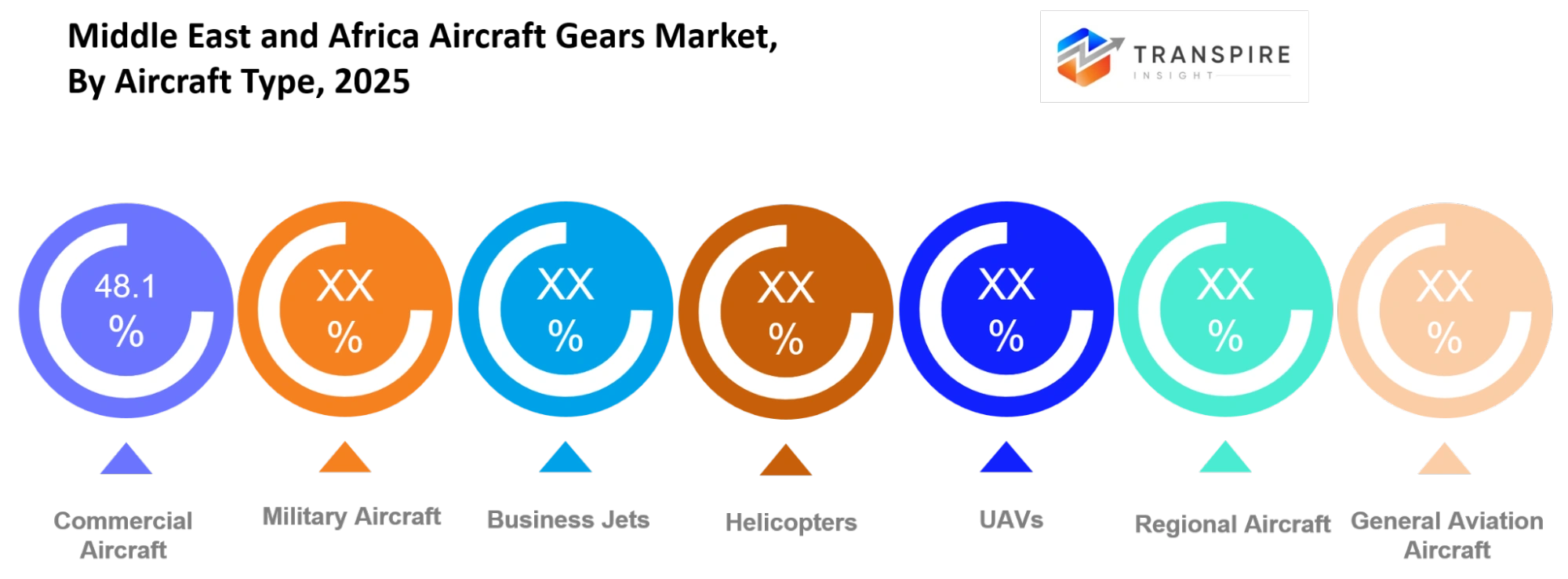
- As for end users, commercial aircraft remained the biggest group with around 46% share, while military aircraft keep expanding through regional defense investments.
- Among the key players , Safran Landing Systems, Collins Aerospace, Liebherr Aerospace, Honeywell Aerospace, RTX, and GKN Aerospace continue putting money into lightweight gear technologies.
- Manufacturers are also leaning into partnerships with regional MRO providers , alongside additive manufacturing and digital inspection tools, so they can shorten overhaul cycles.
- Overall , strategic expansion into Middle Eastern aerospace hubs helps aftermarket services, improves component availability, and supports long-term competitive positioning.
What are the Key Drivers, Restraints, and Opportunities in the Middle East and Africa Aircraft Gears Market?
Fleet modernization through the Gulf states and steady defense purchasing still sit as the biggest drivers for the aircraft gears industry. In Saudi Arabia and the UAE, national aerospace localization plays have pushed more spending into aircraft assembly, servicing, and component fabrication, while carriers keep swapping older fleets for more fuel-efficient aircraft. All of this has a direct need for high performance gear assemblies, that can handle heavier mechanical loads and stricter compliance rules. On top of that, regional MRO sites are growing, so the replacement rhythms for landing gear and engine gear parts keep getting shorter and more frequent, which ends up producing ongoing aftermarket income next to original equipment sales.
Aircraft gear production relies on certified aerospace-grade alloys, careful machining, and tough qualification routines, and well… all of it needs serious capital budgets plus long certification calendars. A lot of Middle Eastern and African countries still depend on imported high-value parts, usually coming from North American and European suppliers, and that makes everyone vulnerable to logistics hiccups, currency swings, and longer lead times. Those structural limits reduce local output capacity, delay fleet maintenance, and shrink possible market revenue especially when supply chains get shaky, or when availability drops suddenly.
Meanwhile, investment across the region in aerospace manufacturing and advanced maintenance infrastructure looks like a solid long term opening. Techniques like additive manufacturing, digital twin methods, and AI supported quality checks can help produce certified replacement gears quicker, while cutting down material waste plus lowering production expenses.
What Has the Impact of Artificial Intelligence Been on the Middle East and Africa Aircraft Gears Market?
Artificial intelligence is kind of changing how aircraft gear manufacturing and maintenance get handled, mostly by boosting inspection accuracy, tweaking maintenance scheduling, and improving production flow, like not just faster but more steady. Machine learning algorithms look at vibration signals, lubrication conditions, temperature swings, and operational loads, then they figure out early cues of gear degradation before a mechanical failure shows up. Airlines and maintenance groups are starting to pair AI with digital twin platforms—so they can sort of “rehearse” how a component will behave across its full service life, and then engineers can adjust overhaul timing, which lowers the chances of nasty, unplanned aircraft downtime. On top of that, computer vision systems automate quality checks in manufacturing too, spotting microscopic surface flaws that typical manual inspections might miss, leading to more consistent results while also trimming production time.
Then there’s advanced analytics, which further fine tune spare parts inventory and maintenance planning across regional facilities, so operators can keep aircraft from sitting on the ground too long and improve overall fleet availability. AI assisted manufacturing also helps with machining precision and process control, cutting down scrap and improving reliability of the finished gears. Still, adoption is somewhat slowed by the high cost of hooking AI platforms into certified aerospace manufacturing setups and older maintenance software. A lot of regional operators also lack enough historical operating data to train predictive models well, especially when it comes to specialized military aircraft and smaller commercial fleets. Even with that, the growth of digital aviation infrastructure, plus ongoing investment in smart manufacturing, should speed up AI use in both aircraft gear production and the aftermarket services, slowly but surely.
Key Market Trends
- After 2021, aircraft makers more and more swapped typical steel parts for titanium, and other advanced metal mixtures to squeeze more fuel efficiency out of every flight and to keep parts useful longer.
- From 2022 through 2025, regional carriers pushed fleet updates faster, which made demand jump for precision certified landing gear transmission pieces, kind of across the board.
- On the defense side, procurement agendas leaned harder into locally sustained aerospace supply chains, often through industrial tie ups with major global OEMs.
- Additive manufacturing also moved, sort of, from quick prototyping toward certified aerospace component production, and that trimmed the lead time for some replacement gear assemblies.
- Predictive maintenance platforms that use AI plus sensor analytics became much more common with big MRO providers. This helped component trustworthiness, and also made maintenance planning less guessy, more structured.
- Aerospace companies broadened collaborations with maintenance hubs in the Middle East, aiming to improve aftermarket support and also speed up overhaul turnaround times.
- Digital quality inspection systems, powered by machine vision, improved consistency in production. At the same time, they cut down how much manual checking was needed during precision gear manufacturing.
- Commercial aviation recovery after the pandemic redirected spending toward fleet dependability and lifecycle cost reduction, rather than leaning on deferred maintenance.
- Worldwide suppliers, including Safran , Collins Aerospace , Honeywell Aerospace, and RTX, expanded technology cooperation to strengthen regional aerospace know-how.
- And governments increasingly backed aerospace localization rules, which encouraged bigger regional manufacturing involvement and long term industrial competitiveness.
Middle East and Africa Aircraft Gears Market Segmentation
By Gear Type
Landing Gears take the biggest share, more or less, because safe takeoff, landing, and even taxiing depend on durable gear assemblies that can handle repeated stress day after day. Spur Gears back up straightforward power transfer with dependable results, especially in auxiliary systems where steady torque has to stay essential. Bevel Gears help with smooth motion handoff between intersecting shafts, while Helical Gears tend to run quieter and manage load better, which matters a lot for demanding aerospace work. Planetary Gears bring a compact layout with strong torque potential, so installation becomes workable in aircraft systems that are space-limited.
Worm Gears are used when controlled motion is required, since speed reduction and accurate positioning still have to stay true. Precision Gears are getting more attention, because newer aircraft platforms demand close manufacturing tolerances and reliable mechanical behavior. There are also other setups—specialized gear layouts created for particular aircraft shapes and mission-focused equipment. Ongoing improvements in manufacturing methods and material quality keep reinforcing performance across basically every gear category.
By Aircraft Type
Commercial Aircraft are kinda the most important segment, because as passenger traffic keeps expanding and fleet modernization programs keep going, there is steady demand for dependable gear assemblies , even more than the rest. Military Aircraft on the other hand need heavy duty gear systems that can handle combat missions, surveillance work, plus transport activities all at once, usually under harsh conditions. Business Jets lean toward lighter and more efficient gear solutions, they boost operational reliability while also fitting in with frequent flight schedules. Helicopters demand specialized gear arrangements, so the rotor transmission stays stable and the flight performance stays dependable, day after day.
UAVs are also getting a lot more attention now, mainly for border surveillance, inspection, and defense operations where compact and efficient mechanical systems are a must. Regional Aircraft help with domestic connectivity between multiple countries, and they rely on durable gear components because their aircraft are used often. General Aviation Aircraft generate steady replacement needs through pilot training, private aviation, and utility services. Others covers specialized types built for firefighting, medical evacuation, agricultural operations, and research missions , where the gear requirements can be different.
By Material
Steel stays the chosen material, mainly because its high strength durability , and wear resistance help important aircraft activities keep running smoothly for very long service periods. Titanium keeps getting used more widely in advanced aircraft, since it has strong strength-to-weight benefits along with a solid resistance to corrosion. Aluminum alloys still matter too, they cut down part mass while keeping decent mechanical behavior for a bunch of aerospace uses. Composite materials are also getting broader acceptance, because lighter mass can mean better fuel efficiency , and that tends to improve overall aircraft performance.
Nickel alloys do especially well in high temperature situations, where engine driven gear systems end up facing harsh conditions. High strength alloys bring durability together with fewer routine upkeep needs, so you get a long operational life even when heavy mechanical loads show up. Other categories include specialty materials picked for uncommon operational scenarios or tailored to specific aircraft platforms. In practice, material selection comes down to the operating environment, the expected performance, the maintenance calendar, and the certification rules .
By Application
Landing Gear Systems take the biggest slice of attention here, mostly because essentially every aircraft needs trustworthy gear mechanisms when it comes to takeoff, landing, and all that ground moving. Engine Systems then lean on high level gear assemblies to move power effectively, while still keeping the engine performance steady even when operating conditions change a bit. Flight Control Systems depend on precise mechanical motion that helps the pilot manage the aircraft safely, and keep controls responsive through each portion of flight. Transmission Systems, meanwhile, make sure mechanical power gets shared out smoothly across multiple aircraft functions, without the whole thing feeling jerky or uneven.
Actuation Systems handle the conversion of mechanical movement into controlled action for a range of onboard components that really need accurate positioning. Rotor Systems are still a must for helicopters since effective power transfer keeps rotor operation more stable, and it also supports safe flight performance. There are also other setups, like specialized aerospace equipment, where customized gear solutions fit the strange operational needs. And of course ongoing engineering improvements keep pushing things forward, boosting reliability, improving efficiency, and extending service life across every application, yes even the ones that look a little niche at first.
By End User
Aircraft OEMs end up creating major demand, because brand new aircraft production needs certified gear assemblies that follow strict aerospace quality rules. MRO Providers keep a steady flow of work via inspection and overhaul, then repair , and also replacements, all of that tends to happen across an aircraft lifespan. Defense Organizations pour funding into advanced gear technology so combat readiness stays high, and so transport operations, surveillance missions , and the long run fleet availability can keep moving forward. Commercial Airlines instead lean on dependable replacement components, to cut maintenance delays and make sure aircraft utilization stays better.
Aerospace Component Suppliers improve the supply chain by producing precision gears and helping the original equipment production with specialized engineering abilities. Government Agencies also matter, they support public aviation programs and research, and they run regulatory projects that end up requiring certified aerospace equipment. Other participants include aviation training organizations, private operators, and specialized service providers who have their own operational requirements. Plus, expanding aviation infrastructure, along with fleet modernization efforts continues to support demand across basically every end user group.
What are the Key Use Cases Driving the Middle East and Africa Aircraft Gears Market?
Landing gear operation keeps being the primary use case, because basically every commercial as well as military aircraft relies on steady mechanical transmission during takeoff, landing, and also taxiing movement. Safety rules, scheduled maintenance requirements, and fleet modernization programs kinda push ongoing replacement, plus the installation of more advanced gear assemblies across both airline and defense fleets.
Engine power transmission and helicopter rotor systems still keep expanding, since maintenance organizations and defense operators upgrade airframes for better operational efficiency. Business aviation, along with regional aircraft operators, also start adopting precision gear technologies, which support mechanical reliability, while simultaneously cutting maintenance downtime during routine service cycles.
Newer use cases are starting to show up with unmanned aerial vehicle platforms, and with advanced aerospace manufacturing projects, backed by localization programs across Gulf countries. Lightweight precision gears, made with additive manufacturing and digital engineering approaches, will open fresh opportunities as regional aerospace production capabilities continue growing.
|
Report Metrics |
Details |
|
Market size value in 2025 |
USD 31.5 Million |
|
Market size value in 2026 |
USD 32.77 Million |
|
Revenue forecast in 2033 |
USD 43.21 Million |
|
Growth rate |
CAGR of 4.03% from 2026 to 2033 |
|
Base year |
2025 |
|
Historical data |
2021 - 2024 |
|
Forecast period |
2026 - 2033 |
|
Report coverage |
Revenue forecast, competitive landscape, growth factors, and trends |
|
Regional scope |
Middle East and Africa (Saudi Arabia, United Arab Emirates, South Africa, Rest of Middle East and Africa) |
|
Key company profiled |
Safran Landing Systems, Collins Aerospace, Liebherr Aerospace, Triumph Group, Parker Hannifin, Honeywell Aerospace, RTX, Boeing, Airbus, GKN Aerospace, Moog, SKF Aerospace, Timken, Eaton Aerospace, Kawasaki Heavy Industries. |
|
Customization scope |
Free report customization (country, regional & segment scope). Avail customized purchase options to meet your exact research needs. |
|
Report Segmentation |
By Gear Type (Landing Gears, Spur Gears, Bevel Gears, Helical Gears, Planetary Gears, Worm Gears, Precision Gears, Others); By Aircraft Type (Commercial Aircraft, Military Aircraft, Business Jets, Helicopters, UAVs, Regional Aircraft, General Aviation Aircraft, Others); By Material (Steel, Titanium, Aluminum Alloys, Composite Materials, Nickel Alloys, High-Strength Alloys, Others); By Application (Landing Gear Systems, Engine Systems, Flight Control Systems, Transmission Systems, Actuation Systems, Rotor Systems, Others); By End User (Aircraft OEMs, MRO Providers, Defense Organizations, Commercial Airlines, Aerospace Component Suppliers, Government Agencies, Others). |
Which Regions are Driving the Middle East and Africa Aircraft Gears Market Growth?
The Middle East, guided by Saudi Arabia along with the United Arab Emirates, makes up the largest portion of the regional market due to ongoing investments in commercial aviation, defense modernization, and aerospace manufacturing. Local industrial roadmaps push for aerospace production to become more localized, but also major international airports, plus the continual growth of maintenance repair and overhaul spaces help strengthen demand for aircraft gear systems. Large commercial airline fleets and the steady purchase of military aircraft also mean requirements for both original equipment and replacement parts remain firm. Add strict regulatory monitoring and long-range aviation development plans, and you get a tightly connected ecosystem that kind of keeps reinforcing regional dominance.
South Africa shows up as the second-largest regional contributor, mainly from a mature aerospace engineering foundation and a capable maintenance network, not because of huge fleet growth. In comparison with Gulf countries, momentum leans more on dependable overhaul cycles, component refurbishing, and strong technical service capacity rather than fresh aircraft procurement. Aviation rules stay relatively stable, engineering talent is available, and aerospace manufacturing investment keeps rolling, so demand for certified gear assemblies remains steady. With this mix, the country is able to bring in consistent market revenue even if fleet expansion moves at a more moderate tempo.
As for the rest of Africa, especially places like Egypt, Morocco, and Nigeria, it is anticipated to post the quickest expansion by 2033, since aviation infrastructure investment, and fleet renewal programs, both ramp up.
Who are the Key Players in the Middle East and Africa Aircraft Gears Market and How Do They Compete?
Competition still looks kinda moderately consolidated, because making aircraft landing gear really needs advanced engineering, strict aerospace certification, and those long qualification cycles that end up making it hard for new players to just jump in. Most companies end up competing on precision machining, lighter material know-how, ongoing OEM relationships, and solid aftermarket service ability, not only on price. And when you look at regional expansion now, it really leans on partnerships with airlines, defense organizations, and maintenance providers, that kind of fortify the local support web and also shorten how fast components move.
Safran Landing Systems stands out with specialized landing gear engineering, plus end-to-end lifecycle coverage, like design manufacturing repair and overhaul services. They keep investing in lightweight structures and digital maintenance technologies, so durability goes up and lifecycle cost goes down, at the same time. Collins Aerospace meanwhile leans into integrated aircraft systems, mixing mechanical hydraulic and digital technologies so customers can reduce how complicated maintenance feels, and raise operational efficiency too. Their growth through cooperative programs with aircraft manufacturers also helps lock in longer term production chances across commercial aviation and defense.
Liebherr Aerospace competes via precision flight control and landing gear solutions, backed by a worldwide maintenance network that helps aftermarket response stay quick. Honeywell Aerospace strengthens the position by bringing in predictive maintenance, digital diagnostics, and connected aerospace systems, which collectively cut down unplanned maintenance occurrences.
Company List
- Safran Landing Systems
- Collins Aerospace
- Liebherr Aerospace
- Triumph Group
- Parker Hannifin
- Honeywell Aerospace
- RTX
- Boeing
- Airbus
- GKN Aerospace
- Moog
- SKF Aerospace
- Timken
- Eaton Aerospace
- Kawasaki Heavy Industries
Recent Development News
In April 2026, Airbus and Saudi Arabian Military Industries (SAMI) expanded their strategic cooperation on aerospace industrial development. The agreement supports localization of aerospace manufacturing and maintenance capabilities, strengthening regional supply chains for aircraft systems and components.
Source: https://www.airbus.com
In February 2026, Safran Landing Systems inaugurated a new maintenance capability for landing gear support in the Middle East. The investment enhances regional overhaul capacity and reduces turnaround time for airline and defense customers.
Source: https://www.safran-group.com/news (Safran)
In October 2025, Honeywell Aerospace and Ethiopian Airlines signed an expanded agreement for connected aircraft technologies and maintenance solutions. The collaboration strengthens digital maintenance capabilities and supports improved fleet reliability across Africa.
Source: https://aerospace.honeywell.com
What Strategic Insights Define the Future of the Middle East and Africa Aircraft Gears Market?
The market is drifting toward more regional production, digital maintenance, and lightweight precision gear technologies, as governments push for a bit more aerospace self sufficiency and airlines try to cut lifecycle operating costs. The biggest structural pull will probably come from localization policies that encourage domestic manufacturing, along with growing maintenance repair and overhaul capabilities. A quieter risk is that manufacturers stay tied to imported aerospace grade alloys and certified precision components, which can leave them exposed to supply disruptions, export limits, and raw material price swings. At the same time, additive manufacturing for certified replacement gears is turning into a real opening, especially in Saudi Arabia and the United Arab Emirates, where aerospace industrial investment is still growing. Firms that set up nearby engineering collaborations, vet and qualify local suppliers, and start early on digital manufacturing and predictive upkeep tools will be more likely to lock in long term contracts and build stronger competitive resilience during the coming decade.
Middle East and Africa Aircraft Gears Market Report Segmentation
By Gear Type
- Landing Gears
- Spur Gears
- Bevel Gears
- Helical Gears
- Planetary Gears
- Worm Gears
- Precision Gears
- Others
By Aircraft Type
- Commercial Aircraft
- Military Aircraft
- Business Jets
- Helicopters
- UAVs
- Regional Aircraft
- General Aviation Aircraft
- Others
By Material
- Steel
- Titanium
- Aluminum Alloys
- Composite Materials
- Nickel Alloys
- High-Strength Alloys
- Others
By Application
- Landing Gear Systems
- Engine Systems
- Flight Control Systems
- Transmission Systems
- Actuation Systems
- Rotor Systems
- Others
By End User
- Aircraft OEMs
- MRO Providers
- Defense Organizations
- Commercial Airlines
- Aerospace Component Suppliers
- Government Agencies
- Others
Frequently Asked Questions
Find quick answers to common questions.
The expected Middle East and Africa Aircraft Gears Market size for the market will be USD 43.21 Million in 2033.
Key segments for the Middle East and Africa Aircraft Gears Market are By Gear Type (Landing Gears, Spur Gears, Bevel Gears, Helical Gears, Planetary Gears, Worm Gears, Precision Gears, Others); By Aircraft Type (Commercial Aircraft, Military Aircraft, Business Jets, Helicopters, UAVs, Regional Aircraft, General Aviation Aircraft, Others); By Material (Steel, Titanium, Aluminum Alloys, Composite Materials, Nickel Alloys, High-Strength Alloys, Others); By Application (Landing Gear Systems, Engine Systems, Flight Control Systems, Transmission Systems, Actuation Systems, Rotor Systems, Others); By End User (Aircraft OEMs, MRO Providers, Defense Organizations, Commercial Airlines, Aerospace Component Suppliers, Government Agencies, Others).
Major Middle East and Africa Aircraft Gears Market players are Safran Landing Systems, Collins Aerospace, Liebherr Aerospace, Triumph Group, Parker Hannifin, Honeywell Aerospace, RTX, Boeing, Airbus, GKN Aerospace, Moog, SKF Aerospace, Timken, Eaton Aerospace, Kawasaki Heavy Industries.
The Middle East and Africa Aircraft Gears Market size is USD 31.5 Million in 2025.
The Middle East and Africa Aircraft Gears Market CAGR is 4.03% from 2026 to 2033.
- Safran Landing Systems
- Collins Aerospace
- Liebherr Aerospace
- Triumph Group
- Parker Hannifin
- Honeywell Aerospace
- RTX
- Boeing
- Airbus
- GKN Aerospace
- Moog
- SKF Aerospace
- Timken
- Eaton Aerospace
- Kawasaki Heavy Industries
About the Authors

Tejashri Dhatrak
I am Tejashri Dhatrak, a Senior Research Analyst at Transpire Insight, specializing in the Aerospace and Defence sector. My work focuses on analyzing industry trends, defence technologies, market developments, and emerging innovations that shape the global aerospace and security landscape. At Transpire Insight, I research complex topics, evaluate credible sources, and transform technical insights into accurate, well-structured, and easy-to-understand content for industry professionals and decision-makers. My goal is to provide reliable, research-backed information that helps readers stay informed about defence capabilities, aerospace advancements, strategic developments, and the evolving dynamics of the global defence ecosystem.

Chakradhar Khansole
Chakradhar serves as the Research Director at Transpire Insight, bringing over 8 years of experience in technology, innovation, and strategic market intelligence. He specializes in transforming complex market data into actionable business insights that enable organizations to make informed, growth-oriented decisions. Recognized for his strategic vision and analytical expertise, Chakradhar leads high-impact research initiatives, delivering comprehensive market assessments, competitive intelligence, and forward-looking industry analysis.
Recently Published Reports
-
Apr 2026
Aerospace Fluoropolymers Market
Aerospace Fluoropolymers Market Size, Share & Analysis Report By Type (PTFE, FEP, PFA, ETFE, and Others), By Application (Electrical Insulation, Seals & Gaskets, Coatings, and Others), By End User (Commercial Aviation, Military Aviation, General Aviation, and Others), and Geography (North America, Europe, Asia-Pacific, Middle East and Africa, South and Central America), 2021 - 2031
-
Apr 2026
Airborne SATCOM System Market
Airborne SATCOM System Market Size, Share & Analysis Report By Type (SATCOM Terminals, Transceivers, Airborne Radio, Modems and Routers, SATCOM Radomes, and Other), By Application (Government and Defense and Commercial), and Geography (North America, Europe, Asia-Pacific, Middle East and Africa, South and Central America), 2021 – 2031
-
Apr 2026
Ship Leasing Market
Ship Leasing Market Size, Share & Analysis Report By Vessel Type (Container Ships, Bulk Carriers, Tankers, and Specialized Vessels), By Lease Duration (Short-Term Lease (Less than 1 year), Medium-Term Lease (1-5 years), and Long-Term Lease (More than 5 years)), By Lease Type (Bareboat Charter, Time Charter, Financial Lease, and Others), By End-User Industry (Oil and Gas, Manufacturing and Industrial, Automotive, Agriculture and Food, Retail and Consumer Goods, and Others), and Geography (North America, Europe, Asia-Pacific, Middle East and Africa, South and Central America), 2021 – 2031
-
Apr 2026
Thread Rolling Dies Market
Thread Rolling Dies Market Size, Share & Analysis Report By Type (Flat Thread Rolling Dies, Circular (Cylindrical) Dies, Tangential Thread Rolling Dies, Planetary Thread Rolling Dies, and Other Types), By Material Type (High-Speed Steel (HSS), Carbide, Tool Steel, Alloy Steel, and Other Specialized Alloys), By Distribution Channel (Direct Sales, Distributors and Dealers, and Online Platforms), By Application (Automotive Industry, Aerospace and Defense, Construction and Infrastructure, Industrial Machinery, Electronics and Electrical Components, Medical Devices, and Fastener Production), and Geography (North America, Europe, Asia-Pacific, Middle East and Africa, South and Central America), 2021 – 2031
Our Clients