
Middle East and Africa Aerospace Engineering Services Outsourcing Market Size & Forecast:
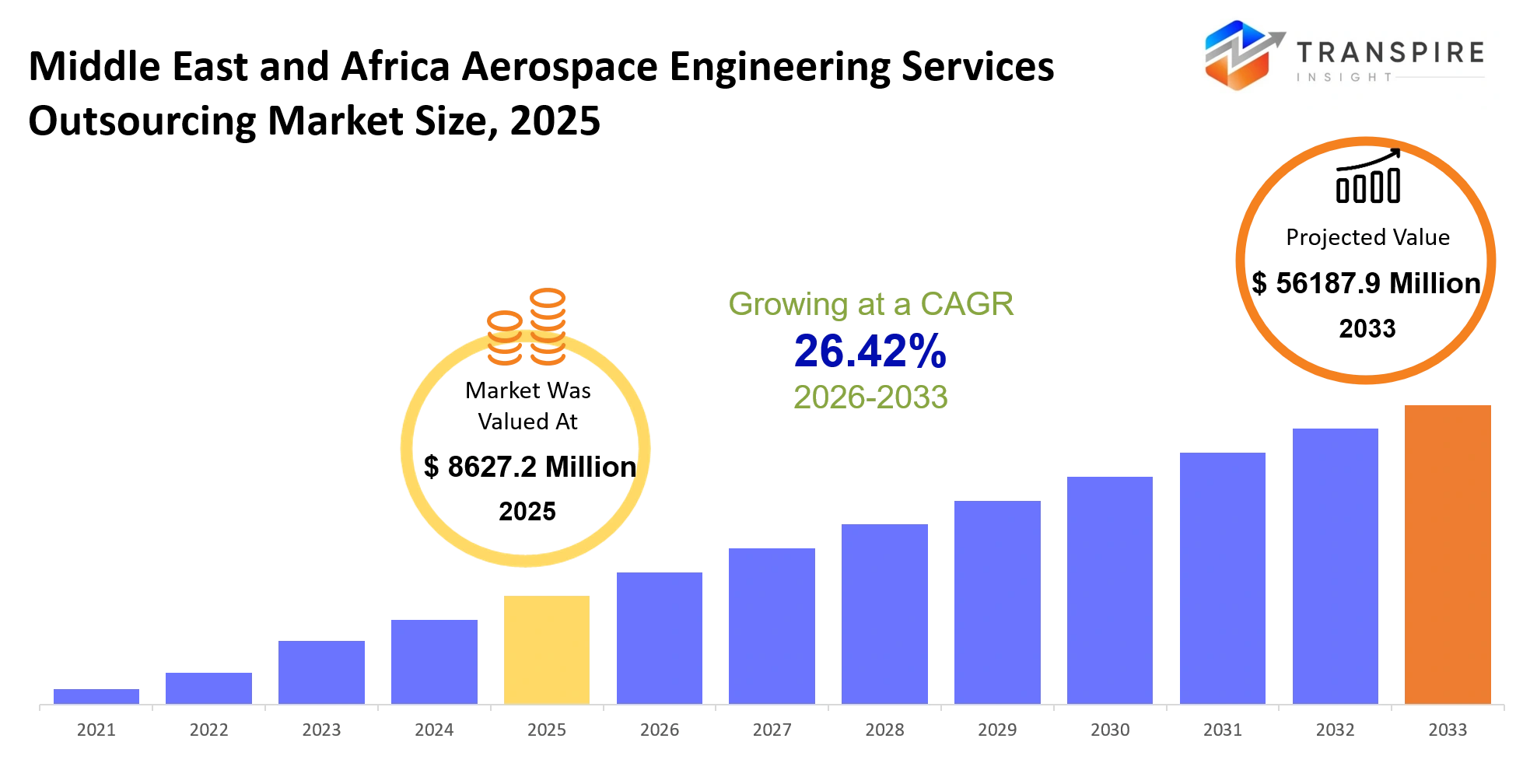
- Middle East and Africa Aerospace Engineering Services Outsourcing Market Size 2025: USD 8627.2 Million
- Middle East and Africa Aerospace Engineering Services Outsourcing Market Size 2033: USD 56187.9 Million
- Middle East and Africa Aerospace Engineering Services Outsourcing Market CAGR: 26.42%
- Middle East and Africa Aerospace Engineering Services Outsourcing Market Segments: By Service Type (Design Engineering, Manufacturing Engineering, Simulation Services, Testing Services, Maintenance Engineering, Certification Services, Others); By Aircraft Type (Commercial Aircraft, Military Aircraft, Helicopters, UAVs, Spacecraft, Business Jets, Others); By Application (Structural Engineering, Avionics Engineering, Propulsion Systems, Cabin Systems, Digital Engineering, Others); By End User (Aerospace OEMs, Defense Contractors, Airlines, Space Agencies, Others).
To learn more about this report,  Download Free Sample Report
Middle East and Africa Aerospace Engineering Services Outsourcing Market Summary
The Middle East and Africa Aerospace Engineering Services Outsourcing Market was valued at USD 8627.2 Million in 2025. It is forecast to reach USD 56187.9 Million by 2033. That is a CAGR of 26.42% over the period.
In the Middle East and Africa, the Aerospace Engineering Services Outsourcing Market seems like it matters a lot for aircraft makers, airlines, defense organizations, and maintenance providers, because it lets them tap into specialized engineering know-how without needing to build huge in-house squads. Basically these services cover aircraft design, digital validation, embedded software work, maintenance engineering, testing efforts, certification processes, and what people often call lifecycle management. In real life, outsourcing helps aerospace firms shave down development timelines , keep spending under control, and deal with engineering needs that are getting more intricate year by year.
Over the last five years, the market has been moving away from classic mechanical engineering support, and leaning more into digital engineering, embedded software , simulation, and model based systems engineering. One big reason for this shift, was the global aerospace supply chain disruption after the pandemic, which really nudged manufacturers and operators to look for flexible engineering capacity from specialized service providers. Meanwhile, fleet modernization programs, higher defense spending in Gulf countries, and more money going into unmanned aerial systems have made outsourced engineering expertise feel more necessary than before. And since aircraft platforms are becoming more software driven, while certification requirements keep getting stricter and more complicated, aerospace companies are putting more of their engineering funds into outside partners, which then creates ongoing revenue chances across the whole region, even when local conditions vary a bit.
Key Market Insights
- The Middle East and Africa Aerospace Engineering Services Outsourcing Market is kinda benefiting from more outsourcing for engineering-intensive aerospace programs across both commercial and defense aviation, sectors. In a lot of places it’s more like, they just don’t have enough in house capacity, so the external help comes fast
- For 2025, Gulf countries were estimated to hold around 45%+ of the regional market share , mainly driven by aviation infrastructure investments and defense modernization programs that are moving at a steady pace
- The UAE is still the biggest regional contributor, backed by aerospace clusters, MRO facilities, and airline-led engineering investments, which feels like it has been compounding year over year
- South Africa is showing up as the fastest-growing regional market all the way through 2033 because aerospace manufacturing keeps expanding , and there’s more engineering talent available than before
- In terms of service type, Mechanical engineering services held roughly 50% of the regional revenue share in recent years, so it stays the largest service segment
- Electrical and electronic engineering services take the #2 spot, mainly because avionics complexity keeps increasing across new aircraft programs
- Embedded software engineering is projected to be the fastest growing segment through 2033, largely due to autonomous systems and digital aircraft technologies, basically the whole “smarter aircraft” direction
- When it comes to application demand, Maintenance process engineering dominates, representing more than 35% of outsourcing engagements tied to fleet support activities
- Meanwhile digital validation and simulation applications are expanding quickly because manufacturers are adopting virtual testing environments, to shorten certification timelines and reduce rework
- Overall the leading end users are Aerospace OEMs , airlines, defense contractors, and MRO providers
- But UAV developers and space technology firms are also becoming a rapidly growing customer base, which is starting to look more important than people expected
What are the Key Drivers, Restraints, and Opportunities in the Middle East and Africa Aerospace Engineering Services Outsourcing Market?
The biggest growth driver is basically the increasing complexity of modern aircraft development programs, like it’s gotten more and more elaborate over the last years. Aircraft manufacturers and defense contractors now have to manage advanced avionics, embedded software, digital twins, autonomous systems, and also those very strict certification requirements. But building all of this in-house, means a lot of spending and specialized people , not just a small team. So, it makes sense that aerospace companies increasingly outsource engineering work to specialist providers, who can bring the know-how with lower operating costs and shorter project durations. That change is directly pushing up outsourcing contract volumes and engineering service revenues across the region.
The key limiter still feels like the shortage of highly specialized aerospace engineering talent. Aerospace design, certification, systems integration, and safety-critical software development need years of training along with real industry experience. In many places , local labor pools can’t grow fast enough to match the pace of project demand. And this kind of structural issue, it basically caps how fast projects can scale, it drags delivery timelines, and it lifts labor costs too. It also slows down the moment outsourcing providers can start new aerospace programs, which then dampens potential market revenue.
A strong opportunity is showing up in digital engineering and next-generation aerospace technologies. Investments in unmanned aerial systems, smart defense platforms, sustainable aviation technologies, and AI-enabled aircraft design are generating brand new engineering requirements. Countries such as the UAE and Saudi Arabia are putting serious money into aerospace innovation ecosystems, so conditions become more supportive for outsourced engineering providers.
What Has the Impact of Artificial Intelligence Been on the Middle East and Africa Aerospace Engineering Services Outsourcing Market?
Artificial intelligence is kinda transforming aerospace engineering outsourcing, in a way that it seems to speed up engineering productivity, shorten development cycles, and improve how teams make operational calls. More and more engineering service providers are using AI powered design tools , which can automate things like technical documentation, software validation, component optimization, and compliance reporting. With these systems engineering groups can handle huge streams of design data while cutting down on the boring manual work.
Then there is machine learning, and it is getting really good at predictive maintenance. Airlines and MRO companies, for instance, run AI algorithms over sensor signals from engines, avionics, and other crucial aircraft subsystems, to catch potential failures before they show up. In practice this reduces unplanned maintenance events, boosts fleet availability, and helps lower long run operating expenses. At the same time, AI supported digital twins are making performance simulations more faithful, which can reduce the amount of physical testing needed, and also push certification timelines forward faster.
More recent industry partnerships show AI moving deeper into aerospace engineering workflows, not just as a side tool. Airbus, for example, leaned further into its AI plans through a partnership with Mistral AI, to back engineering automation, industrial operations, and design optimization work.
Still, adoption is not totally smooth. It is held back by integration expenses, strict cybersecurity obligations, and the limited supply of high quality aerospace operational data. Plus, safety critical aerospace settings demand extensive validation, so AI generated outputs cannot just be dropped into certified engineering processes right away. That requirement can slow down implementation across some programs, even if the potential is strong.
Key Market Trends
- Between 2021 and 2026, aerospace companies increasingly kind of moved their engineering workloads away from internal groups and toward specialized outsourcing partners, though the “how” differed a bit from firm to firm.
- Embedded software work also expanded a lot, especially when next-generation aircraft started bringing in autonomous functions plus connected avionics systems.
- Digital twin adoption grew across many engineering programs, so in some projects the need for physical prototypes dropped by something like 20–30% , as teams leaned on modeled testing instead.
- AI-assisted engineering documentation and simulation tools gathered real momentum in 2025 and 2026, particularly at major aerospace organizations that wanted faster iteration cycles and better traceability.
- Meanwhile Gulf aerospace investments picked up speed after defense localization programs rolled out across Saudi Arabia and the UAE, which pushed demand for local capability and nearby delivery.
- Regional engineering hubs then expanded their capacity too, because airlines and MRO operators were asking for a quicker turnaround and more maintenance support services, not just longer reports.
- Outsourcing providers started putting more emphasis on cybersecurity and certification skills, to satisfy aerospace compliance requirements that keep getting tighter.
- At the same time, strategic partnerships between aerospace manufacturers and engineering service firms became more visible across digital engineering initiatives, like you could see it in procurement choices.
- Sustainable aviation technologies, along with alternative propulsion programs, essentially opened new outsourcing avenues for specialist engineering providers.
- Cross-border engineering collaboration models became more usual as firms tried to balance talent availability, overall costs, and project delivery needs, sometimes all at once.
Middle East and Africa Aerospace Engineering Services Outsourcing Market Segmentation
By Service Type
The service type segment signals the broad spectrum of engineering roles that get sourced across aerospace development, production, and the day to day operational support stuff. In practice, Design Engineering sits in the forefront because aircraft programs need very advanced design know-how to boost performance, safety, and day to day efficiency. Manufacturing Engineering backs up production cadence, process refinement, and quality enhancement across aerospace manufacturing sites. Then there are Simulation Services, which have a kind of lower development exposure by letting teams do virtual trials and performance judgement before anything physical is actually put in place.
Testing Services still matter a lot, mainly to confirm system behavior, safety norms, and operational dependability across multiple aircraft platforms. Maintenance Engineering keeps the fleet ready through technical review, repair scheduling, and lifecycle governance activities. Certification Services help companies satisfy regulatory expectations, and get the proper sign offs for aerospace systems and parts. The “Others” bucket covers niche engineering tasks built for unusual technical demands, new emerging technologies, and project driven aerospace uses.
By Aircraft Type
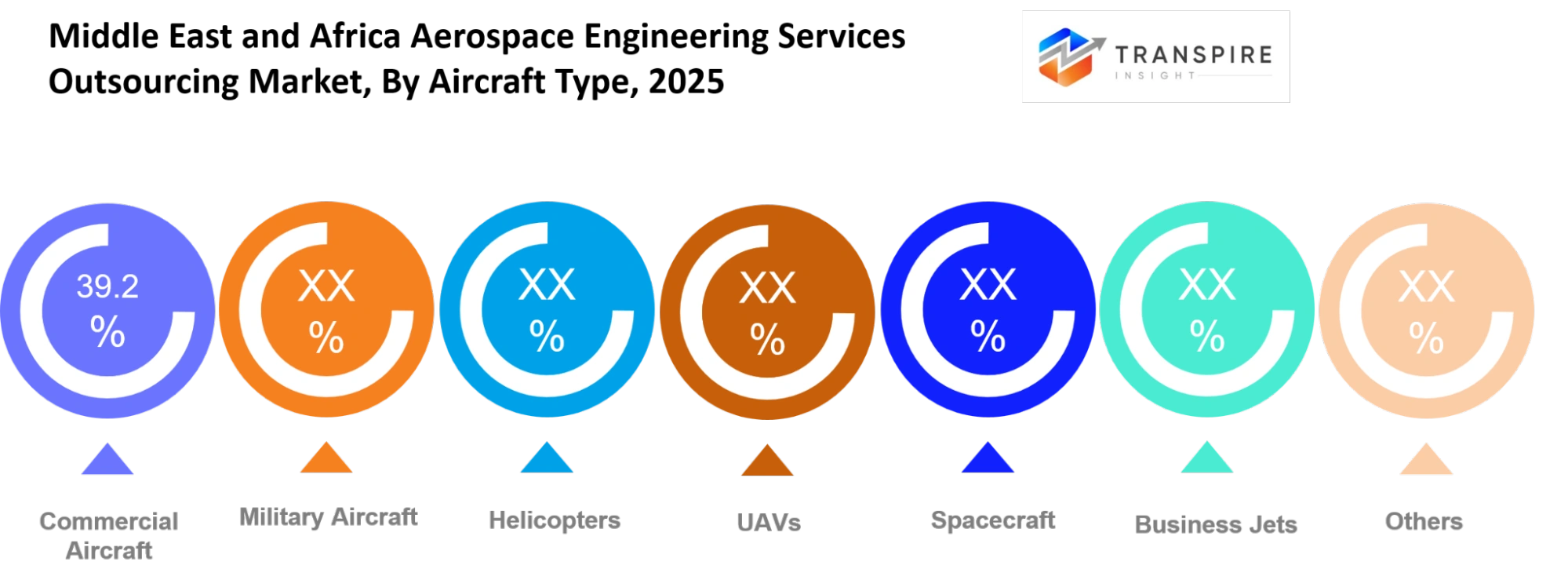
The aircraft type segment sort of shows how outsourced engineering services back different aviation platforms, each with their own operational, and technical constraints. Commercial Aircraft take up a big portion because airlines and manufacturers keep spending on fleet growth, modernization drives, and those performance refinements type upgrades. Military Aircraft needs more advanced engineering help for mission systems, structural renovations, and defense modernization efforts. Helicopters keep pulling steady engineering work through maintenance schedules, component development, and operational enhancement initiatives, you know the usual cycle.
UAVs still draw a lot of engineering investment because defense agencies and commercial operators are widening unmanned aviation use cases. Spacecraft create openings for specialized engineering assistance that connects to launch systems, satellite technologies and space exploration programs, it’s not just one lane. Business Jets lean on engineering knowledge to boost passenger experience, operational efficiency, and aircraft dependability. Others cover more niche aircraft categories that need technical support fitted to their specific operating conditions and performance expectations, even if the details change.
To learn more about this report, Download Free Sample Report
By Application
The application segment shows, in a kind of practical way, how engineering outsourcing helps with key aerospace roles across design, creation, and day to day operations. Structural Engineering is an important slice, because airplane structures really do need ongoing tuning for strength, lighter mass, and dependable safety behavior. Then Avionics Engineering covers navigation, messaging, and governing systems, which are getting more sophisticated in modern aircraft. Propulsion Systems engineering, on the other hand, feeds engine efficiency and steadiness, while also keeping everything aligned with the required performance rules.
Cabin Systems create a visible kind of demand through initiatives aimed at better passenger comfort, smoother connectivity and more useful on board functionality. Digital Engineering keeps widening its reach as simulation tools are adopted, along with digital twins and development workflows that depend on data. Other areas can include niche engineering deployments, which tackle emerging aerospace technologies, and the shifting technical needs around them. Overall, application demand will likely stay shaped by innovation programs, modernization pushes, and the rising intricacy of aerospace systems.
By End User
The end user segment points at the organizations that lean on outsourced engineering talent to help with aerospace development, operations, and that kind of innovation work. Aerospace OEMs make up a major chunk, because aircraft development programs call for a lot of engineering capacity, across many project stages. Defense Contractors also depend on specialized engineering support, to craft new advanced systems, push platform performance forward, and still satisfy the very strict defense requirements. Having access to that outside know-how supports faster project delivery while keeping the technical standard in place.
Airlines drive a notable level of demand via fleet maintenance , operational tuning and aircraft modification projects. Space Agencies create engineering openings tied to satellite build outs, launch systems , and research initiatives . Other participants include groups working on niche aerospace activities where technical know-how is needed either for short term assignments , or longer horizon development programs. In the meantime, end user demand should keep mirroring aviation spending patterns, technology progress and the widening aerospace capability footprint across both regional and global markets.
What are the Key Use Cases Driving the Middle East and Africa Aerospace Engineering Services Outsourcing Market?
The largest use case sort of involves aircraft design along with structural engineering, and then maintenance engineering support for commercial aviation fleets. Airlines, OEMs, and maintenance providers end up leaning on outsourced engineering teams , to boost aircraft reliability, handle certification requirements, and cut down operational downtime. This whole application area creates big demand because airlines need to keep fleet availability steady , while still controlling engineering costs.
More additional applications are starting to show up, especially in avionics integration, embedded software development, and defense aerospace programs. Military modernization efforts across Gulf countries are also expanding the need for engineering support that touches surveillance systems, unmanned aerial vehicles, and mission-critical software platforms.
New opportunities are forming around digital twins and autonomous flight technologies, plus advanced air mobility systems. In a similar vein, engineering service providers are getting more involved with AI-enabled aircraft development , predictive maintenance solutions, and sustainable aviation technology programs. These are expected to be adopted more widely during the forecast period.
|
Report Metrics |
Details |
|
Market size value in 2025 |
USD 8627.2 Million |
|
Market size value in 2026 |
USD 10887.3 Million |
|
Revenue forecast in 2033 |
USD 56187.9 Million |
|
Growth rate |
CAGR of 26.42% from 2026 to 2033 |
|
Base year |
2025 |
|
Historical data |
2021 - 2024 |
|
Forecast period |
2026 - 2033 |
|
Report coverage |
Revenue forecast, competitive landscape, growth factors, and trends |
|
Regional scope |
Middle East and Africa (Saudi Arabia, United Arab Emirates, South Africa, Rest of Middle East and Africa) |
|
Key company profiled |
Airbus, Boeing, Safran Engineering, Capgemini Engineering, Alten Group, AKKA Technologies, Cyient, Tata Technologies, HCLTech, Infosys, Wipro, Expleo, Rolls-Royce, Thales Group, Dassault Aviation. |
|
Customization scope |
Free report customization (country, regional & segment scope). Avail customized purchase options to meet your exact research needs. |
|
Report Segmentation |
By Service Type (Design Engineering, Manufacturing Engineering, Simulation Services, Testing Services, Maintenance Engineering, Certification Services, Others); By Aircraft Type (Commercial Aircraft, Military Aircraft, Helicopters, UAVs, Spacecraft, Business Jets, Others); By Application (Structural Engineering, Avionics Engineering, Propulsion Systems, Cabin Systems, Digital Engineering, Others); By End User (Aerospace OEMs, Defense Contractors, Airlines, Space Agencies, Others). |
Which Regions are Driving the Middle East and Africa Aerospace Engineering Services Outsourcing Market Growth?
The Gulf Cooperation Council region kinda represents the leading market, within the Middle East and Africa overall. Nations like the UAE and Saudi Arabia keep putting real money into aviation infrastructure, defense modernization, airline expansion, and they are also scaling aerospace manufacturing capabilities. With strong government support, advanced airport ecosystems, and aviation hubs that are internationally recognized, the overall environment feels pretty favorable for outsourced engineering services. Plus, you have big airlines, MRO facilities, and aerospace technology initiatives, which all together kinda keep reinforcing the regional leadership.
South Africa sits as the second-largest contributor, but it is doing things in a slightly different way in terms of growth. Instead of leaning mostly on massive aviation investments, the country benefits from a clear pool of engineering talent, aerospace manufacturing know-how, and industrial capabilities that are already in place. Local engineering firms support both domestic work and international aerospace programs. Because of that, there is a steadier revenue base, and it tends to be less dependent on large government-led aviation programs.
Meanwhile the wider African market is expected to show the fastest growth through 2033. Airline fleets are expanding, infrastructure investments are continuing, aerospace training initiatives are getting traction and defense procurement programs are also ramping up, so new engineering outsourcing opportunities keep appearing. A few countries are upgrading their aviation capabilities while at the same time looking for cost-efficient engineering solutions from external providers. For investors and new entrants, these developing markets can be an opening to set up engineering delivery centers, before competitive intensity rises too much later.
Who are the Key Players in the Middle East and Africa Aerospace Engineering Services Outsourcing Market and How Do They Compete?
Competition is still kinda moderately fragmented, with global aerospace manufacturers, engineering specialists, and IT services firms all going after long term engineering contracts. Getting the win usually hinges on technical know how, certification capacity, digital engineering skills, and the capability to run scalable global delivery models. Cost competitiveness still matters, but honestly technological capability is, more and more, what really nudges the contract awards forward.
Airbus feels different because of its advanced aerospace design know how, plus continued digital engineering investments, and then it has solid relationships with both commercial and defense customers. Also its more recent AI focused partnership initiatives, they show a plan that is more about engineering innovation and productivity improvements, than just doing business as usual.
Safran Engineering leans hard into specialized aerospace systems engineering, certification support, and propulsion related expertise. It’s that deep aerospace domain knowledge that lets it take part in highly regulated engineering programs, where the requirements are pretty strict. At the same time Capgemini Engineering leans on bigger scale digital engineering ability, simulation know-how, and global engineering delivery networks, to back aerospace customers with a sort of end to end support style.
Then you’ve got Cyient and HCLTech, they compete using offshore engineering models, digital transformation services, and embedded software know how. Their strength is kinda in mixing aerospace engineering with software development, plus data analytics. That combination becomes a strong value argument for OEMs and MRO organizations that want cost efficient innovation without losing momentum.
Company List
- Airbus
- Boeing
- Safran Engineering
- Capgemini Engineering
- Alten Group
- AKKA Technologies
- Cyient
- Tata Technologies
- HCLTech
- Infosys
- Wipro
- Expleo
- Rolls-Royce
- Thales Group
- Dassault Aviation
Recent Development News
In March 2026, Airbus inaugurated its new 5,000-seat Airbus India Technology Centre in Bengaluru. The facility expands engineering, digital transformation, procurement, and customer service capabilities that support global aerospace outsourcing activities.
Source: https://www.airbus.com
In November 2025, Leonardo and EDGE announced the formation of a joint venture in the UAE. The partnership will develop and produce advanced defense systems while strengthening regional aerospace engineering, testing, and workforce development capabilities.
Source: https://www.reuters.com
What Strategic Insights Define the Future of the Middle East and Africa Aerospace Engineering Services Outsourcing Market?
The market is kind of moving, toward a digitally integrated engineering ecosystem, where software development, AI-enabled design, simulation, certification support, and lifecycle engineering services become more valuable than just traditional engineering labor alone. The main thing driving this change is basically the growing amount of software content and system complexity you see in modern aircraft, defense platforms, and autonomous aerospace systems.
One risk people overlook is talent concentration. Right now, only a small set of engineering hubs supply a large share of specialized aerospace know-how. So competition for certified aerospace engineers might rise, and that can push labor costs up, plus cause execution bottlenecks even if the overall market keeps looking strong.
There’s also a pretty interesting opportunity in AI-enabled digital engineering platforms, that merge simulation, predictive analytics, and automated certification workflows. Adoption so far is still kind of early, but over the next decade these tools could reshape aerospace development economics in a major way, like more than people expect.
For market participants, the most effective approach is to invest in specialized engineering capabilities, rather than trying to win mainly on labor costs. Companies that grow real expertise in embedded software, AI-driven engineering, digital twins, and certification support will be in a better spot to land high-value aerospace programs and keep long-term customer relationships, too.
Middle East and Africa Aerospace Engineering Services Outsourcing Market Report Segmentation
By Service Type
- Design Engineering
- Manufacturing Engineering
- Simulation Services
- Testing Services
- Maintenance Engineering
- Certification Services
- Others
By Aircraft Type
- Commercial Aircraft
- Military Aircraft
- Helicopters
- UAVs
- Spacecraft
- Business Jets
- Others
By Application
- Structural Engineering
- Avionics Engineering
- Propulsion Systems
- Cabin Systems
- Digital Engineering
- Others
By End User
- Aerospace OEMs
- Defense Contractors
- Airlines
- Space Agencies
- Others
Frequently Asked Questions
Find quick answers to common questions.
The expected Middle East and Africa Aerospace Engineering Services Outsourcing Market size for the market will be USD 56187.9 Million in 2033.
Key segments for the Middle East and Africa Aerospace Engineering Services Outsourcing Market are By Service Type (Design Engineering, Manufacturing Engineering, Simulation Services, Testing Services, Maintenance Engineering, Certification Services, Others); By Aircraft Type (Commercial Aircraft, Military Aircraft, Helicopters, UAVs, Spacecraft, Business Jets, Others); By Application (Structural Engineering, Avionics Engineering, Propulsion Systems, Cabin Systems, Digital Engineering, Others); By End User (Aerospace OEMs, Defense Contractors, Airlines, Space Agencies, Others).
Major Middle East and Africa Aerospace Engineering Services Outsourcing Market players are Airbus, Boeing, Safran Engineering, Capgemini Engineering, Alten Group, AKKA Technologies, Cyient, Tata Technologies, HCLTech, Infosys, Wipro, Expleo, Rolls-Royce, Thales Group, Dassault Aviation.
The Middle East and Africa Aerospace Engineering Services Outsourcing Market size is USD 8627.2 Million in 2025.
The Middle East and Africa Aerospace Engineering Services Outsourcing Market CAGR is 26.42% from 2026 to 2033.
- Airbus
- Boeing
- Safran Engineering
- Capgemini Engineering
- Alten Group
- AKKA Technologies
- Cyient
- Tata Technologies
- HCLTech
- Infosys
- Wipro
- Expleo
- Rolls-Royce
- Thales Group
- Dassault Aviation
About the Authors

Tejashri Dhatrak
I am Tejashri Dhatrak, a Senior Research Analyst at Transpire Insight, specializing in the Aerospace and Defence sector. My work focuses on analyzing industry trends, defence technologies, market developments, and emerging innovations that shape the global aerospace and security landscape. At Transpire Insight, I research complex topics, evaluate credible sources, and transform technical insights into accurate, well-structured, and easy-to-understand content for industry professionals and decision-makers. My goal is to provide reliable, research-backed information that helps readers stay informed about defence capabilities, aerospace advancements, strategic developments, and the evolving dynamics of the global defence ecosystem.

Chakradhar Khansole
Chakradhar serves as the Research Director at Transpire Insight, bringing over 8 years of experience in technology, innovation, and strategic market intelligence. He specializes in transforming complex market data into actionable business insights that enable organizations to make informed, growth-oriented decisions. Recognized for his strategic vision and analytical expertise, Chakradhar leads high-impact research initiatives, delivering comprehensive market assessments, competitive intelligence, and forward-looking industry analysis.
Recently Published Reports
-
Apr 2026
Aerospace Fluoropolymers Market
Aerospace Fluoropolymers Market Size, Share & Analysis Report By Type (PTFE, FEP, PFA, ETFE, and Others), By Application (Electrical Insulation, Seals & Gaskets, Coatings, and Others), By End User (Commercial Aviation, Military Aviation, General Aviation, and Others), and Geography (North America, Europe, Asia-Pacific, Middle East and Africa, South and Central America), 2021 - 2031
-
Apr 2026
Airborne SATCOM System Market
Airborne SATCOM System Market Size, Share & Analysis Report By Type (SATCOM Terminals, Transceivers, Airborne Radio, Modems and Routers, SATCOM Radomes, and Other), By Application (Government and Defense and Commercial), and Geography (North America, Europe, Asia-Pacific, Middle East and Africa, South and Central America), 2021 – 2031
-
Apr 2026
Ship Leasing Market
Ship Leasing Market Size, Share & Analysis Report By Vessel Type (Container Ships, Bulk Carriers, Tankers, and Specialized Vessels), By Lease Duration (Short-Term Lease (Less than 1 year), Medium-Term Lease (1-5 years), and Long-Term Lease (More than 5 years)), By Lease Type (Bareboat Charter, Time Charter, Financial Lease, and Others), By End-User Industry (Oil and Gas, Manufacturing and Industrial, Automotive, Agriculture and Food, Retail and Consumer Goods, and Others), and Geography (North America, Europe, Asia-Pacific, Middle East and Africa, South and Central America), 2021 – 2031
-
Apr 2026
Thread Rolling Dies Market
Thread Rolling Dies Market Size, Share & Analysis Report By Type (Flat Thread Rolling Dies, Circular (Cylindrical) Dies, Tangential Thread Rolling Dies, Planetary Thread Rolling Dies, and Other Types), By Material Type (High-Speed Steel (HSS), Carbide, Tool Steel, Alloy Steel, and Other Specialized Alloys), By Distribution Channel (Direct Sales, Distributors and Dealers, and Online Platforms), By Application (Automotive Industry, Aerospace and Defense, Construction and Infrastructure, Industrial Machinery, Electronics and Electrical Components, Medical Devices, and Fastener Production), and Geography (North America, Europe, Asia-Pacific, Middle East and Africa, South and Central America), 2021 – 2031
Our Clients





