
South Korea Inertial Navigation System Market Size & Forecast:
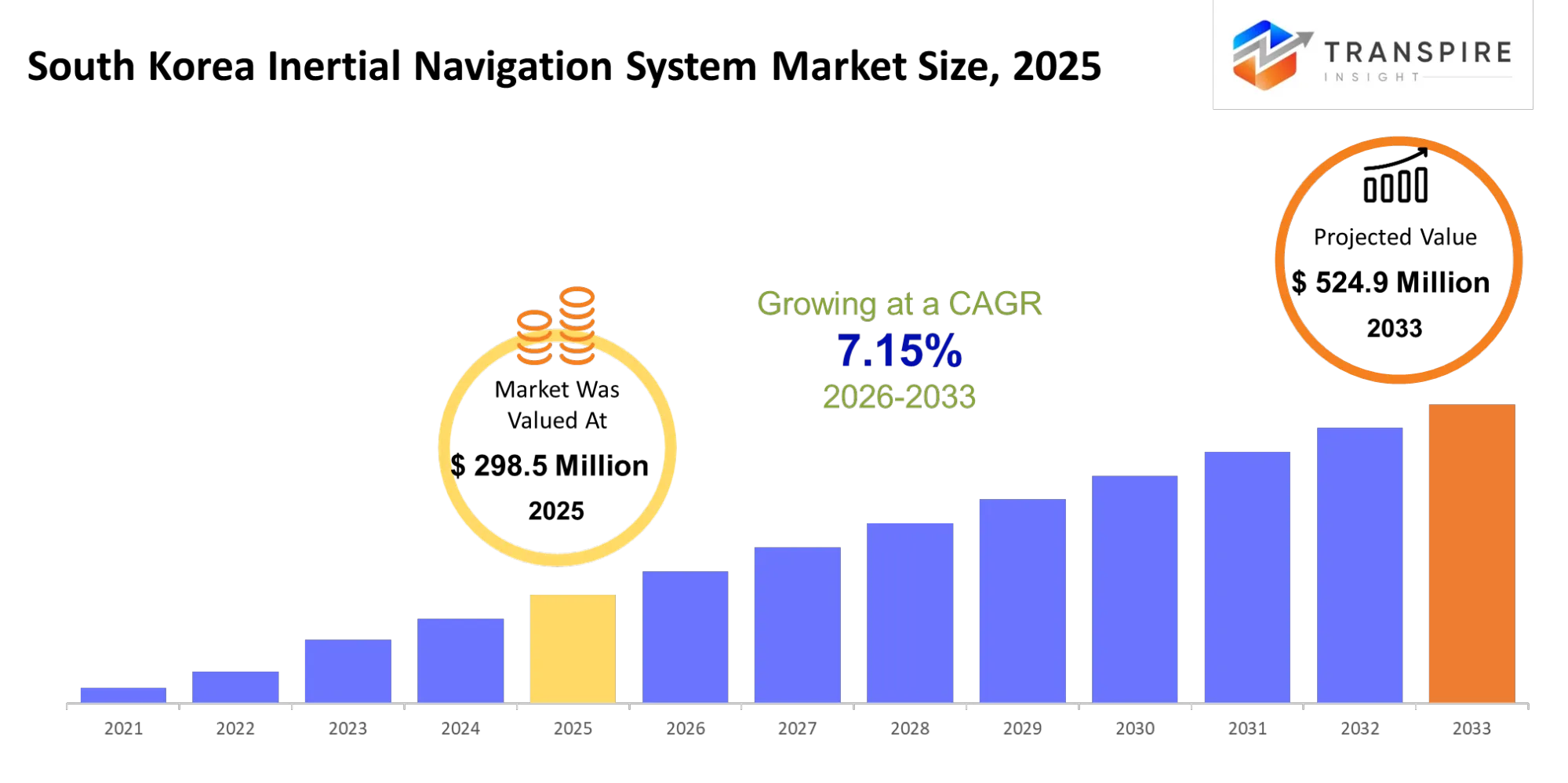
- South Korea Inertial Navigation System Market Size 2025: USD 298.5 Million
- South Korea Inertial Navigation System Market Size 2033: USD 524.9 Million
- South Korea Inertial Navigation System Market CAGR: 7.15%
- South Korea Inertial Navigation System Market Segments: By System Type (Mechanical INS, Ring Laser Gyroscope INS, Fiber Optic Gyroscope INS, MEMS-based INS, Others); By Application (Aircraft Navigation, Missile Guidance, Naval Navigation, Autonomous Vehicles, Others); By Component (Accelerometers, Gyroscopes, Navigation Processors, Others); By End User (Defense Forces, Aerospace Companies, Automotive Industry, Marine Industry, Others); By Platform (Airborne INS, Land-based INS, Naval INS, Space-based INS, Others)
To learn more about this report,  Download Free Sample Report
South Korea Inertial Navigation System Market Summary
The South Korea Inertial Navigation System Market was valued at USD 298.5 Million in 2025. It is forecast to reach USD 524.9 million by 2033. That is a CAGR of 7.15% over the period.
In South Korea, inertial navigation systems act like that quiet, almost unseen guidance layer behind submarines, unmanned vessels, aircraft, and also more advanced industrial robotics where GPS signals are often unreliable or, sometimes, outright denied. These systems keep computing position and motion straight from onboard sensing, so navigation stays steady even in crowded sea lanes and in fast-moving defence scenarios.
Over the last 3–5 years the market has kind of flipped, not just in terms of features but in structure too. You can see it shifting from standalone inertial units toward more tightly coupled hybrid navigation stacks, mixing GNSS, AI assisted calibration, and fiber optic sensor tech. Meanwhile South Korea expanding defense modernization programs and the ongoing push for unmanned naval platform deployments have worked like a real trigger in the field, which speeds up procurement timelines and makes local OEMs put resilience on top, especially when precision is non negotiable.
Then there were the supply chain disruptions during the semiconductor crunch, that part also changed sourcing behavior. Buyers leaned more toward domestic sensor development and they reduced dependence on imported parts, a pretty noticeable adjustment. So adoption is now driven less by simple navigation requirements and more by the need for mission continuity, autonomy, and even resistance to electronic warfare while operating inside complicated environments.
Key Market Insights
- South Korea Inertial Navigation System Market is growing fast, kind of pushed by naval automation and those GPS denied type operational needs across defense platforms. You know, in practice it matters a lot for mission continuity even when signals get messed up.
- Fiber-optic gyro systems are currently leading the pack, roughly 38–42% share, mainly because they deliver strong precision and dependable performance for military grade use.
- Hybrid navigation setups, mixing INS with GNSS, are seeing the quickest adoption ramp through the 2033 forecast period, not just slowly but with real momentum.
- For applications, maritime defense takes close to 45% share, driven by submarine programs and unmanned surface vessel deployments.
- Aerospace navigation sits as the second largest segment, supported by UAV and fighter jet modernization initiatives, where responsiveness is pretty crucial.
- For end use, unmanned naval systems are the fastest-growing category, expanding at more than 9% annually in procurement contracts, and that’s one of the reasons attention keeps shifting there.
- Key players include Honeywell, Northrop Grumman, Safran, Raytheon Technologies, and Thales Group, and they’re also working to strengthen regional partnerships.
- Innovation efforts are leaning into MEMS miniaturization, lowering overall system weight by more than 20% in next gen platforms, with tighter integration becoming common.
- Strategic collaborations between global OEMs and South Korean defense contractors help with localization and also supply security, especially for components that can be hard to source.
- Finally, AI assisted calibration and sensor fusion technologies are coming up as differentiators, and they’re increasingly shaping competitiveness in the South Korea Inertial Navigation System Market.
What are the Key Drivers, Restraints, and Opportunities in the South Korea Inertial Navigation System Market?
The main push behind the South Korea Inertial Navigation System Market is the fast growth of defense modernization programs, built around autonomous sea and air platforms. South Korea is really emphasizing stronger surveillance in nearby waters, so procurement of submarine-grade navigation systems and unmanned surface vessels is rising. In turn, this has kept demand steady for high-accuracy inertial systems that can keep working without satellite help, and that change directly feeds into bigger system integration contracts for both global and local providers.
One big brake though, is the very high calibration and integration complexity of next-gen inertial systems, especially fiber-optic and ring laser gyro options. These need a pretty specialized manufacturing setup, plus extended testing timelines, so scaling quickly becomes difficult. For smaller companies, certification demands across defense and aerospace efforts often cause long revenue gaps, and that kind of friction limits who can enter the market, which then reduces competition and slows take-up beyond strictly military uses in wider industry.
Still, there is also a real chance that’s forming: unmanned autonomous navigation platforms, especially for coastal monitoring and smart naval logistics. South Korea’s spending on AI-enabled unmanned maritime fleets, along with smart harbor infrastructure, is driving interest in lighter inertial solutions with low drift, plus integration with real-time analytics. And as those platforms move from small trial deployments to actual operational fleets, providers that focus on miniaturization and software-first performance boosts should see a new revenue stream, sort of like a fresh expansion layer for navigation system offerings.
What Has the Impact of Artificial Intelligence Been on the South Korea Inertial Navigation System Market?
Artificial intelligence is kind of reshaping the way inertial navigation systems run, mostly by pushing sensor fusion further, improving calibration precision, and making the whole system more adaptable in real time, even when conditions get weird. In South Korea’s defense and maritime sectors, AI algorithms are more and more often used to merge inertial sensor outputs with GNSS data plus radar signals and visual cues, so navigation stays steadier in GPS-denied or jammed conditions. Because of that, operational continuity has gotten much better for submarines, unmanned vessels, and also for high-speed aerial platforms.
On the predictive maintenance side, machine learning models can look at drift behaviors and sensor wear trends, then they forecast calibration needs before anything turns into a real failure. That approach helps cut downtime in mission-critical defense systems and it supports better long-term reliability overall. Day to day, AI-driven optimization has improved navigation accuracy and increased system uptime while also lowering how much manual recalibration is needed during complex naval operations.
Still, AI adoption has its limits, mainly because maritime data in the real world is sometimes inconsistent and not always available, and the integration costs can be quite high across older defense platforms. Offshore, connectivity issues show up too, which restrict real-time model updates and makes cloud based analytics harder to deploy. Even with those constraints, AI remains a major driver for next generation inertial navigation performance, particularly as South Korea moves toward autonomous naval fleets and more digitally integrated defense ecosystems.
Key Market Trends
- South Korea Inertial Navigation System Market seemed to move away from standalone setups toward hybrid GNSS-INS integration during 2022–2026, and yes it kinda felt faster than expected.
- Defense procurement has been leaning more and more toward fiber-optic gyros, which help cut drift error accuracy by about 30% in mission critical systems, at least in those sensitive deployments.
- In 2025 alone, unmanned surface vessel adoption jumped, that then drove higher needs for compact navigation modules, kind of like a domino effect.
- On the aerospace side, UAV fleet upgrades pushed INS integration rates across surveillance platforms.
- Then AI based sensor fusion setups helped navigation stability when GPS was jammed, especially across naval exercises, you could see the difference.
- Also, domestic sourcing of inertial parts went up after the global semiconductor disruptions around 2023–2024, because supply chains got a bit messy.
- South Korea defense agencies meanwhile expanded procurement partnerships with global OEMs to support localization strategies and reduce dependency.
- Miniaturized MEMS based INS solutions also started gaining traction, especially for lightweight drone applications, where every gram matters.
- And lately, cyber resilient navigation systems are being prioritized more often, due to the rising electronic warfare risks, and it’s not just a theoretical concern anymore.
South Korea Inertial Navigation System Market Segmentation
By System Type
Mechanical INS still has a declining but not fully gone, position. You’ll still see it mostly in older aerospace and industrial navigation setups where the replacement pace stays slow, kind of painful slow. Those systems last a long time because the operational lifespan is long, and the replacement costs can be really high inside certified platforms.
Ring Laser Gyroscope INS sits in a fairly strong spot, especially for top-tier defense and aerospace use. It’s valued for better accuracy, and also for being less sensitive to external interference, which is the usual talking point. Meanwhile Fiber Optic Gyroscope INS feels like the most advanced mainstream slice. It’s getting strong traction in submarines, missiles and unmanned systems, largely because it delivers high precision and lower drift rates. MEMS-based INS, on the other hand, leads the volume side in commercial drones and automotive navigation. This is mainly because it’s compact and cost efficient, which tends to matter more when production scales. Other approaches remain mostly stuck in experimental modes or hybrid arrangements.
Over time Mechanical INS keeps getting pushed out as modernization efforts favor lighter and more accurate options. Ring Laser equipment holds on in strategic defense platforms, where extreme precision is treated like non negotiable. Fiber Optic systems keep expanding too, as naval and aerospace programs build more robust navigation stacks. MEMS-based INS is growing fastest, driven by autonomous vehicle integration and the steady miniaturization trend. During the forecast period, development is likely to shift toward hybrid architectures, mixing MEMS scalability with fiber optic accuracy. That, in turn, reshapes procurement behavior for defense and mobility programs.
By Application
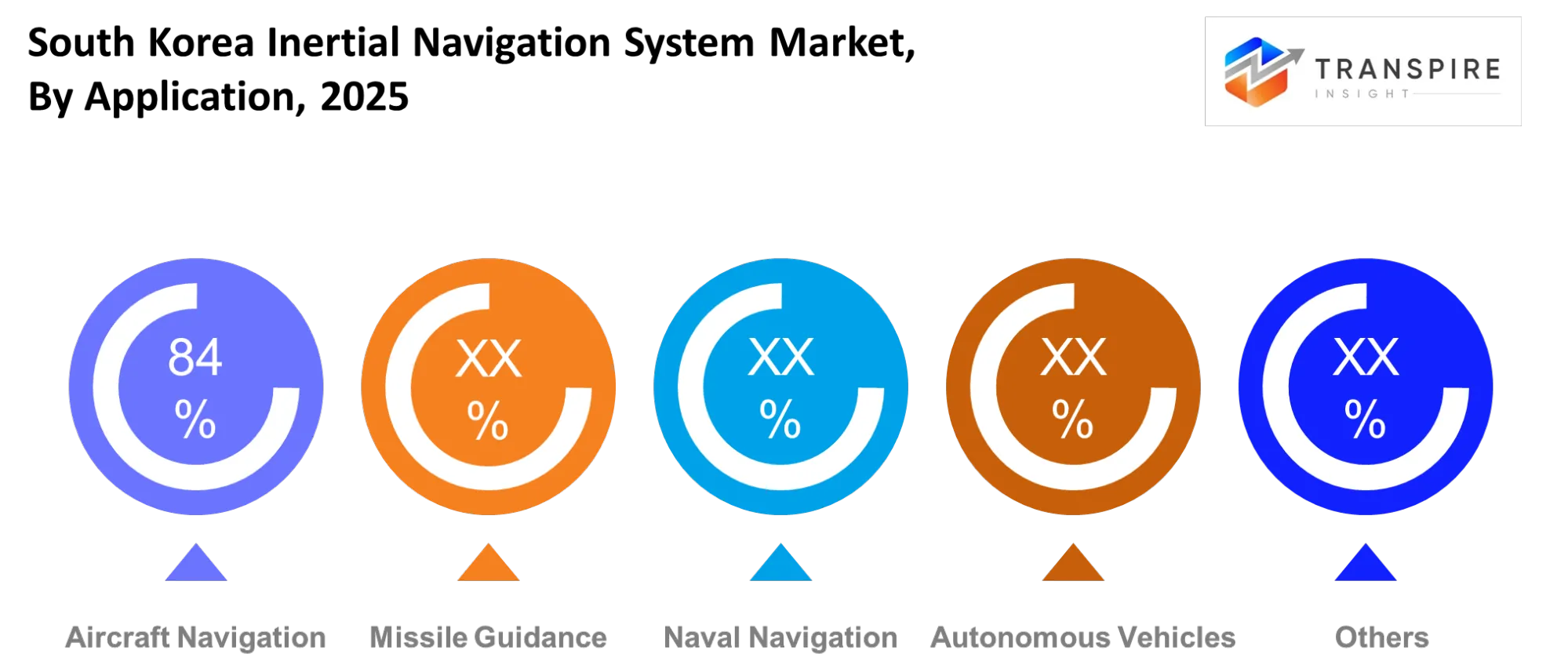
Aircraft Navigation keeps a clear leading position, kind of like because there’s ongoing need from military aviation modernization and the UAV fleet expansion, plus upgrades that never really stop. The thing is, its strong integration with avionics systems and dependence on accurate inertial positioning in GPS contested scenarios really supports that leadership, even when signal conditions get messy. Then Missile Guidance sits as another high value part, driven mostly by national defense modernization and precision strike ambitions, the sort of capability planners like to mention a lot. Naval Navigation also stays steady, largely because submarine missions and long duration maritime operations demand uninterrupted positioning, so the market doesn’t drift away. Autonomous Vehicles are a rapidly expanding slice, supported by robotics, unmanned ground systems and self navigating platforms, not just one of them. The rest of the applications stay pretty limited, mostly niche industrial and experimental use cases.
Aircraft navigation keeps dominating, especially now that aerospace modernization programs push for advanced avionics integration. Missile guidance is getting more strategic weight, because demand for high precision defense systems keeps rising, and planners are paying attention. Naval applications keep moving upward too, with more unmanned surface and underwater deployments in the mix. Autonomous vehicle applications are expanding the fastest, since AI based navigation and inertial sensing technologies keep converging, and that makes adoption easier. Looking forward, overall application demand should drift toward autonomous and multi domain systems that need continuous navigation independence from satellite infrastructure, whether it’s stable or not .
To learn more about this report, Download Free Sample Report
By Component
Accelerometers hold a kind of dominant place, because they’re basically needed for motion detection,and for position calculations across nearly all inertial setups. Because their reliability stays high, and they integrate well through aerospace and defense platforms, the demand remains stable. Gyroscopes are the most crucial high-value item,they push precision for orientation and help keep directional stability in complicated navigation situations. Navigation processors are also moving up, since real time computation with sensor fusion is turning into a must for better navigation results. Then there are other pieces, like supporting electronics,and calibration modules used during system integration.
Accelerometers still anchor core system functionality, due to their broad use across both premium and everyday commercial platforms. Gyroscopes are getting more attention as accuracy expectations climb in defense, and in autonomous systems too. Navigation processors are expanding fast, as AI enabled sensor fusion and on board computing start reshaping the whole system architecture. The remaining components are still supportive, but they’re increasingly built into modular design frameworks, or so it seems. Over the forecast period, component innovation will mostly orbit around high efficiency processing units and ultra low drift sensing technologies, just to enable autonomous navigation ecosystems.
By End User
Defense Forces keep the upper hand because they keep throwing money at missile systems, naval platforms and unmanned defense technologies, non stop basically. There is also a high dependency on GPS-independent navigation systems so procurement cycles stay steady, and yeah it tends to keep rolling. Aerospace Companies stay as a major slice too, mainly due to aircraft modernization, UAV development, and avionics integration programs that keep showing up. Automotive Industry is sort of growing quietly, but it’s clearly emerging with more adoption of inertial systems for autonomous driving, plus advanced driver assistance systems. Marine Industry looks calm and stable, mostly tied to commercial shipping, offshore operations, and navigation upgrade efforts. Other end users are still kinda scattered across research and industrial robotics applications.
Defense forces still dominate because they need precision navigation in contested environments, that’s the core. Aerospace companies keep expanding as aircraft and UAV fleets go through those modernization cycles, again and again. Automotive applications grow fast because autonomy levels rise, and sensor fusion becomes critical for navigation safety. Marine industry remains consistent, driven by fleet upgrades and operational reliability needs. Over the forecast period, end-user demand will broaden further, especially as inertial navigation moves beyond defense into commercial autonomy ecosystems, which then creates extra revenue layers across mobility sectors too.
What are the Key Use Cases Driving the South Korea Inertial Navigation System Market?
In South Korea, the biggest, most obvious use case for inertial navigation systems is tied to submarine and naval vessel navigation, where GPS coverage is missing or sometimes deliberately messed with. In these setups the systems keep giving continuous positioning during underwater defense missions, so in practice they become something like the backbone for strategic maritime operations.
More broadly, you also see inertial navigation showing up in unmanned aerial vehicles and coastal surveillance drones that defense agencies, as well as security forces, operate. Those platforms depend on inertial navigation not just for “basic” guidance but for stable flight control and mission fidelity, particularly when the environment is contested, or when signals are limited, for whatever reason.
Newer use cases keep coming too, especially in autonomous harbor logistics systems and what’s basically called next-generation smart naval bases. Here, inertial navigation is paired with AI-driven automation to help with vessel docking, cargo transfer movement, and coordination across unmanned fleets, and this kind of combination suggests a gradual shift toward more fully autonomous maritime infrastructure across the forecast period.
|
Report Metrics |
Details |
|
Market size value in 2025 |
USD 298.5 Million |
|
Market size value in 2026 |
USD 323.7 Million |
|
Revenue forecast in 2033 |
USD 524.9 Million |
|
Growth rate |
CAGR of 7.15% from 2026 to 2033 |
|
Base year |
2025 |
|
Historical data |
2021 - 2024 |
|
Forecast period |
2026 - 2033 |
|
Report coverage |
Revenue forecast, competitive landscape, growth factors, and trends |
|
Regional scope |
South Korea |
|
Key company profiled |
Hanwha Systems, LIG Nex1, Northrop Grumman, Honeywell, Safran, Thales Group, Collins Aerospace, BAE Systems, RTX Corporation, Kearfott Corporation, KVH Industries, Bosch Sensortec, Analog Devices, iXblue, Teledyne Technologies . |
|
Customization scope |
Free report customization (country, regional & segment scope). Avail customized purchase options to meet your exact research needs. |
|
Report Segmentation |
By System Type (Mechanical INS, Ring Laser Gyroscope INS, Fiber Optic Gyroscope INS, MEMS-based INS, Others); By Application (Aircraft Navigation, Missile Guidance, Naval Navigation, Autonomous Vehicles, Others); By Component (Accelerometers, Gyroscopes, Navigation Processors, Others); By End User (Defense Forces, Aerospace Companies, Automotive Industry, Marine Industry, Others); By Platform (Airborne INS, Land-based INS, Naval INS, Space-based INS, Others) |
Which Regions are Driving the South Korea Inertial Navigation System Market Growth?
South Korea’s biggest regional demand is sort of clustered around the Seoul–Incheon–Gyeonggi industrial corridor where defense contractors, aerospace integrators and advanced electronics firms work in close alignment. it feels “leading” mostly because a lot of procurement decision centers for major defense programs sit there, plus there are testing facilities for navigation-grade sensors, too. With strong government push for indigenous defense technologies, you end up with a really tight ecosystem of suppliers, certification bodies, and R&D institutes. Even naval modernization programs and UAV development contracts are largely routed through organizations that are headquartered in this same corridor, so most high-precision inertial navigation integration, and prototyping activity get anchored here, and it stays that way.
Meanwhile the southeastern coastal area, especially Busan and Ulsan, plays a steady role but in a different kind of structure. Unlike the capital region, its advantage leans more toward commercial maritime operations rather than defense design and development. Big shipbuilding companies and fleet operators tend to focus on reliability enhancements and long-horizon maintenance for navigation systems, not so much on quick tech replacement cycles. So the demand pattern leans toward retrofitting inertial navigation systems in cargo vessels, LNG carriers, and offshore support fleets. Shipbuilding export stability also helps keep procurement timing predictable, which makes this region a reliable revenue contributor, rather than a pure innovation hub.
The fastest-growing momentum is showing up in Jeju and nearby southern maritime zones, mostly because of smart port pilots and autonomous vessel testing corridors. Recent funding for unmanned maritime logistics, and coastal surveillance infrastructure has pushed adoption forward for compact, AI-assisted navigation systems, fairly quickly.
Who are the Key Players in the South Korea Inertial Navigation System Market and How Do They Compete?
Competition in the South Korea Inertial Navigation System Market is somewhat moderately consolidated, especially at the high-precision defense and aerospace layer, but it stays more fragmented when it comes to MEMS based, commercial uses. The big incumbent global defense contractors still hold a very strong grip on certified submarine and avionics-grade systems, mostly because qualification cycles are long, and reliability standards are strict, like really strict. That said, competition is getting more intense, as South Korean defense firms keep pushing localization strategies, and they try to lower dependency on imported navigation technologies. Still, the main “fight” isn’t really cost first, it’s more about sharper sensor accuracy, better system integration competence, and military-grade environmental endurance compliance.
Hanwha Systems and LIG Nex1 compete pretty aggressively in domestically integrated defense navigation platforms by basically embedding inertial solutions into missiles, UAVs, and naval combat systems. Their edge comes from direct fit with South Korea’s defense procurement roadmap, and also from tight alignment with local military programs, which tends to shorten certification time, and that also helps improve deployment timing. They’re expanding via multi-year defense contracts, and also by taking on more roles in the development of unmanned naval platforms.
Meanwhile, global specialists such as Honeywell, Safran, and Thales Group keep leading in high-end fiber-optic and ring laser gyro solutions. Their differentiation is tied to established aerospace certifications, ultra-low drift performance, and multi-platform interoperability across submarines, aircraft, and even space programs. They are also strengthening their footing through joint ventures with Asian defense integrators, and by delivering next-generation hybrid INS-GNSS modules for autonomous systems.
Company List
- Hanwha Systems
- LIG Nex1
- Northrop Grumman
- Honeywell
- Safran
- Thales Group
- Collins Aerospace
- BAE Systems
- RTX Corporation
- Kearfott Corporation
- KVH Industries
- Bosch Sensortec
- Analog Devices
- iXblue
- Teledyne Technologies
Recent Development News
In February 2026, Honeywell entered into a Memorandum of Understanding with LIG Nex1 to explore cooperation in unmanned aerial and autonomous defense navigation technologies. The collaboration focuses on resilient navigation systems and integration of inertial-based solutions for UAVs and multi-domain defense platforms, strengthening South Korea’s next-generation navigation stack.http://aerospace.honeywell.com/
In March 2026, LIG Nex1 (LIG Defense & Aerospace) announced expanded satellite communications and navigation-related collaboration with Zenoco. The partnership aims to develop integrated satellite communications and aviation systems that enhance inertial navigation accuracy and positioning reliability for defense platforms.http://www.ligdefenseaerospace.com
In April 2026, LIG Defense & Aerospace showcased AI-based manned–unmanned integrated combat systems at the Yi Sun-sin Defense Exhibition. The systems included inertial-guided unmanned surface vessels and electronic warfare platforms designed to improve autonomous navigation and operational resilience in contested maritime environments.http://www.ligdefenseaerospace.com
What Strategic Insights Define the Future of the South Korea Inertial Navigation System Market?
The South Korea Inertial Navigation System Market is shifting, toward autonomy centric navigation ecosystems, where inertial systems act like the backbone for GPS-free decision making across defense and maritime operations. This movement is pushed by the rapid roll out of unmanned vessels, plus the rising electronic warfare exposure in nearby regional waters. In the next 5–7 years, the value will likely cluster around integrated navigation stacks, that is, inertial sensing paired with AI led correction layers, not so much standalone hardware boxes.
There’s also a quieter risk building up, namely the growing reliance on a small group of high end gyro manufacturing supply chains, and that can turn into a bottleneck if export controls get tighter or if semiconductor grade materials get disrupted. At the same time though, there’s a real opportunity that is emerging, in the form of autonomous coastal logistics corridors being built in southern maritime areas, where field trials are now sliding into early deployment. Market players who put money upfront into software-defined navigation systems and localised certification partnerships will probably be better placed to win long term platform level agreements, instead of only grabbing component based revenue streams.
South Korea Inertial Navigation System Market Report Segmentation
By System Type
- Mechanical INS
- Ring Laser Gyroscope INS
- Fiber Optic Gyroscope INS
- MEMS-based INS
- Others
By Application
- Aircraft Navigation
- Missile Guidance
- Naval Navigation
- Autonomous Vehicles
- Others
By Component
- Accelerometers
- Gyroscopes
- Navigation Processors
- Others
By End User
- Defense Forces
- Aerospace Companies
- Automotive Industry
- Marine Industry
- Others
By Platform
- Airborne INS
- Land-based INS
- Naval INS
- Space-based INS
- Others
Frequently Asked Questions
Find quick answers to common questions.
The estimated South Korea Inertial Navigation System Market size for the market will be USD 524.9 Million in 2033.
Key segments for the South Korea Inertial Navigation System Market are By System Type (Mechanical INS, Ring Laser Gyroscope INS, Fiber Optic Gyroscope INS, MEMS-based INS, Others); By Application (Aircraft Navigation, Missile Guidance, Naval Navigation, Autonomous Vehicles, Others); By Component (Accelerometers, Gyroscopes, Navigation Processors, Others); By End User (Defense Forces, Aerospace Companies, Automotive Industry, Marine Industry, Others); By Platform (Airborne INS, Land-based INS, Naval INS, Space-based INS, Others).
Major South Korea Inertial Navigation System Market players are Hanwha Systems, LIG Nex1, Northrop Grumman, Honeywell, Safran, Thales Group, Collins Aerospace, BAE Systems, RTX Corporation, Kearfott Corporation, KVH Industries, Bosch Sensortec, Analog Devices, iXblue, Teledyne Technologies.
The South Korea Inertial Navigation System Market size is USD 298.5 Million in 2025.
The South Korea Inertial Navigation System Market CAGR is 7.15% from 2026 to 2033.
- Hanwha Systems
- LIG Nex1
- Northrop Grumman
- Honeywell
- Safran
- Thales Group
- Collins Aerospace
- BAE Systems
- RTX Corporation
- Kearfott Corporation
- KVH Industries
- Bosch Sensortec
- Analog Devices
- iXblue
- Teledyne Technologies
About the Authors

Tejashri Dhatrak
I am Tejashri Dhatrak, a Senior Research Analyst at Transpire Insight, specializing in the Aerospace and Defence sector. My work focuses on analyzing industry trends, defence technologies, market developments, and emerging innovations that shape the global aerospace and security landscape. At Transpire Insight, I research complex topics, evaluate credible sources, and transform technical insights into accurate, well-structured, and easy-to-understand content for industry professionals and decision-makers. My goal is to provide reliable, research-backed information that helps readers stay informed about defence capabilities, aerospace advancements, strategic developments, and the evolving dynamics of the global defence ecosystem.

Chakradhar Khansole
Chakradhar serves as the Research Director at Transpire Insight, bringing over 8 years of experience in technology, innovation, and strategic market intelligence. He specializes in transforming complex market data into actionable business insights that enable organizations to make informed, growth-oriented decisions. Recognized for his strategic vision and analytical expertise, Chakradhar leads high-impact research initiatives, delivering comprehensive market assessments, competitive intelligence, and forward-looking industry analysis.
Recently Published Reports
-
Apr 2026
Aerospace Fluoropolymers Market
Aerospace Fluoropolymers Market Size, Share & Analysis Report By Type (PTFE, FEP, PFA, ETFE, and Others), By Application (Electrical Insulation, Seals & Gaskets, Coatings, and Others), By End User (Commercial Aviation, Military Aviation, General Aviation, and Others), and Geography (North America, Europe, Asia-Pacific, Middle East and Africa, South and Central America), 2021 - 2031
-
Apr 2026
Airborne SATCOM System Market
Airborne SATCOM System Market Size, Share & Analysis Report By Type (SATCOM Terminals, Transceivers, Airborne Radio, Modems and Routers, SATCOM Radomes, and Other), By Application (Government and Defense and Commercial), and Geography (North America, Europe, Asia-Pacific, Middle East and Africa, South and Central America), 2021 – 2031
-
Apr 2026
Ship Leasing Market
Ship Leasing Market Size, Share & Analysis Report By Vessel Type (Container Ships, Bulk Carriers, Tankers, and Specialized Vessels), By Lease Duration (Short-Term Lease (Less than 1 year), Medium-Term Lease (1-5 years), and Long-Term Lease (More than 5 years)), By Lease Type (Bareboat Charter, Time Charter, Financial Lease, and Others), By End-User Industry (Oil and Gas, Manufacturing and Industrial, Automotive, Agriculture and Food, Retail and Consumer Goods, and Others), and Geography (North America, Europe, Asia-Pacific, Middle East and Africa, South and Central America), 2021 – 2031
-
Apr 2026
Thread Rolling Dies Market
Thread Rolling Dies Market Size, Share & Analysis Report By Type (Flat Thread Rolling Dies, Circular (Cylindrical) Dies, Tangential Thread Rolling Dies, Planetary Thread Rolling Dies, and Other Types), By Material Type (High-Speed Steel (HSS), Carbide, Tool Steel, Alloy Steel, and Other Specialized Alloys), By Distribution Channel (Direct Sales, Distributors and Dealers, and Online Platforms), By Application (Automotive Industry, Aerospace and Defense, Construction and Infrastructure, Industrial Machinery, Electronics and Electrical Components, Medical Devices, and Fastener Production), and Geography (North America, Europe, Asia-Pacific, Middle East and Africa, South and Central America), 2021 – 2031
Our Clients