

Middle East and Africa AI Tutors Market Size & Forecast:
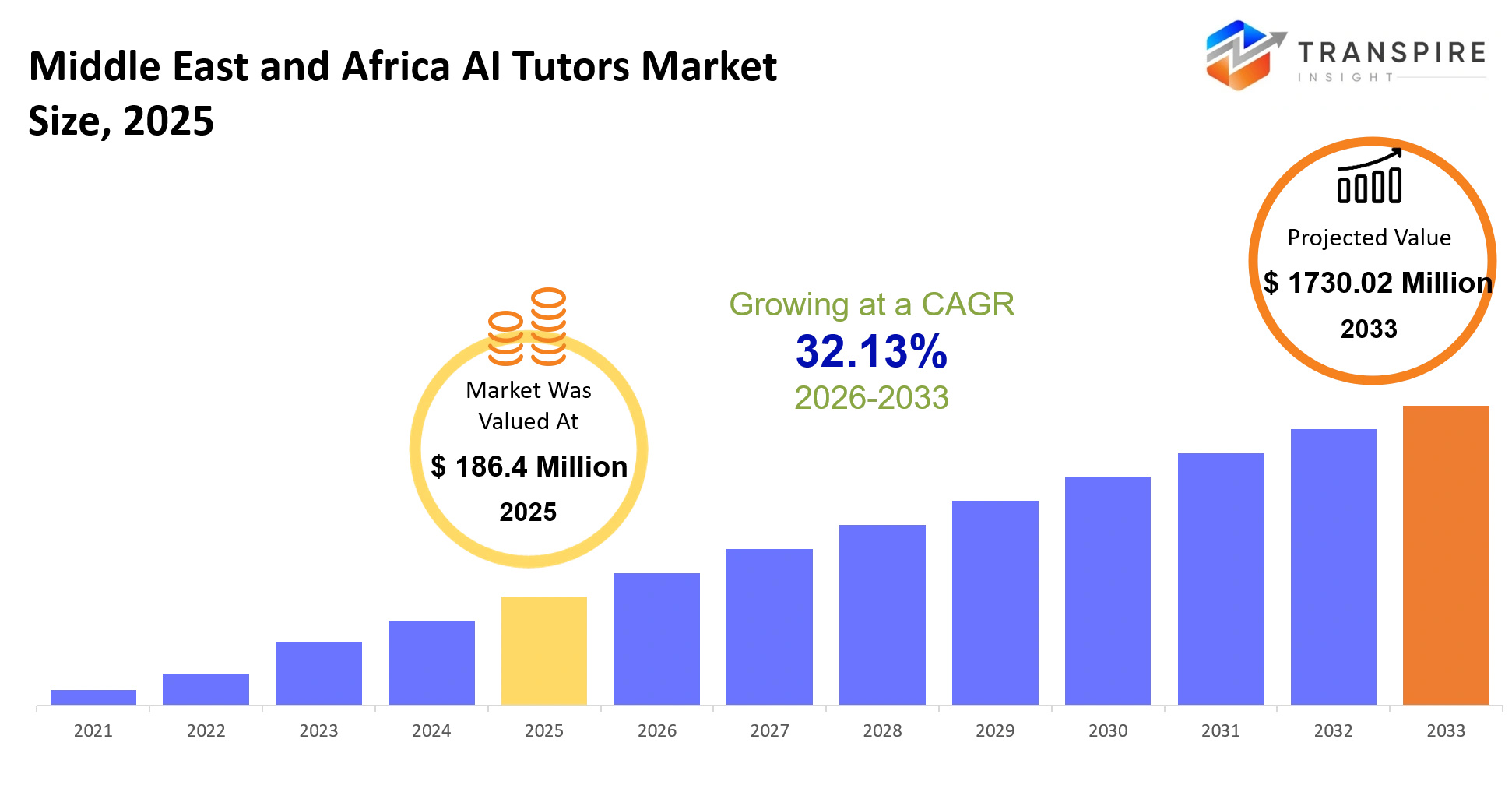
- Middle East and Africa AI Tutors Market Size 2025: USD 186.4 Million
- Middle East and Africa AI Tutors Market Size 2033: USD 1730.02 Million
- Middle East and Africa AI Tutors Market CAGR: 32.13%
- Middle East and Africa AI Tutors Market Segments: By Deployment (Cloud-Based, On-Premise, Hybrid, Others); By Application (K-12 Education, Higher Education, Test Preparation, Corporate Learning, Others); By Technology (Generative AI, NLP, Machine Learning, Others); By End User (Schools, Universities, Individual Learners, Others)
To learn more about this report,  Download Free Sample Report
Middle East and Africa AI Tutors Market Summary
The Middle East and Africa AI Tutors Market was valued at USD 186.4 Million in 2025. It is forecast to reach USD 1730.02 Million by 2033. That is a CAGR of 32.13% over the period.
The Middle East and Africa AI Tutors Market is sort of tackling a practical problem in education systems, by offering personalized learning support, sort of at scale. AI tutoring platforms let students get quick feedback, automatically tweak lesson plans, provide language assistance, and offer exam preparation guidance, without the usual constraints tied to traditional one-to-one tutoring. Over roughly the last five years, things shifted away from rule-based educational software, toward generative AI learning assistants that can hold contextual conversations, run personalized assessments, and generate content in real time. One big trigger that really sped up adoption was that fast digital learning transition after pandemic-driven school disruptions, it revealed gaps in teacher availability and also learning continuity.
After that, governments, universities, and private education providers started expanding their investments in digital education infrastructure, more aggressively than before. Then, as large language models grew more capable and also more affordable, AI tutors moved from being “extra support” tools into something closer to active learning companions. This kind of change is now spreading across K-12, higher education, and professional learning settings, and it’s opening up new subscription revenue, licensing income, and broader enterprise opportunities across the region.
Key Market Insights
- In the Middle East and Africa, the AI Tutors Market is moving away from just static e-learning stuff and more toward adaptive tutoring systems, that sort of tweak lessons on the fly. instead of one fixed flow for everyone.
- In 2025, Gulf countries made up roughly 45% of the regional revenue, pushed along by national digital education programs.
- Cloud-based deployment is still the big winner, taking close to 60% of the market share because it cuts infrastructure costs and gets running quicker.
- Hybrid deployment should become the fastest-growing slice through 2033, since schools and institutions try to balance security with scalability, not just one or the other.
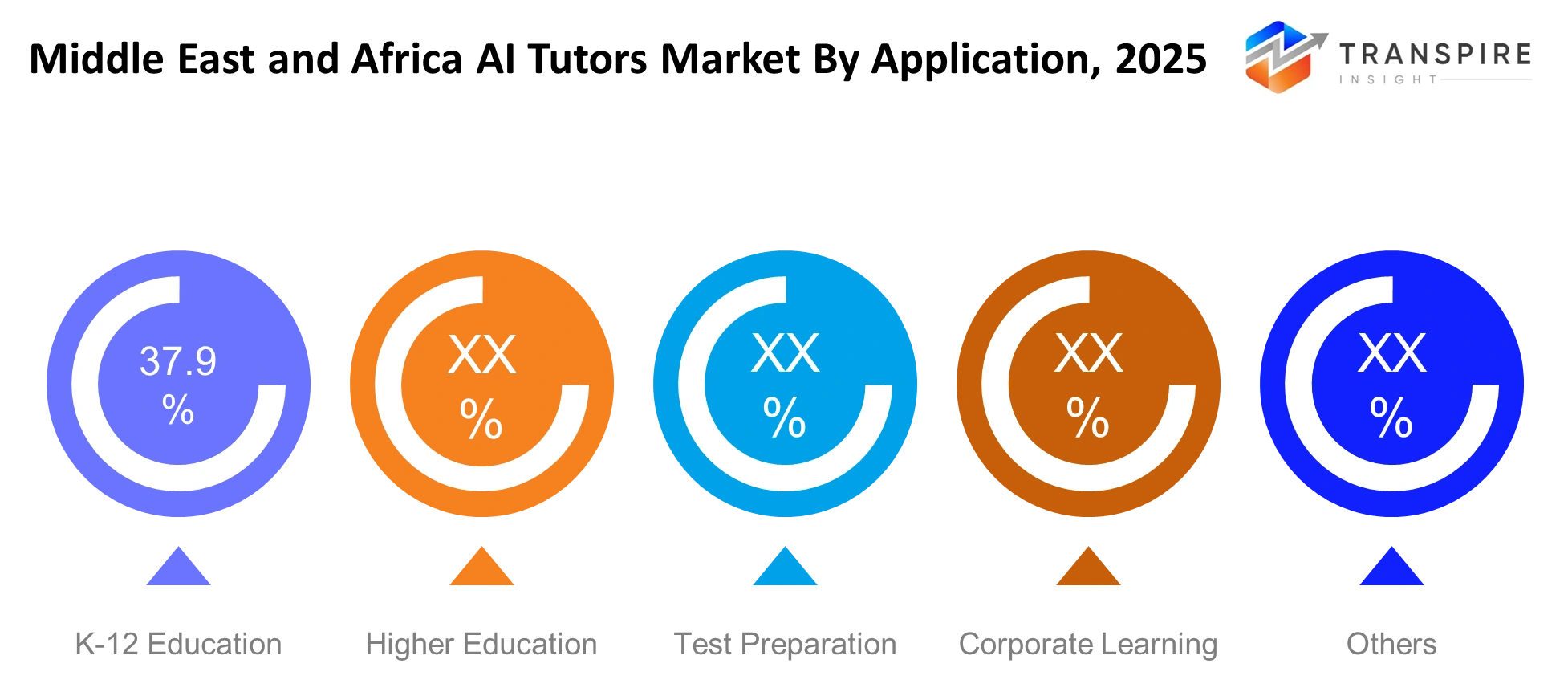
- When it comes to demand, K-12 education is over 40% of the total market, mainly thanks to curriculum support plus more personalized learning pathways.
- Higher education stays in the second spot, as universities keep folding AI assistants into student services, advising and daily tasks.
- On the tech side, generative AI solutions saw adoption growth of more than 35% annually in 2024–2025, across educational institutions.
- For end users, individual learners are the fastest-growing group too, as mobile-first learning ecosystems keep spreading across the region.
- Also, strategic partnerships between education institutions and technology providers are speeding up AI tutor rollouts in emerging markets.
- Meanwhile, Google, Microsoft, OpenAI, Pearson, Coursera, and Duolingo keep expanding AI-powered learning features through product innovation and tighter platform integration.
What are the Key Drivers, Restraints, and Opportunities in the Middle East and Africa AI Tutors Market?
The strongest growth driver seems to be the integration of generative AI into mainstream educational platforms. Then the release of advanced large language models that can deliver contextual explanations, adaptive assessments, and multilingual support kinda shifted the economics of personalized learning. Schools and universities before had limits on scaling individualized instruction because of teacher shortages, also budget constraints in many cases. Now AI tutors can offer nonstop help across thousands of learners at the same time, and that boosts engagement while instructional costs get smaller. Because of this the whole adoption curve is speeding up, plus platform uptake is feeding subscription based revenue streams for schools, universities and corporate learning providers.
Still the biggest restraint, in practice, is uneven digital infrastructure across parts of Africa and many emerging Middle Eastern economies. Broadband reliability, cloud connectivity and even basic device availability vary a lot between cities and countryside. It is kind of structural because infrastructure build outs need long term public and private money, and timelines are never quick. When connectivity is limited, platform performance drops, access to advanced AI features gets constrained, and implementation slows in underserved areas. So even with strong technology availability market penetration remains below what it could be.
A major future opportunity, though, is multilingual AI tutoring systems for Arabic French English and regional African languages. Educational technology providers are increasingly investing in localized language models and culturally tuned materials. Governments in the Gulf Cooperation Council and parts of Africa are rolling out broader digital education programs, which creates favorable conditions for region specific education .
What Has the Impact of Artificial Intelligence Been on the Middle East and Africa AI Tutors Market?
Artificial intelligence kinda becomes the base of modern tutoring platforms across the region, and yeah it supports the whole thing. More advanced AI models do a lot automatically like lesson planning, assessment creation, content recommendations, and tracking learner progress in a pretty continuous way. Schools and other educational institutions are now more and more using intelligent tutoring systems that watch student answers in real time, then they shift the instructional path depending on performance patterns. In the end this automation helps cut down paperwork and it also boosts learning personalization a lot.
Then there are machine learning models that make predictive analytics possible. Some platforms can kinda spot students who might end up underperforming, they forecast learning outcomes, and then they suggest specific interventions before the gaps get any larger. Adaptive learning engines keep tuning how the material is delivered, they do that by looking at engagement signals, assessment results, and behavioral data. And because of that, completion rates can go up, knowledge retention gets stronger, and the whole learning experience feels more efficient. On the operations side, there’s also faster content creation, less dependence on manual tutoring resources, and improved learner engagement overall. AI-powered systems also tend to offer multilingual support and basically 24/7 availability, which expands educational access for different groups of people.
Still, there’s a big limitation that keeps showing up. The supply of high quality localized training data is not always there. A lot of regional languages and curriculum standards simply do not have enough datasets, so optimal model training becomes harder. On top of that, integration costs can be high, data privacy concerns keep coming up, and different levels of digital readiness slow things down. So even with all the technological progress, implementation remains a bit messy.
Key Market Trends
- From 2024 to 2025, generative AI adoption jumped, like more than 35% ,while educational institutions rolled out conversational tutoring systems.
- At the same time, cloud-native tutoring platforms sorta replaced a lot of older on-premise learning setups, trimming deployment time by almost 40% ,which felt pretty significant.
- In the Gulf region, education authorities increased digital learning budgets across 2024–2025, and that move helped speed up AI integration throughout public schools.
- Also in 2025, Google upgraded LearnLM capabilities, which strengthened AI-driven educational experiences ,plus those guided learning features students can lean on.
- Then OpenAI came out with Study Mode in 2025, and the focus stayed on guided problem-solving, not just handing over the direct answer in a straight line.
- Another thing, multilingual tutoring became a kind of must-have purchasing criterion for institutions that serve diverse student populations ,so they could cover more learners without extra friction.
- Universities also increasingly adopted AI learning assistants to boost student retention and support services, especially around academics.
- Meanwhile mobile-first learning models picked up speed because smartphone-based education kept expanding across African markets.
- Corporate learning providers then shifted toward AI-powered skills development and workforce training programs, more emphasis on upskilling with smarter guidance.
- And near the end of 2025 ,strategic alliances between technology companies and education organizations intensified to accelerate market expansion overall.
Middle East and Africa AI Tutors Market Segmentation
By Deployment
Cloud based solutions keep a solid portion of the market , mainly because schools and universities need scalable access, reduced infrastructure spend ,and easier software upgrades. Most cloud platforms let institutions handle big student populations , while also supporting ongoing refinements through centralized AI model updates. As internet access keeps expanding , and government backed digital learning programs keep rolling out, adoption tends to get a boost too
On premise solutions still matter for places with strict data governance, plus regulatory duties they can’t really bypass. Hybrid deployments are getting more momentum , since many schools and universities want a kind of middle path between security and flexibility. And then you have other deployment models, they show up when specialized use cases exist where unusual operational realities or compliance obligations affect how teams pick the technology
By Application
K-12 education brings about a lot of adoption, since adaptive tutoring systems, kind of support learning that’s personal, and also help with curriculum reinforcement. There are interactive lessons , homework assistance, and performance tracking tools that can lift engagement across many kinds of student groups. Educational authorities are also moving more and more toward AI-enabled learning platforms, as part of their digital education plans.
In higher education, institutions lean on tutoring platforms for academic support, keeping students enrolled, and building personalized learning pathways. Test preparation applications keep growing, mostly because adaptive assessment capabilities and performance analytics help a student figure out what to fix. In corporate learning environments , AI tutors are used for workforce upskilling , compliance training, and professional development. At the same time, other approaches cover specialized educational needs, in case the basics aren’t enough.
To learn more about this report, Download Free Sample Report
By Technology
Generative AI shows up as the big, really transformative tech segment, mostly because it’s good at making content, running conversational tutoring, and giving personalized educational help. With advanced models, you can get explanations, quizzes, summaries, and various learning tasks that are matched to someone’s needs, not generic stuff. Schools and educational organizations keep leaning into these abilities, in a way that aims to boost learner outcomes, and honestly it feels faster than before.
Then there’s Natural Language Processing, which tends to improve communication quality thanks to multilingual support and some deeper contextual grasp. On top of that, machine learning makes predictive analytics more powerful, helps shape adaptive learning pathways, and supports performance optimization. Along the way, other technologies also step in for more specific roles, including speech recognition, recommendation engines, and intelligent content management systems, where the material gets organized and served more smoothly.
By End User
Schools make up a pretty substantial share of platform adoption, like administrators are really looking for scalable ways to do personalized learning. AI tutors step in to deal with teacher workload issues but also, somehow still back differentiated instruction. Curriculum aligned learning experiences also help the roll out across both primary, and secondary education settings.
Universities then use AI tutoring systems to boost academic support and keep student engagement up. Individual learners are a fast growing slice too, mostly because self paced learning feels flexible and the subscription fees are more affordable. Besides those groups, other end users include training organizations, education service providers, and professional development institutions that want tailored learning solutions.
What are the Key Use Cases Driving the Middle East and Africa AI Tutors Market?
The whole main use case basically centers on personalized academic support in K-12 education. AI tutor platforms give adaptive lessons, homework help, and real time feedback, all still mapped to what the curriculum needs. This app ends up with real strong demand, because schools are getting pushed harder to lift learning outcomes while also dealing with scarce teaching time and limited instructional resources
Other things are showing up too, especially across higher education and professional learning settings. Universities often use AI assistants for student mentoring, research assistance, and academic guidance. In corporate training, teams roll out intelligent tutoring systems to deliver skills training, certification practice and workforce development programs, even when budgets are tight
Newer use cases keep appearing like multilingual tutoring, AI powered career coaching, and specialized STEM help. More advanced generative AI models are also making it easier to craft personalized lifelong learning tracks, plus competency based education programs that could be more noticeable across the forecast period overall
|
Report Metrics |
Details |
|
Market size value in 2025 |
USD 186.4 Million |
|
Market size value in 2026 |
USD 246.05 Million |
|
Revenue forecast in 2033 |
USD 1730.02 Million |
|
Growth rate |
CAGR of32.13% from 2026 to 2033 |
|
Base year |
2025 |
|
Historical data |
2021 - 2024 |
|
Forecast period |
2026 - 2033 |
|
Report coverage |
Revenue forecast, competitive landscape, growth factors, and trends |
|
Regional scope |
Middle East and Africa (Saudi Arabia, United Arab Emirates, South Africa, Rest of Middle East and Africa) |
|
Key company profiled |
Google, Microsoft, OpenAI, Khan Academy, Duolingo, Coursera, Udemy, BYJU'S, Pearson, Chegg, Anthropic, Quizlet, Blackboard, Instructure, Simplilearn |
|
Customization scope |
Free report customization (country, regional & segment scope). Avail customized purchase options to meet your exact research needs. |
|
Report Segmentation |
By Deployment (Cloud-Based, On-Premise, Hybrid, Others); By Application (K-12 Education, Higher Education, Test Preparation, Corporate Learning, Others); By Technology (Generative AI, NLP, Machine Learning, Others); By End User (Schools, Universities, Individual Learners, Others) |
Which Regions are Driving the Middle East and Africa AI Tutors Market Growth?
The Gulf Cooperation Council area seems to pull ahead when it comes to market revenue generation, largely because there are quite hefty digital education investments, strong connectivity infrastructure, and basically persistent government backing for AI adoption . Places like the United Arab Emirates and Saudi Arabia are still folding artificial intelligence into their national education strategies. In the meantime, well-financed institutions, plus policy frameworks that look pretty supportive, help enable broad deployment of AI-powered learning tools. And then there’s the strong public-private collaboration that keeps the region’s leadership vibe in place, you know.
Moving outward, the broader Middle East sits as the second-largest contributor to market revenue. Here, momentum comes from higher education systems growing in scope, steady technology investment, and more widespread adoption of digital learning products. Schools and universities keep modernizing their learning environments via cloud-based infrastructure along with intelligent educational platforms. Even with economic conditions that differ from country to country, demand stays fairly resilient overall.
Africa, though, is expected to show the fastest growth during the forecast window. Mobile connectivity is expanding, digital inclusion initiatives are gaining traction, and education technology investments are changing how access works for personalized learning. A number of countries are pushing harder with education modernization by leaning on both public and private sector partnerships. That whole push, in practice, creates promising chances for technology providers and investors, especially for long-term growth from 2026 through 2033.
Who are the Key Players in the Middle East and Africa AI Tutors Market and How Do They Compete?
Competition is still kinda moderately fragmented, with big global technology firms, education technology providers, and a bunch of specialized AI learning companies all going after multiple segments at once. What mostly separates them is product quality, personalization know-how, language coverage, and how well they fit into existing ecosystems. Meanwhile, the more established education providers keep pushing harder on their AI capabilities, but the technology companies keep rolling out purpose built learning models as well.
Google is leaning hard into learning optimized AI with LearnLM and Gemini driven educational experiences. It basically stands out by leaning on advanced multimodal learning abilities and a really tight integration with educational productivity tools. They keep funding learning science research too, which in turn boosts the platform effectiveness, over time.
Microsoft leans on cloud infrastructure, productivity software, and AI partnerships to grow its educational offerings. Through strategic collaborations with educational orgs and learning providers, Microsoft broadens market reach and supports institutional adoption. OpenAI differentiates mainly through conversational AI, plus guided learning experiences like Study Mode. The emphasis is on interactive reasoning and tailored instruction, which helps deepen learner engagement.
Pearson blends educational content expertise with AI enabled learning solutions. With technology partnerships in place, it can expand product development and also support workforce learning applications. Coursera, along with Duolingo, keeps extending personalized learning through adaptive content delivery and AI powered engagement tools. This, overall, strengthens competitiveness across most of the online learning segments.
Company List
- Microsoft
- OpenAI
- Khan Academy
- Duolingo
- Coursera
- Udemy
- BYJU'S
- Pearson
- Chegg
- Anthropic
- Quizlet
- Blackboard
- Instructure
- Simplilearn
Recent Development News
"In July 2025, OpenAI launched Study Mode within ChatGPT. The feature introduced guided learning workflows and personalized tutoring experiences that strengthened AI-assisted education adoption.https://openai.com
"In January 2025, Pearson entered a multiyear strategic partnership with Microsoft. The collaboration focuses on AI-powered learning, workforce skilling solutions, and expanded educational technology capabilities.https://news.microsoft.com
"In July 2025, Microsoft, OpenAI, Anthropic, and the American Federation of Teachers launched the National Academy for AI Instruction. The initiative aims to expand educator training and accelerate responsible AI integration across learning environments.https://news.microsoft.com/
What Strategic Insights Define the Future of the Middle East and Africa AI Tutors Market?
The market is drifting toward highly personalized, multilingual, and always adjusting learning ecosystems, powered by advanced generative AI. The main nudge behind this shift is that large language models can now offer individualized educational help at scale, and still keep costs pretty efficient. Over the next five to seven years, AI tutors will get folded into formal education systems more and more, not just sit there as extra learning aids.
There’s also a quieter risk, the kind people don’t notice right away. The market could become concentrated around a handful of AI foundation model providers. If educational institutions rely too heavily on only a small circle of technology vendors, that could bring pricing pressure, compliance headaches, and platform lock-in issues. But on the flip side, localized AI tutoring solutions for Arabic and African language education look like a real opening that is still, kinda underdeveloped.
So market participants should push partnerships with schools and universities, keep investing in region-specific content creation, and improve their multilingual competence. The groups that manage to blend localized learning pathways with scalable AI infrastructure will likely end up best placed to win longer-term growth across the region.
Middle East and Africa AI Tutors Market Report Segmentation
By Deployment
- Cloud-Based
- On-Premise
- Hybrid
- Others
By Application
- K-12 Education
- Higher Education
- Test Preparation
- Corporate Learning
- Others
By Technology
- Generative AI
- NLP
- Machine Learning
- Others
By End User
- Schools
- Universities
- Individual Learners
- Others
Frequently Asked Questions
Find quick answers to common questions.
The expected Middle East and Africa AI Tutors Market size for the market will be USD 1730.02 Million in 2033.
Key segments for the Middle East and Africa AI Tutors Market are By Deployment (Cloud-Based, On-Premise, Hybrid, Others); By Application (K-12 Education, Higher Education, Test Preparation, Corporate Learning, Others); By Technology (Generative AI, NLP, Machine Learning, Others); By End User (Schools, Universities, Individual Learners, Others).
Major Middle East and Africa AI Tutors Market players are Google, Microsoft, OpenAI, Khan Academy, Duolingo, Coursera, Udemy, BYJU'S, Pearson, Chegg, Anthropic, Quizlet, Blackboard, Instructure, Simplilearn.
The Middle East and Africa AI Tutors Market size is USD 186.4 Million in 2025.
The Middle East and Africa AI Tutors Market CAGR is 32.13% from 2026 to 2033.
- Microsoft
- OpenAI
- Khan Academy
- Duolingo
- Coursera
- Udemy
- BYJU'S
- Pearson
- Chegg
- Anthropic
- Quizlet
- Blackboard
- Instructure
- Simplilearn
About the Authors

Mayur Shinde
I am Mayur Shinde, a Senior Research Analyst at Transpire Insight, specializing in the Automotive & Transportation and Information & Communication Technology (ICT) Industry. My work focuses on analyzing emerging market trends, technological advancements, competitive landscapes, and industry developments to deliver accurate, data-driven insights. I am passionate about transforming complex market information into clear, actionable content that helps businesses, professionals, and decision-makers stay informed and make confident strategic decisions.

Chakradhar Khansole
Chakradhar serves as the Research Director at Transpire Insight, bringing over 8 years of experience in technology, innovation, and strategic market intelligence. He specializes in transforming complex market data into actionable business insights that enable organizations to make informed, growth-oriented decisions. Recognized for his strategic vision and analytical expertise, Chakradhar leads high-impact research initiatives, delivering comprehensive market assessments, competitive intelligence, and forward-looking industry analysis.
Recently Published Reports
-
Apr 2026
3D Optical Profiler Market
3D Optical Profiler Market Size, Share & Analysis Report By Type (Desktop 3D Optical Profiler, and Portable 3D Optical Profiler), By Technology (Confocal Technology, and White Light Interference), By End-Use Industry (Manufacturing, Research Institutions, Automotive, Aerospace and Defense, Medical Devices, and Other), and Geography (North America, Europe, Asia-Pacific, Middle East and Africa, South and Central America), 2021 - 2031
-
Apr 2026
Depth Sensor Market
Depth Sensor Market Size, Share & Analysis Report By Type (Infrared Depth Sensors, Time-of-Flight (ToF) Sensors, Stereo Vision Sensors, Structured Light Sensors, Ultrasonic Depth Sensors), By Application (Automotive, Robotics, Gaming, Consumer Electronics, Industrial Automation, Healthcare, Security & Surveillance, Others), By End Users (Automotive Manufacturers, Consumer Electronics Companies, Healthcare Providers, Industrial Companies, Security Agencies, Gaming Companies, Robotics Companies, Others), and Geography (North America, Europe, Asia-Pacific, Middle East and Africa, South and Central America), 2021 – 2031
-
Apr 2026
Digital Manufacturing Market
Digital Manufacturing Market Size, Share & Analysis Report By Component (Hardware, Software, and Services), By Technology (Robotics, 3D Printing, Internet of Things (IoT), and Others), By Application (Automotive and Transportation, Aerospace and Defense, Consumer Electronics, Industrial Machinery, and Others), By Process Type (Computer-Based Designing, Computer-Based Simulation, Computer 3D Visualization, Analytics, and Others), and Geography (North America, Europe, Asia-Pacific, Middle East and Africa, South and Central America), 2021 – 2031
-
Apr 2026
Digital Visa Services Market
Digital Visa Services Market Size, Share & Analysis Report By Type (Individual Travelers, Group Travelers), By Application (Tourism, Business Travel, Others), and Geography (North America, Europe, Asia-Pacific, Middle East and Africa, South and Central America), 2021 – 2031