

Global Generative AI in Pricing Market Size & Forecast:
- Global Generative AI in Pricing Market Size 2025: USD 310.96 Million
- Global Generative AI in Pricing Market Size 2033: USD 985.07 Million
- Global Generative AI in Pricing Market CAGR: 15.5%
- Global Generative AI in Pricing Market Segments: By Component (Software, Platforms, Services), By Application (Dynamic Pricing, Forecasting, Revenue Optimization, Personalization), By End-User (Retail, E-commerce, Travel, BFSI)

To learn more about this report,  Download Free Sample Report
Global Generative AI in Pricing Market Summary:
The Global Generative AI in Pricing Market size is estimated at USD 310.96 Million in 2025 and is anticipated to reach USD 985.07 Million by 2033, growing at a CAGR of 15.5% from 2026 to 2033.
This technology basically kills the guesswork in setting prices. Companies are finally dumping static spreadsheets and letting AI adjust their pricing on the fly based on competitor moves, local inventory, and live web traffic. The big wake-up call hit recently when sudden inflation spikes broke older pricing models. Businesses realized pretty quickly that human teams simply couldn't update numbers fast enough to match daily cost changes.
That bottleneck forced a massive structural shift toward fully automated revenue management. With margins under constant pressure, brands are pouring money into platforms that test thousands of price variations every minute. It really comes down to self-defense—major retailers and travel companies are adopting these tools just to protect their profits and avoid getting boxed out by faster competitors.
Key Market Insights:
- The market is abandoning rigid, spreadsheet-based markups for predictive, context-aware automation. This is driven by a massive technological movement from enterprises demanding instant, generative pricing to protect profit margins against sudden supply and inflation shifts.
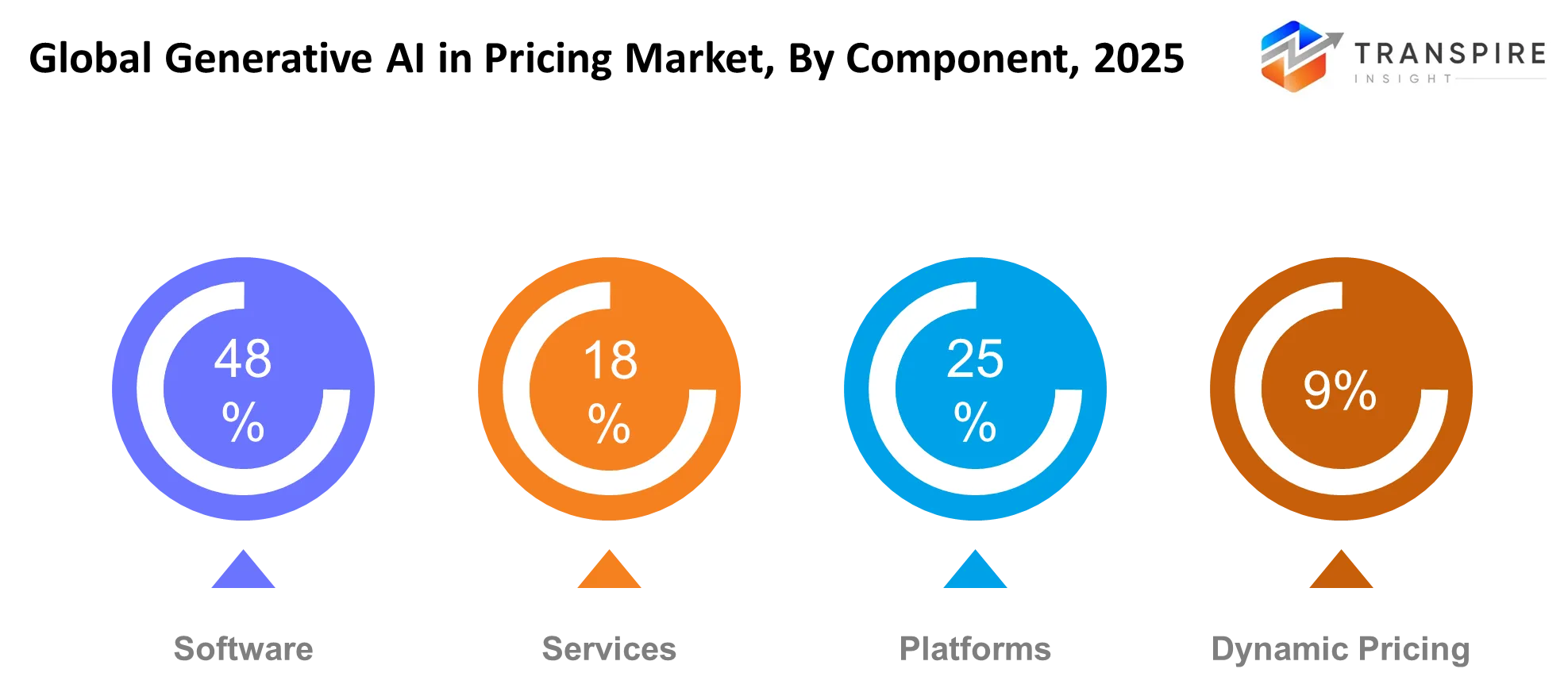
- Software leads with a 48% component share as Salesforce integrates generative AI into CRMs, driving a technological movement toward instant, automated B2B quoting.
- Dynamic pricing dominates with a 69% application share as Amazon AWS advances real-time algorithms, fueling a behavioral movement to match competitor rates instantly.
- North America commands a 35% geographic share as Google pioneers deep learning models, reflecting a behavioral movement among retailers to hyper-personalize customer discounts.
- Services capture a 27% component share as Deloitte expands its implementation consulting, sparking a behavioral movement from brands demanding fully managed AI integration.
- Platforms account for a 25% component share as IBM scales its Watsonx infrastructure, driving a technological movement toward centralized, cloud-based pricing engines.
- The Asia Pacific region accelerates at a 15.7�GR as Zoho rolls out accessible AI tools, cementing a behavioral movement among growing e-commerce brands to automate pricing.
- The platforms segment expands rapidly at a 13.9�GR as Microsoft upgrades its Azure capabilities, sparking a technological movement for highly scalable retail pricing grids.
What are the Key Drivers, Restraints, and Opportunities in the Global Generative AI in Pricing Market?
Driver
Margin compression from volatile supply chains and inflation is the primary catalyst pushing this market forward. Human analysts simply cannot process daily cost fluctuations fast enough to keep retail pricing accurate. To close that gap, enterprises are integrating generative AI to evaluate thousands of pricing variations on the fly. Catching these discrepancies early leads directly to recovered revenue. Look at Walmart's recent strategy. They use AI-backed dynamic models to adjust numbers based on local demand and competitor shifts without requiring manual approval. Once a market leader establishes that kind of automated infrastructure, it forces the entire sector to invest in similar tools just to defend their market share.
Restraint
The main roadblock holding the market back is the "black box" data problem. Generative AI relies heavily on massive amounts of perfectly clean data to make accurate predictions. However, most older enterprises still operate on fractured legacy ERP systems and siloed databases. Because this structural data mess persists, executives hesitate to trust AI with full control over their pricing, terrified a rogue algorithm might slash prices too low and destroy their margins overnight.
Opportunity
A massive future opportunity lies in automating complex B2B contract quoting. While retail gets all the attention, B2B manufacturers are still stuck dealing with incredibly slow, manual contract negotiations. The shift toward industry-specific generative platforms—like Salesforce or SAP building custom AI specifically for heavy manufacturing—will unlock entirely new revenue channels. Especially across the fast-growing Asia Pacific region, investing in AI models that can instantly generate personalized, high-volume bulk pricing grids will be a total game-changer.
What Has the Impact of Artificial Intelligence Been on the Global Generative AI in Pricing Market?
Artificial intelligence basically rewrote how companies protect their profit margins. Instead of tweaking static spreadsheets, businesses now use AI to automate their entire pricing strategy. The software instantly digests live competitor rates, supply chain costs, and web traffic to generate the best possible price tag on the fly.
Beyond basic automation, these algorithms bring real predictive power to the table. They can forecast demand shifts based on subtle market triggers before they actually hit the balance sheet. Look at Zilliant's launch of its Pricing Plus platform in late 2025. They specifically designed the AI to help B2B manufacturers replace messy, manual quoting with structured data, allowing sales teams to close hidden margin leaks and execute complex industrial deals much faster.
Operationally, this removes the endless waiting game for manager approvals, letting sales reps close contracts much faster. However, the technology still faces a massive integration roadblock. Wiring these advanced AI engines into decades-old, messy ERP databases is incredibly expensive. If the AI learns from bad historical data, it creates a dangerous accuracy gap where the system might accidentally generate absurdly low prices, meaning companies still have to keep human safety nets in place.
Key Market Trends:
- Pricing strategies are actively shifting from reactive competitor matching to proactive margin protection. Companies are moving away from scheduled rate updates in favor of continuous, generative adjustments that respond to real-world market friction.
- Moving past basic numerical data, businesses now use natural language processing to scan competitor news and earnings calls, marking a technological shift toward context-aware pricing algorithms.
- Rather than juggling separate databases, sales reps are adopting pricing engines embedded directly into their CRMs, driving a behavioral movement toward single-screen contract negotiations.
- While e-commerce was the early tester, heavy manufacturing is finally scrapping legacy rate cards for generative quoting, signaling an industry shift toward automated B2B deal pricing.
- Vendors are transitioning away from secretive "black box" models to tools that explicitly explain their math, sparking a behavioral shift where human teams actually trust the software with VIP clients.
- Retailers are abandoning broad seasonal sales to focus on individual shopper profiles, an industry shift powered by AI generating unique price tags based on live cart behavior.
- Older cloud-only frameworks are making way for local edge computing, a technological movement that lets physical supermarkets update digital shelf tags instantly without network lag.
- SaaS companies are dropping flat monthly subscription tiers and using generative tools to run complex, usage-based billing, reflecting a behavioral shift toward pay-for-performance pricing.
- Merchandisers are breaking the habit of reactionary clearance sales, instead using AI to map out markdown schedules months in advance to optimize the entire inventory lifecycle.
Global Generative AI in Pricing Market Segmentation
By Component
Software currently controls 48% of the market. Most companies just want plug-and-play tools that sync right into their existing CRMs, completely avoiding the headache of building AI architecture from the ground up. Vendors are noticing this shift and will likely start pushing lightweight API microservices over bulky, traditional enterprise suites. On the platform side, we are seeing the fastest growth—a 13.9�GR that pushes it to a 25% share. When huge corporations hit the limits of standard software, they need massive cloud setups to safely train custom pricing models using their own private data. Watch for heavy consolidation here as tech giants like AWS and Microsoft start buying up smaller niche platforms. Services lock down the final 27%. Hooking AI up to messy, outdated legacy databases is notoriously difficult. Businesses are relying on outside consultants to scrub their historical data before they even flip the switch on the algorithms. Down the line, expect those initial consulting gigs to turn into permanent managed services, with third-party teams watching the algorithms full-time to catch any expensive pricing mistakes.
To learn more about this report, Download Free Sample Report
By Application
Applications, dynamic pricing completely dominates the category with a massive 69% sub-segment share. E-commerce players absolutely have to match competitor rates instantly just to survive, driving an immediate rush for tools that automatically adjust numbers based on live web traffic. Soon, basic price matching will just be table stakes, and algorithms will have to focus entirely on local inventory scarcity to find hidden margin bumps. Forecasting serves as a critical secondary growth area. Ongoing supply chain volatility forces brands to project future cost spikes months in advance so they can adjust prices before taking a financial hit. Over time, these forecasting engines will merge directly with inventory procurement systems. Revenue optimization remains a steady, high-value segment favored by B2B players. Industrial manufacturers use these tools to figure out the exact maximum threshold a long-term VIP client is willing to pay before walking away, which will fundamentally change contract negotiations by removing manual, emotional discounting. Finally, personalization is rapidly emerging across consumer markets. Retailers realize broad seasonal sales destroy margins, so they use AI to offer targeted markdowns based on cart abandonment history. However, this shift will likely spark new consumer pushback and data privacy debates once shoppers realize they are seeing different price tags than their neighbors.
By End-User
For end-users, retail and e-commerce are the traditional heavyweights driving the vast majority of early AI adoption. Razor-thin margins combined with millions of daily transactions make it physically impossible for human teams to update spreadsheets fast enough. Down the road, physical retail stores will likely sync their electronic shelf labels directly to the exact same AI engine running their e-commerce sites for total pricing parity. The travel sector represents a highly mature segment pushing the boundaries of dynamic rate adjustments. Airlines and hotels deal with expiring inventory, pushing them to use generative models to map incredibly precise booking curves. Pricing here will soon shift to factor in hyper-local events, weather, and individual traveler loyalty tiers in real time. Meanwhile, banking, financial services, and insurance (BFSI) act as an expanding frontier for complex AI pricing models. Banks need to instantly calculate personalized loan rates or insurance premiums based on live risk profiling rather than relying on outdated actuarial tables. As this grows, regulators will aggressively step in, forcing financial institutions to make their AI pricing models completely transparent to avoid accidental algorithmic bias.
What are the Key Use Cases Driving the Global Generative AI in Pricing Market?
For retail and e-commerce players, the core focus is instant price matching. Stores hook dynamic algorithms straight into their web platforms to constantly scrape rival rate changes. If a competitor drops a price, the software tweaks the numbers on the fly to protect the margin—completely skipping the need for manager approval.
Outside of retail, industrial manufacturers and travel companies use the technology for predictive revenue optimization. B2B sales teams use forecasting engines to instantly generate complex contract quotes, calculating the maximum price a client will actually pay before walking away from the deal.
A rapidly emerging use case is hyper-personalized rate generation. The financial sector is testing these models to instantly calculate custom loan rates and insurance premiums based on live behavioral risk profiling rather than relying on outdated, static tables.
|
Report Metrics |
Details |
|
Market size value in 2025 |
USD 310.96 Million |
|
Market size value in 2026 |
USD 359.15 Million |
|
Revenue forecast in 2033 |
USD 985.07 Million |
|
Growth rate |
CAGR of 15.5% from 2026 to 2033 |
|
Base year |
2025 |
|
Historical data |
2021 - 2024 |
|
Forecast period |
2026 - 2033 |
|
Report coverage |
Revenue forecast, competitive landscape, growth factors, and trends |
|
Regional scope |
United States; Canada; Mexico; United Kingdom; Germany; France; Italy; Spain; Denmark; Sweden; Norway; China; Japan; India; Australia; South Korea; Thailand; Brazil; Argentina; South Africa; Saudi Arabia; United Arab Emirates |
|
Key company profiled |
IBM, Microsoft, Google, Amazon AWS, SAP, Oracle, Salesforce, NVIDIA, Adobe, Accenture, Deloitte, SAS, Zoho, HubSpot, Stripe |
|
Customization scope |
Free report customization (country, regional & segment scope). Avail customized purchase options to meet your exact research needs. |
|
Report Segmentation |
By Component (Software, Platforms, Services), By Application (Dynamic Pricing, Forecasting, Revenue Optimization, Personalization), By End-User (Retail, E-commerce, Travel, BFSI) |
Which Regions are Driving the Global Generative AI in Pricing Market Growth?
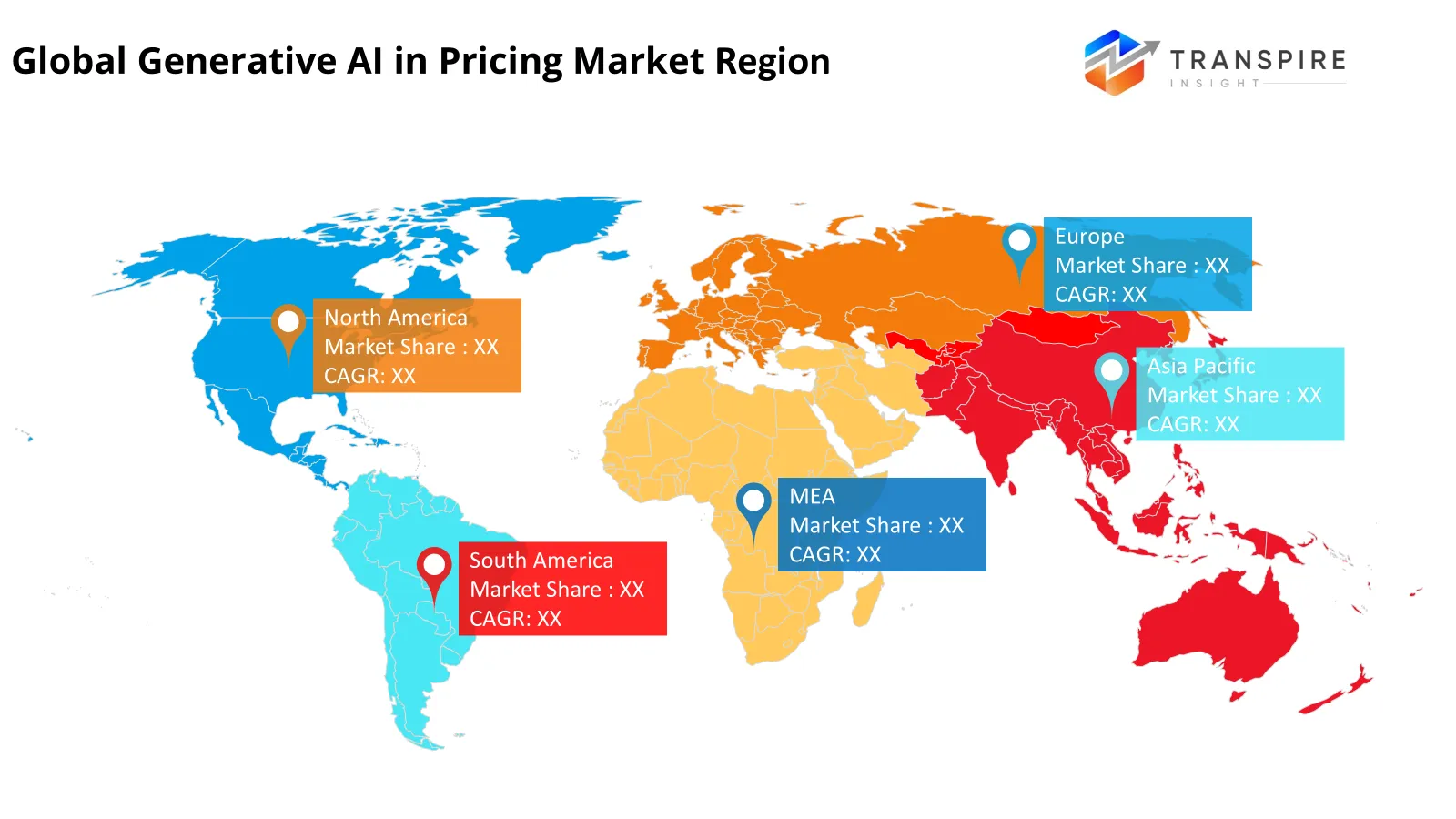
North America dominates this market largely because massive cloud providers and retail giants are already heavily invested in AI infrastructure. Unlike other areas, the local ecosystem provides the exact computing power needed to run complex pricing algorithms without lag. Unrelenting pressure to protect profit margins drives continuous demand from massive retail and e-commerce networks looking to automate their revenue strategies. Because of this structural advantage, businesses here are usually the first to deploy advanced generative tools for real-time price matching. In November 2025, Salesforce expanded its AI platform across North America, allowing sales teams to automatically generate dynamic contract quotes based on live supply chain costs.
Europe approaches the market a bit differently than North America, focusing heavily on compliance-driven stability rather than just raw deployment speed. Strict data privacy regulations essentially force companies to invest in transparent, explainable pricing algorithms instead of relying on opaque "black box" models. This regulatory environment creates a highly stable ecosystem where corporate data security acts as the foundation for software adoption. Local manufacturers also heavily rely on these customized tools to safely calculate and automate complex cross-border tariffs without risking non-compliance. In February 2026, SAP introduced specialized generative AI agents designed to automate European trade pricing while strictly adhering to EU sovereign cloud requirements.
Asia Pacific is rapidly turning into the fastest-growing market thanks to an explosive surge in mobile e-commerce and a massive shift toward digital supply chains. Local brands recently hit a breaking point where traditional manual spreadsheets simply could not keep up with the sheer volume of daily online transactions. This operational bottleneck is finally forcing both massive conglomerates and mid-sized businesses to actively seek out automated rate adjustments. Looking ahead, there is a huge opportunity for software vendors to supply plug-and-play dynamic pricing engines to these rapidly expanding regional businesses. In March 2026, Japan's Aeon Retail rolled out AI-driven analytics combined with predictive pricing models to instantly adjust digital shelf numbers based on live store foot traffic.
To learn more about this report, Download Free Sample Report
Who are the Key Players in the Global Generative AI in Pricing Market and how do they Compete?
The Global Generative AI in Pricing Market is fiercely consolidated around heavy enterprise cloud providers and specialized CRM vendors. Competition revolves entirely around integration speed and algorithmic transparency. Rather than fighting over basic software subscription costs, vendors are racing to embed their pricing engines natively into existing enterprise resource pipelines to minimize friction and prevent clients from needing to rebuild their data architecture.
Salesforce competes through workflow innovation, embedding its generative pricing directly into the daily dashboards of B2B sales teams. By differentiating itself with this ecosystem approach, it prevents users from having to toggle between separate platforms to generate a complex contract quote. The company expands aggressively by acquiring smaller AI startups to build out hyper-specific pricing modules for niche manufacturing and retail sectors.
Zoho takes a drastically different approach, targeting the mid-market with a strict cost-leadership strategy. It differentiates by offering accessible, low-code pricing engines that do not require an army of expensive data scientists to operate. To expand its global footprint, particularly across the Asia Pacific region, Zoho bundles its generative pricing tools with its broader software suite, heavily undercutting the massive implementation fees charged by legacy tech giants.
Company List:
- IBM
- Microsoft
- Amazon AWS
- SAP
- Oracle
- Salesforce
- NVIDIA
- Adobe
- Accenture
- Deloitte
- SAS
- Zoho
- HubSpot
- Stripe
Recent Development News
- In May 2026, Oracle added new Machine Learning Services and a dynamic AI cost estimator to its OCI Enterprise setup. This update helps big B2B companies figure out exactly what it will cost to run their custom pricing models before they actually deploy them.https://www.oracle.com
- In March 2025, PROS Holdings, Inc. rolled out new Agentic AI features directly inside its main pricing platform. This setup pairs standard rule-based forecasting with generative AI, letting sales teams lock in live numbers quickly without worrying about the software hallucinating bad data.https://pros.com
What Strategic Insights Define the Future of the Global Generative AI in Pricing Market?
The market is quickly moving past basic price matching. We are heading toward fully autonomous margin protection, where algorithms adjust rates based on early supply chain hiccups before those costs actually hit the balance sheet.
There is a massive hidden risk here: algorithmic collusion. If major competitors all rely on similar foundational AI, their pricing engines could implicitly learn to fix prices together without any human input, which will absolutely trigger heavy antitrust lawsuits. On the flip side, tying pricing to live environmental metrics is a huge emerging opportunity. Brands can soon offer dynamic discounts based on the real-time carbon footprint of a specific delivery route.
To navigate this, businesses need to set up strict, human-led auditing. Do not just buy an AI pricing engine and let it run wild. You must constantly verify the underlying math to ensure your pricing strategy stays transparent and legally safe.
Global Generative AI in Pricing Market Segments:
By Component
- Software
- Platforms
- Services
By Application
- Dynamic Pricing
- Forecasting
- Revenue Optimization
- Personalization
By End-User
- Retail
- E-commerce
- Travel
- BFSI
Regional Outlook
North America
- United States
- Canada
- Mexico
Europe
- Germany
- United Kingdom
- France
- Spain
- Italy
- Rest of Europe
Asia Pacific
- Japan
- China
- Australia & New Zealand
- South Korea
- India
- Rest of Asia Pacific
South America
- Brazil
- Argentina
- Rest of South America
Middle East & Africa
- Saudi Arabia
- United Arab Emirates
- South Africa
- Rest of the Middle East & Africa
Frequently Asked Questions
Find quick answers to common questions.
The approximate Global Generative AI in Pricing Market size for the market will be USD 985.07 Million in 2033.
Key segments for the global generative AI in pricing market are Component (Software, Platforms, Services), Application (Dynamic Pricing, Forecasting, Revenue Optimization, Personalization), and End-User (Retail, E-commerce, Travel, BFSI).
Major global generative AI in pricing market players are IBM, Microsoft, Google, Amazon AWS, SAP, Oracle, Salesforce, NVIDIA, Adobe, Accenture, Deloitte, SAS, Zoho, HubSpot, and Stripe.
The global generative AI in pricing market size is USD 359.15 Million in 2026.
The global generative AI in pricing market CAGR is 15.5%.
- IBM
- Microsoft
- Amazon AWS
- SAP
- Oracle
- Salesforce
- NVIDIA
- Adobe
- Accenture
- Deloitte
- SAS
- Zoho
- HubSpot
- Stripe
About the Authors

Mayur Shinde
I am Mayur Shinde, a Senior Research Analyst at Transpire Insight, specializing in the Automotive & Transportation and Information & Communication Technology (ICT) Industry. My work focuses on analyzing emerging market trends, technological advancements, competitive landscapes, and industry developments to deliver accurate, data-driven insights. I am passionate about transforming complex market information into clear, actionable content that helps businesses, professionals, and decision-makers stay informed and make confident strategic decisions.

Chakradhar Khansole
Chakradhar serves as the Research Director at Transpire Insight, bringing over 8 years of experience in technology, innovation, and strategic market intelligence. He specializes in transforming complex market data into actionable business insights that enable organizations to make informed, growth-oriented decisions. Recognized for his strategic vision and analytical expertise, Chakradhar leads high-impact research initiatives, delivering comprehensive market assessments, competitive intelligence, and forward-looking industry analysis.
Recently Published Reports
-
Apr 2026
3D Optical Profiler Market
3D Optical Profiler Market Size, Share & Analysis Report By Type (Desktop 3D Optical Profiler, and Portable 3D Optical Profiler), By Technology (Confocal Technology, and White Light Interference), By End-Use Industry (Manufacturing, Research Institutions, Automotive, Aerospace and Defense, Medical Devices, and Other), and Geography (North America, Europe, Asia-Pacific, Middle East and Africa, South and Central America), 2021 - 2031
-
Apr 2026
Depth Sensor Market
Depth Sensor Market Size, Share & Analysis Report By Type (Infrared Depth Sensors, Time-of-Flight (ToF) Sensors, Stereo Vision Sensors, Structured Light Sensors, Ultrasonic Depth Sensors), By Application (Automotive, Robotics, Gaming, Consumer Electronics, Industrial Automation, Healthcare, Security & Surveillance, Others), By End Users (Automotive Manufacturers, Consumer Electronics Companies, Healthcare Providers, Industrial Companies, Security Agencies, Gaming Companies, Robotics Companies, Others), and Geography (North America, Europe, Asia-Pacific, Middle East and Africa, South and Central America), 2021 – 2031
-
Apr 2026
Digital Manufacturing Market
Digital Manufacturing Market Size, Share & Analysis Report By Component (Hardware, Software, and Services), By Technology (Robotics, 3D Printing, Internet of Things (IoT), and Others), By Application (Automotive and Transportation, Aerospace and Defense, Consumer Electronics, Industrial Machinery, and Others), By Process Type (Computer-Based Designing, Computer-Based Simulation, Computer 3D Visualization, Analytics, and Others), and Geography (North America, Europe, Asia-Pacific, Middle East and Africa, South and Central America), 2021 – 2031
-
Apr 2026
Digital Visa Services Market
Digital Visa Services Market Size, Share & Analysis Report By Type (Individual Travelers, Group Travelers), By Application (Tourism, Business Travel, Others), and Geography (North America, Europe, Asia-Pacific, Middle East and Africa, South and Central America), 2021 – 2031