
Europe Generative AI in Pricing Market Size & Forecast:
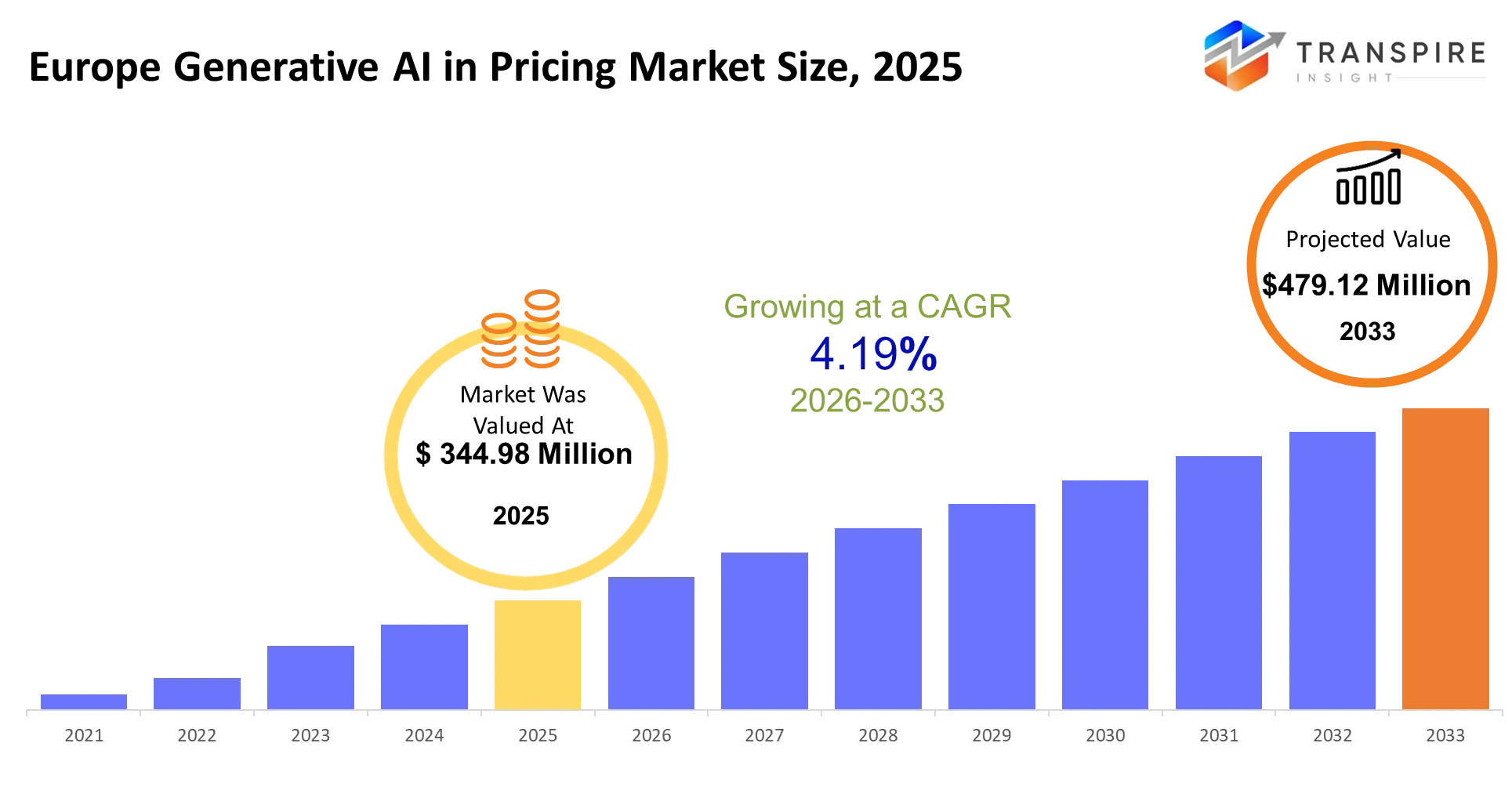
- Europe Generative AI in Pricing Market Size 2025: USD 344.98 Million
- Europe Generative AI in Pricing Market Size 2033: USD 479.12 Million
- Europe Generative AI in Pricing Market CAGR: 4.19%
- Europe Generative AI in Pricing Market Segments: By Type (Pricing Software, AI Models, Analytics Platforms, Others); By Application (Dynamic Pricing, Revenue Optimization, Demand Forecasting, Competitive Pricing, Personalization, Others); By End-User (Retailers, E-commerce, Travel & Hospitality, BFSI, Manufacturing, Others); By Deployment (Cloud, On-premise, Hybrid, Others)
To learn more about this report,  Download Free Sample Report
Europe Generative AI in Pricing Market Summary
The Europe Generative AI in Pricing Market was valued at USD 344.98 Million in 2025. It is forecast to reach USD 479.12 Million by 2033. That is a CAGR of 4.19% over the period.
The Europe Generative AI in Pricing Market helps business customers through AI-based systems which enable them to create and modify product and service prices throughout their retail manufacturing telecommunications and financial operations. The system uses real-time optimization models which replace traditional pricing rules because it can adapt to changing market demand and cost patterns and competitive forces throughout online sales and enterprise resource planning systems.
The market has developed from its previous system which used rule-based pricing software to current systems that operate autonomous through generative AI pricing technology which enterprise platforms directly integrate. The European economy experienced continuous rising prices after 2022 which forced businesses to adapt their pricing methods on an ongoing basis instead of using scheduled updates. The EU AI Act established new rules which required companies to develop transparent and explainable systems, thus forcing them to change their pricing frameworks for legal compliance instead of their system optimization goals.
The combination of rising operational costs together with increased government monitoring has transformed enterprise operations, which now drive businesses to use AI pricing solutions that work with cloud systems and help organizations maintain their profit margins while staying compliant. Continuous pricing intelligence now determines revenue growth, because businesses no longer depend on manual pricing updates or set pricing schedules.
Key Market Insights
- The Western European market for Generative AI in Pricing will reach 42% market share by 2025 because companies need to comply with EU AI Act regulations and their enterprise resource planning systems need to connect with AI technology.
- Northern Europe emerges as a stable second hub due to high cloud penetration and early adoption of AI-enabled pricing automation in retail and telecom sectors.
- Southern and Eastern Europe represent the fastest-growing region, forecast to expand rapidly through 2030 due to EU digital funding and SME cloud adoption.
- The Europe Generative AI in Pricing Market generates its highest market share through pricing software which controls 38% of the market because it integrates deeply with enterprise resource planning systems used by large companies.
- The period between 2025 and 2032 will show AI-driven pricing models as the most rapidly developing industry segment because companies will adopt agentic pricing automation solutions.
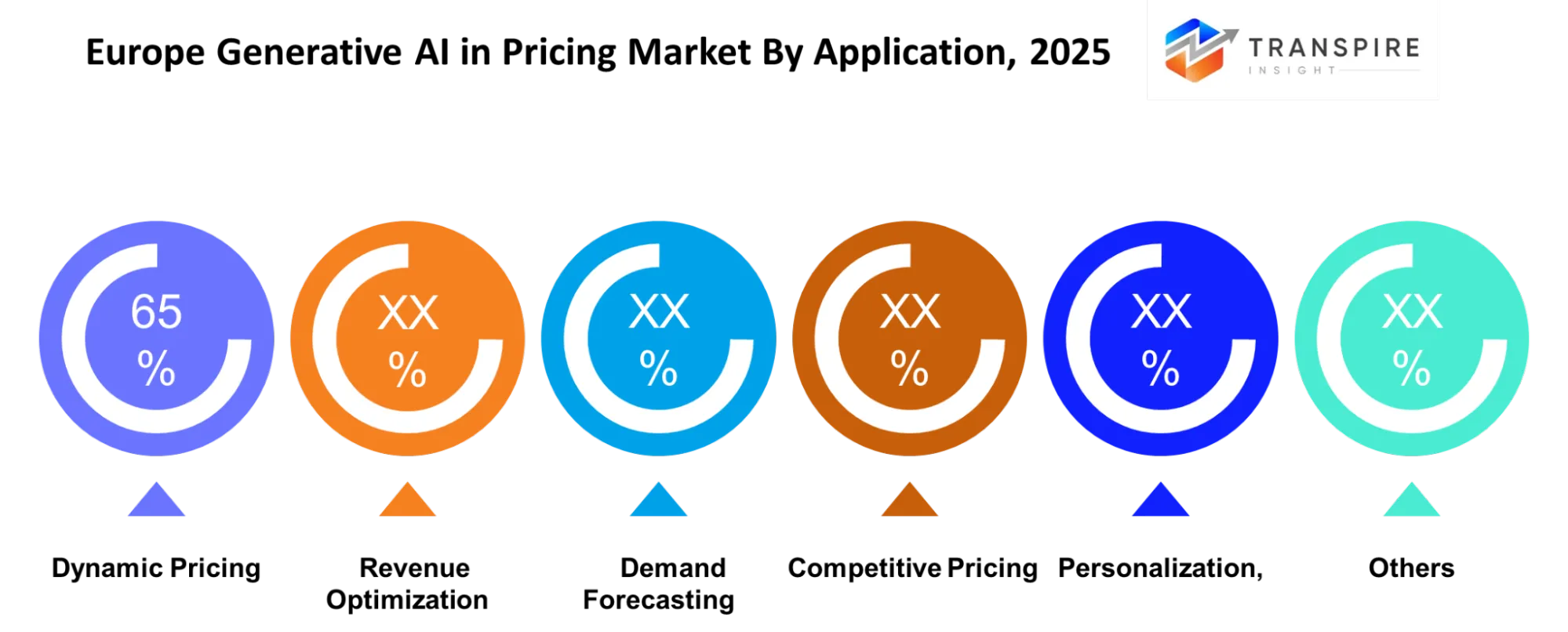
- Dynamic pricing applications dominate with over 40% usage share, especially in retail and e-commerce ecosystems.
- AI pricing intelligence technology will drive revenue optimization which serves as the fastest growing application used by telecom companies and subscription based businesses.
- The retail industry continues to dominate as the primary user group while the banking and financial services industry experiences its most rapid development through implementing risk-based pricing changes.
- IBM and Oracle develop AI model governance technology together with explainability solutions to satisfy European Union regulatory compliance requirements.
- The Europe Generative AI in Pricing Market uses three main methods for developing its business which include establishing partnerships and forming cloud alliances and creating agentic AI technologies.
What are the Key Drivers, Restraints, and Opportunities in the Europe Generative AI in Pricing Market?
The primary driver of business growth exists because enterprises need to maximize their profit margins under the conditions of fluctuating European inflation rates and ongoing pricing evaluations. The retail, telecom, and manufacturing sectors experienced cost uncertainties after 2023, which led them to adopt generative AI for improving their pricing systems. Cloud-based ERP ecosystems now enable businesses to update their pricing in real time, which results in immediate revenue increases through pricing intelligence instead of waiting for revenue boosts from scheduled optimization periods. Businesses now use AI-powered pricing systems that operate continuously throughout their commercial activities and supply chain operations instead of using fixed pricing methods which depend on predefined rules.
The EU AI governance framework requires organizations to comply with dual requirements, which create the main obstacle to implementation because public regulations demand technical systems to explain their functions while businesses utilize multiple data systems. Organizations in the banking, financial services, and insurance sectors face restrictions that prevent them from using automated pricing systems because their models must maintain both auditability and transparency. The dual requirements for human and artificial intelligence systems lead to higher operating expenses for businesses while they work to implement their systems. Organizations need to maintain hybrid operational abilities which combine human operators with artificial intelligence systems because their existing workflow system requires both.
The development of sovereign AI pricing systems, which operate on EU-compliant cloud infrastructure, creates a new business opportunity through initiatives established in Germany and France. SAP's sovereign cloud partnerships and regional AI hubs provide platforms, which allow safe and local implementation of generative pricing engines.This sets the tone for a considerably scaled-up uptake in mid-market companies that hitherto lacked efficient compliance-ready infrastructure, opening up another window of expansion spanning the years 2026 through 2033.
What Has the Impact of Artificial Intelligence Been on the Europe Generative AI in Pricing Market?
Artificial intelligence is transforming pricing optimization systems throughout Europe because it integrates automated systems into business decision-making processes which use generative models to modify pricing parameters and create demand forecasts and implement instantaneous changes through ERP and ecommerce systems. Retail and e-commerce businesses use AI-based automated systems which maintain constant price adjustments according to their product stock availability and their competitors activities and the purchasing habits of their customers. Manufacturing and logistics operations utilize automated systems to enhance contract pricing processes by matching cost factors with margin objectives and supply chain fluctuations while decreasing dependence on fixed spreadsheet systems and manual work.
Businesses now depend on machine learning models for their predictive demand forecasting needs and revenue optimization processes which enable them to estimate price elasticity changes and seasonal demand patterns with greater accuracy. The models enable enterprises to assess pricing methods through inflation impacts and supply shortages before they implement new strategies. Businesses achieve better margin control and faster pricing processes while large retailers cut their price update time from days to minutes and enhance promotion effectiveness through specific changes.
Businesses encounter implementation difficulties because existing ERP system integration demands extensive technical effort while enterprise systems provide inconsistent data quality. European Union regulations require companies to demonstrate their models through model explainability, which makes it impossible for them to maintain total control over pricing, resulting in delayed organization-wide implementation.
Key Market Trends
- Enterprises shifted from rule-based pricing engines in 2022 through 2023 to AI-driven dynamic pricing systems which they integrated into their ERP platforms throughout Europe.
- In 2025 SAP and Microsoft enhanced their AI pricing features by introducing real-time autonomous pricing capabilities which replaced their previous advisory analytics system.
- The EU AI Act established compliance requirements that forced companies to develop pricing systems which provided transparent explanations instead of using hidden optimization methods.
- Retailers increased adoption of generative AI pricing tools in 2025 because these tools automated discounting through algorithms that adjusted to market demand.
- The share of cloud deployment increased dramatically after 2024 because companies preferred cloud solutions over on-premise pricing systems which required high maintenance costs.
- Zilliant and Vendavo introduced agentic AI models for pricing optimization between 2024 and 2026 which enabled them to develop deeper automation capabilities.
- Manufacturing firms in Germany and Italy adopted AI pricing systems in 2025 for contract bidding, which allowed them to move away from using fixed margin templates.
- In 2023 companies began to differentiate themselves through pricing accuracy while in 2026 they adopted enterprise data ecosystem integration as their main competitive advantage.
- BFSI sectors increased their use of hybrid deployment models during 2025 because regulators introduced new data localization requirements and more stringent audit procedures.
Europe Generative AI in Pricing Market Segmentation
By Type:
The segment which contains Pricing Software AI Models Analytics Platforms and Others assembles its maximum market portion because businesses continue to use structured software systems for their pricing decision implementation needs. The industry adopts pricing software as the leading solution because it establishes direct connections with ERP and CRM systems which deliver immediate business results without removing existing systems. The AI models sector expands rapidly because businesses need solutions which can adapt to changing conditions while generating new outputs that enhance their ability to respond to fluctuating demand. Analytics platforms remain important to businesses which need to understand their pricing decisions while meeting EU requirements for decision-making explanations and system evaluations. The software industry will develop towards tighter integration between its products and their built-in AI systems which will push vendors to create complete pricing intelligence solutions that bring together all pricing functions instead of offering separate components.
By Application:
The applications of Dynamic Pricing Revenue Optimization Demand Forecasting Competitive Pricing Personalization and Others demonstrate that dynamic pricing stands as the primary application because retail and e-commerce companies need to adjust prices in real time for maintaining their profit margins. The telecom and subscription-based sectors follow revenue optimization as their second priority because these industries depend on managing customer lifetime value. Enterprises now use demand forecasting because supply chain disruptions require businesses to implement predictive pricing methods across their procurement and inventory management operations. Competitive pricing remains important in highly saturated markets, while personalization grows in BFSI and digital commerce through individualized offer structuring. The future will see AI technologies control multiple applications within one decision engine instead of using separate applications for different tasks.
To learn more about this report, Download Free Sample Report
By End-User:
Retailers from E-commerce platforms and the Travel & Hospitality sector and BFSI and Manufacturing industry and other sectors create this market because they conduct many transactions which respond immediately to price changes. The travel and hospitality industry shows strong user acceptance because its pricing system affects both occupancy rates and booking rates during various demand periods. The BFSI sector uses pricing intelligence to determine credit product and insurance premium and risk adjusted pricing model costs while manufacturing companies use it to manage contract pricing and cost pass-through methods. Other sectors select their digital technology usage according to their existing digital capabilities and their access to data resources. AI governance frameworks will enable manufacturers and BFSI organizations to adopt wider AI systems because enterprises will develop better data systems which connect their operational systems.
By Deployment:
Cloud solutions dominate deployment for On-premise and Hybrid and Other deployment types because they provide businesses with better scalability and cheaper initial expenses and simplified connections to generative AI models. Organizations in BFSI and defense domains continue to use on-premise solutions because these fields needspecial data sovereignty protections which prevent them from using external data centers. Organizations are adopting hybrid systems because they want to achieve optimal compliance management and they want to benefit from AI capabilities which come from cloud technology. This framework shows how flexibility in deployment systems has become more important than choosing between permanent infrastructure options. Organizations will choose hybrid AI pricing models in increasing numbers which will compel vendors to create models which function without problems in different computing environments.
What are the Key Use Cases Driving the Europe Generative AI in Pricing Market?
The primary use case for retail and e-commerce dynamic pricing optimization, which drives generative AI pricing systems in Europe, serves as the main reason for its market presence. The systems enable companies to modify their pricing strategies whenever they detect changes in customer demand and competitor activities and their available stock, which proves essential for markets where prices are affected by inflation. The application generates its highest market demand because it affects revenue margins and businesses can implement it through their existing ERP and commerce systems.
Industrial companies in manufacturing and logistics sectors are now using AI pricing applications for contract pricing bid optimization and supply chain cost pass-through, which has resulted in secondary use case development. Telecom operators are also adopting generative AI to personalize subscription pricing and reduce churn through real-time offer adjustments. The applications provide their highest value to large enterprises that need to manage complex pricing systems.
The energy-intensive industries need carbon-adjusted pricing models, which are emerging as critical applications, while AI-driven public procurement pricing operates under EU transparency rules. The use cases remain in their initial stages, but European markets are starting to adopt them due to the rising need for regulatory compliance and sustainability reporting across multiple sectors.
| Report Metrics | Details |
| Market size value in 2025 | USD 344.98 Million |
| Market size value in 2026 | USD 359.43 Million |
| Revenue forecast in 2033 | USD 479.12 Million |
| Growth rate | CAGR of 4.19% from 2026 to 2033 |
| Base year | 2025 |
| Historical data | 2021 - 2024 |
| Forecast period | 2026 - 2033 |
| Report coverage | Revenue forecast, competitive landscape, growth factors, and trends |
| Regional scope | Europe (Germany, United Kingdom, France, Italy, Spain, Rest of Europe) |
| Key company profiled | IBM, Microsoft, Google, Amazon, SAP, Oracle, Salesforce, Pricefx, PROS, Vendavo, Zilliant, Competera, Blue Yonder, Revionics, Omnia Retail |
| Customization scope | Free report customization (country, regional & segment scope). Avail customized purchase options to meet your exact research needs. |
| Report Segmentation | By Type (Pricing Software, AI Models, Analytics Platforms, Others); By Application (Dynamic Pricing, Revenue Optimization, Demand Forecasting, Competitive Pricing, Personalization, Others); By End-User (Retailers, E-commerce, Travel & Hospitality, BFSI, Manufacturing, Others); By Deployment (Cloud, On-premise, Hybrid, Others) |
Which Regions are Driving the Europe Generative AI in Pricing Market Growth?
Western Europe leads the Europe generative AI in pricing market because it has many advanced enterprise software users and its regulatory framework creates requirements for businesses to adopt structured AI systems. The active EU AI governance regulations compel German and French and Dutch companies to establish pricing systems which can be easily understood and verified by others. The regulatory requirements have increased the use of generative AI technology in main ERP systems and revenue management systems instead of using it as separate applications. The SAP ecosystem together with Microsoft Azure partners and enterprise SaaS vendors maintains its market position through advanced cloud services and regulatory compliance infrastructure. Businesses use AI for pricing because it has become an essential part of their operations which they run at industrial scale across all retail activities.
Northern Europe serves as a reliable secondary center which relies on digital advancement and continuous business spending to operate instead of needing businesses to follow regulatory mandates. This area has high cloud adoption rates because businesses trust automated systems which leads to better operational results than Western European countries that need businesses to follow compliance rules. The companies in this region focus their efforts on achieving operational excellence through their pricing strategies which they implement across retail and telecom and logistics operations. The combination of strong digital networks and early AI research experiments creates a stable demand increase for the market. The market creates a steady income stream for vendors who develop pricing solutions which operate on scalable SaaS models.
The Southern and Eastern European region now experiences its fastest growth period because of the EU digitalization funding and the rapid development of its retail and manufacturing industries.The countries of Italy Poland and Spain have started using cloud-based pricing systems as a component of their Industry 4.0 and SME digital transformation projects. The transition started only a short time ago because businesses gained better access to hyperscale cloud services and experienced reduced costs when implementing generative AI models. The current progress enables businesses to reach mid-sized companies because their product offering now includes elements that target both large and mid-sized organizations. The region presents growth possibilities for new market players yet they must establish local operations while developing robust partnerships to successfully handle the varying levels of digital development.
Who are the Key Players in the Europe Generative AI in Pricing Market and How Do They Compete?
The Europe generative AI in pricing market operates with moderate market fragmentation but major companies and specialized pricing providers are establishing their market dominance. Modern competition requires businesses to develop revenue systems that use both generative and agentic AI instead of utilizing traditional static pricing optimization tools. Companies that already exist in the market use platform integration to protect their market share while niche businesses create market disruption through their quick implementation of specialized AI systems. The major competitive element between businesses has moved toward measuring their ability to meet regulatory requirements and their capacity to connect with ERP systems and cloud platforms under EU data sovereignty rules.
SAP develops its platform-driven business model SAP Business Technology Platform through its generative AI development which enables European customer base to use AI-based pricing and decision automation solutions from their sovereign cloud partnerships. The company uses integration-first method which establishes its market position through compliance capabilities that exceed basic pricing functions.
Zilliant develops its Pricing Plus platform as a technology-focused specialized product that uses pricing automation agents to eliminate traditional pricing methods. Its differentiation comes from agentic AI architecture designed specifically for pricing decisions rather than generalized enterprise AI.
Microsoft expands its business operations by using its existing ecosystem to incorporate Azure OpenAI pricing-related AI functions across its products. The company benefits from its extensive infrastructure which supports rapid enterprise growth throughout European multinational companies. Vendavo develops its market niche by using its extensive knowledge in manufacturing and industrial pricing to create strategic alliances with cloud providers for their digital transformation efforts.
Company List
-
SAP
-
Oracle
-
Salesforce
-
Pricefx
-
PROS
-
Vendavo
-
Zilliant
-
Competera
-
Blue Yonder
-
Revionics
-
Omnia Retail
Recent Development News
In April 2026, SAP SE announced acquisition of pricing AI startup Pricefx. The deal strengthens SAP’s generative AI-driven pricing optimization capabilities within its ERP ecosystem for European enterprises. https://news.sap.com
In March 2026, Pros Holdings Inc. announced acquisition of AI RevOps Europe. The acquisition expands PROS’ generative AI pricing solutions footprint across Europe, enhancing dynamic pricing automation for airlines and manufacturing clients. https://www.pros.com
What Strategic Insights Define the Future of the Europe Generative AI in Pricing Market?
The Europe generative AI in pricing market is moving toward deep enterprise embedding, where pricing engines become continuous, autonomous decision layers inside ERP and revenue management systems rather than standalone tools. The industry shift exists because companies need better margins in inflation-sensitive sectors while they face EU AI Act requirements that demand transparent and auditable pricing methods.
The hidden danger exists because businesses depend on few European hyperscalers, which reduces their ability to negotiate with vendors and creates risks of higher costs and limited access during times of political or regulatory unrest.Retail and logistics operators can discover new business possibilities through sovereign domain-specific pricing models, which run on regional cloud systems to meet their data residency and explainability standards.
Market participants should invest in specialized pricing systems that use compliance-by-design architecture while they establish partnerships with EU-based cloud providers to support their future growth and regulatory needs.
Europe Generative AI in Pricing Market Report Segmentation
By Type
-
Pricing Software
- AI Models
- Analytics Platform
- Others
By Application
- Dynamic Pricing
- Revenue Optimization
- Demand Forecasting
- Competitive Pricing
- Personalization
- Others
By End-User
- Retailers
- E-commerce
- Travel & Hospitality
- BFSI
- Manufacturing
- Others
By Deployment
- Cloud
- On-premise
- Hybrid
- Others
Frequently Asked Questions
Find quick answers to common questions.
The Europe Generative AI in Pricing Market size is USD 479.12 Million in 2033.
Key segments for the Europe Generative AI in Pricing Market are By Type (Pricing Software, AI Models, Analytics Platforms, Others); By Application (Dynamic Pricing, Revenue Optimization, Demand Forecasting, Competitive Pricing, Personalization, Others); By End-User (Retailers, E-commerce, Travel & Hospitality, BFSI, Manufacturing, Others); By Deployment (Cloud, On-premise, Hybrid, Others).
Major Europe Generative AI in Pricing Market players are IBM, Microsoft, Google, Amazon, SAP, Oracle, Salesforce, Pricefx, PROS, Vendavo, Zilliant, Competera, Blue Yonder, Revionics, Omnia Retail.
The Europe Generative AI in Pricing Market size is USD 344.98 Million in 2025.
The Europe Generative AI in Pricing Market CAGR is 4.19% from 2026 to 2033.
-
IBM
-
Microsoft
-
Google
-
Amazon
-
SAP
-
Oracle
-
Salesforce
-
Pricefx
-
PROS
-
Vendavo
-
Zilliant
-
Competera
-
Blue Yonder
-
Revionics
-
Omnia Retail
Recently Published Reports
-
Apr 2026
3D Optical Profiler Market
3D Optical Profiler Market Size, Share & Analysis Report By Type (Desktop 3D Optical Profiler, and Portable 3D Optical Profiler), By Technology (Confocal Technology, and White Light Interference), By End-Use Industry (Manufacturing, Research Institutions, Automotive, Aerospace and Defense, Medical Devices, and Other), and Geography (North America, Europe, Asia-Pacific, Middle East and Africa, South and Central America), 2021 - 2031
-
Apr 2026
Depth Sensor Market
Depth Sensor Market Size, Share & Analysis Report By Type (Infrared Depth Sensors, Time-of-Flight (ToF) Sensors, Stereo Vision Sensors, Structured Light Sensors, Ultrasonic Depth Sensors), By Application (Automotive, Robotics, Gaming, Consumer Electronics, Industrial Automation, Healthcare, Security & Surveillance, Others), By End Users (Automotive Manufacturers, Consumer Electronics Companies, Healthcare Providers, Industrial Companies, Security Agencies, Gaming Companies, Robotics Companies, Others), and Geography (North America, Europe, Asia-Pacific, Middle East and Africa, South and Central America), 2021 – 2031
-
Apr 2026
Digital Manufacturing Market
Digital Manufacturing Market Size, Share & Analysis Report By Component (Hardware, Software, and Services), By Technology (Robotics, 3D Printing, Internet of Things (IoT), and Others), By Application (Automotive and Transportation, Aerospace and Defense, Consumer Electronics, Industrial Machinery, and Others), By Process Type (Computer-Based Designing, Computer-Based Simulation, Computer 3D Visualization, Analytics, and Others), and Geography (North America, Europe, Asia-Pacific, Middle East and Africa, South and Central America), 2021 – 2031
-
Apr 2026
Digital Visa Services Market
Digital Visa Services Market Size, Share & Analysis Report By Type (Individual Travelers, Group Travelers), By Application (Tourism, Business Travel, Others), and Geography (North America, Europe, Asia-Pacific, Middle East and Africa, South and Central America), 2021 – 2031