

Global Tinplate Packaging Market Size & Forecast:
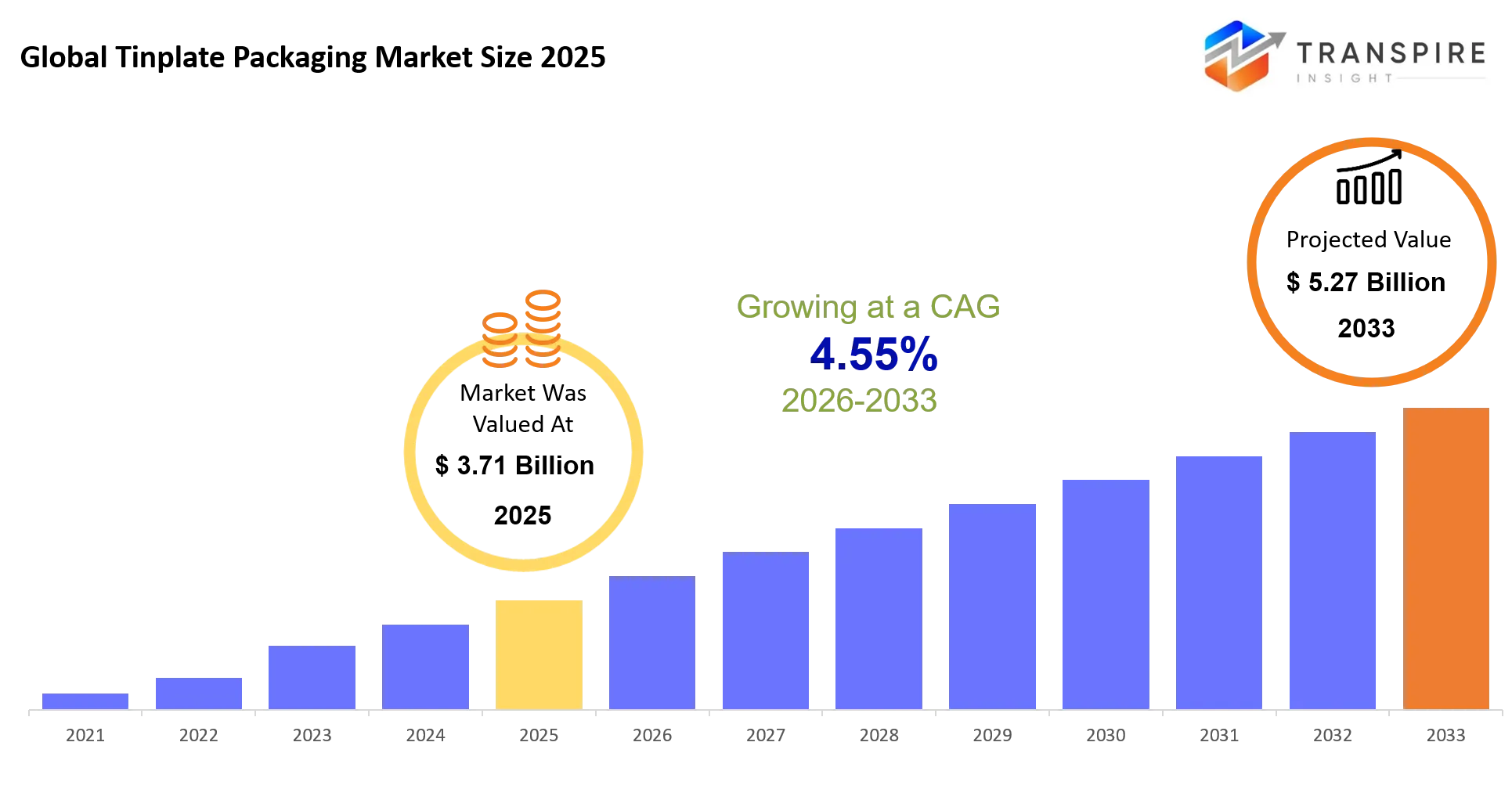
- Global Tinplate Packaging Market Size 2025: USD 3.71 Billion
- Global Tinplate Packaging Market Size 2033: USD 5.27 Billion
- Global Tinplate Packaging Market CAGR: 4.55%
- Global Tinplate Packaging Market Segments: By Product (Food Cans, Beverage Cans, Aerosol Cans, Closures, Containers, Specialty Packaging, Others); By End User (Food & Beverage, Chemicals, Pharmaceuticals, Personal Care, Paints & Coatings, Others); By Coating Type (Lacquered, Printed, Plain, Polymer-coated, Others); By Thickness (Light Gauge, Medium Gauge, Heavy Gauge, Others); By Distribution Channel (Direct Sales, Distributors, OEM Supply, Others)
Global Tinplate Packaging Market Summary
As per Transpire Insight Analysis, the Global Tinplate Packaging Market size is estimated at USD 3.71 Billion in 2025 and is anticipated to reach USD 5.27 Billion by 2033, growing at a CAGR of 4.55% from 2026 to 2033. This industrial packaging sector provides the high-tensile, corrosion-resistant steel sheets coated with a microscopic layer of pure tin to manufacture hermetically sealed cans - protective closures, and specialized storage containers. Over the past few years - mounting regulatory bans on single-use plastics and intense consumer pushback against non-recyclable materials have forced global brands to abandon polymer-based structures in favor of infinitely recyclable metallic protection. This progression triggered a massive structural shift as global food supply networks scaled up automated thermal processing and long-shelf-life canning frameworks to secure supply chains against erratic climate events. By preventing light and oxygen degradation across volatile logistics networks, tinplate packaging ensures complete product integrity and eliminates downstream spoilage, driving massive brand adoption.
Key Market Insights
The global tinplate packaging landscape is undergoing a structural paradigm shift, moving rapidly from mass commodity steel sheet production toward specialized, light-gauge engineering fabrics treated with ultra-clean organic passivation technologies. Driven by the critical requirement to fulfill rigid international chemical safety regulations and meet corporate net-zero carbon mandates, global packaging manufacturers are swapping heavy, high-emissions metal materials for thin-gauge, polymer-coated steel substrates that offer pristine barrier isolation.
- Locking down a dominant 42% Market share, Food Cans lead the product matrix, with Sonoco Products launching its new re-sealable metal can portfolio to extend canned asset shelf stability up to 36 months without chemical additives.
- Expanding at a Market-accelerating standalone CAGR of 12.1% within its matrix, Printed Tinplate Packaging solutions dominate technology growth as brands transition away from secondary plastic labels to direct-to-metal low-migration ink systems.
- Capturing a dominant 45% of total global revenue, the Asia Pacific theater functions as the largest geographic Market, backed by expanding urban consumer networks and massive raw steel mill production capacity.
- Pacing regional Market growth with an explosive standalone CAGR of 11.2%, Latin America acts as the fastest-growing territory, fueled by surging packaged food logistics and private-sector investments in localized canning infrastructure.
- Holding a stable 24% Market slice, Europe drives strict material compliance, pushing enterprise manufacturers like Thyssenkrupp Rasselstein to scale its Bluemint carbon-reduced packaging steel to slash container emissions by 62%.
- Securing 23% of total industry demand, Beverage Cans remain an essential foundation for carbonated liquid storage, with CANPACK deploying advanced two-piece structural engineering to reduce tin layer thicknesses while maintaining rigid burst pressures.
- Representing 13% of total component revenue, Aerosol Cans face heavy personal care and pharmaceutical modernization as suppliers deploy high-barrier monobloc formats to compete against premium aluminum alternatives.
- Accounting for a targeted 10% slice of the Market footprint, Closures expand rapidly across vacuum-sealed food containers, with Silgan Holdings introducing specialized BPA-free internal lacquer coatings to prevent acidic corrosion.
- Claiming an integrated 6% Market presence, industrial Containers represent a vital segment for industrial fluid safety, with Mauser Packaging optimizing heavy-duty, leak-proof pails to satisfy strict REACH chemical transport compliance.
- Capturing the remaining 6% slice of global revenue, the Middle East & Africa region represents an emerging development zone, driving bulk food preservation strategies to secure regional food distribution networks.
What Are the Key Drivers, Restraints, and Opportunities in the Global Tinplate Packaging Market?
Driver
The Market expansion is heavily propelled by the global regulatory and consumer backlash against single-use plastics, driving a major transition toward infinitely recyclable metal packaging formats. Traditional polymer packaging structures create massive landfill overhead and microplastic pollution, sparking rigid governmental bans and extended producer responsibility (EPR) mandates worldwide. This friction triggered a structural shift toward low-carbon steel substrates coated with protective tin layers, which retain 99% of their original material value post-recycling without structural degradation. This industry-wide transition drives massive raw material and design conversion revenue as global food and beverage brands aggressively swap out plastic pouches for durable, shelf-stable tin containers.
In February 2026, global packaging leader Crown Holdings officially reported a strong financial performance across its fiscal full-year results, highlighted by a significant volume expansion and increased shipments within its North American tinplate businesses. This structural demand growth was heavily propelled by rising regional consumer consumption of shelf-stable canned goods and specialized pet foods, alongside a steady industrial material cost pass-through of USD 507 Million to maintain clean processing margins. By executing these large-scale manufacturing upgrades without sacrificing production velocity, the company's delivery data underscores an accelerating, long-term brand conversion from rigid polymers toward sustainable metal-can architecture across domestic retail ecosystems.
Restraint
Severe structural price volatility across underlying global metal commodities like coking coal, iron ore, and pure tin blocks stable margin forecasting for medium-sized packaging firms. Because raw steel and tin components make up roughly 70% to 80% of total package manufacturing costs, unpredictable supply disruptions in major mining hubs create intense, erratic price swings. This financial risk persists because gingpacka manufacturers operate under fixed, long-term supply contracts with enterprise brands, forcing the suppliers to fully absorb sudden smelting cost shocks and limiting their capital for automation upgrades.
Opportunity
The most lucrative growth window lies in the development of hyper-specialized, double-reduced light-gauge tinplate packaging treated with advanced polymer coatings for premium, non-food sectors. Fusing chemical-resistant, bisphenol A-free (BPA-free) water-based internal linings with precision multi-color metal printing lets factories produce premium monobloc aerosol cans and limited-edition cosmetic gift boxes. This structural transition unlocks highly profitable custom design revenue streams as personal care, chemical paint, and high-end consumer brands invest in durable, nostalgic metallic presentations to eliminate traditional paper labeling steps entirely.
What Has the Impact of Artificial Intelligence Been on the Global Tinplate Packaging Market?
Artificial intelligence is completely reinventing the tinplate packaging Market, shifting high-speed metal container production away from manual physical inspection loops toward automated, machine-vision defect detection fabrics. Instead of requiring assembly line operators to manually catch structural micro-cracks or lithographic mismatches on rapid rolling mills, tinplate factories deploy integrated deep learning engines to monitor real-time sheet surface quality and automatically reject out-of-spec sheets on the fly.
Inside massive stamping and shaping environments, built-in AI models drive operational improvements through predictive machine maintenance and active gauge optimization. These algorithms continually evaluate vibrational data frequencies across high-speed can-shaping presses, predicting exactly when a progressive die requires calibration or replacement before micro-defects manifest. By anticipating structural tool degradation, the system automatically adjusts coil feed tension and runs inline toolpath corrections, maximizing manufacturing yield and significantly reducing material scrap.
However, a serious operational limitation persists around high upfront integration costs and accuracy gaps across diverse lacquer textures. Training vision models to accurately distinguish harmless specular glare from critical internal coating scratches requires vast, high-fidelity datasets, creating a steep technical implementation hurdle that can slow down product changeover loops.
Key Market Trends
The global tinplate packaging space - moving rapidly away from standardized, high-mass steel configurations toward ultra-thin, double-reduced light-gauge sheets integrated with advanced organic and polymer linings. Driven by strict international chemical safety regulations like the EU Packaging and Packaging Waste Regulation (PPWR) and mounting corporate carbon-reduction mandates, food and industrial brands are abandoning thick commodity metals for micro-engineered steel substrates that maximize material yield without risking structural collapse.
- Procurement managers used to focus exclusively on standard prime-grade metal sheets, but they are now shifting toward ultra-light gauge, double-reduced tinplate variants to minimize shipping weight and lower scope 3 logistics emissions.
- Production lines are moving away from traditional bisphenol A (BPA) epoxy coatings to implement advanced, water-based polyester and polyolefin interior liners that fully protect organic food properties against acidic interaction.
- Industrial paint and coating sectors are replacing flat unprinted pails with high-resolution, directly lithographed tinplate containers featuring integrated QR codes to enable instant digital batch traceability across supply chains.
- Aerosol can manufacturers are transitioning from conventional three-piece soldered metal assemblies to seamless, monobloc tinplate profiles to better compete against premium extruded aluminum formats in the personal care sector.
- Metal printing shops used to rely heavily on toxic, solvent-based decoration inks, but they are rapidly adopting mineral oil-free, UV-cured low-migration inks to eliminate volatile organic compound emissions from factory floors.
- Sourcing teams are moving far past standard open-Market hot-rolled steel coils, focusing instead on buying certified carbon-reduced steel substrates manufactured via scrap-optimized electric arc furnaces to achieve brand sustainability compliance.
- Closure designers are shifting from rigid, continuous-thread twist caps to easy-open safety button vacuum-sealed lids that provide visual and tactile proof of pressure freshness for premium baby foods.
- Chemical logistics networks are abandoning standard plastic jerrycans to deploy heavy-duty, leak-proof tinplate drums featuring tamper-evident closures to ensure complete alignment with strict international hazardous material shipping rules.
- Rather than relying on simple mechanical sorting in recovery facilities, regional recycling networks are adopting advanced automated optical sorters alongside high-intensity electromagnets to achieve a massive 84% tinplate collection rate.
- Packaging engineering squads are shifting away from rigid, single-use metal canisters to engineer modular, nested specialty tin boxes that double as aesthetic, long-term collectible household storage items.
Global Tinplate Packaging Market Segmentation
By Product
Food Cans command the largest share of Market capital, holding a dominant 42% of global revenue due to their unmatched mechanical protection, long shelf-stability performance, and widespread adoption across mass consumer preservation channels. Beverage Cans follow closely at 23%, Aerosol Cans hold 13%, Closures capture 10%, while industrial Containers and specialty packaging account for the remaining 12% of the total industry footprint. This division is shaped by the absolute necessity for airtight, light-blocking physical barriers to eliminate food spoilage and maximize inventory shelf life without artificial refrigeration. Food Cans maintain this peak position because commercial agricultural supply chains and massive processed-food exporters require low-cost, high-tensile metallic protection that survives rigorous thermal processing and high-velocity shipping. Moving forward, structural designs will pivot toward advanced, double-reduced lightweight can geometry, forcing metal packaging manufacturers to reduce baseline steel sheet thickness while utilizing multi-beaded wall engineering to preserve vertical crush strength.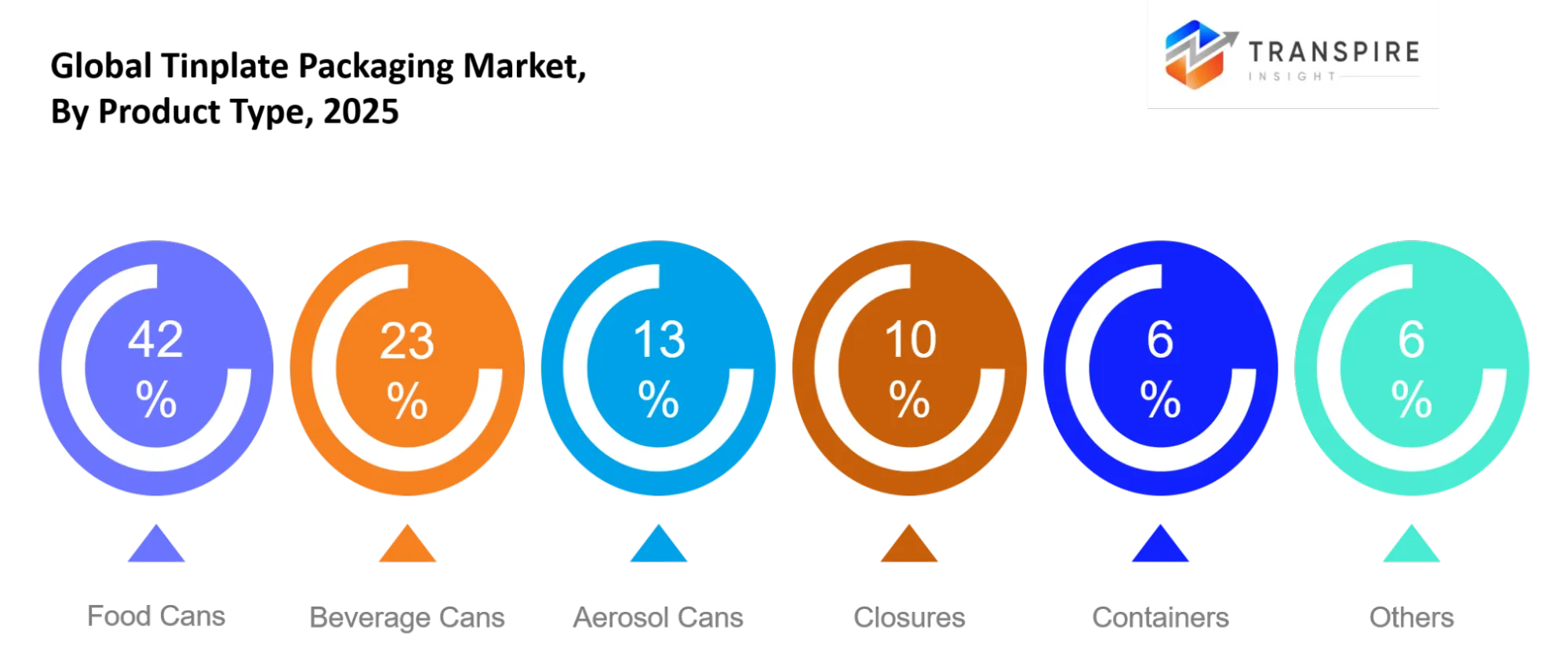
By End User
The Food & Beverage sector serves as the primary financial engine of the Market, controlling massive procurement budgets as it locks down the undisputed anchor position across global retail supply networks. Concurrently, Chemicals, Paints & Coatings, Personal Care, and Pharmaceuticals represent highly active secondary buyers requiring secure containment. The underlying growth logic relies on the shifting chemical stability and pressure retention demands of different industrial applications, where paint manufacturers require leak-proof pails and personal care brands seek premium aerosol aesthetics. Food & Beverage dominates because consumer staples like infant formula, seafood, and ready-to-eat meals dictate continuous, high-volume container replenishment cycles globally. Moving forward, Market success will require a complete pivot toward bisphenol A-free (BPA-free) internal lacquer compliance, compelling steel rolling mills and coating plants to supply pre-validated, non-toxic organic linings that natively satisfy tightening international food safety regulations right out of the box.
By Coating Type
Lacquered coatings command the largest baseline Market position to prevent chemical interaction between the metal sheet and organic components, while Printed tinplate packaging stands out as the fastest-accelerating Market driver, expanding at a high standalone CAGR of 12.1%. Plain and polymer-coated variations maintain stable secondary shares across industrial and heavy chemical transportation lines. This distribution pattern is driven by the major brand transition away from secondary plastic film labeling toward high-resolution, direct-to-metal offset lithography. Printed tinplate packaging is growing exponentially because global consumer product companies leverage direct metallic printing to create premium, nostalgic presentation profiles that elevate brand distinction on crowded retail shelves while streamlining recycling sortation. Moving forward, decoration technology will shift heavily toward UV-cured low-migration digital ink systems, enabling container manufacturers to execute high-speed, variable-data custom printing runs without emitting volatile organic compounds on the factory floor.
By Thickness
Medium Gauge sheets capture the largest share of global revenue due to their optimal balance of structural rigidity - deep-drawing capabilities, and cost efficiency across traditional three-piece food can architectures. Light Gauge options function as the fastest-growing technology standard across high-volume beverage and aerosol sectors, while Heavy Gauge steel blocks hold a stable position in large-scale industrial shipping drums. This division is shaped by the intense manufacturing trade-off between baseline material cost optimization and structural safety requirements under heavy stack pressures. Medium Gauge maintains its dominant position because it provides the dependable tensile threshold needed to withstand internal vacuum changes during commercial retort sterilization processes without paneling or buckling. Moving forward, the industry will pivot sharply toward hyper-consistent, double-reduced ultra-thin light gauge alloys, forcing metallurgy labs to utilize precise continuous annealing methods to achieve elite structural tempers at fractionally lower metal volumes.
By Distribution Channel
Direct Sales networks maintain a commanding grip on this segment, locking down a dominant portion of total industry revenue, while OEM Supply configurations follow as a critical, highly integrated operational standard for hyper-scale commercial canneries. Independent Distributors handle the remaining secondary volume, servicing localized or seasonal mid-Market canning lines. This operational structure is dictated by the intense logistic coordination required to synchronize continuous, high-speed container manufacturing plants directly with automated food processing facilities. Direct Sales lead the Market position because global consumer goods conglomerates require long-term, high-volume contract frameworks that guarantee strict pricing predictability, exact thickness tolerances, and just-in-time container deliveries to avoid plant floor storage bottlenecks. Moving forward, supply chain strategies will focus heavily on close-proximity manufacturing clustering, pushing tinplate packaging firms to build dedicated, wall-to-wall fabrication nodes attached directly to their largest customer processing facilities via automated overhead conveyor lines.
What Are the Key Use Cases Driving the Global Tinplate Packaging Market?
Canning drives the bulk of this Market because metal - unbeatable at blocking oxygen and light during long-haul transit. Processors pack seafood and infant formula into hermetically sealed tins, using intense thermal retort sterilization so products survive on retail shelves for years without rotting or needing energy-intensive refrigeration.
Outside the grocery aisle, brands leverage tinplate's burst resistance to build safe, high-pressure aerosol cans for personal and home care. Because the rigid steel handles volatile propellants without flexing, it guarantees a steady, fine-mist spray for shaving gels under extreme shipping pressures.
Lately, luxury spirit and confectionery brands are ditching cardboard for collectible tins. Designers print vivid artwork directly onto the metal, turning disposable packaging into permanent household keepsakes.
|
Report Metrics |
Details |
|
Market size value in 2025 |
USD 3.71 Billion |
|
Market size value in 2026 |
USD 3.86 Billion |
|
Revenue forecast in 2033 |
USD 5.27 Billion |
|
Growth rate |
CAGR of 4.55% from 2026 to 2033 |
|
Base year |
2025 |
|
Historical data |
2021 - 2024 |
|
Forecast period |
2026 - 2033 |
|
Report coverage |
Revenue forecast, competitive landscape, growth factors, and trends |
|
Regional scope |
United States; Canada; Mexico; United Kingdom; Germany; France; Italy; Spain; China; Japan; India; Australia; South Korea; Thailand; Brazil; Argentina; South Africa; Saudi Arabia; United Arab Emirates |
|
Key company profiled |
Crown Holdings, Ball Corporation, Ardagh Group, Silgan Holdings, CANPACK, Toyo Seikan, Tata Steel, JFE Steel, thyssenkrupp Rasselstein, Baosteel, Sonoco Products, CPMC Holdings, Kian Joo Can Factory, Mauser Packaging, CCL Container |
|
Customization scope |
Free report customization (country, regional & segment scope). Avail customized purchase options to meet your exact research needs. |
|
Report Segmentation |
By Product (Food Cans, Beverage Cans, Aerosol Cans, Closures, Containers, Specialty Packaging, Others); By End User (Food & Beverage, Chemicals, Pharmaceuticals, Personal Care, Paints & Coatings, Others); By Coating Type (Lacquered, Printed, Plain, Polymer-coated, Others); By Thickness (Light Gauge, Medium Gauge, Heavy Gauge, Others); By Distribution Channel (Direct Sales, Distributors, OEM Supply, Others) |
Which Regions are Driving the Global Tinplate Packaging Market Growth?
The Asia Pacific region maintains a commanding grip on the tinplate packaging Market, capturing a dominant 45% of all worldwide industry revenue. This geographic leadership is heavily driven by expanding urban consumer networks across massive developing economies like China and India alongside a staggering domestic steel manufacturing infrastructure. The regional ecosystem is structurally supported by high-volume agricultural processing centers and massive seafood exporters that require immense inventories of shelf-stable food containers to fulfill both domestic and international supply contracts. Consequently, transitioning from rigid plastic configurations to infinitely recyclable metallic preservation formats has become the primary operational benchmark for local consumer brands.
Europe serves as a highly stable, predictable secondary pillar for the global Market, locking down an essential 24% share of total industry demand. While Asian expansion is propelled by aggressive raw volume growth and urban food logistics, European tinplate packaging adoption is shaped by rigid continental environmental mandates and circular economy targets like the EU Packaging and Packaging Waste Regulation (PPWR). This regional Market stability is structurally insulated by a strong corporate preference for closed-loop packaging substrates, pushing brands to heavily leverage the continent's advanced metal recycling infrastructure. To avoid severe carbon penalties and satisfy tightening corporate net-zero parameters, European consumer goods groups steadily invest in pre-passivated, low-emissions packaging steels.
In February 2026, global packaging leader Crown Holdings officially reported a strong financial performance across its fiscal full-year results, highlighted by a significant volume expansion and increased shipments within its European beverage business. This structural demand growth was heavily propelled by an accelerating substrate shift away from single-use plastics and glass toward sustainable metal can architectures across major continental retail networks. To lock in this momentum, the company announced targeted capital expenditures of approximately USD 550 Million in 2026 dedicated exclusively to facility upgrades and capacity expansions across strategic European hubs like Spain and Greece.
Latin America has emerged as the fastest-growing territory globally, accelerating at a Market-leading CAGR of 11.2% despite currently holding a smaller 5% slice of global sales. This sudden structural shift is driven by massive private-sector investments in regional food processing infrastructure, expanding meat exports, and a wholesale brand transition toward localized metal packaging plants. Historically, regional packers relied heavily on expensive imported container formats, but a sudden explosion in localized production nodes has allowed them to rapidly deploy affordable, high-performance tinplate containers locally. Looking ahead, future development in this booming corridor relies heavily on spinning up flexible, directly printed tinplate lines to capture growing premium cosmetic and aerosol Markets affordably.
In February 2026, sustainable packaging giant Ardagh Metal Packaging S.A. officially reported a strong operational performance for its global business units, registering an impressive annual shipments growth of over 3% alongside a 10% surge in full-year Adjusted EBITDA. This Market expansion was heavily supported by solid volume execution and favorable product mix delivery within the Americas, which captured a massive 24% revenue surge to USD 807 Million in the final quarter of the fiscal year alone. By utilizing automated cost pass-through mechanisms and optimizing its production footprint across localized networks, the company successfully scaled its metallic container shipments to meet rising regional consumer demands. 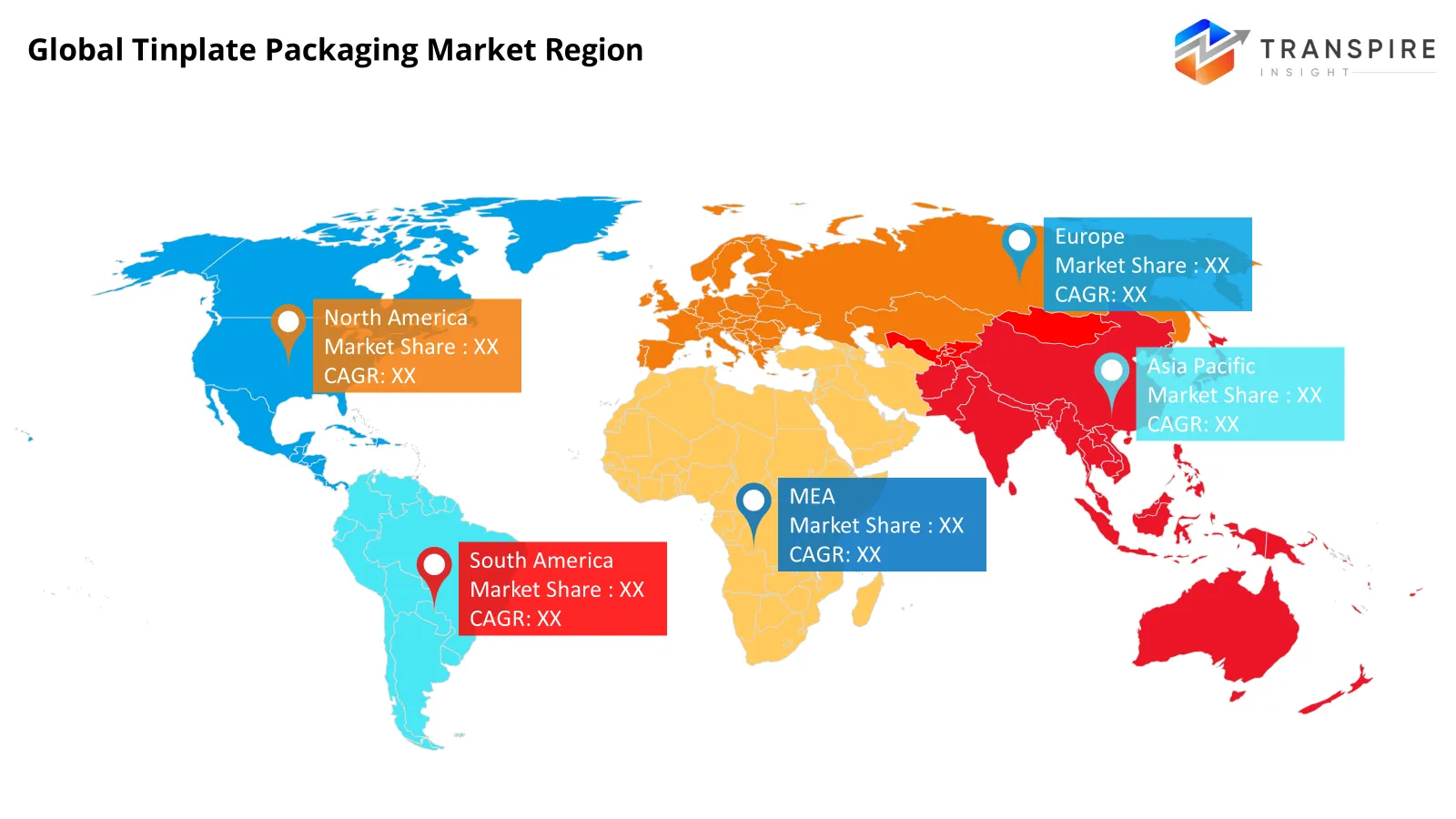
Who Are the Key Players in the Global Tinplate Packaging Market and How Do They Compete?
The global tinplate packaging space is an intense battleground between multi-billion-dollar rigid packaging conglomerates and massive integrated steel metallurgical producers. With international consumer brands moving rapidly away from single-use plastics to hit aggressive circular economy targets, vendors are competing primarily on three fronts: engineering ultra-thin steel gauge geometry, eliminating toxic chemical additives from protective inner coatings, and deploying high-definition, direct-to-metal offset lithography to replace secondary labels.
Crown Holdings utilizes an innovation-focused strategy, positioning its global metal packaging segments around high-efficiency, multi-beaded structural design and maximum raw material yield. What makes them stand out is their proprietary lightweighting processing capabilities and strict chemical management, which allow them to reduce tin sheet thickness while fully preserving extreme vertical crush resistance. The company expands its global Market footprint by directing extensive capital expenditures—such as its planned USD 550 Million investment layout in 2026—into strategic facility upgrades and capacity expansions across growing international corridors like Brazil, Greece, Spain, and India.
Silgan Holdings runs a highly defensive platform-niche strategy focused squarely on the hyper-stable, high-volume ambient food canning and specialized consumer closure industries. The vendor differentiates its Market presence by embedding highly specialized, pre-validated bisphenol A-free (BPA-free) internal organic linings and easy-open vacuum button lids directly into its core metal container portfolio to ensure complete food safety regulatory compliance. They expand their industrial footprint through structured, long-term direct sales contract frameworks with tier-one consumer goods conglomerates, capturing regional food supply networks via localized processing facilities built near major agricultural centers.
Company List
- Crown Holdings
- Ball Corporation
- Ardagh Group
- Silgan Holdings
- CANPACK
- Toyo Seikan
- Tata Steel
- JFE Steel
- thyssenkrupp Rasselstein
- Baosteel
- Sonoco Products
- CPMC Holdings
- Kian Joo Can Factory
- Mauser Packaging
- CCL Container
Recent Development News
In August 2025, global packaging supplier Ball Corporation completed a strategic divestment by selling 41% of its 51% ownership stake in the Ball United Arab Can Manufacturing Company, retaining a 10% minority equity slice. This corporate restructuring deconsolidates the middle-eastern business from Ball's primary balance sheet - allowing the firm to reallocate capital into higher-yielding Economic Value Added (EVA) assets and debt optimization while freeing up immediate liquidity. [https://investors.ball.com
In January 2026, sustainable aluminum and beverage packaging specialist Ball Corporation completed the acquisition of a majority 80% stake in Benepack, absorbing its entire multi-facility structural operation including two major container production plants located in Belgium and Hungary. This regional expansion embeds the acquired manufacturing capabilities straight into Ball’s primary EMEA operational segment, allowing the group to aggressively scale localized supply chains and fulfill surging continental beverage can shipments for European retail brands. [https://www.packagingdive.com
In April 2026, metal container manufacturing pioneer Crown Holdings officially announced a major international footprint expansion to construct a new two-line, high-speed beverage can production plant in Northern India. This greenfield project deployment addresses soaring regional retail consumption across both alcoholic and non-alcoholic consumer brackets, allowing the group to anchor high-volume, localized supply chains while capitalizing on the rapid substrate transition from single-use plastic toward infinitely recyclable metallic packaging frameworks. [https://mundolatas.com
What Strategic Insights Define the Future of the Global Tinplate Packaging Market?
The Global Tinplate Packaging Market is heading toward full material circularity and absolute lightweighting abstraction, where advanced metallurgy produces ultra-thin, deep-drawn steel substrates that completely bypass downcycling loops.
A significant hidden risk lies in "passivation compliance friction." As regulatory frameworks like Europe's REACH and global food safety codes strictly outlaw hexavalent chromium or bisphenol A (BPA) chemistries, manufacturers face abrupt plant line halts if their alternative trivalent chromium or organic water-based coatings suffer from microscopic adhesion failures or unexpected curing variations.
Conversely, a major emerging opportunity is the rapid cross-industry expansion of double-reduced (DR) light-gauge tinplate into premium, non-food consumer segments. Brands are leveraging direct-to-metal offset lithography to replace paper and plastic labels completely on high-pressure aerosol formats and nostalgic luxury packaging.
Strategic recommendation: Manufacturers must immediately halt capital allocation toward single-purpose heavy-gauge sheet lines and transition toward flexible, multi-coating rolling facilities that natively apply polymer-laminated - chrome-free protection layers to secure long-term regulatory compliance and maximize raw material yield.
By Product
- Food Cans
- Beverage Cans
- Aerosol Cans
- Closures
- Containers
- Specialty Packaging
- Others
By End User
- Food & Beverage
- Chemicals
- Pharmaceuticals
- Personal Care
- Paints & Coatings
- Others
By Coating Type
- Lacquered
- Printed
- Plain
- Polymer-coated
- Others
By Thickness
- Light Gauge
- Medium Gauge
- Heavy Gauge
- Others
By Distribution Channel
- Direct Sales
- Distributors
- OEM Supply
- Others
Regional Outlook
North America
- United States
- Canada
- Mexico
Europe
- Germany
- United Kingdom
- France
- Spain
- Italy
- Rest of Europe
Asia Pacific
- Japan
- China
- Australia & New Zealand
- South Korea
- India
- Rest of Asia Pacific
South America
- Brazil
- Argentina
- Rest of South America
Middle East & Africa
- Saudi Arabia
- United Arab Emirates
- South Africa
- Rest of the Middle East & Africa
Frequently Asked Questions
Find quick answers to common questions.
The Global Tinplate Packaging Market size was valued at USD 3.71 Billion in 2025 and is poised to reach USD 5.27 Billion by 2033, expanding at a 4.55% CAGR.
Key segments for the Global Tinplate Packaging Market are By Product (Food Cans, Beverage Cans, Aerosol Cans, Closures, Containers, Specialty Packaging, Others); By End User (Food & Beverage, Chemicals, Pharmaceuticals, Personal Care, Paints & Coatings, Others); By Coating Type (Lacquered, Printed, Plain, Polymer-coated, Others); By Thickness (Light Gauge, Medium Gauge, Heavy Gauge, Others); By Distribution Channel (Direct Sales, Distributors, OEM Supply, Others).
Growth is primarily driven by strict worldwide regulatory bans and consumer backlash against single-use plastics, forcing an industry-wide transition toward infinitely recyclable metal packaging. It is further accelerated by expanding urban consumer networks, heightened demand for long-shelf-life canned staples, and structural advancements in double-reduced, lightweight steel substrates.
The global Market is led by major manufacturers including Crown Holdings, Ball Corporation, Ardagh Group, Silgan Holdings, CANPACK, Toyo Seikan, Tata Steel, JFE Steel, thyssenkrupp Rasselstein, Baosteel, Sonoco Products, CPMC Holdings, Kian Joo Can Factory, Mauser Packaging, and CCL Container.
Asia Pacific commands a dominant 45% share of the total global industry revenue, anchoring Market dynamics through its massive raw steel manufacturing capacity and extensive metallurgical supply chains. The region’s dominance is further reinforced by expanding commercial food canning operations, rising urban retail consumption, and substantial domestic infrastructure developments across major developing economies like China and India.
Highly profitable commercial opportunities exist in the development of hyper-specialized, double-reduced light-gauge tinplate integrated with advanced, bisphenol A-free (BPA-free) polymer or water-based organic coatings. Additionally, huge growth windows are unlocking in premium, non-food consumer sectors like luxury cosmetics and personal care by utilizing high-resolution direct-to-metal offset lithography to create highly collectible, labeled monobloc aerosol cans and decorative boxes.
- Crown Holdings
- Ball Corporation
- Ardagh Group
- Silgan Holdings
- CANPACK
- Toyo Seikan
- Tata Steel
- JFE Steel
- thyssenkrupp Rasselstein
- Baosteel
- Sonoco Products
- CPMC Holdings
- Kian Joo Can Factory
- Mauser Packaging
- CCL Container
About the Authors

Kartik bhong
I am Kartik Bhong, a Senior Research Analyst at Transpire Insight, specializing in the Packaging, Manufacturing, and Construction industry. My work focuses on analyzing market trends, emerging technologies, industry regulations, and competitive landscapes to deliver accurate, data-driven insights. I am passionate about transforming complex industry information into clear, practical content that helps businesses, professionals, and decision-makers stay informed and make confident strategic decisions. Through continuous research and a strong commitment to accuracy, I strive to create reliable, well-researched content that reflects the latest developments across these dynamic industries and supports the vision of Transpire Insight in delivering valuable market intelligence.

Chakradhar Khansole
Chakradhar serves as the Research Director at Transpire Insight, bringing over 8 years of experience in technology, innovation, and strategic market intelligence. He specializes in transforming complex market data into actionable business insights that enable organizations to make informed, growth-oriented decisions. Recognized for his strategic vision and analytical expertise, Chakradhar leads high-impact research initiatives, delivering comprehensive market assessments, competitive intelligence, and forward-looking industry analysis.
Recently Published Reports
-
Apr 2026
Pharmaceutical Cold Chain Packaging Market
Pharmaceutical Cold Chain Packaging Market By Material (Plastic,(Polyethylene (PE), Polypropylene (PP), Polyethylene Terephthalate (PET), Expanded Polystyrene (EPS), Polyurethane (PU),Others), Paper, Metal, Others), By Product (Small Boxes, Pallets, Large Sized Pallet Containers, Others), By End Use (Biopharmaceutical Companies, Clinical Research Organizations, Hospitals, Research Institutes, Logistics and Distribution Companies, Others)”, By Industry Analysis, Size, Share, Growth, Trends, and Forecasts 2026-2033
-
Apr 2026
Active & Intelligent Packaging Market
Active & Intelligent Packaging Market By Type (Active Packaging, Smart Packaging), By Material (Polymer-Based, Paper & Board-Based, Metal-Based, Glass-Based), By Technology (Time-Temperature Indicators, Freshness Indicators, RFID, Antimicrobial Packaging, Modified Atmosphere Packaging), By Application (Food & Beverages, Pharmaceutical, Cosmetics & Personal Care, Electronics & Consumer Goods, Others), By Industry Analysis, Size, Share, Growth, Trends, and Forecasts 2026-2033
-
Apr 2026
Biodegradable Cut Flower Packaging Market
Biodegradable Cut Flower Packaging Market By Material Type (Paper & Paperboard, Biodegradable Plastics, Natural Fibers, Molded Pulp, Others), By Product Type (Sleeves, Wraps, Boxes & Cartons, Bags & Pouches, Inserts & Holders), By Application (Roses, Carnations, Tulips, Chrysanthemums, Mixed Flowers, Others) and By Distribution Channel (Direct Sales, Distributors & Wholesalers, Online Channels), By Industry Analysis, Size, Share, Growth, Trends, and Forecasts 2026-2033
-
May 2026
Pharmaceutical Packaging Market
Pharmaceutical Packaging Market By Material Type (Plastic, Glass, Metal, Paper & Paperboard, Others), By Packaging Type (Bottles, Blister Packs, Vials, Ampoules, Pouches & Sachets, Others) and By End User (Hospitals & Clinics, Retail Pharmacies, Online Pharmacies, Pharmaceutical Manufacturers), By Industry Analysis, Size, Share, Growth, Trends, and Forecasts 2026-2033