
Asia Pacific Plastic Packaging Market Summary
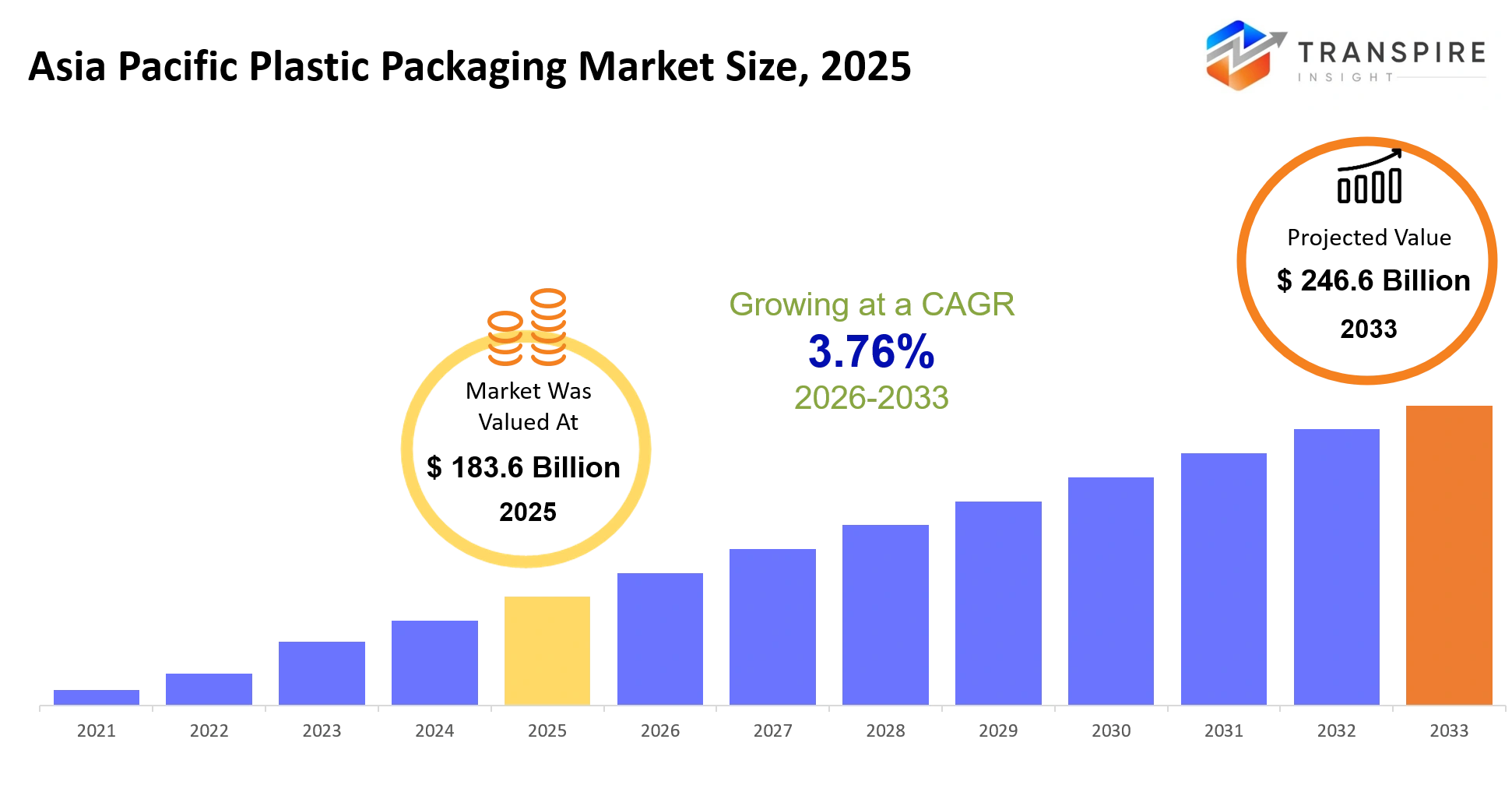
As per Transpire Insight Analysis the Asia Pacific Plastic Packaging Market size is estimated at USD 183.6 Billion in 2025 and is anticipated to reach USD 246.6 Billion by 2033, growing at a CAGR of 3.76% from 2026 to 2033.
The Asia Pacific Plastic Packaging Market is sort of key for shielding, keeping items fresh, getting them moved around, and, in general, stretching the time products stay usable on shelves. It supports food , beverages , pharmaceuticals , personal care , and also industrial supply chains. It allows makers to cut down on product losses, boost logistics efficiency, and in a more practical way also align with the changing needs of retail plus e-commerce packaging.
In the last five years, you can see a noticeable turn, more like a structural shift toward mono material packaging, more recycled resin integration, and lighter weight designs. This direction has been pushed by extended producer responsibility policies, and by stricter rules around plastic waste in several Asia Pacific economies. During the COVID-19 pandemic, there were also supply chain disruptions, which then sped up investment in more localized packaging production and automation, so companies started diversifying where they get raw materials from, and they also wanted to strengthen regional manufacturing networks too.
All these shifts, kind of helped build better production resilience, encouraged packaging upgrades that add extra value, and widened adoption across high volume consumer industries.As a result, the region has seen fairly steady revenue growth over time, without too much sudden swings.
Asia Pacific Plastic Packaging Market Size & Forecast:
- Asia Pacific Plastic Packaging Market Size 2025: USD 183.6 Billion
- Expected Market Value 2033: USD 246.6 Billion
- Forecast CAGR: 3.76%
- Leading region in 2025:
- Fastest Growing region:
- Key Profile: Amcor, Berry Global, Sealed Air, Sonoco Products, Huhtamaki, Mondi Group, Coveris, Constantia Flexibles, Winpak, UFlex, SCG Packaging, Plastipak Packaging, ALPLA, Toyo Seikan Group, AptarGroup
Key Market Insights
- Asia Pacific Plastic Packaging Market hit USD 183.6 billion in 2025, and it is expected to climb to USD 246.6 billion by 2033, which shows a pretty steady long-term growth of the whole industry though not exactly headline fast.
- China still leads the Asia Pacific Plastic Packaging Market with an estimated share of over 42% in 2025, backed by huge manufacturing scale, plus packaging work that leans heavily into exports, so it’s kind of built for overseas demand.
- India is the fastest-moving market through 2033, largely because organized retail keeps stretching, pharmaceutical manufacturing keeps adding capacity, and e-commerce fulfillment infrastructure is filling in rapidly in more areas.
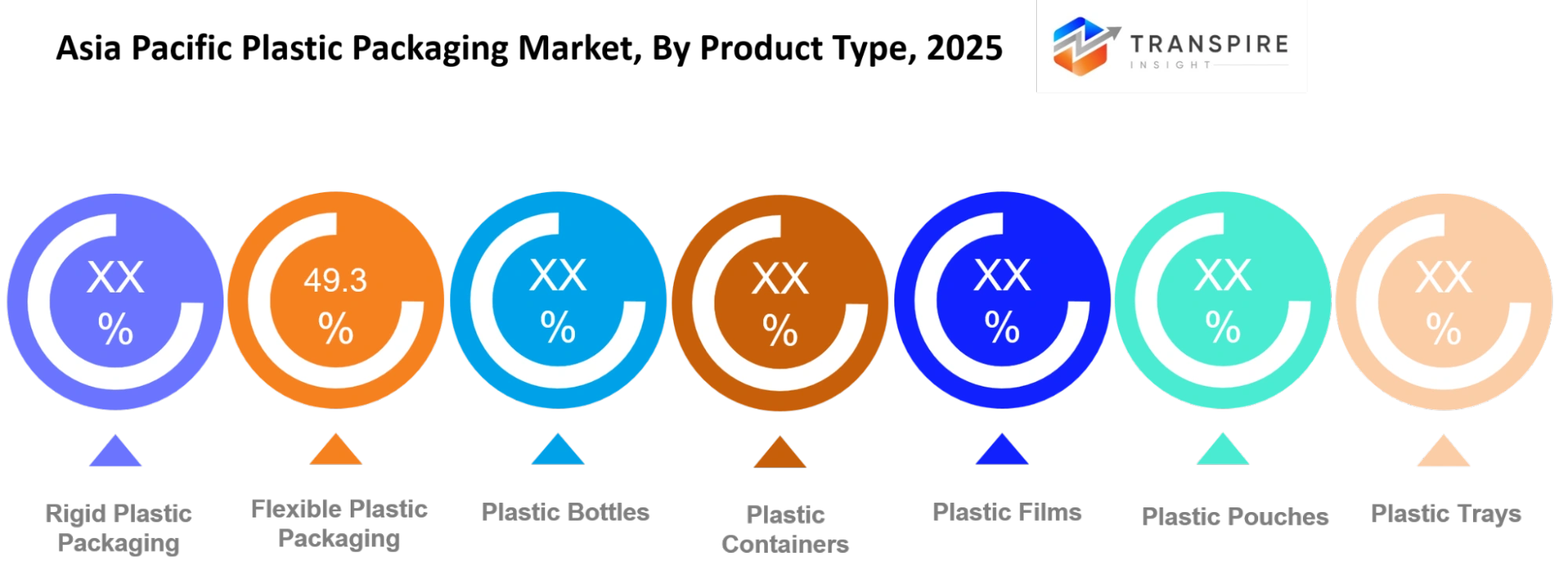
- Flexible plastic packaging sits in first place with around 46% market share, while plastic bottles are still the second-biggest product category across beverage and personal care.
- Plastic pouches are the quickest-growing product segment through 2033. This is tied to lightweight designs that cut transportation spend by about 15% to 20%, and that helps supply chains move more smoothly.
- Food and beverage packaging makes up nearly 48% of total demand, and pharmaceutical packaging keeps growing too, mainly due to stricter product safety rules, along with traceability expectations that companies can’t really ignore.
- Consumer goods and personal care packaging have seen double digit adoption of recycled-content packaging since 2021. This reflects stronger compliance pressures tied to local sustainability regulations, so businesses had to adjust.
- Key players like Amcor, Berry Global, Sealed Air, Huhtamaki, UFlex, and ALPLA continue tightening their positions using recyclable packaging innovations, and by expanding regional manufacturing footprints.
- Also, strategic partnerships with FMCG brands, investments in PCR resin processing, and digital printing technologies help manufacturers do more custom work, reduce lead times, and lower material waste, sometimes all at once.
What are the Key Drivers, Restraints, and Opportunities in the Asia Pacific Plastic Packaging Market?
The biggest factor pushing the Asia Pacific Plastic Packaging Market forward is the rapid modernization of food processing , pharmaceutical manufacturing, and also organized retail networks. In China, India, Indonesia, and Vietnam, governments have backed local production via industrial development policies plus investments in packaging infrastructure, kind of like a push from the inside. Meanwhile, the growth of e-commerce ecosystems demands durable yet lightweight and cost efficient packaging, so products stay protected even through long distance shipments. Because of that whole mix, manufacturers have been leaning into automated production lines, recyclable packaging styles, and higher performance barrier materials, which opens up fresh revenue paths for packaging suppliers.
The hardest, more structural problem is still the tightening of environmental rules around single use plastics and waste handling. A lot of countries already rolled out extended producer responsibility duties, recycled content requirements, and limitations on specific plastic types.But meeting those rules means more spending on recycling infrastructure , material redesign, and upgrades to production and that is not the kind of thing you can wrap up overnight. So operating margins get squeezed, and smaller to mid-sized packaging manufacturers often hold back a bit , which then slows down the overall market growth.
The next real opening seems to be advanced circular packaging ideas, built around post-consumer recycled plastics , chemical recycling pathways, and even mono material packaging formats. Places like India and Japan keep expanding their recycling capabilities, while multinational consumer brands are making commitments for more recycled content before 2030 . Because of that, the demand signals are getting louder and louder.
What Has the Impact of Artificial Intelligence Been on the Asia Pacific Plastic Packaging Market?
Artificial intelligence together with advanced digital tools is slowly reshaping manufacturing tasks across the Asia Pacific Plastic Packaging Market, mostly because it boosts output efficiency, ups product quality, and makes day to day operations more even, even steadier. AI driven vision inspection setups can flag defects like closure issues, uneven coloring, small dimensional swings, and even contamination that older inspection ways might miss. Then manufacturers add machine learning models to make resin usage more sensible, tune extrusion settings, and also anticipate equipment failures ahead of time, so that unwanted downtime doesn’t arrive so suddenly. For predictive maintenance, these platforms look at vibration patterns, temperature shifts, and real time production signals, which helps increase equipment availability, cut maintenance expenses, and push production throughput higher.
On top of that, digital manufacturing platforms help with inventory thinking, production scheduling, and supply chain coordination too— they often do it by forecasting customer demand as well as raw material needs. AI assisted energy management approaches also lower electricity consumption, while still holding production quality stable in large volume manufacturing plants. Automated process optimization is another lever, it improves material utilization and reduces scrap creation, which supports both profit targets and sustainability objectives, more or less at the same time.
Even with all of that, big scale adoption of AI is still held back by a few things: integration costs can be high, legacy manufacturing assets complicate upgrades, factory data is often fragmented, and there is a shortage of skilled people who can actually manage advanced analytics platforms. Smaller packaging producers typically take longer to implement such systems, because modernizing existing production infrastructure demands major capital outlay, plus extensive workforce training, which is not always easy.
Key Market Trends
- Since 2021, manufacturers have kind of ramped up investment in mono-material packaging, which helps recyclability, and also makes waste handling easier across several Asia Pacific countries—although the exact timelines vary a bit.
- In 2025, China still held an estimated 42%+ market share, kinda driven by those integrated manufacturing ecosystems and all plus strong packaging production capacity that keeps scaling up.
- Packaging producers also pushed post-consumer recycled resin use up by around 20% to 30% across certain product categories since 2022, so yeah the blend rates look noticeably higher now, especially in places where specs tightened.
- More facilities are running automated quality inspection with AI, and machine vision too, this has brought down packaging defect rates by roughly 15% to 25% in modern manufacturing plants.
- Flexible packaging keeps swapping in for rigid formats in food and personal care, partly because lighter materials reduce shipping costs and even warehouse space needs , which is a big deal for logistics teams.
- Big players like Amcor, Berry Global, Sealed Air, Huhtamäki, and ALPLA are still widening their regional manufacturing footprints, and adding recyclable packaging portfolios through strategic investments .
- Digital printing has gotten broader adoption since 2020, meaning shorter production runs, more customization on packs, and quicker product launches without so much lead time.
- For pharmaceuticals, packaging manufacturers are increasingly turning to high-barrier materials, and also adding serialization technologies, mainly to satisfy tighter safety requirements and stricter traceability rules.
- Supply chains have also been moving toward localized raw material sourcing and regional production networks after pandemic related logistics disruptions, which improves operational resilience, even when conditions get messy.
- And smart packaging—stuff like QR codes, digital authentication, and consumer engagement features—continues expanding across premium food, healthcare, and general consumer goods applications.
Asia Pacific Plastic Packaging Market Segmentation
By Product Type
Rigid Plastic Packaging kinda supports product protection for fragile and premium goods , using strong structures that help keep the shape during storage and while shipping. Flexible Plastic Packaging on the other hand gives lighter solutions that cut down material usage while also raising storage efficiency for food, healthcare, and regular consumer products. Plastic Bottles are still the preferred pick for beverages, personal care items , household cleaners , and pharmaceutical liquids, mainly because they’re durable and also just easy to handle. Plastic Containers give secure storage for prepared meals, dairy products , chemicals , and industrial materials across several sectors.
Plastic Films work as wrapping and sealing as well as protection layers where moisture resistance matters and an extended shelf life stays important. Plastic Pouches keep getting more acceptance too , because their compact designs reduce the transport costs, and make retail packaging feel more convenient. Plastic Trays assist with fresh produce, meat, bakery products, and medical equipment with a stable display and safe handling in practice. Others cover specialized packaging formats, made for specific industrial and medical use, or even customized commercial needs, where particular functional performance is basically required.
By Material
Polyethylene (PE) stays popular for a sort of reason, flexibility, moisture resistance, and cost efficiency really do fit food packaging, carry bags, and protective films. Polyethylene Terephthalate , or PET , tends to work really well for beverage bottles and food packaging. You usually get great clarity, sturdy performance, and recycling capacity as well. Polyvinyl Chloride , aka PVC , shows up in medical packaging and pharmaceutical goods, plus a number of industrial uses, especially where resistance to chemicals still has to stay reliable for a long service life. Polystyrene , or PS , keeps coming back as a lightweight option for disposable food containers, protective inserts and also insulated products.
Bioplastics keep expanding, because producers want renewable material options, that also align with sustainability goals and the more recent environmental regulations. Multi-layer Plastics basically combine different material traits for better barrier performance, improved product safety, and longer shelf life for sensitive goods. Others are out there too, like specialty polymers developed for high-performance packaging work, where you need a unique mix of strength, flexibility, or chemical resistance, in practice.
By Application
Food & Beverage Packaging comes up as the biggest application area, mostly because freshness stays important, hygiene matters, shelf life goes longer, and transportation can be done more efficiently for processed foods, drinks, dairy products, and ready-to-eat meals. Pharmaceutical Packaging is next, since it needs dependable barrier protection, contamination control, plus regulatory compliance for medicines, vaccines, and other healthcare products , in general. Personal Care Packaging helps cosmetics, skin care lines, shampoos, and even household care items look good while still giving secure dispensing features, so it feels safer for customers. Industrial Packaging meanwhile guards chemicals, automotive components, construction materials, and all kinds of manufacturing supplies during storage , and also while they’re being shipped.
Consumer Goods Packaging boosts product visibility and overall appeal while still protecting electronics , household products, and everyday-use items across the supply chain. Agricultural Packaging covers seeds, fertilizers, pesticides, and harvested produce by using durable , moisture-resistant materials. E-commerce Packaging keeps growing because online shopping needs lightweight protective packaging that’s also cost-efficient, so items arrive safe at delivery. Others kind of includes specialized packaging solutions made for smaller niche commercial, institutional, and industrial needs.
By Packaging Format
Bottles still get used a lot for beverages, edible oils, pharmaceuticals, household chemicals, and personal care products, because a firm seal and relatively easy handling make product safety easier to keep. Bags and sacks help move bulk agricultural goods, industrial supplies , food ingredients, and everyday consumer items along, using designs that are both durable, and kind of light. Films and wraps do a different job, they shield items from moisture, dust, and contamination, plus they help extend shelf life during storage and the whole transportation part. Pouches keep growing across food, drinks, healthcare, and household categories because the compact packaging saves space, and also cuts down transport costs.
Containers offer dependable packaging for prepared foods, dairy products, frozen meals, industrial chemicals, and consumer items that really need structural protection. Cups and tubs support yogurt, desserts, ice cream, spreads, and ready-to-eat meals, mostly thanks to convenient packaging forms. Blister packs remain important for pharmaceutical tablets, capsules, medical devices, and even small consumer goods, especially when each unit has to stay secure on its own. Others cover customized packaging formats that get built for specialized industrial, commercial, and healthcare use cases.
By End User
Food and Beverage Companies are taking the biggest share, sorta because packaged food output, drink manufacturing, and cold chain logistics all lean on durable hygienic packaging answers. Pharmaceutical Companies, also, lean hard on high quality packaging to keep product stability intact, stop contamination, and stay inside very strict healthcare rules. Cosmetics Manufacturers usually choose attractive yet functional packaging, it helps the product look better, while also shielding delicate formulations. The Retail Industry depends on packaging that boosts product visibility, makes inventory tasks easier, and helps distribution run smoothly across both physical shelves and online channels.
Industrial Manufacturers need heavy duty packaging for machinery parts, chemicals, automotive components, and industrial supplies, all of which pass through pretty tangled logistics networks. E-commerce Companies keep pushing more packaging needs too, because online order fulfillment really wants lightweight materials with strong protective capabilities. The Agriculture Sector uses packaging for seeds, fertilizers, pesticides, harvested crops, and even fresh produce during storage and transport. Others, like healthcare providers, institutional buyers, and specialized commercial industries, have their own distinct packaging performance expectations, so it’s not really one size fits all.
What are the Key Use Cases Driving the Asia Pacific Plastic Packaging Market?
Food and beverage manufacturing still seems like the biggest use case ,mostly because packaging helps keep the product quality steady, it can extend the shelf life, and honestly it makes large-scale retail distribution easier. When processors use high-barrier flexible formats plus lighter containers they tend to cut transport expenses, but they also need to hold the line on food safety standards. Packaged foods and beverages keep getting bought across China, India, Japan, and much of Southeast Asia which keeps this application running.
Pharmaceutical packaging, along with e-commerce fulfillment, is also showing up as a real growth area. Healthcare manufacturers want sterile, tamper-evident, and traceable packaging, and it needs to line up with tight regulatory requirements. Meanwhile online retailers rely on sturdy protective packaging that can handle complicated logistics networks, so that products arrive intact, not just “pretty ok”. These segments keep growing, likely because people keep investing in healthcare production and in digital commerce infrastructure too.
Then there is smart packaging with QR-enabled product authentication and recycled-content packaging, which feels like an emerging use case with solid long-term upside. Digital tracking improves supply chain visibility and helps curb counterfeit items, especially in pharmaceuticals and in premium consumer goods. Chemical recycling and food-grade recycled plastics will likely push advanced packaging further as regional recycling infrastructure keeps maturing, bit by bit.
|
Report Metrics |
Details |
|
Market size value in 2025 |
USD 183.6 Billion |
|
Market size value in 2026 |
USD 190.5 Billion |
|
Revenue forecast in 2033 |
USD 246.6 Billion |
|
Growth rate |
CAGR of 3.76% from 2026 to 2033 |
|
Base year |
2025 |
|
Historical data |
2021 - 2024 |
|
Forecast period |
2026 - 2033 |
|
Report coverage |
Revenue forecast, competitive landscape, growth factors, and trends |
|
Regional scope |
United States; Canada; Mexico; United Kingdom; Germany; France; Italy; Spain; Denmark; Sweden; Norway; China; Japan; India; Australia; South Korea; Thailand; Brazil; Argentina; South Africa; Saudi Arabia; United Arab Emirates |
|
Key company profiled |
Amcor, Berry Global, Sealed Air, Sonoco Products, Huhtamaki, Mondi Group, Coveris, Constantia Flexibles, Winpak, UFlex, SCG Packaging, Plastipak Packaging, ALPLA, Toyo Seikan Group, AptarGroup. |
|
Customization scope |
Free report customization (country, regional & segment scope). Avail customized purchase options to meet your exact research needs. |
|
Report Segmentation |
By Product Type (Rigid Plastic Packaging, Flexible Plastic Packaging, Plastic Bottles, Plastic Containers, Plastic Films, Plastic Pouches, Plastic Trays, Others); By Material (Polyethylene (PE), Polypropylene (PP), Polyethylene Terephthalate (PET), Polyvinyl Chloride (PVC), Polystyrene (PS), Bioplastics, Multi-layer Plastics, Others); By Application (Food & Beverage Packaging, Pharmaceutical Packaging, Personal Care Packaging, Industrial Packaging, Consumer Goods Packaging, Agricultural Packaging, E-commerce Packaging, Others); By Packaging Format (Bottles, Bags & Sacks, Films & Wraps, Pouches, Containers, Cups & Tubs, Blister Packs, Others); By End User (Food & Beverage Companies, Pharmaceutical Companies, Cosmetics Manufacturers, Retail Industry, Industrial Manufacturers, E-commerce Companies, Agriculture Sector, Others). |
Which Regions are Driving the Asia Pacific Plastic Packaging Market Growth?
China is kind of leading the regional market because it has a huge manufacturing base, a closely linked petrochemical supply chain, and also a lot of domestic consumer demand. On top of that, national policies that back advanced manufacturing plus circular economy programs have made companies push money into recyclable packaging technologies. Then there are ports, and logistics systems that are already well set up which helps with distribution inside the country, as well as export work. With strong production capacity in food, beverage, pharmaceuticals, and consumer goods, the leadership position just keeps getting reinforced over time, more or less.
Japan shows up as a steady contributor thanks to advanced packaging technology, reliable regulatory follow-through and really high manufacturing standards. But unlike China, its growth is less about raw production scale and more about premium packaging, automation upgrades, and material innovation. Food safety rules and also careful healthcare manufacturing make the demand feel consistent for high-performance packaging solutions. And long term investment in research, plus advanced converting technologies, keeps revenue generation more stable too.
India, meanwhile, is expected to grow the fastest by 2033, mainly because organized retail is expanding quickly, pharmaceutical manufacturing is ramping up, and e-commerce logistics is getting stronger. Government efforts aimed at domestic manufacturing, along with investments into recycling infrastructure, have helped speed up packaging modernization. More packaged food consumption, plus cold chain networks that keep growing, are also opening up fresh opportunities. All of this basically creates favorable conditions for packaging manufacturers, technology suppliers, and investors who are looking for long-term expansion across the region.
Who are the Key Players in the Asia Pacific Plastic Packaging Market and How Do They Compete?
Competition still looks fairly consolidated, but the multinational packaging players keep going after the same customers using material innovation, big manufacturing scale, sustainability know how , and these regional production networks that can move fast when demand shifts. In practice it’s not just about pricing, it’s more about recyclable packaging technologies, product customization, and the capability to support multinational consumer brands in several countries at once. Most companies continue putting money into automation, recycled-content materials, and localized manufacturing, sort of to firm up their competitive stance.
Amcor, for instance, seems to stand out via broad material expertise, plus flexible and rigid packaging capabilities , and a constant stream of investment into recyclable packaging technologies. The completion of the Berry Global combination also added more manufacturing capacity, wider product offerings, and extra research muscle, while at the same time generating meaningful operational synergies.
Huhtamaki leans heavily into sustainable food packaging solutions, mixing fiber-based innovation with advanced flexible packaging for food and healthcare customers. UFlex reinforces its standing through vertically integrated manufacturing, customized packaging solutions, and solid production capabilities across South Asia and Southeast Asia. ALPLA is known for rigid plastic packaging and bottle manufacturing, though it keeps expanding recycled resin processing capacity to back circular packaging initiatives too.
Sealed Air maintains a competitive edge by protective packaging technologies that boost product safety and even improve supply chain efficiency. Toyo Seikan Group differentiates itself through advanced barrier packaging and precision manufacturing for food, beverages and pharmaceutical use cases.
Company List
- Amcor
- Berry Global
- Sealed Air
- Sonoco Products
- Huhtamaki
- Mondi Group
- Coveris
- Constantia Flexibles
- Winpak
- UFlex
- SCG Packaging
- Plastipak Packaging
- ALPLA
- Toyo Seikan Group
- AptarGroup
Recent Development News
In April 2025, Amcor completed its combination with Berry Global. The transaction expanded Amcor's consumer and healthcare packaging portfolio, creating significant material science capabilities and targeting approximately USD 650 million in synergy benefits by FY2028.
Source: https://www.amcor.com
In April 2025, Berry Global's Versalite™ cups received the APR Design® for Recyclability Recognition. The certification validated compatibility with existing recycling systems and supported wider adoption of recyclable food service packaging.
Source: https://www.berryglobal.com
What Strategic Insights Define the Future of the Asia Pacific Plastic Packaging Market?
The market seems to be drifting toward more circular packaging systems, built around recyclable materials, using post consumer recycled resins, plus digitally enabled manufacturing. Regulatory requirements touching recycled content, together with heavy investments in chemical recycling and newer advanced sorting technologies, are likely to mess with product development and the way capital is allocated over the next five to seven years.
One of the less obvious risks (and it kind of sneaks in) is that there may be only limited access to high quality recycled feedstock , and that could push raw material costs up even if packaging demand stays pretty steady. Still, there’s an emerging chance that looks especially interesting, food-grade recycled plastics, enabled by chemical recycling technologies, in particular in India and Southeast Asia where the recycling setup keeps expanding.
The companies that move early on closed-loop material supply chains, plus AI-enabled production optimization and more regional recycling partnerships, should end up tougher for the long haul. They also may lower their exposure to future regulatory pressure, and those raw material headaches as well.
Asia Pacific Plastic Packaging Market Report Segmentation
By Product Type
- Rigid Plastic Packaging
- Flexible Plastic Packaging
- Plastic Bottles
- Plastic Containers
- Plastic Films
- Plastic Pouches
- Plastic Trays
- Others
By Material
- Polyethylene (PE)
- Polypropylene (PP)
- Polyethylene Terephthalate (PET)
- Polyvinyl Chloride (PVC)
- Polystyrene (PS)
- Bioplastics
- Multi-layer Plastics
- Others
By Application
- Food & Beverage Packaging
- Pharmaceutical Packaging
- Personal Care Packaging
- Industrial Packaging
- Consumer Goods Packaging
- Agricultural Packaging
- E-commerce Packaging
- Others
By Packaging Format
- Bottles
- Bags & Sacks
- Films & Wraps
- Pouches
- Containers
- Cups & Tubs
- Blister Packs
- Others
By End User
- Food & Beverage Companies
- Pharmaceutical Companies
- Cosmetics Manufacturers
- Retail Industry
- Industrial Manufacturers
- E-commerce Companies
- Agriculture Sector
- Others
Frequently Asked Questions
Find quick answers to common questions.
The expected Asia Pacific Plastic Packaging Market size for the market will be USD 246.6 Billion in 2033.
Key segments for the Asia Pacific Plastic Packaging Market are By Product Type (Rigid Plastic Packaging, Flexible Plastic Packaging, Plastic Bottles, Plastic Containers, Plastic Films, Plastic Pouches, Plastic Trays, Others); By Material (Polyethylene (PE), Polypropylene (PP), Polyethylene Terephthalate (PET), Polyvinyl Chloride (PVC), Polystyrene (PS), Bioplastics, Multi-layer Plastics, Others); By Application (Food & Beverage Packaging, Pharmaceutical Packaging, Personal Care Packaging, Industrial Packaging, Consumer Goods Packaging, Agricultural Packaging, E-commerce Packaging, Others); By Packaging Format (Bottles, Bags & Sacks, Films & Wraps, Pouches, Containers, Cups & Tubs, Blister Packs, Others); By End User (Food & Beverage Companies, Pharmaceutical Companies, Cosmetics Manufacturers, Retail Industry, Industrial Manufacturers, E-commerce Companies, Agriculture Sector, Others).
Major Asia Pacific Plastic Packaging Market players are Amcor, Berry Global, Sealed Air, Sonoco Products, Huhtamaki, Mondi Group, Coveris, Constantia Flexibles, Winpak, UFlex, SCG Packaging, Plastipak Packaging, ALPLA, Toyo Seikan Group, AptarGroup.
The Asia Pacific Plastic Packaging Market size is USD 183.6 Billion in 2025.
The Asia Pacific Plastic Packaging Market CAGR is 3.76% from 2026 to 2033.
- Amcor
- Berry Global
- Sealed Air
- Sonoco Products
- Huhtamaki
- Mondi Group
- Coveris
- Constantia Flexibles
- Winpak
- UFlex
- SCG Packaging
- Plastipak Packaging
- ALPLA
- Toyo Seikan Group
- AptarGroup
About the Authors

Kartik bhong
I am Kartik Bhong, a Senior Research Analyst at Transpire Insight, specializing in the Packaging, Manufacturing, and Construction industry. My work focuses on analyzing market trends, emerging technologies, industry regulations, and competitive landscapes to deliver accurate, data-driven insights. I am passionate about transforming complex industry information into clear, practical content that helps businesses, professionals, and decision-makers stay informed and make confident strategic decisions. Through continuous research and a strong commitment to accuracy, I strive to create reliable, well-researched content that reflects the latest developments across these dynamic industries and supports the vision of Transpire Insight in delivering valuable market intelligence.

Chakradhar Khansole
Chakradhar serves as the Research Director at Transpire Insight, bringing over 8 years of experience in technology, innovation, and strategic market intelligence. He specializes in transforming complex market data into actionable business insights that enable organizations to make informed, growth-oriented decisions. Recognized for his strategic vision and analytical expertise, Chakradhar leads high-impact research initiatives, delivering comprehensive market assessments, competitive intelligence, and forward-looking industry analysis.
Recently Published Reports
-
Apr 2026
Pharmaceutical Cold Chain Packaging Market
Pharmaceutical Cold Chain Packaging Market By Material (Plastic,(Polyethylene (PE), Polypropylene (PP), Polyethylene Terephthalate (PET), Expanded Polystyrene (EPS), Polyurethane (PU),Others), Paper, Metal, Others), By Product (Small Boxes, Pallets, Large Sized Pallet Containers, Others), By End Use (Biopharmaceutical Companies, Clinical Research Organizations, Hospitals, Research Institutes, Logistics and Distribution Companies, Others)”, By Industry Analysis, Size, Share, Growth, Trends, and Forecasts 2026-2033
-
Apr 2026
Active & Intelligent Packaging Market
Active & Intelligent Packaging Market By Type (Active Packaging, Smart Packaging), By Material (Polymer-Based, Paper & Board-Based, Metal-Based, Glass-Based), By Technology (Time-Temperature Indicators, Freshness Indicators, RFID, Antimicrobial Packaging, Modified Atmosphere Packaging), By Application (Food & Beverages, Pharmaceutical, Cosmetics & Personal Care, Electronics & Consumer Goods, Others), By Industry Analysis, Size, Share, Growth, Trends, and Forecasts 2026-2033
-
Apr 2026
Biodegradable Cut Flower Packaging Market
Biodegradable Cut Flower Packaging Market By Material Type (Paper & Paperboard, Biodegradable Plastics, Natural Fibers, Molded Pulp, Others), By Product Type (Sleeves, Wraps, Boxes & Cartons, Bags & Pouches, Inserts & Holders), By Application (Roses, Carnations, Tulips, Chrysanthemums, Mixed Flowers, Others) and By Distribution Channel (Direct Sales, Distributors & Wholesalers, Online Channels), By Industry Analysis, Size, Share, Growth, Trends, and Forecasts 2026-2033
-
May 2026
Pharmaceutical Packaging Market
Pharmaceutical Packaging Market By Material Type (Plastic, Glass, Metal, Paper & Paperboard, Others), By Packaging Type (Bottles, Blister Packs, Vials, Ampoules, Pouches & Sachets, Others) and By End User (Hospitals & Clinics, Retail Pharmacies, Online Pharmacies, Pharmaceutical Manufacturers), By Industry Analysis, Size, Share, Growth, Trends, and Forecasts 2026-2033