

United Kingdom Medical Flexible Packaging Market Summary
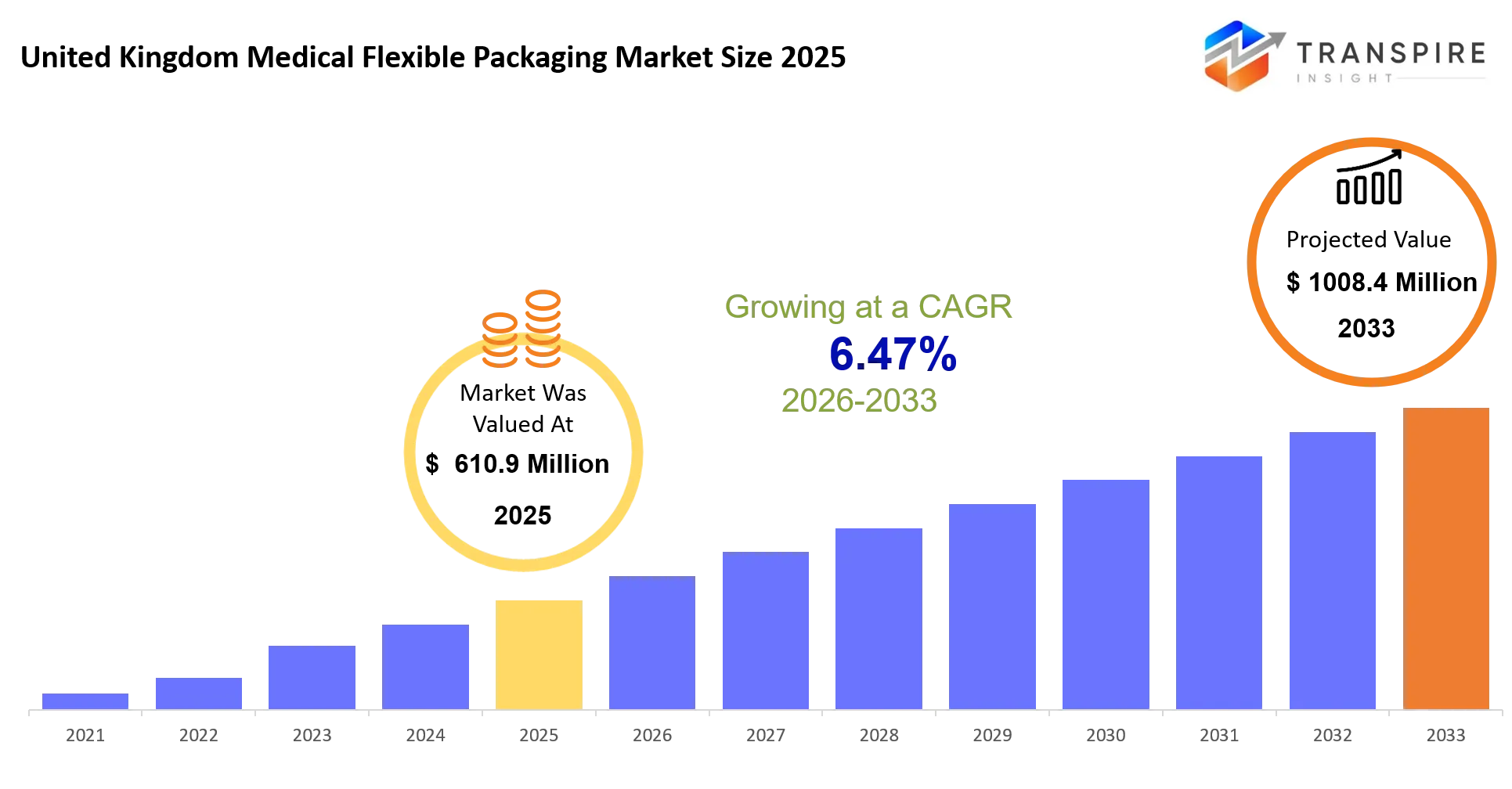
As per Transpire Insight Analysis the United Kingdom Medical Flexible Packaging Market size is estimated at USD 610.9 Million in 2025 and is anticipated to reach USD 1008.4 Million by 2033, growing at a CAGR of 6.47% from 2026 to 2033.
In the United Kingdom, the Medical Flexible Packaging Market really plays an important role in keeping sterile medical devices secure , along with pharmaceuticals, diagnostic kits and those single use healthcare products , from day one of storage all the way through transport and then the actual clinical use. Basically, flexible packaging helps producers keep the product integrity more or less fully intact while they also cut down on material usage, make logistics feel a lot simpler, and stretch the shelf life further. Because of that, hospitals, pharmaceutical companies, and medical device manufacturers tend to lean on these packaging solutions to meet strict safety and compliance requirements, without messing up daily operations.
Over the last three to five years, the market has started moving toward higher performance options, with more sustainable packaging materials. This change is tied to barrier technologies that got better, plus more recyclable formats that are actually practical. At the same time, stricter environmental policies, and the supply chain disruptions seen during the COVID-19 period, highlighted how necessary resilient and locally adaptable packaging strategies can be. As healthcare manufacturers grew their domestic production and tightened inventory planning, spending on advanced flexible packaging sped up too. This whole shift has nudged broader take up of automation compatible packaging, enhanced traceability, and a few premium material innovations, which lets suppliers win higher value contracts while still backing changing regulatory expectations and healthcare delivery needs across the United Kingdom.
United Kingdom Medical Flexible Packaging Market Size & Forecast:
- United Kingdom Medical Flexible Packaging Market Size 2025: USD 610.9 Million
- Expected Market Value 2033: USD 1008.4 Million
- Forecast CAGR: 6.47%
- Leading region in 2025: England
- Fastest Growing region: Scotland
- Key Profile: Amcor, Berry Global, Sealed Air, Mondi, Huhtamaki, Constantia Flexibles, Sonoco Products, AptarGroup, Coveris, Winpak, Wipak, ProAmpac, UFlex, Clondalkin Group, TekniPlex
Key Market Insights
- England sort of dominated the United Kingdom Medical Flexible Packaging Market, with around 72% share in 2025, and this was pretty much backed by dense pharmaceutical manufacturing plus medical device production clusters .
- Scotland is expected to be the fastest-moving regional market, through 2025–2032, sort of mainly because life sciences funding keeps climbing, and pharmaceutical packaging capacity keeps expanding, maybe even a little more than people first assumed.
- In the product mix, flexible pouches basically took the lead, with close to 38% market share in 2025, since makers leaned into lightweight yet sterile barrier packaging , which also helps keep logistics costs lower.
- Then high-barrier medical films showed up as the second-largest segment, backed by wider adoption across pharmaceutical blister packs, diagnostic items, and surgical packaging uses.
- Recyclable mono-material packaging is forecast to be the quickest grower from 2025 to 2032, as regulatory expectations, and material innovation, start reshaping purchasing choices, step by step, more and more.
- For applications, pharmaceutical packaging stayed dominant, grabbing roughly 46% market share in 2025, because prescription medicines rely on validated sterile, plus tamper-evident formats.
- Medical device packaging should see the fastest expansion through 2032 too, given that advanced diagnostics and minimally invasive devices need stronger protective packaging.
- In 2025 , pharmaceutical manufacturers were responsible for roughly 49% of end user revenue, largely because production of medicines, biologics, and various sterile healthcare products keeps moving along.
- On the other hand, medical device manufacturers are expected to be the fastest-growing end-user group across the forecast window, since domestic manufacturing together with export activity is still getting stronger , and that makes the whole sector keep expanding.
What are the Key Drivers, Restraints, and Opportunities in the United Kingdom Medical Flexible Packaging Market?
The main growth driver is the tightening regulatory framework around sterile healthcare packaging and material traceability, kind of a big deal. Medical manufacturers responded by upgrading to more advanced barrier films, validated sealing technologies, and recyclable flexible formats. These moves, in practice, boosted regulatory compliance while also cutting down on packaging failures and product recalls, which is pretty measurable. With better production efficiency showing up in the numbers, it fed into stronger contract wins and more high-value packaging portfolios. Meanwhile healthcare production expansion across pharmaceuticals and medical devices kept reinforcing revenue opportunities along the whole packaging supply chain.
Even so, raw material volatility is still the biggest structural restraint. Medical-grade polymers, specialty films, and adhesive inputs have to go through strict qualification processes, and they cannot really be swapped out quickly. Packaging suppliers must finish long validation cycles before they can introduce alternative materials. So launches get pushed, and procurement decisions get postponed, sometimes quietly, sometimes not. Based on the Transpire Insight review of regional procurement announcements and launch schedules, supply chain concentration remains the primary execution risk. The outcome tends to be delayed adoption, compressed operating margins, and deferred revenue across multiple supplier categories.
The strongest opportunity is in recyclable mono material healthcare packaging ,aided by advanced barrier coatings and digital manufacturing, like really. Ongoing investments in intelligent converting machinery plus material science keep reducing technical constraints, slowly but surely . Pharmaceutical makers are now actively reviewing packaging with less environmental footprint while still protecting sterility . The suppliers who can blend sustainable materials with automated quality inspection and serialization features will likely build stronger long term competitiveness across the United Kingdom healthcare packaging sector.
What Has the Impact of Artificial Intelligence Been on the United Kingdom Medical Flexible Packaging Market?
Artificial intelligence and digital manufacturing technologies are, sort of, reshaping how medical flexible packaging production happens, mainly by raising quality control levels, making compliance management easier , and improving factory efficiency overall. AI driven vision inspection systems keep watching seal integrity, print appearance, and packaging defects all in real time, so manual checking is reduced, and the results stay more uniform across regulated manufacturing conditions. Then, digital compliance platforms automate things like the paperwork trails, batch verification, and complete traceability , which means manufacturers can answer regulatory audit requests much faster.
At the same time, machine learning models are increasingly used for demand forecasting, production timing, and predictive maintenance of converting equipment. They look at older production logs, maintenance records, and order rhythms. Because of that, unplanned downtime goes down, and material use gets better. In practice, manufacturers often say they get higher equipment availability, less waste generation, stronger throughput, and quicker adjustments when pharmaceutical schedules shift around. Digital twins and linked production lines also add more operational visibility across packaging facilities, like a clearer view of what’s going on everywhere.
Still, despite those gains, broad AI rollouts hit some real-world issues. The integration costs are high , because many production sites still run legacy machinery that needs major upgrades before advanced analytics can even work properly. Also, AI models need dependable operational data, and that data is not always consistently there for every packaging workflow. These limits keep slowing adoption for small and medium sized healthcare packaging manufacturers, even when the potential is pretty attractive.
Key Market Trends
- Since 2023, healthcare manufacturers have been speeding up adoption of recyclable mono material packaging , to satisfy tougher environmental rules while still keeping the sterile barrier doing what it should , even if that balance is kinda hard in real life.
- AI enabled vision inspection systems have also boosted how well packaging defects get spotted, so by 2025 there’s less reliance on manual checks in regulated production lines, you know, the kind with strict documentation.
- Pharmaceutical companies have leaned more into domestic packaging partnerships after the latest supply chain disruptions showed they were too tied to imported medical packaging materials and that was a wakeup moment.
- Since 2022, advanced high barrier film technologies have moved into broader commercial use , helping extend protection for biologics and other temperature sensitive healthcare goods.
- During 2024, investments in serialization and digital traceability ramped up, as healthcare manufacturers pushed harder on regulatory compliance and product authenticity, this is where the paperwork meets the reality.
- Amcor , Berry Global , and Mondi increased investments in sustainable medical packaging technologies from 2023 to 2025, mainly through new product development efforts and related initiatives that keep iterating.
- Automation across converting and sealing steps has lowered production variability, while also lifting throughput and cutting packaging waste inside more modern manufacturing facilities.
- Since 2023, demand for flexible packaging that supports diagnostic kits and wearable medical devices has strengthened, kind of alongside the overall expansion of healthcare technology.
- Meanwhile, contract packaging providers expanded cleanroom production capacity across the 2024–2026 timeframe, to support pharmaceutical outsourcing and specialized medical device manufacturing without so many bottlenecks .
United Kingdom Medical Flexible Packaging Market Segmentation
By Material :
Polyethylene is sort of in the lead due to solid sealing ability, moisture defense, and cost efficiency across pharmaceutical plus medical packaging. Polypropylene comes next with strong heat endurance and durability for items that need sterilization before they are released for distribution. PVC still supports a number of healthcare uses, where transparency and easy forming matter most, even though substitution keeps happening little by little. Polyamide and PET also step in, since they deliver better strength along with stronger barrier results, for products that must stay protected longer during storage and transit.
Aluminum foil keeps being used for packaging types that need top tier shielding against moisture, oxygen and light. Paper based flexible packaging keeps getting more acceptance as healthcare producers push greener packaging approaches, while still staying in line with regulatory requirements. Other specialized materials help with smaller, niche needs using refined coatings, multilayer setups, and tuned barrier characteristics. In the end, material choice depends on product safety, regulatory standards, how efficiently it processes, and how well it performs over long-term storage.
By Product Type :
Pouches generate the biggest share, mainly due to lightweight building, efficient storage, and sturdy barrier defense that actually lines up with pharmaceutical and healthcare packaging needs. Bags stay pretty common for medical disposables, sterile items, and bulk healthcare supplies across hospitals, plus manufacturing facilities, where volume really matters. Sachets work well for single-dose offerings and diagnostic use-cases, especially when precise portion control is essential. Wraps keep doing their job too , giving sterile protection for surgical tools and healthcare products while they move through distribution and sit in storage.
Blister packaging keeps a fairly steady demand, largely because it offers dependable pharmaceutical packaging and also clearer product viewing. Stick packs keep growing across healthcare product lines that need convenient unit-dose packaging, while also lowering material consumption. Rollstock films back automated packaging processes , which means higher production efficiency and sealing quality that stays consistent. Other product formats cover more specific medical packaging requirements, based on thing sizes , sterility conditions, and how the items must be handled during processing.
By Application :
Pharmaceutical packaging ends up being the biggest use, because medicines really need trustworthy protection, contamination control, and that full regulatory compliance thing all along the supply chain, not just at one step. Medical device packaging comes in right behind it, since more advanced devices need sterile barriers and secure transport before they even reach clinical use. Diagnostic kits are still growing too, with broader lab testing and point-of-care health services spreading across the country. IV bags stay very relevant as well, mainly because hospitals need dependable packaging for fluid delivery and injectable therapies.
Surgical products lean on high-quality flexible packaging to keep sterility intact until clinical procedures start. Wound care products then call for packaging that safeguards product quality, while still making handling easier in hospitals and home healthcare setups. Healthcare consumables keep a fairly steady demand, because day to day medical operations rely on consistent packaging performance, plus efficient logistics. Other applications also exist, supporting specialized treatments through customized packaging solutions that are tuned to particular healthcare requirements.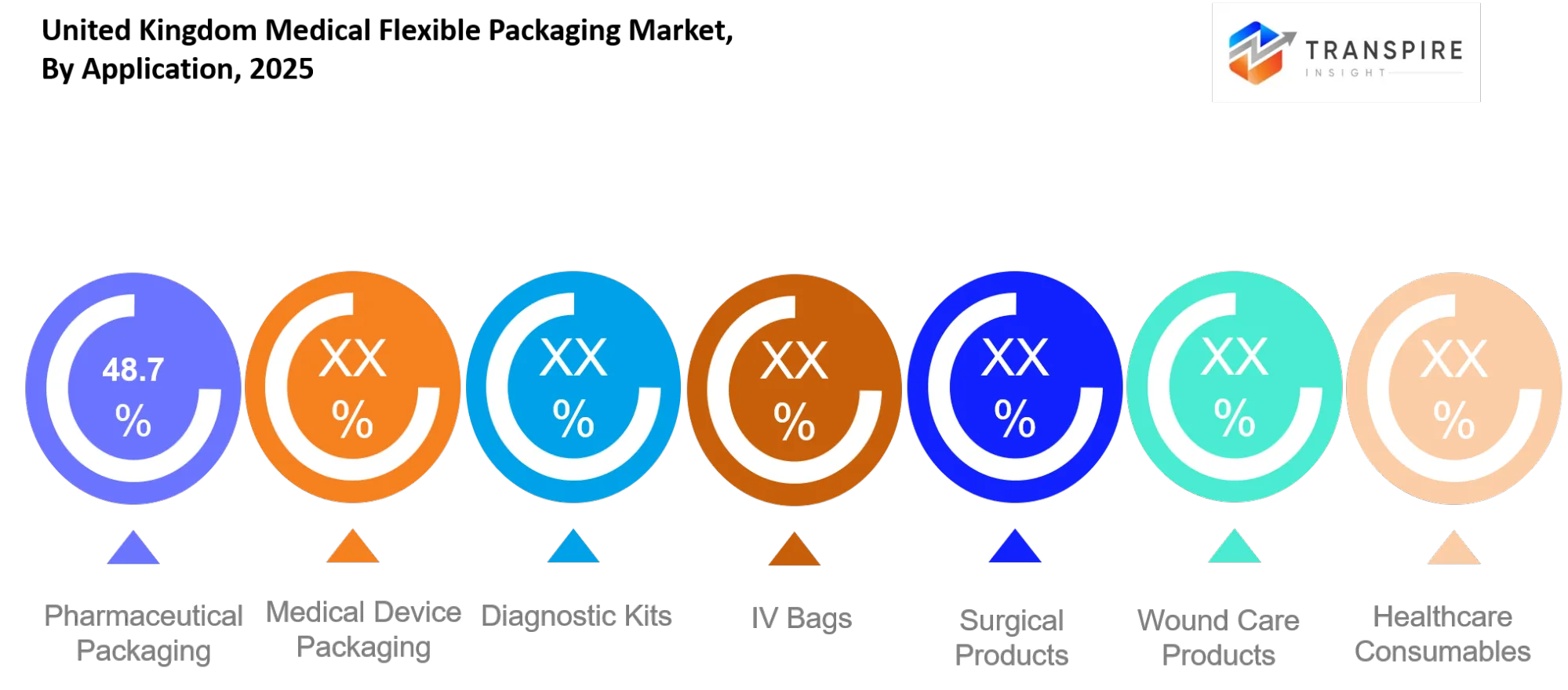
By Packaging Type :
Sterile packaging tends to lead the segment because patient safety and regulatory compliance depend on keeping product integrity intact until the very end of use. Non-sterile packaging supports healthcare products that don’t actually require sterile conditions, but they still need dependable protection during the whole transportation and storage period . Barrier packaging keeps moving forward in relevance due to better defense against moisture, oxygen, and outside contaminants. Vacuum packaging helps particular medical products by extending shelf stability and also lowering contamination hazards.
Peelable packaging makes day to day handling easier, because it allows simple opening without messing with sterile performance. Reclosable packaging is for products that need repeated access, while still keeping protection after the first opening. Child-resistant packaging stays relevant for healthcare items that call for extra safety steps during household storage. Other packaging styles cover specialized clinical and pharmaceutical needs through application specific designs.
By End User :
Pharmaceutical companies take up the biggest share, since large scale medicine making really hinges on prevalidated packaging materials that, uh, satisfy strict healthcare regulations. Medical device manufacturers keep putting money into packaging too, because product novelty and export movement keep increasing across different healthcare markets. Hospitals stay with steady purchasing, as everyday clinical routines depend on sterile and protective packing, for all kinds of medical items. Diagnostic laboratories generate steady need via laboratory testing services and the gradual build out of diagnostic capabilities.
Contract packaging businesses boost their market presence by offering niche packing services for pharma and other healthcare producers. Biotechnology firms in turn lean on advanced flexible packaging for biologics, research goods, and those temperature sensitive healthcare solutions. Healthcare distributors rely on durable packaging that shields products during storage and nationwide transit. Other end users, like specialized healthcare teams and medical supply operations, also add to the demand through related services.
What are the Key Use Cases Driving the United Kingdom Medical Flexible Packaging Market?
In the United Kingdom Medical Flexible Packaging Market, a big chunk of demand comes from sterile packaging for medical devices plus surgical consumables. Like, hospitals diagnostic laboratories, and medical device manufacturers typically choose pouches, bags, and thermoform packs to keep the goods sterile during transport , storage, and actual clinical handling. This is done while meeting tight healthcare quality rules and regulatory obligations, which is kind of the main point.
Demand isn’t staying there either. It’s also growing in pharmaceutical packaging and in diagnostic testing uses. Pharmaceutical firms are leaning more on flexible blister formats, sachets, and unit-dose versions, mainly to boost product defense and also make things easier for patients. Meanwhile, diagnostic kit makers want high barrier flexible films for test parts that get used in hospitals, pathology labs , and even decentralized healthcare setups.
New opportunities are showing up as well, especially around packaging for personalized therapies and next generation biologics. Those solutions need specialized barrier features , plus stronger traceability. And flexible packaging meant for home healthcare products, wearable medical devices, and remote patient monitoring kits seems poised to pick up speed too, since care delivery keeps shifting away from only the usual hospital environment and moving toward more distributed care models.
|
Report Metrics |
Details |
|
Market size value in 2025 |
USD 610.9 Million |
|
Market size value in 2026 |
USD 650.4 Million |
|
Revenue forecast in 2033 |
USD 1008.4 Million |
|
Growth rate |
CAGR of 6.47% from 2026 to 2033 |
|
Base year |
2025 |
|
Historical data |
2021 - 2024 |
|
Forecast period |
2026 - 2033 |
|
Report coverage |
Revenue forecast, competitive landscape, growth factors, and trends |
|
Regional scope |
United Kingdom (England, Scotland, Wales, Northern Ireland) |
|
Key company profiled |
Amcor, Berry Global, Sealed Air, Mondi, Huhtamaki, Constantia Flexibles, Sonoco Products, AptarGroup, Coveris, Winpak, Wipak, ProAmpac, UFlex, Clondalkin Group, TekniPlex . |
|
Customization scope |
Free report customization (country, regional & segment scope). Avail customized purchase options to meet your exact research needs. |
|
Report Segmentation |
By Material (Polyethylene, Polypropylene, PVC, Polyamide, PET, Aluminum Foil, Paper-Based Flexible Packaging, Others); By Product Type (Pouches, Bags, Sachets, Wraps, Blister Packaging, Stick Packs, Rollstock Films, Others); By Application (Pharmaceutical Packaging, Medical Device Packaging, Diagnostic Kits, IV Bags, Surgical Products, Wound Care Products, Healthcare Consumables, Others); By Packaging Type (Sterile Packaging, Non-Sterile Packaging, Barrier Packaging, Vacuum Packaging, Peelable Packaging, Reclosable Packaging, Child-Resistant Packaging, Others); By End User (Pharmaceutical Companies, Medical Device Manufacturers, Hospitals, Diagnostic Laboratories, Contract Packaging Companies, Biotechnology Companies, Healthcare Distributors, Others) |
Which Regions are Driving the United Kingdom Medical Flexible Packaging Market Growth?
England sort of, accounts for about 70% of the United Kingdom medical Flexible Packaging Market, and so it is basically the main regional contributor. The reason feels like it’s backed by where pharmaceutical manufacturing is concentrated, plus more advanced healthcare infrastructure, and also tight regulatory compliance for medical products. There’s also this dense web of packaging converters, medical device manufacturers, research institutions and logistics providers, which keeps the supply chain working efficiently, and supports large scale production. With continued investment in healthcare manufacturing capacity and pharmaceutical innovation, England should keep its market lead during the whole forecast period, more or less.
Scotland comes in as the second-largest regional market, with growth that seems to lean on a strong life sciences sector, not only on manufacturing size alone. Public investment in healthcare innovation stays consistent, regulatory alignment is fairly stable, and long term industrial development programs tend to create fairly predictable demand for high quality medical packaging solutions. You can also point to pharmaceutical research, biotechnology firms, and specialized medical technology companies, all of which together make a steady customer base for flexible packaging suppliers. Because of these underlying strengths, Scotland looks like a dependable source of recurring revenue, even if its industrial profile is more specialized in nature.
Wales is set to see the speedier sort of growth in the 2026–2033 window , with healthcare manufacturing investment and life sciences expansion rising together across the broader region. Lately there has been more activity around medical technology facilities, plus greater backing for home based pharmaceutical production, and the modernization of industrial infrastructure all at once . Those moves, in turn, have strengthened the pull for advanced flexible packaging.
The area is also being looked at by manufacturers who want cost efficient production spots, but still need reliable access to the wider United Kingdom healthcare supply chain. With all that momentum building, there are pretty appealing openings for packaging suppliers , and for investors who want to scale into emerging healthcare manufacturing clusters.
Who are the Key Players in the United Kingdom Medical Flexible Packaging Market and How Do They Compete?
In the United Kingdom , competition within the Medical Flexible Packaging Market feels like it is moderately consolidated , you know, not totally scattered but not like one or two players either. Big multinational packaging companies go head to head with more specialized healthcare packaging manufacturers and that mix matters. Usually the fight is over things like material innovation , regulatory compliance , product quality , and, honestly, the ability to deliver customized packagings for pharma as well as medical device uses. Most established manufacturers keep pushing ahead by investing in sustainable materials, barrier technologies, and sort of end to end packaging services. At the same time, smaller specialized suppliers tend to carve out space by handling niche clinical needs and very specific pharmaceutical requirements.
Amcor stands out with high-barrier flexible packaging know-how , plus recyclable material development and solid pharmaceutical packaging capability, which in turn helps customers align with changing sustainability goals. Berry Global leans more on broad manufacturing capacity and a wide healthcare packaging range, so they can move efficiently and still offer tailored solutions for medical device and pharmaceutical clients. Mondi competes by building on paper-based approaches and sustainable flexible packaging innovations, and it also grows partnerships that support more environmentally responsible healthcare packaging.
Sealed Air talks about sterile barrier technologies, plus the packaging systems that keep delicate medical products safe all the way through distribution. Coveris also, sort of reinforces its position using healthcare packaging solutions made to fit, with fast product development. They also invest in recyclable flexible packaging, which follows the shifting environmental rules and—customer procurement needs too. In practice, both firms compete by mixing regulatory know-how, material science skills, and long term relationships with pharmaceutical manufacturers and healthcare providers.
Company List
Berry Global
Mondi
Huhtamaki
Sonoco Products
AptarGroup
Winpak
Wipak
UFlex
Clondalkin Group
TekniPlex
Recent Development News
In April 2026, Amcor opened an advanced healthcare packaging coating facility in Malaysia following an investment of more than US$35 million. The facility introduced air-knife coating technology for sterile medical packaging, strengthening global healthcare packaging supply chains that serve manufacturers, including those in the United Kingdom.
Source https://www.prnewswire.com/
In October 2025, Coveris partnered with SABIC, Zuyderland Medical Centre, and Artivion to launch the first closed-loop medical packaging project that recycles non-contaminated hospital plastic waste into new sterile medical packaging. The initiative demonstrated a commercially viable circular packaging model with relevance for healthcare packaging producers across the United Kingdom and Europe. Source https://www.coveris.com/
What Strategic Insights Define the Future of the United Kingdom Medical Flexible Packaging Market?
The United Kingdom Medical Flexible Packaging Market is slowly moving toward super specialized, regulation driven packaging options, that kind of fuse sterility with sustainability, and digital traceability, all while being pushed along by more pharma manufacturing and biologics output, plus decentralized healthcare delivery in the next five to seven years.
A risk that is a bit less obvious, is how much the industry is starting to rely on a small set of suppliers for high performance barrier films, and medical grade polymers, and that reliance could end up exposing manufacturers to supply shocks and cost swings, even if demand stays fairly strong.
At the same time there’s an opportunity that feels newer: intelligent flexible packaging, including serialization plus RFID, and smart labeling features. This should help with tougher requirements around product authentication and lifecycle tracking, especially when it comes to advanced therapies and personalized medicines.
Market players may want to treat recyclable high barrier materials as a priority, and also invest in digitally enabled packaging platforms, but not ignore diversification. By setting up multiple sourcing approaches, they can improve supply resilience and keep their edge as regulations and customer expectations keep changing, almost year by year.
United Kingdom Medical Flexible Packaging Market Report Segmentation
By Material
- Polyethylene
- Polypropylene
- PVC
- Polyamide
- PET
- Aluminum Foil
- Paper-Based Flexible Packaging
By Product Type
- Pouches
- Bags
- Sachets
- Wraps
- Blister Packaging
- Stick Packs
- Rollstock Films
By Application
- Pharmaceutical Packaging
- Medical Device Packaging
- Diagnostic Kits
- IV Bags
- Surgical Products
- Wound Care Products
- Healthcare Consumables
By Packaging Type
- Sterile Packaging
- Non-Sterile Packaging
- Barrier Packaging
- Vacuum Packaging
- Peelable Packaging
- Reclosable Packaging
- Child-Resistant Packaging
By End User
- Pharmaceutical Companies
- Medical Device Manufacturers
- Hospitals
- Diagnostic Laboratories
- Contract Packaging Companies
- Biotechnology Companies
- Healthcare Distributors
Frequently Asked Questions
Find quick answers to common questions.
The Expected United Kingdom Medical Flexible Packaging Market size for the Market will be USD 1008.4 Million in 2033.
Key Segments for the United Kingdom Medical Flexible Packaging Market are By Material (Polyethylene, Polypropylene, PVC, Polyamide, PET, Aluminum Foil, Paper-Based Flexible Packaging, Others); By Product Type (Pouches, Bags, Sachets, Wraps, Blister Packaging, Stick Packs, Rollstock Films, Others); By Application (Pharmaceutical Packaging, Medical Device Packaging, Diagnostic Kits, IV Bags, Surgical Products, Wound Care Products, Healthcare Consumables, Others); By Packaging Type (Sterile Packaging, Non-Sterile Packaging, Barrier Packaging, Vacuum Packaging, Peelable Packaging, Reclosable Packaging, Child-Resistant Packaging, Others); By End User (Pharmaceutical Companies, Medical Device Manufacturers, Hospitals, Diagnostic Laboratories, Contract Packaging Companies, Biotechnology Companies, Healthcare Distributors, Others).
Major United Kingdom Medical Flexible Packaging Market Players are Amcor, Berry Global, Sealed Air, Mondi, Huhtamaki, Constantia Flexibles, Sonoco Products, AptarGroup, Coveris, Winpak, Wipak, ProAmpac, UFlex, Clondalkin Group, TekniPlex .
The Current United Kingdom Medical Flexible Packaging Market size is USD 610.9 Million in 2025.
The United Kingdom Medical Flexible Packaging Market CAGR is 6.47% from 2026 to 2033.
Amcor
Berry Global
Sealed Air
Mondi
Huhtamaki
Constantia Flexibles
Sonoco Products
AptarGroup
Coveris
Winpak
Wipak
ProAmpac
UFlex
Clondalkin Group
TekniPlex
About the Authors

Kartik bhong
I am Kartik Bhong, a Senior Research Analyst at Transpire Insight, specializing in the Packaging, Manufacturing, and Construction industry. My work focuses on analyzing market trends, emerging technologies, industry regulations, and competitive landscapes to deliver accurate, data-driven insights. I am passionate about transforming complex industry information into clear, practical content that helps businesses, professionals, and decision-makers stay informed and make confident strategic decisions. Through continuous research and a strong commitment to accuracy, I strive to create reliable, well-researched content that reflects the latest developments across these dynamic industries and supports the vision of Transpire Insight in delivering valuable market intelligence.

Chakradhar Khansole
Chakradhar serves as the Research Director at Transpire Insight, bringing over 8 years of experience in technology, innovation, and strategic market intelligence. He specializes in transforming complex market data into actionable business insights that enable organizations to make informed, growth-oriented decisions. Recognized for his strategic vision and analytical expertise, Chakradhar leads high-impact research initiatives, delivering comprehensive market assessments, competitive intelligence, and forward-looking industry analysis.
Recently Published Reports
-
Apr 2026
Pharmaceutical Cold Chain Packaging Market
Pharmaceutical Cold Chain Packaging Market By Material (Plastic,(Polyethylene (PE), Polypropylene (PP), Polyethylene Terephthalate (PET), Expanded Polystyrene (EPS), Polyurethane (PU),Others), Paper, Metal, Others), By Product (Small Boxes, Pallets, Large Sized Pallet Containers, Others), By End Use (Biopharmaceutical Companies, Clinical Research Organizations, Hospitals, Research Institutes, Logistics and Distribution Companies, Others)”, By Industry Analysis, Size, Share, Growth, Trends, and Forecasts 2026-2033
-
Apr 2026
Active & Intelligent Packaging Market
Active & Intelligent Packaging Market By Type (Active Packaging, Smart Packaging), By Material (Polymer-Based, Paper & Board-Based, Metal-Based, Glass-Based), By Technology (Time-Temperature Indicators, Freshness Indicators, RFID, Antimicrobial Packaging, Modified Atmosphere Packaging), By Application (Food & Beverages, Pharmaceutical, Cosmetics & Personal Care, Electronics & Consumer Goods, Others), By Industry Analysis, Size, Share, Growth, Trends, and Forecasts 2026-2033
-
Apr 2026
Biodegradable Cut Flower Packaging Market
Biodegradable Cut Flower Packaging Market By Material Type (Paper & Paperboard, Biodegradable Plastics, Natural Fibers, Molded Pulp, Others), By Product Type (Sleeves, Wraps, Boxes & Cartons, Bags & Pouches, Inserts & Holders), By Application (Roses, Carnations, Tulips, Chrysanthemums, Mixed Flowers, Others) and By Distribution Channel (Direct Sales, Distributors & Wholesalers, Online Channels), By Industry Analysis, Size, Share, Growth, Trends, and Forecasts 2026-2033
-
May 2026
Pharmaceutical Packaging Market
Pharmaceutical Packaging Market By Material Type (Plastic, Glass, Metal, Paper & Paperboard, Others), By Packaging Type (Bottles, Blister Packs, Vials, Ampoules, Pouches & Sachets, Others) and By End User (Hospitals & Clinics, Retail Pharmacies, Online Pharmacies, Pharmaceutical Manufacturers), By Industry Analysis, Size, Share, Growth, Trends, and Forecasts 2026-2033