

Global Subsea Well Access Systems Market Size & Forecast:
- Global Subsea Well Access Systems Market Size 2025: USD 4.25 Billion
- Global Subsea Well Access Systems Market Size 2033: USD 6.19 Billion
- Global Subsea Well Access Systems Market CAGR:4.83%
- Global Subsea Well Access Systems Market Segments: By System Type (Intervention Systems, Wireline Systems, Riser Systems, Lubricator Systems, Coiled Tubing Systems, Control Systems, Others); By Application (Exploration, Production, Maintenance, Well Intervention, Decommissioning, Others); By Water Depth (Shallow, Deepwater, Ultra-deepwater, Others); By End User (Oil Companies, Service Providers, Offshore Operators, Others); By Installation (Fixed, Mobile, Modular, Others).

Global Subsea Well Access Systems Market Summary
As per Transpire Insight Analysis, the Global Subsea Well Access Systems Market size is estimated at USD 4.25 Billion in 2025 and is anticipated to reach USD 6.19 Billion by 2033, growing at a CAGR of 4.83% from 2026 to 2033. This vital offshore industry provides the heavy-duty pressure barriers, hydraulic controls, and structural pipe interfaces needed to safely enter, maintain, and plug oil and gas wells directly on the ocean floor. Over the last few years - the rapid depletion of easy-to-reach shallow water reserves forced oil companies to shift their drilling investments into extreme marine environments. This exploration transition triggered a massive structural shift, as offshore operators rapidly migrated from conventional rig-based setups to lighter, riserless well intervention systems operated via nimble monohull vessels. Because drilling entirely new ultra-deepwater wells costs upwards of USD 120 million, operators are using advanced subsea well access hardware to execute targeted downhole maintenance and chemical stimulations. This highly practical approach allows operators to dramatically boost declining reservoir flow rates at a fraction of greenfield capital expenses, driving stable hardware and service procurement across the global energy sector.
Key Market Insights
The global subsea well access systems market is fundamentally shifting from rigid, rig-heavy configurations to highly modular, vessel-based rigless architectures that drastically reduce intervention cycles. Driven by the financial realities of deepwater exploration, offshore operators are replacing high-cost floating drilling rigs with light well intervention (LWI) vessels and digital twin tracking systems to safely optimize downhole pressure management without interrupting field production.
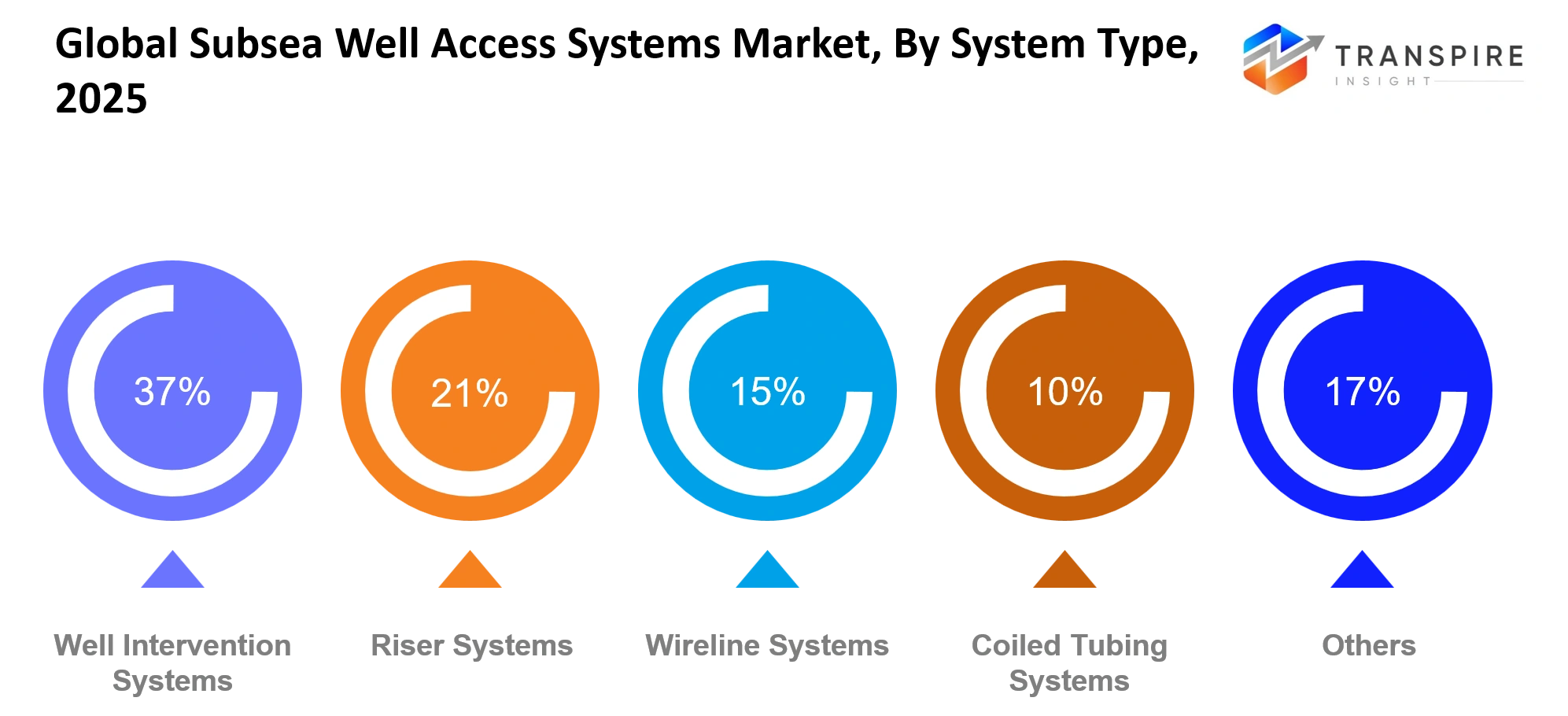
- Locking down a 37% share, Well Intervention Systems lead the market, with TechnipFMC deploying advanced riserless stacks to easily extend mature field lifespans.
- Expanding at a 12.7% CAGR, Ultra-deepwater Systems dominate acceleration as operators swap shallow configurations for heavy-duty, high-pressure subsea architectures.
- Capturing 34% of worldwide revenue, North America functions as the largest geographic market, backed by massive cluster capital investments across the deepwater Gulf of Mexico.
- Commanding a stable 27% market slice, Europe drives system innovation, pushing North Sea operators to adopt modular lubricator setups that meet strict marine safety codes.
- Representing 18% of total industry demand, the Asia Pacific theater relies on expanding drilling activity, compelling state-backed energy firms to procure flexible subsea trees.
- Securing 15% of the market footprint, the Middle East & Africa region represents the fastest-growing corridor, accelerating at a 13.9% CAGR via deepwater expansion.
- Claiming a targeted 6% market share, Latin America moves toward extreme depths, relying on specialized technical solutions to tap complex pre-salt subsea oil basins.
- Accounting for 21% of procurement volume, Riser Systems remain an essential hardware segment, integrating high-fatigue pipes directly into high-throughput floating production units.
- Securing 15% of the product matrix, Wireline Systems face rapid upgrades as operators leverage advanced downhole logging tools to optimize reservoir performance mapping.
- Accounting for 10% of total procurement, Coiled Tubing Systems expand in intervention campaigns, allowing service providers to run high-velocity mechanical downhole cleanouts.
What are the Key Drivers, Restraints, and Opportunities in the Global Subsea Well Access Systems Market?
Driver
The market is expanding due to the financial urgency to maximize production from a massive global inventory of maturing offshore brownfields. High drillship day rates hovering between USD 450,000 and USD 550,000 make mobilizing a full rig for basic downhole maintenance completely unviable. This cost pressure was triggered by severe production declines and water breakthrough issues across older subsea wells, forcing operators to rapidly adopt vessel-based, riserless light well intervention (RLWI) stacks. This operational shift drives immediate hardware revenue as operators choose modular access lines that bypass the need for heavy drilling structures.
In June 2026, energy services leader Expro officially secured a major five-year subsea completion and intervention services contract extension with a prominent operator in the deepwater Gulf of America. This strategic deployment introduces Expro's proprietary Solus shear-and-seal valve technology alongside its advanced subsea landing string configurations to deliver high-integrity pressure containment directly at the wellhead. By providing these certified structural barriers to manage challenging offshore conditions safely, this equipment integration allows operators to perform critical downhole remediation and completion loops without relying on high-cost rig spreads, substantially driving market adoption.
Restraint
A severe, structural shortage of purpose-built subsea intervention monohull vessels acts as a major bottleneck capping market growth. With global fleet utilization rates routinely soaring past 90% and a multi-year lack of new vessel construction, offshore operators face extreme backlogs when trying to book intervention campaigns. This capacity squeeze persists because the immense capital risk of financing new specialty vessels prevents marine logistics providers from expanding fleets, leaving major subsea fields waiting months for standard pressure validation or mechanical cleanouts.
Opportunity
The most lucrative growth window lies in the technical adaptation of subsea well access systems for ultra-deepwater carbon capture and storage (CCS) injection infrastructure. Fusing high-fatigue electro-hydraulic subsea control modules with specialized dynamic riser sets allows operators to repurpose depleted subsea reservoirs into permanent, high-volume carbon dioxide storage sinks. This technical transition unlocks massive long-term equipment procurement contracts as major energy consortiums across Europe and North America look to build out high-integrity, automated injection blocks capable of handling dense-phase gas streams safely beneath the ocean floor.
What Has the Impact of Artificial Intelligence Been on the Global Subsea Well Access Systems Market?
Artificial intelligence is completely changing how engineers handle subsea well access, moving the industry away from rigid calendar schedules into a flexible, data-driven approach. Instead of guessing when to rent a high-cost intervention vessel, operators are using machine learning models to continuously watch real-time data streaming from deepwater wells.
On the boat, AI makes sense of messy downhole data by feeding sensor inputs straight into virtual digital twins. These smart networks constantly track pressure spikes, shifting hydraulic valve positions, and structural fatigue on active risers or control modules. By matching these patterns, the software flags issues like subsea blowout preventer (BOP) wear or downhole sand buildup long before things actually freeze up. This early warning lets teams book quick, riserless light well intervention (RLWI) trips exactly when they matter most, keeping production running smoothly. But there is a catch - these tools only work as well as the data they receive. AI models built on clean, indoor test data often stumble in the real world, failing to separate normal ocean noise from actual mechanical wear under severe deep-sea pressures. Even with these hurdles, the tech is moving fast. In November 2025, a collaborative subsea technical panel launched an AI-driven monitoring framework designed to track deepwater health in real time. This digital twin setup pairs direct sensor feeds with predictive physics to screen out background ocean noise. By converting complex acoustic signals into simple risk alerts, this automated tool lets operators line up maintenance crews well before a major asset goes dark.
Key Market Trends
The subsea well access landscape is undergoing a major structural evolution, shifting away from high-cost, rig-dependent deepwater drilling assemblies toward agile, vessel-deployed rigless architectures. Driven by severe cost containment constraints and soaring deepwater drillship rates, offshore engineering teams are replacing massive steel marine riser lines with light well intervention (LWI) configurations to complete critical pressure barrier validation and downhole logging directly from flexible monohull vessels.
- For decades, offshore operators relied almost exclusively on standard rig-based landing strings to execute basic hydraulic adjustments, but field teams are rapidly moving toward subsea intervention lubricators (SILs) to bypass the surface-to-seabed pipeline footprint entirely.
- Instead of running rigid, unmonitored baseline pressure lines that lack visibility, control room technicians are actively equipping subsea control modules with real-time multiplexed fiber-optic telemetry arrays to track minute fluid variations instantly.
- Traditional offshore engineering camps historically separated physical downhole logging tools from automation logic, but modern deepwater teams are aggressively fusing intelligent, electric-wireline robotics directly into dynamic coiled tubing runs to guarantee hands-free tool manipulation.
- To prevent severe internal mechanical fatigue and subsequent localized cracking across high-pressure dynamic riser stacks, hardware engineers are pivoting away from heavy carbon steels to integrate advanced high-fatigue titanium alloy structural pipes.
- Rather than deploying thick, resource-heavy emergency disconnect blocks that require days of manual setup, system developers are transitioning toward standardized, automated quick-disconnect emergency valves to secure open-water pressure boundaries during sudden maritime drift-offs.
- Commercial offshore operators are looking far beyond standard shallow shelf exploration, driving a massive operational move toward ultra-deepwater plays exceeding depths of 3,000 meters that demand highly specialized 20,000-psi-rated seabed trees.
- Instead of relying on manual diver intervention or low-bandwidth hydraulic lines that delay critical flow data, subsea equipment suppliers are deeply embedding resident remotely operated vehicles (ROVs) and low-temperature actuator systems directly onto the permanent wellhead structure.
- To satisfy tightening international zero-emission and marine conservation targets, offshore system designers are abandoning basic hydraulic fluid venting protocols to adopt closed-loop all-electric subsea control modules that eliminate chemical discharge risks entirely.
- Local subsea development hubs are completely overhauling their brownfield field management plans, pushing a strategic transition toward long-distance satellite subsea tie-backs that stretch beyond 150 kilometers to link isolated ocean-floor wells back to existing production assets.
Global Subsea Well Access Systems Market Segmentation
By System Type
Well Intervention Systems command the largest share of market capital, holding a dominant 37% of all global revenue. Riser Systems follow as a key structural line at 21%, with Wireline Systems sitting at 15%, Coiled Tubing Systems at 10%, and other ancillary subsea components accounting for 17%. This distribution persists because deepwater asset management requires heavy seabed pressure control arrays to safely manage oil and gas workflows. Well Intervention Systems maintain their dominant market position because operators are shifting away from traditional rig-based exploration to focus on stretching the production lifecycle of existing subsea wells. Meanwhile, Wireline and Coiled Tubing categories are accelerating as field teams demand highly mobile, rigless tools to execute downhole cleanouts and log fluid data without deploying full floating drilling setups. Moving forward, structural hardware will transition fully toward automated, all-electric configurations. Equipment providers will focus heavily on delivering modular, riserless light well intervention (RLWI) stacks integrated with real-time telemetry to meet strict international zero-venting safety mandates and lower operational day rates.
By Application
Production management functions as the undisputed anchor of this segment, locking down the largest portion of hardware procurement. At the same time, Well Intervention and Maintenance activities represent the fastest-growing application spaces. The underlying growth logic is tied directly to the aging profile of the world's deepwater well inventory and the high cost of drilling replacement greenfield assets. Production operations demand highly reliable, permanent subsea tree access points to handle continuous high-pressure flows, while Well Intervention applications are growing rapidly as operators run target-specific mechanical adjustments to counter reservoir pressure drops and water breakthroughs. Looking ahead, hardware development will focus heavily on long-term mechanical reliability and modularity. Subsea equipment manufacturers will need to balance two distinct workloads: building highly durable, specialized high-pressure access lines for core production fields while simultaneously refining modular, rapid-disconnect landing strings tailored for short-cycle, multi-well maintenance campaigns.
By Water Depth
Deepwater operations capture the largest volume of day-to-day equipment orders, while Ultra-deepwater Systems stand as the undisputed market accelerator, driving the fastest growth with an explosive 12.7% CAGR. This divergence is shaped by the exhaustion of easy-to-reach shallow-shelf reserves, forcing energy companies to move exploration into ocean depths exceeding 3,000 meters. Standard shallow-water access lines fail in these environments because they cannot withstand extreme seabed pressures and freezing ambient temperatures. Ultra-deepwater Systems resolve this technical hurdle by incorporating high-fatigue titanium alloys and thick-walled structural steel barriers rated up to 20,000 psi. In the coming years, water depth categories will merge with advanced automated drilling logic. Seafloor equipment suppliers will need to redesign their product lineups to focus on intelligent, ultra-deepwater pressure control boundaries that can run autonomously on the ocean floor for extended deployments without constant surface intervention.
By End User
Oil Companies, particularly major international oil companies (IOCs) and national oil companies (NOCs), serve as the primary financial engine of the market, controlling large-scale capital procurement budgets. Concurrently, Offshore Operators and Service Providers are rising as highly active, fast-growing secondary buyers. The market dynamic here relies on the shifting execution model of offshore projects, where major oil companies establish long-term framework contracts, while agile service providers manage the actual day-to-day deployment of intervention vessels and tool strings. Oil companies use multi-year capital agreements to lock down equipment availability, whereas service providers look for modular, brand-agnostic tool configurations that adapt to various subsea tree styles. Moving forward, market success will require a move away from standalone hardware sales. Long-term profitability will belong to providers who offer integrated "Equipment-as-a-Service" models, bundling physical access hardware with real-time digital twin monitoring and ongoing predictive field support.
By Installation
Fixed installations retain a massive portion of the existing operational footprint due to their long historical deployment as permanent wellhead completions. Meanwhile, Modular and Mobile configurations are leading market growth as the fastest-accelerating options. The growth pattern is driven by a broad industrial transition toward flexible, rigless offshore operations designed to eliminate the long setup times and high costs tied to fixed structures. Legacy fixed assemblies are ideal for high-volume, long-life fields, but modular access systems are gaining ground because they allow crews to quickly swap out control modules and valve segments directly from small monohull vessels. Looking ahead, the industry will pivot sharply toward easily adaptable, plug-and-play architectural designs. Seafloor hardware suppliers will be forced to transition toward standardized modular landing strings and interchangeable subsea control pods that let operators rapidly adjust, deploy, and retrieve seabed equipment to minimize expensive vessel deck time.
What are the Key Use Cases Driving the Global Subsea Well Access Systems Market?
The primary use case driving this market is deepwater production enhancement and active reservoir fluid management. Offshore operators deploy heavy-duty well access setups directly onto seabed trees to restore oil flow, run mechanical diagnostics, and clear out hydrate blockages from declining marine oilfields without shutting down the main asset.
Expanding applications focus heavily on managing complex infrastructure maintenance across deepwater corridors. Field crews utilize these modular pressure-control lines to run high-speed downhole logging tools, replace corroded safety valves, and execute localized chemical injections from light vessels, avoiding the high capital expenses tied to traditional floating rigs.
An emerging use case centers on subsea plug - abandonment (P&A) loops for field decommissioning. Regulatory mandates require operators to use structural well access barriers to permanently isolate mature downhole reservoirs and cut away marine steel strings, safely sealing depleted assets beneath the seafloor.
|
Report Metrics |
Details |
|
Market size value in 2025 |
USD 4.25 Billion |
|
Market size value in 2026 |
USD 4.45 Billion |
|
Revenue forecast in 2033 |
USD 6.19 Billion |
|
Growth rate |
CAGR of 4.83% from 2026 to 2033 |
|
Base year |
2025 |
|
Historical data |
2021 - 2024 |
|
Forecast period |
2026 - 2033 |
|
Report coverage |
Revenue forecast, competitive landscape, growth factors, and trends |
|
Regional scope |
United States; Canada; Mexico; United Kingdom; Germany; France; Italy; Spain; Denmark; Sweden; Norway; China; Japan; India; Australia; South Korea; Thailand; Brazil; Argentina; South Africa; Saudi Arabia; United Arab Emirates |
|
Key company profiled |
Schlumberger, Halliburton, Baker Hughes, TechnipFMC, Oceaneering, Expro, Helix Energy Solutions, Aker Solutions, NOV, Saipem, Weatherford, Proserv, OneSubsea, Dril-Quip, Subsea 7. |
|
Customization scope |
Free report customization (country, regional & segment scope). Avail customized purchase options to meet your exact research needs. |
|
Report Segmentation |
By System Type (Intervention Systems, Wireline Systems, Riser Systems, Lubricator Systems, Coiled Tubing Systems, Control Systems, Others); By Application (Exploration, Production, Maintenance, Well Intervention, Decommissioning, Others); By Water Depth (Shallow, Deepwater, Ultra-deepwater, Others); By End User (Oil Companies, Service Providers, Offshore Operators, Others); By Installation (Fixed, Mobile, Modular, Others). |
Which Regions are Driving the Global Subsea Well Access Systems Market Growth?
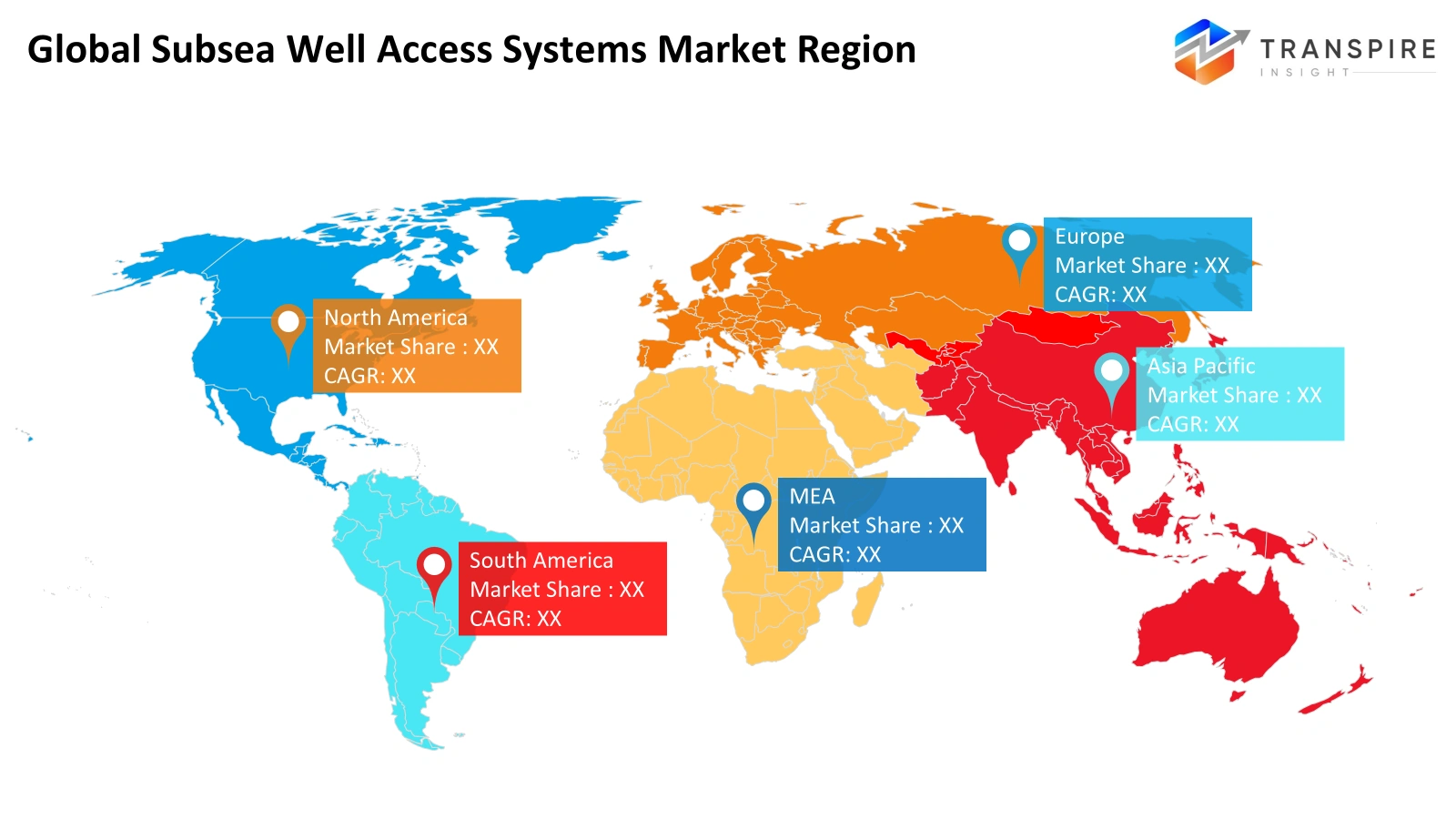
North America maintains a commanding grip on the subsea well access systems market, capturing a dominant 34% of all worldwide industry revenue. This geographic leadership is heavily driven by deepwater extraction hubs across the Gulf of Mexico, where hundreds of maturing subsea assets require continuous lifecycle management. The regional ecosystem is structurally supported by a massive concentration of specialized offshore engineering contractors and rigorous federal BSEE safety compliance policies that mandate frequent pressure barrier validations. Consequently, integrating advanced high-fatigue landing strings and automated quick-disconnect valves has become a major operational standard for operators looking to manage complex deep-sea fields safely.
Europe serves as a highly stable, predictable secondary pillar for the global market, locking down an essential 27% share of total industry demand. While North American field expansion concentrates heavily on deepwater deep-sea Gulf assets, European system adoption is driven entirely by mature, high-latitude brownfields operating across the North Sea shelf. This regional market stability is structurally insulated by strict zero-emission marine conservation mandates and an engineering focus on integrating permanent all-electric control systems to eliminate hydraulic fluid venting. To maintain strict workflow integrity, North Sea engineering teams steadily invest in modular subsea intervention lubricators that handle complex downhole data-logging from low-cost support vessels.
In February 2026, operator Aker BP awarded a major five-year maintenance, modification, and operations frame contract to engineering specialist Aker Solutions to support its offshore infrastructure across the Norwegian Continental Shelf. This comprehensive alliance model explicitly integrates digital twin tracking tools and real-time subsea health analytics across multiple mature North Sea developments, including the new Yggdrasil area. This long-term contract deployment ensures a steady procurement pipeline for high-reliability well access hardware and localized component modifications to maximize production from existing maritime wells.
The Middle East & Africa region has emerged as the fastest-growing territory globally, accelerating at a market-leading CAGR of 13.9% to capture a 15% slice of global sales. This sudden structural shift is driven by massive greenfield deepwater natural gas discoveries and aggressive multi-well exploration pipelines across the Rovuma and Congo basins. Historically, regional extraction relied almost completely on onshore and shallow-shelf infrastructure, but the territory has now rapidly pivoted toward deepwater and ultra-deepwater plays that require complex seafloor pressure control infrastructure. Looking ahead, future equipment procurement in this booming corridor relies entirely on deploying heavy-duty, 20,000-psi-rated subsea tree interfaces capable of supporting long-distance satellite tie-backs to floating production platforms.
Who are the Key Players in the Global Subsea Well Access Systems Market and How Do They Compete?
The global arena for subsea well access systems is heavily consolidated, with a tight group of tier-one offshore engineering giants locking horns over digital tech ecosystems, modular hardware design, and massive turnkey installation deals. Competition in this sector isn't just about selling machinery; it is a race to cut down expensive vessel rental fees and field deployment schedules while maintaining zero-leak pressure barriers at the bottom of the ocean.
TechnipFMC relies on a heavy integration strategy, pushing its unique "integrated Engineering, Procurement, Construction, and Installation" (iEPCI) framework to squeeze out third-party contractor middle-men. What sets them apart is their ability to blend seafloor access stacks, flexible flowing lines, and structural deepwater frames into a single, straightforward purchase order. To grow their footprint, they focus on signing exclusive master service agreements with deepwater operators, guaranteeing a steady line of equipment orders across active regions like the North Sea and Latin America.
Meanwhile - SLB OneSubsea fights back with an innovation-first approach built around standardized, modular seabed setups that take the headache out of routine downhole maintenance. Their secret weapon is a line of ready-to-deploy, high-pressure landing strings and subsea booster modules that fit various well types without requiring costly custom engineering. This joint-venture powerhouse builds its global reach by snap-purchasing niche tech firms and setting up localized manufacturing bases, allowing them to ship multi-well equipment packages quickly as new deepwater fields open up.
Company List
- Schlumberger
- Halliburton
- Baker Hughes
- TechnipFMC
- Oceaneering
- Expro
- Helix Energy Solutions
- Aker Solutions
- NOV
- Saipem
- Weatherford
- Proserv
- OneSubsea
- Dril-Quip
- Subsea 7
Recent Development News
In April 2026, industrialized energy solutions leader Baker Hughes announced a comprehensive commercial contract with Turkish Petroleum to deliver complex subsea production systems in the Black Sea. This technical equipment deployment provides five deepwater horizontal tree packages, integrated ocean-floor manifolds, and high-integrity topside subsea control units to secure reliable domestic natural gas infrastructure loops.
Source: https://investors.bakerhughes.com
In June 2026, subsea technology provider TechnipFMC secured a large-scale integrated engineering, procurement, construction, and installation (iEPCI) contract valued between USD 500 million and USD 1 billion from Vår Energi. This major long-term structural collaboration deploys advanced seabed development architectures across the Ofelia and Gjøa Nord subsea projects in the North Sea, dramatically accelerating field cycle timelines to achieve first oil extraction within twenty-four months.
Source: https://www.technipfmc.com
In June 2026, marine construction and offshore installation specialist Ocean Installer was awarded a major subsea engineering, procurement, construction, and installation (EPCI) contract valued over NOK 2,000 million by Vår Energi for the Balder Next New Wells project. This fast-track offshore expansion ties six single satellite wells back to the Jotun FPSO host in the North Sea, integrating direct subsea production systems from its strategic partner OneSubsea to safely streamline future downhole well access and flowline connections.
Source: https://live.euronext.com/
What Strategic Insights Define the Future of the Global Subsea Well Access Systems Market?
The future of subsea well access hinges entirely on complete seafloor decoupling and the elimination of heavy surface dependencies. As deepwater fields age, the market is heading toward a modular, rigless future dominated by all-electric subsea control configurations and long-distance satellite tie-backs that keep operators far from hazardous floating environments.
However, a hidden structural risk lies in the massive electronics integration bottleneck. Merging high-speed automated digital twin sensors into legacy, decades-old hydraulic architectures often induces severe network delays or immediate electrical failures under intense deep-sea thermal cycling. Conversely, an emerging opportunity is expanding in carbon injection infrastructure, where operators can repurpose existing dynamic risers and high-pressure landing strings to transport and store dense-phase carbon dioxide securely under the ocean floor.
Strategic Recommendation: Subsea equipment providers must shift their business models from transactional hardware manufacturing to an absolute "Hardware-as-a-Service" (HaaS) framework, bundling predictive edge-analytics software directly with standardized, brand-agnostic riserless tool strings.
Key Segmentations are:
By System Type
- Intervention Systems
- Wireline Systems
- Riser Systems
- Lubricator Systems
- Coiled Tubing Systems
- Control Systems
- Others
By Application
- Exploration
- Production
- Maintenance
- Well Intervention
- Decommissioning
- Others
By Water Depth
- Shallow
- Deepwater
- Ultra-deepwater
- Others
By End User
- Oil Companies
- Service Providers
- Offshore Operators
- Others
By Installation
- Fixed
- Mobile
- Modular
- Others
Regional Outlook
North America
- United States
- Canada
- Mexico
Europe
- Germany
- United Kingdom
- France
- Spain
- Italy
- Rest of Europe
Asia Pacific
- Japan
- China
- Australia & New Zealand
- South Korea
- India
- Rest of Asia Pacific
South America
- Brazil
- Argentina
- Rest of South America
Middle East & Africa
- Saudi Arabia
- United Arab Emirates
- South Africa
- Rest of the Middle East & Africa
Frequently Asked Questions
Find quick answers to common questions.
The global subsea well access systems market size was valued at USD 4.25 Billion in 2025 and is poised to reach USD 6.19 Billion by 2033, expanding at a 4.83% CAGR.
Key segments for the global subsea well access systems market are System Type (Intervention Systems, Wireline Systems, Riser Systems, Lubricator Systems, Coiled Tubing Systems, Control Systems, Others), Application (Exploration, Production, Maintenance, Well Intervention, Decommissioning, Others), Water Depth (Shallow, Deepwater, Ultra-deepwater, Others), End User (Oil Companies, Service Providers, Offshore Operators, Others), and Installation (Fixed, Mobile, Modular, Others).
Growth is primarily driven by the financial urgency to maximize oil and gas production from a massive global inventory of maturing offshore brownfields, paired with high drillship day rates that make vessel-based, riserless light well intervention (RLWI) stacks far more viable than mobilizing a full drilling rig.
The global market is led by major manufacturers including Schlumberger, Halliburton, Baker Hughes, TechnipFMC, Oceaneering, Expro, Helix Energy Solutions, Aker Solutions, NOV, Saipem, Weatherford, Proserv, OneSubsea, Dril-Quip, and Subsea 7.
North America holds a dominant 34% share of worldwide revenue, heavily influencing market dynamics due to the high density of mature subsea wells in the deepwater Gulf of Mexico, extensive offshore cluster infrastructure, and strict federal safety regulations that mandate regular well pressure barrier validation and integrity testing.
Lucrative opportunities exist in adapting high-integrity subsea well access hardware and specialized dynamic riser lines for ultra-deepwater carbon capture and storage (CCS) injection infrastructures, allowing major energy consortiums to safely transport and store dense-phase carbon dioxide streams within depleted subsea reservoirs.
- Schlumberger
- Halliburton
- Baker Hughes
- TechnipFMC
- Oceaneering
- Expro
- Helix Energy Solutions
- Aker Solutions
- NOV
- Saipem
- Weatherford
- Proserv
- OneSubsea
- Dril-Quip
- Subsea 7
About the Authors

Avinash Kumar
I’m Avinash Kumar, a Senior Research Analyst at Transpire Insight, with expertise in the Electronics and Semiconductor and Energy & Power industry. My work focuses on analyzing emerging technologies, market trends, industry developments, and innovation across these sectors. I specialize in transforming complex technical and market insights into clear, research-backed content that helps professionals, businesses, and decision-makers stay informed. Through continuous industry research and data-driven analysis, I strive to deliver accurate, reliable, and practical perspectives on the latest advancements shaping the semiconductor and energy landscape.

Chakradhar Khansole
Chakradhar serves as the Research Director at Transpire Insight, bringing over 8 years of experience in technology, innovation, and strategic market intelligence. He specializes in transforming complex market data into actionable business insights that enable organizations to make informed, growth-oriented decisions. Recognized for his strategic vision and analytical expertise, Chakradhar leads high-impact research initiatives, delivering comprehensive market assessments, competitive intelligence, and forward-looking industry analysis.
Recently Published Reports
-
Apr 2026
Active Power Filter Market
Active Power Filter Market Size, Share & Analysis Report By Type (Shunt Active Power Filters, Series Active Power Filter, Hybrid Active Power Filter), By Application (Harmonics Mitigation, Reactive Power Compensation, Voltage Regulation, Power Factor Correction), By Phase (Single Phase, Three Phase), By End-User Industry (Manufacturing, Healthcare, Commercial, Automotive, Oil and Gas, Others), and Geography (North America, Europe, Asia-Pacific, Middle East and Africa, South and Central America), 2021 - 2031
-
Apr 2026
Electrical Transformer Market
Electrical Transformer Market Size, Share & Analysis Report By Core (Closed, Shell, and Berry), By Insulation (Gas, Oil, Solid, Air, and Other), By Phase (Single, and Three), By Rating (100 MVA to 500 MVA, 501 MVA to 800 MVA, and 801 MVA to 1200 MVA), and Geography (North America, Europe, Asia-Pacific, Middle East and Africa, South and Central America), 2021 – 2031
-
Apr 2026
Hydraulic Piston Pumps Market
Hydraulic Piston Pumps Market Size, Share & Analysis Report By Type (Axial Piston Pumps, Radial Piston Pumps), By Operating Pressure (Low Pressure, Medium Pressure, High Pressure), By Application (Construction, Mining, Agriculture, Automotive, Oil & Gas, Industrial Machinery, Others), By End-User (OEMs, Aftermarket), and Geography (North America, Europe, Asia-Pacific, Middle East and Africa, South and Central America), 2021 – 2031
-
Apr 2026
Laboratory Gas Generators Market
Laboratory Gas Generators Market Size, Share & Analysis Report By Product (Nitrogen Gas Generator, Hydrogen Gas Generator, Zero Air Gas Generator, Purge Gas Generator, TOC Gas Generators, Others), By Application (Gas Chromatography, Liquid Chromatography-mass Spectrometry (LC-MS), Gas Analyzers, Others), By End-user (Life Science, Chemical & Petrochemical, Food & Beverage, Others), and Geography (North America, Europe, Asia-Pacific, Middle East and Africa, South and Central America), 2021 – 2031