

Asia Pacific Electronic Expansion Valve (EEV) Market Size & Forecast:
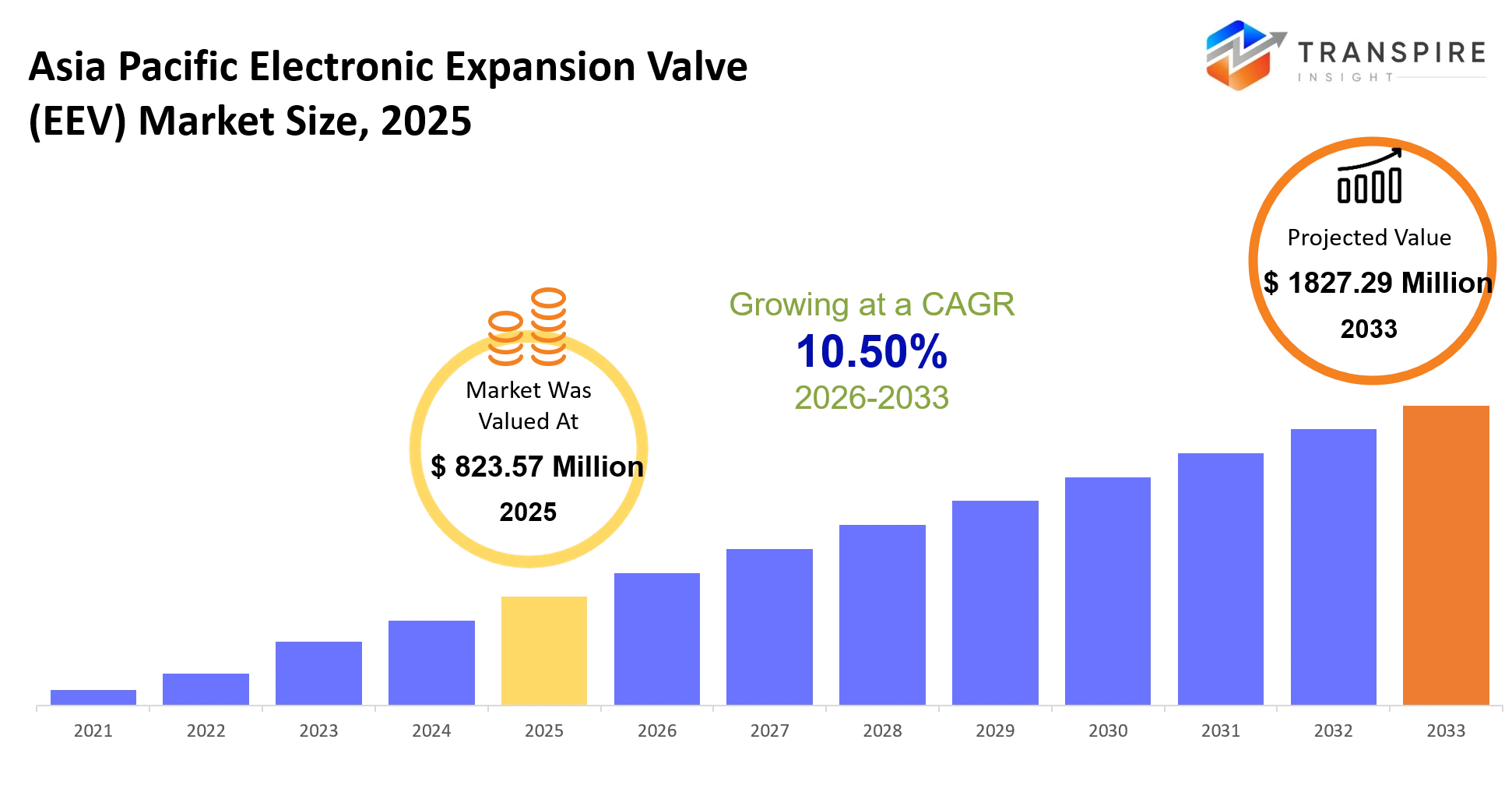
- Asia Pacific Electronic Expansion Valve (EEV) Market Size 2025: USD 823.57 Million
- Asia Pacific Electronic Expansion Valve (EEV) Market Size 2033: USD 1827.29 Million
- Asia Pacific Electronic Expansion Valve (EEV) Market CAGR: 10.50%
- Asia Pacific Electronic Expansion Valve (EEV) Market Segments: By Type (Stepper Motor EEV, Pulse Width Modulation EEV, Thermostatic EEV, Others); By Application (HVAC Systems, Refrigeration Systems, Automotive AC Systems, Heat Pumps, Others); By End User (Commercial Buildings, Industrial Facilities, Automotive Industry, Others)
To learn more about this report,  Download Free Sample Report
Asia Pacific Electronic Expansion Valve (EEV) Market Summary
The Asia Pacific Electronic Expansion Valve (EEV) Market was valued at USD 823.57 Millionin 2025. It is forecast to reach USD 1827.29 Million by 2033. That is a CAGR of 10.50% over the period.
Electronic expansion valves, sorta became a critical control part in modern air conditioning, refrigeration heat pump, and cold chain setups. They basically regulate refrigerant flow with a much finer degree of precision than typical mechanical valves, which is why they are seen as so important in practice. The real value shows up in better energy efficiency, a more steady cooling behavior and also in helping the equipment comply with tougher efficiency rules, across residential buildings,commercial sites, and industrial plants. Over the last five years, the market momentum has moved away from conventional thermostatic expansion valves, and toward electronically controlled ones, mostly because inverter driven HVAC units and variable speed compressors have turned into the norm in Asia Pacific.
A big reason for this shift was regional refrigerant transition policies plus stricter energy efficiency regulations that basically nudged manufacturers toward high performance thermal management solutions. Then there were supply chain disruptions during the pandemic,which made OEMs revisit system layouts, aiming for higher efficiency and more digital style control. Now as governments keep tightening efficiency targets and building operators want to cut electricity costs, manufacturers are embedding EEVs into the next generation HVAC and refrigeration platforms. This change is lifting installation volumes, raising the component value for each system, and opening up fresh revenue avenues across residential cooling, commercial refrigeration, data centers, and even electric vehicle thermal management,where control has to be more responsive.
Key Market Insights
- Asia Pacific Electronic Expansion Valve (EEV) Market is still, kind of, mostly led by East Asia, holding close to 48% market share in 2025, thanks to big scale HVAC manufacturing capacity.
- China stays in the lead for regional output, it supplies over 55% of the electronic expansion valve components used across Asia Pacific refrigeration and cooling equipment—so yeah, that pipeline is pretty concentrated.
- By 2025, residential inverter air conditioners were responsible for more than 35% of the Asia Pacific EEV Market demand, largely because efficiency standards got stricter and nobody can really ignore them.
- From 2026 up to 2033, heat pump applications showed up as the fastest-growing segment, as low-GWP refrigerant uptake started accelerating in regional markets.
- On the commercial side, commercial refrigeration held a strong portion, exceeding 28% in 2025, supported by supermarket upgrades and cold-chain infrastructure spending.
- Meanwhile, data center cooling systems pushed higher EEV integration by more than 20% since 2022, because operators want tighter precision thermal management, not just “good enough”.
- For the product mix, electronic stepper-motor valve technology dominates, mainly because it provides better refrigerant control accuracy than mechanical alternatives.
- Electric vehicle thermal management systems are also one of the quickest moving opportunity areas, especially across China, South Korea, and Japan.
- Manufacturers are increasingly rolling out AI-enabled controllers and digital monitoring platforms, to fine tune refrigerant optimization and cut down system energy consumption.
- Companies such as Danfoss, Sanhua, Emerson, Carel Industries, and Mitsubishi Electric are expanding via product innovation, regional manufacturing investments, plus refrigerant-compatible advanced solutions.
What are the Key Drivers, Restraints, and Opportunities in the Asia Pacific Electronic Expansion Valve (EEV) Market?
The most powerful push behind market growth is sort of the fast rollout of inverter-based air conditioning, refrigeration, and heat pump units across Asia Pacific. In China, Japan, South Korea, and India energy efficiency rules were brought in, and that has basically pushed manufacturers to boost cooling output while also cutting electricity use. Electronic expansion valves let OEMs handle refrigerant in a more controlled way and that helps them meet efficiency targets that mechanical valves can’t really match anymore. Since premium and mid range HVAC systems keep moving toward variable-speed compressors, the install rate for EEVs keeps going up, and that in turn lifts component revenue through most of the supply chain.
Still, the main drag is the higher total system price plus the added technical complexity tied to electronic control setups. EEVs aren’t just “drop in” parts, they need sensors, controllers, software integration, and careful calibration during manufacturing and also during servicing. In practice this is kinda structural, because several emerging markets still don’t have enough strong service coverage and trained maintenance teams. So adoption tends to be slower in price sensitive commercial and residential groups especially outside the biggest city hubs.
At the same time, there’s a real opportunity forming around electric vehicle thermal management. Battery health depends a lot on accurate temperature control, which then creates demand for improved refrigerant flow regulation. China’s electric vehicle production environment plus rising funding into battery cooling technologies is making conditions easier for niche EEV developers. Firms that can build compact, high response valves that fit EV platforms are likely to tap into a revenue stream that keeps expanding through the next ten years.
What Has the Impact of Artificial Intelligence Been on the Asia Pacific Electronic Expansion Valve (EEV) Market?
Artificial intelligence is getting worked into advanced HVAC, refrigeration, and thermal management systems more and more, the ones that lean on electronic expansion valves for refrigerant control. In today’s control platforms, AI driven algorithms keep looking at compressor speed, evaporator conditions, ambient temperature, and refrigerant pressure. Instead of just sticking with fixed parameters all the time, these setups automatically shift valve positioning, in real time, trying to squeeze better cooling efficiency and keep superheat steady, like it’s supposed to be.
On top of that, machine learning models are making predictive maintenance feel a lot less guessy. Facility operators gather sensor data from valves, compressors, and refrigeration loops, then look for odd operating patterns ahead of time, before a real failure shows up. In commercial refrigeration, predictive analytics can cut down on surprise downtime while also boosting overall system availability. Data center teams and industrial cooling operators have mentioned measurable energy reductions, thanks to AI assisted thermal tuning plus flexible refrigerant control approaches.
There are also advanced digital monitoring platforms that help with remote diagnostics, performance comparisons, and automated fault detection across a bunch of spread out cooling assets. This all tends to support higher uptime, lowers maintenance expenses, and helps with meeting energy efficiency obligations, even when audits get picky.
Still, AI adoption isn’t fully free or easy, it’s basically limited by integration costs and by messy inconsistent operating data. A lot of older HVAC and refrigeration systems don’t have enough sensors, the connectivity support, or the historical performance records needed to train trustworthy machine learning models.
Key Market Trends
- Since 2021, inverter air conditioner manufacturers have expanded the integration of EEVs in this kinda, energy-efficiency way as regulations tightened across China, Japan,South Korea, and India.
- Low-GWP refrigerants, like R32, R290, and CO2 have pushed redesign of valve layouts and refrigerant stewardship systems, faster than before.
- Commercial refrigeration operators also put more money into electronic control technologies after supermarket cold-chain modernization rolled out across Asia, more and more.
- In the meantime, data center cooling deployments using smart refrigerant controls grew by more than 20% from 2022 to 2025.
- EEV-equipped heat pumps then started getting adopted more aggressively, especially as governments launched incentives that back electrified heating and cooling setups.
- OEMs increasingly mix EEVs with AI-based controllers, aiming for better superheat precision, and also less compressor energy burn.
- Chinese component manufacturers meanwhile expanded output capacity between 2023 and 2025, mostly to satisfy these supply-chain localization constraints.
- Automotive manufacturers started weaving advanced thermal management valves into electric vehicle battery cooling circuits.
- Meanwhile, premium HVAC brands moved away from mechanical expansion devices toward electronically controlled platforms,so they could reach higher seasonal efficiency scores.
- Lastly, strategic partnerships between valve manufacturers and HVAC equipment producers seemed to compress product development timelines and also speed up commercialization of next-generation cooling technologies.
Asia Pacific Electronic Expansion Valve (EEV) Market Segmentation
By Type
Stepper Motor EEV kind of holds a pretty solid share in the market, because precise refrigerant flow control really helps with higher system efficiency and keeps temperature behavior more stable across current cooling equipment. The strong compatibility with inverter driven systems has also made it easier, you know, for people to use it in both commercial and residential installations. Plus the accurate adjustment features can improve equipment performance overall while trimming those unnecessary energy losses.
Pulse Width Modulation EEV keeps getting more attention, mainly because the control method is simpler and it works well with compact cooling systems. Thermostatic EEV still stays relevant too, especially in places where cost concerns and everyday operational simplicity are the big purchasing points. Other options also exist, like specialized valve technologies aimed at niche operating conditions and advanced thermal management needs. This means there are extra opportunities for product development and also for expanding where it can be used.
By Application
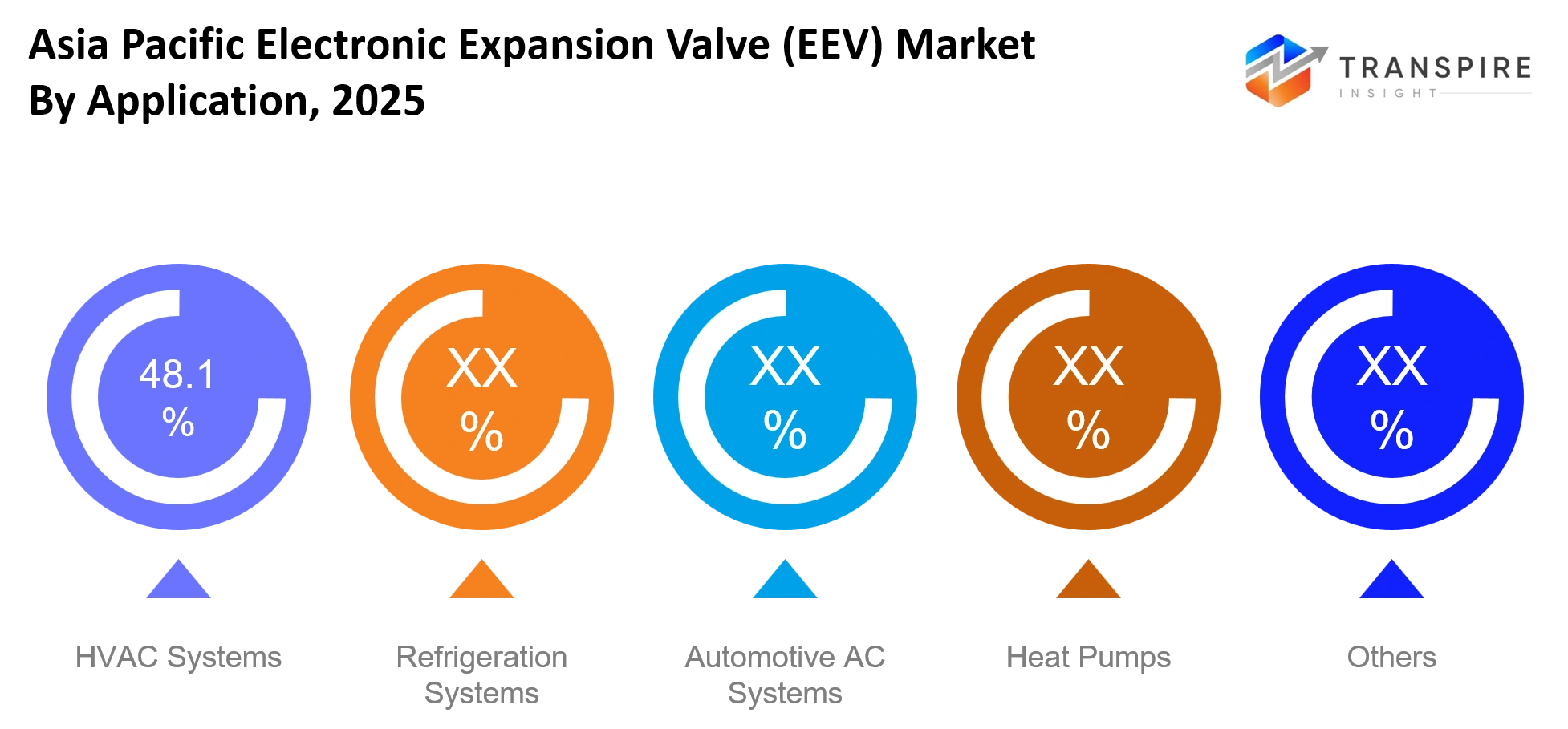
HVAC Systems basically show up as the biggest application area, because efficient refrigerant regulation sort of directly impacts cooling performance,energy savings,and indoor comfort in a very practical way. The ongoing growth in advanced air conditioning systems across both commercial and residential spaces continues to back a steady adoption trend. Also, precise flow control helps manufacturers meet tighter efficiency standards in different regional markets, pretty consistently.
Refrigeration Systems make up a large share of overall demand, since temperature consistency is required for food storage, pharmaceutical preservation, and cold chain operations. Automotive AC Systems keep expanding too, mainly because vehicle makers are trying to raise passenger comfort, while also improving thermal efficiency at the same time. Heat Pumps are drawing more and more investment, as accurate refrigerant management enables efficient heating and cooling performance, even when conditions change. The Others category, meanwhile, covers emerging thermal management applications across specialized industries, kind of where new use cases show up first.
To learn more about this report, Download Free Sample Report
By End User
Commercial Buildings take up a big share, mostly because office complexes, shopping centers, hotels, healthcare facilities and educational institutions all need an efficient climate control setup. In practice, building owners are really leaning toward operational efficiency, and they want long-term energy cost management too, not just short term comfort. So, investments in advanced cooling infrastructure keep moving forward, which keeps demand strong across this part of the market.
Industrial Facilities are also a major end user category, mainly because manufacturing, processing, storage, and production environments still require reliable temperature control. The Automotive Industry is still pushing market opportunities higher, as vehicle production expands, and as more advanced thermal management technologies are used. Then there are other segments, like data centers, logistics facilities, research centers, and niche infrastructure projects, which need very precise cooling and refrigeration performance, for uptime and stability.
What are the Key Use Cases Driving the Asia Pacific Electronic Expansion Valve (EEV) Market?
The biggest chunk of demand comes from residential and business inverter air conditioning systems. A lot of manufacturers rely on electronic expansion valves to regulate the refrigerant flow in a more pinpoint manner, and this helps systems reach better seasonal energy-efficiency scores and keep cooling performance steady even when the load keeps changing, sorta.
Commercial refrigeration and cold-chain logistics show up as a key secondary use case. Think supermarkets, food processing sites, chilled warehouses, and even operators for pharmaceutical storage—they are progressively rolling out refrigeration setups with EEVs to hold a tighter temperature band while also cutting down on electricity use. At the same time, heat pump setups are generating new appetite across commercial buildings plus industrial plants.
There are also newer use cases like electric vehicle battery thermal management, and cooling support for data centers. Those areas need very responsive refrigerant regulation so they can handle constantly shifting heat loads. Even if these are still smaller compared to classic HVAC use, both segments are likely to grow into meaningful drivers for future market expansion as electrification keeps moving forward and digital infrastructure spending ramps up across Asia Pacific.
|
Report Metrics |
Details |
|
Market size value in 2025 |
USD 823.57 Million |
|
Market size value in 2026 |
USD 908.36 Million |
|
Revenue forecast in 2033 |
USD 1827.29 Million |
|
Growth rate |
CAGR of 10.50%from 2026 to 2033 |
|
Base year |
2025 |
|
Historical data |
2021 - 2024 |
|
Forecast period |
2026 - 2033 |
|
Report coverage |
Revenue forecast, competitive landscape, growth factors, and trends |
|
Regional scope |
Asia Pacific (India, China, Japan, Australia, South Korea, Rest of Asia Pacific) |
|
Key company profiled |
Danfoss, Sanhua, Emerson, Carel Industries, Schneider Electric, Honeywell, Parker Hannifin, Fujikoki, Mitsubishi Electric, Daikin, LG Electronics, Panasonic, Johnson Controls, Carrier, Hitachi |
|
Customization scope |
Free report customization (country, regional & segment scope). Avail customized purchase options to meet your exact research needs. |
|
Report Segmentation |
By Type (Stepper Motor EEV, Pulse Width Modulation EEV, Thermostatic EEV, Others); By Application (HVAC Systems, Refrigeration Systems, Automotive AC Systems, Heat Pumps, Others); By End User (Commercial Buildings, Industrial Facilities, Automotive Industry, Others) |
Which Regions are Driving the Asia Pacific Electronic Expansion Valve (EEV) Market Growth?
East Asia is still the main regional market, sort of led by China, Japan, and South Korea. China, really stands out because it’s the world’s largest HVAC manufacturing hub, plus it’s a big maker of refrigeration components. Japan, meanwhile, leans into more advanced engineering skills and it was among the first to adopt inverter-driven cooling technologies early on. There are also solid domestic manufacturing setups, established supplier links, and pretty strict efficiency rules, all of which keep the region’s lead pretty secure.
Southeast Asia comes in as the second-largest contributor, and it grows in a different way. It’s less about manufacturing concentration and more about what’s happening on the ground in each country. Thailand, Vietnam, Malaysia, and Indonesia are often mentioned here because they get traction from expanding commercial infrastructure, tourism spending, and food cold chain development. Even so, demand doesn’t swing too much, since cooling systems are basically required for commercial work during most of the year. Retail refrigeration and industrial cooling systems keep seeing investments, and that steady spending helps produce dependable market income.
South Asia is expected to build the strongest growth momentum through 2033. In India in particular, air-conditioning penetration is rising, urban development is moving fast, and building-efficiency standards are getting tighter. That combo has pushed more customers toward advanced HVAC solutions. On top of that, domestic manufacturing incentives plus investments in cold-storage infrastructure make the outlook even better. So, this trend also opens doors for component suppliers, system integrators, and investors who want exposure to cooling plus refrigeration markets that are developing quickly.
Who are the Key Players in the Asia Pacific Electronic Expansion Valve (EEV) Market and How Do They Compete?
Competition in the Asia Pacific EEV market stays kinda moderately concentrated,but at the same time you still see global HVAC component specialists head-to-head with big Asian manufacturers. What really decides where a company sits is tech performance, refrigerant compatibility, manufacturing scale, and of course OEM relationships. Lately, a lot of the rivalry comes down to valve precision,digital control integration, and how well they support low-GWP refrigerants, rather than just going for the lowest price.
Danfoss tends to lean into advanced refrigerant management ideas along with high-performance valves aimed at commercial refrigeration, heat pumps, and CO₂ setups. Its newer ETS valve developments, kind of reinforce its footing in natural refrigerant use cases. Sanhua, on the other hand, plays the large-scale manufacturing card, pairs it with solid OEM relationships, and uses a broad product suite to keep a strong presence across residential and commercial cooling equipment. Their approach is basically about being ready for next-generation refrigerants and smarter control technologies, which is not surprising.
Emerson differentiates more through integrated control platforms that bring together sensors, controllers, and valve know-how inside wider HVAC ecosystems. Carel Industries concentrates on energy optimization and intelligent refrigeration control, so their solutions tend to look especially appealing for commercial refrigeration operators. Mitsubishi Electric keeps sharpening its position by tightening the link between EEV technology and high-efficiency inverter HVAC systems, especially across Asia’s more premium residential and commercial segments. Overall, these firms keep expanding through technology upgrades, manufacturing investments, and a mix of strategic collaborations with equipment manufacturers.
Company List
- Danfoss
- Sanhua
- Emerson
- Carel Industries
- Schneider Electric
- Honeywell
- Parker Hannifin
- Fujikoki
- Mitsubishi Electric
- Daikin
- LG Electronics
- Panasonic
- Johnson Controls
- Carrier
- Hitachi
Recent Development News
In March 2026, Danfoss launched the EKE 100 1VK all-in-one superheat control kit integrating an electronic expansion valve, pressure transmitter, and temperature sensor. The solution simplifies HVAC and refrigeration system deployment while improving energy efficiency and accelerating adoption of advanced EEV-based control architectures.http://www.danfoss.com
In September 2025, Sanhua launched the eDual (SECD04) dual electronic expansion valve controller. The new controller enables simultaneous management of two independent EEVs within a single circuit, improving evaporator utilization, thermal control precision, and intelligent HVAC&R system performance.http://www.sanhuaeurope.com
In February 2026, Danfoss introduced the ETS 5T electronic expansion valve for CO₂ transcritical refrigeration applications at EuroShop 2026. The compact high-pressure valve expands Danfoss’ low-GWP refrigeration portfolio and supports the transition toward energy-efficient natural refrigerant systems across commercial cooling markets.http://www.youtube.com
What Strategic Insights Define the Future of the Asia Pacific Electronic Expansion Valve (EEV) Market?
The market is moving toward more or less fully digital refrigerant management systems, where electronic expansion valves basically act like intelligent control nodes rather than just being standalone mechanical bits. This shift is being pushed by tighter efficiency rules, refrigerant changes, and that growing need for precision thermal management in heat pumps, data centers, and electric vehicles. Since cooling systems are getting more software centered, valve manufacturers will need real depth in electronics, sensors, and control logic not only “hardware” alone.
One risk that feels kinda underappreciated has to do with supply-chain concentration in niche semiconductor and controller components. If anything disrupts electronics manufacturing, you can get bottlenecks even when valve production capacity is still there. At the same time, electric vehicle thermal management looks like a major emerging chance, because battery cooling asks for increasingly sophisticated refrigerant control approaches, and that’s where the value might land.
Market participants should consider deeper partnerships with HVAC, heat pump, and EV platform manufacturers early inside the product development phase. Firms that manage to blend advanced valve hardware with intelligent control software will likely be in a stronger spot to capture the next wave of value as thermal management systems become more connected, automated,and performance oriented.
Asia Pacific Electronic Expansion Valve (EEV) Market Report Segmentation
By Type
- Stepper Motor EEV
- Pulse Width Modulation EEV
- Thermostatic EEV
- Others
By Application
- HVAC Systems
- Refrigeration Systems
- Automotive AC Systems
- Heat Pumps
- Others
By End User
- Commercial Buildings
- Industrial Facilities
- Automotive Industry
- Others
Frequently Asked Questions
Find quick answers to common questions.
The expected Asia Pacific Electronic Expansion Valve (EEV) Market size for the market will be USD 1827.29 Million in 2033.
Key segments for the Asia Pacific Electronic Expansion Valve (EEV) Market are By Type (Stepper Motor EEV, Pulse Width Modulation EEV, Thermostatic EEV, Others); By Application (HVAC Systems, Refrigeration Systems, Automotive AC Systems, Heat Pumps, Others); By End User (Commercial Buildings, Industrial Facilities, Automotive Industry, Others)
Major Asia Pacific Electronic Expansion Valve (EEV) Market players are Danfoss, Sanhua, Emerson, Carel Industries, Schneider Electric, Honeywell, Parker Hannifin, Fujikoki, Mitsubishi Electric, Daikin, LG Electronics, Panasonic, Johnson Controls, Carrier, Hitachi
The Asia Pacific Electronic Expansion Valve (EEV) Market size is USD 823.57 Million in 2025.
The Asia Pacific Electronic Expansion Valve (EEV) Market CAGR is 10.50% from 2026 to 2033
- Danfoss
- Sanhua
- Emerson
- Carel Industries
- Schneider Electric
- Honeywell
- Parker Hannifin
- Fujikoki
- Mitsubishi Electric
- Daikin
- LG Electronics
- Panasonic
- Johnson Controls
- Carrier
- Hitachi
About the Authors

Avinash Kumar
I’m Avinash Kumar, a Senior Research Analyst at Transpire Insight, with expertise in the Electronics and Semiconductor and Energy & Power industry. My work focuses on analyzing emerging technologies, market trends, industry developments, and innovation across these sectors. I specialize in transforming complex technical and market insights into clear, research-backed content that helps professionals, businesses, and decision-makers stay informed. Through continuous industry research and data-driven analysis, I strive to deliver accurate, reliable, and practical perspectives on the latest advancements shaping the semiconductor and energy landscape.

Chakradhar Khansole
Chakradhar serves as the Research Director at Transpire Insight, bringing over 8 years of experience in technology, innovation, and strategic market intelligence. He specializes in transforming complex market data into actionable business insights that enable organizations to make informed, growth-oriented decisions. Recognized for his strategic vision and analytical expertise, Chakradhar leads high-impact research initiatives, delivering comprehensive market assessments, competitive intelligence, and forward-looking industry analysis.
Recently Published Reports
-
Apr 2026
Fiber Optic Faceplates Market
Fiber Optic Faceplates Market Size, Share & Analysis Report By Type (< 300 mm2, 300-350 mm2, and > 350 mm2, By Application (Night Vision, Holographic Imaging, Medical, and Others), and Geography (North America, Europe, Asia-Pacific, Middle East and Africa, South and Central America), 2021 - 2031
-
Apr 2026
High Temperature Superconductors Market
High Temperature Superconductors Market Size, Share & Analysis Report By Type (1G HTS, and 2G HTS), By Application (Power Cable, Fault Current Limiter, and Transformer), and Geography (North America, Europe, Asia-Pacific, Middle East and Africa, South and Central America), 2021 - 2031
-
Apr 2026
Industrial Plugs and Socket Market
Industrial Plugs and Socket Market Size, Share & Analysis Report By Type (Industrial Plugs, Industrial Sockets), By Current (Up to 32 A, 32 to 125 A, Above 125 A), By Protection (Dustproof and Splash Proof, Waterproof, Explosion Proof), By End User (Heavy Industries, Oil and Gas, Chemicals and Pharmaceuticals, Power Generation, Others), and Geography (North America, Europe, Asia-Pacific, Middle East and Africa, South and Central America), 2021 - 2031
-
Apr 2026
InGaAs Avalanche Photodiodes Market
InGaAs Avalanche Photodiodes Market Size, Share & Analysis Report By Type (1100 - 1700 nm, and 1000 - 1600 nm), By Application (Missile Warning System, Muzzle Flash Detection, Wafer Defect Inspection, Laser Rangefinders, and Others), and Geography (North America, Europe, Asia-Pacific, Middle East and Africa, South and Central America), 2021 - 2031