
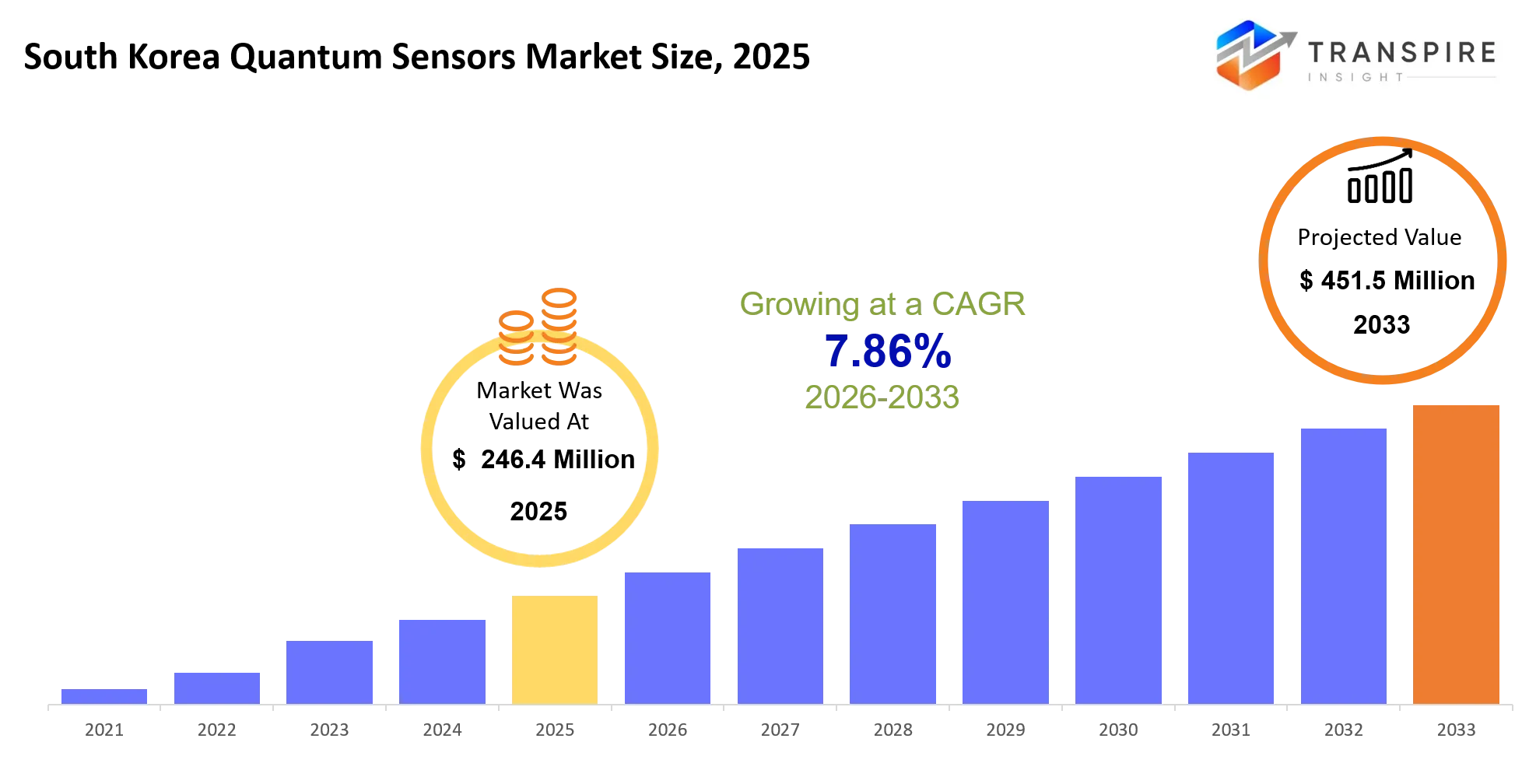
South Korea Quantum Sensors Market Size & Forecast:
- South Korea Quantum Sensors Market Size 2025: USD 246.4 Million
- South Korea Quantum Sensors Market Size 2033: USD 451.5 Million
- South Korea Quantum Sensors Market CAGR: 7.86%
- South Korea Quantum Sensors Market Segments: By Sensor Type (Quantum Magnetic Sensors, Quantum Gravimeters, Quantum Clocks, Quantum Imaging Sensors, Others); By Technology (Cold Atom Technology, NV Diamond Technology, Superconducting Quantum Sensors, Photonic Quantum Sensors, Others); By Application (Defense & Aerospace, Healthcare Diagnostics, Navigation Systems, Oil & Gas Exploration, Others); By End User (Defense Organizations, Research Institutes, Healthcare Industry, Industrial Sector, Others); By Deployment (Portable Quantum Sensors, Fixed Quantum Sensors, Embedded Quantum Sensors, Others)
To learn more about this report,  Download Free Sample Report
South Korea Quantum Sensors Market Summary
The South Korea Quantum Sensors Market was valued at USD 246.4 Million in 2025. It is forecast to reach USD 451.5 Million by 2033. That is a CAGR of 7.86% over the period.
In practice, quantum sensors in South Korea are being used for detect super small changes in gravity, magnetic fields, and time signals that older sensors often just miss, so the navigation can become more precise, especially for submarines , and for semiconductor inspection work where accuracy is really critical. Also defense surveillance is getting stronger in contested maritime areas, and it’s not just a lab story anymore. The market has actually shifted a bit over the last 3–5 years, since quantum technology kind of moved from laboratory prototypes to early industrial rollouts, mostly in defense and advanced manufacturing.
One big structural change is the integration of quantum sensing with AI- based signal processing, which basically means the old isolated hardware experiments are being swapped for software enhanced sensing platforms. There was also a clear push factor, geopolitics in the Indo-Pacific becoming more tense, and that made defense agencies spend more on GPS-denied navigation plus stealth detection systems.
So procurement has moved from short experimental budgets into long term modernization programs, and that helps commercialization pathways a lot. It also makes it easier for private companies to join, particularly in industrial metrology and semiconductor applications , where quantum sensing can actually matter day to day.
Key Market Insights
- South Korea Quantum Sensors Market value touched about USD 246.4 million in 2025, its pushed mainly by defense needs and semiconductor precision demand.
- In the meantime, semiconductor manufacturing makes up more than 30% usage share, mostly because ultra-precise defect detection is required, across the fabrication lines.
- Defense side almost sits at 35% share, and this is supported by GPS-denied navigation efforts plus submarine detection modernization programs, that are rolling out step by step.
- Industrial metrology is the fastest-growing slice, with adoption rising in nanotechnology and advanced materials testing systems, even at smaller scale.
- More recently South Korea Quantum Sensors Market is getting shaped by quantum-AI integration for real-time signal enhancement and some error correction, too.
- Government R&D funding also weighs in heavily, contributing over 25% toward early-stage commercialization pipelines across photonic and atomic sensor technologies.
- On the supply chain front, Asia-Pacific localization is slowly reducing dependency on imported quantum components from Europe and the US.
- Major players such as IBM and Honeywell are expanding tie ups with Korean defense contractors, specifically for sensing modules.
- Samsung Electronics is putting money into quantum-enhanced chip inspection and AI-integrated sensor calibration systems, along with related tooling.
- Meanwhile startups like AOSense and Infleqtion are speeding up commercialization of atomic interferometry platforms, in practice they are moving faster than before.
What are the Key Drivers, Restraints, and Opportunities in the South Korea Quantum Sensors Market?
The main engine behind the South Korea Quantum Sensors Market is basically the fast modernization of defense alongside the semiconductor backbone, where ultra-precise measurement is kind of a must for navigation, targeting systems, and chip fabrication accuracy. This momentum took off when GPS vulnerability worries in contested maritime areas made it obvious that satellite-free quantum inertial navigation systems are needed. So, procurement budgets started to drift toward longer-horizon quantum R&D and deployment programs, which then boosts enterprise as well as government take-up, directly.
The major limiter is that system integration ends up being very costly, plus quantum hardware scaling is not as straightforward as people hope. Quantum sensors tend to call for cryogenic setups, consistently stable calibration conditions, and specialized materials. Because of that, mass production turns out hard, and overall expenses stay high. That structural hurdle can slow commercialization, since even strong prototypes still struggle to become cost-effective for regular industrial use, and this postpones revenue timing for manufacturers, while also restricting broader mid-tier enterprise adoption.
One important opening is in semiconductor inspection and precision manufacturing clusters across South Korea, especially around the newest fabrication hubs. As chip geometry keeps shrinking to sub-nanometer type features, classical sensors often cannot hold the precision floor that production requires. That, in turn, forms a clear pull for quantum-enhanced metrology tools able to catch atomic-scale deviations. Firms that embed quantum sensing into semiconductor QA workflows can potentially secure early large contracts, especially by partnering with major players inside the fabrication ecosystem.
What Has the Impact of Artificial Intelligence Been on the South Korea Quantum Sensors Market?
Artificial intelligence is becoming a critical layer across South Korea’s quantum sensing ecosystem, turning raw quantum signal outputs into more actionable industrial and defense intelligence. For navigation and marine defense systems, AI is often applied to help steady quantum inertial sensor readings, which lowers drift-related mistakes in GPS-denied settings like submarines and also autonomous naval vessels. Because of that, some pilot deployments are reporting better location accuracy , since the cumulative navigation error stays smaller during extended missions.
On the semiconductor side and in industrial monitoring, machine learning models take the quantum sensor data and then try to spot microscopic defects while also forecasting equipment misalignment before production failures start. Those predictive abilities are gradually raising uptime in advanced fabrication lines, mainly by allowing earlier intervention and cutting down on the unplanned downtime cycles. There are also AI-assisted calibration systems that improve energy efficiency and limit day to day operational variability in quantum sensing units.
Still, uptake is being slowed down by a lack of real-world training data. Quantum sensor outputs tend to be extremely sensitive, plus they are not standardized in a consistent way, so it becomes hard to assemble big, labeled datasets for sturdy AI model training. And in maritime and defense environments, connection can be intermittent, which limits real-time model refreshes, so a lot of systems must lean on edge-based processing. That shift then adds more hardware complexity and cost.
Key Market Trends
- Quantum sensing sort of moved from early defense pilot efforts in 2021 , to faster early industrial rollout by 2025 across South Korea, a kind of steady escalation.
- Defense procurement programs then pushed quantum navigation budgets up by more than 20% between 2023 and 2025.
- Semiconductor fabs started folding quantum metrology tools into pilot production lines, to catch sub nanometer defects since 2024.
- AI quantum hybrid systems in the meantime cut sensor drift related mistakes by close to 15% during controlled navigation trial runs.
- Supply chains for the South Korea Quantum Sensors Market are localizing , partly because of geopolitical dependence around semiconductors.
- Also the appetite for GPS independent navigation grew sharply after Indo Pacific maritime security pressures rose during 2022–2024.
- Industrial metrology take up widened as the precision demands for nanomanufacturing became more strict across electronics output.
- Toshiba and Hitachi also leaned into more R&D collaboration , on atomic scale sensing platforms.
- Then quantum hardware miniaturization trends are allowing portable sensing units for field defense use cases.
- Lastly public private partnerships increased quantum research funding , channeling it through Korean national labs and private companies.
South Korea Quantum Sensors Market Segmentation
By Sensor Type
Quantum Magnetic Sensors kinda hold the lead , mainly because they are already strongly adopted in defense navigation systems, semiconductor inspection and precision measurement stuff where ultra-sensitive field detection really has to happen. They’ve also been used a lot in security and aerospace programs , so their dominance keeps getting reinforced because magnetic anomaly detection offers immediate practical value in GPS-denied conditions.
Quantum Gravimeters are a smaller slice but still kinda strategically relevant, backed by geological surveying and infrastructure monitoring use cases. Quantum Clocks keep a steady appetite in navigation synchronization and telecom timing setups, especially now that accuracy standards are tightening up. Quantum Imaging Sensors are still more of an emerging category , though they’re getting more attention in medical diagnostics and advanced materials inspection.
In the near run, Quantum Magnetic Sensors will keep anchoring commercial adoption as defense modernization ramps up and industrial sensing accuracy requirements continue climbing. Quantum Gravimeters should see gradual growth as infrastructure resilience projects roll forward and subsurface mapping needs rise. Quantum Clocks are expected to benefit from telecom expansion and next-generation navigation systems that need ultra-precise timing. Quantum Imaging Sensors will likely grow faster across the forecast , as healthcare diagnostics and industrial inspection technologies start adopting higher-resolution quantum-based imaging systems. Product developers will focus on miniaturization and multi-sensor integration, to unlock those cross-application scenarios that aren’t as obvious at first glance.
By Technology
Cold Atom Technology still holds the dominant position, mostly because it s more mature in high-precision inertial sensing, and it fits navigation as well as defense-grade uses in a really direct way. The adoption picture is also boosted by its ability to keep ultra-low drift results even when the operating surroundings get messy. NV Diamond Technology keeps taking a growing slice, driven by the increasing appetite for compact quantum sensing solutions that work at room temperature. These are used for magnetic field detection, plus biomedical imaging, where people want something practical and close to the patient.
Superconducting Quantum Sensors are more specialized , so they stay mainly in research and high-end measurement setups. In practice they serve the extreme sensitivity crowd, but only where the ecosystem can support them. Photonic Quantum Sensors are not fully everywhere yet , but they are showing real momentum. They seem especially promising inside communication-integrated sensing platforms, because the optical side is already kind of there, almost naturally.
Cold Atom Technology will keep leading the high-end deployments, since defense and aerospace systems tend to value stability and accuracy more than cost efficiency. NV Diamond Technology is likely to grow faster, thanks to its scalability angle and the fact it plays well with portable sensing devices. Superconducting Quantum Sensors should stay limited to niche scientific and industrial applications, mostly because of cooling needs and overall system complexity. Photonic Quantum Sensors are expected to ramp up faster as the integration with optical communication infrastructure keeps improving. In the end, technology rivalry will keep shifting toward scalability, better energy efficiency and field deployment readiness, not just pure lab performance.
By Application
Defense and Aerospace kind of keeps the dominant position ,mostly because there’s strong investment in GPS independent navigation systems, submarine detection, and those advanced surveillance platforms. The high value procurement programs and long development cycles really help sustain the revenue concentration in that segment, so it stays there.
Healthcare Diagnostics is also gaining momentum, with a growing share tied to high resolution imaging and biomagnetic measurement applications. Navigation Systems meanwhile is a critical adoption space, since maritime and autonomous mobility systems need ultra precise positioning, not just “good enough”. Oil and Gas Exploration is smaller but still stable, more like a steady portion that focuses on subsurface mapping and resource detection, rather than huge swings.
Going forward, Defense and Aerospace will keep driving market expansion, especially with geopolitical uncertainty hanging around and military modernization programs ramping up, which intensifies the need for quantum enabled sensing. Healthcare Diagnostics should keep growing at a steady pace as non-invasive imaging and early disease detection improve their accuracy requirements over time. Navigation Systems are likely to see faster uptake in autonomous shipping and aviation uses where resilience against signal disruption matters. Oil and Gas Exploration will remain more niche, particularly for deep sea and complex geological environments.
Overall, application diversification should reduce the dependence on defense only demand cycles and broaden commercial viability, so the mix becomes less lopsided, and that’s probably why this can keep going.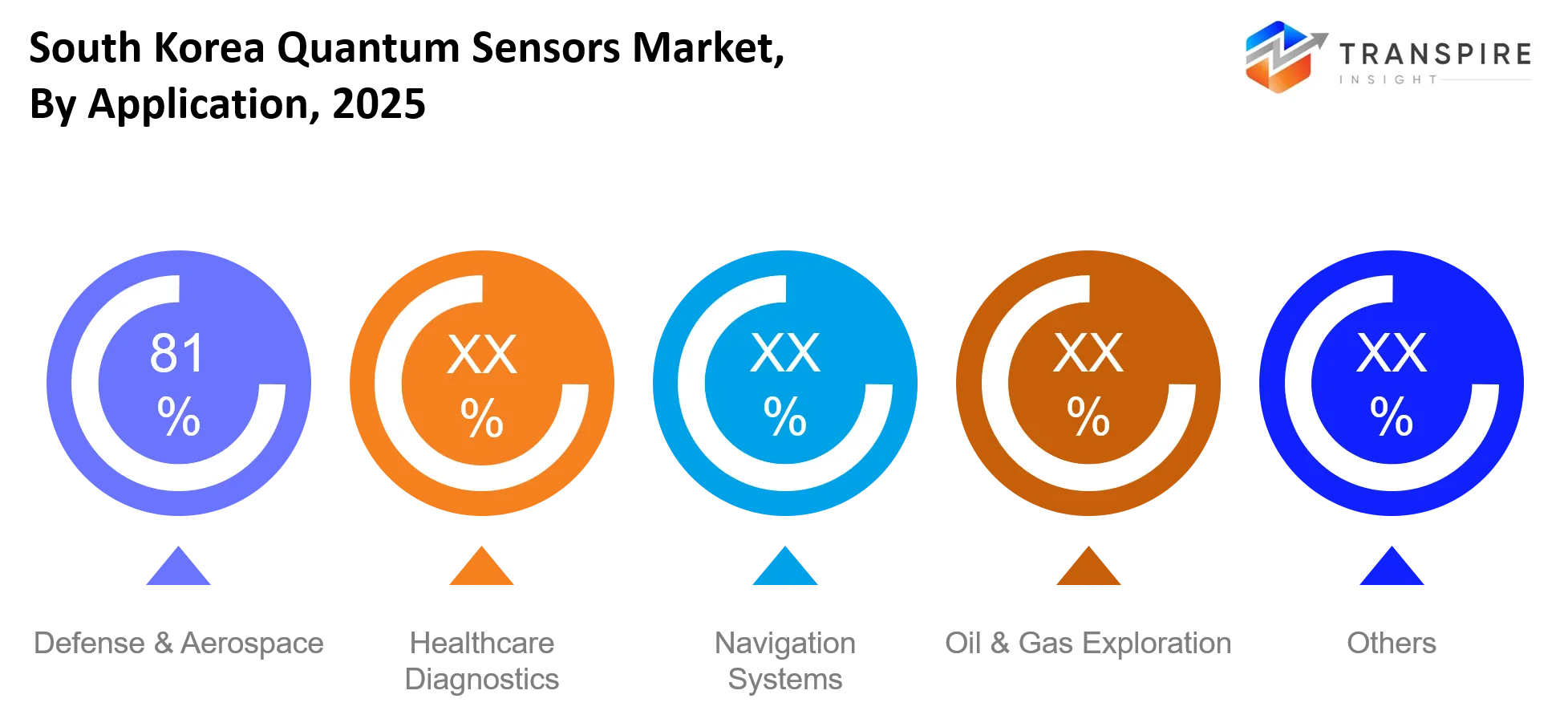
To learn more about this report, Download Free Sample Report
By End User
Defense Organizations end up holding the dominant position, largely because they keep on procuring advanced sensing systems for navigation, surveillance, and electronic warfare support in a pretty sustained way. Plus, strong government-backed modernization efforts, keep the money steady, so there’s an early move toward new technologies that sticks. Research Institutes in particular take up a big portion of the landscape, they basically serve as the core innovation pipeline—prototype development and system validation are their bread and butter, even if the process feels a bit fragmented sometimes. Healthcare Industry adoption is also getting higher, since quantum sensing is improving diagnostic precision and boosting imaging sensitivity. Meanwhile the Industrial Sector is seeing broader applications, especially in manufacturing quality control, along with precision instrumentation where fine measurements actually matter.
Defense Organizations will keep dominating demand, because national security requirements keep pushing steady investment into next-generation sensing systems. Research Institutes will stay central to innovation too, acting as the bridge between what works in the lab and what eventually lands in industrial deployment. Healthcare Industry adoption should speed up as clinical validation for quantum imaging technologies becomes more robust. Industrial Sector usage will likely grow gradually, as manufacturing precision standards tighten across these advanced production environments. Overall, end-user diversification should strengthen ecosystem resilience too, and in practice it reduces how much everything depends on defense procurement cycles.
By Deployment
Portable quantum sensors are holding the lead, mostly because defense field operations keep pushing demand , alongside autonomous systems and mobile industrial inspection tasks. Their compact architecture and that sort of operational flexibility is what makes them a true adoption magnet in messy real world settings, where you can’t always plan everything. Fixed quantum sensors still keep a solid share in lab use, industrial monitoring, and infrastructure tied deployments, mainly where stability and nonstop operation really matter. Embedded quantum sensors are turning into a faster moving segment too, because they get baked right into navigation systems, robotics, and aerospace platforms that need real time sensing. The other deployment models stay kind of experimental, and they tend to be very specific to certain use cases.
Portable quantum sensors should keep growing, as more field based defense and industrial projects expand and they’ll keep needing mobility plus quick, rapid deployment capability. Fixed quantum sensors will likely keep steady pull in high precision environments, like research facilities and industrial monitoring setups that can’t tolerate much drift. Embedded quantum sensors are forecast to grow the fastest, driven by deeper integration into autonomous platforms and smarter infrastructure. Deployment innovation will probably concentrate on shrinking the system footprint, improving energy efficiency, and boosting real time processing performance. Competitive advantage will, increasingly, hinge on how easily the technology integrates across several deployment environments, not just one.
What are the Key Use Cases Driving the South Korea Quantum Sensors Market?
The core use case is defense navigation and submarine positioning , where quantum inertial sensors replace GPS reliance and make sure tracking stays uninterrupted even when conditions get rough at sea. That happens because the normal satellite based systems are pretty exposed, like they can be jammed or just lose signal.
Other areas are getting attention too, especially semiconductor manufacturing and precision industrial inspection . In those settings quantum sensors can pick up atomic-level variations in chip fabrication and in the underlying material structures. The demand is tightly connected to advanced electronics manufacturers and fabrication plants, the kind that want ultra high accuracy for quality control, not just “good enough”.
There are also emerging use cases, like autonomous maritime systems and deep-space navigation research . These are still early on, but the potential looks strong , especially as South Korea puts money into next-generation naval automation and space exploration technologies that need ultra-stable sensing, beyond what conventional systems can handle.
|
Report Metrics |
Details |
|
Market size value in 2025 |
USD 246.4 Million |
|
Market size value in 2026 |
USD 265.9 Million |
|
Revenue forecast in 2033 |
USD 451.5 Million |
|
Growth rate |
CAGR of 7.86% from 2026 to 2033 |
|
Base year |
2025 |
|
Historical data |
2021 - 2024 |
|
Forecast period |
2026 - 2033 |
|
Report coverage |
Revenue forecast, competitive landscape, growth factors, and trends |
|
Regional scope |
South Korea |
|
Key company profiled |
Samsung Electronics, IBM, Honeywell, Thales Group, Lockheed Martin, Bosch, Qnami, Muquans, AOSense, Infleqtion, Quantum Diamond Technologies, Teledyne FLIR, Northrop Grumman, Toshiba, Hitachi . |
|
Customization scope |
Free report customization (country, regional & segment scope). Avail customized purchase options to meet your exact research needs. |
|
Report Segmentation |
By Sensor Type (Quantum Magnetic Sensors, Quantum Gravimeters, Quantum Clocks, Quantum Imaging Sensors, Others); By Technology (Cold Atom Technology, NV Diamond Technology, Superconducting Quantum Sensors, Photonic Quantum Sensors, Others); By Application (Defense & Aerospace, Healthcare Diagnostics, Navigation Systems, Oil & Gas Exploration, Others); By End User (Defense Organizations, Research Institutes, Healthcare Industry, Industrial Sector, Others); By Deployment (Portable Quantum Sensors, Fixed Quantum Sensors, Embedded Quantum Sensors, Others) |
Which Regions are Driving the South Korea Quantum Sensors Market Growth?
The Seoul metropolitan region seems to lead the South Korea Quantum Sensors Market, mainly because there’s this tight clustering of defense research institutes, semiconductor headquarters, and several national R&D funding bodies too. You can also see the region doing well thanks to solid government agency and private tech firms working together, more like an ongoing routine. On top of that, there is advanced infrastructure in place, so teams can do rapid prototyping then testing of quantum systems, without too much delay. In practice this kind of whole ecosystem makes Seoul the main commercialization hub, not only “one of” the hubs.
Then, the Gyeonggi and Incheon industrial belt acts like a stable secondary zone. It’s driven by semiconductor fabs and advanced manufacturing clusters, and it’s kind of different from Seoul because it leans toward production stability and long-term industrial integration. Instead of chasing breakthrough experiments, companies there tend to focus on gradual adoption of quantum sensing in quality control systems. That means the demand stays consistent, but it’s usually less experimental, so the growth pattern is steadier rather than flashy.
Lastly, the fastest-growing area looks like Busan, plus the nearby coastal industrial zones. This growth is tied to naval modernization and port automation investments. Maritime security upgrades, plus smart port initiatives, are pushing stronger demand for precision navigation systems. Because of that, defense contractors and sensor integrators are getting pulled toward coastal deployment sites. Over the 2026–2033 period, this region should become a major field-testing ground for maritime quantum technologies, in a more visible way than before.
Who are the Key Players in the South Korea Quantum Sensors Market and How Do They Compete?
Competition in the South Korea Quantum Sensors market is, sort of, moderately consolidated on the higher-technology end, where big defense and semiconductor players basically take the lead in early deployment programs. Getting in is not easy— barriers are high because R&D is capital-intensive, manufacturing has to be extremely precise, and defense procurement standards are strict. So, the incumbents that already have quantum research skills and solid government ties keep a structural edge, while the newer companies tend to chase more niche innovation directions like atomic interferometry, and diamond based sensing.
Samsung Electronics competes by weaving quantum sensing into semiconductor inspection, plus AI-enabled chip calibration systems, and it also leans on its manufacturing strength across Korea’s electronics ecosystem. IBM leans into quantum computing–sensor convergence, offering algorithmic frameworks for signal correction and precision improvement, usually via collaborative research partnerships. Honeywell differentiates with defense-grade inertial navigation systems made for GPS denied settings, aiming at naval and aerospace buyers.
Thales Group, meanwhile, tries to hold and grow its position through secure navigation and defense electronics integration, especially for maritime surveillance systems. At the same time, AOSense and Infleqtion push for specialization in atomic sensor platforms and more commercial quantum inertial systems, scaling through pilot deployments and defense partnerships. Overall, competitive advantage is shifting toward integration ability, not just standalone sensor performance, so it’s kind of the bigger system that wins more often than the single device.
Company List
- Samsung Electronics
- IBM
- Honeywell
- Thales Group
- Lockheed Martin
- Bosch
- Qnami
- Muquans
- AOSense
- Infleqtion
- Quantum Diamond Technologies
- Teledyne FLIR
- Northrop Grumman
- Toshiba
- Hitachi
Recent Development News
In April 2026, Global Affairs Canada announced a quantum technology partnering delegation with South Korea to promote joint development in quantum sensors, computing, and communications. The program focuses on co-development between SMEs and Korean research institutions.
http://www.tradecommissioner.gc.ca
In March 2026, South Korean quantum company SDT presented its real-time quantum sensing and computing platform for advanced battery and materials analysis at InterBattery 2026. The launch highlights growing industrial adoption of quantum measurement systems in energy and manufacturing sectors.
http://quantuminkorea.org
In January 2024, IBM expanded its partnership with Korea Quantum Computing (KQC) to strengthen quantum computing access and ecosystem development in South Korea, supporting future quantum sensing and hybrid AI-quantum applications.
http://newsroom.ibm.com
What Strategic Insights Define the Future of the South Korea Quantum Sensors Market?
South Korea's Quantum Sensors Market is kind of structurally moving toward full stack integration, where quantum hardware, AI signal processing, and defence-grade software kinda work together as one unified sensing ecosystem, not like separate pieces. This direction is mostly pushed by national security needs, plus semiconductor precision requirements, both of which ask for measurement accuracy that goes beyond classical systems. There is also a quiet risk though, which is when the know-how gets overly concentrated with just a few global suppliers, and that can expose the supply chain plus tech dependency, especially if export controls start getting tighter. On the other hand, an emerging chance shows up with the commercialization of portable quantum inertial sensors for autonomous maritime vessels and industrial robotics , and especially inside smart port ecosystems. Over the next 5–7 years, the players that can lower system cost and still make large scale rollout realistic will capture most of the value. A main strategic recommendation is to lean into hybrid AI quantum architectures, since that reduces calibration headaches, while also supporting quicker industrial adoption across both defense and semiconductor areas.
South Korea Quantum Sensors Market Report Segmentation
By Sensor Type
- Quantum Magnetic Sensors
- Quantum Gravimeters
- Quantum Clocks
- Quantum Imaging Sensors
- Others
By Technology
- Cold Atom Technology
- NV Diamond Technology
- Superconducting Quantum Sensors
- Photonic Quantum Sensors
- Others
By Application
- Defense & Aerospace
- Healthcare Diagnostics
- Navigation Systems
- Oil & Gas Exploration
- Others
By End User
- Defense Organizations
- Research Institutes
- Healthcare Industry
- Industrial Sector
- Others
By Deployment
- Portable Quantum Sensors
- Fixed Quantum Sensors
- Embedded Quantum Sensors
- Others
Frequently Asked Questions
Find quick answers to common questions.
The Expected South Korea Quantum Sensors Market size for the Market will be USD 451.5 Million in 2033.
Key Segments for the South Korea Quantum Sensors Market are By Sensor Type (Quantum Magnetic Sensors, Quantum Gravimeters, Quantum Clocks, Quantum Imaging Sensors, Others); By Technology (Cold Atom Technology, NV Diamond Technology, Superconducting Quantum Sensors, Photonic Quantum Sensors, Others); By Application (Defense & Aerospace, Healthcare Diagnostics, Navigation Systems, Oil & Gas Exploration, Others); By End User (Defense Organizations, Research Institutes, Healthcare Industry, Industrial Sector, Others); By Deployment (Portable Quantum Sensors, Fixed Quantum Sensors, Embedded Quantum Sensors, Others).
Major South Korea Quantum Sensors Market Players are Samsung Electronics, IBM, Honeywell, Thales Group, Lockheed Martin, Bosch, Qnami, Muquans, AOSense, Infleqtion, Quantum Diamond Technologies, Teledyne FLIR, Northrop Grumman, Toshiba, Hitachi.
The Current South Korea Quantum Sensors Market size is USD 246.4 Million in 2025.
The South Korea Quantum Sensors Market CAGR is 7.86% from 2026 to 2033.
- Samsung Electronics
- IBM
- Honeywell
- Thales Group
- Lockheed Martin
- Bosch
- Qnami
- Muquans
- AOSense
- Infleqtion
- Quantum Diamond Technologies
- Teledyne FLIR
- Northrop Grumman
- Toshiba
- Hitachi
About the Authors

Avinash Kumar
I’m Avinash Kumar, a Senior Research Analyst at Transpire Insight, with expertise in the Electronics and Semiconductor and Energy & Power industry. My work focuses on analyzing emerging technologies, market trends, industry developments, and innovation across these sectors. I specialize in transforming complex technical and market insights into clear, research-backed content that helps professionals, businesses, and decision-makers stay informed. Through continuous industry research and data-driven analysis, I strive to deliver accurate, reliable, and practical perspectives on the latest advancements shaping the semiconductor and energy landscape.

Chakradhar Khansole
Chakradhar serves as the Research Director at Transpire Insight, bringing over 8 years of experience in technology, innovation, and strategic market intelligence. He specializes in transforming complex market data into actionable business insights that enable organizations to make informed, growth-oriented decisions. Recognized for his strategic vision and analytical expertise, Chakradhar leads high-impact research initiatives, delivering comprehensive market assessments, competitive intelligence, and forward-looking industry analysis.
Recently Published Reports
-
Apr 2026
Fiber Optic Faceplates Market
Fiber Optic Faceplates Market Size, Share & Analysis Report By Type (< 300 mm2, 300-350 mm2, and > 350 mm2, By Application (Night Vision, Holographic Imaging, Medical, and Others), and Geography (North America, Europe, Asia-Pacific, Middle East and Africa, South and Central America), 2021 - 2031
-
Apr 2026
High Temperature Superconductors Market
High Temperature Superconductors Market Size, Share & Analysis Report By Type (1G HTS, and 2G HTS), By Application (Power Cable, Fault Current Limiter, and Transformer), and Geography (North America, Europe, Asia-Pacific, Middle East and Africa, South and Central America), 2021 - 2031
-
Apr 2026
Industrial Plugs and Socket Market
Industrial Plugs and Socket Market Size, Share & Analysis Report By Type (Industrial Plugs, Industrial Sockets), By Current (Up to 32 A, 32 to 125 A, Above 125 A), By Protection (Dustproof and Splash Proof, Waterproof, Explosion Proof), By End User (Heavy Industries, Oil and Gas, Chemicals and Pharmaceuticals, Power Generation, Others), and Geography (North America, Europe, Asia-Pacific, Middle East and Africa, South and Central America), 2021 - 2031
-
Apr 2026
InGaAs Avalanche Photodiodes Market
InGaAs Avalanche Photodiodes Market Size, Share & Analysis Report By Type (1100 - 1700 nm, and 1000 - 1600 nm), By Application (Missile Warning System, Muzzle Flash Detection, Wafer Defect Inspection, Laser Rangefinders, and Others), and Geography (North America, Europe, Asia-Pacific, Middle East and Africa, South and Central America), 2021 - 2031