
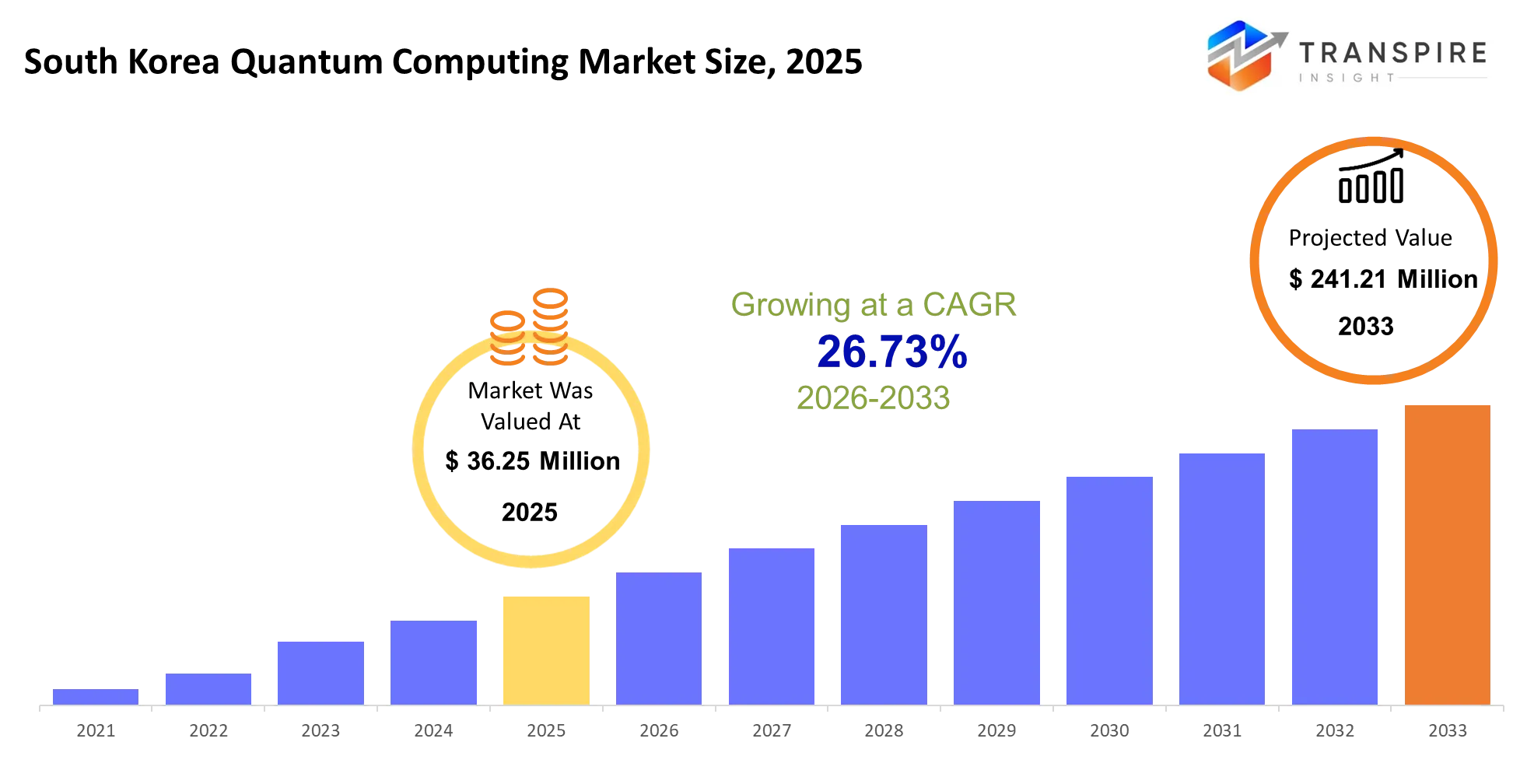
South Korea Quantum Computing Market Size & Forecast:
- South Korea Quantum Computing Market Size 2025: USD 36.25 Million
- South Korea Quantum Computing Market Size 2033: USD 241.21 Million
- South Korea Quantum Computing Market CAGR: 26.73%
- South Korea Quantum Computing Market Segments: By Component (Quantum Processors, Quantum Software, Quantum Networking Systems, Quantum Sensors, Others); By Technology (Superconducting Qubits, Trapped Ion Qubits, Quantum Annealing, Photonic Quantum Computing, Others); By Application (Optimization Problems, Cryptography, Drug Discovery, Financial Modeling, AI & Machine Learning, Others); By End User (Research Institutes, BFSI, Healthcare, Government Organizations, IT Companies, Others); By Deployment (Cloud-based Quantum Computing, On-premise Quantum Systems, Hybrid Quantum Systems, Others)
To learn more about this report,  Download Free Sample Report
South Korea Quantum Computing Market Summary
The South Korea Quantum Computing Market was valued at USD 36.25 Million in 2025. It is forecast to reach USD 241.21 Million by 2033. That is a CAGR of 26.73% over the period.
In South Korea, quantum computing is sort of being worked on as a high performance computational back end, for tackling those hard industrial tasks that older systems can’t really handle well, like molecular modeling, financial optimization, cryptographic security, and advanced materials simulations. In practice it kinda helps research outfits, semiconductor companies, and also defense related analytics, because it can reduce computation time for high dimensional simulations, and speed up decisions in places with lots of data and constant pressure.
Over the last 3–5 years, the market has shifted in a structural way, not just from academic work but more toward hybrid quantum classical cloud platforms, mainly because enterprises have started trying stuff. One big push came from intensified global semiconductor and cybersecurity rivalry, after geopolitical tensions, plus supply chain fragilities, so governments and big companies leaned harder into post quantum security and stronger computation capabilities. That whole shift has altered how people adopt it, now firms tend to focus on pilot deployments and cloud accessible quantum services, instead of building in house experimental labs. So, revenue is getting more tied to service based access models, and to strategic R&D partnerships rather than a straight up product sale.
Key Market Insights
- The South Korea Quantum Computing Market seems to be moving, sort of shifting , toward enterprise pilots, with cloud based quantum access models making it quicker to try and adopt across semiconductor finance and cybersecurity.
- In the Seoul metropolitan region, the market will have ~62% share in 2025, mostly because the area has dense R&D groundwork, strong semiconductor leadership, and national research institutes that are really concentrated on quantum development.
- Daejon looks like the fastest-growing region through 2033, helped by KAIST connected research clusters, plus steady government funding aimed at quantum innovation ecosystems.
- On the product side, quantum computing software platforms are still in the lead with about ~48% share in 2025, since enterprises keep choosing algorithm development tools rather than putting money into full stack hardware.
- Quantum hardware systems are the second biggest segment, and they’re mostly driven by superconducting together with ion trap technologies that are improving system stability and pushing qubit performance.
- Cloud based quantum computing services are growing the quickest as well, because companies are leaning toward scalable , pay per use quantum access rather than building and running in house infrastructure.
- For applications, cryptography and cybersecurity make up around ~34% application share in 2025, with the main push coming from post quantum encryption needs, plus national security modernization efforts.
- Drug discovery and material simulation are also starting to pop off as the fastest growing applications, since pharma needs faster molecular modeling, and advanced materials teams want better simulations.
- Finally, semiconductor and electronics firms lead end user adoption at ~38% share in 2025, using quantum simulation to tune chip design and reduce development cycles.
What are the Key Drivers, Restraints, and Opportunities in the South Korea Quantum Computing Market?
South Korea’s quantum computing ecosystem mostly moves because there’s a fast rise in the need for more powerful computation, especially for semiconductor design, cybersecurity, and financial modeling. You can kind of see it as a domino effect from how chip designs are getting more elaborate, plus the push to get ready for post-quantum cryptography. As companies start folding quantum-ready algorithms into their pilot workflows, the money is coming more from cloud access subscriptions and jointly run R&D efforts, not so much from selling standalone hardware.
Still, there is a big restraint, the whole barrier around keeping qubits stable, doing meaningful error correction, and making systems actually scale up. These issues feel structural, because they’re tied to the basic physics behind quantum systems, so you cannot “patch” them with incremental software updates only. Because of that, commercialization keeps taking a long time, which slows revenue in the near term and postpones broad enterprise adoption. On top of that, integration costs are high, so most smaller players get boxed out, leaving mostly large corporations and state-funded institutions in the loop.
On the other hand, an emerging opportunity is hybrid quantum-classical computing platforms, delivered via cloud environments. South Korea has a strong semiconductor ecosystem, and there are also government-backed quantum initiatives, both of which make this approach easier to grow. For example, partnerships between local telecom operators and global quantum providers are making it possible to use quantum processors remotely, mainly for optimization and simulation work. That then creates a real pathway for SMEs in areas like pharmaceuticals logistics, and finance to use quantum capabilities without having to own physical infrastructure. In practice, that should widen the addressable market a lot.
What Has the Impact of Artificial Intelligence Been on the South Korea Quantum Computing Market?
Artificial intelligence is getting more and more mixed into quantum computing workflows in South Korea, to make algorithm design better, handle error mitigation, and sort out system optimization in a smoother way. In practice, AI-driven tools help automate quantum circuit creation, and they also tune the gate sequences, so there is less wasted computation during the actual experimental runs. In enterprise pilot setups, machine learning approaches are being used to model quantum behavior, and that in turn improves hybrid quantum-classical task distribution, especially for financial risk modeling, plus for semiconductor material discovery.
At the same time, predictive abilities are growing, mostly thanks to AI-assisted calibration of qubit performance, and noise reduction strategies that feel more “hands on”. The outcome is better system stability, and experiments can be run more reliably, which matters a lot for sectors like cryptography and drug discovery. Meanwhile, in semiconductor R&D spaces, AI-enhanced quantum simulations are helping cut down the number of design iterations, while also boosting resource efficiency.
Operationally, these blends have led to quicker simulation throughput, stronger model accuracy ,and less computational overhead when workloads are split between quantum and classical components. Still, there is a big snag left, meaning the scarcity of high quality training data for quantum-specific machine learning models. Plus, the integration costs can be steep, and real-world quantum hardware is not always available at scale, so full AI deployment is hard. There are also connectivity constraints, between cloud based quantum processors and enterprise systems, and that slows down real time optimization in distributed environments, even when teams want to move fast.
Key Market Trends
- South Korea's quantum computing market is moving, kinda from early experimental studies into a more hybrid cloud based commercialization approach, with enterprise and government back-and-forth.
- You can say it’s not just pure lab work anymore, it’s more like a practical rollout with shared responsibility, and it’s slowly getting momentum.
- The market is growing because quantum hardware keeps improving, plus the whole software ecosystem is becoming more mature.
- On top of that, national digital transformation initiatives are giving extra tailwind to adoption, even when companies are cautious.
- After 2023, cloud based access to quantum resources grew noticeably, and that pulled more enterprises in, especially those industries that rely a lot on simulation. Some of them were already used to heavy computation , so the switch felt less disruptive.
- From a spending perspective, semiconductor firms boosted their quantum R&D budgets by almost 40% between 2022 and 2025. The reason was mostly chip design optimization, which makes sense if you’re chasing performance and efficiency at the same time.\
- Meanwhile, post-quantum cryptography adoption picked up speed in 2024. That happened largely after global cybersecurity standardization efforts became clearer, so organizations could justify migration plans with more confidence.
- Hybrid quantum classical systems also gained traction. Enterprises were basically looking for practical deployment pathways, without needing to invest fully in physical hardware right away, so cloud delivery looked like the easier entry.
- Financial institutions started doing pilot testing of quantum optimization models for portfolio risk analysis beginning in 2023, and that trend didn’t really stay isolated.
- Government funded quantum research programs expanded by more than 35% in 2025, which helped strengthen domestic innovation ability. It’s like the funding structure got a lot more solid, and universities and labs felt it.
- Global players—IBM and Google included—also ramped up cloud quantum offerings in South Korea. They did this through regional partnerships, so the presence became less “one-off” and more continuous.
- At the same time, domestic telecom operators rolled out quantum as a service pilots for enterprise customers in 2024, which made access feel more mainstream, at least for early adopters.
- On the technical side, error correction and qubit stabilization research became the main focus across academic institutions, with fewer distractions around longer shot approaches.
- And, semiconductor supply chain complexity has been nudging firms toward quantum simulation, because it can speed up material discovery, rather than waiting on slow cycles in physical testing.
South Korea Quantum Computing Market Segmentation
By Component
Quantum Processors are still in the top spot, mostly because the processing hardware is basically the real basis of every quantum computing setup. A lot of strong investment keep happening from semiconductor makers , research groups and also cloud service providers, which helps explain why this lead stays, especially for superconducting and trapped-ion processor projects. Quantum Software comes in second, mostly due to the rising enterprise appetite for quantum algorithms, simulation tools, and those workflow integration platforms that make teams faster . Quantum Networking Systems and Quantum Sensors sit with smaller shares, while “Others” stays kind of narrow , limited to trials, pilots, or specialized deployments only.
Quantum Processors keep pushing forward as qubit steadiness, error correction, and scale up capability turn into the main competitive goals across the whole sector. Quantum Software is growing the quickest, simply because companies increasingly like software-accessible quantum experimentation, without needing to directly own hardware systems. Quantum Networking Systems are getting more strategic attention for protected communication and quantum-safe data transfer, especially in government and defense uses. During the forecast window, demand for components will likely lean more toward integrated ecosystems where processors, software platform tools, and networking features work together through a single, cloud-based infrastructure.
By Technology
Quantum Processors are still in the top spot, mostly because the processing hardware is basically the real basis of every quantum computing setup. A lot of strong investment keep happening from semiconductor makers , research groups and also cloud service providers, which helps explain why this lead stays, especially for superconducting and trapped-ion processor projects. Quantum Software comes in second, mostly due to the rising enterprise appetite for quantum algorithms, simulation tools, and those workflow integration platforms that make teams faster . Quantum Networking Systems and Quantum Sensors sit with smaller shares, while “Others” stays kind of narrow , limited to trials, pilots, or specialized deployments only.
Quantum Processors keep pushing forward as qubit steadiness, error correction, and scale up capability turn into the main competitive goals across the whole sector. Quantum Software is growing the quickest, simply because companies increasingly like software-accessible quantum experimentation, without needing to directly own hardware systems. Quantum Networking Systems are getting more strategic attention for protected communication and quantum-safe data transfer, especially in government and defense uses. During the forecast window, demand for components will likely lean more toward integrated ecosystems where processors, software platform tools, and networking features work together through a single, cloud-based infrastructure.
By Application
Optimization Problems keep taking the lead, kinda, because quantum systems are now being used more and more for logistics planning, supply chain coordination, and hard industrial scheduling tasks. There’s strong enterprise adoption because they can process huge numbers of variable combinations more efficiently than standard computing setups. Cryptography sits in second place too, mostly due to bigger investments in post-quantum security and national cybersecurity modernization programs. Drug Discovery, Financial Modeling, AI & Machine Learning, and other related areas keep expanding, across both niche commercial work and research environments.
Optimization Problems are still growing, especially as manufacturing, transportation, and semiconductor industries want quicker operational decisions. Cryptography stays a strategically valuable segment, since governments and financial institutions are getting ready for quantum-resistant security infrastructure. Drug Discovery , and AI & Machine Learning show the fastest expansion, partly because quantum simulation helps molecular analysis in a more detailed way, and it also speeds up advanced model training processes. During the forecast period, application demand is expected to lean more toward industry-specific quantum solutions, those that mix cloud accessibility with more tailored algorithm development for enterprise workflows.
By End User
Research Institutes kind a keep the dominant position, mostly because there is huge public funding, experimentation that’s often university-led, and those national technology development programs. The real strong adoption, I mean it comes from ongoing investment in quantum hardware testing, algorithm research, and also workforce development initiatives, which is kind of a feedback loop. BFSI comes in second , mainly since financial institutions are increasingly assessing quantum capabilities for portfolio optimization, fraud detection, and risk analysis. Meanwhile Healthcare, Government Organizations, IT Companies , and Others keep expanding too, but their participation is still comparatively smaller across the wider ecosystem.
Research Institutes keep growing their role as governments put more emphasis on long-term domestic quantum capability building and also being internationally competitive in research. For BFSI, adoption is speeding up, because banks and other financial service providers are looking for a computational edge in forecasting, and asset management use cases. IT Companies are the fastest-growing end-user group, largely because more enterprises are integrating cloud-based quantum access platforms into their digital infrastructure. Over the forecast period, end-user demand will shift more and more from research-driven tinkering toward commercially deployable hybrid computing environments , so less “lab-only” and more practical deployments.
By Deployment
Cloud-based Quantum Computing seems to hold the leading position, mostly because enterprises like a scalable access approach that avoids the whole cost burden of holding onto specialized quantum infrastructure. You can see solid adoption too, and it’s kind of backed by partnerships between cloud service providers and quantum hardware developers, where they supply remote access to the processing systems. On-premise Quantum Systems land in second place because government agencies , defense groups and advanced research facilities want better data control, they really do. Hybrid Quantum Systems and other options keep picking up momentum too, especially across enterprise pilot setups, where teams try things without rushing.
Cloud-based Quantum Computing keeps growing, because organizations are looking for lower entry barriers plus more flexible experimentation atmospheres for algorithm testing and optimization workloads. On-premise Quantum Systems are still important in a strategic sense for sensitive applications—think cybersecurity, national defense, and proprietary semiconductor research. Hybrid Quantum Systems are showing up as the fastest-growing deployment segment, largely since enterprises are mixing classical computing infrastructure with quantum processing capabilities, so they can build practical commercial uses. During the forecast period, the deployment plan is likely to drift toward interoperable hybrid architectures, in an effort to balance scalability, security, and computational efficiency across many industries.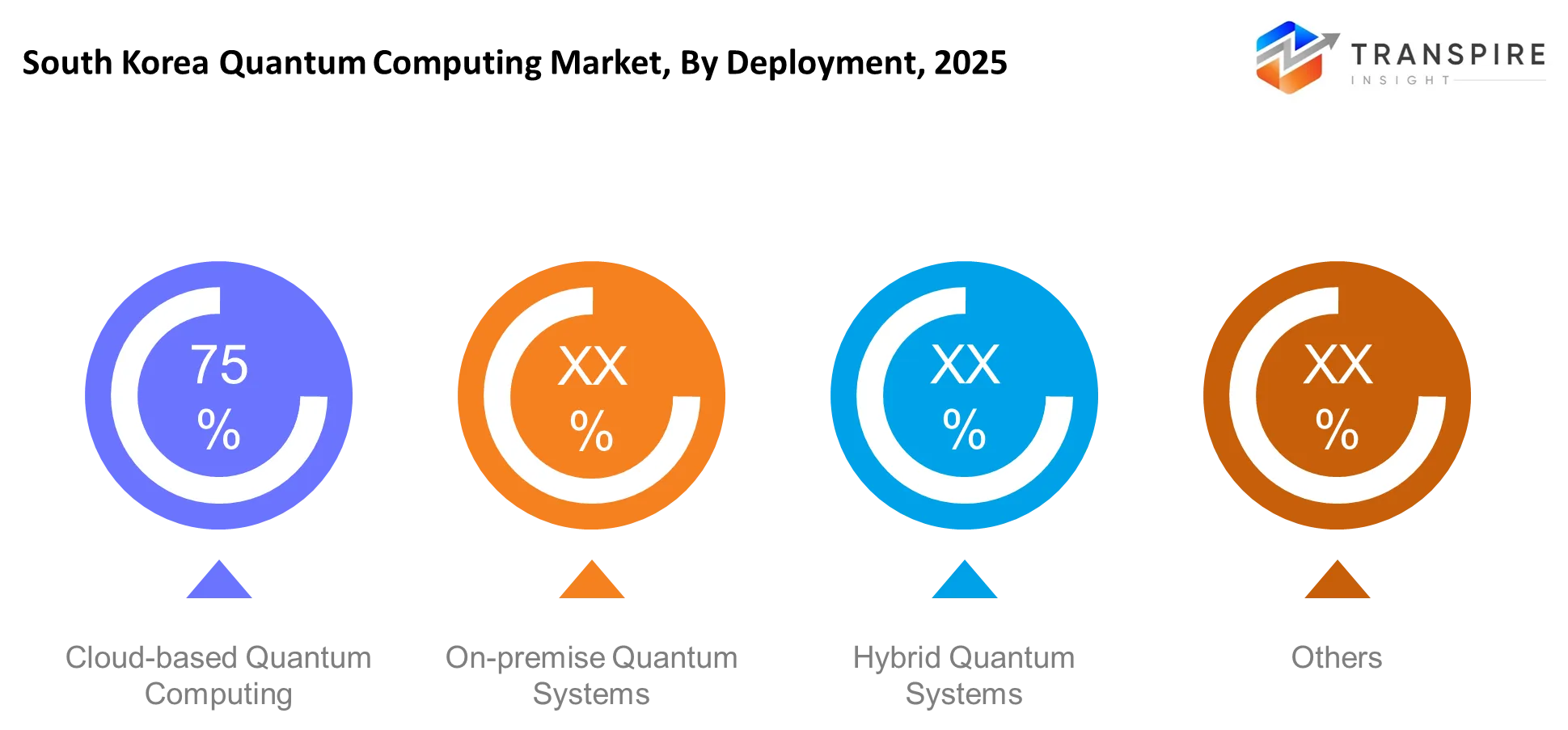
To learn more about this report, Download Free Sample Report
What are the Key Use Cases Driving the South Korea Quantum Computing Market?
In South Korea the core use case is more or less quantum-assisted semiconductor design, plus cryptographic security optimization. Here semiconductor manufacturers lean on quantum simulation to mimic atomic-level material behavior, which in turn helps increase chip efficiency and also trims down development cycles, though not always evenly.
Secondary uses are starting to pop up in financial modeling and logistics optimization. In these areas, banks and large enterprises are applying quantum algorithms for things like portfolio balancing, risk assessment, and supply chain routing. A lot of these efforts are pushed by financial institutions and industrial conglomerates who want quicker multi-variable optimization, even when the models get messy.
More emerging use cases show up in pharmaceutical molecule simulation and in advanced AI model training acceleration. Research institutions and biotech firms are now exploring quantum computing so they can reduce drug discovery timelines and boost predictive accuracy for molecular interactions , which kind of suggests real long-term adoption potential over time.
|
Report Metrics |
Details |
|
Market size value in 2025 |
USD 36.25 Million |
|
Market size value in 2026 |
USD 45.94 Million |
|
Revenue forecast in 2033 |
USD 241.21 Million |
|
Growth rate |
CAGR of26.73% from 2026 to 2033 |
|
Base year |
2025 |
|
Historical data |
2021 - 2024 |
|
Forecast period |
2026 - 2033 |
|
Report coverage |
Revenue forecast, competitive landscape, growth factors, and trends |
|
Regional scope |
South Korea |
|
Key company profiled |
IBM, Google, Intel Corporation, Microsoft, D-Wave Systems, Rigetti Computing, IonQ, Samsung Electronics, SK Telecom, Fujitsu, Toshiba, Honeywell Quantum Solutions, Alibaba Cloud, Amazon Web Services, Atos |
|
Customization scope |
Free report customization (country, regional & segment scope). Avail customized purchase options to meet your exact research needs. |
|
Report Segmentation |
By Fuel Type (Diesel, Gasoline, Natural Gas), By Application (Power Generation, Marine, Oil & Gas, Industrial Machinery), By Power Output (Up to 1 MW, 1–5 MW, Above 5 MW) |
Which Regions are Driving the South Korea Quantum Computing Market Growth?
The Seoul metropolitan region kind of leads the South Korea Quantum Computing Market, mostly because it has this dense mix of national research institutes, major semiconductor headquarters, and government supported innovation hubs. You can see policy alignment that’s pretty direct, like quantum research funding is connected with defense modernization and cybersecurity priorities, so everything lines up a bit too well. Big universities and corporate R&D teams in Seoul keep working together on hybrid quantum classical algorithm work, which sort of improves early commercialization routes. In the end, this whole ecosystem makes it quicker to move academic breakthroughs into enterprise pilot programs, and that supports Seoul’s dominant standing, pretty much steadily.
Gyeonggi Province feels more like a stable industrial backbone, not exactly a research centered hotspot. The main idea is long term investment cycles tied to semiconductor fabrication and electronics manufacturing clusters, especially near Suwon and Pangyo Techno Valley. Compared with Seoul, quantum progress in Gyeonggi is pushed through integration into existing production and testing workflows, rather than trying to push new experimental research every time. Larger firms there often favor incremental adoption for chip tuning and secure computing applications, so demand stays consistent even when breakthrough pace slows. That’s why Gyeonggi can act as a dependable revenue contributor, and it does so without needing constant radical change.
Daejeon is starting to look like the fastest growing quantum computing region, mainly because public funding is moving faster, and academic expertise is concentrated in a useful way. With KAIST plus several government research institutes already in place, a specialized innovation corridor has formed around quantum materials and computing architectures. More recently, expansion of national R&D grants has lifted prototype development activity in the area, and it keeps accelerating. So Daejeon ends up feeling like a momentum driven alternative to the other hubs, at least right now.
Who are the Key Players in the South Korea Quantum Computing Market and How Do They Compete?
Competition in the South Korea quantum computing market is still sort of moderately consolidated, and you see global technology giants mixed in with more niche quantum startups, plus domestic telecom and electronics firms. What really drives the rivalry isn’t so much price, it’s more about technology leading edge, like qubit stability , algorithm efficiency, and cloud based access models. Meanwhile, the incumbents are actively holding ground via ecosystem lock in, and the newcomers tend to zoom in on specific quantum use cases and hybrid computing services, kinda like a narrower play.
IBM pushes harder with cloud quantum access and enterprise partnerships, giving customers scalable experimentation environments that sit inside its hybrid computing stack, and it feels pretty seamless overall. Microsoft comes in through Azure Quantum, standing out using developer-friendly tools and that strong integration into enterprise software ecosystems. Google meanwhile is putting emphasis on quantum supremacy research and the ongoing work around advanced superconducting qubits, and it leans on its AI capabilities to sort of tune and optimize quantum workflows.
IonQ and Rigetti Computing compete largely by hardware improvement, especially trapped-ion systems and superconducting architectures aimed at better fidelity style operations. SK Telecom differentiates through telecom-led quantum communication and secure network integration, and it keeps expanding its involvement in quantum-safe infrastructure development. Overall these players keep growing through cross border partnerships, cloud alliances, and joint research efforts with Korean semiconductor and telecom companies, which helps reinforce hybrid quantum classical adoption across different industries, even outside the obvious segments.
Company List
- IBM
- Intel Corporation
- Microsoft
- D-Wave Systems
- Rigetti Computing
- IonQ
- Samsung Electronics
- SK Telecom
- Fujitsu
- Toshiba
- Honeywell Quantum Solutions
- Alibaba Cloud
- Amazon Web Services
- Atos
Recent Development News
In January 2026,The South Korean Ministry of Science and ICT announced the establishment of five national quantum clusters. The initiative aims to integrate regional industries, universities, and research institutes into commercialization hubs for quantum computing and related technologies, accelerating ecosystem-scale adoption.https://en.sedaily.com
In April 2026, Incheon Metropolitan Government and Yonsei University launched IBM 127-qubit quantum access program for SMEs. The initiative provides selected companies with free quantum computing runtime to develop and test algorithms, lowering entry barriers for enterprise-level quantum experimentation.https://en.sedaily.com
What Strategic Insights Define the Future of the South Korea Quantum Computing Market?
South Korea's quantum computing market is kind of moving, kinda fast, toward cloud-first hybrid quantum ecosystems where enterprise users can reach quantum processors as scalable services instead of owning dedicated infrastructure. it’s basically because semiconductor complexity keeps getting higher and the need is also rising for high-dimensional optimization across cybersecurity and materials science. In the next 5–7 years , commercialization will be way more about software ecosystems and algorithm maturity than about just raw hardware scaling.
There’s also a quieter risk, not everyone talks about it, technological concentration. if a domestic ecosystem relies on just a few global quantum hardware providers then domestic control over critical computing infrastructure can get weaker. That can become a strategic weak spot for sectors tied to national security and advanced manufacturing, even if everything looks fine on paper.
On the opportunity side, there’s growing value in combining quantum computing with AI-driven semiconductor design platforms, especially around the Daejeon and Seoul innovation clusters. Market players should push for ecosystem partnerships with telecom operators and semiconductor companies, in order to lock in early platform integration advantages before standards really settle in and consolidate.
South Korea Quantum Computing Market Report Segmentation
By Component
- Quantum Processors
- Quantum Software
- Quantum Networking Systems
- Quantum Sensors
- Others
By Technology
- Superconducting Qubits
- Trapped Ion Qubits
- Quantum Annealing
- Photonic Quantum Computing
- Others
By Application
- Optimization Problems
- Cryptography
- Drug Discovery
- Financial Modeling
- AI & Machine Learning
- Others
By End User
- Research Institutes
- BFSI
- Healthcare
- Government Organizations
- IT Companies
- Others
By Deployment
- Cloud-based Quantum Computing
- On-premise Quantum Systems
- Hybrid Quantum Systems
- Others
Frequently Asked Questions
Find quick answers to common questions.
The Expected South Korea Quantum Computing Market size for the Market will be USD 241.21 Million in 2033.
Key Segments for the South Korea Quantum Computing Market are By Component (Quantum Processors, Quantum Software, Quantum Networking Systems, Quantum Sensors, Others); By Technology (Superconducting Qubits, Trapped Ion Qubits, Quantum Annealing, Photonic Quantum Computing, Others); By Application (Optimization Problems, Cryptography, Drug Discovery, Financial Modeling, AI & Machine Learning, Others); By End User (Research Institutes, BFSI, Healthcare, Government Organizations, IT Companies, Others); By Deployment (Cloud-based Quantum Computing, On-premise Quantum Systems, Hybrid Quantum Systems, Others).
Major South Korea Quantum Computing Market Players are IBM, Google, Intel Corporation, Microsoft, D-Wave Systems, Rigetti Computing, IonQ, Samsung Electronics, SK Telecom, Fujitsu, Toshiba, Honeywell Quantum Solutions, Alibaba Cloud, Amazon Web Services, Atos
The Current South Korea Quantum Computing Market size is USD 36.25 Million in 2025.
The South Korea Quantum Computing Market CAGR is 26.73% from 2026 to 2033.
- IBM
- Intel Corporation
- Microsoft
- D-Wave Systems
- Rigetti Computing
- IonQ
- Samsung Electronics
- SK Telecom
- Fujitsu
- Toshiba
- Honeywell Quantum Solutions
- Alibaba Cloud
- Amazon Web Services
- Atos
Recently Published Reports
-
Apr 2026
3D Optical Profiler Market
3D Optical Profiler Market Size, Share & Analysis Report By Type (Desktop 3D Optical Profiler, and Portable 3D Optical Profiler), By Technology (Confocal Technology, and White Light Interference), By End-Use Industry (Manufacturing, Research Institutions, Automotive, Aerospace and Defense, Medical Devices, and Other), and Geography (North America, Europe, Asia-Pacific, Middle East and Africa, South and Central America), 2021 - 2031
-
Apr 2026
Depth Sensor Market
Depth Sensor Market Size, Share & Analysis Report By Type (Infrared Depth Sensors, Time-of-Flight (ToF) Sensors, Stereo Vision Sensors, Structured Light Sensors, Ultrasonic Depth Sensors), By Application (Automotive, Robotics, Gaming, Consumer Electronics, Industrial Automation, Healthcare, Security & Surveillance, Others), By End Users (Automotive Manufacturers, Consumer Electronics Companies, Healthcare Providers, Industrial Companies, Security Agencies, Gaming Companies, Robotics Companies, Others), and Geography (North America, Europe, Asia-Pacific, Middle East and Africa, South and Central America), 2021 – 2031
-
Apr 2026
Digital Manufacturing Market
Digital Manufacturing Market Size, Share & Analysis Report By Component (Hardware, Software, and Services), By Technology (Robotics, 3D Printing, Internet of Things (IoT), and Others), By Application (Automotive and Transportation, Aerospace and Defense, Consumer Electronics, Industrial Machinery, and Others), By Process Type (Computer-Based Designing, Computer-Based Simulation, Computer 3D Visualization, Analytics, and Others), and Geography (North America, Europe, Asia-Pacific, Middle East and Africa, South and Central America), 2021 – 2031
-
Apr 2026
Digital Visa Services Market
Digital Visa Services Market Size, Share & Analysis Report By Type (Individual Travelers, Group Travelers), By Application (Tourism, Business Travel, Others), and Geography (North America, Europe, Asia-Pacific, Middle East and Africa, South and Central America), 2021 – 2031