
South Korea Quantum Dots Market Size & Forecast:
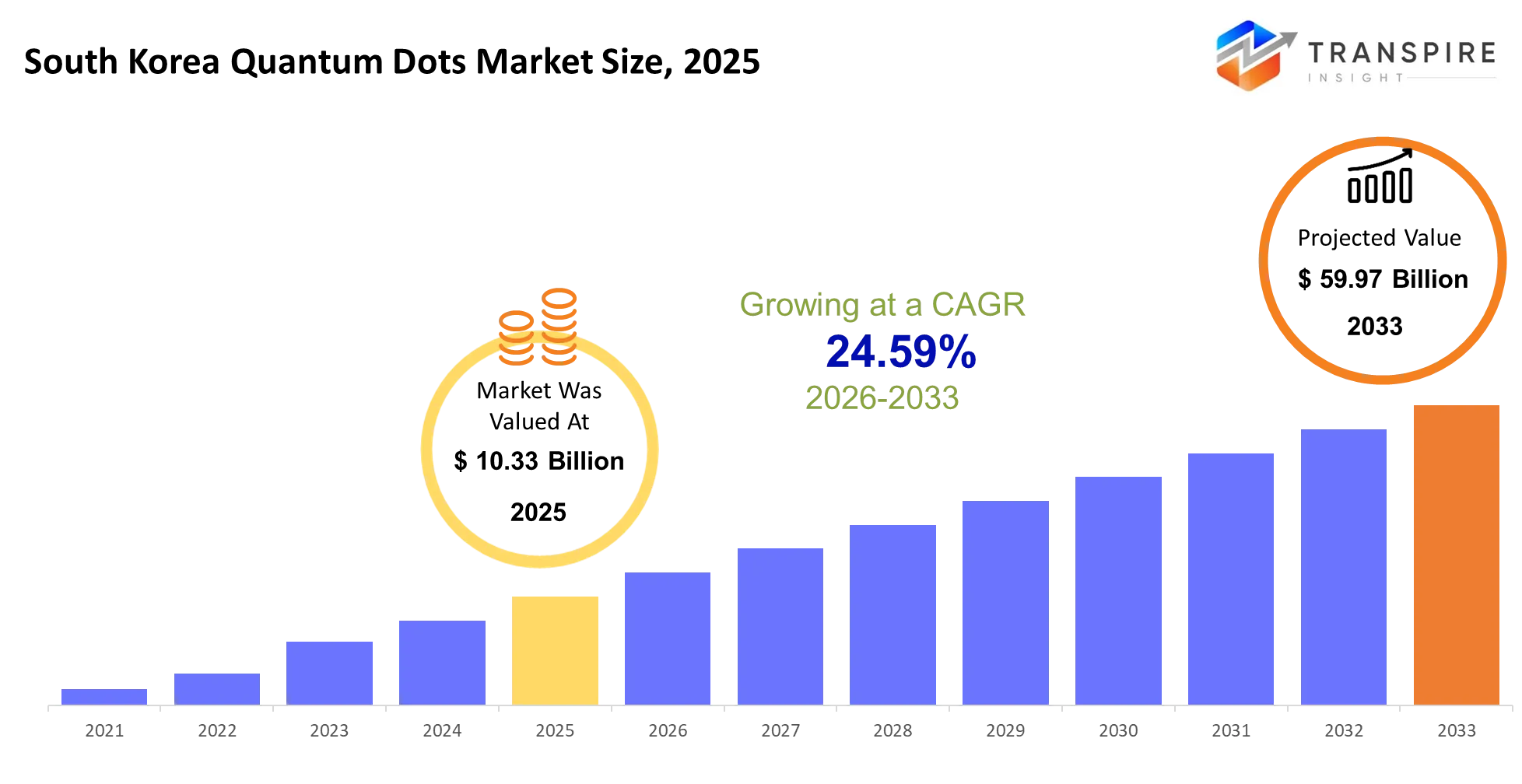
- South Korea Quantum Dots Market Size 2025: USD 10.33 Billion
- South Korea Quantum Dots Market Size 2033: USD 59.97 Billion
- South Korea Quantum Dots Market CAGR: 24.59%
- South Korea Quantum Dots Market Segments: By Material (Cadmium-based Quantum Dots, Cadmium-free Quantum Dots, Graphene Quantum Dots, Others); By Application (Displays, Healthcare Imaging, Solar Cells, Sensors, Lighting, Others); By Technology (Quantum Dot LED, Quantum Dot Enhancement Films, Printable Quantum Dots, Others); By End User (Consumer Electronics Companies, Healthcare Industry, Automotive Industry, Others); By Form (Powder, Liquid Ink, Films, Others)
To learn more about this report,  Download Free Sample Report
South Korea Quantum Dots Market Summary
The South Korea Quantum Dots Market was valued at USD 10.33 Billion in 2025. It is forecast to reach USD 59.97 Billion by 2033. That is a CAGR of 24.59% over the period.
Quantum dots are kind of helping South Korea’s display industry, and more specifically advanced optics industry, make screens that look brighter, with richer color accuracy, and also use less energy. This is most evident in premium TVs, monitors, and even next-generation medical imaging devices. In real practice, the market basically pushes manufacturers to deal with the shortcomings of conventional LCD backlighting. They do this by tuning color volume and light efficiency right at the pixel level, and that ends up boosting how people actually see things , plus it gives companies a way to stand out versus other devices.
Over the last 3–5 years, the whole industry has moved structurally away from cadmium-based quantum dot materials toward cadmium-free phosphide and indium-based formulations. The reason is tighter environmental compliance standards across electronics manufacturing, which made the older approach less comfortable. A big trigger that sped everything up was the global supply chain disruption during the pandemic period, so South Korean panel makers had to localize advanced materials sourcing and reduce dependency on imported optical components, kind of all at once.
Then as production yields improved and the costs for integration started to fall, quantum dot film approaches and electroluminescent technologies began scaling more rapidly. That meant innovation moved faster into the commercial side, and it became easier to see higher adoption across premium display lines.
Key Market Insights
- South Korea Quantum Dots Market kinda feels dominated by display applications, they take up close to 55% share, mostly because OLED and QLED integration keeps coming back around, and honestly the demand is steady.
- Consumer electronics still shows up as the biggest end-use category, backed by Samsung and LG running their premium TV production lines—yeah, those guys really set the pace.
- For the market structure, the display enhancement segment holds the largest piece in the South Korea Quantum Dots Market, and it’s being pushed by ultra-HD and 8K adoption trends, more people are moving up in resolution than before.
- On the materials side, quantum dot film technology accounted for roughly 48% of material usage in 2025 across the entire display manufacturing ecosystem.
- If we zoom into geography, Seoul and Gyeonggi together account for over 60% of production concentration due to semiconductor and display fabrication clusters.
- And the fastest-growing application is medical imaging displays, which is projected to grow above 20% annually through 2033, seems pretty strong.
- Also, South Korea Quantum Dots Market is getting rapid adoption in automotive displays for AR-based navigation systems, plus smarter dashboards that look and react better.
- Adoption of quantum dot enhancement film increased by nearly 35% from 2022 to 2025 in premium TV manufacturing lines.
- Key players including Samsung Electronics, LG Display, Nanosys, Nanoco Group, and 3M are also expanding material innovation partnerships, so collaboration keeps widening.
- Lastly, strategic expansion in cadmium-free quantum dot materials is improving regulatory compliance, and it’s helping speed up export competitiveness too.
What are the Key Drivers, Restraints, and Opportunities in the South Korea Quantum Dots Market?
The main driver of the South Korea Quantum Dots Market is the speeding movement toward ultra-high-definition and energy saving display solutions, where everything kind of clicks together in a way that matters. Panel makers like Samsung Display and LG Display have rolled quantum dot tech into their panels to handle color gamut issues inside LCD designs, so the result is brighter output without the same amount of power drain. In practice, this has bumped up premium product differentiation , and companies can then aim for better margins across the global TV and monitor space
A big restraint is the heavy reliance on intricate nanomaterial synthesis infrastructure. That setup needs precise manufacturing conditions, plus it depends on pricey feedstock inputs. So you end up with kind of rigid cost obstacles, which makes it harder for smaller players to adopt quantum dots, and it also slows commercialization outside the biggest display OEMs. On top of that, scaling electroluminescent quantum dot production isn’t straightforward, so wider use in mid tier devices takes longer, which in turn limits revenue growth in segments that care a lot about price
An opportunity that’s showing up more clearly sits in healthcare imaging plus automotive AR display systems. In South Korea, hospitals are starting to adopt quantum dot based imaging screens to get sharper diagnostic visibility, while automotive brands are also funding high resolution dashboard displays for electric and autonomous vehicles. These neighboring applications are likely to add new demand tiers beyond typical consumer electronics, especially as local R and D efforts in nanophotonics keep climbing.
What Has the Impact of Artificial Intelligence Been on the South Korea Quantum Dots Market?
Artificial intelligence is getting more and more embedded into quantum dot material development, and also into display manufacturing optimization across South Korea. In actual fabrication environments, machine learning is often applied to tune nanoparticle synthesis conditions. This tends to boost consistency in quantum yield, and it can also lower the defect rates, during routine production runs. As a result, companies can shorten the development timeline for cadmium-free quantum dot materials while maintaining steadier output stability as they move to larger display panels.
On the production floor, in the more advanced display manufacturing lines, AI-based process control systems watch things like deposition thickness, color calibration, and backlight efficiency, pretty much in real time. Predictive analytics models then try to spot degradation trends in the display's performance over time, so manufacturers can push for a longer panel lifespan and reduce costs tied to warranty claims. These changes are showing up as real, measurable improvements in production yield efficiency, and they’re sometimes described as sitting in the mid-single-digit percentage range at leading fabs.
That said, AI adoption still faces friction because training data quality is not always strong enough for nanoscale material behavior, especially when the thermal and electrical conditions vary a lot. The interaction story inside quantum dots is also pretty intricate, so real world prediction accuracy remains hard to maintain, notably when you scale up from lab settings to full mass production lines. Even with those limits, AI is still strengthening both R&D efficiency and overall production consistency within South Korea’s advanced display ecosystem.
Key Market Trends
- Between 2022 and 2025, the South Korea Quantum Dots Market kind of shifted away from LCD enhancement films and into hybrid QD-OLED structures, sort of a smoother transition than before.
- By 2025, cadmium-free quantum dot adoption jumped by almost 40% mainly because environmental rules in electronics manufacturing got stricter, and honestly that pressure keeps building.
- Samsung Display also boosted QD-OLED panel output by more than 30% in 2025 to catch up with global premium TV demand, which kept rising.
- At the same time automotive display integration expanded a lot, with AR enabled dashboards climbing above 25% growth each year since 2023, yes that’s pretty fast for the segment.
- In hospitals, adoption of medical imaging displays increased as well, and that helped diagnostic precision via high-color-accuracy visualization tools.
- After the disruptions that occurred post-2021, local material sourcing expanded, reducing reliance on imported quantum dot precursors, even though some imported inputs are still needed.
- Efficiency gains in quantum dot films also mattered. They reportedly cut energy consumption in premium TVs by about 15–20%, which is not small at all.
- Meanwhile Nanoco and Nanosys collaboration with Korean OEMs sped up commercialization of next-gen electroluminescent QD technologies, and the pace feels noticeable.
- Export demand for Korean quantum dot displays grew strongly across North America and Europe, especially in premium electronics segments.
- Finally, AI assisted nanomaterial design reduced development cycles for new QD formulations by nearly 25% in R&D labs, so teams can iterate faster.
South Korea Quantum Dots Market Segmentation
By Material
Cadmium based Quantum Dots kinda hold a big historical spot, mostly because they showed up early in high brightness display backlighting systems and, you know, had really good optical efficiency. The color purity was strong and their quantum yield stayed high, so at the earlier commercialization phase this material became a kind of go to in premium display manufacturing. Still, as environmental compliance pressure keeps growing, its dominance in consumer facing applications has been slowly getting smaller.
That said, growing new cadmium based variants isn’t exactly easy, since regulation is getting tighter around heavy metals in electronics. This hits especially hard in export driven display markets. Cadmium free Quantum Dots are gaining a clear structural advantage, manufacturers move toward more environmentally compliant formulations, using indium phosphide and other similar compounds. Graphene Quantum Dots also exist but they’re more in early stage adoption, mostly tied to research led uses like sensors and biomedical imaging.Over the forecast period, cadmium free systems are expected to lead the innovation pipelines, while graphene based solutions might open up niche high sensitivity applications in advanced electronics and diagnostics.
By Application
Displays are kinda holding the dominant position, mostly because quantum dot technology is integrated pretty deeply into televisions, monitors, and mobile screens, so there’s a constant push for both high color accuracy and better energy efficiency. There’s also strong demand from premium consumer electronics manufacturing, which helps keep adoption steady, especially in large-format and ultra-HD devices. Honestly, this segment remains the main revenue driver across the industry ecosystem, even as other areas catch up.
Healthcare Imaging is showing up as the fastest growing application, since diagnostic systems are more and more adopting high resolution quantum dot enabled visualization tools, mainly for clearer tissue differentiation. Solar Cells still keep a steady development pace too, as research keeps focusing on efficiency improvements using spectral conversion approaches. Sensors and lighting applications are expanding more gradually, driven by industrial automation and smart infrastructure rollouts. Over time, display uses will stay central, but healthcare and energy related uses will gain more strategic importance, as quantum dot performance moves beyond just visual enhancement and into functional photonic systems, you know, the kind that do more than just look good.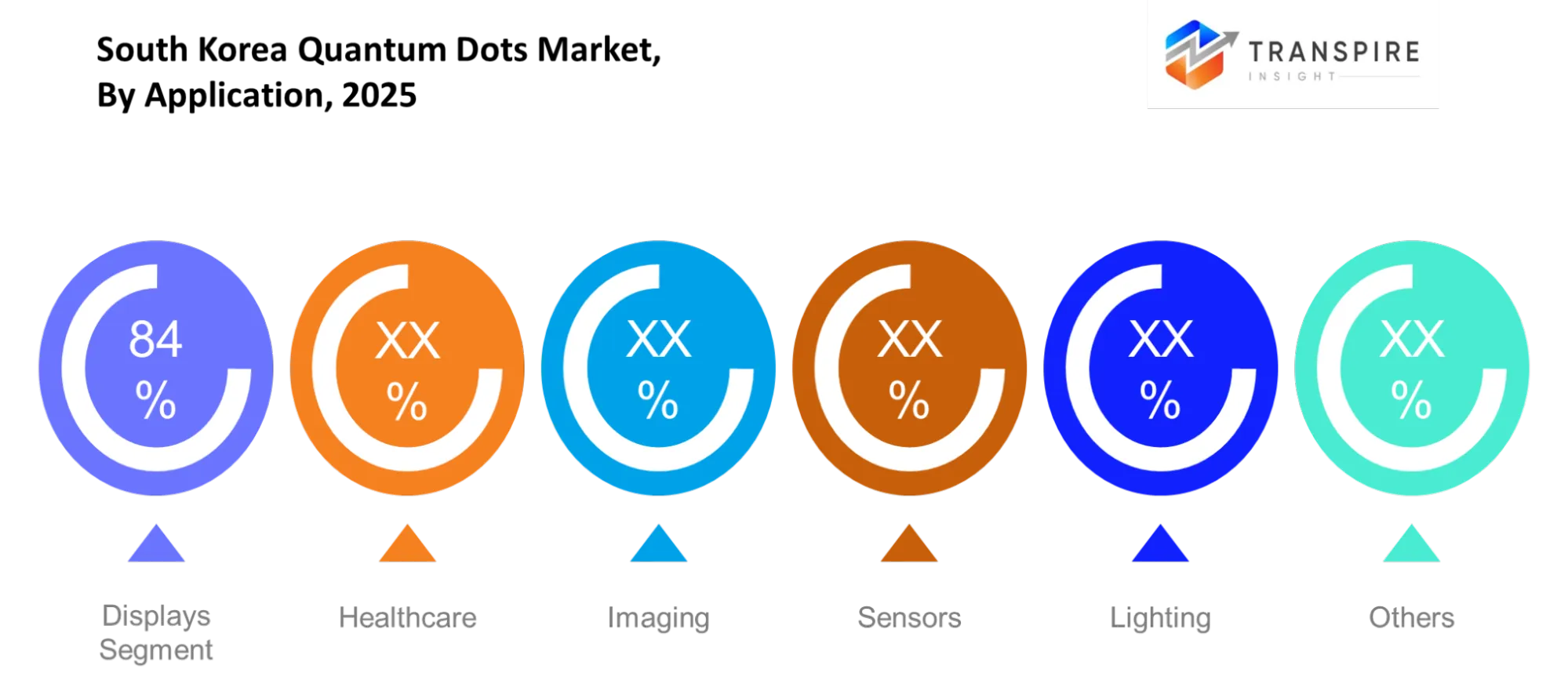
To learn more about this report, Download Free Sample Report
By Technology
Quantum Dot Enhancement Films basically keep the lead because they've been plugged into LCD backlighting setups across most televisions and monitors. The manufacturing side is already well set, and they fit pretty smoothly with the display architecture that most makers already use, so yeah it got commercialised at scale. Plus, the supply chain is mature enough that this leadership stays locked in throughout global display production, even as demand shifts.
For growth, a lot comes from steady tweaks to premium TV resolutions and brighter luminance levels. Quantum Dot LED tech is showing up as what people are calling a next generation architecture, with self emissive behavior and better energy efficiency, so it’s viewed as a long term disruptor. At the same time, Printable Quantum Dots are getting real attention in experimental display fabrication, mainly due to the potential to lower costs and enable scalable production, not just in theory but in practice. Over the forecast window, the market should shift, kind of gradually, away from enhancement based systems and toward self emissive quantum dot displays, and that is likely to change how companies compete in advanced display manufacturing.
By End User
Consumer electronics companies basically hold the dominant position because they make heavy use of quantum dot materials in televisions, monitors, smartphones, and those display panels people look at everyday. There is also strong worldwide demand for high-resolution, energy-smart screens and that keeps procurement volumes rising, mainly from big OEMs and panel manufacturers. On top of that , major electronics firms doing more and more vertical integration also makes their influence stronger, like it sort of compounds.
The automotive industry appears to be the fastest-growing end-user segment, since digital dashboards, AR navigation systems, and infotainment displays are becoming standard, especially in electric and autonomous vehicles. The healthcare industry is still steady too, with imaging and diagnostic visualization systems that need very high color fidelity and precision. Other end users, including industrial and defense applications, stay more of a niche, but they’re still strategically important. Over the forecast period, automotive and healthcare are expected to grow their share, gradually spreading demand and reducing its concentration in consumer electronics.
By Form
Films still seem to hold the dominant position, mostly because they’re used everywhere in display backlighting setups—especially quantum dot enhancement films that are used inside LCD and QLED televisions. Because they’re comparatively easy to integrate and pretty cost-effective for mass production, they end up supporting large-scale adoption across panel manufacturing plants worldwide.
The upward trend in film-based usage stems from the ongoing demand for performance-oriented display upgrades without fully redoing the existing architecture. Liquid Ink is the fastest-growing option, since it lets quantum dots be deposited via inkjet printing, so you can do scalable deposition for the next generation fabrication. Powder forms meanwhile keep a steady presence in industrial use, like in research workflows and chemical processing. Other specialized forms show up mainly in niche scenarios. Through the forecast window, liquid based formulations are expected to pick up more speed as display manufacturing gradually shifts toward flexible, tightly controlled, and cost-efficient production methods, and not just the usual ones.
What are the Key Use Cases Driving the South Korea Quantum Dots Market?
The main use case that’s really driving demand is premium display manufacturing , where quantum dots kinda boost color accuracy, brightness, and energy efficiency in top-tier televisions and monitors. This is the big reason it dominates because South Korean electronics giants lean on quantum dot technology to stand out, and honestly they use it as a differentiator for flagship products in global markets.
There are also some secondary use cases, like automotive display systems and medical imaging equipment. In the auto world, manufacturers are folding quantum dot-enhanced dashboards into AR navigation and real-time visualization. Meanwhile healthcare providers are leaning on high-precision displays for diagnostic imaging, where they need better color faithfulness and higher contrast resolution .
And then there are emerging use cases spreading to wearable devices and next-generation AR/VR headsets. Those are still kind of early-stage, but the expectation is that growth will follow as miniaturization gets better, and as demand rises for super-efficient, high-resolution microdisplays in immersive digital environments.
|
Report Metrics |
Details |
|
Market size value in 2025 |
USD 10.33 Billion |
|
Market size value in 2026 |
USD 12.87 Billion |
|
Revenue forecast in 2033 |
USD 59.97 Billion |
|
Growth rate |
CAGR of24.59% from 2026 to 2033 |
|
Base year |
2025 |
|
Historical data |
2021 - 2024 |
|
Forecast period |
2026 - 2033 |
|
Report coverage |
Revenue forecast, competitive landscape, growth factors, and trends |
|
Regional scope |
South Korea |
|
Key company profiled |
Samsung Electronics, LG Display, Nanosys, Nanoco Technologies, QD Laser, Shoei Chemical, Ocean NanoTech, NNCrystal, BOE Technology, TCL CSOT, Merck KGaA, Sony, UbiQD, Quantum Materials Corporation, Avantama |
|
Customization scope |
Free report customization (country, regional & segment scope). Avail customized purchase options to meet your exact research needs. |
|
Report Segmentation |
By Material (Cadmium-based Quantum Dots, Cadmium-free Quantum Dots, Graphene Quantum Dots, Others); By Application (Displays, Healthcare Imaging, Solar Cells, Sensors, Lighting, Others); By Technology (Quantum Dot LED, Quantum Dot Enhancement Films, Printable Quantum Dots, Others); By End User (Consumer Electronics Companies, Healthcare Industry, Automotive Industry, Others); By Form (Powder, Liquid Ink, Films, Others) |
Which Regions are Driving the South Korea Quantum Dots Market Growth?
Seoul plus the Gyeonggi industrial corridor kind of… basically dominate the South Korea Quantum Dots Market, mainly because they cluster a lot of advanced display fabrication plants and semiconductor-grade material suppliers. In that area, things work better because panel makers, research institutes, and precision chemical producers stay tightly connected, so quantum dot-enhanced display technologies can scale fairly quickly. On top of that , government backing for next-generation display leadership has pushed infrastructure spending, especially around cleanroom expansion, and nanomaterial processing facilities. And since exports flow strongly through Incheon and Busan logistics, it helps keep global distribution of these higher-end display panels pretty smooth, so the region keeps its leadership role.
The Chungcheong region plays more of a stable secondary hub role, with a mix that’s somewhat balanced between electronics manufacturing clusters and chemical processing facilities. Compared with the Seoul–Gyeonggi corridor, it’s less “innovation-buzzy” but more production-stable, so it leans into steady output of display components and supporting materials. Domestic conglomerates have invested for a long time, which builds a resilient industrial base , able to absorb demand swings without too much volatility. It also acts like a reliability center for midstream production, meaning it provides a consistent contribution to national output, especially when it comes to keeping supply continuity for global display OEM contracts.
Then there’s the southeastern coastal region, including Busan and Ulsan, which is the fastest growing contributor lately. That momentum comes from upgrades to export logistics and smart manufacturing infrastructure. The expansion of port automation systems, along with higher investment in advanced electronics assembly lines, has sped up the way it plugs into the quantum dot supply chain.
Who are the Key Players in the South Korea Quantum Dots Market and How Do They Compete?
The South Korea Quantum Dots Market kind of looks moderately consolidated, like there’s a few big players that pretty much run the show, especially vertically integrated display manufacturers while at the same time smaller specialized nanomaterial innovators still pull some influence. The whole competition vibe mostly comes down to technical performance, color purity and efficiency first, then cadmium-free compliance, and also how well everything integrates with OLED and QLED systems. The well known display giants defend their turf using in-house research and development, meanwhile the materials focused companies try to win on next generation quantum dot formulations and by licensing proprietary synthesis know-how, which is kinda a different angle but yeah it matters.
Samsung Electronics leans into technology integration, embedding quantum dot layers into QLED and QD-OLED panels so it keeps that premium display separation and stays ahead in global TV leadership. Their edge is basically control over both panel design and the finished product manufacturing, so commercialization can move quicker, sometimes by a lot. LG Display takes a hybrid display route, mixing OLED efficiency with quantum dot color enhancement, and they also expand through partnerships with materials suppliers, so next gen panel development gets stronger and faster at the same time.
Nanosys and Nanoco Technologies go more for material innovation, they focus on cadmium-free quantum dot formulations designed for high efficiency displays, sort of like the chemistry is the story. What sets them apart is patented nanomaterial chemistry that helps color stay stable even when brightness is high. Merck KGaA also plays a key role, mainly with high purity electronic materials and long term supply arrangements with Asian panel makers. On the other side, BOE Technology and TCL CSOT push hard via large scale display fabrication capacity, aiming straight at global TV and monitor OEM contracts.
Company List
- Samsung Electronics
- LG Display
- Nanosys
- Nanoco Technologies
- QD Laser
- Shoei Chemical
- Ocean NanoTech
- NNCrystal
- BOE Technology
- TCL CSOT
- Merck KGaA
- Sony
- UbiQD
- Quantum Materials Corporation
- Avantama
Recent Development News
In January 2026, Samsung Electronics announced expansion of QD-OLED television production using next-generation quantum dot color conversion technology. The upgrade is designed to improve brightness efficiency and color accuracy in premium display panels, strengthening Samsung’s dominance in high-end TV markets and accelerating adoption of electroluminescent quantum dot architectures.https://www.techradar.com
In January 2026, Nanosys entered a strategic development initiative for next-generation electroluminescent quantum dot displays targeting commercial rollout later in the decade. The collaboration focuses on improving self-emissive QD technology to eliminate backlights and increase energy efficiency in advanced display systems, impacting future TV and monitor architectures.https://www.techradar.com
What Strategic Insights Define the Future of the South Korea Quantum Dots Market?
The South Korea Quantum Dots Market is kind of moving toward full-scale adoption of cadmium-free high-efficiency quantum dot systems across premium display settings , pushed by a blending between OLED design and nanomaterial work. Over the next 5–7 years, growth will depend more and more on how fast makers shift from enhancement films to electroluminescent quantum dot displays that do away with backlight reliance completely , or at least most of it.
There’s also a risk that is a bit less visible, basically tech substitution from microLED panels, which could lower the long-term need for quantum dot enhancement layers in ultra-premium categories if the cost curve improves faster than expected. Another limitation shows up as concentration risk, where a handful of vertically integrated OEMs effectively steer both demand patterns and the innovation roadmap , so everyone else has less room.
Still, there’s an opportunity that is starting to look real in automotive AR display clusters inside South Korea’s smart mobility ecosystem. In those tests, high-brightness quantum dot screens are being tried for navigation views and safety visualization. Companies that align early with automotive Tier-1 suppliers and invest in electroluminescent quantum dot scaling should end up in a stronger position for long-term revenue diversification, even if the display landscape keeps shifting.
South Korea Quantum Dots Market Report Segmentation
By Material
- Cadmium-based Quantum Dots
- Cadmium-free Quantum Dots
- Graphene Quantum Dots
- Others
By Application
- Displays
- Healthcare Imaging
- Solar Cells
- Sensors
- Lighting
- Others
By Technology
- Quantum Dot LED
- Quantum Dot Enhancement Films
- Printable Quantum Dots
- Others
By End User
- Consumer Electronics Companies
- Healthcare Industry
- Automotive Industry
- Others
By Form
- Powder
- Liquid Ink
- Films
- Others
Frequently Asked Questions
Find quick answers to common questions.
The Expected South Korea Quantum Dots Market size for the Market will be USD 59.97 Billion in 2033.
Key Segments for the South Korea Quantum Dots Market are By Material (Cadmium-based Quantum Dots, Cadmium-free Quantum Dots, Graphene Quantum Dots, Others); By Application (Displays, Healthcare Imaging, Solar Cells, Sensors, Lighting, Others); By Technology (Quantum Dot LED, Quantum Dot Enhancement Films, Printable Quantum Dots, Others); By End User (Consumer Electronics Companies, Healthcare Industry, Automotive Industry, Others); By Form (Powder, Liquid Ink, Films, Others).
Major South Korea Quantum Dots Market Players are Samsung Electronics, LG Display, Nanosys, Nanoco Technologies, QD Laser, Shoei Chemical, Ocean NanoTech, NNCrystal, BOE Technology, TCL CSOT, Merck KGaA, Sony, UbiQD, Quantum Materials Corporation, Avantama.
The Current South Korea Quantum Dots Market size is USD 10.33 Billion in 2025.
The South Korea Quantum Dots Market CAGR is 24.59% from 2026 to 2033.
- Samsung Electronics
- LG Display
- Nanosys
- Nanoco Technologies
- QD Laser
- Shoei Chemical
- Ocean NanoTech
- NNCrystal
- BOE Technology
- TCL CSOT
- Merck KGaA
- Sony
- UbiQD
- Quantum Materials Corporation
- Avantama
Recently Published Reports
-
Apr 2026
Fiber Optic Faceplates Market
Fiber Optic Faceplates Market Size, Share & Analysis Report By Type (< 300 mm2, 300-350 mm2, and > 350 mm2, By Application (Night Vision, Holographic Imaging, Medical, and Others), and Geography (North America, Europe, Asia-Pacific, Middle East and Africa, South and Central America), 2021 - 2031
-
Apr 2026
High Temperature Superconductors Market
High Temperature Superconductors Market Size, Share & Analysis Report By Type (1G HTS, and 2G HTS), By Application (Power Cable, Fault Current Limiter, and Transformer), and Geography (North America, Europe, Asia-Pacific, Middle East and Africa, South and Central America), 2021 - 2031
-
Apr 2026
Industrial Plugs and Socket Market
Industrial Plugs and Socket Market Size, Share & Analysis Report By Type (Industrial Plugs, Industrial Sockets), By Current (Up to 32 A, 32 to 125 A, Above 125 A), By Protection (Dustproof and Splash Proof, Waterproof, Explosion Proof), By End User (Heavy Industries, Oil and Gas, Chemicals and Pharmaceuticals, Power Generation, Others), and Geography (North America, Europe, Asia-Pacific, Middle East and Africa, South and Central America), 2021 - 2031
-
Apr 2026
InGaAs Avalanche Photodiodes Market
InGaAs Avalanche Photodiodes Market Size, Share & Analysis Report By Type (1100 - 1700 nm, and 1000 - 1600 nm), By Application (Missile Warning System, Muzzle Flash Detection, Wafer Defect Inspection, Laser Rangefinders, and Others), and Geography (North America, Europe, Asia-Pacific, Middle East and Africa, South and Central America), 2021 - 2031