

United Kingdom Energy Drinks Market Size & Forecast:
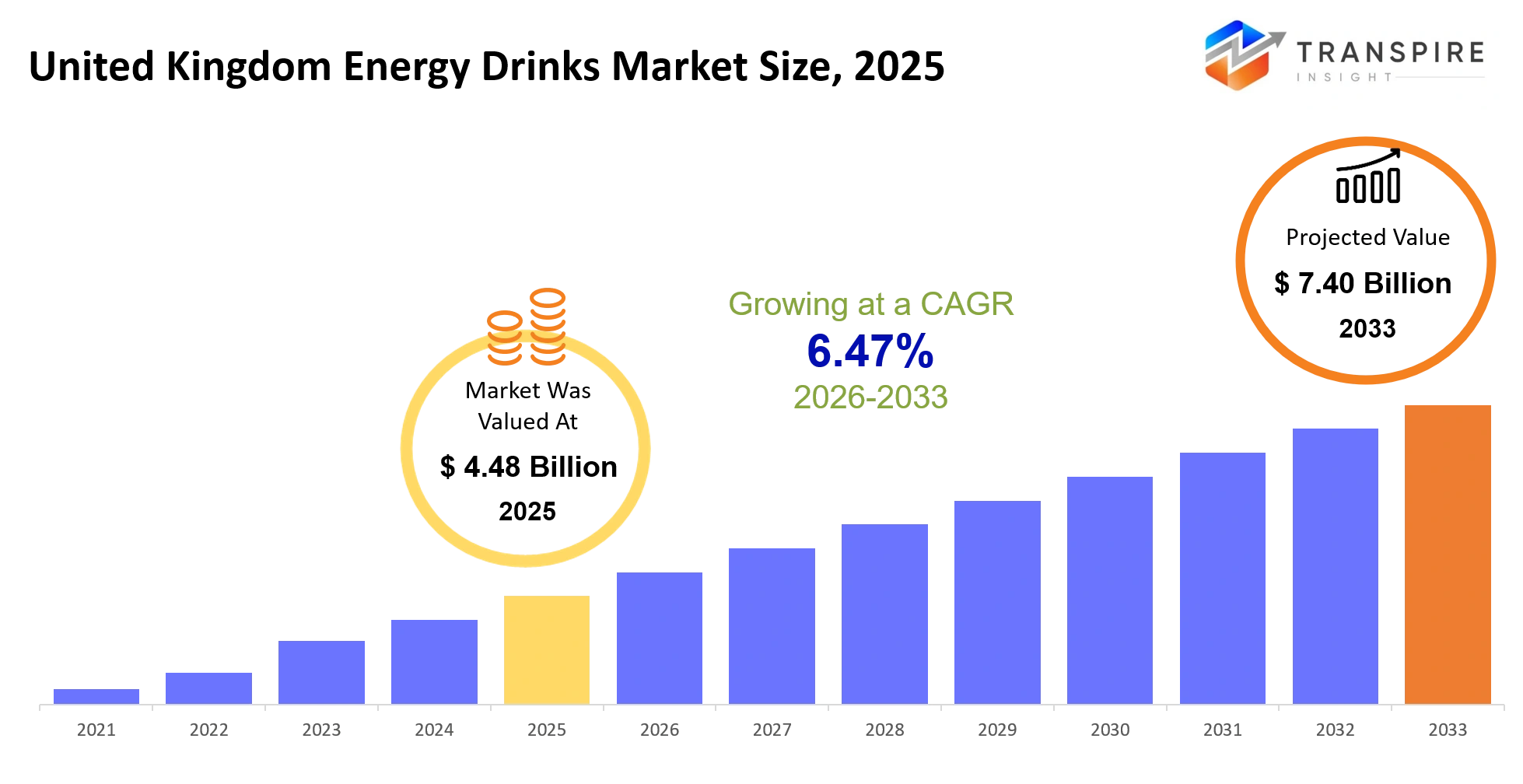
- United Kingdom Energy Drinks Market Size 2025: USD 4.48 Billion
- United Kingdom Energy Drinks Market Size 2033: USD 7.40 Billion
- United Kingdom Energy Drinks Market CAGR: 6.47%
- United Kingdom Energy Drinks Market Segments: By Product Type (Traditional Energy Drinks, Sugar-free Energy Drinks, Organic Energy Drinks, Functional Energy Drinks, Sports Energy Drinks, Caffeinated Beverages, Others); By Flavor (Fruit Flavors, Citrus Flavors, Berry Flavors, Tropical Flavors, Others); By Distribution Channel (Supermarkets, Convenience Stores, Online Retail, Gyms & Fitness Centers, Foodservice, Others); By End User (Teenagers, Adults, Athletes, Fitness Enthusiasts, Working Professionals, Others).
To learn more about this report,  Download Free Sample Report
United Kingdom Energy Drinks Market Summary
The United Kingdom Energy Drinks Market was valued at USD 4.48 Billion in 2025. It is forecast to reach USD 7.40 Billion by 2033. That is a CAGR of 6.47% over the period.
The UK energy drinks market provides fast, portable, caffeine based beverages that help people stay sharp during long work shifts, study blocks, trips, and fitness moments. In real life, it sort of lives in the middle of convenience retail, gyms, and digital commerce, where you want speed in sipping and an immediate functional kick, more than the old idea of “just getting a drink”.
Over the last 3–5 years, the market has been pushed in a structural way toward zero sugar and functional recipes, mostly because of the UK Soft Drinks Industry Levy. That levy basically pushed companies to tweak their products, so they could dodge extra charges. After the pandemic, commuting stuff and evening routines kinda shifted, so people grab energy drinks at times that are different and with another frequency. Then in 2022, energy price inflation put even more strain on retail pricing, like really. These shifts helped speed up the move toward premium positioning and pushed ingredient innovation, which in turn supported margins. At the same moment, it also reshaped how the products compete for attention on shelves at convenience outlets, you know, the whole “who gets seen” thing.
Key Market Insights
- England pretty much dominates the United Kingdom energy drinks market, with an estimated majority slice because there’s dense urban retail and people drink it on repeat, pretty often.
- Scotland and Northern England also look like they’re catching up, with demand going up, helped by more convenience stores opening up and student led consumption habits.
- Wales is kind of steady-growth, you can see it in the way independent retail shelves are getting more shelf space, plus gyms are pushing more of these products too.
- For product type, carbonated energy drinks take the lead in the United Kingdom Energy Drinks Market, mainly due to long standing brand familiarity, and also because impulse buying is a real thing.
- Sugar free and zero calorie variants sit as the second largest segment, and that’s tied to health rules, plus reformulation pressure that follows tax linked changes.
- Functional energy shots are the fastest growing part, they are expanding quickly through 2024–2030, driven by compact but high potency “grab and go” style consumption trends.
- When it comes to application, on-the-go stays in front, it makes up more than one third of total demand in the United Kingdom energy drinks market.
- Fitness and gym usage is actually the quickest rising application, helped by pre workout positioning and marketing that leans into performance benefits.
- For end users, young adults aged 18–34 lead the pack, they’re basically steering bulk retail and convenience store buying.
- Working professionals are the fastest growing category, because longer work hours and hybrid work fatigue patterns create more frequent needs.
What are the Key Drivers, Restraints, and Opportunities in the United Kingdom Energy Drinks Market?
So the introduction of the UK Soft Drinks Industry Levy sort of set off a lot of rearranging across the bigger brands, like they had to rethink formulas, otherwise they’d get hit with heavier taxation. Basically manufacturers had to bring down sugar amounts or deal with the bill. It was a structural shift that pushed players such as Red Bull GmbH and Monster Beverage Corporation to speed up their zero-sugar range, and that ended up boosting shelf visibility. Also it seemed to lift repeat buying in convenience shops and supermarkets, where it’s easier for people to grab the same product again and again. In practice, revenue growth is getting more and more tied to these reformulated SKUs, not the older, high-sugar versions.
A main caveat is that regulators keep tightening their look at caffeine intake levels, especially for younger consumers. This is kind of built-in, structural, because it comes from public health policy and retail rules, not really from what consumers “feel” or market mood. So brands can’t just compensate via pricing tricks or pure advertising. It also limits how much volume can climb in areas close to schools, and it reduces promotional freedom, which slows down getting into the fast, high frequency consumption segments.
The next phase of growth could be hybrid functional energy drinks that blend caffeine with vitamins, adaptogenic extracts, and performance-focused ingredients. Investment is building around pre-workout crossover products, sold through gym chains and also through online stores. The momentum is especially noticeable in urban hubs like London and Manchester. That path may open premiumization too, and supports higher-margin product expansion.
What Has the Impact of Artificial Intelligence Been on the United Kingdom Energy Drinks Market?
In the UK shipping and industrial maritime ecosystem, artificial intelligence along with advanced digital systems are now getting more and more mixed into scrubber performance setups and marine emission control tasks. In day to day operations, AI monitoring platforms are used to automate the exhaust gas cleaning technology diagnostics, while continuously watching SOx , NOx, and particulate behaviour against the IMO compliance ceilings. Because of that, operators see fewer manual inspection rounds, since the platforms flag deviations as they happen, and then tweak control settings to keep the emissions output steady.
At the same time, predictive models powered by machine learning are being rolled out for scrubber fouling, corrosion threats, and pump wear. With this kind of foresight, maintenance can be planned before performance slips, rather than after issues show up. The result is improved vessel availability, and it also supports shipping operators in cutting unplanned dry-docking occurrences, plus it can improve fuel efficiency by using optimized backpressure management. Early deployments , from what people report, suggest directional gains in operational efficiency, like reduced compliance linked penalties, and fuel to emissions ratios that stay more stable across long haul routes.
Still though, the adoption rate is limited. Mainly it’s the onboard connectivity constraints, plus inconsistent sensor data quality in rough marine conditions. There’s also the matter of integration costs, especially when legacy vessels need retrofitting, and that slows the overall scaling for mid-sized operators. Even with those friction points, digital optimization is steadily reshaping compliance handling and lifecycle cost patterns across UK connected maritime fleets.
Key Market Trends
- After 2018, with the UK Soft Drinks Industry Levy, companies like The Coca-Cola Company started reformulating their portfolios, so they reduced the sugar-laden SKUs across the usual energy drink segments, kind of quietly at first.
- Between 2020 and 2025, Monster Beverage Corporation rolled out more zero-sugar variants and that helped steer consumer preference toward low-calorie functional energy items, especially inside convenience channels.
- Then post pandemic, the commuting slump in 2020–2022 brought down the weekday consumption highs, and brands ended up nudging their messaging toward all day drinking occasions for hybrid work routines, not just morning.
- From 2021 onward, retailers increased shelf space for chilled energy shots, which pointed to quicker adoption of smaller compact high-caffeine formats, and yeah it looks like those “grab and go” choices caught on faster.
- Lucozade also sort of repositioned its energy range after 2022, and from that point it leaned harder into sports energy crossover items, aimed at fitness minded people.
- Meanwhile convenience store chains pushed multi buy promotions after the 2023 inflation spikes so they changed up the pricing approach to help steady that falling volume per transaction trend, even if people were still cutting back a bit.
- Meanwhile, esports and gaming partnerships got stronger after 2021, with Red Bull GmbH upping its digital engagement across 18–34-year-old consumers, more focus on feeds and less on traditional ads.
- And gym based distribution kept growing through 2024, matching the rising demand for pre workout energy drinks tied to performance and endurance use cases.
United Kingdom Energy Drinks Market Segmentation
By Product Type :
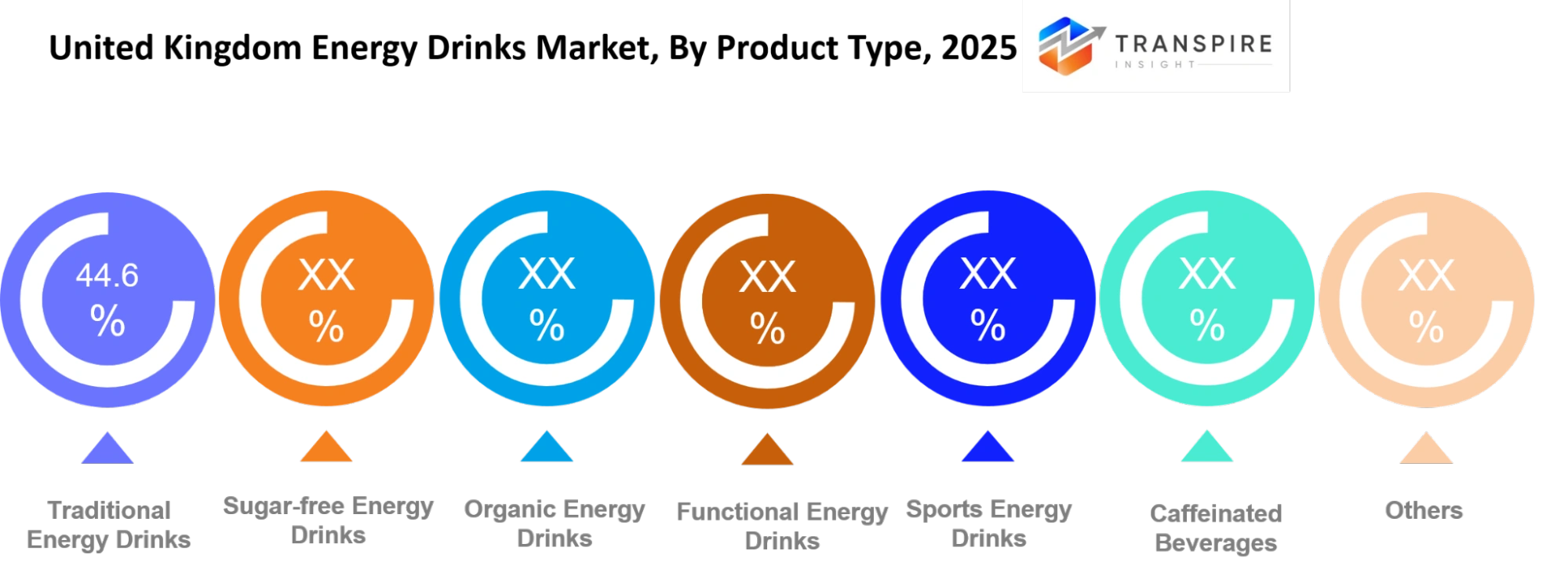
Traditional energy drinks keep showing up strong, mostly because people are already kind of loyal to the brand and because the products stay everywhere—like in convenience shops and similar outlets. Sugar-free energy drinks have also grown, in part because of the tax pressure coming from sugar regulations, which led many companies to redo their formulas across the big name brands. Organic and functional energy drinks are getting more notice lately, since consumers lean more toward cleaner labels, plus those extra wellness perks that feel added.
Sports energy drinks, along with general caffeinated beverages, keep covering performance and alertness expectations for gyms, workplaces, and even travel days. The “Others” group is kind of a grab bag too, with smaller niche blends that mix energy with vitamins or herbal extracts, and they are slowly appearing more often in premium retail areas.
To learn more about this report, Download Free Sample Report
By Flavor :
For flavor, fruit options are still the most widely picked, largely because they taste familiar and are usually easy for younger consumers to accept. Citrus keeps steady demand, too, and it is often tied to ideas of freshness, plus that fast “ quick refresh “ feeling for on-the-go moments.
Berry and tropical flavors have been rising in the past few years, fueled by product innovation and seasonal releases from major brands. Other flavors include mixed combinations, and more experimental profiles that try to pull in premium shoppers, usually through limited-time, small batch cycles that you see in retail stores.
By Distribution Channel :
Supermarkets keep acting like a big distribution hub because people do bulk buys and the leading brands get strong, shelf level visibility. Convenience stores are still really relevant for impulse purchases, mainly in city areas where foot traffic stays high.
Online retail kind of took off after 2020, not just because people were buying more, but also because home delivery systems got stronger and subscriptions for energy drinks became a normal thing. Gyms, training halls, and fitness centers are showing more adoption lately, linked to that pre workout habit and the whole timing pattern around it. Foodservice businesses and other routes also widen the reach, especially when beverage bundles are included with meals.
By End User :
Teenagers stay a crucial customer group, guided by taste preference along with brand marketing exposure across retail aisles and digital platforms. Adults keep a more steady footing, supported by everyday consumption routines and those quick, convenience-driven purchases.
Athletes and fitness enthusiasts are increasing their intake in line with performance goals and endurance needs during training sessions. Working professionals also add more demand, due to longer shifts and a desire for fatigue management, so it fits the day like a routine. Then there are other users too, like occasional consumers who grab an energy drink while traveling or during social events.
What are the Key Use Cases Driving the United Kingdom Energy Drinks Market?
In the United Kingdom, the core demand in the Energy Drinks Market seems to come from that on-the-go kind of usage, especially through convenience stores where commuters and shift workers grab quick caffeine surges. It’s basically because they need to stay alert while doing long travel, dealing with longer retail hours, and working those physically demanding urban shifts which are pretty regular.
Beyond that, people are also using energy drinks in more places like before-workout routines in gyms, during esports gaming marathons, and in these hybrid office patterns where adults depend on energy drinks to control fatigue, sharpen attention, and keep their performance up. This shows up across urban professional groups with irregular working rhythms and schedules.
Then there are the newer angles too, like functional energy blends that mix adaptogens with nootropic components, plus subscription based online delivery options that show up on time, and workplace wellness programs. In those programs employers often provide carefully measured caffeine choices, aiming to help productivity and reduce weariness in demanding office settings across a range of corporate environments.
|
Report Metrics |
Details |
|
Market size value in 2025 |
USD 4.48 Billion |
|
Market size value in 2026 |
USD 4.77 Billion |
|
Revenue forecast in 2033 |
USD 7.40 Billion |
|
Growth rate |
CAGR of 6.47% from 2026 to 2033 |
|
Base year |
2025 |
|
Historical data |
2021 - 2024 |
|
Forecast period |
2026 - 2033 |
|
Report coverage |
Revenue forecast, competitive landscape, growth factors, and trends |
|
Regional scope |
Middle East and Africa (Saudi Arabia, United Arab Emirates, South Africa, Rest of Middle East and Africa) |
|
Key company profiled |
Red Bull, Monster Beverage, Rockstar Energy, PepsiCo, Coca-Cola, Lucozade, Celsius Holdings, Bang Energy, PRIME Hydration, G Fuel, Reign Total Body Fuel, Carabao Group, Hell Energy, Tenzing, Boost Drinks. |
|
Customization scope |
Free report customization (country, regional & segment scope). Avail customized purchase options to meet your exact research needs. |
|
Report Segmentation |
By Product Type (Traditional Energy Drinks, Sugar-free Energy Drinks, Organic Energy Drinks, Functional Energy Drinks, Sports Energy Drinks, Caffeinated Beverages, Others); By Flavor (Fruit Flavors, Citrus Flavors, Berry Flavors, Tropical Flavors, Others); By Distribution Channel (Supermarkets, Convenience Stores, Online Retail, Gyms & Fitness Centers, Foodservice, Others); By End User (Teenagers, Adults, Athletes, Fitness Enthusiasts, Working Professionals, Others). |
Which Regions are Driving the United Kingdom Energy Drinks Market Growth?
England is basically leading the United Kingdom Energy Drinks Market, because the population is dense in cities and the convenience retail web is really well developed, you know. There’s also strong supermarket coverage and the stuff is everywhere in petrol stations and corner stores so people end up buying it on impulse more often. On top of that, the sugar taxation rules are being enforced pretty tightly and this has pushed the big brands to reformulate, so you get better availability of low-sugar and functional variants. And yes, having a big workforce with long commuting hours keeps consumption on a daily rhythm, which then supports the whole dominance thing in practice.
Scotland stays stable and consistent, as a contributor, mainly due to the retail structure being well established and consumer demand staying steady in both urban and semi urban places. The way people drink here is less up and down than in England, mostly because purchasing is predictable in supermarkets and brand loyalty is already kind of entrenched. Sectors tied to industrial work—like construction, logistics, and energy—keep driving demand for high-caffeine choices during long shifts. Retail growth has been gradual not really aggressive, and that helps protect revenue flow from sudden spikes or drops.
Northern Ireland is showing the quickest growth in the United Kingdom Energy Drinks Market, tied to retail modernization moving ahead and youth consumption rising. Product access has improved through cross-border activity with Ireland, and that also increases exposure to international energy drink brands. More recent investments in convenience retail upgrades plus the tourism recovery have strengthened the sales routes across urban areas. Overall this momentum points to solid entry openings for brands that want a more premium angle and wider distribution, stretching from 2026 through 2033.
Who are the Key Players in the United Kingdom Energy Drinks Market and How Do They Compete?
The United Kingdom Energy Drinks Market looks like it is moderately consolidated, like a few global brands are taking up a lot of the shelf space, while smaller niche labels still hustle with flavor innovation and kind of functional positioning too. In this space the fight is mostly about branding muscle, how well they control retail distribution, and doing continuous product reformulation, not just price alone, so it feels a bit different. Big incumbents tend to hold on to share via convenience store dominance and very visible marketing, and at the same time smaller newcomers aim at sugar-free , organic, and performance-centric corners in order to earn some traction with younger consumers
Red Bull GmbH seems to run a premium differentiation play, built around sports marketing esports partnerships, and very high-visibility sponsorships, which all serve to lock in lifestyle imagery rather than getting into direct price competition. Monster Beverage Corporation leans more into large-can formats, lots of flavor diversification, and aggressive retail promotions, and it also benefits from its distribution tie-up with The Coca-Cola Company, helping it push deeper shelf penetration. Meanwhile, The Coca-Cola Company keeps strengthening its spot with portfolio control, especially around UK energy brands like Relentless, and it is also pushing zero-sugar reformulation to match taxation pressures. Then PepsiCo uses its Rockstar Energy brand to compete in convenience channels through pricing campaigns and multi-buy offers, basically those quick impulse type purchases
For Lucozade , under Suntory Beverage & Food Europe, the approach is rooted in UK heritage and this sports-drink crossover angle, with attention on functional energy products linked to fitness and recovery use cases. Its growth path emphasizes product reformulation and retail partnerships spanning supermarkets and gyms, so it keeps reinforcing a health-oriented brand identity. Still, it is operating in a pretty tight shelf environment, so it must stay sharp while others keep coming at the same time
Company List
- Red Bull
- Monster Beverage
- Rockstar Energy
- PepsiCo
- Coca-Cola
- Lucozade
- Celsius Holdings
- Bang Energy
- PRIME Hydration
- G Fuel
- Reign Total Body Fuel
- Carabao Group
- Hell Energy
- Tenzing
- Boost Drinks
Recent Development News
In April 2025, Heineken announced acquisition of a minority stake exceeding 25% in Tenzing. The investment strengthened the distribution capabilities of the UK natural energy drink brand by leveraging Heineken’s global retail and convenience network, accelerating its expansion across underserved UK independent stores.
Source: https://www.thetimes.com/
In May 2026, E.ON announced acquisition of Ovo Energy, forming one of the UK’s largest energy suppliers with a combined customer base exceeding 9 million. While primarily a utilities deal, Ovo’s diversification portfolio includes consumer energy and lifestyle-linked services that intersect with broader functional beverage and retail energy ecosystems influencing UK retail distribution networks.
Source: https://www.reuters.com/
What Strategic Insights Define the Future of the United Kingdom Energy Drinks Market?
The United Kingdom Energy Drinks Market is, kinda slowly but steadily, structurally moving toward a premium functional and regulation-shaped portfolio, where low-sugar compliance and performance minded formulations set the long-term pace. This direction is being pushed by ongoing fiscal pressure from sugar taxation frameworks and a consumer preference shift toward sustained energy instead of that quick burst, like you feel it for a short moment then it is gone. Over the next 5 to 7 years, revenue concentration is expected to get stronger in zero-sugar and functional blends rather than the classic carbonated variants.
There is also a less visible risk, it sits more in ingredient supply concentration, especially when dependence forms around a fairly narrow set of caffeine, taurine, and specialty additive suppliers. That can lead to cost swings and it may disturb formulation stability during global commodity shocks, even when sales look steady on paper. At the same time, an opportunity is quietly forming in gym-integrated retail ecosystems where energy drinks are increasingly framed as pre-workout performance products, sold via fitness chains and digital subscription platforms in urban centres.
For market participants, the practical next step is to prioritize formulation diversification, and also strengthen partnerships with fitness plus convenience retail networks. That way demand consistency is more protected and exposure to regulatory driven volume compression is reduced, even if the rules tighten further.
United Kingdom Energy Drinks Market Report Segmentation
By Product Type
- Traditional Energy Drinks
- Sugar-free Energy Drinks
- Organic Energy Drinks
- Functional Energy Drinks
- Sports Energy Drinks
- Caffeinated Beverages
By Flavor
- Fruit Flavors
- Citrus Flavors
- Berry Flavors
- Tropical Flavors
By Distribution Channel
- Supermarkets
- Convenience Stores
- Online Retail
- Gyms & Fitness Centers
- Foodservice
By End User
- Teenagers
- Adults
- Athletes
- Fitness Enthusiasts
- Working Professionals
Frequently Asked Questions
Find quick answers to common questions.
The United Kingdom Energy Drinks Market size is USD 7.40 Billion in 2033.
Key segments for the United Kingdom Energy Drinks Market are By Product Type (Traditional Energy Drinks, Sugar-free Energy Drinks, Organic Energy Drinks, Functional Energy Drinks, Sports Energy Drinks, Caffeinated Beverages, Others); By Flavor (Fruit Flavors, Citrus Flavors, Berry Flavors, Tropical Flavors, Others); By Distribution Channel (Supermarkets, Convenience Stores, Online Retail, Gyms & Fitness Centers, Foodservice, Others); By End User (Teenagers, Adults, Athletes, Fitness Enthusiasts, Working Professionals, Others).
Major United Kingdom Energy Drinks Market players are Red Bull, Monster Beverage, Rockstar Energy, PepsiCo, Coca-Cola, Lucozade, Celsius Holdings, Bang Energy, PRIME Hydration, G Fuel, Reign Total Body Fuel, Carabao Group, Hell Energy, Tenzing, Boost Drinks.
The United Kingdom Energy Drinks Market size is USD 4.48 Billion in 2025.
The United Kingdom Energy Drinks Market CAGR is 6.47% from 2026 to 2033.
- Red Bull
- Monster Beverage
- Rockstar Energy
- PepsiCo
- Coca-Cola
- Lucozade
- Celsius Holdings
- Bang Energy
- PRIME Hydration
- G Fuel
- Reign Total Body Fuel
- Carabao Group
- Hell Energy
- Tenzing
- Boost Drinks
About the Authors

Chetan Dhatrak
I’m Chetan Dhatrak, a Senior Research Analyst at Transpire Insight, specializing in the Consumer Goods, Foods and Beverages industry. I focus on analyzing market trends, consumer behavior, competitive landscapes, and industry developments to deliver accurate, data-driven insights. My research at Transpire Insight is built on credible sources and in-depth analysis, helping businesses and readers better understand market dynamics, emerging opportunities, and evolving consumer preferences. I’m committed to creating reliable, well-researched content that supports informed decision-making and reflects the latest developments in the consumer goods and food & beverage sectors.

Chakradhar Khansole
Chakradhar serves as the Research Director at Transpire Insight, bringing over 8 years of experience in technology, innovation, and strategic market intelligence. He specializes in transforming complex market data into actionable business insights that enable organizations to make informed, growth-oriented decisions. Recognized for his strategic vision and analytical expertise, Chakradhar leads high-impact research initiatives, delivering comprehensive market assessments, competitive intelligence, and forward-looking industry analysis.
Recently Published Reports
-
Apr 2026
Baby Infant Formula Market
Baby Infant Formula Market Size, Share & Analysis Report By ype (Infant Milk, Follow On Milk, Specialty Baby Milk, Growing-Up Milk), By Ingredient (Carbohydrate, Fat, Protein, Minerals, Vitamins, and Others), By Product Form (Powder, Liquid, and Ready-to-feed), By Distribution Channels (Supermarket/Hypermarket, Specialty Store, Pharmacies, Online Retail, and Others), and Geography (North America, Europe, Asia-Pacific, Middle East and Africa, South and Central America), 2021 - 2031
-
Apr 2026
Edible Insects for Animal Feed Market
Edible Insects for Animal Feed Market Size, Share & Analysis Report By Type (Insect Powder, Insect Meal, Insect Bar, Insect Paste, Insect Oil, and Others), By Insect Type (Beetles, Cricket, Caterpillar, Hymenoptera, Orthoptera, Tree Bugs, and Others), By Application (Livestock, Pet Food, and Aquaculture), By Livestock Type (Poultry, Swine, and Others), and Geography (North America, Europe, Asia-Pacific, Middle East and Africa, South and Central America), 2021 - 2031
-
Apr 2026
Food Industry Disinfection and Bacterial Control Market
Food Industry Disinfection and Bacterial Control Market Size, Share & Analysis Report By Type (Chemical Disinfectants, Physical Disinfectants, and Biocides and Antimicrobials), By Application (Food Processing Equipment Surface Disinfection, Food Preparation Areas Surface Disinfection, Storage Areas Surface Disinfection, Anti-microbial Coatings Food Preservation, and Preservative Solutions Food Preservation), By End User (Meat and Poultry Processing, Dairy Processing, Seafood Processing, Bakery and Confectionery, Restaurants and Commercial Kitchens, and Food Service Providers), By Sales Channel (Online, Offline), and Geography (North America, Europe, Asia-Pacific, Middle East and Africa, South and Central America), 2021 - 2031
-
May 2026
Freeze Dried Food Market
Freeze Dried Food Market Size, Share & Analysis Report By Product Type (Fruits, Vegetables, Freeze-Dried Dairy Products, Freeze-Dried Meat and Seafood, Freeze-Dried Pet Food, and Prepared Meal), By Nature (Organic, and Conventional), By Form (Powdered, Granules, and Diced), By End Use (Breakfast Cereals, Dairy Products, Bakery & Confectionery, Nutritional Bars & Supplements, Powdered Beverages, Snacks, and Retail (Household)), and Geography (North America, Europe, Asia-Pacific, Middle East and Africa, South and Central America), 2021 - 2031