
Germany Artificial Intelligence Market Size & Forecast:
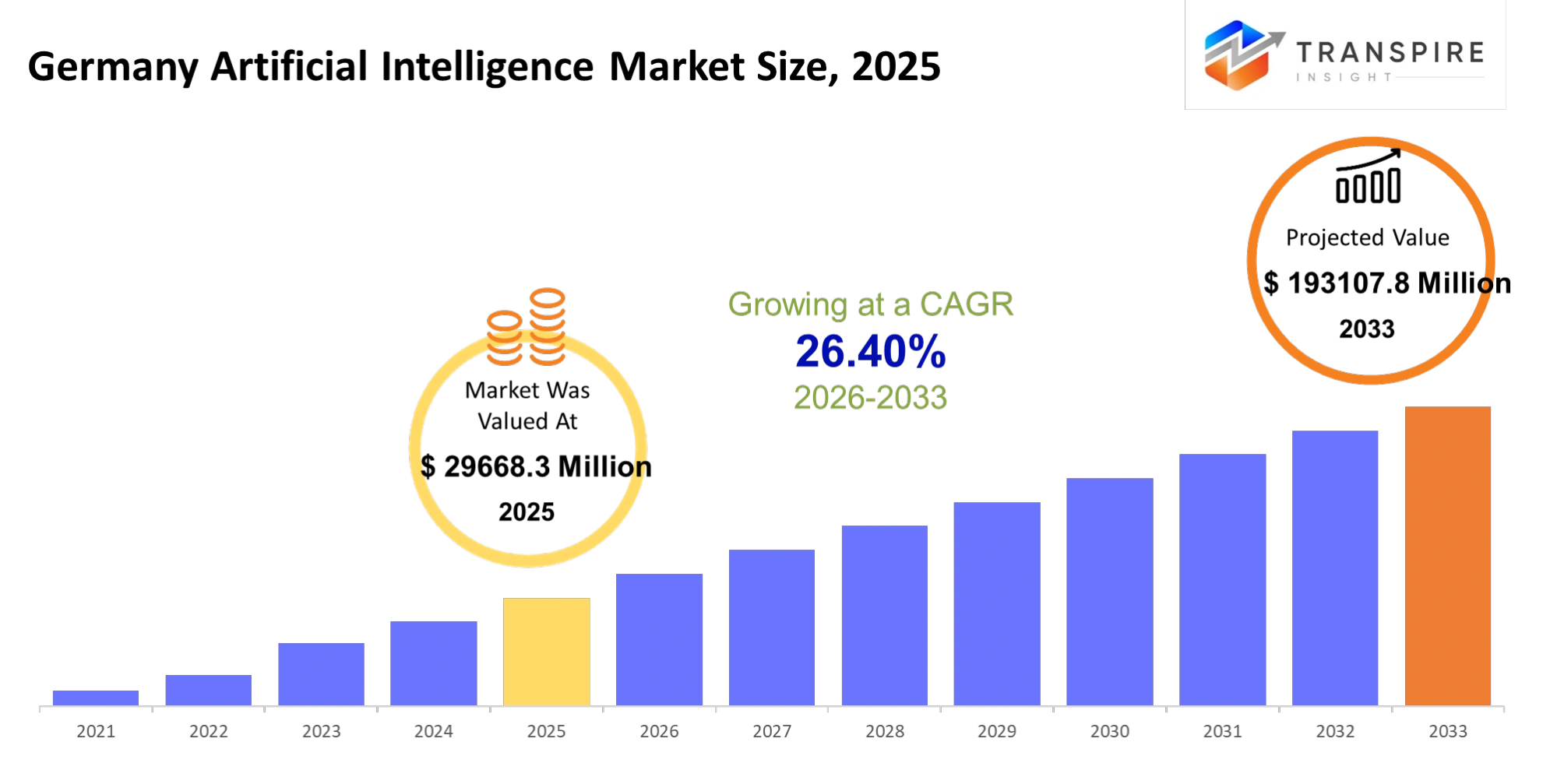
- Germany Artificial Intelligence Market Size 2025: USD 29668.3 Million
- Germany Artificial Intelligence Market Size 2033: USD 193107.8 Million
- Germany Artificial Intelligence Market CAGR: 26.40%
- Germany Artificial Intelligence Market Segments: ByComponent (Hardware, Software, Services), By Deployment (Cloud, On-Premise), By Industry Vertical (Healthcare, Automotive, BFSI, Retail)
To learn more about this report,  Download Free Sample Report
Germany Artificial Intelligence Market Summary:
The Germany Artificial Intelligence Market size is estimated at USD 29668.3 Million in 2025 and is anticipated to reach USD 193107.8 Million by 2033, growing at a CAGR of 26.40% from 2026 to 2033.
The Germany artificial intelligence market in the digital technology industry will see further integration with manufacturing, mobility, finance, and public services. The Germany market will see machine learning being integrated into various industries, reflecting the culture of Germany as an industrial powerhouse. The consumers will demand faster digital services, transparent machine learning, and better data security, forcing companies to balance innovation with trust. The government’s policy and EU’s rules on data management and AI safety will guide product development and deployment. The Germany market will see cooperation between various companies, from start-ups to institutes and carmakers, to convert lab-based models into working solutions in factories across Germany.
Key Market Trends & Insights:
Germany’s industry structure will increasingly incorporate intelligent software into its production system, especially in the automotive and advanced manufacturing sectors. The industry will increasingly rely on intelligent software to enhance the precision of its operations, especially in quality inspection. This will redefine the industry’s operations, especially in terms of enhanced collaboration between engineers, data scientists, and manufacturers.
Germany’s consumers will increasingly demand services with instant response capabilities and seamless interactions between services, especially in banking, retail, and mobility services. Businesses will increasingly incorporate intelligent software to meet these demands. As the quality of services improves, businesses will compete to provide faster decision-making and personalized services.
The regulatory environment of both Germany and the European Union will have a bearing on the implementation of intelligent technology. Data protection regulations, as well as ethical considerations, will lead to the development of intelligent systems. Enterprises will focus on the development of transparent decision models, ensuring the outcomes of intelligent systems remain understandable.
There will be enhanced collaboration between research institutions, the government, as well as other enterprises. The technology institutes of Germany will focus on the testing of intelligent language models, robotics, as well as industrial vision systems. These partnerships will lead to the movement of concepts from the academic environment into practical usage.
Germany Artificial Intelligence Market Segmentation
By Component
Hardware- Advanced processors, AI accelerators, and edge computing devices will be used to support intelligent workloads for various German industries. Manufacturers will use specialized chips and advanced servers to support data-intensive intelligent workloads like computer vision, robotics, and analytics.
Software- Software will be used to support machine learning development, data orchestration, and automated decisions. German companies will use intelligent analytics software, natural language processing software, and model management software to process data and provide useful insights for business optimization.
Services- Professional services will be used to support the design, implementation, and operation of intelligent solutions. Consulting services will be used to help German companies plan and implement intelligent solutions and monitor the performance of the implemented solutions.
By Deployment
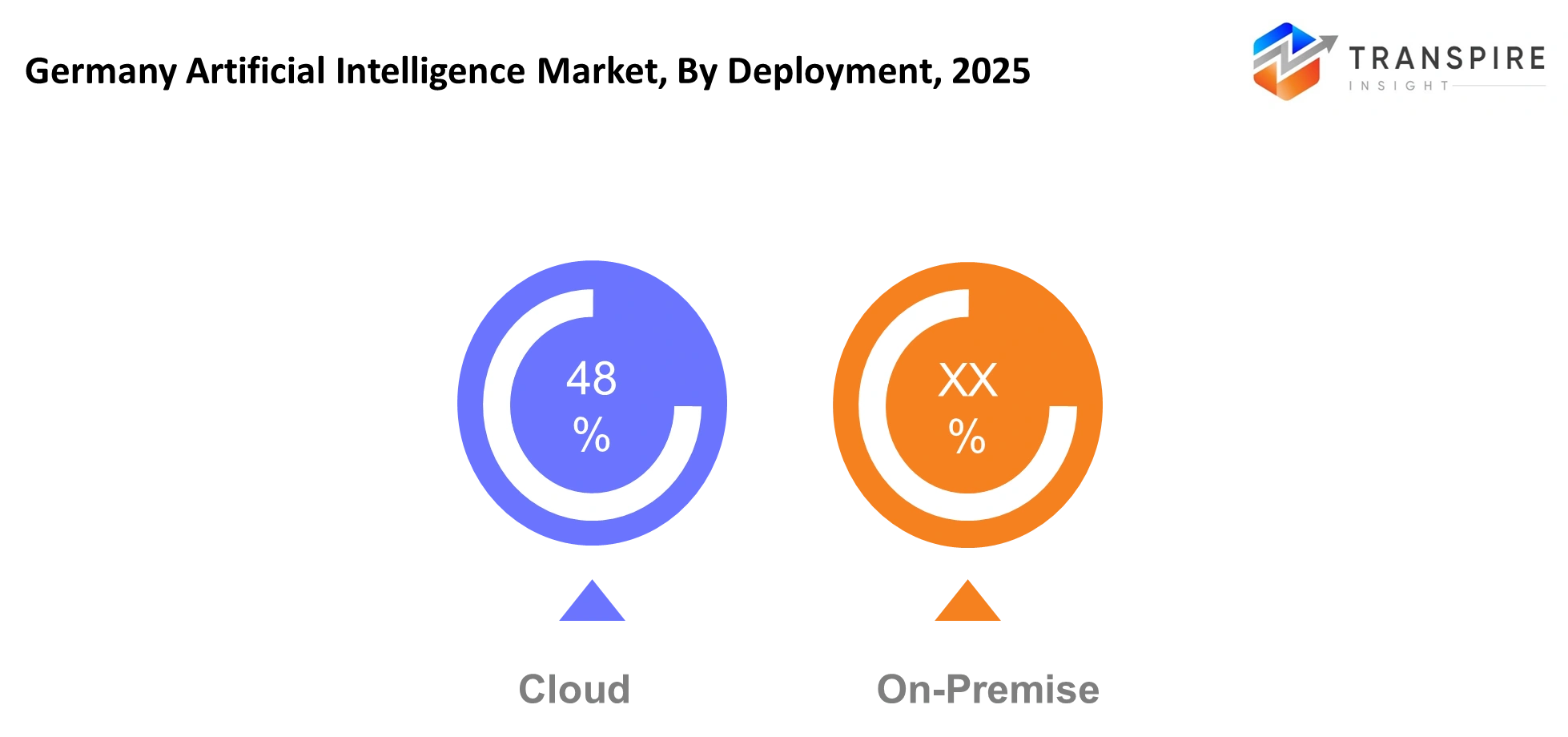
Cloud- This will help German organizations access computing resources without having to invest heavily in infrastructure. Businesses will be able to access servers remotely, which will provide computing resources. This will ensure that organizations can scale up without compromising security.
On-Premise- For sectors that require high control over data, on-premise deployment will be used. This will include manufacturing and finance. Businesses will use intelligent systems, and the data will be available within the data center. This will ensure that data is secure, and there is stability.
To learn more about this report, Download Free Sample Report
By Industry Vertical
Healthcare- In Germany, healthcare organizations will use intelligent diagnostic tools, medical image analysis tools, and predictive health monitoring tools. Healthcare organizations in Germany will use intelligent tools to analyze medical images and provide better healthcare services to patients. Moreover, intelligent tools will help German healthcare organizations improve decision-making capabilities and administrative processes.
Automotive- Automotive organizations in Germany will use intelligent technologies for developing autonomous driving technologies, intelligent manufacturing processes, and predictive maintenance tools. German automotive organizations will use intelligent tools to analyze data and improve safety features in vehicles, manufacturing processes, and innovation in the mobility sector.
BFSI- Financial organizations in Germany will use intelligent tools for risk assessment, fraud detection, and customer service tools. German financial organizations will use intelligent tools to analyze financial transactions in real-time, ensuring better security and improving financial services.
Retail- Retail organizations in Germany will use intelligent tools for demand forecasting, inventory management, and customer relationship management tools. German retail organizations will use intelligent tools to analyze customer purchasing behavior and improve decision-making capabilities.
Country Insights
The technology infrastructure in Germany will continue to support the development and advancement of intelligent computing technology in all sectors, whether in industry or services. The expertise in engineering, coupled with world-class research facilities and close ties between manufacturers and software companies, will continue to encourage experimentation with intelligent computing technology in various sectors.
The cities of Berlin, Munich, and Hamburg will continue to be significant centers for innovation, with new start-ups working closely with established companies to develop intelligent computing technology for commercial use, with venture capital investment in technology incubators to support start-ups in transforming experimental models into commercial products for use in Europe.
The public policy in Germany would remain committed to responsible digital transformation. National policies would be in alignment with European Union policy and would focus on issues like transparency, data security, and responsible algorithm development. Public funding would support research in areas like robotics, language processing, and automation, and thus would ensure that technological advancement goes hand in hand with responsible policy and regulation.
German businesses would increasingly focus on smart technology that promises efficiency rather than novelty. Business groups in manufacturing, logistics, and healthcare would focus on smart technology that promises improvements in precision, productivity, and service delivery. This would further establish Germany’s reputation for using technology in actual economic activities.
Recent Development News
Germany Sets Ambitious AI Infrastructure Initiative- Germany is planning to increase its digital infrastructure as it aims to increase its data centre capacity twice over and its artificial intelligence processing capabilities fourfold over the next decade. The digital strategy is to increase its computing capabilities to support the needs of advanced AI tools and make it more attractive to foreign investment to increase its competitiveness against other global tech leaders.
First Industrial AI Cloud Hub Begins Operations- A major milestone was achieved as the first industrial AI factory was launched in Munich's Tucherpark. The facility is providing high-performance computing capabilities to companies and is already serving clients who use machine learning and robotics and engineering simulations. The facility is backed by partnerships with companies such as Deutsche Telekom and NVIDIA.
|
Report Metrics |
Details |
|
Market size value in 2025 |
USD 29668.3 Million |
|
Market size value in 2026 |
USD 37470.4 Million |
|
Revenue forecast in 2033 |
USD 193107.8 Million |
|
Growth rate |
CAGR of 26.40% from 2026 to 2033 |
|
Base year |
2025 |
|
Historical data |
2021 – 2024 |
|
Forecast period |
2026 – 2033 |
|
Report coverage |
Revenue forecast, competitive landscape, growth factors, and trends |
|
Country scope |
Germany |
|
Key company profiled |
Google LLC, Microsoft Corporation, IBM Corporation, Amazon Web Services, SAP SE, Siemens AG, NVIDIA Corporation, Intel Corporation, Bosch AI, DeepMind Technologies, OpenAI, Salesforce Inc., Oracle Corporation, H2O.ai, C3.ai. |
|
Customization scope |
Free report customization (country, regional & segment scope). Avail customized purchase options to meet your exact research needs. |
|
Report Segmentation |
By Component (Hardware, Software, Services), By Deployment (Cloud, On-Premise), By Industry Vertical (Healthcare, Automotive, BFSI, Retail) |
Key Germany Artificial Intelligence Market Company Insights
The German Artificial Intelligence Market has the potential to grow as industries increasingly incorporate the latest data processing, automation, and intelligent decision-making tools into daily operations. Manufacturing, automobile engineering, finance, and healthcare sectors will increasingly incorporate analytical tools into daily operations. The presence of top-notch research facilities, data governance, and increasing investment from enterprises will provide a practical and innovative technology landscape.
Company List
- Google LLC
- Microsoft Corporation
- IBM Corporation
- Amazon Web Services
- SAP SE
- Siemens AG
- NVIDIA Corporation
- Intel Corporation
- Bosch AI
- DeepMind Technologies
- OpenAI
- Salesforce Inc.
- Oracle Corporation
- H2O.ai
- C3.ai
Germany Artificial Intelligence Market Report Segmentation
By Component
- Hardware
- Software
- Services
By Deployment
- Cloud
- On-Premise
By Industry Vertical
- Healthcare
- Automotive
- BFSI
- Retail
Frequently Asked Questions
Find quick answers to common questions.
The approximate Germany Artificial Intelligence Market size for the market will be USD 193107.8 Million in 2033.
Key segments for the Germany Artificial Intelligence Market By Component (Hardware, Software, Services), By Deployment (Cloud, On-Premise), By Industry Vertical (Healthcare, Automotive, BFSI, Retail)
Major players in the Germany Artificial Intelligence Market are Google LLC, Microsoft Corporation, IBM Corporation, Amazon Web Services, SAP SE, Siemens AG, NVIDIA Corporation, Intel Corporation, Bosch AI, DeepMind Technologies, OpenAI, Salesforce Inc., Oracle Corporation, H2O.ai, C3.ai.
The Germany Artificial Intelligence Market size is USD 29668.3 Million in 2025.
The Germany Artificial Intelligence Market CAGR is 26.40%.
- Google LLC
- Microsoft Corporation
- IBM Corporation
- Amazon Web Services
- SAP SE
- Siemens AG
- NVIDIA Corporation
- Intel Corporation
- Bosch AI
- DeepMind Technologies
- OpenAI
- Salesforce Inc.
- Oracle Corporation
- H2O.ai
- C3.ai
Recently Published Reports
-
Apr 2026
3D Optical Profiler Market
3D Optical Profiler Market Size, Share & Analysis Report By Type (Desktop 3D Optical Profiler, and Portable 3D Optical Profiler), By Technology (Confocal Technology, and White Light Interference), By End-Use Industry (Manufacturing, Research Institutions, Automotive, Aerospace and Defense, Medical Devices, and Other), and Geography (North America, Europe, Asia-Pacific, Middle East and Africa, South and Central America), 2021 - 2031
-
Apr 2026
Depth Sensor Market
Depth Sensor Market Size, Share & Analysis Report By Type (Infrared Depth Sensors, Time-of-Flight (ToF) Sensors, Stereo Vision Sensors, Structured Light Sensors, Ultrasonic Depth Sensors), By Application (Automotive, Robotics, Gaming, Consumer Electronics, Industrial Automation, Healthcare, Security & Surveillance, Others), By End Users (Automotive Manufacturers, Consumer Electronics Companies, Healthcare Providers, Industrial Companies, Security Agencies, Gaming Companies, Robotics Companies, Others), and Geography (North America, Europe, Asia-Pacific, Middle East and Africa, South and Central America), 2021 – 2031
-
Apr 2026
Digital Manufacturing Market
Digital Manufacturing Market Size, Share & Analysis Report By Component (Hardware, Software, and Services), By Technology (Robotics, 3D Printing, Internet of Things (IoT), and Others), By Application (Automotive and Transportation, Aerospace and Defense, Consumer Electronics, Industrial Machinery, and Others), By Process Type (Computer-Based Designing, Computer-Based Simulation, Computer 3D Visualization, Analytics, and Others), and Geography (North America, Europe, Asia-Pacific, Middle East and Africa, South and Central America), 2021 – 2031
-
Apr 2026
Digital Visa Services Market
Digital Visa Services Market Size, Share & Analysis Report By Type (Individual Travelers, Group Travelers), By Application (Tourism, Business Travel, Others), and Geography (North America, Europe, Asia-Pacific, Middle East and Africa, South and Central America), 2021 – 2031