

Global Remote Vehicle Diagnostics Market Size & Forecast:
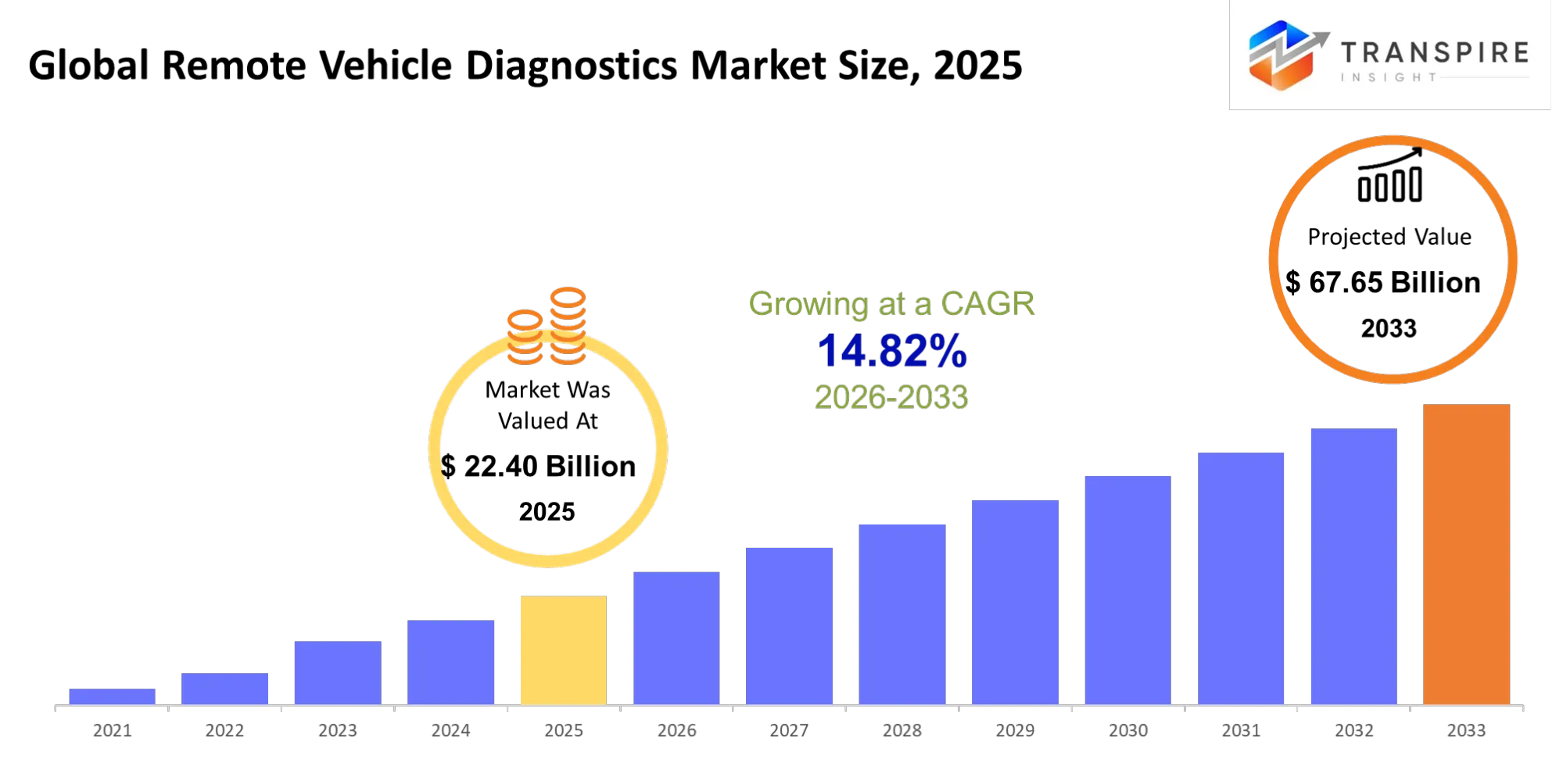
- Global Remote Vehicle Diagnostics Market Size 2025: USD 22.40 Billion
- Global Remote Vehicle Diagnostics Market Size 2033: USD 67.65 Billion
- Global Remote Vehicle Diagnostics Market CAGR: 14.82%
- Global Remote Vehicle Diagnostics Market Segments: By Type (OBD-based Diagnostics, Telematics Diagnostics, Cloud-connected Diagnostics, Predictive Maintenance Platforms, AI-driven Vehicle Analytics, Fleet Diagnostics Solutions, Others); By Application (Passenger Vehicles, Commercial Vehicles, Electric Vehicles, Fleet Management, Insurance Telematics, Others); By End-User (Automotive OEMs, Fleet Operators, Insurance Companies, Consumers, Others); By Technology (IoT-enabled Diagnostics, AI-assisted Diagnostics, GPS-integrated Systems, Hybrid Diagnostic Platforms, Others)
Global Remote Vehicle Diagnostics Market Summary:
The Global Remote Vehicle Diagnostics Market size is estimated at USD 22.40 Billion in 2025 and is anticipated to reach USD 67.65 Billion by 2033, growing at a CAGR of 14.82% from 2026 to 2033. Motivated by growing vehicular connectivity and reliance on real-time performance analysis. The market allows manufacturers, fleet managers, and third parties to diagnose problems, check the health status of vehicles, and cut down the chances of unforeseen downtimes via connectivity technologies. In the past 3-5 years, the market has undergone a transition from reactive maintenance practices towards predictive and cloud-based diagnostics thanks to the implementation of IoT, AI, and telematics. One of the key factors that has pushed the growth in adoption is the fast pace at which connected and electric vehicles have been proliferating; these require consistent monitoring and software-based maintenance services.
Global Remote Vehicle Diagnostics Market Insights:
The future of remote vehicle diagnosis is moving from simply being a system for troubleshooting issues to becoming a fully predictive service platform that uses connected cars and software-defined vehicle architectures. More and more companies are adopting real-time monitoring systems, OTA services, and AI-based maintenance services.
- Nearly 60%+ of remote diagnostics implementations belong to passenger vehicles as the automobile industry moves to establish connected car service offerings.
- About 30–35% of applications involve fleet management as logistics firms seek to minimize vehicle downtimes using predictive maintenance systems.
- Over 75% of vehicles from the premium segment have integrated remote diagnosis functionalities during launch.
- There are many investments made by automotive OEMs on software technologies that provide remote diagnosing without the need for visits to service centers.
- Electric cars are one of the most prominent market segments with an increased focus on battery diagnostics as their global adoption continues growing.
- Telematics services with 5G capabilities are becoming more popular thanks to faster data transmission and real-time monitoring of vehicle performance.
- Commercial vehicle providers are increasingly opting for subscription-based diagnosing tools in order to save money and increase efficiency.
- Predictive maintenance solutions using AI have become popular as businesses transition from reactive to proactive maintenance strategies.
- Cloud-based deployment services currently make up over 55% of new deployments due to several advantages.
What are the Key Drivers, Restraints, and Opportunities in the Global Remote Vehicle Diagnostics Market?
Driver:
The main factor that is fueling growth in the Global Remote Vehicle Diagnostics Market includes the fast expansion of connected vehicles infrastructure and the rising adoption of predictive maintenance systems. Telematics and IoT technologies have been widely adopted in the automobile industry and led to the need for constant vehicle monitoring. The increasing usage of remote vehicle diagnostics is mainly driven by the need to decrease vehicle downtime, reduce maintenance costs, and prevent unnecessary breakages of vehicles. All the above factors have a direct impact on revenue generation.
Restraint:
Market expansion is currently hindered by issues relating to cybersecurity and challenges in integration with older vehicles’ structures. Remote diagnostics are highly dependent on information transfer, and thus expose the network to cyber threats and security breaches. Moreover, many old cars do not have the necessary digital structure, making their modification costly.
Opportunity:
One area where there are great prospects for growth is that of AI-based diagnostic tools coupled with the rise of electric vehicles. The advanced algorithms, machine learning, and battery analysis techniques are some of the factors behind the emergence of maintenance solutions that can bring in profits through the development of electric vehicle production capacity and smart mobility systems.
What Has the Impact of Artificial Intelligence Been on the Global Remote Vehicle Diagnostics Market?
There are several aspects which demonstrate how Artificial Intelligence has revolutionized the Global Remote Vehicle Diagnostics Market. Namely, due to the emergence of advanced analytics systems based on machine learning techniques, diagnostics has transitioned from reactive maintenance towards prediction and automation of maintenance operations in order to prevent any breakdowns before they occur.
In terms of automation, one should pay attention to such issues as real-time fault detection, scheduled services, and remote diagnostics. Thanks to machine learning methods, systems can monitor not only the condition of each element of a car but also its environment and drivers' actions to find the best maintenance schedule.
One of the most significant achievements of artificial intelligence technologies is related to their predictive abilities, which can be helpful in minimizing expenses in commercial companies and for maintaining electric vehicle batteries. In March 2025, the automotive industry adopted the implementation of predictive maintenance solutions driven by artificial intelligence in order to enhance over-the-air diagnosis and decrease dependence on service centers. As a result, intelligent remote monitoring systems were increasingly utilized in fleet management and electric mobility.
Global Remote Vehicle Diagnostics Market Trends:
- In the past five years, there has been a gradual evolution of diagnostics from diagnostic checkups in workshops to continual diagnostics in the connected vehicle environment.
- The industry has started moving away from preventive maintenance to predictive maintenance, which involves using artificial intelligence-based analyses and sensors.
- Manufacturers have started incorporating OTA features in vehicles, cutting down the need for physical service checkups.
- Fleets have begun relying more and more on real-time diagnostics platforms due to changing priorities related to uptime and failure avoidance.
- The cloud-based diagnosis ecosystems have taken over isolated systems that relied on hardware alone for diagnosis.
- As the number of electric vehicles increases, the need for diagnostics shifts to battery diagnostics rather than engine diagnostics.
- The increase in the use of 5G and telematics technology enables quick communication between the vehicle and the cloud, allowing for instant fault detection.
- The automotive firms are moving towards a subscription model, generating profits out of remote diagnostics.
- With rising vehicle connectivity, cybersecurity and data protection have become key concerns for the industry.
Global Remote Vehicle Diagnostics Market Segmentation:
By Type
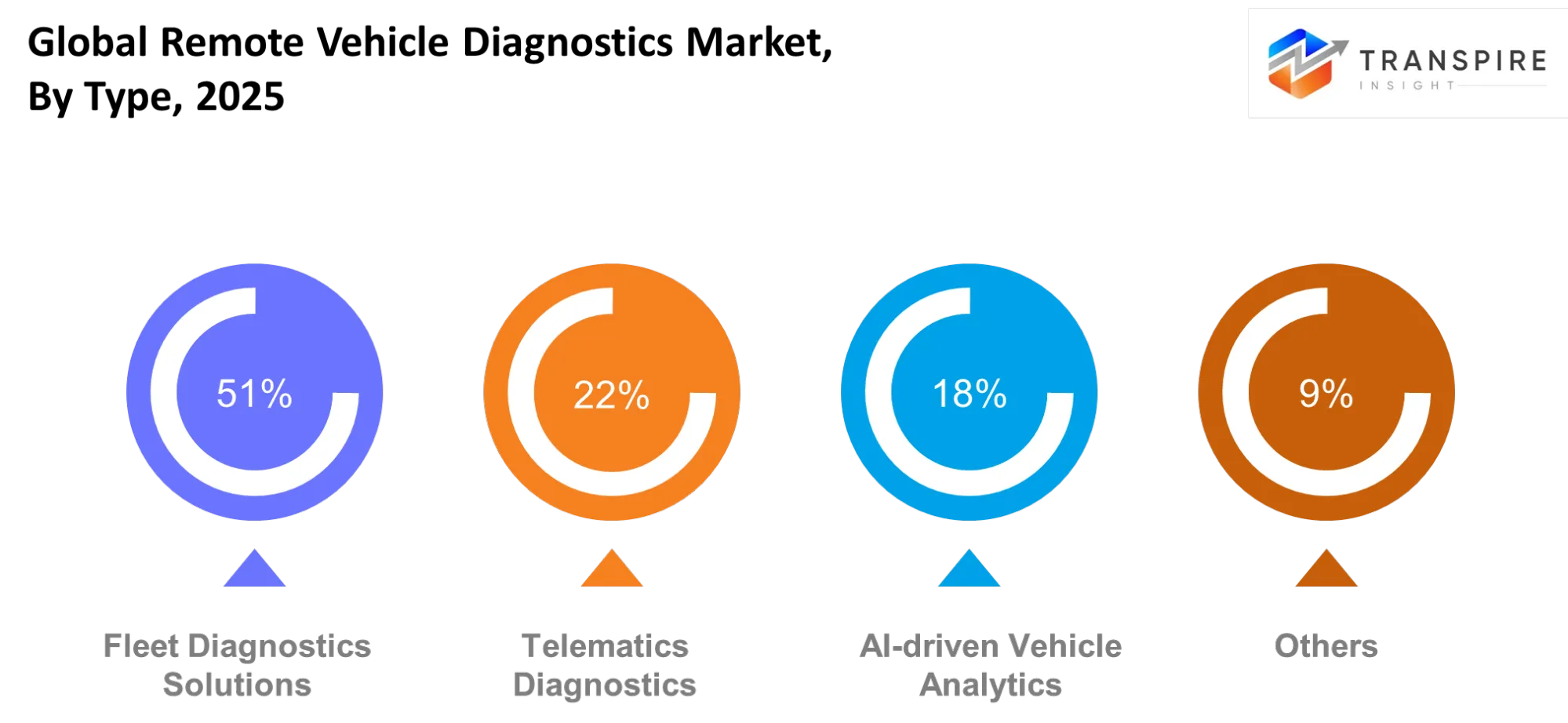
Telematics diagnostics and connected diagnostics enjoy good market positions because of their capabilities to provide real-time diagnostics, remote support, and uninterrupted connection with the vehicle. Diagnostics based on OBD remains relevant due to its low cost and availability for existing car fleets. Predictive maintenance platforms and AI-based vehicle analytics are gaining increasing traction in line with a proactive approach to maintenance. Fleet diagnostics are growing in popularity among commercial operators. In the long run, there is a possibility that diagnostic platforms will turn into mobility intelligence systems.
By Application
Passenger cars account for the biggest market share since car makers are increasingly offering such functionalities in consumer vehicles. The commercial vehicle segment is witnessing rapid growth, and so are fleet management solutions because logistic companies want to reduce downtimes and better utilize their assets. EVs have become an increasingly significant market segment because there is an increased need for battery monitoring and powertrain diagnosis. Telematics applications related to insurance companies are increasingly finding adoption among the various market segments as insurers rely more on behavioral analysis and diagnostics to formulate risk profiles.
By End-User
From an end-user perspective, automotive OEMs occupy a prominent place since diagnostic capability is continuously integrated within car systems. Another fast-growing segment includes fleet owners due to their direct influence on operating expenses. Remote diagnostics for insurance companies is becoming increasingly popular for the improvement of claims processing as well as underwriting processes. Mobile applications with remote diagnostics capability are also gaining popularity among consumers. Future development indicates closer cooperation between the mentioned players.
By Technology
The IoT-based diagnostic solutions prevail because ongoing connectivity with sensors forms the backbone of remote diagnostic devices. The AI-based solution is on the rise due to better accuracy in predicting errors with machine learning. GPS-based solutions will further advance due to the rising need for fleet tracking. Hybrid solutions based on cloud computing and other technologies, such as telematics and AI, are likely to gain significance in the future.
What are the Key Use Cases Driving the Global Remote Vehicle Diagnostics Market?
Global Remote Vehicle Diagnostics Market Use Case Drivers include predictive maintenance and live monitoring of a vehicle's health status in passenger cars and fleets. The monitoring of engine performance, system diagnostics, and maintenance issues can lead to better maintenance performance, less downtime, and reduced maintenance expenses.
Growing applications are being seen within commercial transport, fleet management, and electric mobility ecosystems, where remote diagnostics allow for improved fuel consumption and asset usage, along with increased battery monitoring and overall operational efficiency. Telematics in insurance also uses diagnostics data for improved risk assessment and usage-based pricing systems.
Future potential uses are mainly around autonomous diagnostics with AI, as well as software and software defined vehicle ecosystems. More advanced analytics platforms will enable automated diagnostics of faults, remote monitoring, and intelligent maintenance schedules.
|
Report Metrics |
Details |
|
Market size value in 2025 |
USD 22.40 Billion |
|
Market size value in 2026 |
USD 25.72 Billion |
|
Revenue forecast in 2033 |
USD 67.65 Billion |
|
Growth rate |
CAGR of 14.82% from 2026 to 2033 |
|
Base year |
2025 |
|
Historical data |
2021 - 2024 |
|
Forecast period |
2026 - 2033 |
|
Report coverage |
Market size analysis, growth drivers, restraints, opportunities, competitive landscape, technology trends, AI impact analysis, regional outlook, and segmentation analysis |
|
Regional scope |
North America, Europe, Asia Pacific, Latin America, Middle East & Africa |
|
Key company profiled |
Bosch, Continental AG, Verizon Connect, Geotab, Harman International, Zubie, Delphi Technologies, Vector Informatik, Visteon, Qualcomm, OCTO Telematics, TomTom Telematics, Trimble, Siemens Mobility, CarMD |
|
Customization scope |
Additional country-level analysis, competitive benchmarking, segment-specific analysis, company profiling, and customized forecasting |
|
Report Segmentation |
By Type (OBD-based Diagnostics, Telematics Diagnostics, Cloud-connected Diagnostics, Predictive Maintenance Platforms, AI-driven Vehicle Analytics, Fleet Diagnostics Solutions, Others); By Application (Passenger Vehicles, Commercial Vehicles, Electric Vehicles, Fleet Management, Insurance Telematics, Others); By End-User (Automotive OEMs, Fleet Operators, Insurance Companies, Consumers, Others); By Technology (IoT-enabled Diagnostics, AI-assisted Diagnostics, GPS-integrated Systems, Hybrid Diagnostic Platforms, Others) |
Which Regions are Driving the Global Remote Vehicle Diagnostics Market Growth?
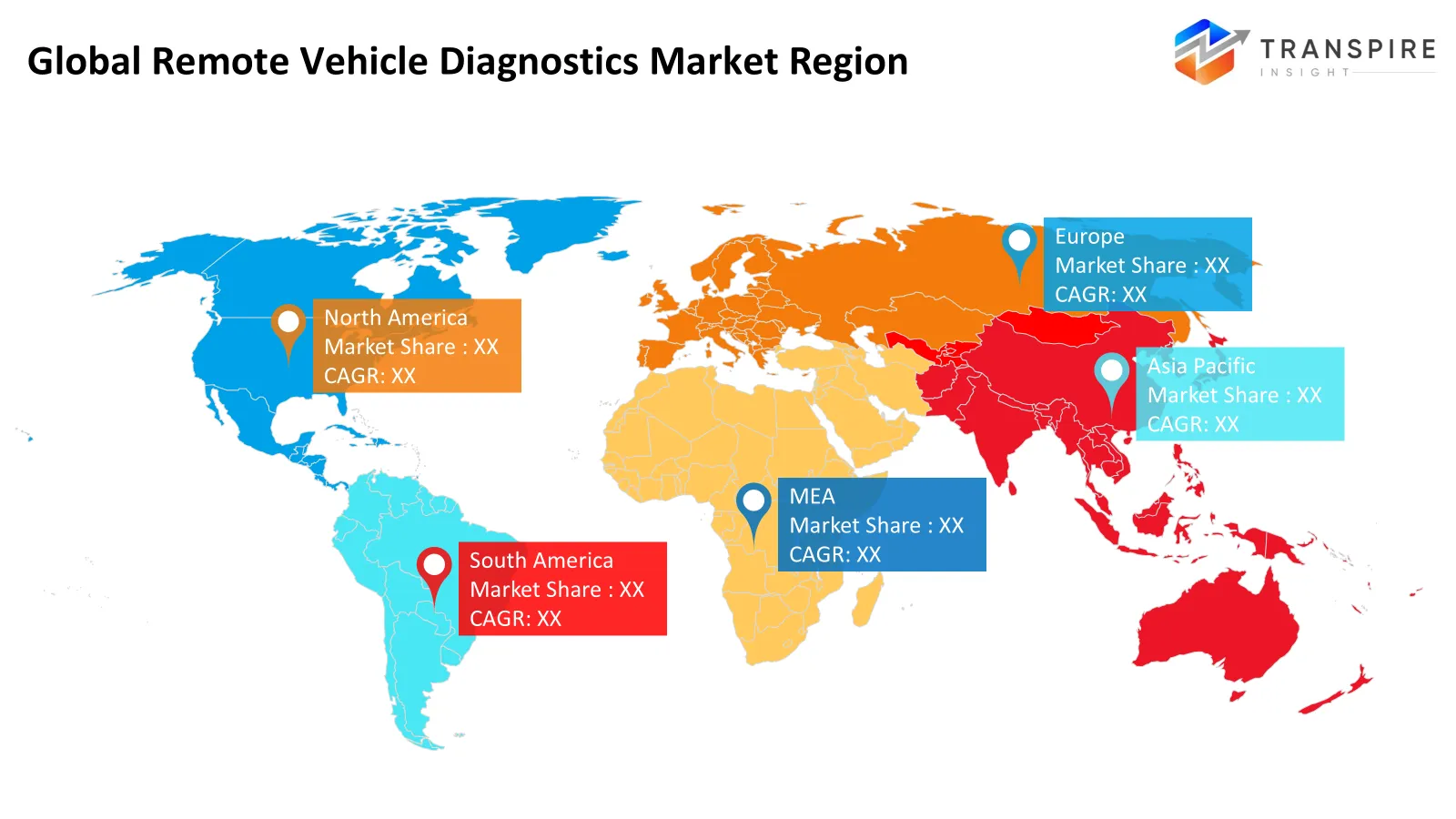
The Global Remote Vehicle Diagnostics Market sees Europe as the dominant region owing to the presence of an advanced connected car ecosystem, well-established automotive manufacturing industry, and robust regulatory framework for promoting the use of digital solutions for automotive needs. The regional dominance is driven by the presence of well-established telematics systems, increased penetration of electric vehicles, and regulations that favor cybersecurity of vehicles along with software-based preventive maintenance ecosystems. In December 2025, the ability to conduct remote diagnostics got further boost with the emergence of connected diagnostic tools that helped independent workshops gain access to previously restricted OEM-only vehicle interfaces.
North America contributes to the second biggest growth driver, yet expansion is primarily dependent on economics of the commercial fleet instead of regulation-led adoption. North America can boast an abundance of commercial fleets, strong penetration rates of telematics in use, subscription-driven mobility solutions, and a well-developed system of insurance telematics that guarantees stable demand for telematics. In October 2025 confirmed, widespread adoption of fleet telematics had been attained in response to the increasing importance of predictive maintenance and operational efficiency improvements.
Asia-Pacific is set to become the world’s fastest growing region owing to the fast-paced digitization taking place in the automotive industry, faster EV manufacturing and increased investments in software-defined automotive ecosystems. The dynamics of growth have transformed considerably as manufacturers are now integrating OTA services, cloud connectivity and embedded diagnostics into mainstream vehicles, as opposed to only luxury vehicles. In April 2026, the implementation of OTA and remote diagnostics systems in production cars signaled the growing trend of adoption of software-defined automotive ecosystems by this region. In the future, increased adoption of connected infrastructure and more vehicle ownership will present many opportunities for such platforms.
Who are the Key Players in the Global Remote Vehicle Diagnostics Market and how do they Compete?
Competition in the Global Remote Vehicle Diagnostics Market occurs based on the technological capabilities for integration of hardware and software, connectivity, and data analysis. Competitive firms are expanding their offerings of cloud-based services, embedding diagnostics capabilities into vehicle architecture and building ongoing relationships through subscription services. Those companies able to integrate telematics, artificial intelligence analytics, cybersecurity measures, and software over-the-air features in mobility platforms are becoming more prominent competitors.
The main competitive advantages of Bosch arise from its ability to innovate and create products for the connected mobility ecosystems and predictive maintenance solutions through the integration of various sensors, software platforms, and vehicle electronics. The competitive strengths of Continental AG are derived from its efforts to enhance intelligent mobility ecosystems via the integration of telematics, connected services, and cloud architectures, giving it an advantage in partnering with automobile producers. Denso differentiates itself through advanced integration and diagnostic capabilities, especially for electric vehicles.
The differentiation strategy for ZF Friedrichshafen includes offering digital fleet management solutions along with commercial vehicle optimization solutions, extending via alliances within mobility ecosystems. For BorgWarner, differentiation is about diagnostic solutions that have an electrical element to enhance its standing in the connected mobility sector. The telematics companies such as Geotab, Verizon Connect, and OCTO offer differentiation via analytics-based platforms and subscription services among other offerings.
Global Remote Vehicle Diagnostics Market Companies:
- Bosch
- Continental AG
- Verizon Connect
- Geotab
- Harman International
- Zubie
- Delphi Technologies
- Vector Informatik
- Visteon
- Qualcomm
- OCTO Telematics
- TomTom Telematics
- Trimble
- Siemens Mobility
- CarMD
Recent Development News:
In April 2026, Excelfore entered into collaboration with automotive vendors to launch their OTA update and remote diagnostic platform on their next generation of vehicles starting with Tata Sierra. This further enhanced the software-defined vehicle capabilities and hastened adoption of cloud-based diagnostic ecosystems.
In February 2026, saw the unveiling by Geotab of its GO and GO Plus telematic systems, which were designed to offer improved levels of information on the efficiency of vehicles and their operations. The introduction of the product line enhanced the capabilities for data analysis.
What Strategic Insights Define the Future of the Global Remote Vehicle Diagnostics Market?
For the future growth and success of the Global Remote Vehicle Diagnostics Market, companies will have to focus on developing ecosystems of connected mobility which transform remote vehicle diagnostics from maintenance toolkits into vehicle intelligence platforms.
One potential issue in the industry involves the increasing fragmentation and complexity of data and cybersecurity challenges posed by increased connectivity, resulting in barriers to large-scale adoption.
One potential opportunity for the industry is based on the synergy between electric vehicles, advanced AI, predictive analytics, and subscription-based mobility services. These technologies could help companies establish a profitable business model by managing vehicle lifecycles intelligently.
On the basis of the foregoing analysis, strategic considerations suggest that companies need to focus on ecosystem building, cloud-native approaches, and scalable analytics platforms since owning vehicle data ecosystems will become more important than possessing certain hardware capabilities in the long run.
Global Remote Vehicle Diagnostics Market Segmentation:
By Type
- OBD-based Diagnostics
- Telematics Diagnostics
- Cloud-connected Diagnostics
- Predictive Maintenance Platforms
- AI-driven Vehicle Analytics
- Fleet Diagnostics Solutions
- Others
By Application
- Passenger Vehicles
- Commercial Vehicles
- Electric Vehicles
- Fleet Management
- Insurance Telematics
- Others
By End-User
- Automotive OEMs
- Fleet Operators
- Insurance Companies
- Consumers
- Others
By Technology
- IoT-enabled Diagnostics
- AI-assisted Diagnostics
- GPS-integrated Systems
- Hybrid Diagnostic Platforms
- Others
Frequently Asked Questions
Find quick answers to common questions.
The Global Remote Vehicle Diagnostics Market size was valued at USD 22.40 Billion in 2025 and is poised to reach USD 67.65 Billion by 2033, expanding at a 14.82% CAGR from 2026 to 2033.
Key segments for the Global Remote Vehicle Diagnostics Market are By Type (OBD-based Diagnostics, Telematics Diagnostics, Cloud-connected Diagnostics, Predictive Maintenance Platforms, AI-driven Vehicle Analytics, Fleet Diagnostics Solutions, Others); By Application (Passenger Vehicles, Commercial Vehicles, Electric Vehicles, Fleet Management, Insurance Telematics, Others); By End-User (Automotive OEMs, Fleet Operators, Insurance Companies, Consumers, Others); By Technology (IoT-enabled Diagnostics, AI-assisted Diagnostics, GPS-integrated Systems, Hybrid Diagnostic Platforms, Others).
Growth is primarily driven by rising connected vehicle adoption, expanding telematics infrastructure, increasing predictive maintenance demand, growing EV deployment, and AI-enabled remote monitoring solutions.
The global market is led by major manufacturers including Bosch, Continental AG, Verizon Connect, Geotab, Harman International, Zubie, Delphi Technologies, Vector Informatik, Visteon, Qualcomm, OCTO Telematics, TomTom Telematics, Trimble, Siemens Mobility, CarMD.
North America holds around 37% market share, driven by strong connected vehicle adoption, advanced telematics infrastructure, large commercial fleet operations, and increasing investments in predictive maintenance technologies.
Commercial opportunities include AI-powered predictive maintenance, EV battery diagnostics, subscription-based fleet monitoring, OTA software services, and expanding connected vehicle ecosystems.
- Bosch
- Continental AG
- Verizon Connect
- Geotab
- Harman International
- Zubie
- Delphi Technologies
- Vector Informatik
- Visteon
- Qualcomm
- OCTO Telematics
- TomTom Telematics
- Trimble
- Siemens Mobility
- CarMD
About the Authors

Mayur Shinde
I am Mayur Shinde, a Senior Research Analyst at Transpire Insight, specializing in the Automotive & Transportation and Information & Communication Technology (ICT) Industry. My work focuses on analyzing emerging market trends, technological advancements, competitive landscapes, and industry developments to deliver accurate, data-driven insights. I am passionate about transforming complex market information into clear, actionable content that helps businesses, professionals, and decision-makers stay informed and make confident strategic decisions.

Chakradhar Khansole
Chakradhar serves as the Research Director at Transpire Insight, bringing over 8 years of experience in technology, innovation, and strategic market intelligence. He specializes in transforming complex market data into actionable business insights that enable organizations to make informed, growth-oriented decisions. Recognized for his strategic vision and analytical expertise, Chakradhar leads high-impact research initiatives, delivering comprehensive market assessments, competitive intelligence, and forward-looking industry analysis.
Recently Published Reports
-
Apr 2026
ATV & UTV Market
ATV & UTV Market Size, Share & Analysis Report By Type (ATV, and UTV), By Variants (Less Than 400 CC, 400 CC To 800 CC, and More Than 800 CC), and Geography (North America, Europe, Asia-Pacific, Middle East and Africa, South and Central America), 2021 - 2031
-
Apr 2026
Automotive Central Gateway Module Market
Automotive Central Gateway Module Market Size, Share & Analysis Report By Type (Ethernet Central Gateway Module, CAN Central Gateway Module, LIN Central Gateway Module, and FlexRay), By Application (Powertrain Control, Body Control, Infotainment System, Advanced Driver Assistance Systems (ADAS), and Others), By End User (Passenger Vehicles, and Commercial Vehicles), and Geography (North America, Europe, Asia-Pacific, Middle East and Africa, South and Central America), 2021 - 2031
-
Apr 2026
Automotive Engine Oil Filter Market
Automotive Engine Oil Filter Market Size, Share & Analysis Report By Filter Type (Fuel Filter, Engine Oil Filter, Hydraulic Oil Filter, and Others), By Filter Media (Cellulose, Synthetic, and Micro), By Sales Channel (OEMs, and Aftermarket), By Vehicle Type (Passenger Cars, Light Commercial Vehicles, Heavy Duty Trucks, Buses and Coaches, and Off-road Vehicles), and Geography (North America, Europe, Asia-Pacific, Middle East and Africa, South and Central America), 2021 - 2031
-
Apr 2026
Automotive Parts Aluminium Die Casting Market
Automotive Parts Aluminium Die Casting Market Size, Share & Analysis Report By Production Process (Pressure Die Casting, Vacuum Die Casting, Squeeze Die Casting, Gravity Die Casting), By Application (Body Parts, Engine Parts, Transmission Parts, Battery And Related Components, Other Application Types), and Geography (North America, Europe, Asia-Pacific, Middle East and Africa, South and Central America), 2021 - 2031
Our Clients



