

Asia Pacific Automotive Internet Of Things (IoT) Market Size & Forecast:
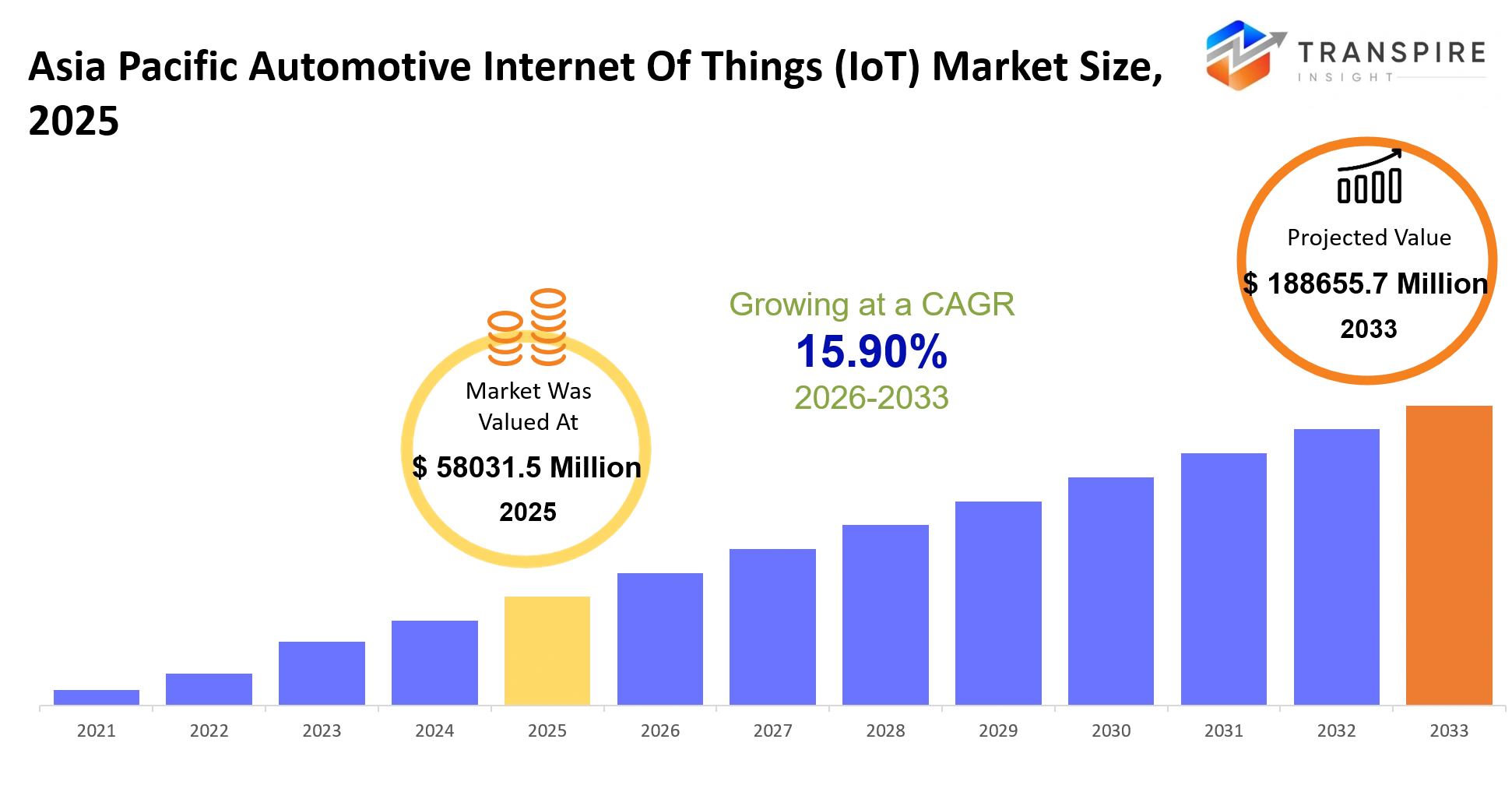
- Asia Pacific Automotive Internet Of Things (IoT) Market Size 2025: USD 58031.5 Million
- Asia Pacific Automotive Internet Of Things (IoT) Market Size 2033: USD 188655.7 Million
- Asia Pacific Automotive Internet Of Things (IoT) Market CAGR: 15.90%
- Asia Pacific Automotive Internet Of Things (IoT) Market Segments: By Component (Hardware, Software, Connectivity Solutions, Sensors, Telematics Units, Cloud Platforms, Others); By Application (Connected Cars, Fleet Management, Predictive Maintenance, Infotainment, Autonomous Driving, Vehicle Diagnostics, Others); By Connectivity (4G, 5G, Wi-Fi, Bluetooth, Satellite, Others); By End User (OEMs, Fleet Operators, Mobility Providers, Consumers, Others).
To learn more about this report,  Download Free Sample Report
Asia Pacific Automotive Internet Of Things (IoT) Market Summary
The Asia Pacific Automotive Internet Of Things (IoT) Market was valued at USD 58031.5 Million in 2025. It is forecast to reach USD 188655.7 Million by 2033. That is a CAGR of 15.90% over the period.
The Asia Pacific Automotive Internet of Things market lets vehicles continuously trade data with drivers, manufacturers, fleet operators, insurers, and even the wider infrastructure networks. In real life it can cut vehicle downtime, boost driver safety, make fleet utilization more efficient, back predictive maintenance, and also enable connected mobility services that keep earning recurring income after the actual vehicle sale.
In the last five years, things sort of shifted in a major way, away from standalone telematics, and toward software-defined, cloud-linked vehicles that can take over-the-air updates and share real time operational insights. That movement kind of changed how connectivity is viewed, from a “nice to have” feature into a core part of how the vehicle is built. After the COVID-19 period, there were semiconductor shortages and supply chain issues, and that did push faster investment into vehicle visibility and remote diagnostics. So automakers, along with fleet operators, started prioritizing these connected technologies more quickly. And since vehicles are now producing bigger data streams, manufacturers are turning digital services into new revenue streams while fleet operators are using analytics to lower operating costs, which makes the business case for broader IoT rollouts pretty solid across both passenger vehicles and commercial segments.
Key Market Insights
- China kind of dominates the Asia Pacific Automotive Internet of Things (IoT) market, holding around 45%+ of the market share by 2025 , largely because its connected vehicle ecosystem is really well developed and also pretty mature.
- India is also the fastest-growing regional space across the whole forecast period, helped by growing telematics intake, plus more money going into digital fleet management programs ,as adoption keeps climbing.
- In Southeast Asia, you can see new demand forming, especially when logistics operators roll out connected vehicle solutions to boost day to day operational efficiency and kind of streamline routes and workflows.
- On the product side, hardware offerings lead the pack, and they are contributing close to 50% of industry revenue in 2025, driven by sensors , gateways, connectivity modules, and onboard diagnostics systems.
- Meanwhile, connectivity platforms and telematics services make up the second-largest segment, mainly because those recurring subscription-based revenue models keep showing up year after year.
- Cloud based automotive analytics is getting traction faster than anything else, and from 2025 to 2032 it looks like the quickest growing segment , since automakers start monetizing data that vehicles create, kind of like nonstop output.
- Fleet management basically holds the lead in application share, and it’s expected to exceed 30% of total market revenue in 2025, mostly due to route optimization , plus predictive maintenance—those two go together.
- When it comes to safety, vehicle safety and advanced driver assistance systems ADAS are showing the fastest growth too, largely pushed by regulatory and insurance needs, and yeah that pressure matters.
- Also remote diagnostics, and over the air software updates, are picking up momentum in a noticeable way across both passenger vehicles and commercial fleets.
- On the manufacturer side, passenger vehicle manufacturers take the biggest slice of the market, backed by connected car feature integration and digital services that customers actually use.
What are the Key Drivers, Restraints, and Opportunities in the Asia Pacific Automotive Internet Of Things (IoT) Market?
The main growth engine in the Asia Pacific Automotive Internet Of Things (IoT) Market is the movement toward software-defined and always-connected cars. Automakers are increasingly seeing connectivity as a repeatable revenue engine more than just a separate feature. With 4G, and 5G rollout in place, plus reduced cloud-computing expenses, it’s become much easier to do real-time vehicle tracking, predictive upkeep, remote diagnostics, and over-the-air software updates, at scale. This whole change lets manufacturers earn after-sale digital service income while fleet managers cut down maintenance expenses and push higher vehicle usage, so adoption and market expansion get a direct boost.
Still, cybersecurity and data privacy worries stay the biggest kind of structural obstacle. Connected vehicles produce and send huge amounts of operational, location, and driver information across many digital environments. To protect these systems, companies need ongoing spending on encryption, software verification, regulatory adherence, and constant risk surveillance. Since security requirements don’t match evenly across the Asia Pacific region, manufacturers run into messy build-and-deploy challenges that raise overall development costs and make widespread rollout take longer. All of that limits possible revenue by making certain risk-aware fleet operators and enterprise buyers hesitate, which in turn slows adoption.
The strongest next opportunity feels like it sits in vehicle-to-everything (V2X) messaging, and also in intelligent transport infrastructure, sort of like the whole flow of streets getting a little more aware. Countries such as China , South Korea, and Singapore are putting serious money into smart mobility ecosystems that link vehicles with traffic systems, road infrastructure, and even cloud platforms. As these networks start to become more mature, automotive IoT providers can roll out advanced safety support, help for autonomous driving, dynamic traffic management, and real time mobility analytics. In that way the market doesn’t just stay about connected vehicles, it stretches into a larger transportation intelligence ecosystem, which then opens up fresh revenue streams for technology vendors and automakers alike.
What Has the Impact of Artificial Intelligence Been on the Asia Pacific Automotive Internet Of Things (IoT) Market?
Artificial intelligence along with more advanced digital technologies are quietly reshaping the Asia Pacific Automotive Internet Of Things market, sort of by making connected vehicles into always- evolving, data driven assets. It’s more subtle than it sounds, as if the whole ecosystem is getting smarter bit by bit, even when people are not watching it closely. Automakers and fleet operators are leaning more and more on AI enabled telematics platforms, to automate vehicle health monitoring, driver conduct analysis, routing optimization, and reporting for compliance requirements. Connected vehicle control systems can even spot abnormal engine parameters, battery efficiency problems, or early component wear and then push service alerts, with no need for someone to manually step in.
Also, it seems like machine learning models keep getting better at prediction for both passenger and commercial fleets, not just one side. When they examine sensor signals, driving patterns, local weather, and even earlier maintenance notes somehow, these systems can foresee component failures before they actually happen, so it means less sudden downtime and more usable life, generally speaking. Meanwhile, AI analytics can fine tune fuel usage, electric vehicle battery behavior, and the overall fleet utilization rhythm, which helps operators cut down operating costs while also boosting vehicle availability.
On the ground, the gains show up as better fleet uptime, less maintenance spending, stronger safety results, and steadier adherence to emissions and vehicle performance expectations. Still, there’s a big catch: integrating AI platforms with older vehicle setups is expensive, and the data ecosystems are often fragmented. A lot of fleets run mixed vehicle platforms, so standardizing data capture becomes complicated, and model accuracy can drift across different real world operating conditions, even when everyone expects it to stay consistent.
Key Market Trends
- Since 2021, automakers have moved away from standalone telematics boxes to software-defined vehicle platforms that can do continuous over-the-air updates and feature upgrades.
- After the nationwide 5G rollout in China, Chinese manufacturers pushed connected vehicle deployments faster, so adoption of real-time diagnostics and vehicle data services went quicker too, sometimes even more smoothly than expected.
- Fleet operators have also been shifting from reactive upkeep habits to predictive maintenance setups which basically read sensor information and try to curb that nasty unexpected downtime.
- Starting in 2022, commercial transport firms broadened AI-powered route optimization tools, aiming to lift fuel efficiency and better vehicle utilization across those regional networks.
- Lately the regulatory focus has leaned more toward cybersecurity compliance, so manufacturers started putting serious money into secure connected vehicle architectures , plus data protection frameworks that actually hold up.
- Bigger players like Toyota, Hyundai, Bosch, Continental, and Denso have been expanding their agreements with cloud and telecommunications providers, especially since 2023.
- And yeah, vehicle-generated data monetization has become a major business pathway , where manufacturers offer subscription based services for navigation diagnostics and fleet analytics.
- Between 2020 and 2023, supply chain disruptions caused extra industry investment in remote diagnostics , asset visibility, and connected fleet management technologies.
- Buyers now tend to judge connected vehicle platforms based on software maturity, cybersecurity resilience, and the wider digital service ecosystem, not just the hardware spec sheet alone.
Asia Pacific Automotive Internet Of Things (IoT) Market Segmentation
By Component :
Hardware is basically the physical base of connected vehicle systems, and it brings devices that collect, process, and send information tied to a bunch of vehicle functions, not just one. Sensors, telematics units, communication modules, and control devices together keep doing continuous monitoring, things like vehicle performance, day to day operating conditions, and even driving patterns. And as advanced electronics keep getting more integrated, hardware really became more central to modern automotive connectivity, somehow.
Then there’s software, which takes that incoming information and figures out what it means, plus it manages it over time. With connectivity solutions, the idea is that communication happens between vehicles, cloud spaces, and outside networks, all at once, or at least in a coordinated way. Cloud platforms bring storage, analytics, and remote access features, so vehicle manufacturers and service providers can push updates, diagnostics, and all kinds of digital services. There are also other component groups, sort of supporting technologies that improve data exchanging and overall operational efficiency across connected mobility ecosystems.
By Application :
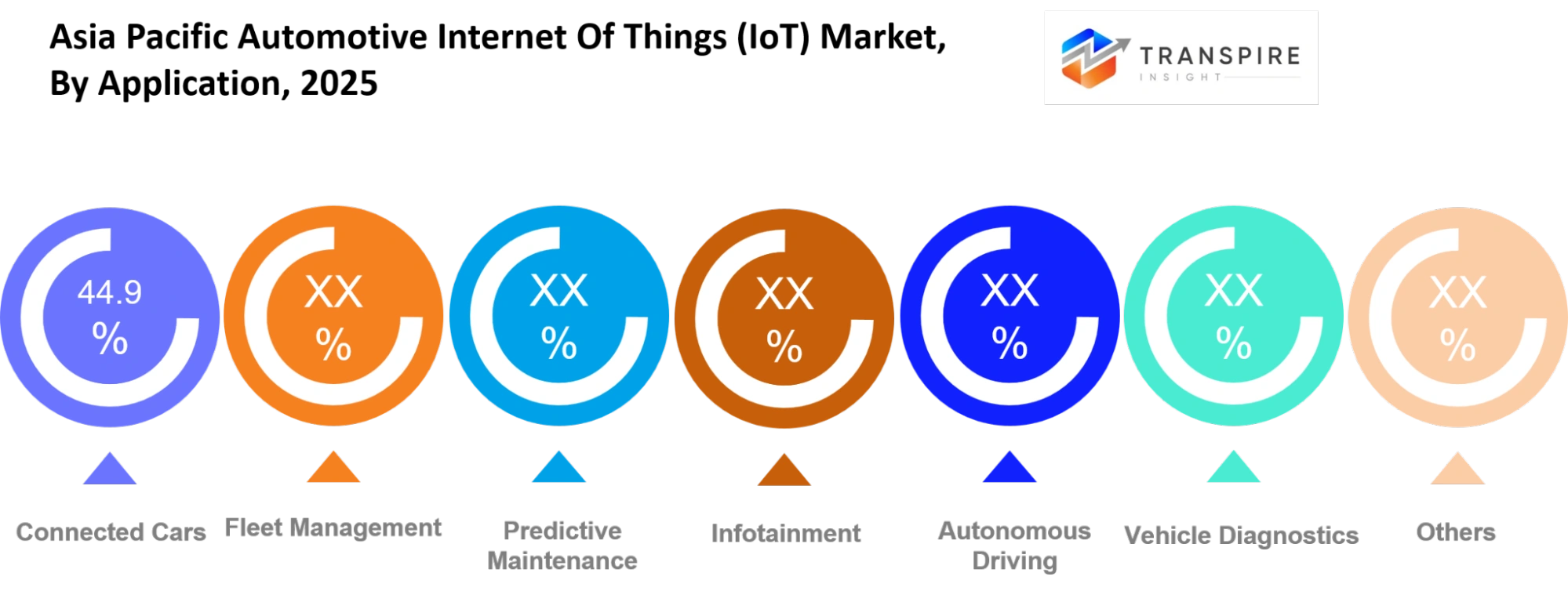
Connected cars are sort of one of the most widely adopted uses today, where vehicles can exchange data with outside networks, local infrastructure, and digital platforms . This kind of access tends to improve navigation, increase safety, and make remote monitoring and everyday user comfort more practical. Also, the infotainment system helps make the ride feel more like a connected experience, by offering things like entertainment , messaging, and various information services, all in one place.
On the other side, fleet management solutions help organizations keep an eye on vehicle positions, fuel usage , how drivers behave, and whether routes are really efficient. Predictive maintenance apps lean on operational data to spot possible problems before they turn into actual failures, so downtime drops and maintenance costs usually follow. Meanwhile, autonomous driving technologies , together with vehicle diagnostics systems, keep growing , which supports higher automation, near real-time performance tracking, and better reliability overall. There are also other applications that answer new mobility and transportation needs , in their own ways.
To learn more about this report, Download Free Sample Report
By Connectivity :
4G connectivity has played a big role in enabling connected vehicle services, by giving a dependable channel for navigation telematics, remote diagnostics and fleet operations. A lot of connected vehicle platforms still lean on tried-and-true 4G networks because the coverage is wide and the behavior stays steady across both city roads and regional transit corridors.
5G is getting more attention lately, mostly for quicker data transfer rates, lower latency and it supports more sophisticated connected vehicle use cases. Wi-Fi and Bluetooth are usually used for near-range messaging and for device integration inside the vehicle, sometimes people say it’s more convenient than long distance options. Satellite connectivity helps when vehicles operate in remote zones where terrestrial network reach is thin. Besides these, other connectivity approaches show up too, they cover specialized communication needs and help extend a broader set of automotive IoT functions.
By End User :
OEMs leverage connected vehicle technologies to help nudge product performance up, give digital services a real place, and build stronger customer engagement across the entire vehicle lifecycle. When connected platforms get properly integrated , manufacturers can capture operational insights, back software updates, and open up new revenue angles via subscription based services , plus advanced vehicle features that actually feel newer.
Fleet operators in turn lean on automotive IoT solutions to raise asset utilization, keep an eye on vehicle health, and fine tune transportation activities. Mobility providers use connected capabilities to enable shared transportation, and also to power digital mobility services that fit how people move today. Consumers get the upside too, with better convenience , improved safety, smarter navigation, and more personalized driving experiences.
Beyond that, other end user groups adopt connected vehicle technologies in order to satisfy their own operational, commercial, or transportation needs, especially within the Asia Pacific Automotive Internet Of Things (IoT) Market.
What are the Key Use Cases Driving the Asia Pacific Automotive Internet Of Things (IoT) Market?
Connected vehicle services still kinda stay the main reason people adopt the Asia Pacific Automotive Internet Of Things (IoT) Market. Automakers and fleet operators lean on real time telematics, vehicle diagnostics and even location tracking to get better operational visibility , cut down downtime, and boost driver safety. For this reason, this kind of application tends to create the strongest demand because it brings clear cost savings, and also keeps vehicle performance under a more continuous kind of watch.
At the same time, fleet management alongside predictive maintenance is starting to show broader uptake, especially with logistics firms, commercial transport operators and mobility service providers. The information coming from connected vehicles helps in route optimization, fuel consumption monitoring, more proactive maintenance scheduling , and improved asset utilization. Honestly these functions are getting more relevant as transportation networks grow through fast urbanizing regions.
Some new use cases are also taking shape like vehicle to everything (V2X) communication and advanced autonomous driving assistance systems. Smart city programs in places such as China, South Korea, and Singapore are opening up opportunities for connected vehicles to link with traffic infrastructure, so they can support more fluid traffic management, better road safety, and even what you might call next wave autonomous mobility services.
|
Report Metrics |
Details |
|
Market size value in 2025 |
USD 58031.5 Million |
|
Market size value in 2026 |
USD 67140.3 Million |
|
Revenue forecast in 2033 |
USD 188655.7 Million |
|
Growth rate |
CAGR of 15.90% from 2026 to 2033 |
|
Base year |
2025 |
|
Historical data |
2021 - 2024 |
|
Forecast period |
2026 - 2033 |
|
Report coverage |
Revenue forecast, competitive landscape, growth factors, and trends |
|
Regional scope |
Asia Pacific (India, China, Japan, Australia, South Korea, Rest of Asia Pacific) |
|
Key company profiled |
Bosch, Continental, Denso, Aptiv, Harman, Qualcomm, Huawei, Ericsson, Cisco, IBM, Microsoft, AWS, Intel, NXP Semiconductors, Samsung Electronics. |
|
Customization scope |
Free report customization (country, regional & segment scope). Avail customized purchase options to meet your exact research needs. |
|
Report Segmentation |
By Component (Hardware, Software, Connectivity Solutions, Sensors, Telematics Units, Cloud Platforms, Others); By Application (Connected Cars, Fleet Management, Predictive Maintenance, Infotainment, Autonomous Driving, Vehicle Diagnostics, Others); By Connectivity (4G, 5G, Wi-Fi, Bluetooth, Satellite, Others); By End User (OEMs, Fleet Operators, Mobility Providers, Consumers, Others). |
Which Regions are Driving the Asia Pacific Automotive Internet Of Things (IoT) Market Growth?
China kinda leads the Asia Pacific Automotive Internet Of Things (IoT) Market, mostly because strong government backing really helps connected mobility, intelligent transportation systems, and vehicle digitization. On top of that, the huge rollout of 5G infrastructure has made it easier for connected vehicle services to show up across passenger fleets and also commercial ones. There’s also the fact that the country hosts big automakers, tech firms, semiconductor suppliers, and cloud service providers, so innovation doesn’t really slow down. So overall, policy support + manufacturing scale, plus digital infrastructure sort of keeps pushing China ahead in the market.
Japan and South Korea, meanwhile, bring in a major portion of the regional revenue using a different approach, more like steady technical maturity with long-term investment. Automotive players there tend to put lots of emphasis on advanced vehicle electronics, safety systems, and deeper software integration. With regulatory rules that stay fairly stable and research and development budgets that don’t swing too much, the environment for connected vehicle deployment feels more predictable. If you compare it with China, the pace is more measured . Still, strong technology strength means both markets stay dependable contributors to industry revenue.
India and Southeast Asia are showing up as the quickest regional markets, mostly because rapid transport digitalization and the steady expansion of commercial vehicle fleets. Lately there’s been a bunch of investments in smart mobility programs , digital logistics networks, and next-generation telecom infrastructure. That has kind of sped up how fast connected vehicle technologies are getting used. Fleet operators now more and more lean on telematics and predictive maintenance solutions to boost operational efficiency, and manage their costs , better. As things keep growing across these places, the 2026–2033 period should bring pretty promising chances for technology vendors, connectivity providers, and automotive software developers.
Who are the Key Players in the Asia Pacific Automotive Internet Of Things (IoT) Market and How Do They Compete?
Competition in the Asia Pacific Automotive Internet Of Things (IoT) market is moderately consolidated, I mean not total chaos but still. Big global automotive technology suppliers, vehicle manufacturers, and digital platform providers are jostling for long term connectivity ecosystems, not really for one-time hardware sales. These days technology capability is the main thing, like it’s the core advantage , especially in vehicle connectivity, predictive analytics, cybersecurity, over the air updates, and cloud integration. Established automotive suppliers keep trying to hold market share with heavy research spending and long term relationships with vehicle manufacturers. At the same time, telecommunications firms and software companies are pushing out new connected mobility services, and honestly it kind of makes the older business models wobble. So in practice the competitive edge now relies on stitching hardware, software, and data services into one unified platform, rather than just selling a component.
Robert Bosch GmbH seems to set itself apart with integrated automotive electronics, connectivity solutions, and artificial intelligence capabilities that back predictive maintenance and vehicle diagnostics. It keeps building partnerships with automakers and cloud technology providers so it can expand software-defined vehicle features. Continental AG, on the other hand, leans heavily into intelligent mobility systems, advanced telematics, and connected safety technologies. Its strong footing in vehicle electronics and driver assistance systems lets Continental deliver integrated solutions that support both connectivity and vehicle performance optimization.
Denso Corporation puts a lot of weight on high reliability for automotive parts and also connected vehicle tech, mostly shaped for Asian car makers. It works in close coordination with regional vehicle producers so the products fit local needs pretty neatly though sometimes details shift. Meanwhile Hyundai Motor Company together with Toyota Motor Corporation is pushing farther on connected vehicle ecosystems, using software platforms, digital services and a few mobility technology alliances. They both keep leaning into vehicle data as an everyday practice, doing remote diagnostics and using over the air update functions, in order to generate repeat service revenue, and also keep customers more steadily across Asia Pacific markets.
Company List
- Bosch
- Continental
- Denso
- Aptiv
- Harman
- Qualcomm
- Huawei
- Ericsson
- Cisco
- IBM
- Microsoft
- AWS
- Intel
- NXP Semiconductors
- Samsung Electronics
Recent Development News
In August 2025, Geely, through its aerospace subsidiary Geespace, launched 11 additional satellites, expanding its automotive-focused IoT constellation to 41 satellites. The investment enhanced vehicle connectivity, navigation, and future ADAS capabilities, making Geely the only major automaker operating its own satellite-enabled connected-vehicle network.
Source: https://www.wired.com/
In April 2025, Volkswagen Group launched five intelligent, fully connected vehicles and introduced a new AI-based advanced driver-assistance system at Auto Shanghai 2025. The launch reinforced the company’s ‘In China, for China’ strategy and expanded the deployment of connected-vehicle technologies that are central to the automotive IoT market in Asia Pacific.
Source: https://www.volkswagen-group.com/
What Strategic Insights Define the Future of the Asia Pacific Automotive Internet Of Things (IoT) Market?
The Asia Pacific Automotive Internet Of Things (IoT) Market is sliding toward a more software‑centric mobility model, where vehicle value isn’t just in hardware but more and more in connected services, data‑driven applications, and lifecycle management. The push underneath all of that is basically the coming together of 5G networks, artificial intelligence, cloud computing, and software‑defined vehicle architectures. As connectivity turns into a normal feature across nearly every vehicle category, the competitive focus shifts from component differentiation to platform ownership and ongoing digital revenue streams.
There’s also one quiet risk that can be easy to miss. The market can become concentrated around a limited set of software, cloud, and connectivity providers. If manufacturers or fleet operators rely on just a few tech ecosystems then cybersecurity exposure can rise, interoperability issues may appear, and pricing flexibility can shrink for everyone involved, including fleet operators. Still, there’s an opportunity running in parallel, because vehicle‑to‑everything (V2X) infrastructure is starting to take off. This is especially noticeable in China, South Korea, and Singapore, where smart transportation spending keeps expanding
So market participants should lean into open and interoperable platforms, plus strategic partnerships. The idea is to support scalable data services, while also lowering dependence on any one single technology ecosystem, even if that ecosystem looks “convenient” today.
Asia Pacific Automotive Internet Of Things (IoT) Market Report Segmentation
By Component
- Hardware
- Software
- Connectivity Solutions
- Sensors
- Telematics Units
- Cloud Platforms
By Application
- Connected Cars
- Fleet Management
- Predictive Maintenance
- Infotainment
- Autonomous Driving
- Vehicle Diagnostics
By Connectivity
- 4G
- 5G
- Wi-Fi
- Bluetooth
- Satellite
By End User
- OEMs
- Fleet Operators
- Mobility Providers
- Consumers
Frequently Asked Questions
Find quick answers to common questions.
The expected Asia Pacific Automotive Internet Of Things (IoT) Market size is USD 188655.7 Million in 2033.
Key segments for the Asia Pacific Automotive Internet Of Things (IoT) Market are By Component (Hardware, Software, Connectivity Solutions, Sensors, Telematics Units, Cloud Platforms, Others); By Application (Connected Cars, Fleet Management, Predictive Maintenance, Infotainment, Autonomous Driving, Vehicle Diagnostics, Others); By Connectivity (4G, 5G, Wi-Fi, Bluetooth, Satellite, Others); By End User (OEMs, Fleet Operators, Mobility Providers, Consumers, Others).
Major Asia Pacific Automotive Internet Of Things (IoT) Market players are Bosch, Continental, Denso, Aptiv, Harman, Qualcomm, Huawei, Ericsson, Cisco, IBM, Microsoft, AWS, Intel, NXP Semiconductors, Samsung Electronics.
The Asia Pacific Automotive Internet Of Things (IoT) Market size is USD 58031.5 Million in 2025.
The Asia Pacific Automotive Internet of Things (IoT) Market CAGR is 15.90% from 2026 to 2033.
- Bosch
- Continental
- Denso
- Aptiv
- Harman
- Qualcomm
- Huawei
- Ericsson
- Cisco
- IBM
- Microsoft
- AWS
- Intel
- NXP Semiconductors
- Samsung Electronics
About the Authors

Mayur Shinde
I am Mayur Shinde, a Senior Research Analyst at Transpire Insight, specializing in the Automotive & Transportation and Information & Communication Technology (ICT) Industry. My work focuses on analyzing emerging market trends, technological advancements, competitive landscapes, and industry developments to deliver accurate, data-driven insights. I am passionate about transforming complex market information into clear, actionable content that helps businesses, professionals, and decision-makers stay informed and make confident strategic decisions.

Chakradhar Khansole
Chakradhar serves as the Research Director at Transpire Insight, bringing over 8 years of experience in technology, innovation, and strategic market intelligence. He specializes in transforming complex market data into actionable business insights that enable organizations to make informed, growth-oriented decisions. Recognized for his strategic vision and analytical expertise, Chakradhar leads high-impact research initiatives, delivering comprehensive market assessments, competitive intelligence, and forward-looking industry analysis.
Recently Published Reports
-
Apr 2026
ATV & UTV Market
ATV & UTV Market Size, Share & Analysis Report By Type (ATV, and UTV), By Variants (Less Than 400 CC, 400 CC To 800 CC, and More Than 800 CC), and Geography (North America, Europe, Asia-Pacific, Middle East and Africa, South and Central America), 2021 - 2031
-
Apr 2026
Automotive Central Gateway Module Market
Automotive Central Gateway Module Market Size, Share & Analysis Report By Type (Ethernet Central Gateway Module, CAN Central Gateway Module, LIN Central Gateway Module, and FlexRay), By Application (Powertrain Control, Body Control, Infotainment System, Advanced Driver Assistance Systems (ADAS), and Others), By End User (Passenger Vehicles, and Commercial Vehicles), and Geography (North America, Europe, Asia-Pacific, Middle East and Africa, South and Central America), 2021 - 2031
-
Apr 2026
Automotive Engine Oil Filter Market
Automotive Engine Oil Filter Market Size, Share & Analysis Report By Filter Type (Fuel Filter, Engine Oil Filter, Hydraulic Oil Filter, and Others), By Filter Media (Cellulose, Synthetic, and Micro), By Sales Channel (OEMs, and Aftermarket), By Vehicle Type (Passenger Cars, Light Commercial Vehicles, Heavy Duty Trucks, Buses and Coaches, and Off-road Vehicles), and Geography (North America, Europe, Asia-Pacific, Middle East and Africa, South and Central America), 2021 - 2031
-
Apr 2026
Automotive Parts Aluminium Die Casting Market
Automotive Parts Aluminium Die Casting Market Size, Share & Analysis Report By Production Process (Pressure Die Casting, Vacuum Die Casting, Squeeze Die Casting, Gravity Die Casting), By Application (Body Parts, Engine Parts, Transmission Parts, Battery And Related Components, Other Application Types), and Geography (North America, Europe, Asia-Pacific, Middle East and Africa, South and Central America), 2021 - 2031
Our Clients



