

Global Presswood Pallets Market Summary
As per Transpire Insight Analysis, the Global Presswood Pallets Market size is estimated at USD 4.01 Billion in 2025 and is anticipated to reach USD 6.41 Billion by 2033, growing at a CAGR of 6.05% from 2026 to 2033.
The Global Presswood Pallets Market functions as a critical backbone for international logistics by transforming industrial wood byproduct shavings, sawdust, and synthetic resins into highly dense, uniform shipping platforms under extreme heat and pressure. The past three to five years have seen a massive structural shift away from heavy, non-standardized raw timber skids toward lightweight, molded composite alternatives that naturally bypass cross-border biosecurity checks. This transition was triggered by severe post-pandemic spikes in global shipping container freight rates - forcing logistics managers to actively prioritize nestable, space-saving designs to maximize physical volume per cargo container. Because these engineered pallets compress tightly into one another when empty, businesses drastically lower their reverse-logistics freight costs while meeting strict corporate circular-feedstock mandates across high-velocity global supply corridors.
Global Presswood Pallets Market Size & Forecast
Global Market Size 2025: USD 4.01 Billion
Expected Market Value (2033): USD 6.41 Billion
Forecast CAGR (2026–2033): 6.05%
Leading Region in 2025: Europe
Fastest Growing Region: Asia Pacific
Key Company Profiles: Litco International, Presswood International, Nefab, Brambles, CABKA Group, Craemer Group, Millwood Inc., PECO Pallet, Loscam, Schoeller Allibert, INKA Paletten, PalletOne, Kronus, Faber Halbertsma Group, IPP Pooling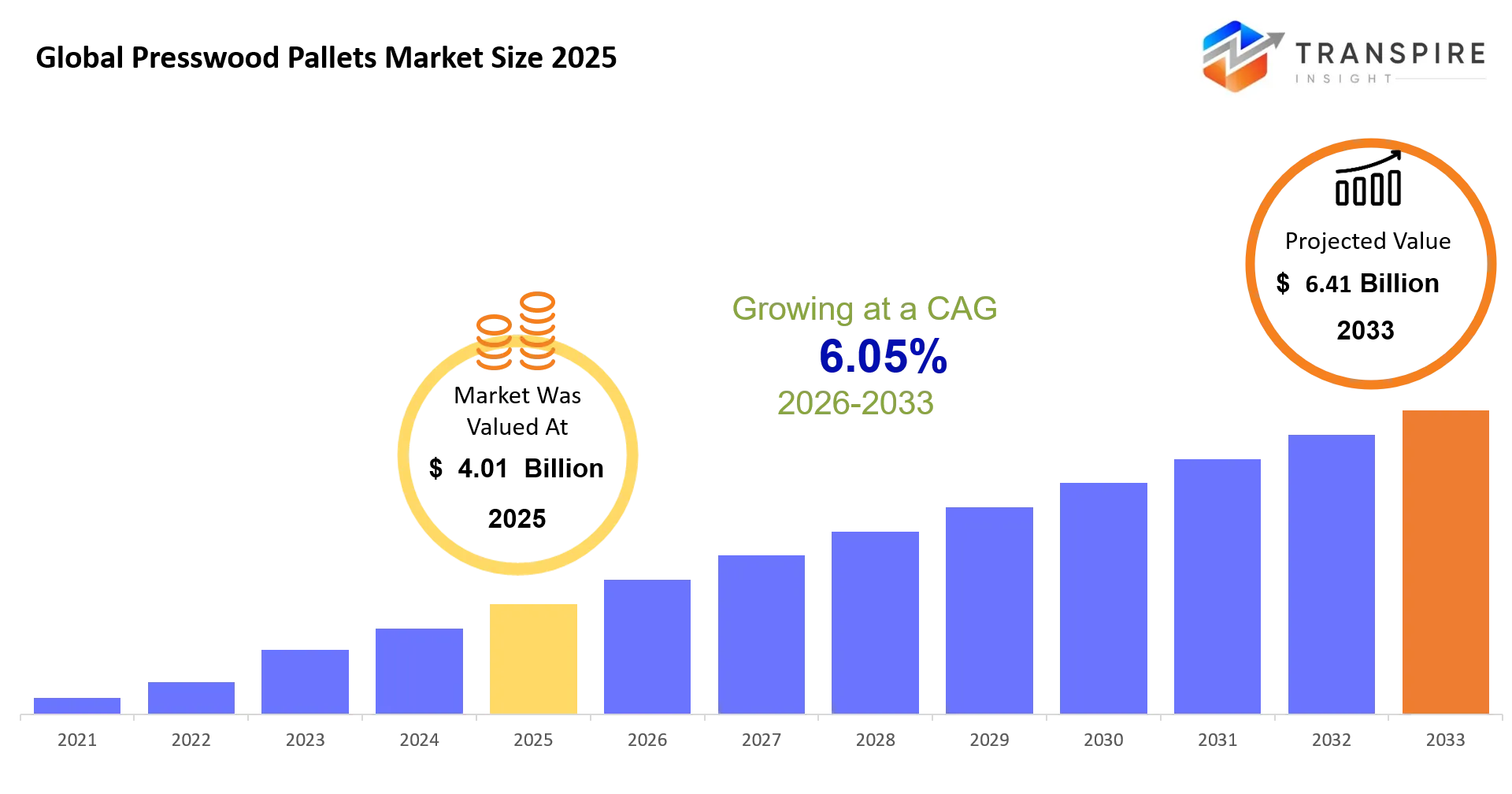
Key Global Presswood Pallets Market Insights
The presswood pallets market is shifting from treating basic shipping skids as passive, single-use lumber units toward utilizing highly engineered, molded composite circular platforms. Mechanical rigidity, precise stackability metrics, and native ISPM-15 phytosanitary exemption across global transit lanes are the pillars driving modern industrial warehouse optimization.
- Locking down a dominant 41% market share, Nestable Presswood Pallets lead the configuration matrix, with industry pioneers like Litco International offering a 4:1 storage space-saving ratio over conventional wood blocks to maximize tight warehouse footprints.
- Pacing regional expansion with a commanding 37% market slice, Europe acts as the absolute financial anchor of the industry, driven by brands like INKA Paletten launching precise Euro-format (1200x800mm) configurations to match automated European conveyor networks.
- Expanding at a market-accelerating standalone regional CAGR of 16.3%, the Asia Pacific theater operates as the fastest-growing geographical market as suppliers like Loscam expand high-density molded operations across fast-growing regional manufacturing corridors.
- Capturing a stable 24% revenue share, North America drives advanced industrial logistical adaptations, where packaging experts like Millwood Inc. deploy automated material Handling integrations to speed up cross-docking operations.
- Securing 19% of total industry volume, Export Presswood Pallets remain an essential foundation for intercontinental shipping lines, prompting innovators like Nefab to leverage pest-free composite structures that naturally bypass strict border customs delays.
- Representing 15% of the design matrix, Heavy-duty Presswood Pallets face steady adoption across high-capacity industrial floors, with companies like Craemer Group building ultra-dense, compression-molded frameworks capable of handling high dynamic weight limits.
- Accounting for a targeted 10% slice of the structural market footprint, Four-way Entry Pallets expand rapidly across complex e-commerce fulfillment hubs where companies like PECO Pallet optimize omnidirectional forklift entry ports to compress trailer loading cycles.
- Holding a specialized 7% market slice, Industrial Presswood Pallets support heavy-machinery and chemical manufacturing segments, prompting engineering suppliers like CABKA Group to refine resin-to-fiber binder ratios for maximum chemical splash resistance.
- Flying forward as the fastest-growing tech sector with an explosive standalone CAGR of 14.8%, Recycled Presswood Pallets dominate market momentum as companies like Brambles and Schoeller Allibert convert 100% post-industrial sawdust and wood chips into circular logistics assets.
- Securing a combined 10% market presence, Latin America and the Middle East & Africa operate as emerging distribution channels, where supply specialists like Faber Halbertsma Group and IPP Pooling deploy humidity-stable pallet options to preserve vulnerable agricultural and export logistics chains.
What Are the Key Drivers, Restraints, and Opportunities in the Global Presswood Pallets Market?
Driver
Market expansion is heavily propelled by strict international phytosanitary border controls and severe freight-cost pressures—forcing export logistics networks to abandon traditional solid timber skids. Standard raw lumber requires expensive - time-consuming heat treatment or chemical fumigation to comply with ISPM-15 regulations, creating acute supply chain bottlenecks and cargo entry rejections at international ports. This operational friction triggered a wholesale transition toward engineered presswood pallets, which naturally bypass these biosecurity checks due to the high-heat compression molding manufacturing process. This compliance-driven transition accelerates global revenue growth and high-volume direct procurement contracts as multinational consumer goods, food, and pharmaceutical brands restructure their shipping matrices to ensure frictionless, zero-delay intercontinental transport pipelines.
In January 2026, the United States Department of Agriculture Animal and Plant Health Inspection Service (USDA APHIS) officially ended its temporary grace period and reinstated absolute enforcement of strict ISPM-15 wood packaging material marking formats - including specific hyphenation codes. This hard regulatory pivot means that solid wood shipments failing inspection face immediate border holds, mandatory re-export, or strict destruction penalties - heavily catalyzing major global supply networks to swap raw lumber skids for certified molded composite platforms that eliminate customs biosecurity risks entirely. [https://www.woodlandgroup.com/news/aphis-confirms-full-enforcement-of-ispm-15-hyphen-requirement-from-january-2026]
Restraint
Severe structural open-beam rack vulnerabilities and static deflection limits associated with heavy localized industrial warehousing act as a major barrier holding back mainstream penetration. Because presswood profiles are engineered from compressed particulate fibers and resins rather than continuous wood grains, they lack the high flexural rigidity required to bridge open edge-supported racking frames without bowing under heavy loads. This physical material limitation persists because standard automated warehouse layouts feature open-beam structures, making compressed wood pallets highly prone to structural sagging or catastrophic cracking if overweighted, restricting their utilization strictly to floor-stacking, nestable one-way export, or flat-deck storage setups.
Opportunity
The most lucrative growth window lies in the development of hyper-dense - resin-optimized industrial configurations engineered explicitly for automated storage and retrieval systems (AS - RS). Integrating precise, machine-molded uniform edge geometries with high-performance eco-resins allows next-generation composite pallets to achieve the exact millimeter-level dimensional consistency required - high-speed warehouse robotics, shuttle carts, and optical sorting eyes without warp variance. This structural transformation unlocks highly efficient, closed-loop pooling operations across fast-growing industrial sectors like automotive component and chemical distribution, allowing logistics managers to replace heavy multi-material plastic boards with sustainable, low-profile alternative decks that reduce dead-weight shipping surcharges while optimizing vertical warehouse footprints.
What Has the Impact of Artificial Intelligence Been on the Global Presswood Pallets Market?
Artificial intelligence is reshaping the molded composite logistics sector by transforming heavy hydraulic compression systems into adaptive, data-driven production cells. Rather than absorbing manufacturing losses from fractured wood fibers or moisture blistering, production lines leverage machine learning algorithms to instantly analyze real-time raw material characteristics.
On the factory floor, integrated AI modules optimize production efficiency by feeding material variables directly into predictive operational engines. These intelligent systems analyze fiber content, density anomalies, and resin ratios to automatically modify press cycle durations and temperature parameters. By continuously mapping structural strength-to-weight metrics - the system proactively adjusts hydraulic molding forces to ensure each pallet meets exact load bearing tolerances. However, a significant integration and accuracy gap persists; automated AI sorting systems frequently struggle to align sudden, highly inconsistent variations in low-grade agricultural residues or wet sawmill sawdust waste, meaning human technical oversight remains essential.
In August 2025, turnkey equipment pioneer PalletMach officially integrated advanced automation controls across its automated glue-mixing and hydraulic presswood pallet production lines. This engineering rollout utilizes electronic weighing platforms paired with intelligent silo tracking units to automatically regulate MDI resin dosage relative to wood chip humidity, eliminating structural warping and avoiding press blowout failures.
Key Market Trends
The Global Presswood Pallets Market is transitioning from a localized, single-use shipping accessory sector into an advanced node of the multi-national automated circular supply network. Driven by strict international decarbonization mandates, corporate ESG metrics, and intense pressure to eliminate unneeded freight tare weight, modern high-velocity distribution networks are swapping out heavy, raw timber blocks for hyper-consistent, compression-molded composite decks designed to integrate seamlessly into robotic handling setups.
- Over time, international shipping lines are rapidly executing an industry shift toward composite skids to bypass border inspections, sparking a behavioral movement where global brands establish permanent, stamp-free custom clearances for molded platforms.
- Procurement managers are systematically moving away from heavy, nails-and-board wood frames to adopt ultra-lightweight nestable shapes, using this technological movement to compress empty pallet transport volumes by more than half.
- Material processing is experiencing an intense change as factories abandon freshly logged softwood inputs, adopting a green structural shift that blends 100% post-industrial sawdust with agricultural residues and specialized MDI resins.
- Warehousing centers are showing a distinct shift over time by phase-out of manual floor-stacking techniques, implementing a behavioral transition toward standardized, machine-molded edge dimensions that align with automated shuttle tracks.
- Food and beverage corridors are steadily executing a high-hygiene industry shift, utilizing a technological movement toward high-temperature compression molding () that inherently sanitizes the core deck to resist listeria and insect burrowing.
- E-commerce fulfillment networks are displaying a multi-size change over time, driving an industry shift toward specialized half-size and display-ready modular presswood formats to streamline rapid last-mile city micro-fulfillment unloading.
- Closed-loop logistics operations are executing a massive structural shift away from linear "buy-and-discard" procurement, favoring a behavioral movement toward unified asset pooling networks where broken composite pallets are consistently grinded into circular landscape mulch or biomass fuel.
Global Presswood Pallets Market Segmentation
By Product Type
Nestable Presswood Pallets anchor this segment, holding a dominant 41% share of total industry revenue, while Export Presswood Pallets follow as the second largest pillar at 19%. Heavy-duty and Four-way Entry configurations command 15% and 10% shares respectively, with Industrial designs securing 7%, and Recycled Presswood Pallets capturing 5% of the remaining market footprint. This baseline distribution persists because manufacturing facilities and global shipping lines fundamentally require high-density, space-saving shipping platforms that can compress storage footprints during empty reverse-logistics legs. Nestable variants retain their peak market position because their unique tapered design provides a 4:1 storage space-saving ratio over conventional wood blocks, letting operations managers reclaim vital warehouse square footage. Meanwhile, Recycled Presswood Pallets are expanding as the fastest-growing technology sector at an explosive standalone CAGR of 14.8% because modern enterprise supply chains are aggressively implementing strict circular feedstock mandates to meet corporate carbon-neutrality deadlines. Moving forward, single-use shipping skids will completely dissolve into smart, highly optimized circular shipping platforms. Leading manufacturers will focus heavily on optimizing compression molding dies to engineer lightweight profiles that preserve high multi-ton loading capacities without adding unnecessary material weight.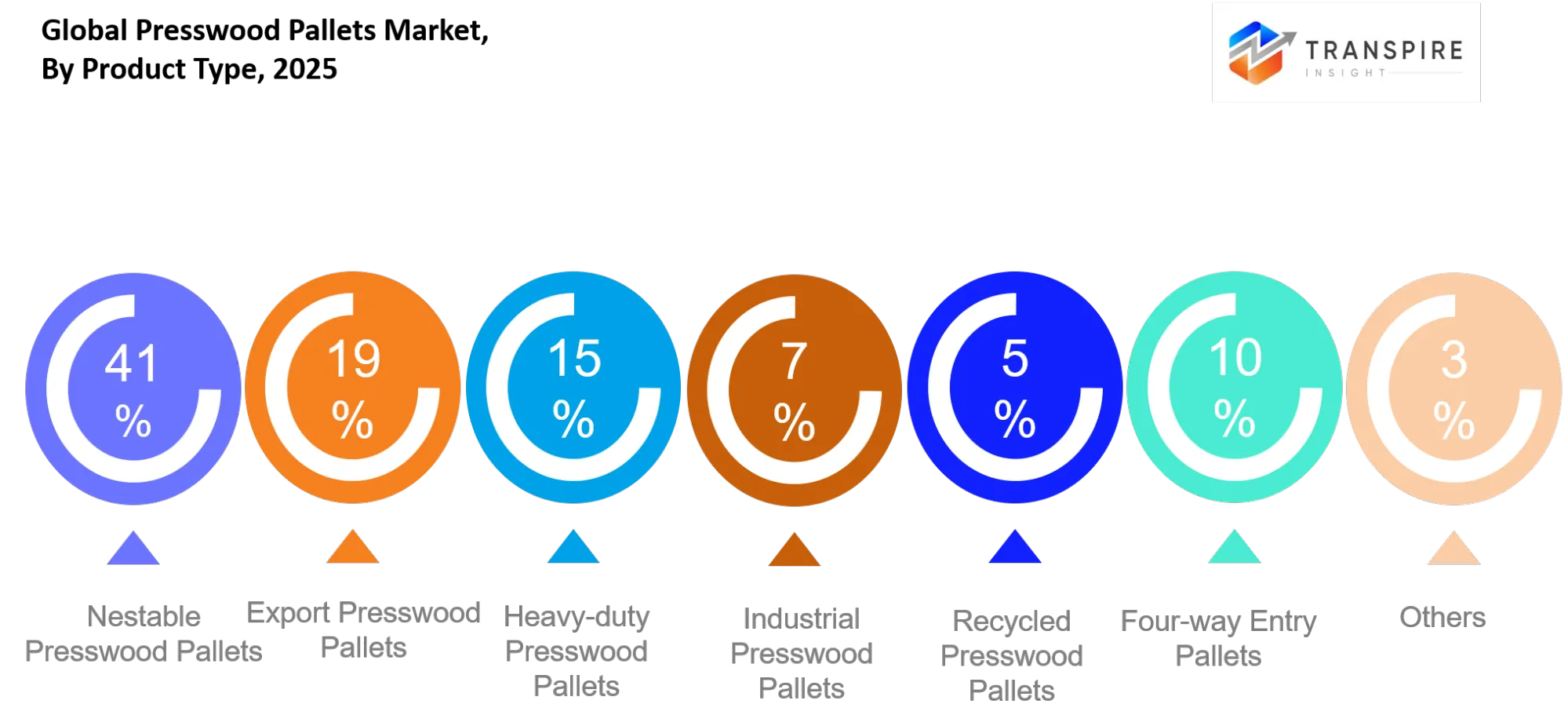
By Material
Recycled Wood Fibers serve as the primary structural engine of the market, holding the largest portion of global material volume, while Softwood Fibers, Hardwood Fibers, and Sawdust represent the highly stable secondary material blocks. Concurrently, Agricultural Residues and MDF Waste represent the fastest-growing design segments within the raw material spectrum. This market distribution is tied directly to industrial timber byproduct availability, where the utilization of post-industrial wood waste allows manufacturers to secure a low-cost, eco-friendly alternative to virgin lumber planks. Recycled Wood Fibers maintain their high market share because their manufacturing processing yield is incredibly high, turning low-value sawmill waste into structural assets via advanced hydraulic binder integration. However, specialized sub-segments like Agricultural Residues are growing at an accelerated clip because processing plants in developing regions seek localized, bio-based fiber alternatives to protect profit margins from volatile timber import pricing. Moving forward, raw material formulation will move past standard wood-and-glue recipes. Market dominance will belong to composite engineers who develop hyper-consistent bio-resins that maximize molecular cross-linking with diverse, alternative non-wood plant fibers without losing structural tensile integrity.
By Load Capacity
The 1000–1500 kg capacity bracket functions as the absolute financial anchor of the industry, capturing the largest slice of the revenue footprint due to its widespread alignment with standard mid-market palletized freight metrics. Meanwhile, the Above 2000 kg high-performance tier and specialized Heavy-duty Pallets represent the fastest-growing operational segments. The market dynamic relies on global supply chain synchronization; the majority of consumer goods, pharmaceutical boxes, and electronics parcels match moderate load profiles, making 1000–1500 kg composite decks the ideal cost-to-capacity engineering investment for logistics operators. These standard capacity systems maximize transit safety without incurring the premium raw material costs of highly dense, heavily reinforced composite blocks. Conversely, the Above 2000 kg segment is expanding rapidly because heavy industrial chemical drums and automotive component sub-assemblies require extreme compression resistance to ensure safety during multi-tier static stack configurations. Looking ahead, the structural dividing line between vendor models will depend on cross-sectional flexural strength. Scalable market success will belong to equipment providers who integrate advanced density profiling into the molding phase, allowing pallets to withstand intense edge-supported open-beam rack pressures without bowing.
By End User
The Food & Beverage vertical leads the market with a commanding share of global industry volume, driven by high-velocity consumer goods processing and rigid international phytosanitary shipping rules. Concurrently, Logistics & Warehousing and E-commerce entities are rising as highly active, fast-growing secondary buyer pipelines. The underlying market logic is dictated by the sheer velocity and regulatory sensitivity of products flowing through these specific networks, where food processing plants require pest-free, mold-resistant transport decks and e-commerce fulfillment hubs face heavy parcel turnover. Food & Beverage plants deploy molded presswood pallets because the high-heat manufacturing process () naturally sanitizes the core deck, ensuring zero risk of insect infestation or bacterial harboring. Logistics players leverage these nestable decks to optimize tight cross-docking environments and slash empty-pallet freight return costs. Looking ahead, competitive advantages among pallet vendors will depend heavily on automated handling compatibility. Long-term profitability will belong to composite manufacturers that engineer hyper-flat deck geometries that interface seamlessly with high-speed automated storage and retrieval systems (AS/RS), allowing robotics and optical sorting eyes to process pallets with zero mechanical drag.
By Distribution Channel
Direct Sales dominate this segment by securing the largest portion of overall market revenue, driven by high-volume, long-term procurement contracts signed directly between multi-national corporations and large-scale compression molding factories. Concurrently, Distributors and specialized Packaging Companies follow as highly active, fast-growing secondary transactional pipelines. This structural alignment persists because massive enterprise networks require highly predictable, bulk supply streams of uniform packaging assets to feed their automated distribution centers without experiencing inventory stockouts. Direct Sales lead because they compress supply chains, allowing enterprise buyers to bypass intermediary markups while collaborating directly on custom dimensional blueprints or specific corporate sustainability certifications. Meanwhile, Distributors and Online Sales categories are growing swiftly because small-to-medium enterprises demand agile, on-demand shipping asset procurement with shorter lead times to handle unexpected, seasonal shifts in consumer demand. Moving forward, distribution boundaries will unify under digital, closed-loop asset management platforms. Rather than executing simple, linear sales transactions, next-generation pallet providers will leverage integrated asset-pooling systems to track, reclaim, and regrind damaged composite structures into fresh circular logistics assets.
What Key Use Cases Driving the Global Presswood Pallets Market?
The primary use case centers on high-volume one-way export shipping within the food and beverage and retail sectors, where logistics hubs require lightweight, nestable platforms to minimize outbound freight costs. Because empty composite decks stack closely together at a 4:1 compression ratio, shipping managers can significantly scale up transit container density, allowing global distribution corridors to maximize spatial volume while completely bypassing costly overseas pallet return logistics.
Beyond standard transit corridors, expanding applications focus heavily on clean-room material transport inside the pharmaceutical and electronics industries. Driven by rigid contamination rules - manufacturers leverage nail-free, single-piece molded decks that feature a naturally smooth surface to prevent product packaging punctures, wood splinter shedding, or electrostatic dust attraction during automated assembly cycles.
Emerging use cases are shifting toward automated vertical transport setups across high-density material handling factories equipped with advanced warehouse robotics. Modern distribution facilities combine high-precision compression molding with specialized resin binders to guarantee consistent millimeter-level dimensional accuracy across the deck edges - ensuring seamless interaction with optical sensors, sorting conveyors, and automated storage and retrieval systems (AS/RS) without risking mechanical line jams.
|
Report Metrics |
Details |
|
Market size value in 2025 |
USD 4.01 Billion |
|
Market size value in 2026 |
USD 4.25 Billion |
|
Revenue forecast in 2033 |
USD 6.41 Billion |
|
Growth rate |
CAGR of 6.05% from 2026 to 2033 |
|
Base year |
2025 |
|
Historical data |
2021 - 2024 |
|
Forecast period |
2026 - 2033 |
|
Report coverage |
Revenue forecast, competitive landscape, growth factors, and trends |
|
Regional scope |
United States; Canada; Mexico; United Kingdom; Germany; France; Italy; Spain; China; Japan; India; Australia; South Korea; Indonesia; Brazil; Argentina; South Africa; Saudi Arabia; United Arab Emirates |
|
Key company profiled |
Litco International, Presswood International, Nefab, Brambles, CABKA Group, Craemer Group, Millwood Inc., PECO Pallet, Loscam, Schoeller Allibert, INKA Paletten, PalletOne, Kronus, Faber Halbertsma Group, IPP Pooling |
|
Customization scope |
Free report customization (country, regional & segment scope). Avail customized purchase options to meet your exact research needs. |
|
Report Segmentation |
By Product Type (Nestable Presswood Pallets, Export Presswood Pallets, Heavy-duty Presswood Pallets, Four-way Entry Pallets, Industrial Presswood Pallets, Custom Presswood Pallets, Recycled Presswood Pallets, Others); By Material (Recycled Wood Fibers, Hardwood Fibers, Softwood Fibers, Agricultural Residues, MDF Waste, Sawdust, Wood Chips, Others); By Load Capacity (Below 500 kg, 500–1000 kg, 1000–1500 kg, 1500–2000 kg, Above 2000 kg, Medium-duty Pallets, Heavy-duty Pallets, Others); By End User (Food & Beverage, Logistics & Warehousing, Chemicals, Pharmaceuticals, Automotive, Consumer Goods, E-commerce, Others); By Distribution Channel (Direct Sales, Distributors, Export Suppliers, OEM Partnerships, Online Sales, Warehouse Suppliers, Packaging Companies, Others) |
Which Regions are Driving the Global Presswood Pallets Market Growth?
Europe maintains a commanding grip on the presswood pallets market, capturing a dominant 37% of all worldwide industry revenue. This geographic leadership is heavily driven by intense regional enforcement of strict circular-economy landfill bans and massive corporate investments into closed-loop green logistics networks. The regional ecosystem is structurally supported by a dense concentration of automated intra-logistics warehouses and rigid carbon-accounting frameworks across Western Europe that favor bio-based transport platforms. Consequently, integrating high-density Euro-format molded pallets has become an operational necessity for local manufacturers to eliminate standard timber disposal taxes and achieve immediate transport decarbonization.
Asia Pacific serves as a highly active, rapidly expanding secondary pillar for the global market, locking down an essential 29% - share of total industry demand. While European market maturation centers on strict regulatory carbon reporting, Asia Pacific presswood pallet adoption is shaped by the explosive expansion of cross-border manufacturing hubs and intense multi-national cost-optimization pressures. This regional market stability is structurally insulated by surging export container volumes emerging out of key manufacturing zones in China, India, and Southeast Asia, where companies must compress raw material shipping expenses. To balance daily freight operations amid rising maritime shipping fuel tariffs, regional logistics managers continuously invest in ultra-lightweight nestable pallets to safely pack electronics and consumer goods without exceeding weight thresholds.
North America functions as the fastest-growing territory globally, accelerating at a market-leading pace to secure a vital 24% slice of global sales. This sudden structural shift is driven by severe domestic warehouse square-footage constraints and a rapid - widespread pivot among retail networks toward maximizing floor-space efficiency in urban fulfillment corridors. Historically, regional consumer distribution chains relied heavily on bulky, multi-piece hardwood block pallets that consume significant floor space when empty, but the territory has now rapidly turned toward molded composite alternatives to optimize tight multi-tier cross-dock yards. Looking ahead, future manufacturing optimization in this booming corridor relies entirely on deploying standardized, nestable presswood decks capable of compressing empty pallet storage footprints by 75% while maintaining high dynamic loading capacities across automated delivery lanes.
In April 2026, North American molded wood pallet and materials handling expert Litco International officially announced the strategic relocation and expansion of its regional custom logistics manufacturing operations into a new 40,000-square-foot facility at the Ohio Commerce Park in Lordstown. This industrial scaling initiative nearly triples the company's operational footprint, enabling production lines to rapidly accommodate surging enterprise demand for custom load securement and high-volume, forecast-driven industrial shipping programs. By dramatically expanding regional floor capacity, this facility expansion allows North American supply networks to efficiently scale up their deployment of lightweight, nail-free presswood platforms to lower spatial overhead costs across high-turnover cross-docking environments.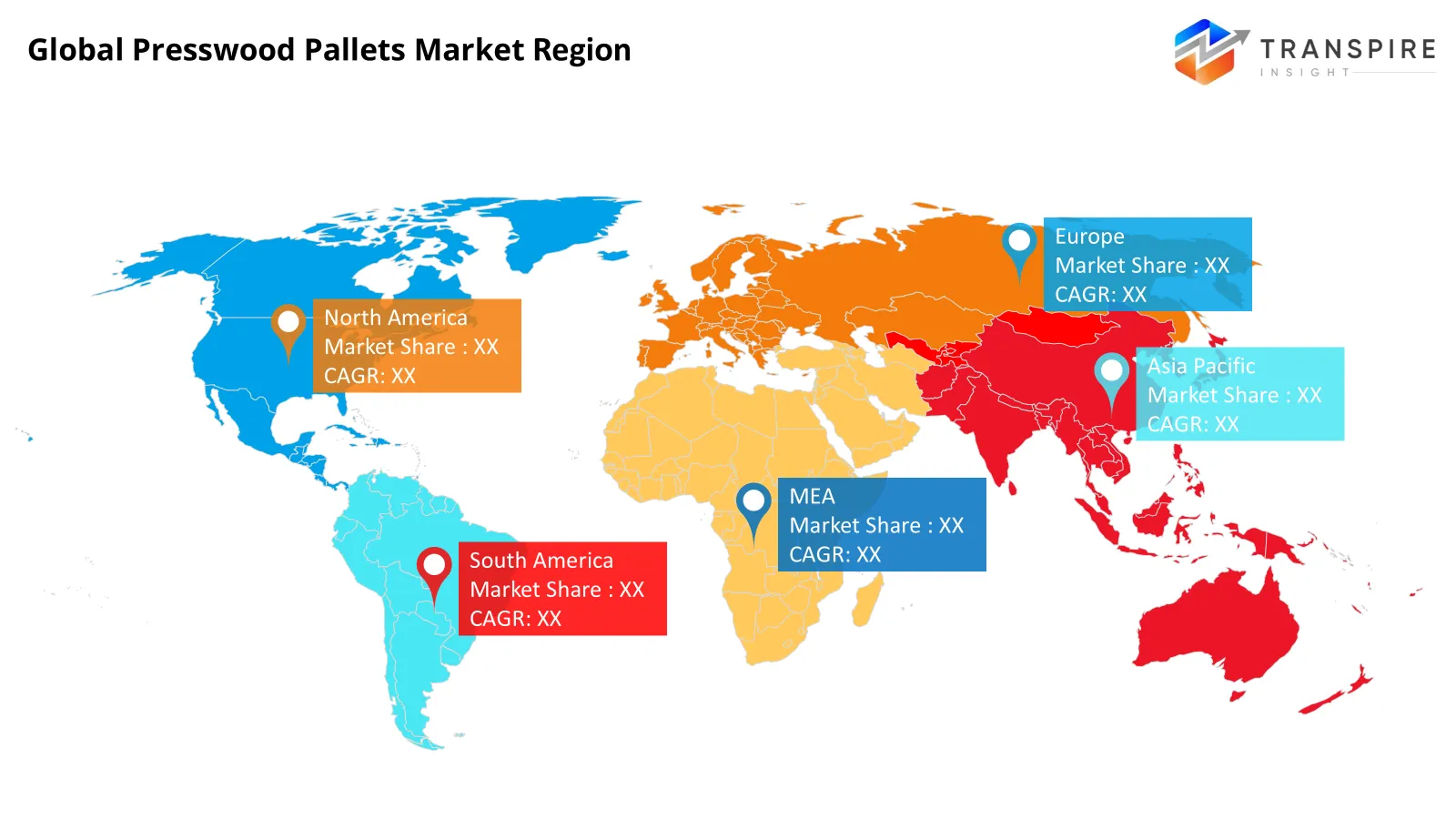
Who Are the Key Players in the Global Presswood Pallets Market and How Do They Compete?
Competition in this space is a battle between massive, diversified global material handling pooling giants and specialized, high-precision compression molding engineering firms. Instead of just competing on flat per-unit pallet pricing, manufacturers win major enterprise supply contracts by proving strict compliance with ISPM-15 phytosanitary protocols, demonstrating high structural density profiles capable of resisting moisture, and offering high space-saving nesting ratios that optimize empty return logistics.
Litco International wins by positioning itself as an agile innovation leader specializing in high-performance, sustainable export shipping solutions. They differentiate their product line by offering certified Cradle-to-Cradle molded composite decks engineered to withstand up to 7,500 - pounds of static floor weight while staying entirely free of nails, staples, or splinters. Their expansion approach relies heavily on targeting heavy-velocity North American industrial fulfillment zones, scaling up production facilities to deliver custom-sized, on-demand logistics platforms that eliminate dimensional waste.
Nefab dominates by embedding a highly focused niche strategy tailored around specialized intercontinental supply chain protection and multi-material export packaging. They stand out in the marketplace by pairing their ultra-lightweight presswood decks with integrated outer protective casing structures - ensuring that sensitive pharmaceutical, automotive, and electronics components remain completely insulated from transit shocks. Their geographic expansion strategy focuses on establishing duplicate compression manufacturing pipelines and deep distributor networks directly inside active cross-border maritime corridors across Europe and Asia to minimize equipment lead times.
Company List
- Litco International
- Presswood International
- Nefab
- Brambles
- CABKA Group
- Craemer Group
- Millwood Inc.
- PECO Pallet
- Loscam
- Schoeller Allibert
- INKA Paletten
- PalletOne
- Kronus
- Faber Halbertsma Group
- IPP Pooling
Recent Development News
In March 2026, industrial logistics provider Nefab officially rolled out its new advanced 3,000-square-meter packaging production and engineering center in Guadalajara Mexico. The whole expansion kind of gives localized real world transit simulation, testing, and prototyping options, so regional tech manufacturers can shield high value server racks and electronic infrastructure, as they move through global supply lanes. [https://www.nefab.com
In April 2026, global industrial packaging - logistics solutions leader Nefab Group officially acquired Slovakian packaging expert Vallos s.r.o. This strategic acquisition strengthens Nefab's market position in Central Europe while significantly expanding its portfolio of high-quality corrugated and fiber-based sustainable packaging solutions optimized for the data communications and energy sectors. [https://www.nefab.com
In April 2026, circular reuse pioneer Tosca partnered with transport packaging innovator Cabka to officially launch the new Euro-sized Tosca Circular Pallet (CP 1208). This collaborative product launch establishes an automation-ready, non-porous alternative to wooden skids that complies with strict European packaging regulations while integrating ergonomic top-deck handles to reduce manual lifting injuries across retail networks. [https://investors.cabka.com
What Strategic Insights Define the Future of the Global Presswood Pallets Market?
The presswood pallets market is rapidly heading toward an era of fully unified circular asset-pooling ecosystems where traditional one-way shipping skids merge completely with automated material handling architectures. This structural evolution shifts logistics procurement away from treating pallets as disposable end-of-line timber utilities toward deploying hyper-consistent - engineered data-carrier nodes that integrate natively into high-speed automated storage and retrieval systems (AS/RS).
However, a major hidden risk lies in hydro-structural degradation under extreme ambient moisture variations. As global supply lines scale up their utilization of highly recycled agricultural or sawmill waste substrates, fluctuations in binder curing depth and relative humidity can trigger microscopic core blistering and rapid flexural sagging, leading to sudden mechanical buckling failures on open-beam warehouse racking corridors.
An emerging opportunity is unfolding around the industry-wide formulation of functional bio-composite coatings. Material engineering companies can leverage these advanced, non-porous polymer barriers to structurally seal the compressed wood fibers, eliminating moisture absorption entirely and expanding composite decks into high-hygiene pharmaceutical and chemical transit applications previously dominated by expensive heavy plastic platforms.
To win long-term, technology executives must transition away from treating presswood manufacturing as a basic timber-grinding operation. Engineering departments should pivot toward embedding native multi-frequency RFID tracking sensors directly into the high-heat compression molding stage, converting basic composite decks into smart, trace-isolated logistics tools that systematically eliminate manual inventory tracking bottlenecks before shipping containers arrive at port border customs.
By Product Type
- Nestable Presswood Pallets
- Export Presswood Pallets
- Heavy-duty Presswood Pallets
- Four-way Entry Pallets
- Industrial Presswood Pallets
- Custom Presswood Pallets
- Recycled Presswood Pallets
- Others
By Material
- Recycled Wood Fibers
- Hardwood Fibers
- Softwood Fibers
- Agricultural Residues
- MDF Waste
- Sawdust
- Wood Chips
- Others
By Load Capacity
- Below 500 kg
- 500–1000 kg
- 1000–1500 kg
- 1500–2000 kg
- Above 2000 kg
- Medium-duty Pallets
- Heavy-duty Pallets
- Others
By End User
- Food & Beverage
- Logistics & Warehousing
- Chemicals
- Pharmaceuticals
- Automotive
- Consumer Goods
- E-commerce
- Others
By Distribution Channel
- Direct Sales
- Distributors
- Export Suppliers
- OEM Partnerships
- Online Sales
- Warehouse Suppliers
- Packaging Companies
- Others
Regional Outlook
North America
- United States
- Canada
- Mexico
Europe
- Germany
- United Kingdom
- France
- Spain
- Italy
- Rest of Europe
Asia Pacific
- Japan
- China
- Australia & New Zealand
- South Korea
- India
- Rest of Asia Pacific
South America
- Brazil
- Argentina
- Rest of South America
Middle East & Africa
- Saudi Arabia
- United Arab Emirates
- South Africa
- Rest of the Middle East & Africa
Frequently Asked Questions
Find quick answers to common questions.
The Global Presswood Pallets Market size was valued at USD 4.01 Billion in 2025 and is poised to reach USD 6.41 Billion by 2033, expanding at a 6.05% CAGR.
Key segments for the Global Presswood Pallets Market are Product Type (Nestable Presswood Pallets, Export Presswood Pallets, Heavy-duty Presswood Pallets, Four-way Entry Pallets, Industrial Presswood Pallets, Custom Presswood Pallets, Recycled Presswood Pallets, Others), Material (Recycled Wood Fibers, Hardwood Fibers, Softwood Fibers, Agricultural Residues, MDF Waste, Sawdust, Wood Chips, Others), Load Capacity (Below 500 kg, 500–1000 kg, 1000–1500 kg, 1500–2000 kg, Above 2000 kg, Medium-duty Pallets, Heavy-duty Pallets, Others), End User (Food & Beverage, Logistics & Warehousing, Chemicals, Pharmaceuticals, Automotive, Consumer Goods, E-commerce, Others), Distribution Channel (Direct Sales, Distributors, Export Suppliers, OEM Partnerships, Online Sales, Warehouse Suppliers, Packaging Companies, Others).
Growth is primarily driven by strict international phytosanitary border regulations (ISPM-15 compliance) that make raw timber pallets costly and slow to export, combined with heavy corporate reverse-logistics freight cost pressures that make space-saving, high-compression nestable designs the preferred choice for cross-border transit corridors.
The global market is led by major manufacturers including Litco International, Presswood International, Nefab, Brambles, CABKA Group, Craemer Group, Millwood Inc., PECO Pallet, Loscam, Schoeller Allibert, INKA Paletten, PalletOne, Kronus, Faber Halbertsma Group, and IPP Pooling.
Europe holds a dominant 37% share of total global revenue, anchoring the industry through its high concentration of automated intra-logistics warehouses, strict regional enforcement of circular-economy landfill bans on wood packaging, and heavy corporate supply chain decarbonization mandates that incentivize the widespread use of bio-based molded composite platforms.
Lucrative opportunities exist around the engineering of hyper-dense, resin-optimized pallet configurations designed explicitly for high-speed automated storage and retrieval systems (AS/RS), along with the formulation of advanced, moisture-resistant bio-composite top coatings that allow these platforms to win closed-loop market share in clean-room pharmaceutical and chemical distribution environments.
- Litco International
- Presswood International
- Nefab
- Brambles
- CABKA Group
- Craemer Group
- Millwood Inc.
- PECO Pallet
- Loscam
- Schoeller Allibert
- INKA Paletten
- PalletOne
- Kronus
- Faber Halbertsma Group
- IPP Pooling
About the Authors

Kartik bhong
I am Kartik Bhong, a Senior Research Analyst at Transpire Insight, specializing in the Packaging, Manufacturing, and Construction industry. My work focuses on analyzing market trends, emerging technologies, industry regulations, and competitive landscapes to deliver accurate, data-driven insights. I am passionate about transforming complex industry information into clear, practical content that helps businesses, professionals, and decision-makers stay informed and make confident strategic decisions. Through continuous research and a strong commitment to accuracy, I strive to create reliable, well-researched content that reflects the latest developments across these dynamic industries and supports the vision of Transpire Insight in delivering valuable market intelligence.

Chakradhar Khansole
Chakradhar serves as the Research Director at Transpire Insight, bringing over 8 years of experience in technology, innovation, and strategic market intelligence. He specializes in transforming complex market data into actionable business insights that enable organizations to make informed, growth-oriented decisions. Recognized for his strategic vision and analytical expertise, Chakradhar leads high-impact research initiatives, delivering comprehensive market assessments, competitive intelligence, and forward-looking industry analysis.
Recently Published Reports
-
Apr 2026
Pharmaceutical Cold Chain Packaging Market
Pharmaceutical Cold Chain Packaging Market By Material (Plastic,(Polyethylene (PE), Polypropylene (PP), Polyethylene Terephthalate (PET), Expanded Polystyrene (EPS), Polyurethane (PU),Others), Paper, Metal, Others), By Product (Small Boxes, Pallets, Large Sized Pallet Containers, Others), By End Use (Biopharmaceutical Companies, Clinical Research Organizations, Hospitals, Research Institutes, Logistics and Distribution Companies, Others)”, By Industry Analysis, Size, Share, Growth, Trends, and Forecasts 2026-2033
-
Apr 2026
Active & Intelligent Packaging Market
Active & Intelligent Packaging Market By Type (Active Packaging, Smart Packaging), By Material (Polymer-Based, Paper & Board-Based, Metal-Based, Glass-Based), By Technology (Time-Temperature Indicators, Freshness Indicators, RFID, Antimicrobial Packaging, Modified Atmosphere Packaging), By Application (Food & Beverages, Pharmaceutical, Cosmetics & Personal Care, Electronics & Consumer Goods, Others), By Industry Analysis, Size, Share, Growth, Trends, and Forecasts 2026-2033
-
Apr 2026
Biodegradable Cut Flower Packaging Market
Biodegradable Cut Flower Packaging Market By Material Type (Paper & Paperboard, Biodegradable Plastics, Natural Fibers, Molded Pulp, Others), By Product Type (Sleeves, Wraps, Boxes & Cartons, Bags & Pouches, Inserts & Holders), By Application (Roses, Carnations, Tulips, Chrysanthemums, Mixed Flowers, Others) and By Distribution Channel (Direct Sales, Distributors & Wholesalers, Online Channels), By Industry Analysis, Size, Share, Growth, Trends, and Forecasts 2026-2033
-
May 2026
Pharmaceutical Packaging Market
Pharmaceutical Packaging Market By Material Type (Plastic, Glass, Metal, Paper & Paperboard, Others), By Packaging Type (Bottles, Blister Packs, Vials, Ampoules, Pouches & Sachets, Others) and By End User (Hospitals & Clinics, Retail Pharmacies, Online Pharmacies, Pharmaceutical Manufacturers), By Industry Analysis, Size, Share, Growth, Trends, and Forecasts 2026-2033