

United Kingdom Agriculture Drones Market Summary
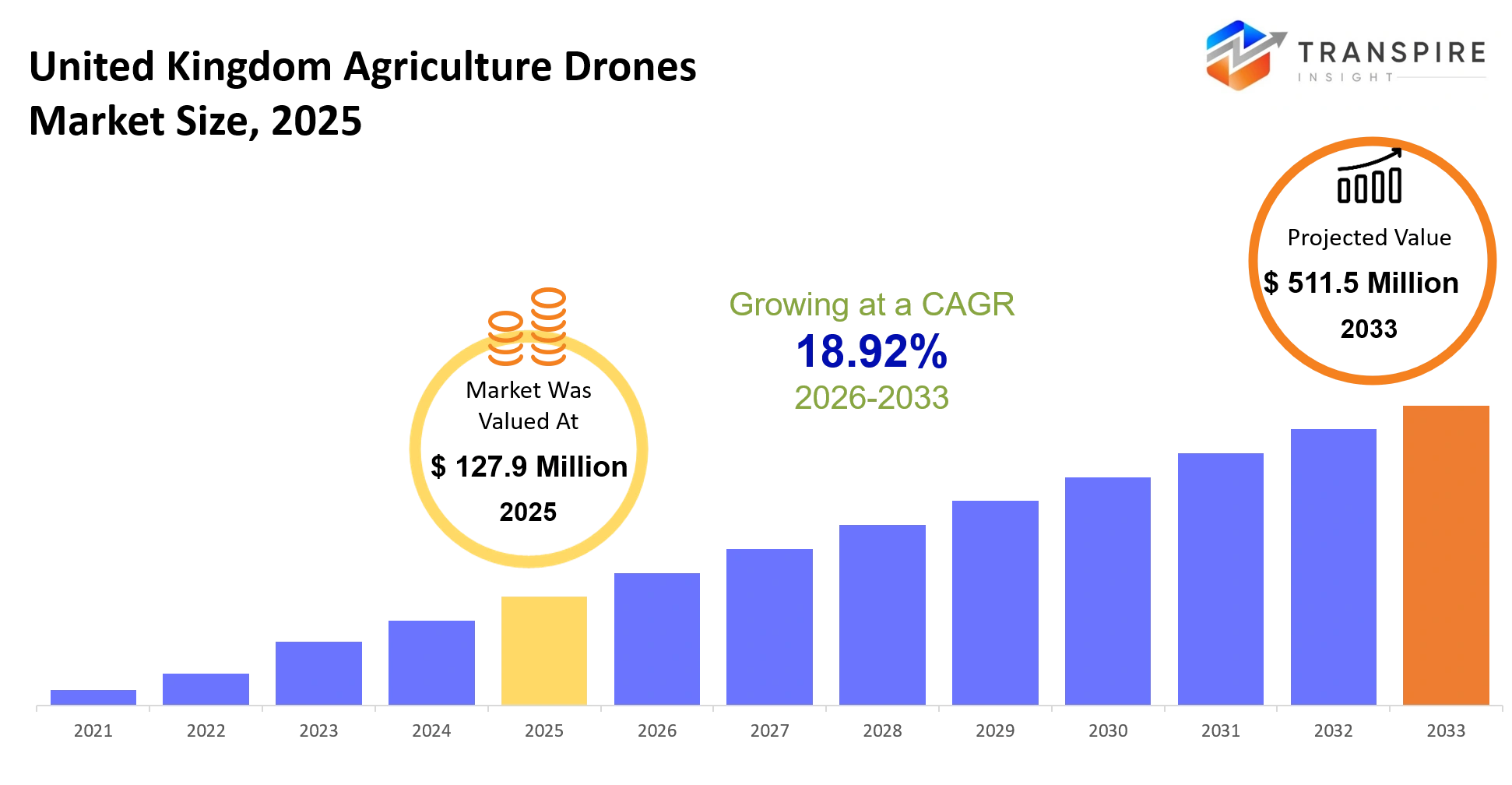
As per Transpire Insight Analysis the United Kingdom Agriculture Drones Market size is estimated at USD 127.9 Million in 2025 and is anticipated to reach USD 511.5 Million by 2033, growing at a CAGR of 18.92% from 2026 to 2033.
The United Kingdom Agriculture Drones Market, sort of helps farmers by turning aerial field checks into faster, more data led choices that can improve crop management, fine tune input application, and cut down on operational waste. In practice agricultural producers, contractors, and even larger farming enterprises use drones for crop vigor monitoring, checking soil status, mapping whole fields, and doing more precise spraying. It also helps with labor shortages, while pushing overall productivity across different kinds of farming operations.
Over the past three to five years, the market has sort of moved away from basic overhead imaging toward more connected precision agriculture setups. These newer platforms blend drone hardware with artificial intelligence, multispectral sensors, and farm management software. The shift picked up speed as the United Kingdom leaned harder into sustainable farming after post-Brexit agricultural policy reforms, which encouraged more efficient land use and resource management. Since many farms are looking for clear outcomes around input efficiency and regulatory alignment, drone use is shifting from trial runs to regular, everyday field work. With this real operational integration service providers, and equipment sellers can also broaden what they offer which in turn creates steadier revenue chances via software, analytics, maintenance, and niche agricultural drone services.
United Kingdom Agriculture Drones Market Size & Forecast:
- United Kingdom Agriculture Drones Market Size 2025: USD 127.9 Million
- Expected Market Value 2033: USD 511.5 Million
- Forecast CAGR: 18.92%
- Leading region in 2025: England
- Fastest Growing region: Scotland
- Key Profile: DJI, Parrot, AgEagle Aerial Systems, XAG, Trimble, Sentera, DroneDeploy, PrecisionHawk, Delair, AeroVironment, senseFly, Yamaha Motor, Syngenta, Pix4D, Hexagon AB
Key Market Insights
- England kind of dominated the market in 2025 with around 68% market share ,and that was backed by lots of arable farming, plus heavier investments in precision farming tools, and also pretty established drone service providers.
- Scotland, on the other hand, is expected to show the fastest rise across 2026–2032, largely because digital farming initiatives are getting traction, along with large scale livestock and mixed farming operations.
- When it comes to the product side, surveillance and mapping drones basically led the segment with close to 44% share in 2025, mainly because growers wanted field intelligence before any seasonal crop interventions started.
- Spraying drone services took the next spot as the second-largest segment, since commercial farms are increasingly handing off specialized aerial applications to certified operators, rather than doing it in house.
- AI-enabled autonomous spraying platforms are forecast to grow the quickest between 2026 and 2032 too, supported by stricter precision application needs, and well, labor limitations that are hard to ignore.
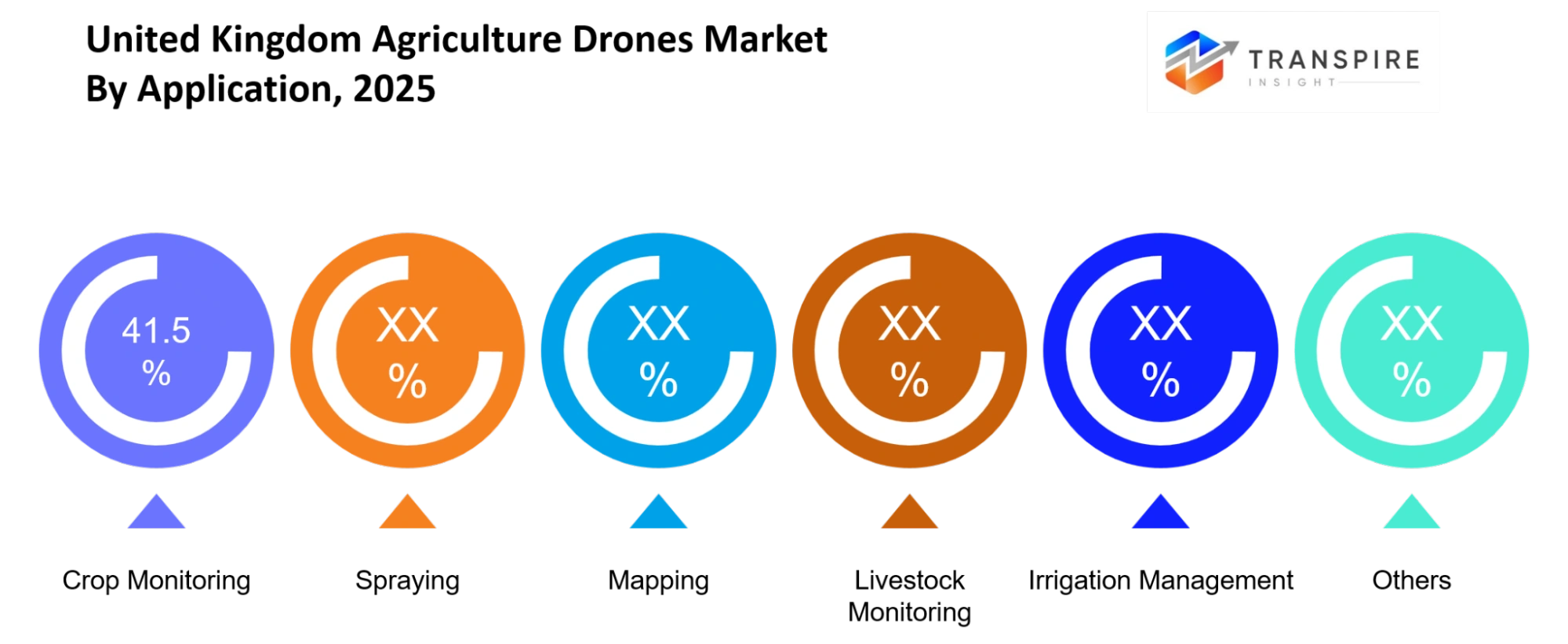
- For applications, crop monitoring was the biggest with about 47% market share in 2025, because frequent aerial checkups made it easier to fine-tune fertilizer planning and spot disease earlier.
- Precision spraying is expected to become the fastest-growing application over the forecast period, since targeted chemical use cuts down input waste and also reduces operating costs. That part matters a lot.
- On the end-user front, commercial farming enterprises held the lead with nearly 61% share in 2025, which is tied to higher technology budgets and larger cultivated land areas.
- Lastly, agricultural service contractors are projected to become the fastest-growing end-user category during 2026–2032, expanding drone-as-a-service options for small and medium sized farms, kind of like a convenient outsource pathway.
What are the Key Drivers, Restraints, and Opportunities in the United Kingdom Agriculture Drones Market?
The main thing pushing growth is a kind of fast uptake of precision agriculture, helped by post Brexit farming policy tweaks, plus digital farm modernization . At the same time higher fertilizer and crop protection costs have sort of shifted investment focus. Instead of broad, whole-field treatment, farmers are now trying to see clear, measurable reductions in input use. Drone mapping and variable-rate application help with better decision quality and also reduce chemical consumption, while cutting down field inspection time. That improved operational efficiency then turns into stronger spending on equipment buys, software subscriptions, and even drone service contracts across commercial farms.
The biggest structural restraint is basically the mix of aviation regulations, operator certification requirements, and those high deployment costs. A lot of farms still don’t have trained pilots, and many still don’t have integrated digital farm management systems in place. So fleet deployment moves, like more slowly, even when the technology is ready. Based on a Transpire Insight review of local procurement notices and launch calendars, supply chain concentration is still the main execution risk. If components come later, or if certification timelines stretch out, fleet expansion gets postponed. That then delays annual revenue realization, and it also slows the wider push toward commercial adoption.
The strongest future opportunity seems to be in these autonomous drone ecosystem types that are linked to artificial intelligence, multispectral imaging, and cloud based farm management platform. When farms adopt integrated digital workflows they can kind of automate crop scouting, prescription mapping, and also targeted spraying all within one operating environment. There’s also investment in robotics, and agri software across the United Kingdom that is building good conditions for subscription based analytics, plus drone-as-a-service styles of business models. In the end these changes can expand recurring revenue streams while lifting day to day operational efficiency for farms of every scale, even the smaller ones.
What Has the Impact of Artificial Intelligence Been on the United Kingdom Agriculture Drones Market?
Artificial intelligence is sorta transforming drone work in agriculture , by turning aerial photos into results you can actually use for agronomic decisions in just a few hours, not days. The AI systems sort of automatically spot crop stress, where nutrients might be missing, weed growth, pest issues, and even irrigation variability from multispectral and thermal imagery. And then there’s the automated flight planning,plus route optimization that makes the operator job lighter while keeping field coverage steadier and easier to stay compliant with the rules.
Then machine learning models add more foresight, like predicting disease outbreaks before they spread, estimating how crops will perform, setting up preventive maintenance schedules, and improving battery usage across drone fleets. These digital aids let farmers choose interventions earlier, so yield losses hopefully do n’t get too far along. That also helps resource allocation , and it reduces the amount of unnecessary chemical applications. Integrated analytics supports better uptime too, quicker inspections, and less labor effort, while producing field data that stays more consistent during the whole growing season.
Still though, broad rollout has some real world constraints. The cost to connect drones with farm management software, sensors, and existing equipment can be pretty high, and that discourages smaller farms. Also the AI accuracy can dip when weather keeps shifting, when crops are mixed in the same area, or when image quality is inconsistent. In addition, limited connectivity in rural regions can block real-time analytics, so fully autonomous field operations are not really possible, and the wider digital transformation in precision farming moves slower.
Key Market Trends
- Since 2023, AI powered crop analytics have basically stepped in for manual image interpretation across a lot of commercial farming operations, speeding up decisions a lot and keeping things more consistent in day to day work.
- Autonomous flight planning has grown quite a bit since 2024, cutting inspection time, while also giving repeatable field coverage over large agricultural holdings, which is kind of the point really.
- Multispectral and thermal imaging adoption picked up strongly after 2022 , so growers could spot plant disease earlier and also tune fertilizer choices with more accuracy.
- Drone as a service providers expanded their regional reach in 2023, so smaller farms can tap into advanced aerial tools without having to buy and maintain full fleets.
- Software integration with precision agriculture platforms is now a big competitive move , and the cloud based analytics help keep continuous watch on farm performance, like always.
- DJI and XAG keep putting money into autonomous spraying technologies, which boost application accuracy while lowering chemical consumption across commercial fields.
- Battery technology improvements since 2024 have stretched operational flight time, making it possible to survey larger areas during one deployment cycle, instead of many.
- Regulatory alignment between aviation authorities and agricultural operators is slowly getting smoother, easing commercial drone deployment while still keeping safety standards in place.
- Precision spraying systems are gradually taking over uniform chemical application habits, making input usage more efficient and supporting measurable drops in operating costs across big farms.
United Kingdom Agriculture Drones Market Segmentation
By Drone Type :
Fixed-wing drones work well for big farms where long endurance, and broad swath coverage can add real day-to-day value. They can be used for extensive crop surveys, field mapping , and seasonal monitoring, so this segment fits commercial agriculture operations that oversee broad acreage . Also, the lower energy burn during those longer flights tends to boost operational efficiency across entire properties. As precision agriculture tools keep growing, they will likely keep pushing more farms to adopt fixed-wing platforms.
Meanwhile, rotary-wing drones are still common because vertical take-off, steady hovering, and controlled motion help with more detailed crop checks and pinpoint spraying. Hybrid drones sort of mix things up, delivering long-range reach along with flexible take-off behavior, which can be useful for varied farming conditions . Other drone types show up for niche needs too, like research efforts, pilot trials, and customized agricultural work where a standard setup might not fully satisfy the operating constraints.
By Component :
Hardware still takes the biggest slice, mostly because drones, sensors, cameras, batteries, and navigation systems kinda become the basis of most agricultural work. As battery life keeps improving, along with payload capacity and imaging quality , the whole “swap out equipment” thing happens faster and fleets tend to grow. When the gear works better overall, it also helps with more faithful field tracking and precision spraying, even when crop types are different. So, investment in advanced hardware will likely stay one of the big sources of market revenue, at least for now.
Software is also getting more weight, since digital platforms turn aerial data into real, usable farming directions. In parallel, service providers handle drone operation, maintenance, pilot coaching or training, data processing, and consulting support, so farms don’t need to keep the know-how in-house. Besides that, there are other bits like communication accessories and supporting technologies, which basically reinforce system dependability and keep performance steady during on-field activity.
By Application :
Crop monitoring actually drives application demand since regular aerial reviews help spot plant stress, nutrient shortages, pest activity, and disease before the visible harm spreads too far. Early on-site checking gives farmers better choices and it also helps keep fertilizer use and crop protection schedules more efficient. With clearer visibility across large fields, there are fewer random trips into the field, but output tends to rise. In general precision agriculture approaches keep reinforcing why this application matters.
Spraying has also turned into a useful application, because delivering chemicals in a targeted way cuts down waste, and makes treatment more accurate. Mapping comes along for land planning, drainage evaluation and even better field measurement for long term farm oversight. Livestock tracking matters too, in the sense it helps follow animal movement over broad grazing zones, while irrigation control highlights moisture inconsistencies that improve how water gets allocated. Other uses include environmental checking, research, and specialized farm inspections.
By Farm Size :
Big farms take the leading share, mostly because wide land holdings end up producing better economic results when you lean into automated aerial monitoring and precision input handling. Budgets for higher tech are also usually larger, so they can be put toward drone platforms, software ecosystems, and the analytical toolsets that come with them. As the cultivated acreage keeps growing, day to day operational efficiency becomes more and more essential. Because of that, digital farming approaches tend to be adopted quicker inside larger agricultural businesses.
Medium-sized farms keep bringing in drone services, often via shared technology frameworks or through farm contractors who already have the equipment. Smaller farms, meanwhile, are leaning more heavily on service providers, rather than buying hardware outright, which lowers the capital outlay burden. Other kinds of operations include research farms and demonstration sites, plus specialty agricultural production that uses drones for particular requirements.
By End User :
Farmers still look like the biggest end user group because, day to day crop management really hinges on getting field information in time and using resources in a smart way. Drone tech helps with more grounded planning for irrigation timing, fertilization control , pest surveillance, and even harvest scheduling. When field data shows up faster, teams can make operational decisions better during the whole growing season. And those practical financial perks keep nudging adoption forward in the commercial market, even when budgets feel tight.
Meanwhile, agribusinesses tap into aerial approaches across contract farming, input distribution, and crop advisory services so they can support customers more clearly. Government bodies also use drone technology for agricultural monitoring, environmental review, and rural development programs. Beyond that, the other end users are research institutions, educational organizations, and agricultural consultants who back innovation, along with field based studies that need real observation.
By Technology :
GPS technology is still kind of the core of how agricultural drone operations work, because good positioning really helps with flight planning, steering, and getting repeatable coverage across the field. When location data is dependable , the mapping comes out cleaner and the precision applications hold up better across different farming situations. With steady navigation , there’s less chance for operational mistakes during everyday farming tasks. So, GPS integration keeps on backing efficient field management.
At the same time, artificial intelligence steps in for image interpretation, crop health appraisal, and that kind of automated decision guidance that precision agriculture depends on. IoT connectivity allows a continuous data flow between drones, farming machinery, and farm management systems, while the sensors grab lots of detail—visual, thermal, and multispectral views—to judge conditions in the field. Other parts like communication modules and navigation upgrades also come into play, they strengthen operational accuracy and overall system output.
What are the Key Use Cases Driving the United Kingdom Agriculture Drones Market?
Crop monitoring still feels like the main use case behind the **United Kingdom Agriculture Drones Market**, mostly because most commercial farms need regular field awareness to safeguard yields and also keep input expenses under control. Bigger farm operations and agribusiness firms end up putting money into aerial surveillance systems so they can spot crop stress early, tune fertilizer use, and make quicker operational choices over large, planted areas, most days.
Precision spraying alongside field mapping is growing pretty consistently in medium to large holdings. More often, agribusiness service providers are deploying spraying drones to apply targeted crop protection treatments, and at the same time mapping software helps with site planning, drainage checks and meeting compliance needs linked to more modern farming policies, which are pushing sustainability.
Livestock monitoring plus irrigation management are starting to look like newer applications, but they have real staying power long-term. Some farms with wide grazing lands are trialing drone based animal tracking to cut down inspection time, and imaging sensor setups are also being tested to spot water stress—so they can help with smarter irrigation timing, especially as resource management expectations get tighter, and more enforced.
|
Report Metrics |
Details |
|
Market size value in 2025 |
USD 127.9 Million |
|
Market size value in 2026 |
USD 152.1 Million |
|
Revenue forecast in 2033 |
USD 511.5 Million |
|
Growth rate |
CAGR of 18.92% from 2026 to 2033 |
|
Base year |
2025 |
|
Historical data |
2021 - 2024 |
|
Forecast period |
2026 - 2033 |
|
Report coverage |
Revenue forecast, competitive landscape, growth factors, and trends |
|
Regional scope |
United Kingdom (England, Scotland, Wales, Northern Ireland) |
|
Key company profiled |
DJI, Parrot, AgEagle Aerial Systems, XAG, Trimble, Sentera, DroneDeploy, PrecisionHawk, Delair, AeroVironment, senseFly, Yamaha Motor, Syngenta, Pix4D, Hexagon AB . |
|
Customization scope |
Free report customization (country, regional & segment scope). Avail customized purchase options to meet your exact research needs. |
|
Report Segmentation |
By Drone Type (Fixed-Wing, Rotary-Wing, Hybrid, Others); By Component (Hardware, Software, Services, Others); By Application (Crop Monitoring, Spraying, Mapping, Livestock Monitoring, Irrigation Management, Others); By Farm Size (Small, Medium, Large, Others); By End User (Farmers, Agribusinesses, Government, Others); By Technology (GPS, AI, IoT, Imaging Sensors, Others) |
Which Regions are Driving the United Kingdom Agriculture Drones Market Growth?
England keeps a leading grip on roughly 68% of market revenue, mostly because the area has the biggest clump of commercial arable farming alongside precision agriculture initiatives. There are also supportive modernization policies in agriculture, plus aviation rules that are already nicely established, and then the digital farming infrastructure is fairly strong , which altogether makes it easier for agricultural drones to roll out more widely. You can see it in how equipment suppliers, software developers, agronomy specialists, and drone service providers all connect, like an integrated ecosystem , that helps tech adoption happen even for the large farming operations. And with continued spending on precision farming and data guided crop management, England should keep that regional lead across the forecast span.
Scotland sits next, as the second-largest regional market, mainly because farming is tied a bit more tightly to mixed practices, livestock production, and operations spread out across the landscape, rather than the large-scale arable cultivation model. When agricultural policy gets implemented in a consistent way, and public support for rural innovation stays stable, plus farming investment patterns stay resilient, that gives a dependable base for adopting new technology. Local agricultural contractors keep ramping up drone based services, so there’s less pressure for each individual farm to own and run an entire drone fleet. This more balanced setup means Scotland can continue to act as a steady contributor to industry revenue during the forecast period.
Wales is expected to see the quickest growth from 2026 to 2033 after stronger push behind digital agriculture , environmental land management and precision farming technologies. There’s been a greater emphasis on sustainable resource management so more farmers are re-evaluating aerial crop monitoring and livestock surveillance across many different farm setups. At the same time, expanding rural connectivity, plus better access to agriculture technology services, is making it easier to roll out tools for drone operators as well as for software providers. All that effort together is starting to look like an appealing opening for fresh entrants and investors , especially those chasing expansion via specialized services, advanced analytics, and regional technology partnerships.
Who are the Key Players in the United Kingdom Agriculture Drones Market and How Do They Compete?
Competition is still sort of moderately fragmented, because global drone manufacturers are competing right next to precision agriculture software firms, plus specialized service providers that do the more hands-on stuff. The main way people compete seems to hinge on technology capability , and also on how well they can bundle integrated service delivery together. Even so, innovation is starting to outweigh price all by itself, more and more. The older, established suppliers keep building out digital ecosystems, while the specialized players bring in narrowly focused offerings like crop monitoring, precision spraying , and agricultural analytics, trying to snag the newer opportunities before others do.
DJI holds its spot with advanced agricultural drone platforms, where high payload capacity is paired with automated flight planning and precision spraying features. They keep iterating on products, and they also expand software integration, so commercial farms can boost operational efficiency over those large cultivated areas. XAG leans into autonomous farming technologies, basically mixing artificial intelligence, robotics, and smart application systems so there’s less manual intervention, and treatment accuracy goes up.
Trimble competes by threading drone-generated data straight into precision agriculture software that supports farm planning and resource management, so the customer gets value that goes beyond just hardware sales. AgEagle Aerial Systems highlights aerial analytics and higher quality imaging, which then supports crop intelligence and better operational decisions for ag businesses. Sentera keeps expanding via advanced multispectral imaging, data analytics , and software partnerships, which together give detailed agronomic insights, so customers can turn aerial information into practical field management choices.
Company List
- DJI
- Parrot
- AgEagle Aerial Systems
- XAG
- Trimble
- Sentera
- DroneDeploy
- PrecisionHawk
- Delair
- AeroVironment
- senseFly
- Yamaha Motor
- Syngenta
- Pix4D
- Hexagon AB
Recent Development News
In June 2025, The Watercress Company invested £80,000 in three DJI Agras T50 agricultural drones for fertilizer and seed application. The investment highlighted accelerating commercial adoption of agricultural spraying drones in the United Kingdom and demonstrated growing confidence in precision farming technologies. Sourcehttps://www.theguardian.com/
In January 2025, DJI released a firmware update that removed its geofencing system for many drone models, replacing it with an enhanced warning system. The change simplified operational planning for commercial drone operators, including agricultural users, while maintaining compliance responsibilities under local aviation regulations. Sourcehttps://www.dji.com/
What Strategic Insights Define the Future of the United Kingdom Agriculture Drones Market?
The United Kingdom Agriculture Drones Market is moving toward integrated digital farm ecosystems where drones run alongside artificial intelligence, connected sensing systems, farm management platforms and autonomous field tools, not really as stand-alone aerial devices, you know. This shift is mostly pushed by the need to lift productivity, trim input spending and also build better environmental documentation as agricultural rules keep changing. There is also a quieter kind of risk building, which is increased reliance on a small set of drone hardware providers and those critical component suppliers. That can leave operators stuck with procurement delays, pricing pressure, or even technology constraints if global supply conditions turn worse.
At the same time, there is an emerging opening in autonomous drone networks that stitch together real-time imaging with variable-rate application especially for high-value crops, and for big commercial farms too. In practice, market participants should gain the most by putting money into interoperable software platforms, local service teams, and operator training, because that creates longer-term customer ties rather than depending only on hardware selling.
United Kingdom Agriculture Drones Market Report Segmentation
By Drone Type
- Fixed-Wing
- Rotary-Wing
- Hybrid
By Component
- Hardware
- Software
- Services
By Application
- Crop Monitoring
- Spraying
- Mapping
- Livestock Monitoring
- Irrigation Management
By Farm Size
- Small
- Medium
- Large
By End User
- Farmers
- Agribusinesses
- Government
By Technology
- GPS
- AI
- IoT
- Imaging Sensors
Frequently Asked Questions
Find quick answers to common questions.
The expected United Kingdom Agriculture Drones Market size for the market will be USD 511.5 Million in 2033.
Key segments for the United Kingdom Agriculture Drones Market are By Drone Type (Fixed-Wing, Rotary-Wing, Hybrid, Others); By Component (Hardware, Software, Services, Others); By Application (Crop Monitoring, Spraying, Mapping, Livestock Monitoring, Irrigation Management, Others); By Farm Size (Small, Medium, Large, Others); By End User (Farmers, Agribusinesses, Government, Others); By Technology (GPS, AI, IoT, Imaging Sensors, Others).
Major United Kingdom Agriculture Drones Market players are DJI, Parrot, AgEagle Aerial Systems, XAG, Trimble, Sentera, DroneDeploy, PrecisionHawk, Delair, AeroVironment, senseFly, Yamaha Motor, Syngenta, Pix4D, Hexagon AB.
The United Kingdom Agriculture Drones Market size is USD 127.9 Million in 2025.
The United Kingdom Agriculture Drones Market CAGR is 18.92% from 2026 to 2033.
- DJI
- Parrot
- AgEagle Aerial Systems
- XAG
- Trimble
- Sentera
- DroneDeploy
- PrecisionHawk
- Delair
- AeroVironment
- senseFly
- Yamaha Motor
- Syngenta
- Pix4D
- Hexagon AB
About the Authors

Kartik bhong
I am Kartik Bhong, a Senior Research Analyst at Transpire Insight, specializing in the Packaging, Manufacturing, and Construction industry. My work focuses on analyzing market trends, emerging technologies, industry regulations, and competitive landscapes to deliver accurate, data-driven insights. I am passionate about transforming complex industry information into clear, practical content that helps businesses, professionals, and decision-makers stay informed and make confident strategic decisions. Through continuous research and a strong commitment to accuracy, I strive to create reliable, well-researched content that reflects the latest developments across these dynamic industries and supports the vision of Transpire Insight in delivering valuable market intelligence.

Chakradhar Khansole
Chakradhar serves as the Research Director at Transpire Insight, bringing over 8 years of experience in technology, innovation, and strategic market intelligence. He specializes in transforming complex market data into actionable business insights that enable organizations to make informed, growth-oriented decisions. Recognized for his strategic vision and analytical expertise, Chakradhar leads high-impact research initiatives, delivering comprehensive market assessments, competitive intelligence, and forward-looking industry analysis.
Recently Published Reports
-
Apr 2026
Handling and Lifting Equipment Market
Handling and Lifting Equipment Market Size, Share & Analysis Report By Product (Cranes and Hoists, Forklifts, Conveyor Systems, Aerial Work Platforms, Others), By Application (E-Commerce, Automotive and Railway, Food and Beverages, Aviation, Others), and Geography (North America, Europe, Asia-Pacific, Middle East and Africa, South and Central America), 2021 - 2031
-
Apr 2026
HVAC Equipment Market
HVAC Equipment Market Size, Share & Analysis Report By Heating Equipment Type (Boilers and Furnaces, Heat Pumps, and Unitary Heaters), By Ventilation Equipment (Air Handling Units, Humidifiers and Dehumidifiers, Air Filters, and Fan Coiling Units), By Air Conditioning Equipment (Unitary Air Conditioners, Room Air Conditioners, Packaged Terminal Air Conditioners, and Chillers), By End User (Commercial, Residential, Industrial, and others), and Geography (North America, Europe, Asia-Pacific, Middle East and Africa, South and Central America), 2021 – 2031
-
Apr 2026
Refrigeration Valves Market
Refrigeration Valves Market Size, Share & Analysis Report By Type (Solenoid Valves, Expansion Valves, Check Valves, Service Valves, Others), By Application (Commercial Refrigeration, Industrial Refrigeration, Transport Refrigeration, Residential Refrigeration, Air Conditioning Systems), By End User (Food and Beverage Industry, Pharmaceutical Industry, HVAC Industry, Chemical Industry, Others), and Geography (North America, Europe, Asia-Pacific, Middle East and Africa, South and Central America), 2021 – 2031
-
Apr 2026
E-Commerce Packaging Materials Market
E-Commerce Packaging Materials Market By Material Type (Corrugated Boxes, Paper & Paperboard, Foam & Cushioning Materials, Plastic Packaging, Flexible Packaging, Protective Packaging, Others), By Product(Primary Packaging, Secondary Packaging, Tertiary Packaging), By Packaging Function (Protective Packaging, Branding & Presentation Packaging, Transit & Logistic Packaging, Sustainable Packaging, Tamper Evidence Packaging), By End-User (Retail & Consumer Goods, Electronic Appliances, Food & Beverages, Healthcare & Pharmaceutical, Fashion & Apparel, Home & Furnishing, Others); By Industry Analysis, Size, Share, Growth, Trends, and Forecasts 2021-2033