

Middle East and Africa Farm Equipment Rental Market Size & Forecast:
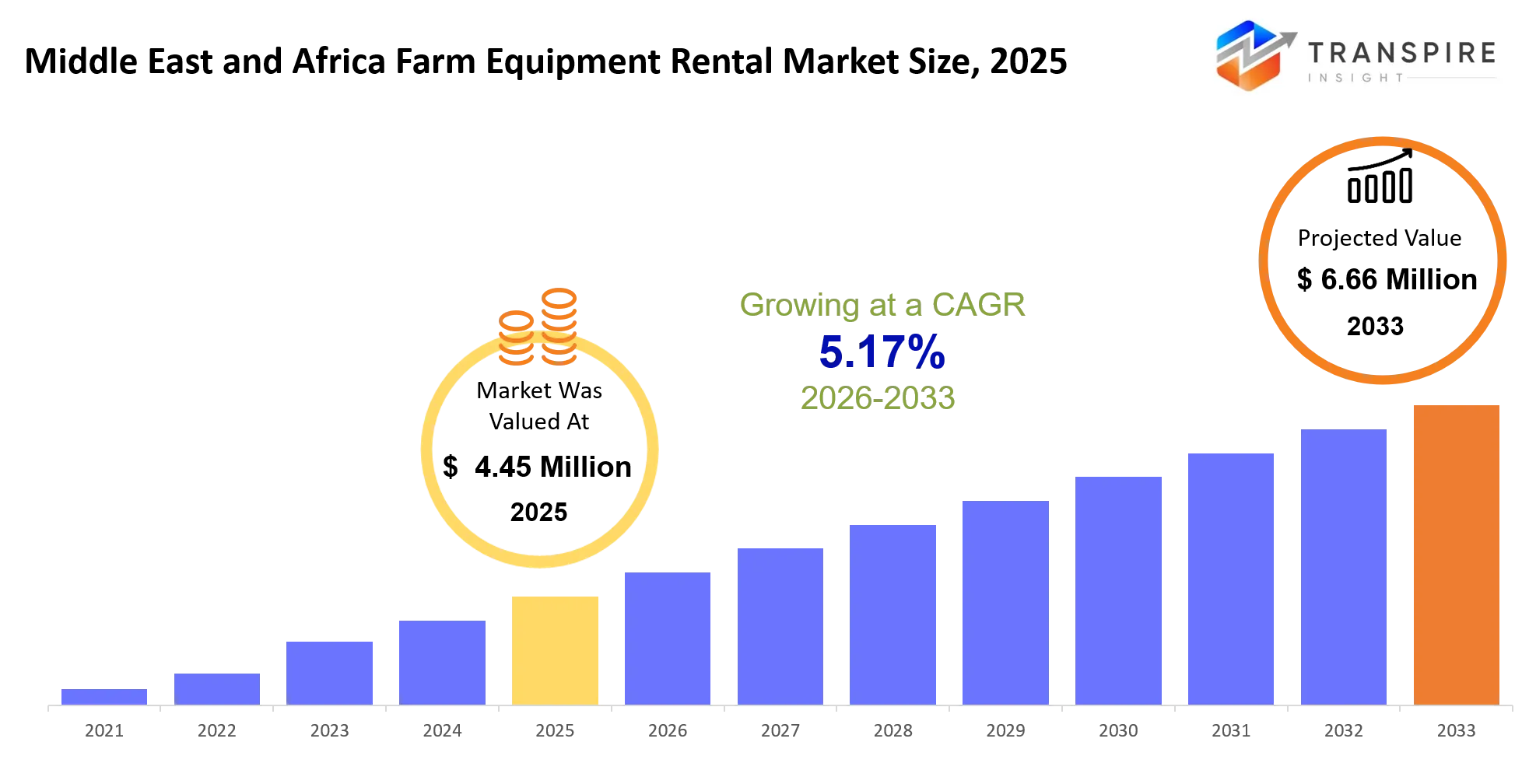
- Middle East and Africa Farm Equipment Rental Market Size 2025: USD 4.45 Million
- Middle East and Africa Farm Equipment Rental Market Size 2033: USD 6.66 Million
- Middle East and Africa Farm Equipment Rental Market CAGR: 5.17%
- Middle East and Africa Farm Equipment Rental Market Segments: By Equipment Type (Tractors, Harvesters, Sprayers, Seeders, Irrigation Equipment, Others); By Rental Type (Short-Term, Long-Term, Seasonal, Others); By Application (Crop Farming, Livestock Farming, Horticulture, Others); By End User (Small Farms, Medium Farms, Large Farms, Others)
To learn more about this report,  Download Free Sample Report
Middle East and Africa Farm Equipment Rental Market Summary
The Middle East and Africa Farm Equipment Rental Market was valued at USD 4.45 Million in 2025. It is forecast to reach USD 6.66 Million by 2033. That is a CAGR of 5.17% over the period.
The Middle East and Africa farm equipment rental industry helps farmers get access to tractors, harvesters, seeders, sprayers, and irrigation systems without that big capital weight of owning machines. In other words, rental services handle a real, day to day problem across the region, where a lot of farms run on seasonal cash flow cycles and honestly cannot justify paying for costly equipment all year.
Over the last five years , the market has been moving from informal equipment lending toward more organized rental networks. This is happening alongside digital booking platforms, fleet management tools , and agricultural service providers that coordinate deliveries and maintenance. One big push behind this shift was the sharp rise in machinery prices, plus supply chain disruptions after the global logistics disruptions of 2020–2022. Equipment ownership became pricier and also more unpredictable which made farmers look for alternatives. So as costs went up, many buyers switched to rental models because they bring flexibility and usually require less upfront spending. This change is helping mechanization spread across small and medium sized farms, which boosts output, and it also creates steady recurring revenue opportunities for rental operators throughout the region.
Key Market Insights
- The Middle East and Africa Farm Equipment Rental Market is kinda riding on mechanization programs that push productivity upgrades across commercial agriculture, not just in one place but broadly.
- Gulf Cooperation Council countries hold an estimated 35%+ market share, mostly because of big farming investments and pretty advanced irrigation projects, which makes renting make more sense.
- Southern Africa is still the fastest expanding regional cluster through 2033, backed by commercial farming expansion and modernization pushes that keep rolling.
- Tractors pretty much dominate the equipment category, around 40% of rental revenue, since they can be used all year in multiple farming activities, nonstop.
- Harvesters sit as the second-largest segment, especially in grain producing areas across South Africa and a few selected Middle Eastern markets.
- Irrigation equipment rentals are forecast to grow above 6�ch year because water management is becoming a strategic priority for farming operations.
- Crop farming is responsible for more than 55% of equipment rental demand, largely from extensive land prep, sowing, and harvesting needs—so the demand stays consistent.
- Small and medium farms, together drive over 60% of rental transactions, mainly because ownership costs stay a serious financial hurdle for many operators.
- Digital fleet tracking and telematics are said to have jumped by nearly 20% among major rental operators between 2022 and 2025, it’s not just talk anymore.
- Strategic expansion by John Deere, CNH Industrial, AGCO, Kubota, Mahindra, and CLAAS is also improving equipment availability across emerging agricultural markets, even where supply used to be limited.
What are the Key Drivers, Restraints, and Opportunities in the Middle East and Africa Farm Equipment Rental Market?
The main growth driver is that the cost of agricultural machinery ownership keeps going up. Today tractors, harvesters and a lot of precision farming systems need serious capital outlay, so it becomes hard for farmers who basically earn on a seasonal basis. Equipment makers have rolled out more and more advanced machines , with GPS guidance, telematics, and engines that use fuel efficiently. Sure, that helps performance but it also pushes the price higher. When owning starts to feel less economical, rental services become the easier route, giving farmers access to updated equipment while spreading the spending across several users. This tends to lift equipment utilization levels too, and it also pulls more mechanization, so in turn it supports rental revenue.
Another big structural limiter is limited rural infrastructure. In many farming regions, transportation networks are still weak, service coverage is scattered, and maintenance facilities are limited. Because of that, equipment deliveries take longer, and the operating costs rise for rental providers. This is not like a quick short-term economic shock; fixing roads and related infrastructure takes years, and it usually needs both public and private funding. So rental penetration remains smaller in remote farming areas, and that slows adoption, which then delays potential income for the market.
There is also a meaningful long-term opportunity in precision agriculture. Rental fleets that include GPS steering, telematics, variable-rate application capabilities, and data-focused farm management tools let farmers use advanced solutions without buying everything up front. In places like Saudi Arabia, South Africa, and the United Arab Emirates, investment in agricultural modernization is increasing , along with a shift toward water-smart cultivation methods.
What Has the Impact of Artificial Intelligence Been on the Middle East and Africa Farm Equipment Rental Market?
Artificial intelligence is kinda transforming agricultural equipment rental operations, mostly by boosting fleet utilization, tightening up maintenance planning, and generally making day to day work more efficient. Rental providers are using AI based telematics systems more and more, not just to track the usual stuff. They watch engine performance, fuel use, operating hours, and even where each piece of equipment is, live in real time. In the background, automated fleet management platforms tend to help with equipment allocation, so there’s less wasted waiting time and fewer idle periods across several farms at once.
Also, machine learning models are rolling out for predictive maintenance, that’s another big piece. They look at vibration patterns, temperature levels, how the hydraulic system behaves, and past repair notes. Then they can flag possible component failures before they actually turn into breakdowns. In practice, this supports better equipment availability and cuts unplanned downtime. Some operators mention maintenance cost reductions in the 10% to 20% range after predictive analytics and remote diagnostics get set up, and yeah it seems to stick.
Beyond that, advanced analytics tools back fuel optimization and operational scheduling. AI algorithms can suggest more efficient deployment schedules, which lowers transport expenses and improves asset utilization. With that, rental companies can keep their profitability steady while still offering reliable service to farmers.
Still though, AI adoption has hurdles. The integration costs can be high, connectivity can be inconsistent in remote agricultural areas, and sometimes there simply isn’t enough historical equipment data to train models properly. Because of those limitations, model accuracy can take a hit, and deployment can drag on, especially for smaller rental operators. Even so, the longer-term benefits are often clear, it’s just that the rollout isn’t always simple or quick.
Key Market Trends
- Organized rental networks kinda expanded a lot between 2021 and 2025, as agricultural service providers basically formalized equipment-sharing operations, in a more structured way.
- Telematics-equipped rental fleets rose by more than 20�ross major operators since 2022, and it’s noticeable.
- Tractors with GPS-assisted guidance got better traction among commercial farming customers who were really after operational efficiency, not just convenience.
- Seasonal rental contracts started growing faster than the normal annual agreements, mostly because farmers prioritized cost flexibility, somewhat.
- Water-efficient irrigation equipment rentals increased by around 15% from 2022 to 2025 in arid farming regions, where water constraints are tough.
- John Deere and AGCO expanded precision agriculture capabilities across their equipment lines too, and that pushed rental fleet upgrades across the market.
- Fleet utilization analytics became this competitive edge for larger regional rental providers after 2023, plain and simple.
- Commercial farming operations leaned more and more toward bundled equipment plus maintenance rental packages rather than standalone machinery hire, you know what I mean.
- Cross-border agricultural investment projects also created new demand hubs across Southern and Eastern Africa.
- Rental operators started partnering more frequently with financial institutions, in order to improve machinery accessibility for smaller farms.
Middle East and Africa Farm Equipment Rental Market Segmentation
By Equipment Type
Tractors show up as the biggest slice of rental demand, mainly because they’re versatile across land preparation, planting, hauling, and cultivation, yep. Rental fleets often choose tractors first, since they get steady work across the agricultural calendar and don’t sit idle too long. Harvesters stay important too, especially when the peak harvesting windows arrive, because farms can cover larger acreages without locking up too much capital upfront.
Sprayers and seeders back precision farming efforts and they also help with smoother operations during planting and the crop protection phase. Irrigation equipment is getting more attention in places dealing with water scarcity, and also with rainfall that is less predictable than before. The other equipment group usually includes loaders, tillers, balers, and specialized farm machinery, all of that to match specific crop needs, plus individual farm routines.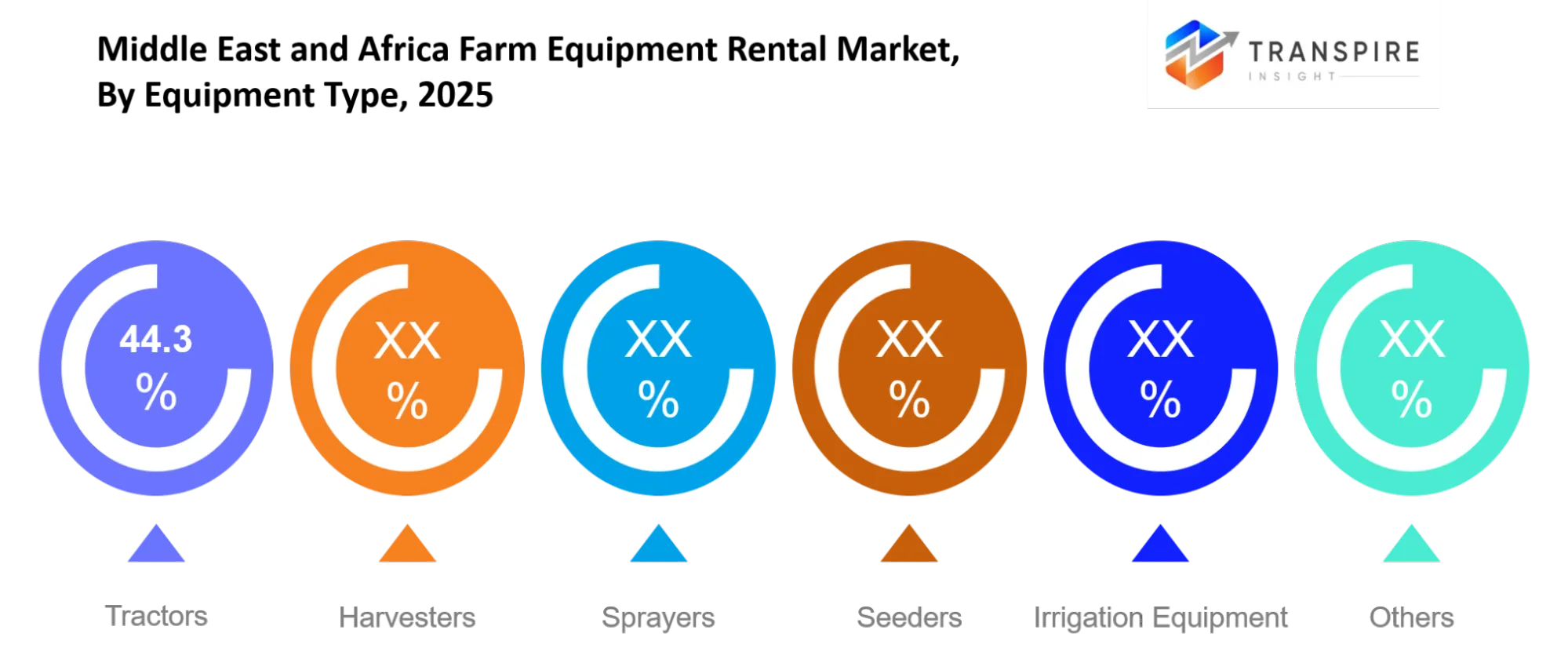
To learn more about this report, Download Free Sample Report
By Rental Type
Short-term rentals still get used a lot for the little agricultural chores like planting , spraying, and harvesting. This kind of model lets farms tap into machinery only when it’s really needed, while at the same time keeping costs under tight control. Meanwhile, long-term rental agreements work well for commercial operations because they want equipment that’s there on time, in a predictable way, without the heavy ownership responsibilities.
Seasonal rentals keep picking up momentum too, mostly because farm work often tracks crop production cycles. With flexible agreements, machinery can be rolled out exactly during the high-demand weeks, so there’s no wasting money on idle equipment. There are also other formats , such as tailored contracts, cooperative-sharing programs, and project-based equipment leasing setups.
By Application
Crop farming ends up taking the biggest slice of equipment rental activity since planting, cultivation, and harvesting kind of depend on heavy mechanization. The rental machines help raise output, and they make it easier to handle huge farmland areas in a more orderly way. Tractors, harvesters, and seeders basically stay the key pieces in this segment.
Livestock farming, meanwhile, creates a steady need for machinery that goes into feed production, land management, and also material moving. In horticulture, more and more operations are using specialized equipment for putting crops in place, irrigation tasks, and crop upkeep. Other options show up too, like mixed farming setups, or small targeted agricultural work that just needs short term machinery access now and then.
By End User
Small farms end up being a pretty big customer group, because owning equipment is still often financially tough, and honestly it’s not getting easier. With rental solutions, farmers can tap into modern machinery, while also keeping working capital for seeds, fertilizers, and everyday operational costs. Medium sized farms, in particular, tend to lean on rental services so they can smooth out those seasonal workload shifts, rather than buying something they only need for a short while.
When you get to large farms they often use rental equipment to back up their own fleets during peak periods. This method supports higher output and it reduces the urge to sink money into machinery that sits idle for parts of the year. In addition, other end users show up as agricultural cooperatives, farming associations, research institutions, and contract farming organizations, all looking for flexible access.
What are the Key Use Cases Driving the Middle East and Africa Farm Equipment Rental Market?
Crop production still ends up being the main reason people rent equipment. Farmers often rent tractors, seeders, and harvesters during land prep , planting, and the harvesting period. In this way they get access to up to date machinery, without needing that big amount of upfront investment.
At the same time, the smaller but growing uses are showing up across horticulture and livestock work. Horticulture producers increasingly rent irrigation systems and spraying gear, mostly to boost yield and use water or inputs more efficiently. Livestock operations also bring in rented machinery for feed processing, yard or field management, and even moving materials or animals.
New opportunities are also starting to form around precision farming and climate resilient agriculture. Machinery with GPS guidance, telematics, and variable-rate application tools is getting easier to obtain via rental programs. If this keeps moving forward it may speed up adoption of these kinds of solutions on farms that previously just couldn't reach advanced agricultural equipment, or didn't have the option to.
|
Report Metrics |
Details |
|
Market size value in 2025 |
USD 4.45 Million |
|
Market size value in 2026 |
USD 4.68 Million |
|
Revenue forecast in 2033 |
USD 6.66 Million |
|
Growth rate |
CAGR of 5.17%from 2026 to 2033 |
|
Base year |
2025 |
|
Historical data |
2021 - 2024 |
|
Forecast period |
2026 - 2033 |
|
Report coverage |
Revenue forecast, competitive landscape, growth factors, and trends |
|
Regional scope |
Middle East and Africa (Saudi Arabia, United Arab Emirates, South Africa, Rest of Middle East and Africa) |
|
Key company profiled |
John Deere, CNH Industrial, AGCO, Kubota, Mahindra, JCB, Caterpillar, Komatsu, Escorts Kubota, CLAAS, Yanmar, SDF Group, TAFE, Zoomlion, Deutz-Fahr |
|
Customization scope |
Free report customization (country, regional & segment scope). Avail customized purchase options to meet your exact research needs. |
|
Report Segmentation |
By Equipment Type (Tractors, Harvesters, Sprayers, Seeders, Irrigation Equipment, Others); By Rental Type (Short-Term, Long-Term, Seasonal, Others); By Application (Crop Farming, Livestock Farming, Horticulture, Others); By End User (Small Farms, Medium Farms, Large Farms, Others) |
Which Regions are Driving the Middle East and Africa Farm Equipment Rental Market Growth?
The Middle East seems to take the lead in revenue generation across the region, mostly because of big agricultural modernization pushes, improved irrigation projects and various government-backed food security programs. Saudi Arabia, and the United Arab Emirates in particular, keep putting money into mechanized farming systems. They also benefit from solid infrastructure, plus easier access to financing that helps scale equipment rental expansion, or at least that's what many operators are seeing. Along with that, large-scale commercial farming operations keep boosting market demand more and more over time.
Southern Africa shows up as the second-largest contributor. The momentum here comes from established commercial agriculture, fairly mature farming routines , and consistent investment aimed at better productivity outcomes. South Africa is still a key market, driven by wide mechanization and strong agricultural output. And because commercial producers tend to hold steady demand, rental providers get more consistent revenue opportunities.
Eastern Africa is currently showing up as the fastest-growing region. A mix of agricultural modernization efforts, rising needs for local food production and increasing private investment is basically opening up fresh avenues. Mechanization rates are still comparatively low , so there is plenty of room for growth. This outlook is also drawing equipment suppliers, rental operators and investors who want longer-term market development chances, all the way through 2033.
Who are the Key Players in the Middle East and Africa Farm Equipment Rental Market and How Do They Compete?
The competition is still pretty moderately fragmented, global agricultural machinery manufacturers kind of steer the rental fleet composition, while regional operators handle equipment deployment more directly. Cost efficiency, equipment reliability, service coverage, and technology integration are the main competitive levers here. Lately, most market players are trying to set themselves apart via fleet modernization and digital management know how, like it’s becoming a default move.
John Deere leans hard into precision agriculture technologies, telematics integration, and advanced fleet connectivity, which helps rental providers keep track of equipment monitoring, plan maintenance sooner ,and generally improve operational efficiency. CNH Industrial, meanwhile, differentiates through the Case IH and New Holland portfolios, selling machinery suited to a range of farm sizes and different applications. AGCO also pushes smart farming solutions and equipment productivity improvements that fit commercial agricultural operations pretty well.
Kubota and Mahindra tend to compete by offering durable machinery designed for cost-sensitive farming settings. Their strong dealer networks plus broad product availability helps support regional expansion initiatives, without too much drama. CLAAS stays competitive through harvesting expertise and high-capacity equipment meant for large scale agricultural operations. Across the whole industry, continued investment in digital agriculture, fleet analytics, and regional partnerships stays right at the center of the competitive strategy, even if everyone says it slightly differently.
Company List
- John Deere
- CNH Industrial
- AGCO
- Kubota
- Mahindra
- JCB
- Caterpillar
- Komatsu
- Escorts Kubota
- CLAAS
- Yanmar
- SDF Group
- TAFE
- Zoomlion
- Deutz-Fahr
Recent Development News
In February 2026, John Deere launched new 8R and 8RX tractor models with up to 540 horsepower. The launch expanded high-performance equipment options and strengthened advanced mechanization capabilities relevant to commercial farming and rental fleets.https://www.deere.com
In June 2025, CNH's Case IH Quadtrac 715 received international recognition through the Red Dot Product Design Awards. The recognition highlighted advanced engineering features and reinforced the industry's focus on productivity-enhancing machinery.https://www.cnh.com
What Strategic Insights Define the Future of the Middle East and Africa Farm Equipment Rental Market?
Over the next five to seven years, it seems the industry is going to lean more toward technology-enabled equipment access, instead of people doing old-school machinery ownership. The mix of equipment costs that keep climbing , plus the adoption of precision agriculture, and the constant need to boost farm productivity , should make the rental model grow across both the commercial side and the smallholder segments.
There’s also a risk that is a little less obvious, more like a quiet pressure point: getting more dependent on a small number of global machinery manufacturers. If there are supply chain disruptions , shortages of key components, or even just pricing changes coming from the big equipment suppliers, then it can hit fleet expansion plans pretty directly. It can also affect rental profitability in a way that doesn’t show up right away. Meanwhile, precision agriculture rentals actually look like a real opportunity. Rentals that come with telematics, GPS guidance, and data-driven farm management tools are still not widely used, but they could quickly become a major growth pocket.
So market participants should focus on digital fleet management, predictive maintenance, and building smart partnerships with agricultural technology providers. Firms that can blend equipment access with technology-enabled services should end up with the strongest longer term competitive edge.
Middle East and Africa Farm Equipment Rental Market Report Segmentation
By Equipment Type
- Tractors
- Harvesters
- Sprayers
- Seeders
- Irrigation Equipment
- Others
By Rental Type
- Short-Term
- Long-Term
- Seasonal
- Others
By Application
- Crop Farming
- Livestock Farming
- Horticulture
- Others
By End User
- Small Farms
- Medium Farms
- Large Farms
- Others
Frequently Asked Questions
Find quick answers to common questions.
The Expected Middle East and Africa Farm Equipment Rental Market size for the Market will be USD 6.66 Million in 2033.
Key Segments for the Middle East and Africa Farm Equipment Rental Market are By Equipment Type (Tractors, Harvesters, Sprayers, Seeders, Irrigation Equipment, Others); By Rental Type (Short-Term, Long-Term, Seasonal, Others); By Application (Crop Farming, Livestock Farming, Horticulture, Others); By End User (Small Farms, Medium Farms, Large Farms, Others).
Major Middle East and Africa Farm Equipment Rental Market Players are John Deere, CNH Industrial, AGCO, Kubota, Mahindra, JCB, Caterpillar, Komatsu, Escorts Kubota, CLAAS, Yanmar, SDF Group, TAFE, Zoomlion, Deutz-Fahr.
The Current Middle East and Africa Farm Equipment Rental Market size is USD 4.45 Million in 2025
The Middle East and Africa Farm Equipment Rental Market CAGR is 5.17% from 2026 to 2033.
- John Deere
- CNH Industrial
- AGCO
- Kubota
- Mahindra
- JCB
- Caterpillar
- Komatsu
- Escorts Kubota
- CLAAS
- Yanmar
- SDF Group
- TAFE
- Zoomlion
- Deutz-Fahr
About the Authors

Mayur Shinde
I am Mayur Shinde, a Senior Research Analyst at Transpire Insight, specializing in the Automotive & Transportation and Information & Communication Technology (ICT) Industry. My work focuses on analyzing emerging market trends, technological advancements, competitive landscapes, and industry developments to deliver accurate, data-driven insights. I am passionate about transforming complex market information into clear, actionable content that helps businesses, professionals, and decision-makers stay informed and make confident strategic decisions.

Chakradhar Khansole
Chakradhar serves as the Research Director at Transpire Insight, bringing over 8 years of experience in technology, innovation, and strategic market intelligence. He specializes in transforming complex market data into actionable business insights that enable organizations to make informed, growth-oriented decisions. Recognized for his strategic vision and analytical expertise, Chakradhar leads high-impact research initiatives, delivering comprehensive market assessments, competitive intelligence, and forward-looking industry analysis.
Recently Published Reports
-
Apr 2026
ATV & UTV Market
ATV & UTV Market Size, Share & Analysis Report By Type (ATV, and UTV), By Variants (Less Than 400 CC, 400 CC To 800 CC, and More Than 800 CC), and Geography (North America, Europe, Asia-Pacific, Middle East and Africa, South and Central America), 2021 - 2031
-
Apr 2026
Automotive Central Gateway Module Market
Automotive Central Gateway Module Market Size, Share & Analysis Report By Type (Ethernet Central Gateway Module, CAN Central Gateway Module, LIN Central Gateway Module, and FlexRay), By Application (Powertrain Control, Body Control, Infotainment System, Advanced Driver Assistance Systems (ADAS), and Others), By End User (Passenger Vehicles, and Commercial Vehicles), and Geography (North America, Europe, Asia-Pacific, Middle East and Africa, South and Central America), 2021 - 2031
-
Apr 2026
Automotive Engine Oil Filter Market
Automotive Engine Oil Filter Market Size, Share & Analysis Report By Filter Type (Fuel Filter, Engine Oil Filter, Hydraulic Oil Filter, and Others), By Filter Media (Cellulose, Synthetic, and Micro), By Sales Channel (OEMs, and Aftermarket), By Vehicle Type (Passenger Cars, Light Commercial Vehicles, Heavy Duty Trucks, Buses and Coaches, and Off-road Vehicles), and Geography (North America, Europe, Asia-Pacific, Middle East and Africa, South and Central America), 2021 - 2031
-
Apr 2026
Automotive Parts Aluminium Die Casting Market
Automotive Parts Aluminium Die Casting Market Size, Share & Analysis Report By Production Process (Pressure Die Casting, Vacuum Die Casting, Squeeze Die Casting, Gravity Die Casting), By Application (Body Parts, Engine Parts, Transmission Parts, Battery And Related Components, Other Application Types), and Geography (North America, Europe, Asia-Pacific, Middle East and Africa, South and Central America), 2021 - 2031
Our Clients



