

Asia Pacific Indoor Farming Market Size & Forecast:
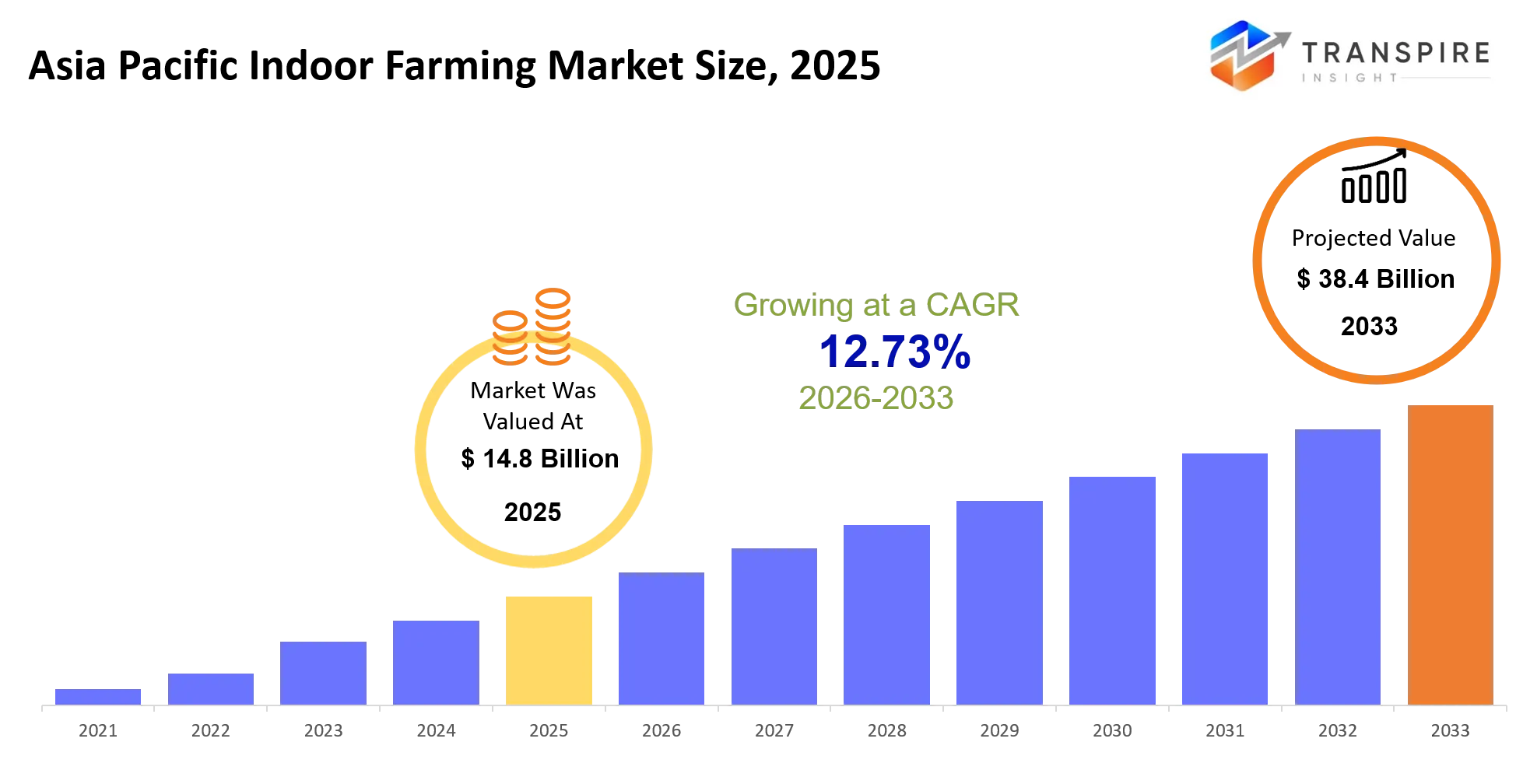
- Asia Pacific Indoor Farming Market Size 2025: USD 14.8 Billion
- Asia Pacific Indoor Farming Market Size 2033: USD 38.4 Billion
- Asia Pacific Indoor Farming Market CAGR: 12.73%
- Asia Pacific Indoor Farming Market Segments: By Facility Type (Vertical Farms, Greenhouses, Container Farms, Indoor Gardens, Hydroponics, Aeroponics, Aquaponics, Others); By Crop Type (Leafy Greens, Herbs, Fruits, Vegetables, Flowers, Microgreens, Others); By Technology (LED Lighting, Climate Control, Sensors, Automation, AI Systems, Others); By End User (Commercial Growers, Research Institutes, Retailers, Others)
To learn more about this report,  Download Free Sample Report
Asia Pacific Indoor Farming Market Summary
The Asia Pacific Indoor Farming Market was valued at USD 14.8 Billion in 2025. It is forecast to reach USD 38.4 Billion by 2033. That is a CAGR of 12.73% over the period.
The Asia Pacific indoor farming market is kind of dealing with a real practical problem for both food producers and retailers: getting fresh vegetables, herbs, and specialty crops nearer to city shoppers, while also cutting down the risk tied to weather swings , limited land, and those long distribution networks that tend to add cost and delays. In the real world, indoor farms make possible year round growing with steadier output and quality, and that is especially useful in crowded urban areas and places that still depend a lot on imports.
Over the last five years, things have moved from mostly small-scale pilot projects toward facilities that actually run at commercial level, and they tend to blend LED lighting, climate control , sensors, and this more data-driven approach for crop management. One big push came during the COVID-19 period, when food supply chains got disrupted, and it basically revealed weak points in the usual sourcing setups , so investors leaned harder into localized production. At the same time, extreme weather events across parts of Asia have also made the case for controlled growing spaces much stronger. As a result, production reliability is getting better, retailer partnerships are becoming more common, and premium produce that is consistently available is starting to support stronger revenue results.
Key Market Insights
- In East Asia there is this kind of dominance over the Asia Pacific Indoor Farming Market, pulling in roughly 45% to 50% of regional revenue, and its basically driven by Japan , China, and South Korea.
- Across the broader emerging Asia Pacific economies, government-backed agricultural modernization programs keep pushing market penetration forward, almost like a steady nudge every year, no real pause.
- When you look at the setups, hydroponic systems tend to dominate the Asia Pacific Indoor Farming Market, and they account for more than 50% of commercial indoor farming installations, by a wide margin.
- LED grow lighting is still the second biggest segment too, helped along by lower energy consumption, along with improved crop productivity which makes the whole operation feel more “sure thing”.
- And vertical farming systems are the fastest-growing segment through 2030 , mostly because operators are trying to maximize output per square meter, especially in dense urban locations where space is tight.
- Automation platforms , and environmental monitoring solutions are quickly grabbing more market share as labor optimization turns into this real strategic priority for companies.
- When you look at vegetable cultivation it pretty much leads, with over 60% market share, especially leafy greens, lettuce, spinach, and those herbs people buy for salads.
- Premium produce keeps showing solid commercial viability because the quality stays consistent, and the harvest cycle runs year round without much break.
- On the fruit side, cultivation is the fastest growing application, mostly because improvements in controlled pollination together with climate management technologies are getting better all the time.
- Meanwhile specialty crops are also starting to pop up as higher-margin segments across commercial indoor agriculture facilities.
What are the Key Drivers, Restraints, and Opportunities in the Asia Pacific Indoor Farming Market?
The main force pushing the Asia Pacific Indoor Farming Market is this growing need for dependable food production, especially in places where cities keep expanding, climate swings are getting worse, and usable farmland keeps getting thinner. Meanwhile, upgrades in LED lighting efficiency , better sensor technology, and hydroponic systems kind of make controlled-environment agriculture far more workable than it used to be. When the cost per kilogram goes down, and crop output becomes more steady, commercial growers can lock in premium supply agreements with retailers, restaurants, and food distributors. This change, in turn, backs revenue growth by lowering crop losses and letting production run all year long, even when seasons act unpredictable.
That said, the biggest roadblock still feels like the high capital and ongoing operating cost setup tied to indoor farming facilities. Bigger vertical farms need heavy investment in lighting, climate-control equipment, automation systems, and the whole energy-intensive day to day operation. And honestly this is structural , since electricity prices, building expenses, and financing hurdles aren't things that can be fixed quickly. Because of that, lots of potential operators postpone expansion moves, while smaller ag businesses often can’t reach economic viability, which then limits broader market adoption. In developing economies this ends up holding back revenue potential too, not just slowing growth.
A big opportunity sort of sits in how we blend artificial intelligence, automation, and renewable energy together inside indoor agriculture facilities. You can see this happening in places like China , Singapore, and Japan where more and more money is moving into smart farming platforms that can tune irrigation, nutrient delivery and surrounding conditions in real time. As these tools get more mature and the costs for putting them in actually drop, the operators can end up boosting yields while also cutting back on resource consumption. That mix of digital agriculture with controlled environment growing is kind of set to open the next stage of regional market growth, mainly because it helps with scalability as well as profitability.
What Has the Impact of Artificial Intelligence Been on the Asia Pacific Indoor Farming Market?
Artificial intelligence is quietly changing the Asia Pacific indoor farming world, mostly by upping operational precision , making resources stretch further, and improving crop output. In newer controlled environment agriculture setups, teams are increasingly relying on AI monitoring systems to run the show for lighting schedules, temperature levels, humidity levels, carbon dioxide amounts, and nutrient dosing. These automation platforms kind of keep scanning sensor signals all day long, then they tweak the growing conditions to hold a steady, best-case environment for crops, with a lot less manual back and forth.
At the same time, machine learning models are boosting predictive power across many commercial indoor farms. OOperators can use predictive analytics to kinda anticipate crop growth cycles, flag disease risks way before obvious symptoms show up,and tune the harvest schedule so it lands nearer to the ideal. Plus AI based image recognition can catch plant stress, notice nutrient shortfalls, and even early pest activity faster than the more old fashioned inspection approach, which then helps lessen crop losses and keeps product consistency more reliable.
And yeah, all these digital tools turn into real, day to day wins. Farms might cut water use with precision irrigation, reduce fertilizer waste, boost labor productivity, and push higher facility utilization rates. When the environment is handled with more accuracy, yields often climb, product quality tends to look better, and overall profitability gets a firmer footing across bigger operations.
Still, there are limits. AI adoption can hit a wall due to expensive integration, fragmented data systems, and not enough historical crop datasets, which can drag down model accuracy and slow the payback period. A lot of smaller growers also struggle to roll out advanced analytics at true commercial scale, especially in cost sensitive areas across the region.
Key Market Trends
- Since 2020, commercial operators, kind of moved past demonstration farms, and now bigger facilities are pushing production economics and long term retailer supply commitments, not just trial results.
- LED lighting adoption got a big boost between 2021 and 2025, because energy efficient systems cut electricity use while also helping deliver more stable crop performance, even when conditions swing a bit.
- Growers started swapping out manual monitoring for AI enabled sensors, these things keep tuning temperature, humidity, nutrient delivery, and lighting scenarios, all the time so things stay aligned.
- Across Japan, Singapore, and South Korea, food retailers widened their collaborations with indoor farms, mainly to reduce dependence on imported fresh produce and keep shelves filled, somehow.
- Since 2022, climate related disruptions kept showing up, and that pushed producers toward controlled environment agriculture, which helps rein in exposure to droughts, floods and those annoying seasonal yield bumps.
- Companies including Spread Co., Ltd. and Panasonic Holdings Corporation have also increased spending on automated cultivation systems, aiming to raise labor productivity and reduce the ongoing headache of staffing.
- Vertical farming projects gained more momentum after 2021, since urban land limits basically forced higher output cultivation into tighter metropolitan footprints.
- Hydroponic cultivation expanded further commercially, because operators wanted better water use efficiency compared with standard field agriculture approaches, even when operating costs get scrutinized.
- Governments in China, Singapore,and Japan have been slowly folding smart agriculture into broader food security playbooks, which in turn made it easier for tech rollout to happen faster, and for facility expansion to get the green light.
- At the same time, the competitive spotlight started moving away from only chasing maximum production volume, toward the more nuanced stuff like better yield per square meter, energy efficiency measures,and those longer term operating margins that actually hold up when the market cycles swing.
Asia Pacific Indoor Farming Market Segmentation
By Facility Type :
Facility type matters a lot for how production methods get shaped across the Asia Pacific Indoor Farming Market. You’ll see vertical farms leaning on stacked growing systems to push out more output in tight spaces, while greenhouses mix in natural light with carefully tuned climate control. Container farms on the other hand, give compact, movable cultivation units that help local production happen faster.
Then there are indoor gardens which usually cover small-scale and specialty cultivation needs, and soil free growing approaches like hydroponics, aeroponics, and aquaponics that tend to boost resource efficiency. Some other facility formats exist too, for niche use cases and more experimental cultivation routes. Basically, the facility type is chosen based on crop requirements, how much space is available, the investment capacity, and how high the target production levels need to be.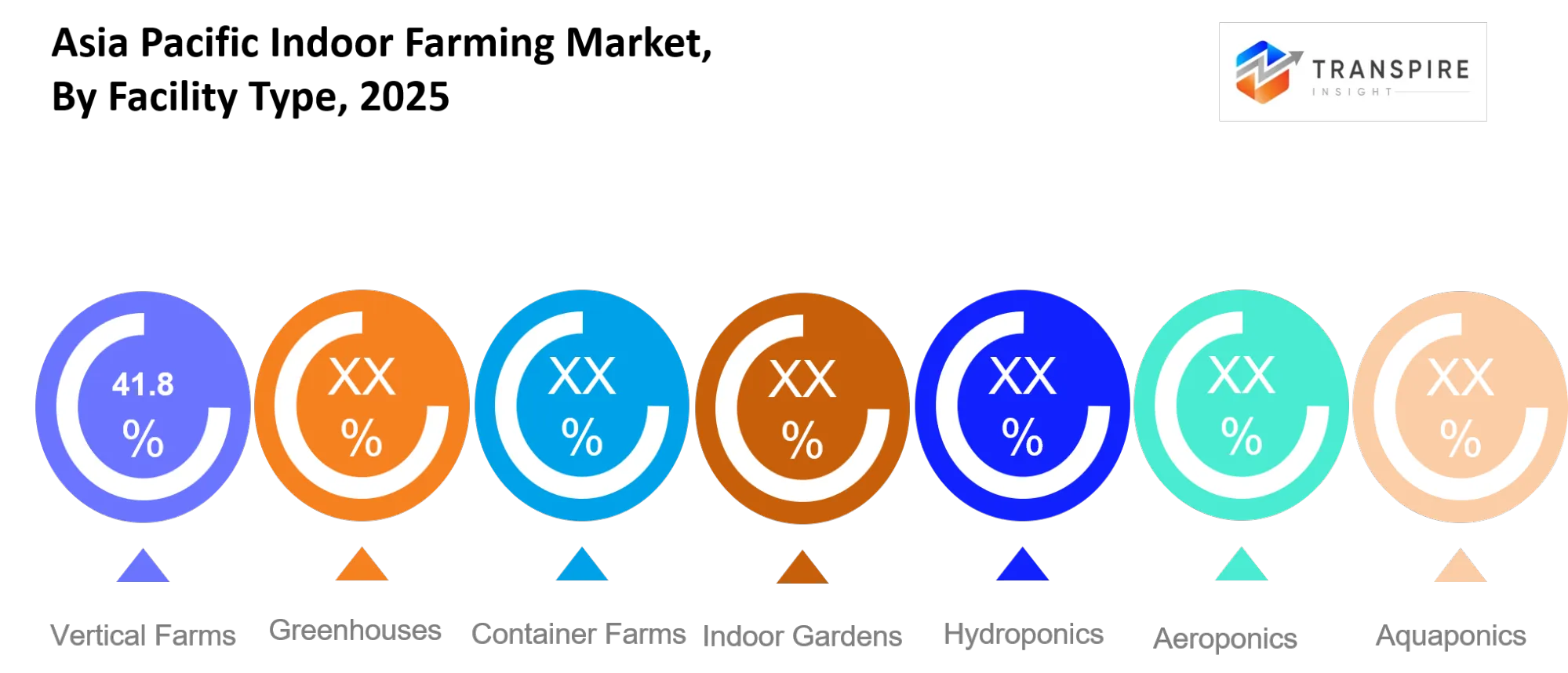
To learn more about this report, Download Free Sample Report
By Crop Type :
Crop type segmentation also highlights the range of products grown inside controlled indoor environments. Leafy greens stay dominant, mainly because growth cycles are shorter and the conditions are simpler to manage. Herbs keep showing up everywhere as well, partly because food service and retail demand is strong.
Fruits, vegetables, flowers, plus microgreens continue to pull more attention as cultivation technology gets better, especially for crops that are more complex. Each crop category tends to need its own lighting setup, nutrient delivery approach, and climate management. Other crop types focus on specialty markets where premium quality, along with year round availability, opens up extra commercial prospects.
By Technology :
Technology really kind of acts as the base layer for today’s indoor farming operations. LED lighting systems give the plant the light spectrum it needs for growth, and at the same time they help cut energy use. Then climate control solutions keep temperature, humidity and air movement in check, so plants develop more evenly all year long, even when seasons shift a bit
Sensors , automation platforms , and AI systems also help a lot with day to day operations, because they gather real time data and then fine tune the growing environment when it becomes necessary. In practice this means less manual involvement, better use of water and inputs , and steadier production outputs. Some other technologies even cover specialized work like nutrient management, ongoing monitoring, and full system integration
By End User :
On the customer side segmentation, you can see the different groups that use indoor farming systems. Commercial growers take a large portion because big cultivation facilities usually aim to deliver fresh produce to shoppers through established distribution networks. For them operational efficiency and dependable output are basically the main priorities
Research institutes use indoor farming spaces to study how crops behave, how cultivation methods work, and how agricultural technologies perform under controlled conditions. Retailers also get more involved nowadays via direct sourcing and localized production approaches, which tends to increase freshness. Beyond that, educational organizations and specialty operators are also common end users, they pursue unusual cultivation goals, and they look for niche market chances
What are the Key Use Cases Driving the Asia Pacific Indoor Farming Market?
The main use case that really seems to push adoption across the Asia Pacific Indoor Farming Market is, mostly, the production of leafy greens for supermarkets , food service chains, and those urban retail networks. With controlled cultivation growers can keep delivering a pretty consistent quality, plus harvests that are predictable, kind of on schedule all year round. That steadiness lowers the chances of major weather disruptions, and also lets retailers keep a stable inventory level, so leafy greens end up being the biggest commercial demand driver.
After leafy greens, indoor farming is getting more visible in the herb, and specialty vegetable side, yeah kinda Commercial growers are increasingly leaning on controlled environments to supply restaurants , premium grocery outlets, and food processors that want uniform products and dependable delivery timing. Even research institutes get involved too , because they can test crop performance , and cultivation methods inside indoor facilities while everything stays standardized and not drifting.
More emerging directions include pharmaceutical and nutraceutical plant cultivation, where tight environmental control helps keep product consistency, steady and predictable. There s also growing attention on microgreens and specialty crops aimed at premium consumers, that opens fresh revenue avenues as cultivation technologies keep getting better, and at the same time become more cost efficient.
|
Report Metrics |
Details |
|
Market size value in 2025 |
USD 14.8 Billion |
|
Market size value in 2026 |
USD 16.6 Billion |
|
Revenue forecast in 2033 |
USD 38.4 Billion |
|
Growth rate |
CAGR of 12.73% from 2026 to 2033 |
|
Base year |
2025 |
|
Historical data |
2021 - 2024 |
|
Forecast period |
2026 - 2033 |
|
Report coverage |
Revenue forecast, competitive landscape, growth factors, and trends |
|
Regional scope |
Asia Pacific (India, China, Japan, Australia, South Korea, Rest of Asia Pacific) |
|
Key company profiled |
AeroFarms, Plenty, Bowery Farming, Infarm, Spread, Sky Greens, Signify, OSRAM, Freight Farms, Gotham Greens, CropOne, Kalera, Agrilution, Valoya, Everlight |
|
Customization scope |
Free report customization (country, regional & segment scope). Avail customized purchase options to meet your exact research needs. |
|
Report Segmentation |
By Facility Type (Vertical Farms, Greenhouses, Container Farms, Indoor Gardens, Hydroponics, Aeroponics, Aquaponics, Others); By Crop Type (Leafy Greens, Herbs, Fruits, Vegetables, Flowers, Microgreens, Others); By Technology (LED Lighting, Climate Control, Sensors, Automation, AI Systems, Others); By End User (Commercial Growers, Research Institutes, Retailers, Others) |
Which Regions are Driving the Asia Pacific Indoor Farming Market Growth?
East Asia still feels like the main region within the Asia Pacific Indoor Farming Market, like by quite a lot, not just a little bit. China, Japan, and South Korea have put real money into controlled-environment agriculture , as part of bigger plans for food security and agricultural modernization. There are strong tech ecosystems behind it too, with advanced lighting systems, automation platforms, sensing solutions, and climate-control hardware being developed and then actually used by commercial indoor farms. Large cities, plus research institutions, equipment suppliers, and commercial growers all in one place, makes a bit of a connected network, and that network keeps pushing the region ahead.
Southeast Asia, on the other hand, shows up as the second-largest contributor, but the way it grows is a little different. Instead of leaning mainly on technological dominance, countries like Singapore, Thailand, and Malaysia tend to aim at raising food self-sufficiency, and also lowering how much they rely on imported vegetables and other produce. Government-backed agricultural programs, steady investment , and a rising number of private-sector operators all help keep expansion on track. So overall it’s a mix of policy support, long-term food supply thinking , and consistent execution, which ends up making the region a dependable source of market revenue.
South Asia seems to be coming up as the quickest moving region during the forecast period, at least that’s what the indicators point too. There is rapid urbanization, a growing squeeze on agricultural land, and more money being put into modern farming infrastructure. All of that makes conditions kinda favorable for indoor cultivation, or maybe “controlled environment” as some people say. In India specifically, there’s been a noticeable rise in interest around hydroponic systems and vertical farming projects, especially from commercial operators who are trying for better productivity, and also more predictable harvests. This momentum is likely to keep building, and between 2026 and 2033 it should open up appealing prospects for tech providers, equipment manufacturers, and investors too, as indoor farming adoption rolls out further across metro areas
Who are the Key Players in the Asia Pacific Indoor Farming Market and How Do They Compete?
Competition in the Asia Pacific Indoor Farming Market is still kind of moderately fragmented, not super unified, with a mix of agricultural technology companies, indoor farm operators, lighting specialists, plus automation providers all trying to take more market share. At the moment, technology innovation is the main reason everyone is pushing, because operators want higher yields, less energy use, and more uniform production results. Even though older, established participants keep growing their commercial scale setups, newer entrants are bringing in specialized cultivation systems and data-driven farm management solutions, and those basically nudge the older models out of the spotlight, a bit.
Spread Co., Ltd. sort of stands out with highly automated vertical farming facilities, aimed at cutting labor needs and raising production efficiency. The company is still extending its automated cultivation abilities to grow output while keeping crop quality steady and repeatable. Panasonic Holdings Corporation leans on its expertise in environmental controls, sensors, and energy management systems, to enable precision agriculture applications. That tech backbone helps it connect indoor farming offerings with broader smart infrastructure platforms, so it can fit into wider connected environments.
Signify N.V. is basically competing using advanced horticultural lighting technologies that help growers get better plant growth, while also lowering day to day operating costs. It keeps pushing continuous development of crop specific lighting solutions, which basically reinforces its position with commercial cultivation operators. AeroFarms, on the other hand, leans hard on data driven cultivation systems that bring automation together with environmental monitoring, and also precision growing techniques. Urban Crop Solutions highlights customizable indoor farming platforms and turnkey facility solutions, letting them expand into new regional markets through partnerships, plus more project based deployments. With all that, these distinct ways of working let each company compete on efficiency, scalability, and production performance not just on price alone.
Company List
- AeroFarms
- Plenty
- Bowery Farming
- Infarm
- Spread
- Sky Greens
- Signify
- OSRAM
- Freight Farms
- Gotham Greens
- CropOne
- Kalera
- Agrilution
- Valoya
- Everlight
Recent Development News
In December 2025, Agroz Inc. launched Agroz Robotics in partnership with UBTECH Robotics. The collaboration integrates AI-driven robotics into Agroz’s controlled-environment vertical farming operating system, enhancing automation and scalability for indoor farming operations in Asia-Pacific. Source https://www.nasdaq.com/
In May 2026, Nomura Real Estate Development Co., Ltd. entered a strategic capital and business partnership with Oishii Farm Corporation. The alliance is intended to accelerate next-generation indoor vertical farming infrastructure and support Oishii Farm’s expansion, strengthening the indoor farming ecosystem in Japan and the broader Asia-Pacific region. Source https://www.nomura-re.co.jp/
What Strategic Insights Define the Future of the Asia Pacific Indoor Farming Market?
The Asia Pacific Indoor Farming Market is sliding into a more integrated, and honestly more tech-heavy way of producing over the next five to seven years. The biggest push behind this shift seems to be the need to lock in steady food output in crowded urban areas while also lowering exposure to climate swings and the usual agricultural land limits. Going forward, investment probably won’t center as much on just adding more facilities and instead it will tilt toward boosting day to day performance, better energy handling, and higher crop yields, via automation and cultivation systems that use data in a smarter way.
There’s also a bit of a quieter risk, that people sometimes overlook. The sector is becoming more dependent on electricity, and that electricity needs can be intense. If energy prices stay jumpy, or if there are power delivery issues in important markets, then operating margins could get squeezed even when demand looks solid. Another worry is how concentrated advanced technology suppliers can be, because that can lead to procurement headaches and pricing pressure for operators running farms.
Still, there’s an emerging chance too, especially when indoor farming is paired with renewable energy plus AI based resource optimization platforms, and this looks particularly promising across South Asia. Market players should really lean into scalable, energy-smart operating models and form longer term partnerships with technology vendors, not just chase production growth for its own sake.
Asia Pacific Indoor Farming Market Report Segmentation
By Facility Type
- Vertical Farms
- Greenhouses
- Container Farms
- Indoor Gardens
- Hydroponics
- Aeroponics
- Aquaponics
By Crop Type
- Leafy Greens
- Herbs
- Fruits
- Vegetables
- Flowers
- Microgreens
By Technology
- LED Lighting
- Climate Control
- Sensors
- Automation
- AI Systems
By End User
- Commercial Growers
- Research Institutes
- Retailers
Frequently Asked Questions
Find quick answers to common questions.
The Expected Asia Pacific Indoor Farming Market size is USD 38.4 Billion in 2033.
Key Segments for the Asia Pacific Indoor Farming Market are By Facility Type (Vertical Farms, Greenhouses, Container Farms, Indoor Gardens, Hydroponics, Aeroponics, Aquaponics, Others); By Crop Type (Leafy Greens, Herbs, Fruits, Vegetables, Flowers, Microgreens, Others); By Technology (LED Lighting, Climate Control, Sensors, Automation, AI Systems, Others); By End User (Commercial Growers, Research Institutes, Retailers, Others).
Major Asia Pacific Indoor Farming Market players are AeroFarms, Plenty, Bowery Farming, Infarm, Spread, Sky Greens, Signify, OSRAM, Freight Farms, Gotham Greens, CropOne, Kalera, Agrilution, Valoya, Everlight.
The Current Asia Pacific Indoor Farming Market size is USD 14.8 Billion in 2025.
The Asia Pacific Indoor Farming Market CAGR is 12.73% from 2026 to 2033.
- AeroFarms
- Plenty
- Bowery Farming
- Infarm
- Spread
- Sky Greens
- Signify
- OSRAM
- Freight Farms
- Gotham Greens
- CropOne
- Kalera
- Agrilution
- Valoya
- Everlight
About the Authors

Mayur Shinde
I am Mayur Shinde, a Senior Research Analyst at Transpire Insight, specializing in the Automotive & Transportation and Information & Communication Technology (ICT) Industry. My work focuses on analyzing emerging market trends, technological advancements, competitive landscapes, and industry developments to deliver accurate, data-driven insights. I am passionate about transforming complex market information into clear, actionable content that helps businesses, professionals, and decision-makers stay informed and make confident strategic decisions.

Chakradhar Khansole
Chakradhar serves as the Research Director at Transpire Insight, bringing over 8 years of experience in technology, innovation, and strategic market intelligence. He specializes in transforming complex market data into actionable business insights that enable organizations to make informed, growth-oriented decisions. Recognized for his strategic vision and analytical expertise, Chakradhar leads high-impact research initiatives, delivering comprehensive market assessments, competitive intelligence, and forward-looking industry analysis.
Recently Published Reports
-
Apr 2026
3D Optical Profiler Market
3D Optical Profiler Market Size, Share & Analysis Report By Type (Desktop 3D Optical Profiler, and Portable 3D Optical Profiler), By Technology (Confocal Technology, and White Light Interference), By End-Use Industry (Manufacturing, Research Institutions, Automotive, Aerospace and Defense, Medical Devices, and Other), and Geography (North America, Europe, Asia-Pacific, Middle East and Africa, South and Central America), 2021 - 2031
-
Apr 2026
Depth Sensor Market
Depth Sensor Market Size, Share & Analysis Report By Type (Infrared Depth Sensors, Time-of-Flight (ToF) Sensors, Stereo Vision Sensors, Structured Light Sensors, Ultrasonic Depth Sensors), By Application (Automotive, Robotics, Gaming, Consumer Electronics, Industrial Automation, Healthcare, Security & Surveillance, Others), By End Users (Automotive Manufacturers, Consumer Electronics Companies, Healthcare Providers, Industrial Companies, Security Agencies, Gaming Companies, Robotics Companies, Others), and Geography (North America, Europe, Asia-Pacific, Middle East and Africa, South and Central America), 2021 – 2031
-
Apr 2026
Digital Manufacturing Market
Digital Manufacturing Market Size, Share & Analysis Report By Component (Hardware, Software, and Services), By Technology (Robotics, 3D Printing, Internet of Things (IoT), and Others), By Application (Automotive and Transportation, Aerospace and Defense, Consumer Electronics, Industrial Machinery, and Others), By Process Type (Computer-Based Designing, Computer-Based Simulation, Computer 3D Visualization, Analytics, and Others), and Geography (North America, Europe, Asia-Pacific, Middle East and Africa, South and Central America), 2021 – 2031
-
Apr 2026
Digital Visa Services Market
Digital Visa Services Market Size, Share & Analysis Report By Type (Individual Travelers, Group Travelers), By Application (Tourism, Business Travel, Others), and Geography (North America, Europe, Asia-Pacific, Middle East and Africa, South and Central America), 2021 – 2031