

North America Harvester Market Size & Forecast:
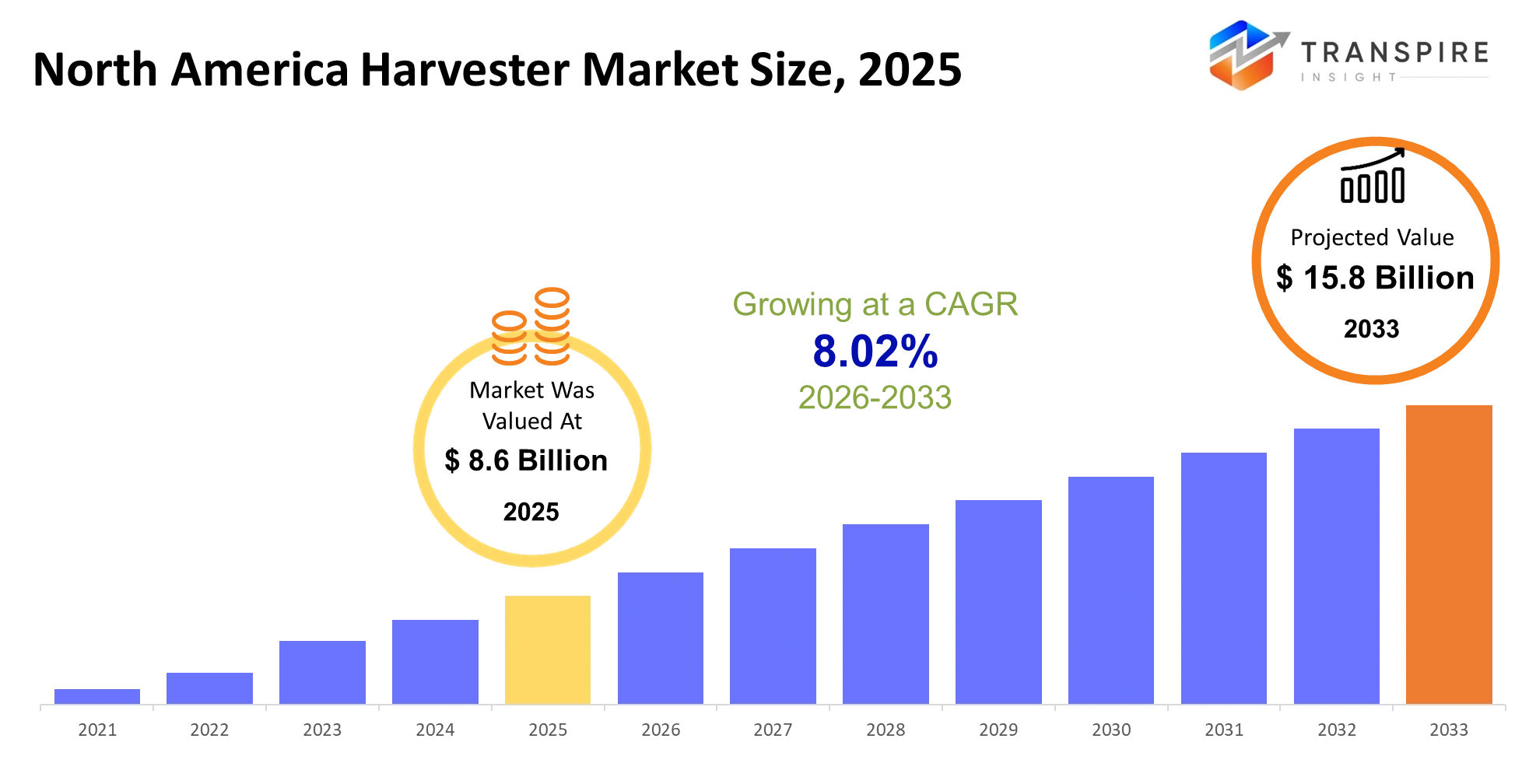
- North America Harvester Market Size 2025: USD 8.6 Billion
- North America Harvester Market Size 2033: USD 15.8 Billion
- North America Harvester Market CAGR: 8.02%
- North America Harvester Market Segments: By Type (Combine Harvester, Forage Harvester, Sugarcane Harvester, Potato Harvester, Grain Harvester, Cotton Harvester, Specialty); By Application (Agriculture, Farming, Crop Harvesting, Commercial Farming, Precision Farming, Organic Farming, Large-scale); By Power (Manual, Electric, Diesel, Hybrid, Autonomous, Smart, AI-enabled); By End-User (Farmers, Agribusiness, Contractors, Govt, Cooperatives, Research, Large Farms); By Distribution (Direct, Dealers, Online, Retail, OEM, Export, Leasing)
To learn more about this report,  Download Free Sample Report
North America Harvester Market Summary:
The North America Harvester Market size is estimated at USD 8.6 Billion in 2025 and is anticipated to reach USD 15.8 Billion by 2033, growing at a CAGR of 8.02% from 2026 to 2033.
The North American harvester market within the agricultural machinery industry will continue to reflect how farming practices across the United States and Canada are adjusting to labor shortages, cost pressures, and the push for higher field efficiency. Farmers will require equipment which can process different crop varieties without causing work interruptions while achieving lower fuel consumption and service downtime. The shift in buyer preferences has already compelled manufacturers to improve machine durability and operator comfort which proves essential during extended harvesting periods.
The existing framework of the North American harvester market will undergo transformation through technology because precision guidance systems and yield monitoring and semi-autonomous functions have become standard features. Environmental regulations will also influence design choices, encouraging cleaner engines and better residue management. The demand for high-capacity machines will rise through larger farm operations, while smaller farms will search for flexible and cost-effective alternatives which will create a diverse and competitive market environment.
What Has the Impact of Artificial Intelligence Been on the North America Harvester Market?
Artificial intelligence is reshaping North America Harvester Market because it enables companies to make data-based choices while turning conventional farming machinery into intelligent systems. The North America Harvester Market uses AI applications to boost market research and data analysis through its ability to handle large amounts of data which includes information from farm sensors and satellite images and historical yield data.
Manufacturers and stakeholders can use this information to discover new market patterns while they analyze how customer demands differ across different areas and they develop their product development plans. The North America Harvester Market uses artificial intelligence to provide companies with predictive analytics which allows them to forecast seasonal demand changes and enhance their inventory management processes with improved accuracy.
AI technology improves production efficiency through its application in modern analytics and smart automation systems which operate throughout the North America Harvester Market. Advanced machine learning algorithms which power harvesters enable the system to monitor crops in real time while conducting automated modifications which lead to precise harvesting results that enhance product quality while decreasing waste.
Intelligent systems work to streamline business processes while decreasing the need for human workers, which stands as a vital requirement in contemporary farming practices. The AI-based optimization of supply chains enables manufacturers to decrease their operational expenses through better logistics management and reduced equipment downtime and on-schedule delivery of equipment.
Artificial intelligence integration into North America Harvester Market operations creates new opportunities which drive both innovation and competitive edge. Companies are leveraging AI to develop customized harvesting solutions tailored to specific crop types and farm sizes, driving personalization at scale. The North America Harvester Market will achieve ongoing growth and technological progress through AI development which creates market trends and operational improvements and new business opportunities.
Key Market Trends & Insights:
- The North American Harvester Market shows high demand because farmers use more machinery during times when they have fewer workers which requires them to adopt AI harvesting solutions.
- The combination of smart automation with machine learning systems creates new methods for harvest operations, which results in 15 to 20 percent less crop losses for farmers operating large farms.
- The North America Harvester Market uses predictive analytics to improve demand forecasting accuracy by more than 25 percent, which helps businesses with their inventory and production scheduling.
- The United States controls 68 percent of the North American Harvester Market in 2024 because its agricultural operations which create commercial farms throughout the country.
- Canada will become the fastest-growing area because it will achieve a compound annual growth rate of 6.3 percent until 2030, which will be supported by government-backed investments in agricultural technology.
- The North America Harvester Market is mainly controlled by combine harvesters which will achieve 55% market share in 2024 because of their ability to perform multiple functions.
- The segment with the quickest growth rate involves autonomous and AI-powered harvesters which will experience a compound annual growth rate above 7% until 2030.
- The grain harvesting industry controls more than 60% of the market because North America produces high volumes of wheat and corn.
- The North America Harvester Market is primarily controlled by large commercial farms which hold about 70% market share because they can afford to make substantial capital investments.
- The North America Harvester Market features Deere & Company, CNH Industrial, AGCO Corporation, Kubota Corporation, and CLAAS KGaA mbH as its main industry participants.
North America Harvester Market Segmentation
By Type:
The Combine harvester and Forage harvester and Sugarcane harvester and Potato harvester and Grain harvester and Cotton harvester and Specialty machines operate through their single multifunction ability which enables them to complete three processes during one operational cycle. Forage and sugarcane harvesters support crop-specific operations, while potato and cotton harvesters meet niche needs. The agricultural industry requires special machines which handle specific crops because these machines provide operational flexibility across various farming situations.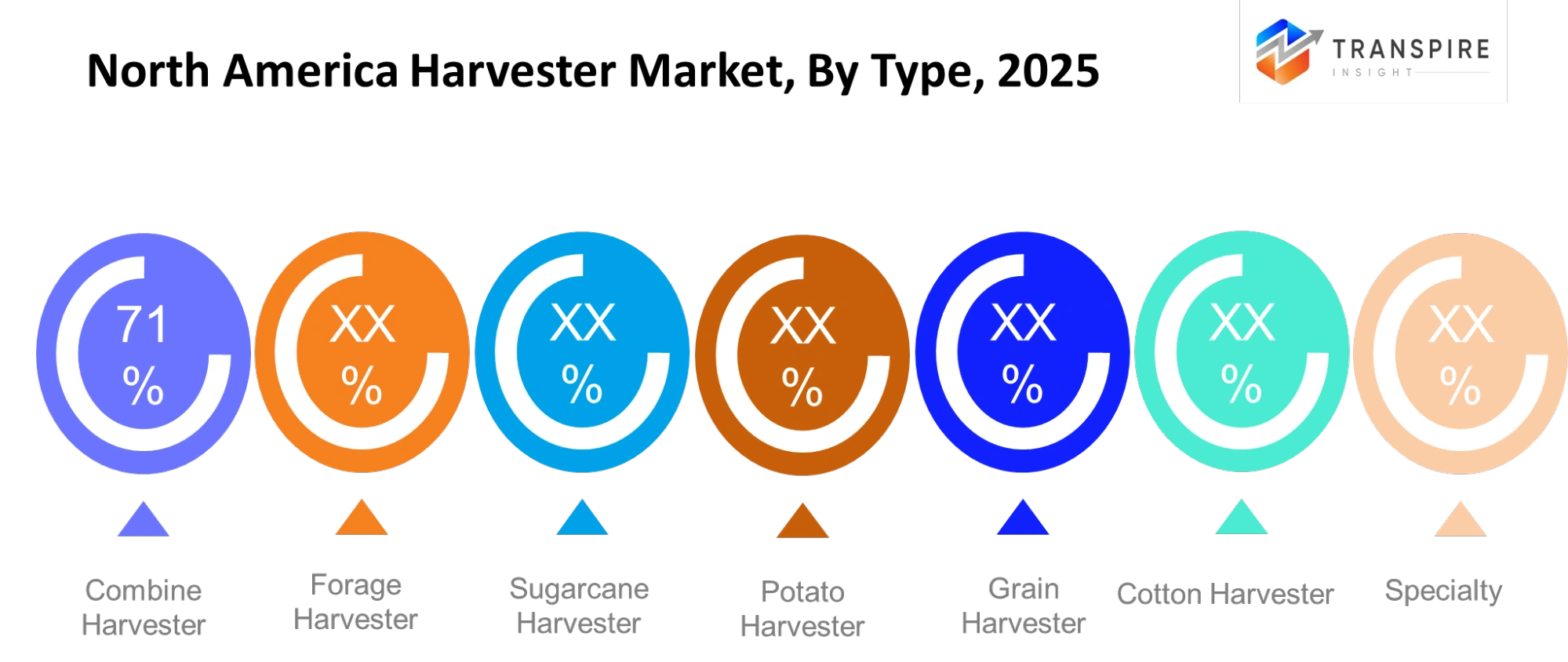
To learn more about this report, Download Free Sample Report
By Application:
The agricultural industry depends on mechanization because it serves as the main operational method for both agriculture and general farming activities. Equipment usage throughout the year depends on crop harvesting activities. The need for powerful machinery increases because commercial farming and large-scale agricultural operations demand it. Advanced harvester systems which handle crops with precision and organic farming methods have become more common because of precision agriculture practices.
By Power:
The equipment at our facility includes six different power sources which include manual and electric and diesel and hybrid and autonomous and smart and AI-enabled systems. Diesel-powered harvesters lead due to strong performance and reliability in large fields. The market shows increased interest in electric and hybrid models because of their ability to lower emissions and decrease operating expenses. Modern farming systems use autonomous and smart and AI-enabled harvesters which operate through automated processes and data collection and decreased requirement for human workers to enhance their productivity and achieve more precise results during the harvesting process.
By End-User:
Continuous productivity tool requirements create a situation where farmers become the biggest user group. Agribusiness and contractors acquire high-capacity machines to use in their service-based operations. Government agencies and cooperatives enable organizations to adopt new technology through their financial assistance programs and their shared access to facilities. Research institutions and large farms use advanced testing models to evaluate their operational efficiency and capacity for producing high-volume outputs.
By Distribution:
The dealer network functions as the main distribution channel which provides product access and service support through its various dealer locations. Customers use direct sales and OEM channels to purchase goods in bulk quantities. The online and retail channels experience slow growth which results from increasing digital technology utilization. Export demand strengthens market reach, while leasing models provide cost-effective access for small and medium-scale farming operations.
What are the Main Challenges for the North America Harvester Market Growth?
The North America Harvester Market encounters multiple technical and operational obstacles which decrease its operational efficiency and ability to expand. Modern harvesters use advanced electronic components and sensor technology and artificial intelligence systems, but the difficulty of combining these systems leads to inconsistent performance and increased need for system upkeep.
Equipment unavailability during peak harvesting times creates major disruptions to farm operations. The present supply chain interruptions, which affect vital components like semiconductors and hydraulic systems, create equipment delivery delays that present major obstacles to North America Harvester Market operations.
The North America Harvester Market expansion faces two major obstacles through manufacturing and commercialization barriers. High production costs driven by advanced technology integration, coupled with fluctuating raw material prices, put pressure on profit margins. Product development and certification procedures require additional time because companies must meet all environmental and safety requirements in both the United States and Canada. The need for ongoing innovation together with these regulatory requirements creates extended delays for product development which restrict market access for existing businesses and new market entrants.
Small and medium-sized farms encounter adoption barriers because they lack financial resources and funding options. The agricultural industry faces widespread adoption problems because there is a shortage of trained operators who can use advanced harvesting machines especially in rural areas.
The current lack of digital infrastructure in specific areas prevents the implementation of connected systems which include autonomous machinery. The North America Harvester Market faces growth challenges because of existing market obstacles and increasing competition from new precision agriculture technologies.
Country Insights
The North America Harvester Market demonstrates constant expansion because advanced farming methods and demand for efficient agricultural equipment drive market development. Modern harvesters receive implementation by United States and Canada farming operations that require extensive agricultural machinery. The market remains active because customers buy products based on technological advancements in automated systems and fuel-efficient equipment.
North America holds its top market position because of its developed farming systems and advanced agricultural machinery usage. The United States leads market share because farmers grow large maize and wheat fields. The Canadian market displays steady demand throughout its grain-producing areas because farmers aim to enhance their operational efficiency through productivity advances.
The region experiences rising demand for cutting-edge harvesting technology because developers continue to invest in precision agriculture. Farmers implement smart harvesting systems to achieve two objectives which are decreasing their operational costs and increasing their crop production. Government support programs together with financing options provide financial assistance for equipment upgrades which helps maintain market stability throughout North America.
Recent Development News
In 03 2026, Kubota Corporation introduced its new mid-capacity combine harvester models which now serve North American agricultural fields. The new lineup focused on improved fuel efficiency and enhanced grain separation technology targeting medium-sized farming operations in the U.S. and Canada. Sourcehttps://www.deere.com/
In 03 2026, Kubota Corporation launched upgraded mid-capacity combine harvester models for North American farms. The new lineup focused on improved fuel efficiency and enhanced grain separation technology targeting medium-sized farming operations in the U.S. and Canada. Source https://www.kubota.com/
|
Report Metrics |
Details |
|
Market size value in 2025 |
USD 8.6 Billion |
|
Market size value in 2026 |
USD 9.21 Billion |
|
Revenue forecast in 2033 |
USD 15.8 Billion |
|
Growth rate |
CAGR of 8.02% from 2026 to 2033 |
|
Base year |
2025 |
|
Historical data |
2021 - 2024 |
|
Forecast period |
2026 - 2033 |
|
Report coverage |
Revenue forecast, competitive landscape, growth factors, and trends |
|
Regional scope |
North America (Canada, The United States, and Mexico) |
|
Key company profiled |
John Deere, CNH Industrial, AGCO, Claas, Kubota, Mahindra, Same Deutz-Fahr, Yanmar, Iseki, Versatile, Rostselmash, Preet Agro, New Holland, Sampo Rosenlew, Zoomlion |
|
Customization scope |
Free report customization (country, regional & segment scope). Avail customized purchase options to meet your exact research needs. |
|
Report Segmentation |
By Type (Combine Harvester, Forage Harvester, Sugarcane Harvester, Potato Harvester, Grain Harvester, Cotton Harvester, Specialty); By Application (Agriculture, Farming, Crop Harvesting, Commercial Farming, Precision Farming, Organic Farming, Large-scale); By Power (Manual, Electric, Diesel, Hybrid, Autonomous, Smart, AI-enabled); By End-User (Farmers, Agribusiness, Contractors, Govt, Cooperatives, Research, Large Farms); By Distribution (Direct, Dealers, Online, Retail, OEM, Export, Leasing) |
How Can New Companies Establish a Strong Foothold in the North America Harvester Market?
New entrants can secure a competitive position in the North America Harvester Market by focusing on niche targeting and clear differentiation aligned with evolving industry trends. Startups should focus on serving unaddressed markets which include small and mid-sized farms and specialty crop harvesting and need compact and low-cost equipment. The segments encounter two main issues because of their financial limits and operational difficulties which result in the need for customized solutions. New companies can achieve market expansion while establishing customer loyalty in the North America Harvester Market by matching their solutions to specific customer challenges.
Innovation strategies centered on smart automation and digital integration are critical for standing out in the North America Harvester Market. Enterprises that implement AI and IoT and machine learning into their harvesting systems can deliver precision agriculture functions which include real-time crop monitoring and predictive maintenance and yield optimization. The emerging company Blue River Technology uses computer vision to enhance agricultural equipment efficiency while AgEagle Aerial Systems demonstrates how data insights power contemporary agricultural systems. The approaches increase productivity while establishing a compelling value proposition for customers who prioritize technology.
The combination of strategic partnerships and ecosystem collaboration will create stronger market entry capabilities. New companies can partner with agritech companies and farm cooperatives and digital platform providers to grow their distribution networks and speed up their product adoption. The combination of flexible financial solutions and leasing programs and after-sales assistance will help customers overcome their adoption challenges. Emerging market players can use innovation and focused market strategies and partnership growth to build a lasting presence in the North America Harvester Market while taking advantage of extended business changes.
Key North America Harvester Market Company Insights
The continuous need for better harvesting machines exists because farmers seek to increase their output while facing worker shortages in major farming areas. Farmers will use mechanization as their primary solution because they need to decrease their work expenses while keeping their crops safe from damage during harvesting time.
The development of automated systems and GPS technology and data-driven agricultural solutions will enable future expansion of the industry. Manufacturers will develop smart harvesting systems which will enable precise operations and better fuel efficiency and increased productivity. These advancements will enable farmers to operate their businesses while achieving sustainability targets and decreasing environmental waste.
Farmers require more agricultural equipment because they are expanding their production of grains oilseeds and premium crops. Farmers require equipment which performs reliably throughout their entire seasonal harvesting activities. Financial support programs together with leasing options will help large farms and midsize agricultural businesses acquire modern harvesting equipment.
Market competition will remain strong with global and regional manufacturers focusing on innovation, pricing strategies, and after-sales services. The companies will improve their distribution networks through research investment which will lead to new efficient business models. The company's future market dominance depends on its strategic partnerships and product enhancements and customer service solutions.
Company List
- John Deere
- CNH Industrial
- AGCO
- Claas
- Kubota
- Mahindra
- Same Deutz-Fahr
- Yanmar
- Iseki
- Versatile
- Rostselmash
- Preet Agro
- New Holland
- Sampo Rosenlew
- Zoomlion
What are the Key Use-Cases Driving the Growth of North America Harvester Market?
The North America Harvester Market experiences growth from three main use-cases which involve large-scale grain harvesting and precision agriculture adoption together with AI-enabled automation systems that enhance yield efficiency. The North American harvester market experiences growth through the increasing use of combine harvesters which use GPS and sensors to operate throughout the corn and wheat and soybean farming regions of the United States and Canada. The combination of predictive analytics and real-time field monitoring systems enables farmers to decrease crop losses while they determine optimal times for harvesting which results in higher output.
The North America harvester market uses specialty crop harvesting systems which need flexible machines that cause minimal damage to fruits and vegetables. The process of livestock and forage harvesting enables better feed efficiency because smart automation systems improve cutting precision while they decrease operational downtime. The applications developed from these systems enable mid-sized diversified farms to expand their market presence in North America.
The North America Harvester Market develops through enterprise fleet management systems together with OEM digital platforms which provide remote diagnostic capabilities and predictive maintenance solutions. The implementation of autonomous harvesting systems together with AI optimization systems enables farms to achieve reduced operational costs and improved labor productivity. The North America harvester market maintains its long-term competitive strength through these technological advancements.
North America Harvester Market Report Segmentation
By Type
- Combine Harvester
- Forage Harvester
- Sugarcane Harvester
- Potato Harvester
- Grain Harvester
- Cotton Harvester
- Specialty
By Application
- Agriculture
- Farming
- Crop Harvesting
- Commercial Farming
- Precision Farming
- Organic Farming
- Large-scale
By Power
- Manual
- Electric
- Diesel
- Hybrid
- Autonomous
- Smart
- AI-enabled
By End-User
- Farmers
- Agribusiness
- Contractors
- Govt
- Cooperatives
- Research
- Large Farms
By Distribution
- Direct
- Dealers
- Online
- Retail
- OEM
- Export
- Leasing
Frequently Asked Questions
Find quick answers to common questions.
The Approximate North America Harvester Market size for the Market will be USD 15.8 Billion in 2033.
Key Segments for the North America Harvester Market are By Type (Combine Harvester, Forage Harvester, Sugarcane Harvester, Potato Harvester, Grain Harvester, Cotton Harvester, Specialty); By Application (Agriculture, Farming, Crop Harvesting, Commercial Farming, Precision Farming, Organic Farming, Large-scale); By Power (Manual, Electric, Diesel, Hybrid, Autonomous, Smart, AI-enabled); By End-User (Farmers, Agribusiness, Contractors, Govt, Cooperatives, Research, Large Farms); By Distribution (Direct, Dealers, Online, Retail, OEM, Export, Leasing).
Major North America Harvester Market Players are John Deere, CNH Industrial, AGCO, Claas, Kubota, Mahindra, Same Deutz-Fahr, Yanmar, Iseki, Versatile, Rostselmash, Preet Agro, New Holland, Sampo Rosenlew, Zoomlion.
The Current North America Harvester Market size is USD 8.6 Billion in 2025.
The North America Harvester Market CAGR is 8.02%.
- John Deere
- CNH Industrial
- AGCO
- Claas
- Kubota
- Mahindra
- Same Deutz-Fahr
- Yanmar
- Iseki
- Versatile
- Rostselmash
- Preet Agro
- New Holland
- Sampo Rosenlew
- Zoomlion
Recently Published Reports
-
Dec 2024
Handling and Lifting Equipment Market
Handling and Lifting Equipment Market Size, Share & Analysis Report By Product (Cranes and Hoists, Forklifts, Conveyor Systems, Aerial Work Platforms, Others), By Application (E-Commerce, Automotive and Railway, Food and Beverages, Aviation, Others), and Geography (North America, Europe, Asia-Pacific, Middle East and Africa, South and Central America), 2021 - 2031
-
Feb 2025
HVAC Equipment Market
HVAC Equipment Market Size, Share & Analysis Report By Heating Equipment Type (Boilers and Furnaces, Heat Pumps, and Unitary Heaters), By Ventilation Equipment (Air Handling Units, Humidifiers and Dehumidifiers, Air Filters, and Fan Coiling Units), By Air Conditioning Equipment (Unitary Air Conditioners, Room Air Conditioners, Packaged Terminal Air Conditioners, and Chillers), By End User (Commercial, Residential, Industrial, and others), and Geography (North America, Europe, Asia-Pacific, Middle East and Africa, South and Central America), 2021 – 2031
-
Feb 2025
Refrigeration Valves Market
Refrigeration Valves Market Size, Share & Analysis Report By Type (Solenoid Valves, Expansion Valves, Check Valves, Service Valves, Others), By Application (Commercial Refrigeration, Industrial Refrigeration, Transport Refrigeration, Residential Refrigeration, Air Conditioning Systems), By End User (Food and Beverage Industry, Pharmaceutical Industry, HVAC Industry, Chemical Industry, Others), and Geography (North America, Europe, Asia-Pacific, Middle East and Africa, South and Central America), 2021 – 2031
-
Dec 2025
E-Commerce Packaging Materials Market
E-Commerce Packaging Materials Market By Material Type (Corrugated Boxes, Paper & Paperboard, Foam & Cushioning Materials, Plastic Packaging, Flexible Packaging, Protective Packaging, Others), By Product(Primary Packaging, Secondary Packaging, Tertiary Packaging), By Packaging Function (Protective Packaging, Branding & Presentation Packaging, Transit & Logistic Packaging, Sustainable Packaging, Tamper Evidence Packaging), By End-User (Retail & Consumer Goods, Electronic Appliances, Food & Beverages, Healthcare & Pharmaceutical, Fashion & Apparel, Home & Furnishing, Others); By Industry Analysis, Size, Share, Growth, Trends, and Forecasts 2021-2033