
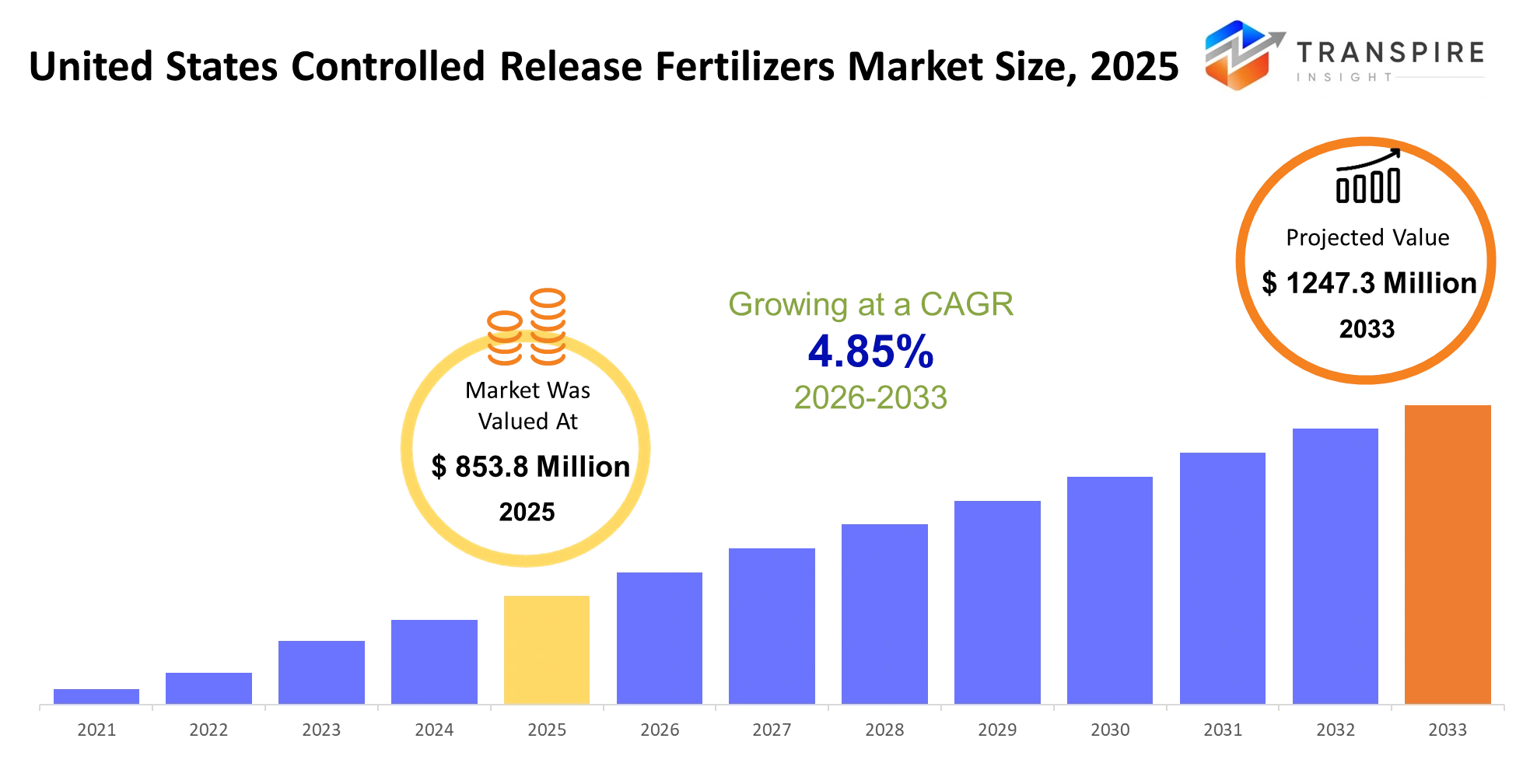
United States Controlled Release Fertilizers Market Size & Forecast:
- United States Controlled Release Fertilizers Market Size 2025: USD 853.8 Million
- United States Controlled Release Fertilizers Market Size 2033: USD 1247.3 Million
- United States Controlled Release Fertilizers Market CAGR: 4.85%
- United States Controlled Release Fertilizers Market Segments: By Product Type (Polymer-coated Fertilizers, Sulfur-coated Fertilizers, Slow-release Fertilizers, Nitrogen Stabilizers, Micronutrient Fertilizers, Others); By Crop Type (Cereals & Grains, Fruits & Vegetables, Oilseeds, Turf & Ornamentals, Plantation Crops, Others); By Application (Agriculture, Horticulture, Greenhouse Farming, Landscaping, Others); By Form (Granules, Powder, Liquid, Water-soluble Fertilizers, Others).
To learn more about this report,  Download Free Sample Report
United States Controlled Release Fertilizers Market Summary
The United States Controlled Release Fertilizers Market was valued at USD 853.8 Million in 2025. It is forecast to reach USD 1247.3 Million by 2033. That is a CAGR of 4.85% over the period.
In the United States, controlled release fertilizers are used by growers and turf managers kind of to feed crops with nutrients in a more measured way, so it lines up with plant uptake and it also cuts down on losses from leaching and those repeated application cycles. Over the last few years, the market has shifted away from the more usual quick-release formulations, toward polymer-coated and sulfur-coated products that get paired with precision agriculture systems. That pairing makes it possible to deliver nutrients more targeted based on soil and crop data, even if the timing is a bit more delicate.
One big trigger was the fertilizer supply shock after the Russia-Ukraine conflict, when prices went higher and it made import dependencies more obvious. At the same time, water quality regulations on nutrient runoff got tighter, so growers felt extra pressure to improve efficiency. Because of all that, adoption has accelerated, since controlled release formulations can reduce how often fertilizer is applied, help stabilize yields when input costs are volatile, and allow large-scale farms and turf operators to stay compliant while still protecting their margins , pretty much.
Key Market Insights
- Midwest basically dominates the United States Controlled Release Fertilizers Market, with almost 34% share in 2025, because there’s heavy corn and soybean cultivation demand behind it
- Southern states also keep a pretty steady adoption pace, backed by turf management, golf courses, and more specialty crop expansion
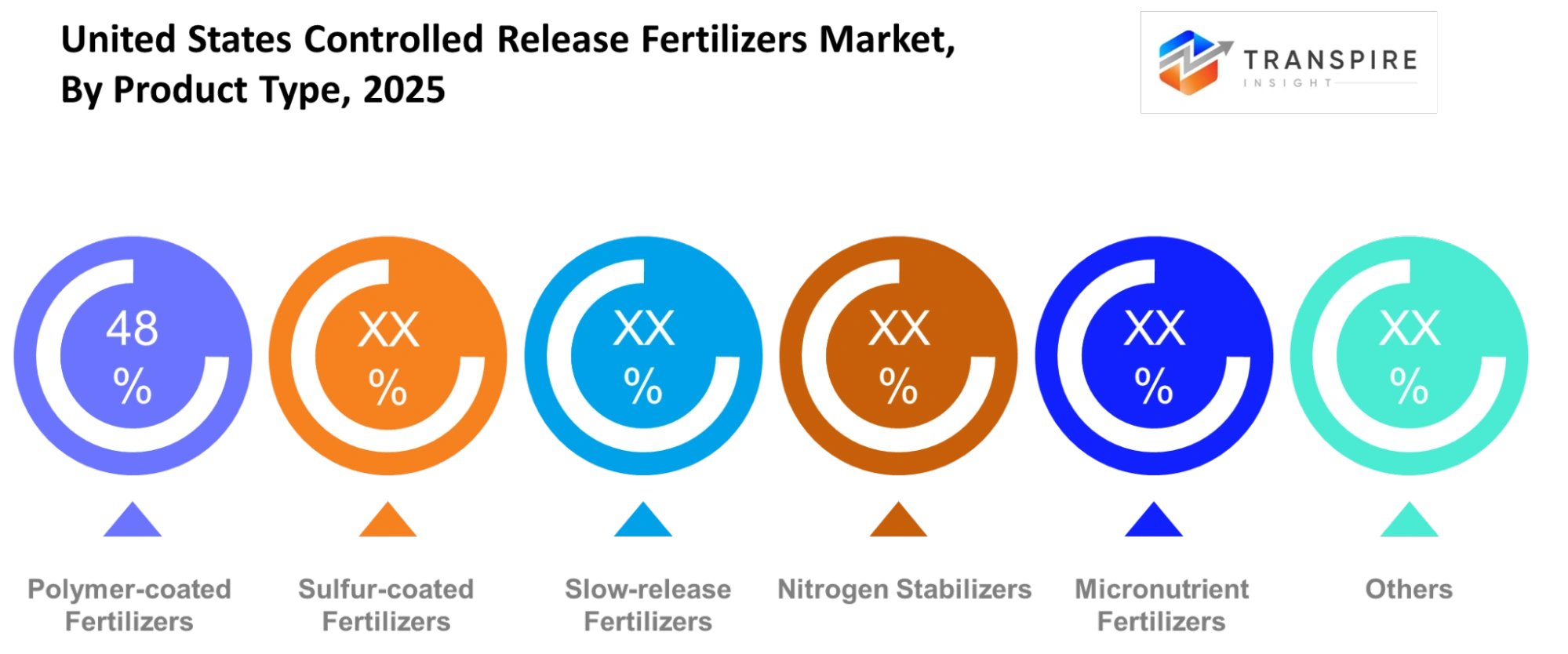
- On the product side polymer coated fertilizers lead the United States Controlled Release Fertilizers Market with around 41% share in 2025, since they deliver better nutrient control efficiency overall
- After that sulfur coated fertilizers take the second spot, they’re commonly used for cost sensitive large scale farming operations, you know the kind
- And the fastest growing part through 2030 seems to be polymer sulfur hybrid formulations, mostly because they improve the cost versus performance balance in a practical way
- Field crops kinda dominate, with about 46% share , and it seems driven by the big need for nutrient management efficiency on larger acreage .
- Turf and ornamental stuff is also the fastest-growing segment though because golf course modernization keeps going , and landscaping demand never really slows down .
- Commercial agriculture still leads the United States Controlled Release Fertilizers Market, with roughly 52% share in 2025.
- Meanwhile, turf management and landscaping services are rapidly expanding end-users , mostly due to urban green infrastructure investments that keep getting approved .
- On the other hand, high value greenhouse growers show rising adoption so they can optimize nutrient precision and reduce input waste at the same time .
What are the Key Drivers, Restraints, and Opportunities in the United States Controlled Release Fertilizers Market?
In the United States Controlled Release Fertilizers Market, the main driver looks like it’s the shift toward precision nutrient handling across large, high-output farms. Lately, fertilizer input volatility has been climbing after global supply disruptions connected to the Russia-Ukraine conflict and that made a lot of growers go for efficiency rather than just chasing total volume. On top of that, stricter nutrient runoff rules in areas like California and around the Chesapeake Bay watershed sort of pushed the market faster, and more growers started selecting controlled release blends, instead of sticking with older quicker nutrients. These offerings also open up more revenue potential for suppliers because farmers are shifting away from repeated seasonal re-orders, and more toward higher-value, tech-based fertilizer solutions. In practice, the idea is that nutrients stay available longer, so it reduces the number of application cycles , which sounds good on paper and in the field.
A major restraint on the United States Controlled Release Fertilizers Market is the relatively high production cost tied to coated fertilizer technologies, especially polymer-based setups. The manufacturing process uses specialized materials, plus controlled layering steps, so unit costs end up higher than conventional fertilizers. This kind of built-in cost hurdle slows adoption among small and mid-scale farmers, mainly those who run on tight input budgets. As a result, penetration becomes uneven, and revenue growth can get delayed in price-sensitive agricultural regions, even when demand is there.
An emerging opportunity kind of sits in digital agriculture integration, especially variable rate fertilizer application systems that are supported by soil sensing, and AI agronomy platforms that sort of coordinate decisions in near real time. Like for example, The Mosaic Company is putting money into data-linked nutrient delivery solutions that fit controlled release fertilizers with what the field looks like right now. When these things are put together, they can unlock more adoption , in high value crops across places such as California and Iowa where precision farming infrastructure is maturing pretty fast.
What Has the Impact of Artificial Intelligence Been on the United States Controlled Release Fertilizers Market?
Artificial intelligence and advanced digital tools are kind of reshaping how controlled release fertilizers get planned, put in the ground, and optimized across the whole agriculture ecosystem in the United States. In practice terms, AI led farm management platforms are now automating nutrient scheduling by pulling together satellite imagery, IoT soil sensors, and weather feeds, so the system can suggest when and where those controlled release formulations should be deployed. That cuts down on a lot of manual decision work and generally boosts application accuracy over large acreage operations, especially out in the Midwest corn belt area.
On the predictive side, machine learning models are also being used more and more to anticipate soil nutrient depletion trends and to tune fertilizer release timing with crop growth stages. These same systems can help with yield prediction, plus input optimization, which means suppliers and agronomy providers can adjust product formulations and then propose more efficient application cycles. Earlier deployments inside precision agriculture networks have shown a kind of directional bump in input efficiency, along with less fertilizer overuse, so costs get controlled better and field productivity can improve too.
Still, widespread adoption is held back by pretty high integration expenses, and also by uneven data quality across many rural farming zones. Quite a few farms don’t have dense sensor coverage, or reliable connectivity , which makes it harder to keep real time model accuracy strong and it also slows down scaling of AI based nutrient management systems. Even with that though, digital agronomy platforms are continuing to grow, and that’s laying down a foundation for more responsive, more data driven fertilizer application strategies across the United States Controlled Release Fertilizers Market.
Key Market Trends
- Since 2022, polymer coated fertilizers have grown their share in the United States Controlled Release Fertilizers Market, and a lot of growers seem to prefer longer nutrient release efficiency, even if it’s not the only reason.
- From 2023, California and Chesapeake Bay regulations got tighter on nutrient runoff controls, so farmers moved toward controlled release adoption for compliance driven efficiency gains, sort of like they had no real choice.
- After 2022 Russia Ukraine supply disruptions, fertilizer import volatility in the US also rose, which then made it easier to lean on efficient controlled release formulations, more than before.
- From 2023 up through 2025, precision agriculture platforms started folding in AI driven nutrient scheduling, and it got noticeably better when controlled release fertilizer is applied across these large farms.
- Since 2021, sulfur coated fertilizer usage has been slipping downward, mostly because release profiles were sometimes inconsistent, and growers are now showing a bit more interest in polymer coated alternatives.
- After the 2024 sustainability mandates, golf course and turf managers increased adoption rates, and they shifted toward controlled release products, so the maintenance frequency gets reduced ,more often than before.
- In the Midwest, corn and soybean operations expanded controlled release fertilizer usage after 2023 input cost spikes. That kind of pressure pushed efficiency minded nutrient strategies forward, and they kept going with it.
- Manufacturers like Nutrien and ICL Group also ramped up R&D spending in coated fertilizer technologies, aiming to sharpen release precision, and extend durability over time.
United States Controlled Release Fertilizers Market Segmentation
By Product Type:
Polymer-coated fertilizers , sulfur-coated fertilizers , slow-release fertilizers, nitrogen stabilizers , micronutrient fertilizers, and other formulations shape the controlled release fertilizers demand in the United States market, to be honest. Polymer-coated variants help keep nutrients moving in a steady flow over time. Sulfur coated fertilizers help with more dependable nutrient protection, which honestly matters more than most people assume. Slow release fertilizers extend the feeding window,so the whole schedule feels less hectic and more relaxed. Nitrogen stabilizers reduce nutrient loss and improve soil efficiency across a lot of different agricultural set ups.
Overall, market appetite for product types stays on an upward track, mainly because growers want higher yields but also less fertilizer wastage. Micronutrient fertilizers support more balanced soil nutrition and that usually shows up as stronger crop quality. Then there are other specialty blends that are tuned for particular soil conditions as well as crop requirements. Adoption is also climbing in large-scale farms and in precision farming systems, because they support efficient nutrient uptake and more consistent crop performance.
To learn more about this report, Download Free Sample Report
By Crop Type:
Cereals and grains, fruits and vegetables, oilseeds , turf and ornamentals , plantation crops, and a few other segments drive usage of controlled release fertilizers in the United States. Cereals and grains still pull strong demand since cultivation areas are broad. Fruits and vegetables often need a more exact nutrient supply, since quality improvement depends on it. Oilseeds benefit from a harmonized nutrient release rhythm that fits their growth stages.
Turf and ornamentals tend to require steady nutrition so growth stays uniform and looks right. Plantation crops need long-duration nutrient support to maintain yield cycles. The remaining crop categories add additional demand based on local farming habits and regional soil realities. Controlled release fertilizers help match nutrient management to each crop , improving soil efficiency and reducing the need for repeated fertilizer applications.
By Application:
Agriculture, horticulture, greenhouse farming, landscaping, and a few other uses are basically the major application pockets in the United States controlled release fertilizers market. Agriculture still leads, because large scale crop production keeps calling for something steady and reliable. Horticulture tends to want a kind of targeted feeding, so plants look better and stay more uniform. Greenhouse farming depends on controlled nutrient release, so the environment stays stable, even when conditions outside swing a lot.
Landscaping also leans on controlled release fertilizers to keep plant health consistent and keep the overall visual look clean. Beyond that, other applications show up in specialized farming setups, where nutrient delivery needs to be regulated without too much guesswork. In general controlled release fertilizers help cut nutrient loss and boost efficiency, and that feeds into stable crop growth plus more sustainable soil management habits.
By Form:
When it comes to segmentation by form in the United States controlled release fertilizers market, granules, powder, liquid, and water soluble fertilizers are the main categories. Granules are most common, largely for application simplicity and because nutrients can be released over a longer window. Powder forms are chosen when flexible mixing is needed in certain soil treatments. Liquid fertilizers work well when fast uptake matters and when people want more precise control over how much land where.
Water soluble fertilizers, meanwhile, are designed for effective distribution through irrigation systems. The different forms match different farming methods and crop needs, so growers can tune the approach. With controlled release properties in every form, leaching tends to drop and absorption tends to improve. Adoption keeps rising alongside more modern farming practices, focused on productivity, soil health, and optimized fertilizer usage—kinda the whole package.
What are the Key Use Cases Driving the United States Controlled Release Fertilizers Market?
The core adoption of controlled release fertilizers in the United States is kinda more on the large-scale field crops—corn, soybean, wheat—across the Midwest, where growers use them to keep nutrient delivery steadier, cut down on leaching losses , and avoid doing so many repeated applications when input costs get all over the place.
More expanded use cases show up in turf and ornamental management, especially at golf courses and in urban landscaping, plus greenhouse horticulture too. There, controlled nutrient release helps with plant consistency, and it also reduces the labor heavy fertilization schedules that commercial growers tend to deal with.
For emerging applications, you see precision agriculture systems, with AI driven variable rate fertilization and soil sensors , and then there are regenerative farming programs, where nutrient efficiency is matched with water conservation, and also with the shifting requirements around environmental compliance.
|
Report Metrics |
Details |
|
Market size value in 2025 |
USD 853.8 Million |
|
Market size value in 2026 |
USD 895.2 Million |
|
Revenue forecast in 2033 |
USD 1247.3 Million |
|
Growth rate |
CAGR of 4.85% from 2026 to 2033 |
|
Base year |
2025 |
|
Historical data |
2021 - 2024 |
|
Forecast period |
2026 - 2033 |
|
Report coverage |
Revenue forecast, competitive landscape, growth factors, and trends |
|
Geographic scope |
United States of America |
|
Key company profiled |
Nutrien, Yara International, ICL Group, Koch Industries, Haifa Group, ScottsMiracle-Gro, SQM, COMPO Expert, Kingenta Ecological Engineering, Helena Agri-Enterprises, CF Industries, EuroChem, Coromandel International, Mosaic Company, BASF. |
|
Customization scope |
Free report customization (country, regional & segment scope). Avail customized purchase options to meet your exact research needs. |
|
Report Segmentation |
By Product Type (Polymer-coated Fertilizers, Sulfur-coated Fertilizers, Slow-release Fertilizers, Nitrogen Stabilizers, Micronutrient Fertilizers, Others); By Crop Type (Cereals & Grains, Fruits & Vegetables, Oilseeds, Turf & Ornamentals, Plantation Crops, Others); By Application (Agriculture, Horticulture, Greenhouse Farming, Landscaping, Others); By Form (Granules, Powder, Liquid, Water-soluble Fertilizers, Others). |
Which Regions are Driving the United States Controlled Release Fertilizers Market Growth?
So the Midwest is still basically the leading region in the United States Controlled Release Fertilizers Market, and it’s because there’s so much corn and soybean cultivation there plus a pretty well woven agricultural supply chain. You know those land-grant universities, they do a lot of outreach and extension support ,and that helps big commercial farms fine-tune fertilizer use. Also there are established input distributors, along with agronomic advisor networks ,that keep pushing the products into rural farming corridors. All of this really helps sustain big adoption levels, because growers tend to want yield stability and better nutrient efficiency over huge stretches of land.
Then there’s the Southern United States, which stays a steady second place, mostly from a mix of uses like turf maintenance, citrus production, and plantation agriculture too. It kind of differs from the Midwest row-crop focus, since the South tends to have year-round growing cycles, which means fertilizer demand stays relatively consistent. On top of that, money coming in from golf course operators and landscaping services keeps consumption steady for controlled release formulations. And the overall economic resilience in states like Florida and Texas makes procurement cycles feel more predictable even when input prices move around, or at least they don’t swing too wildly.
Meanwhile the West Coast is the fastest-growing part, with California leading the way. A big driver is the tightening water-use regulations plus nutrient runoff limitations that have been put into place in recent years. Because of that, high-value horticulture and specialty crop producers are switching toward precision nutrient programs, more so to meet environmental requirements and also deal with drought related limits. More recently, investments in irrigation upgrades and climate-smart agriculture initiatives have sped up adoption across vineyards and vegetable farms. This growing momentum looks like clear potential for technology-enabled fertilizer providers, and also investors aiming at compliance driven agricultural change, right now.
Who are the Key Players in the United States Controlled Release Fertilizers Market and How Do They Compete?
Competition in the United States Controlled Release Fertilizers Market is kind of moderately consolidated, like there’s both big global fertilizer producers and also specialty nutrient companies all trying to grab the same share. Most of the incumbents kinda defend their positions via proprietary coating know-how , plus the usual established distribution channels. On top of that, they lean on agronomy advisory services and local knowledge that feels already in place. What’s a little more obvious now is that the rivalry is getting shaped less by pure pricing, and more by innovation in polymer coatings plus better integration with precision agriculture platforms. Growers want efficiency, and they also want regulatory compliance to not become a headache later.
Nutrien seems to push hard on distribution-led scale, leveraging its retail agronomy network across the US, so it can bundle controlled release fertilizers with crop input services. The Scotts Miracle-Gro Company kind of leans into turf and home lawn, using branded controlled release formulations , and the main angle there is consumer friendly application design with pretty strong retail placement. ICL Group competes by way of specialty fertilizer innovation , leaning hard on polymer coated technologies while also providing tailored nutrient solutions for high value agriculture and horticulture.
Yara International is moving toward digital agriculture integration, pairing controlled release fertilizer systems with data driven nutrient management platforms.Koch Agronomic Services builds advantage in the US Corn Belt using nitrogen efficiency products and long-term grower partnerships that help them stay relevant, even when seasons flip around. Haifa Group focuses on precision-controlled release fertilizers for greenhouse and horticulture uses , and it expands through technical partnerships plus regional distributor networks. Altogether, this kind of dynamic supports wider adoption across more advanced farming systems across North America.
Company List
- Nutrien
- Yara International
- ICL Group
- Koch Industries
- Haifa Group
- ScottsMiracle-Gro
- SQM
- COMPO Expert
- Kingenta Ecological Engineering
- Helena Agri-Enterprises
- CF Industries
- EuroChem
- Coromandel International
- Mosaic Company
- BASF
Recent Development News
In February 2026, Haifa Group announced expansion of its controlled-release fertilizer production capacity through upgraded manufacturing lines for specialty plant nutrition products. The investment is intended to strengthen supply for high-efficiency fertilizers, including CRF products used in North American agricultural and turf applications.
Source: https://www.haifa-group.com/
In January 2026, Nutrien Ltd. expanded its specialty fertilizer portfolio strategy through increased distribution agreements for enhanced-efficiency fertilizers, including controlled-release formulations, across North American retail and agronomy channels. The move supports rising demand for precision nutrient management solutions in U.S. row crop and turf markets.
Source: https://www.nutrien.com/
What Strategic Insights Define the Future of the United States Controlled Release Fertilizers Market?
The United States Controlled Release Fertilizers Market is kind of moving, toward precision led and data integrated nutrient management, where the “real” fertilizer value is now more about how accurately nutrients are released rather than just how much is applied. This shift seems to be pushed by stricter environmental compliance rules and the gradual digitization of farm operations, which in turn makes growers try to squeeze the most from every single unit of nutrient over the next five to seven years.
There is also a quieter risk, around the concentration of raw materials used for coating technologies, and especially the reliance on petrochemical derived polymers. If upstream chemical supply chains get unstable or if there are sustainability driven limits on polymer use, then cost structures can wobble and product scaling can get slower, even when agricultural demand is still holding strong.
On the opportunity side, controlled release fertilizers are starting to converge with AI guided variable rate application systems, and California’s specialty crop corridors are where this seems to be showing up first. It’s still early, but the momentum is growing as water scarcity policies tighten and growers want very localized nutrient control. The firms that can match fertilizer chemistry with digital agronomy platforms should be better placed to take advantage of higher margin, premium value.
Strategically, market participants should focus on modular fertilizer technologies that can slip into farm data systems without much friction, so adaptive nutrient release models can respond directly to real time field conditions.
United States Controlled Release Fertilizers Market Report Segmentation
By Product Type
- Polymer-coated Fertilizers
- Sulfur-coated Fertilizers
- Slow-release Fertilizers
- Nitrogen Stabilizers
- Micronutrient Fertilizers
By Crop Type
- Cereals & Grains
- Fruits & Vegetables
- Oilseeds
- Turf & Ornamentals
- Plantation Crops
By Application
- Agriculture
- Horticulture
- Greenhouse Farming
- Landscaping
By Form
- Granules
- Powder
- Liquid
- Water-soluble Fertilizers
Frequently Asked Questions
Find quick answers to common questions.
The United States Controlled Release Fertilizers Market size is USD 1247.3 Million in 2033.
Key segments for the United States Controlled Release Fertilizers Market are By Product Type (Polymer-coated Fertilizers, Sulfur-coated Fertilizers, Slow-release Fertilizers, Nitrogen Stabilizers, Micronutrient Fertilizers, Others); By Crop Type (Cereals & Grains, Fruits & Vegetables, Oilseeds, Turf & Ornamentals, Plantation Crops, Others); By Application (Agriculture, Horticulture, Greenhouse Farming, Landscaping, Others); By Form (Granules, Powder, Liquid, Water-soluble Fertilizers, Others).
Major United States Controlled Release Fertilizers Market players are Nutrien, Yara International, ICL Group, Koch Industries, Haifa Group, ScottsMiracle-Gro, SQM, COMPO Expert, Kingenta Ecological Engineering, Helena Agri-Enterprises, CF Industries, EuroChem, Coromandel International, Mosaic Company, BASF.
The United States Controlled Release Fertilizers Market size is USD 853.8 Million in 2025.
The United States Controlled Release Fertilizers Market CAGR is 4.85% from 2026 to 2033.
- Nutrien
- Yara International
- ICL Group
- Koch Industries
- Haifa Group
- ScottsMiracle-Gro
- SQM
- COMPO Expert
- Kingenta Ecological Engineering
- Helena Agri-Enterprises
- CF Industries
- EuroChem
- Coromandel International
- Mosaic Company
- BASF
Recently Published Reports
-
Apr 2026
Healthcare Polymer Packaging Market
Healthcare Polymer Packaging Market Size, Share & Analysis Report By Packaging Type (Syringes, IV Bottles and Pouches, Clamshells, Blisters, Bottles & Jars, Containers, Tubes, IV Parental Packaging, Others), By Type (Regulated, Non-regulated), By Polymer Type (LDPE (Low-Density Polyethylene), HDPE (High-Density Polyethylene), Homo-polymer (Homo), Random Copolymer (Random), Block Copolymer (Block), PET, Polystyrene, Polyvinyl Chloride, Polyamide/EVOH, Others), and Geography (North America, Europe, Asia-Pacific, Middle East and Africa, South and Central America), 2021 - 2031
-
Apr 2026
Hydrophilic Tape (Waterstop) Market
Hydrophilic Tape (Waterstop) Market Size, Share & Analysis Report By Type (Bentonite-Based Hydrophilic Tape, Rubber-Based Hydrophilic Tape), By Application (Residential Buildings, Commercial Buildings, Infrastructure Projects), and Geography (North America, Europe, Asia-Pacific, Middle East and Africa, South and Central America), 2021 - 2031
-
Apr 2026
Metalens Market
Metalens Market Size, Share & Analysis Report By Type (Visible Light Metalens, and Infrared Metalens), By Application (Consumer Electronics, Automotive Electronics, Industrial, Medical, and Others), and Geography (North America, Europe, Asia-Pacific, Middle East and Africa, South and Central America), 2021 - 2031
-
Apr 2026
PBT Resin Market
PBT Resin Market Size, Share & Analysis Report By Type (Reinforced PBT Resin, Unreinforced PBT Resin), By Processing Method (Injection Molding, Extrusion, Blow Molding, Others), By End-User (Automotive, Electrical & Electronics, Consumer Appliances, Industrial Machinery, Medical Devices, Packaging, Others), and Geography (North America, Europe, Asia-Pacific, Middle East and Africa, South and Central America), 2021 - 2031