

Asia Pacific Catalyst Fertilizers Market Size & Forecast:
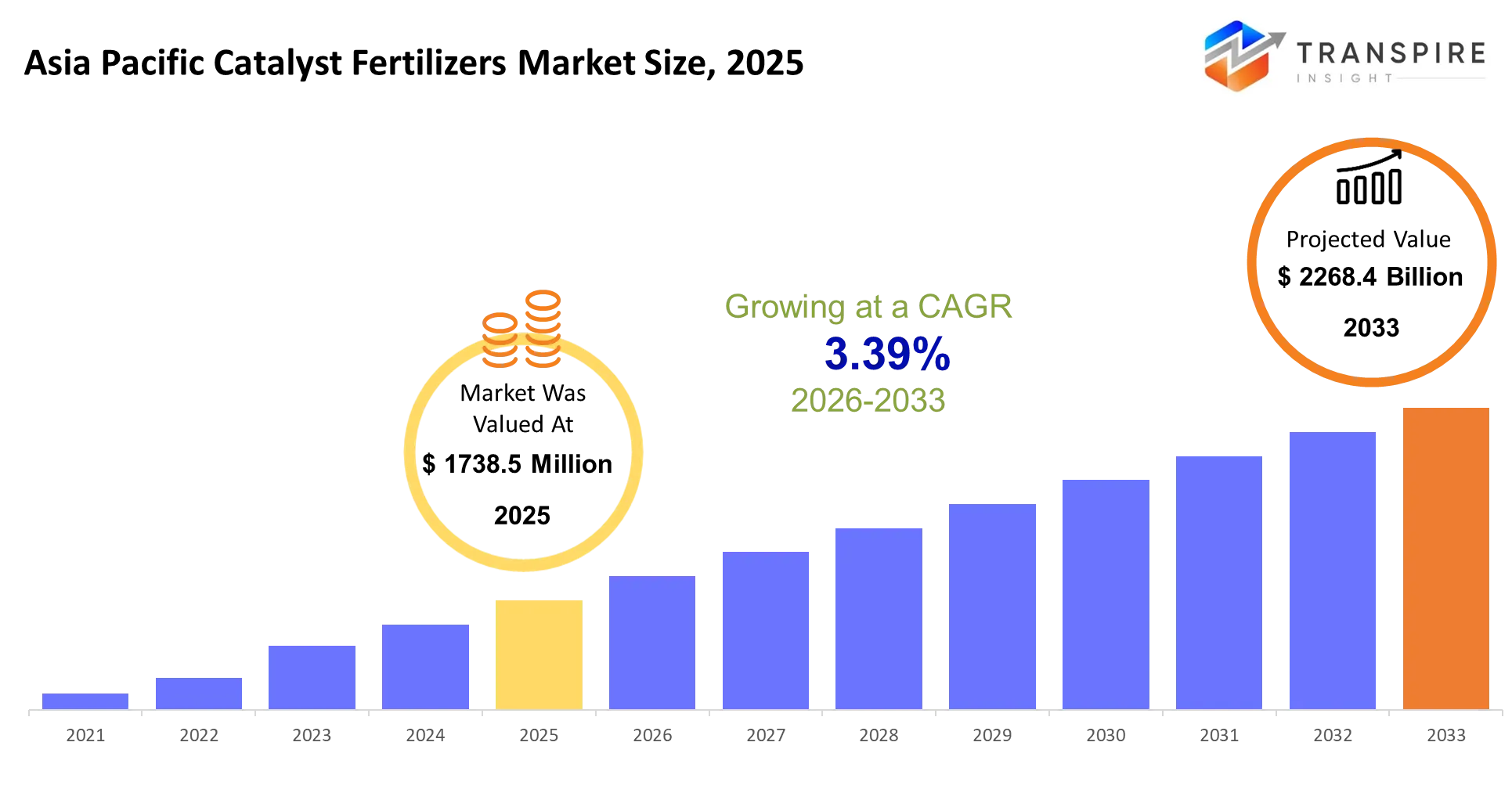
- Asia Pacific Catalyst Fertilizers Market Size 2025: USD 1738.5 Million
- Asia Pacific Catalyst Fertilizers Market Size 2033: USD 2268.4 Billion
- Asia Pacific Catalyst Fertilizers Market CAGR: 3.39%
- Asia Pacific Catalyst Fertilizers Market Segments: By Type (Nitrogen-based, Phosphate-based, Potash-based, Others); By Application (Agriculture, Horticulture, Turf & Ornamentals, Others); By End-User (Farmers, Agribusiness Companies, Government, Agricultural Cooperatives, Others); By Form (Liquid, Granules, Powder, Others)
To learn more about this report,  Download Free Sample Report
Asia Pacific Catalyst Fertilizers Market Summary
The Asia Pacific Catalyst Fertilizers Market was valued at USD 1738.5 Million in 2025. It is forecast to reach USD 2268.4 Billion by 2033. That is a CAGR of 3.39% over the period.
Catalyst fertilizers in Asia Pacific help crops take up nutrients because they increase the speed of nitrogen conversion while they decrease nitrogen losses through volatilization and leaching. The technology allows farmers to achieve greater agricultural productivity from their existing fields which remains vital for intensive agricultural practices used in rice and wheat and horticulture throughout India and China and Southeast Asia. The market has transitioned during the last five years from traditional bulk nutrient products to enhanced efficiency fertilizers which contain inhibitors and catalytic compounds in their granular and coated delivery systems that work with precision agriculture methods.
The Russia-Ukraine conflict created global supply chain interruptions which affected nitrogen and ammonia production and led to price increases while demonstrating the need for that region to import its essential products. Companies in China and India needed to implement new technologies because the two countries established stricter environmental rules for nitrate runoff and ammonia emissions.Buyers now focus on obtaining consistent crop yields through efficient inputs which drives them to buy more expensive catalyst-based products.
Key Market Insights
- China will control approximately 40% of the Asia Pacific Catalyst Fertilizers Market in 2025 because of its high cereal production levels and its enforcement of strict emission regulations.
- India will experience its most rapid development between 2025 and 2030 because of two factors: subsidy reforms and soil nutrient depletion problems.
- The plantation crop industry in Southeast Asia adopts fertilizer technologies that improve operational efficiency at a steady pace.
- The Asia Pacific Catalyst Fertilizers Market displays dominance of nitrification inhibitors which capture about 38% market share for use in systems that cultivate rice and wheat.
- The second-largest market segment for urease inhibitors shows growth because of increasing demand in countries that depend on urea for agricultural production.
- The fastest-growing segment of the market exists through controlled-release catalyst fertilizers because precision agriculture technology and labor optimization practices continue to expand.
- Field crops dominate usage with nearly 55% share, especially rice, wheat, and maize cultivation across Asia Pacific farming systems.
- The growth of horticulture applications achieves its highest rate because export-driven economies develop their high-value fruit and vegetable farming operations.
- Individual farmers and cooperatives account for the leading share of the Asia Pacific Catalyst Fertilizers Market at around 60%.
- The commercial agribusiness sector develops at its fastest pace because technology enables farmers to implement large-scale farming practices.
What are the Key Drivers, Restraints, and Opportunities in the Asia Pacific Catalyst Fertilizers Market?
The Asia Pacific Catalyst Fertilizers Market operates through two main factors because China, India, and several Southeast Asian nations have implemented stricter environmental regulations which restrict nitrogen emissions and fertilizer runoff. The introduction of urea volatilization and nitrate leaching limits by governments has driven farmers to adopt catalyst-based products which include nitrification and urease inhibitors. Farmers who want to achieve better nutrient efficiency and consistent crop production with reduced nitrogen fertilizer application have increased their use of this technology because conventional nitrogen fertilizer prices have risen after global supply chain disruptions. The market now shows a shift from bulk fertilizers toward products that provide enhanced efficiency at higher value.
The major limitation exists because catalyst fertilizers require farmers to make higher initial investments than they would need for standard products. The cost barrier exists as a permanent structural issue because it connects to production methods and chemical formulas which exist in their advanced form but need extended time to develop smaller production methods. Smallholder farmers who form the majority of Asian Pacific agricultural workforce face difficulties in obtaining financing or subsidies which results in slower adoption rates and inconsistent market coverage across rural regions. The overall revenue process experiences delays because demand shows strong potential.
The combination of precision agriculture and digital soil testing with sensor-based nutrient management systems creates an opportunity for expansion into Indian and Chinese markets. Yara International operates a business model which combines catalyst fertilizers with digital advisory platforms to provide farmers with tailored fertilizer application methods which enhance their yield efficiency through bundled agronomic services.
What Has the Impact of Artificial Intelligence Been on the Asia Pacific Catalyst Fertilizers Market?
The Asia Pacific Catalyst Fertilizers Market undergoes transformation through artificial intelligence combined with advanced digital tools which enhance nitrogen-efficient agricultural input management from planning to operational execution. The AI-enabled agronomy platforms now function as a comprehensive system which combines soil testing equipment with satellite imagery and agricultural advisory applications to calculate precise fertilizer requirements while minimizing nitrogen stabilizer usage and enhancing agricultural productivity. The automated system manages nutrient planning together with application schedule development which enables distributors and cooperatives to enhance their inventory management process while cutting down waste throughout their disjointed supply chain system.
The agricultural industry increasingly uses predictive analytics models to determine the essential nutrients for crops by analyzing weather conditions and soil composition and past crop production records. The machine learning systems enable prediction of fertilizer response efficiency while determining the best times to apply fertilizers, which results in better nutrient uptake and diminished nitrogen waste. The digital advisory system shows that fertilizer efficiency has increased by 10 to 15 percent through its implementation in pilot programs across multiple sites in India and China which helps farmers achieve greater profits while creating consistent requirements for advanced catalyst products.
The process of adopting new technologies faces limitations because rural areas lack reliable data infrastructure. The existing connectivity problems together with the incomplete soil databases in multiple regions create challenges for accurate modeling of real-world agricultural conditions. The high expenses required for AI system integration combined with the inadequate digital skills of smallholder farmers create obstacles to widespread technology adoption which prevents complete development of the Asia Pacific Catalyst Fertilizers Market despite its advanced technological capabilities.
Key Market Trends
- Between 2023 and 2026, China and India tightened nitrogen emission rules, which led to increasing use of catalyst-based fertilizers instead of traditional urea products.
- The fertilizer import market in Asia Pacific had to adapt because of Russian and Ukrainian supply interruptions starting in 2022, which caused buyers to seek out nitrogen stabilization technologies that improve efficiency.
- The agricultural sector adopted controlled-release and inhibitor-based formulations from 2023 onwards, which replaced high-volume nitrogen application methods in systems that intensively grow rice.
- The agriculture industry saw rapid growth of precision agriculture platforms, which began operating in 2024, because they combined soil sensors with AI advisory tools that help farmers design custom fertilizer application strategies.
- Yara International and Nutrien established new Asia partnerships during 2023–2025, which combined their catalyst fertilizers with digital agronomy services to assist farmers.
- The period from 2023 onward saw India direct its subsidy system changes to fund efficient fertilizers which resulted in increased usage of nitrogen catalyst products by rural areas.
- After 2024 Southeast Asian plantation industries started using catalyst fertilizers to enhance palm oil and rubber production stability.
- Smallholder farmers in the Asia Pacific region face technology adoption barriers because high initial expenses and restricted financing options in rural areas create difficulties for them to access innovative solutions.
Asia Pacific Catalyst Fertilizers Market Segmentation
By Type :
Farmers in the Asia Pacific region use nitrogen-based fertilizers as essential agricultural need because their crop production requirements demand these fertilizers. The agricultural regions maintain their current fertilizer usage because farmers now prioritize both soil nutrient management and productivity enhancement efforts.
Phosphate-based and potash-based fertilizers support root development while improving the overall quality of crops. The region experiences increasing adoption of balanced nutrient practices together with structured farming methods because these practices enable farmers to cultivate different soil types and various crop types.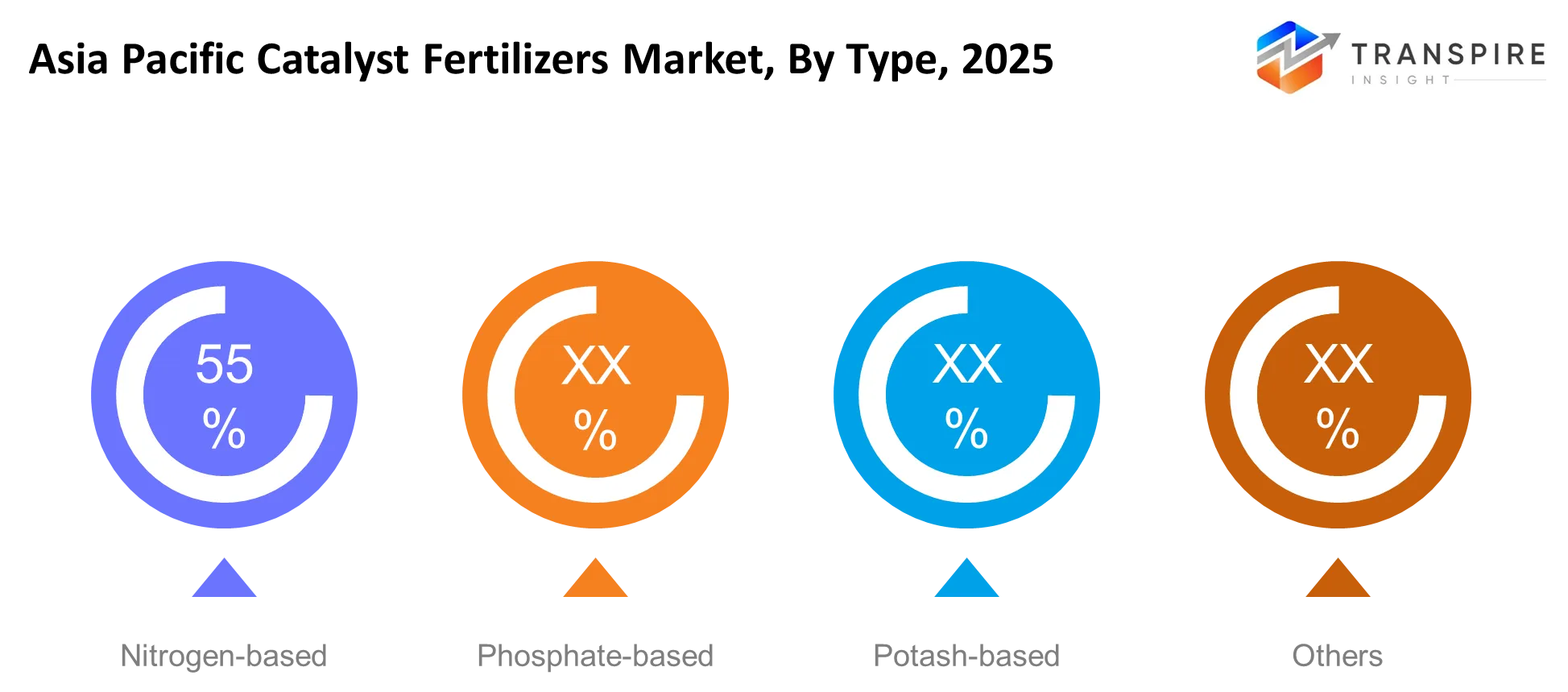
To learn more about this report, Download Free Sample Report
By Application :
The food production activities in agriculture drive demand through their requirement for extensive food output while upcoming challenges impact Asian Pacific food distribution networks. Catalyst fertilizers support improved nutrient efficiency and stronger yield outcomes in major crop cultivation activities.
The horticulture turf and ornamentals sectors display continuous expansion because landscaping demand and indoor growing methods are increasing. Urban green spaces and decorative plant production support consistent fertilizer use across managed cultivation environments.
By End-User :
Farmers and agribusiness companies remain key end-users due to direct involvement in crop production and commercial farming operations. Fertilizer demand continues through farming activities because farmers pursue better productivity results and need to use their resources efficiently.
Government programs and agricultural cooperatives support fertilizer access and rural farming development. The combination of structured distribution systems and policy-driven initiatives enhances both availability and usage of resources throughout farming communities which results in improved agricultural performance.
By Form :
The application of liquid and granule products enables farmers to spread nutrients across their fields with better efficiency. The increasing adoption of mechanized farming equipment drives farmers to choose fertilizers which provide them with precise and effective methods to apply their products on fields.
The industry maintains powder form for use in soil treatment procedures and the creation of specialized fertilizer mixtures. The ability to maintain stability during storage combined with multiple options for creating different agricultural inputs drives demand for products which fulfill specific agricultural preparation needs.
What are the Key Use Cases Driving the Asia Pacific Catalyst Fertilizers Market?
The Asia Pacific Catalyst Fertilizers Market functions mainly for field crop cultivation which focuses on rice wheat and maize farming. Farmers apply catalyst fertilizers to these nitrogen-dependent crops because the fertilizers decrease nitrogen waste while they enhance nutrient absorption efficiency. The method directly boosts yield consistency for agricultural operations in China which uses high-density farming methods throughout the Yangtze basin and India which operates the Indo-Gangetic plains.
The development of horticulture and plantation crop applications has reached its current state through Southeast Asia's palm oil and rubber and fruit production systems. Urease and nitrification inhibitors have become standard among commercial agribusinesses and cooperatives because these products stabilize soil fertility while they help achieve export-quality production for more reliable manufacturing processes.
The agricultural programs which aim for climate protection and the carbon-conscious farming initiatives that various governments support will create new use cases for these technologies. India and China are conducting pilot projects which use catalyst fertilizers combined with digital soil monitoring systems to achieve greenhouse gas emissions reduction. The applications in this space remain under construction but they will transform user adoption methods throughout the entire forecast timeframe.
|
Report Metrics |
Details |
|
Market size value in 2025 |
USD 1738.5 Million |
|
Market size value in 2026 |
USD 1795.8 Million |
|
Revenue forecast in 2033 |
USD 2268.4 Billion |
|
Growth rate |
CAGR of 3.39% from 2026 to 2033 |
|
Base year |
2025 |
|
Historical data |
2021 - 2024 |
|
Forecast period |
2026 - 2033 |
|
Report coverage |
Revenue forecast, competitive landscape, growth factors, and trends |
|
Regional scope |
Asia Pacific (China, India, Japan, South Korea, Australia, Rest of Asia Pacific) |
|
Key company profiled |
Yara International, Nutrien, Mosaic, CF Industries, ICL Group, K+S AG, EuroChem, OCP Group, Coromandel, Haifa Group, Sinofert, IFFCO, Tata Chemicals, UPL, BASF |
|
Customization scope |
Free report customization (country, regional & segment scope). Avail customized purchase options to meet your exact research needs. |
|
Report Segmentation |
By Type (Nitrogen-based, Phosphate-based, Potash-based, Others); By Application (Agriculture, Horticulture, Turf & Ornamentals, Others); By End-User (Farmers, Agribusiness Companies, Government, Agricultural Cooperatives, Others); By Form (Liquid, Granules, Powder, Others) |
Which Regions are Driving the Asia Pacific Catalyst Fertilizers Market Growth?
China holds the top position in the Asia Pacific Catalyst Fertilizers Market because its nutrient loss regulations are strictly enforced and its commercial agriculture operations cover extensive areas. The government has imposed nitrogen runoff and ammonia emission limits which resulted in catalyst-based fertilizers becoming standard practice throughout important grain-producing regions. The developed agricultural supply chain together with the domestic fertilizer production capacity enables ongoing product availability while maintaining stable pricing. State-run agricultural technology initiatives support farmers in practicing precise nutrient management which leads to sustained product demand throughout large agricultural areas.
India presents a more stable market environment which experiences policy-driven changes between its existing state and new policies while China maintains its current market structure. India develops through subsidy systems which provide financial support and through gradual implementation of fertilizer efficiency standards whereas China relies on enforcement measures for its market expansion. The country’s large smallholder farming population depends heavily on cost optimization which sustains steady uptake of catalyst fertilizers despite price sensitivity. The combination of regular monsoon-based agricultural practices and increasing institutional procurement through cooperatives creates established demand patterns for fertilizer distributors and manufacturers.
The region of Southeast Asia experiences its fastest development because plantation agriculture and export-oriented crop production are growing rapidly in the area. The countries of Indonesia and Vietnam have improved their palm oil and rubber and horticulture production through their latest investment activities which benefit from better port facilities and agricultural business development initiatives. The regulatory focus on soil degradation and export quality standards has led to increased use of advanced efficiency fertilizers since 2023. Global suppliers and technology providers have found strong market entry possibilities which will last until 2033 in high-value agricultural corridors.
Who are the Key Players in the Asia Pacific Catalyst Fertilizers Market and How Do They Compete?
The Asia Pacific Catalyst Fertilizers Market presents a competitive landscape which shows moderate market division because international fertilizer companies and powerful local manufacturers battle for market share. The established companies develop new nitrogen efficiency solutions together with their coated fertilizer technology. The newer companies use digital agronomy solutions together with their local distribution systems to create their business expansion.
Yara International creates its market advantage through its development of catalyst fertilizers which work together with digital agronomy systems to predict optimal times for nutrient application. Nutrien expands its operations in Asia Pacific through its retail distribution system and precision farming services which help to establish direct contact with farmers. CF Industries maintains its product availability during market price changes through its ability to produce nitrogen at large volumes and its distributor partnerships.
IFFCO builds its strength through its network of cooperative distribution centers which enable farmers to access stabilized urea throughout India's smallholder agricultural areas. Coromandel International develops crop-specific nutrient solutions while maintaining a strong market presence throughout southern India. Kingenta develops controlled-release fertilizer technology through its research and development initiatives and its partnerships with provincial agricultural technology companies in China.
Company List
- Yara International
- Nutrien
- Mosaic
- CF Industries
- ICL Group
- K+S AG
- EuroChem
- OCP Group
- Coromandel
- Haifa Group
- Sinofert
- IFFCO
- Tata Chemicals
- UPL
- BASF
Recent Development News
In May 2026, PepsiCo and TalusAg entered a strategic collaboration involving approximately 30,000 metric tons of low-carbon ammonia, expanding into Asia Pacific agricultural supply chains to accelerate fertilizer decarbonisation through catalyst-enabled ammonia production systems.Source https://agrospectrumasia.com/
In March 2026, Kiri Industries Limited acquired a 99.93% stake in IndoAsia Agrotech Fertilizers through a ₹70 crore equity investment, making the entity its subsidiary and strengthening its downstream fertilizer manufacturing capacity in India.Source https://scanx.trade/
What Strategic Insights Define the Future of the Asia Pacific Catalyst Fertilizers Market?
The Asia Pacific Catalyst Fertilizers Market is currently undergoing a market transformation which requires fertilizer value assessment through nitrogen-use efficiency metrics instead of assessing total fertilizer volume. The upcoming 5 to 7 years will see adoption growth because environmental enforcement becomes stricter and precision agriculture platforms enable farmers to monitor their soil and crop conditions in real time for efficient input application. The market currently progresses from standard commodity fertilizers toward customized nutrient solutions which rely on scientific data for their development.
The organization faces hidden dangers because it relies heavily on specific patented technologies and essential raw material components which are necessary for its operations. Pricing fluctuations will decrease when supply concentration increases or patents become restricted because of the negative effects these changes will have on economical smallholder farmers in India and Southeast Asia who require better access to their resources.
Farming programs that connect carbon credits with catalyst fertilizers present a new business opportunity which includes China pilot emission trading regions as primary target locations. The organization establishes a new revenue stream which exists outside of yield enhancement. Market participants should establish strategic partnerships with agritech platforms while simultaneously developing production facilities in their target markets to decrease operational expenses and gain competitive advantages in carbon-based agricultural systems which face regulatory requirements.
Asia Pacific Catalyst Fertilizers Market Report Segmentation
By Type
- Nitrogen-based
- Phosphate-based
- Potash-based
By Application
- Agriculture
- Horticulture
- Turf & Ornamentals
By End-User
- Farmers
- Agribusiness Companies
- Government
- Agricultural Cooperatives
By Form
- Liquid
- Granules
- Powder
Frequently Asked Questions
Find quick answers to common questions.
The Asia Pacific Catalyst Fertilizers Market size is USD 2268.4 Billion in 2033.
Key Segments for the Asia Pacific Catalyst Fertilizers Market are By Type (Nitrogen-based, Phosphate-based, Potash-based, Others); By Application (Agriculture, Horticulture, Turf & Ornamentals, Others); By End-User (Farmers, Agribusiness Companies, Government, Agricultural Cooperatives, Others); By Form (Liquid, Granules, Powder, Others).
Major Asia Pacific Catalyst Fertilizers Market players are Yara International, Nutrien, Mosaic, CF Industries, ICL Group, K+S AG, EuroChem, OCP Group, Coromandel, Haifa Group, Sinofert, IFFCO, Tata Chemicals, UPL, BASF.
The Asia current Pacific Catalyst Fertilizers Market size is USD 1738.5 Million in 2025.
The Asia Pacific Catalyst Fertilizers Market CAGR is 3.39% from 2026 to 2033.
- Yara International
- Nutrien
- Mosaic
- CF Industries
- ICL Group
- K+S AG
- EuroChem
- OCP Group
- Coromandel
- Haifa Group
- Sinofert
- IFFCO
- Tata Chemicals
- UPL
- BASF
Recently Published Reports
-
Apr 2026
Healthcare Polymer Packaging Market
Healthcare Polymer Packaging Market Size, Share & Analysis Report By Packaging Type (Syringes, IV Bottles and Pouches, Clamshells, Blisters, Bottles & Jars, Containers, Tubes, IV Parental Packaging, Others), By Type (Regulated, Non-regulated), By Polymer Type (LDPE (Low-Density Polyethylene), HDPE (High-Density Polyethylene), Homo-polymer (Homo), Random Copolymer (Random), Block Copolymer (Block), PET, Polystyrene, Polyvinyl Chloride, Polyamide/EVOH, Others), and Geography (North America, Europe, Asia-Pacific, Middle East and Africa, South and Central America), 2021 - 2031
-
Apr 2026
Hydrophilic Tape (Waterstop) Market
Hydrophilic Tape (Waterstop) Market Size, Share & Analysis Report By Type (Bentonite-Based Hydrophilic Tape, Rubber-Based Hydrophilic Tape), By Application (Residential Buildings, Commercial Buildings, Infrastructure Projects), and Geography (North America, Europe, Asia-Pacific, Middle East and Africa, South and Central America), 2021 - 2031
-
Apr 2026
Metalens Market
Metalens Market Size, Share & Analysis Report By Type (Visible Light Metalens, and Infrared Metalens), By Application (Consumer Electronics, Automotive Electronics, Industrial, Medical, and Others), and Geography (North America, Europe, Asia-Pacific, Middle East and Africa, South and Central America), 2021 - 2031
-
Apr 2026
PBT Resin Market
PBT Resin Market Size, Share & Analysis Report By Type (Reinforced PBT Resin, Unreinforced PBT Resin), By Processing Method (Injection Molding, Extrusion, Blow Molding, Others), By End-User (Automotive, Electrical & Electronics, Consumer Appliances, Industrial Machinery, Medical Devices, Packaging, Others), and Geography (North America, Europe, Asia-Pacific, Middle East and Africa, South and Central America), 2021 - 2031