
Global Crop Protection Chemicals Market Size & Forecast:
- Global Crop Protection Chemicals Market Size 2025: USD 50215.9 Million
- Global Crop Protection Chemicals Market Size 2033: USD 77009.4 Million
- Global Crop Protection Chemicals Market CAGR: 5.50%
- Global Crop Protection Chemicals Market Segments: By Type (Herbicides, Insecticides, Fungicides, Bio-pesticides, Rodenticides, Plant Growth Regulators, Others); By Application (Cereal Crops, Fruits & Vegetables, Oilseeds & Pulses, Plantation Crops, Turf & Ornamentals, Others); By End-User (Farmers, Agricultural Cooperatives, Commercial Plantations, Agrochemical Companies, Others); By Formulation (Liquid Formulations, Granular Formulations, Powder Formulations, Suspension Concentrates, Others) and Forecasts 2026-2033.

To learn more about this report,  Download Free Sample Report
Global Crop Protection Chemicals Market Summary:
The Global Crop Protection Chemicals Market size is estimated at USD 50,215.9 million in 2025 and is anticipated to reach USD 77,009.4 million by 2033, growing at a CAGR of 5.50% from 2026 to 2033.
The Global Crop Protection Chemicals Market provides farmers with herbicides, insecticides, and fungicides to keep their crops free from weeds, insects, and fungal diseases, directly protecting crops and food security. In recent years, the market has moved away from the blanket spraying of chemicals and towards precision agriculture and IPM, due to regulatory pressure to minimise chemical waste and environmental impact. One of the most significant changes in its structure is by incorporating the new AI-driven drone application and satellite monitoring, which allows targeted spraying and can cut chemical application by protecting yields.
The real-world trigger is climate change-related extreme weather events, leading to higher pest infestation and losses; this gives farmers a reason to take more intense measures to protect their crops. The market is expanding because of increasing population pressure worldwide, which requires higher food production, coupled with the urgency for effective protection solutions due to climate-induced crop losses. Policy-driven subsidies in India and Brazil increase the availability of farmers, directly increasing farmer adoption rates and income for companies that have a robust distribution system in emerging markets.
Key Global Crop Protection Chemicals Market Insights:
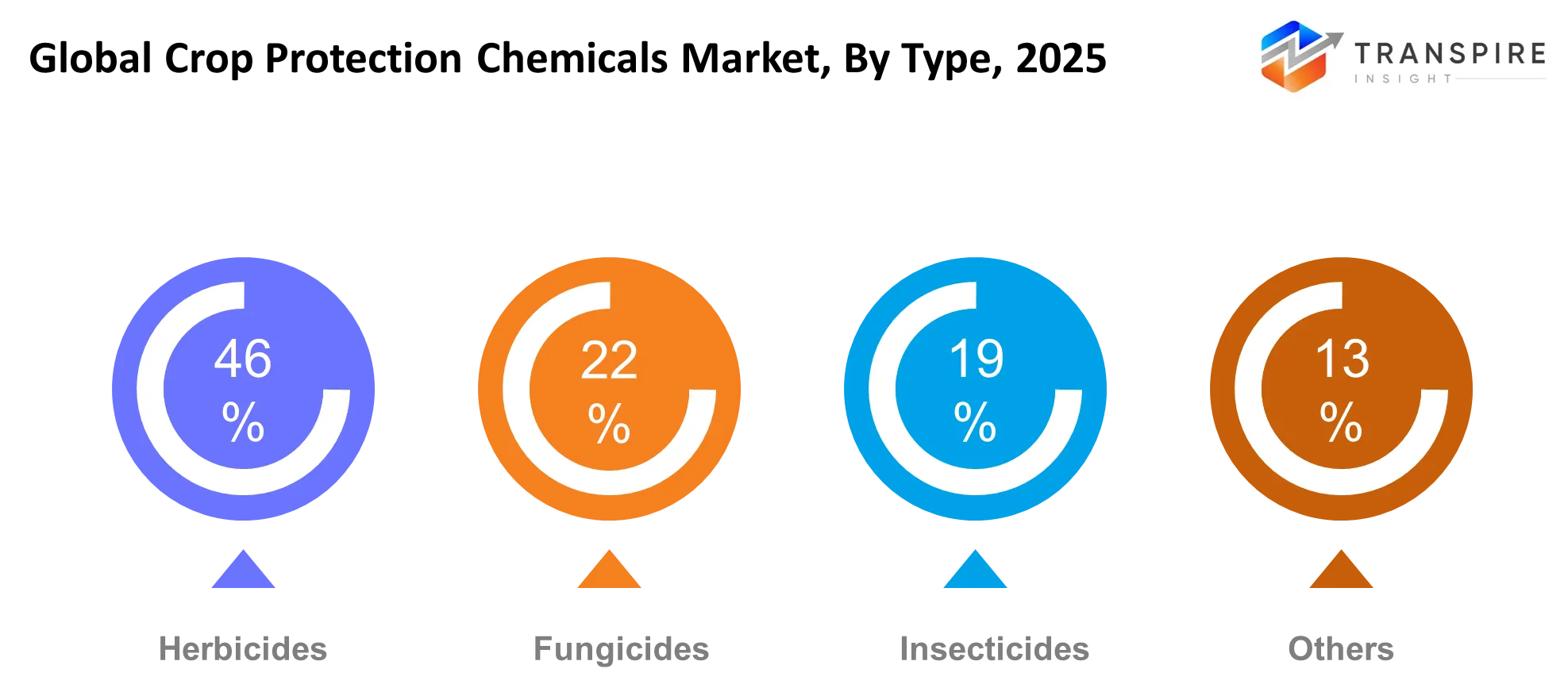
- Herbicides are the biggest market segment, accounting for 46% of the market, with the large-scale commercial farming using glyphosate and sulfonylurea herbicide formulations to control weeds in soybeans and corn.
- Bio-pesticides are the fastest growing market segment with a 13.2% CAGR as compared to 5.50% CAGR for the overall market, due to regulatory frameworks, which are encouraging eco-friendly options.
- With 13.0% market share, BASF leverages its complete agricultural technology solutions to differentiate with premium chemical platforms.
- Precision agriculture application cuts chemical application by 30-50% and protects yield with the aid of AI-driven drone spraying and satellite monitoring.
- Fungicides account for 22% of the market share, while disease management in fruit and vegetable cultivation is becoming more complex, especially in tropical areas.
- Insecticides account for 19% of the market as pest amounts increase in soybean and corn farming in Brazil and Argentina.
- Asia Pacific holds 40% share in the market due to the rise in the adoption rates driven by government subsidy programs and smallholder farmers making a switch to commercial farming.
- Latin America is the fastest-growing region with a CAGR of 12.1%, as the cultivation of soybeans and corn in Brazil and Argentina is growing and is being intensively protected.
What are the Key Drivers, Restraints, and Opportunities in the Global Crop Protection Chemicals Market?
Driver:
The growth is led by the increasing population in the world, losses due to climate change, and stringent government regulations on food security and crop yield protection. Some countries, such as India and Brazil, are rolling out subsidy schemes for crop protection products, thus directly boosting farmer uptake. In January 2026, India's Ministry of Agriculture announced expanded subsidy coverage for biopesticides and integrated pest management products under the National Plant Protection Programme.
Restraint:
Structural issues of high regulatory compliance costs and long approval times remain, with new active ingredients taking time to be approved. This restriction is due to the very strict environmental and toxicology testing procedures in several countries, which are especially difficult for smaller companies without R&D budgets. The barrier slows down the pace of innovation and brings in the market power of the existing multinational companies that have a lot of funds.
Opportunity:
Emerging markets such as India and the Southeast Asian countries offer high potential for growth, with incomes increasing and transitioning from subsistence to commercial farming. The crop protection market is expected to expand in India as DCM Shriram and Bayer's partnership brings agri-inputs and digital advisory services to the rural areas of the country. This is a regional investment strategy that targets segments of the farmer population that are beginning to move towards more high-value crops that need more intensive protection. In March 2026, Syngenta Group announced plans to invest $50 million in expanding its India manufacturing and R&D capabilities. This investment strengthens local supply chains for herbicides and insecticides, enabling faster deployment of climate-resilient crop protection products tailored to Indian and Southeast Asian farming conditions.
What Has the Impact of Artificial Intelligence Been on the Global Crop Protection Chemicals Market?
AI is revolutionizing the Global Crop Protection Chemicals Market by enabling precision application, predictive analysis, and speeding up R&D, which helps to use chemicals more efficiently and minimize environmental impact. Advanced spraying systems powered by machine learning, such as drone systems, and satellite-based technology use AI to analyze the health of the crops on the fly, thereby avoiding the need to spray unnecessarily and either cutting by 30–50% in total chemicals used or keeping the yields protected.
In addition to pattern recognition, AI enables predictive capabilities for pest detection and risk assessment using machine learning algorithms that can analyse historical patterns, weather data and sensor inputs to predict pest infestations before they can cause damage. Bayer's AI discovery platform was able to generate a novel fungicide class that showed 90% lower aquatic toxicity than existing fungicides, while generative models such as IBM RXN and AlphaFold are able to evaluate thousands of chemical structures in minutes, drastically shortening R&D cycles from years to months. Enhanced operations involve the use of AI-powered decision support systems that marry the knowledge of experts with crop management factors to make accurate and timely decisions for the farmer and smart fertilizer systems, such as Yara's N-Sensor, which automatically adjusts nitrogen application based on crop health. In many areas, there is not enough high-quality field-level data to accurately inform models and for accurate generalization, which slows down the regulatory process for chemicals designed using AI.
Instance: In March 2026, BASF Agricultural Solutions completed its acquisition of AgBiTech, a Brisbane-based biological insect control firm, integrating AI-driven strain selection and fermentation optimization into its biologicals portfolio. This acquisition enables BASF to deliver urgently needed sustainable pest management solutions with AI-enhanced production scalability worldwide.
Source:https://www.basf.com/global/en/media/news-releases/2026/03/p-26-029
Key Global Crop Protection Chemicals Market Trends:
The market is moving away from blanket spraying with chemicals and embracing precision agriculture and biological solutions, due to regulatory pressure and resistance management. Rather than just battling on the price of the product, companies are competing on how they integrate technology and how they are sustainable.
- There has been a significant increase in the adoption of precision agriculture, where farmers are now reducing the amount of chemicals used by 30-50% with yield protection enabled by AI-powered drones and satellite monitoring.
- Increasing pressures from pests and diseases have made the use of high-tech crop protection solutions and higher application rates more necessary for farmers, as a result of climate change.
- Biopesticides and biologicals are taking off as the regulatory environment encourages options other than synthetic pesticides.
- Rotating modes of action and using premium-priced “patent” chemistry solutions is a result of pest/weed resistance cycles.
- A new system is emerging to replace the use of chemicals as a single tool for crop protection: integrated pest management (IPM).
- Nanotechnology and encapsulation are advancing formulation techniques to make chemicals more effective and environmentally friendly.
- The use of GPS (geographic positioning system) guided equipment, drones and sensors is becoming essential to reduce the amount of pesticides and greenhouse gas emissions.
- The competition is increasingly moving away from price and towards innovation, technological improvements and reliability of the supply chain.
Global Crop Protection Chemicals Market Segmentation
By Type:
Herbicides hold the majority position in the market at 46% of the total, due to their critical use in large-scale commercial soybean, corn, wheat, and cotton production. The fungicides market accounts for 22% and insecticides 19% share, both of which are expanding at a steady pace driven by the increasing intensity of pest attacks that have been fueled by climate change. Regulatory policies are encouraging bio-pesticides to grow at a faster rate of 13.2% CAGR than the overall market (5.50% CAGR), as export markets are seeking produce with low residues and regulatory laws are more favourable towards environmentally friendly products. The balance of 13% is made up of niche-use rodenticides and plant growth regulators. The implication for the future is that bio-pesticides will keep increasing market share as sustainability regulations become more stringent, favouring those companies that have robust biological portfolios.
To learn more about this report, Download Free Sample Report
By Applications:
The cereal crops are the highest share of the application, as this is crucial for food security in the world, and significant land areas are cultivated for wheat, rice, and corn production worldwide. Fruits & vegetables are the second largest application segment, following 7.1% CAGR with high-value cash crops that demand intensive protection to ensure quality & yield. Expansion in South America and Asia is driving the growth of soybean and canola, and plantation crops such as coffee, cocoa and rubber require targeted protection solutions. High-value crops in fruits and vegetables will increasingly rely on precision agriculture in the future, and will be able to decrease the use of chemicals while maintaining profitability.
By End-User:
Farmers dominate the market; they are the direct buyers of crop protection products for on-farm applications in both the smallholder and commercial farming segments. Agricultural cooperatives are expanding in number as collective buying organizations, which lower the input costs for member farmers through their bulk buying power. Commercial plantations are sophisticated crop management systems, with high-volume buying. The inference is that cooperatives will merge further and eventually have more leverage in their bargaining and more rapid uptake of sustainable practices.
By Formulations:
Liquid formulations have a larger share because they can be applied using modern sprayers. Granular formulations are important in the area of soil treatment herbicides. Moving forward, liquid and suspension concentrate products will likely have more market share due to the increasing adoption of precision equipment that will allow for more precise dosage and less drift.
What are the Key Use Cases Driving the Global Crop Protection Chemicals Market?
The herbicides are the largest market share of crop protection chemicals, representing 45-50% of total global consumption, as large-scale commercial agriculture in North America, Latin America, and Asia-Pacific uses glyphosate and sulfonylurea formulations on soybean, corn, wheat and cotton crops.
Applications of fungicides and insecticides are growing, particularly in tropical areas where high value cash crops and increased pest pressure have intensified applications In Europe and Latin America, an increased reliance on systemic fungicides for disease management is now underway in fruit, vegetable and vine production, while the soybean and corn sectors in Brazil and Argentina are experiencing increased consumer demand for insecticides as a result of increased pest levels.
New applications include spraying biopesticides and precision agriculture, where spraying with drones and crop monitoring using AI can cut the amount of chemicals by 30-50% without compromising efficiency. The use of microbial solutions and active ingredients of plant origin is becoming more popular in the organic farming market and in export markets that demand low-residue produce.
|
Report Metrics |
Details |
|
Market size value in 2025 |
USD 50215.9 Million |
|
Market size value in 2026 |
USD 52928.3 Million |
|
Revenue forecast in 2033 |
USD 77009.4 Million |
|
Growth rate |
CAGR of 5.50% from 2026 to 2033 |
|
Base year |
2025 |
|
Historical data |
2021 - 2024 |
|
Forecast period |
2026 - 2033 |
|
Report coverage |
Revenue forecast, competitive landscape, growth factors, and trends |
|
Regional scope |
United States; Canada; Mexico; United Kingdom; Germany; France; Italy; Spain; Denmark; Sweden; Norway; China; Japan; India; Australia; South Korea; Thailand; Brazil; Argentina; South Africa; Saudi Arabia; United Arab Emirates; Europe; Asia-Pacific; North America. |
|
Key company profiled |
Bayer CropScience, Syngenta, BASF, Corteva Agriscience, FMC Corporation, UPL Limited, ADAMA Agricultural Solutions, Nufarm, Sumitomo Chemical, PI Industries, Isagro, Nippon Soda, Arysta LifeScience, Valent Biosciences, American Vanguard. |
|
Customization scope |
Free report customization (country, regional & segment scope). Avail customised purchase options to meet your exact research needs. |
|
Report Segmentation |
By Type (Herbicides, Insecticides, Fungicides, Bio-pesticides, Rodenticides, Plant Growth Regulators, Others); By Application (Cereal Crops, Fruits & Vegetables, Oilseeds & Pulses, Plantation Crops, Turf & Ornamentals, Others); By End-User (Farmers, Agricultural Cooperatives, Commercial Plantations, Agrochemical Companies, Others); By Formulation (Liquid Formulations, Granular Formulations, Powder Formulations, Suspension Concentrates, Others). |
Which Regions are Driving the Global Crop Protection Chemicals Market Growth?
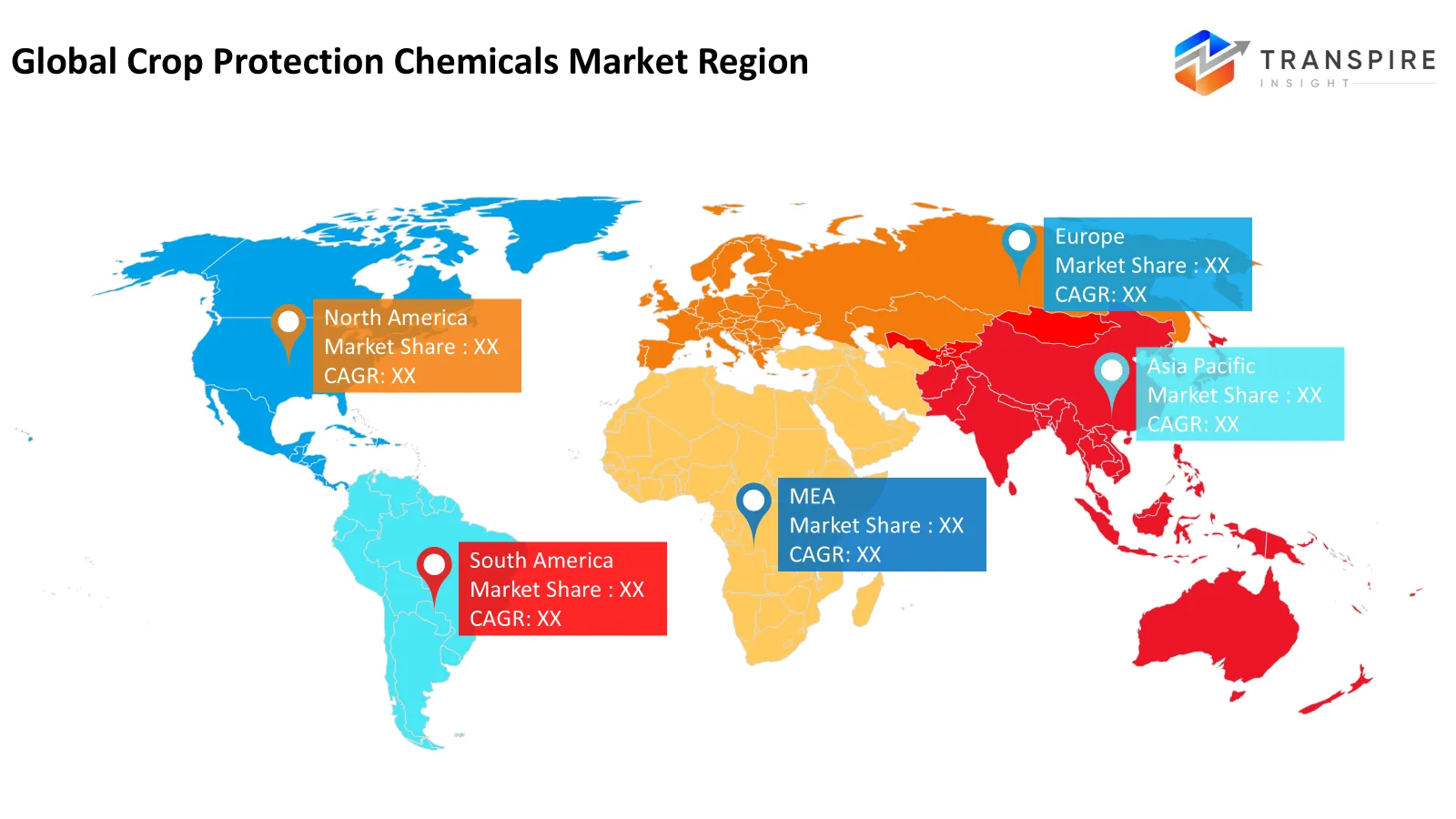
Asia Pacific is the largest market in the Global Crop Protection Chemicals Market, accounting for 40% of the market, due to the high volume of agricultural land in China, India, and Southeast Asia, as well as an increased food security focus across the region. There are supporting mechanisms in the region, like government subsidy programs, large rural distribution networks, and smallholder farmers adapting to commercial farming practices. Policy interventions such as the Indian Plant Protection Programme increase farmers' access to affordable crop protection products and direct crop protection adoption rates. This structure benefits the Asia Pacific to stay the market leader as farmers move to more profitable crops that demand intensive protection. In February 2026, Syngenta Group launched new herbicide formulations for rice and wheat cultivation in China and India. This product launch expands Syngenta's presence in the Asia Pacific's high-growth cereal crop segment, addressing farmers' needs for effective weed control.
Europe accounts for 25% market share and is different from the Asia Pacific because it is more focused on sustainability and environmental compliance than volume growth. The region's stability is based on the implementation of strict regulations for premium-priced and environmentally friendly products and IPM systems as compared to conventional synthetic chemicals. The European farming sector relies on modern agricultural facilities and thriving farming cooperatives that enable collective implementation of precision agriculture technologies. This is a steady market, driven by regulation, which provides slower growth but higher margins for those providing biopesticides. In April 2026, Syngenta Group reported strong Q1 2026 results in Europe, driven by demand for sustainable crop protection solutions and biopesticides. This performance reflects European farmers' shift toward environmentally compliant products, validating the region's regulatory-driven market structure with higher margins for sustainable solutions.
North America leads the pack with 26% market share, while Latin America is the fastest growth region with 12.1% CAGR, mainly as a result of the growing production of soybeans and corn in Brazil and Argentina. AI precision agriculture equipment and drone spraying systems that cut chemical use by 30-50% is the recent growth driver in North America. The future opportunity is in climate-resilient crop protection products and herbicide-tolerant genetically modified crops to solve the growing problem of extreme weather conditions. This technological leadership is making North America the biggest market for technology-driven, high-end crop protection products. In March 2026, BASF completed its acquisition of AgBiTech, strengthening biological insect control capabilities for Latin American soybean and corn markets. This acquisition expands sustainable pest management solutions in Brazil and Argentina, supporting the region's rapid crop protection market growth.
To learn more about this report, Download Free Sample Report
Who are the Key Players in the Global Crop Protection Chemicals Market and how do they Compete?
The Global Crop Protection Chemicals Market is moderately concentrated, with the top five companies in the market accounting for 56.1% market share in 2025, including BASF SE, Bayer CropScience, Syngenta Group, Corteva Agriscience, and FMC Corporation. Competition is all about innovation, product portfolios and geographical reach – the bundles of seeds and chemistry are sticky customer relationships.
The innovation strategy at BASF SE has a market share of 13.0% and is differentiated by comprehensive agricultural technology solutions and best-in-class chemical platform solutions combined with advanced systems. The company continues to grow through strategic acquisitions, such as AgBiTech, which helps to build biologicals portfolios for sustainable pest management. Bayer CropScience pursues innovation through research-oriented environmentally friendly products, differentiating via seed-chemistry-digital farming integration and AI-enabled crop management solutions. Bayer grows by new R&D strategies such as "CropKey" for targeted chemistries at reduced application rates and by commercial strategies in India.
Syngenta Group's Corporate Innovation Strategy is coupled with a strong distribution reach in North America, Europe and emerging markets, and is characterized by integrated pest management and biopesticides. Corteva Agriscience develops biopesticides and genetically modified seeds, builds capacity for herbicides and precision agriculture seed treatments for customers. FMC Corporation focuses on niche specialty chemicals and technological differentiation for the benefit of the grower, seeking premium applications with innovative solutions.
Key Players are:
- Bayer CropScience
- Syngenta
- BASF
- Corteva Agriscience
- FMC Corporation
- UPL Limited
- ADAMA Agricultural Solutions
- Nufarm
- Sumitomo Chemical
- PI Industries
- Isagro
- Nippon Soda
- Arysta LifeScience
- Valent Biosciences
- American Vanguard
Recent Development News
-
In December 2025, DCM Shriram Limited and Bayer Crop Science Limited signed a Memorandum of Understanding to jointly explore opportunities to strengthen India's agriculture ecosystem through innovation, sustainability, and farmer-centric solutions. The collaboration spans agri-inputs, digital advisory, sustainable farming practices, crop solutions, seeds, speciality plant nutrition, and biologicals across India. Source:https://agrotech.space
- In February 2026, BASF launched Kilymos, a fungicide developed exclusively for rice cultivation targeting rice blast and sheath blight diseases. The product integrates into disease management programs across Brazil's rice-producing regions, addressing critical protection needs during the 2026 rice harvest opening. Source:https://www.global-agriculture.com
What Strategic Insights Define the Future of the Global Crop Protection Chemicals Market?
The Global Crop Protection Chemicals Market is moving from a synthetic-dominated portfolio to biologicals and precision application, as biopesticides are expanding with 13.2% CAGR, and IPM is becoming commonplace. An unrecognized problem is the rapid emergence of resistance to the chemicals that are already on the market, which can lead to expensive R&D cycles and can threaten product life cycles. A new opportunity is precision spraying using drones and AI analytics, which minimizes chemical waste, optimizes yield efficiency and allows export-compliant, low-residue formulations. From a strategic point of view, enterprises will need to allocate hybrid portfolios of synthetic effectiveness and biologicals and integrate digital application technologies in order to comply with sustainability requirements and secure premium export markets. This two-in-one solution ensures immediate farmer needs while addressing regulatory and environmental requirements in the long run.
Key Segmentations are:
By Type
- Herbicides
- Insecticides
- Fungicides
- Bio-pesticides
- Rodenticides
- Plant Growth Regulators
- Others
By Application
- Cereal Crops
- Fruits & Vegetables
- Oilseeds & Pulses
- Plantation Crops
- Turf & Ornamentals
- Others
By End-User
- Farmers
- Agricultural Cooperatives
- Commercial Plantations
- Agrochemical Companies
- Others
By Formulation
- Liquid Formulations
- Granular Formulations
- Powder Formulations
- Suspension Concentrates
- Others
Regional Outlook
North America
- United States
- Canada
- Mexico
Europe
- Germany
- United Kingdom
- France
- Spain
- Italy
- Rest of Europe
Asia Pacific
- Japan
- China
- Australia & New Zealand
- South Korea
- India
- Rest of Asia Pacific
South America
- Brazil
- Argentina
- Rest of South America
Middle East & Africa
- Saudi Arabia
- United Arab Emirates
- South Africa
- Rest of the Middle East & Africa
Frequently Asked Questions
Find quick answers to common questions.
The Global Crop Protection Chemicals Market size was valued at USD 50215.9 Million in 2025 and is poised to reach USD 77009.4 Million by 2033, expanding at a 5.50% CAGR from 2025 to 2026.
Key segments for the Global Crop Protection Chemicals Market are By Type (Herbicides, Insecticides, Fungicides, Bio-pesticides, Rodenticides, Plant Growth Regulators, Others); By Application (Cereal Crops, Fruits & Vegetables, Oilseeds & Pulses, Plantation Crops, Turf & Ornamentals, Others); By End-User (Farmers, Agricultural Cooperatives, Commercial Plantations, Agrochemical Companies, Others); By Formulation (Liquid Formulations, Granular Formulations, Powder Formulations, Suspension Concentrates, Others).
Growth is primarily driven by the Global Crop Protection Chemicals Market, which grows due to rising population, climate change-induced crop losses, and government food security regulations, with India and Brazil's subsidy schemes boosting farmer uptake and driving a 5.50% CAGR from 2026 to 2033.
The global market is led by major manufacturers, including Bayer CropScience, Syngenta, BASF, Corteva Agriscience, FMC Corporation, UPL Limited, ADAMA Agricultural Solutions, Nufarm, Sumitomo Chemical, PI Industries, Isagro, Nippon Soda, Arysta LifeScience, Valent Biosciences, and American Vanguard.
Asia Pacific currently accounts for 40% market share and is shaping global dynamics of the crop protection market with its huge agricultural acreage in China and India, government subsidies and the conversion of smallholder farmers to commercial farming.
Commercial opportunities include emerging markets like India and Southeast Asia transitioning to commercial farming, with DCM Shriram-Bayer partnership expanding agri-inputs and digital advisory services targeting farmers moving to high-value crops needing intensive protection.
- Bayer CropScience
- Syngenta
- BASF
- Corteva Agriscience
- FMC Corporation
- UPL Limited
- ADAMA Agricultural Solutions
- Nufarm
- Sumitomo Chemical
- PI Industries
- Isagro
- Nippon Soda
- Arysta LifeScience
- Valent Biosciences
- American Vanguard
About the Authors

Pankaj Ghogare Patil
I am Pankaj Ghogare Patil, a Senior Research Analyst at Transpire Insight, specializing in the Pharmaceutical, Chemicals & Materials, Healthcare IT, and Biotechnology industry. My expertise lies in conducting comprehensive market research, analyzing industry trends, evaluating competitive landscapes, and translating complex data into actionable insights. At Transpire Insight, I closely follow emerging technologies, regulatory developments, and market innovations to create accurate, well-researched, and informative content that helps businesses and professionals make informed decisions. I am committed to producing credible, evidence-based articles that reflect industry best practices while making technical topics accessible and valuable for a broad audience.

Chakradhar Khansole
Chakradhar serves as the Research Director at Transpire Insight, bringing over 8 years of experience in technology, innovation, and strategic market intelligence. He specializes in transforming complex market data into actionable business insights that enable organizations to make informed, growth-oriented decisions. Recognized for his strategic vision and analytical expertise, Chakradhar leads high-impact research initiatives, delivering comprehensive market assessments, competitive intelligence, and forward-looking industry analysis.
Recently Published Reports
-
May 2026
Healthcare Polymer Packaging Market
Healthcare Polymer Packaging Market Size, Share & Analysis Report By Packaging Type (Syringes, IV Bottles and Pouches, Clamshells, Blisters, Bottles & Jars, Containers, Tubes, IV Parental Packaging, Others), By Type (Regulated, Non-regulated), By Polymer Type (LDPE (Low-Density Polyethylene), HDPE (High-Density Polyethylene), Homo-polymer (Homo), Random Copolymer (Random), Block Copolymer (Block), PET, Polystyrene, Polyvinyl Chloride, Polyamide/EVOH, Others), and Geography (North America, Europe, Asia-Pacific, Middle East and Africa, South and Central America), 2021 - 2031
-
Apr 2026
Hydrophilic Tape (Waterstop) Market
Hydrophilic Tape (Waterstop) Market Size, Share & Analysis Report By Type (Bentonite-Based Hydrophilic Tape, Rubber-Based Hydrophilic Tape), By Application (Residential Buildings, Commercial Buildings, Infrastructure Projects), and Geography (North America, Europe, Asia-Pacific, Middle East and Africa, South and Central America), 2021 - 2031
-
Apr 2026
Metalens Market
Metalens Market Size, Share & Analysis Report By Type (Visible Light Metalens, and Infrared Metalens), By Application (Consumer Electronics, Automotive Electronics, Industrial, Medical, and Others), and Geography (North America, Europe, Asia-Pacific, Middle East and Africa, South and Central America), 2021 - 2031
-
Apr 2026
PBT Resin Market
PBT Resin Market Size, Share & Analysis Report By Type (Reinforced PBT Resin, Unreinforced PBT Resin), By Processing Method (Injection Molding, Extrusion, Blow Molding, Others), By End-User (Automotive, Electrical & Electronics, Consumer Appliances, Industrial Machinery, Medical Devices, Packaging, Others), and Geography (North America, Europe, Asia-Pacific, Middle East and Africa, South and Central America), 2021 - 2031