
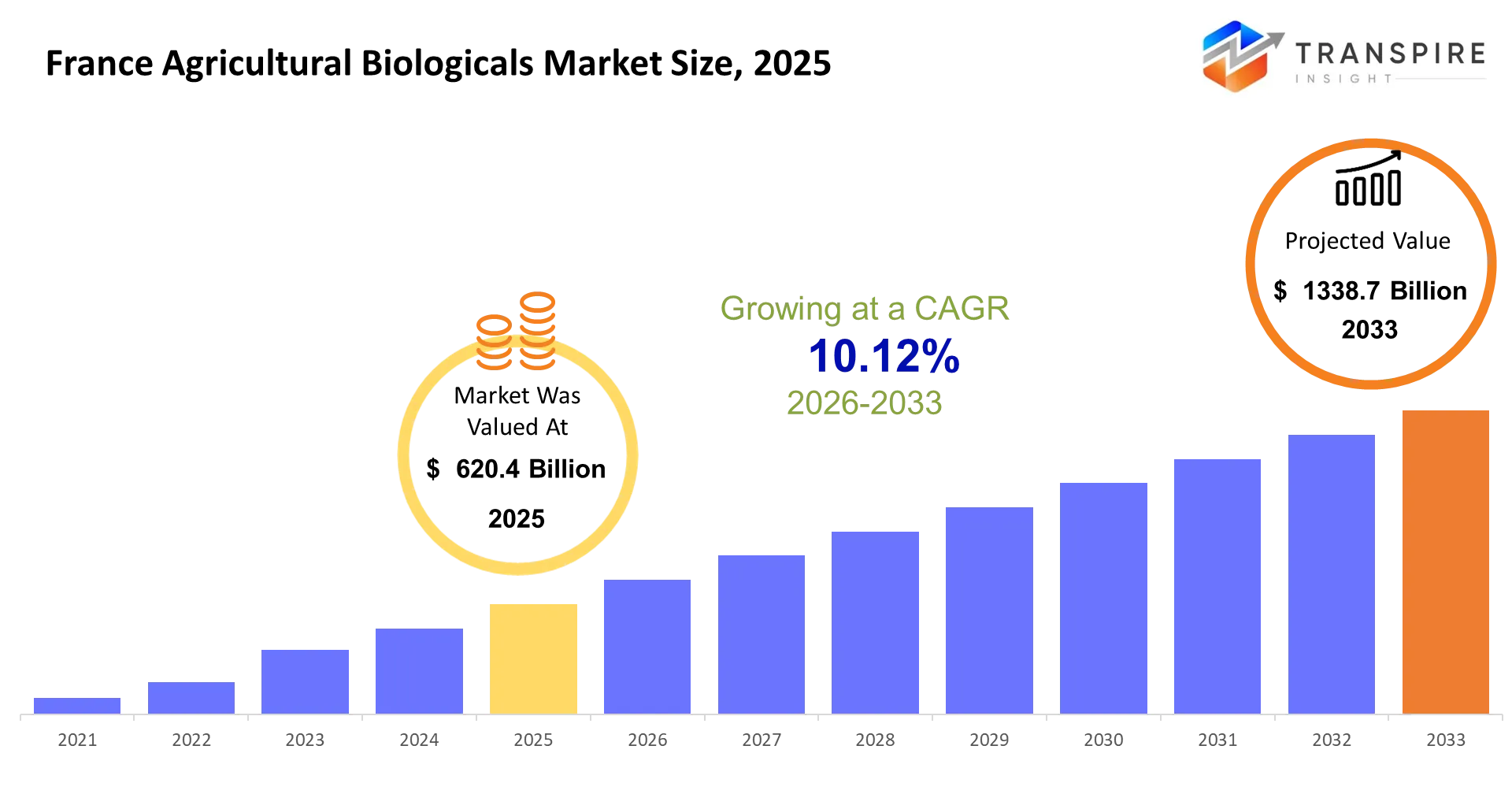
France Agricultural Biologicals Market Size & Forecast:
- France Agricultural Biologicals Market Size 2025: USD 620.4 Million
- France Agricultural Biologicals Market Size 2033: USD 1338.7 Million
- France Agricultural Biologicals Market CAGR: 10.12%
- France Agricultural Biologicals Market Segments: By Type (Biopesticides, Biofertilizers, Biostimulants, Others); By Application (Crop Protection, Soil Health, Seed Treatment, Yield, Others); By End-User (Farmers, Agribusiness, Research, Government, Others); By Form (Liquid, Powder, Others)
To learn more about this report,  Download Free Sample Report
France Agricultural Biologicals Market Summary
The France Agricultural Biologicals Market was valued at USD 620.4 Million in 2025. It is forecast to reach USD 1338.7 Million by 2033. That is a CAGR of 10.12% over the period.
The France Agricultural Biologicals Market enables farmers to sustain their crop yields while decreasing their need for synthetic chemicals which harm soil health and biodiversity. Farmers select biological crop protection agents and biostimulants and microbial seed treatments to enhance plant nutrient absorption and boost their defense systems while meeting European food safety regulations that restrict chemical residues. The market has transformed during the past five years because large agricultural producers now use biological products as part of their standard farming methods which were previously exclusive to organic farming.
The European Union implemented its Farm to Fork approach which created stricter regulations on chemical pesticide usage and promoted agricultural methods that produced lower greenhouse gas emissions. The Russia-Ukraine conflict resulted in supply chain interruptions and fertilizer price fluctuations which led French farmers to look for other methods to support their crop production. The distributors and agri-tech companies are increasing their funding because biological products show clear improvements in soil performance and crop yield which helps establish recurring product use and drive long-term market growth.
Key Market Insights
- The France Agricultural Biologicals Market in 2025 showed Western France as the leading region with a market share of 36 percent because of its extensive cereal and horticulture farming operations.
- Vineyard operators in Southern France are projected to drive the regional market through 2033 as they start using microbial crop protection solutions.
- Growers in 2025 showed their highest market interest towards biostimulants because they wanted to achieve better nutrient management and drought resistance for their wheat and vegetable crops.
- French farms used biofertilizers as their second most important segment because they decreased their need for synthetic fertilizers after major input cost changes during the period from 2022 to 2024.
- The category of biopesticides will experience its highest growth rate until 2033 because EU regulations on pesticide residues will force export-oriented farmers to change their pest control methods.
- The seed treatment applications generated a major market share because they enhanced seed germination rates while reducing crop stress during periods of unpredictable weather.
- The digital agriculture platforms which emerged after 2023 introduced two new agricultural technologies, which enabled farmers to monitor their crop fields and use precise spraying methods at optimal times.
- The end-user market for commercial farming operations showed integrated biological programs as the leading segment because these programs helped farms reduce their long-term soil degradation and regulatory compliance expenses.
- French supermarket chains are currently driving the growth of small and medium organic producers because they focus on agricultural supply contracts which require traceable low-residue products.
- European agricultural networks will benefit from the formulation development and localized trials which market participants obtain through their acquisition of regional biological startups.
What are the Key Drivers, Restraints, and Opportunities in the France Agricultural Biologicals Market?
The France Agricultural Biologicals Market exists today because European Union countries created new restrictions that limit chemical pesticide and fertilizer applications.The EU Farm to Fork strategy established specific targets which required farmers and distributors to change their chemical usage practices by switching to more sustainable methods of crop protection. French agricultural producers of cereals and fruits and vineyards are using microbial biostimulants together with biological pest-control solutions to satisfy European retail chain and export market requirements for residue control.The regulatory change enables biological manufacturers to generate stable income growth because farmers begin using multiple seasonal treatment approaches instead of testing their products once.
The most significant restraint remains inconsistent field performance across varying soil types, weather conditions, and crop systems. Biological products depend on microbial activity, which shows variability according to moisture and temperature and soil biology conditions. The agricultural industry faces adoption difficulties because large commercial growers need consistent yield results instead of new treatment methods. The process of obtaining regulatory approval for biological products in Europe requires multiple steps that take extended periods to complete, which results in delayed product launch and restricted market expansion during initial phases.
Precision agriculture implementation creates major business development potential. French agricultural technology companies and agricultural cooperatives increasingly use satellite tracking and soil measurement and artificial intelligence crop assessment together with specialized biological solutions. Southern France vineyard regions have begun to test microbial treatment systems that utilize data analysis to determine optimal times for spraying and nutrient usage. The development of precision farming systems has reached its highest point.
What Has the Impact of Artificial Intelligence Been on the France Agricultural Biologicals Market?
The combination of artificial intelligence with advanced digital agricultural systems has created new methods for developing and applying and monitoring biological crop inputs in French agricultural practices. AI-enabled farm management platforms now analyze satellite imagery and soil health indicators and moisture conditions and disease patterns to determine the optimal timing for microbial sprays and biostimulant applications. Agricultural cooperatives increasingly use machine learning models to predict fungal outbreaks and nutrient stress and crop performance variability before visible damage occurs. The system enables growers to implement biological solutions with greater accuracy which helps them to decrease unnecessary treatment cycles while decreasing their operational expenses.
The research process for formulation development now benefits from advanced analytics tools. Biological manufacturers use AI-driven genomic modeling to identify microbial strains that perform more effectively under drought conditions or temperature stress common in Southern France. Precision application systems that link smart tractors with autonomous spraying equipment have enhanced treatment accuracy and improved crop quality while decreasing input waste during high-value fruit and vineyard cultivation.
Digital monitoring systems have enabled some commercial farms to achieve better input-use efficiency while decreasing their risk of crop loss during periods of unpredictable weather. The adoption of AI technology still encounters multiple obstacles. Field performance models for biological systems need extensive localized data because small farms do not have complete digital systems or sensor networks. The high costs of implementation together with the disorganized agricultural data networks have hindered medium-sized French farming enterprises from adopting new technologies.
Key Market Trends
- French vineyard operators used microbial fungicides as their primary pest control method after stricter residue standards made their wine export contracts to premium markets unworkable between 2023 and 2024.
- Agricultural cooperatives expanded precision farming partnerships since 2022 to improve biological application timing and reduce seasonal treatment inefficiencies.
- After European regulatory reforms initiated biopesticide registration process accelerations multinational suppliers increased their investments in biological product development for the French market starting from 2021.
- Farmers increasingly combined biologicals with reduced synthetic inputs instead of fully replacing chemicals which created hybrid crop management strategies that farmers used across their cereal fields.
- The adoption of biostimulants increased between 2022 and 2025 because growers wanted to make their crops more resistant to climate-related drought conditions.
- Major suppliers including BASF SE and Syngenta Group expanded their microbial research partnerships with French distributors who operate in regional markets.
- Biological seed treatments gained momentum after fertilizer price spikes increased interest in early-stage nutrient efficiency and root development technologies.
- Fruit and vegetable growers adopted biologically supported pest management systems because retail food chains established stricter low-residue sourcing requirements.
- Digital crop-monitoring platforms became more common after 2023 because growers started using biological performance tracking to predict disease outbreaks through their predictive analytics system.
- The consolidation activity of global agricultural input companies increased after they acquired specialized biological startups to obtain exclusive rights to proprietary microbial formulations and regional distribution rights.
France Agricultural Biologicals Market Segmentation
By Type
Farmers across three major agricultural sectors, which include cereal farming and vineyard cultivation and horticulture, maintain their primary use of biostimulants, which the agricultural biostimulants market in France uses. Commercial growers increasingly use seaweed extracts together with microbial stimulants and amino-acid formulations to improve their crops' ability to absorb nutrients and withstand drought conditions. The continuous need for biostimulant products exists because high fertilizer expenses together with newer nutrient management laws create ongoing demand in intensive farming areas.
Biopesticides serve as a secondary pest control method which vineyard operators and fruit producers use to protect their export-sensitive crops with pest management solutions that leave no harmful residues. Biofertilizers are expanding at a faster pace as large farms seek alternatives to synthetic nitrogen inputs following supply chain disruptions and input price volatility between 2022 and 2025. The market for microbial consortia and plant-derived growth enhancers exists as a niche category but their usage in precision farming systems continues to increase. The forecast period will show biostimulants as the leading product category while biofertilizers and advanced microbial solutions will draw more funding because of their innovative potential.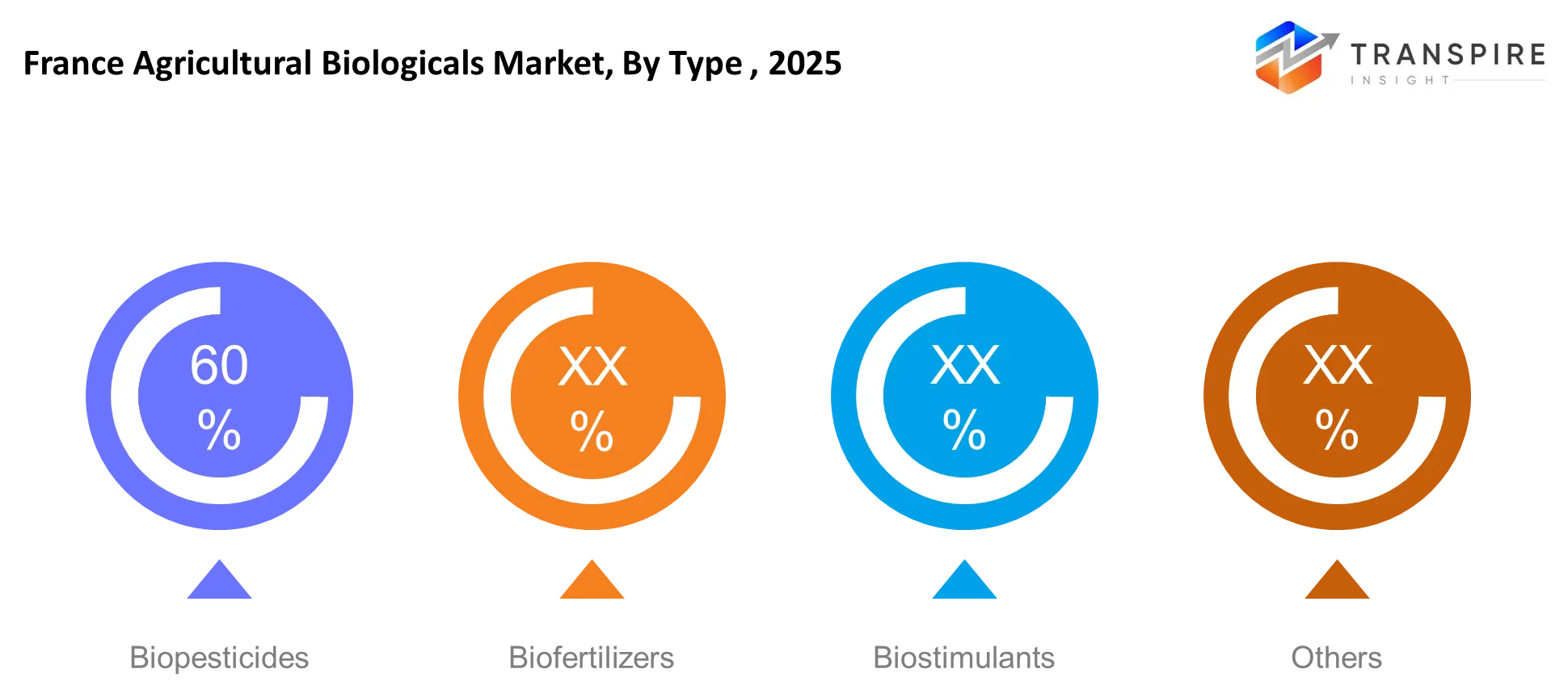
To learn more about this report, Download Free Sample Report
By Application
The main use of crop protection products exists because vineyards and fruit farms and greenhouse operations now use biological methods instead of chemical pesticides that target specific pests. French growers prioritize biological crop protection products to comply with residue restrictions imposed by European retailers and export markets. Farmers adopt microbial fungicides together with biological insect-control methods because climate changes create disease problems.
The current demand for soil health applications remains steady because people show increasing interest in maintaining soil productivity through regenerative agricultural methods. The market for seed treatment applications experiences rapid growth because microbial coatings help seeds germinate better and protect young plants during their first growth period. Farmers use yield enhancement solutions because precision agriculture platforms allow them to apply biological inputs specifically to their commercial farms. The crop protection industry will maintain its revenue leadership through time, while soil health and seed treatment technologies will receive more research funding and product development efforts.
By End-User
Farmers represent the dominant end-user segment because commercial crop producers directly influence purchasing decisions related to biological crop enhancement and protection systems. Large cereal and vineyard operations increasingly integrate biological inputs into hybrid farming programs which maintain productivity while reducing chemical dependency. Professional farming networks adopt new operational pressure because of regulatory compliance requirements and soil performance standards.
Agribusiness companies maintain a significant market presence through contract farming support which includes biological distribution partnerships and integrated agronomy services. Research institutions are expanding influence as microbial innovation and field-testing activities accelerate across France's agricultural technology ecosystem. The government-backed agricultural sustainability programs create market development through their subsidy structures and environmental transition initiatives. The forecast period will show increased agribusiness and research-driven adoption of biological solutions which will become better integrated with precision farming systems and digital crop management technology.
By Form
The market supports liquid formulations as the leading product because liquid biological products enable simpler field usage and their active ingredients get absorbed more quickly while their properties match precision spraying equipment better. Vineyard operators and commercial cereal farms increasingly prefer liquid biostimulants and microbial sprays because these products deliver effective coverage while requiring less effort to manage their application process. The demand for liquid-based biological solutions grows stronger because automated spraying systems and smart irrigation technologies continue to expand their market presence.
Large-scale agricultural distribution networks prefer powder formulations because their storage stability and transportation efficiency create operational benefits which enable organizations to maintain their regular distribution activities. Powder-based microbial inoculants and seed treatment products continue gaining traction in regions where long shelf life and cost-effective logistics influence purchasing decisions. Controlled-release agricultural applications currently use limited formulation types because there is growing interest in granular and gel-based products. The agricultural sector will use liquid products for precision agriculture systems which create high-value outputs while advanced powder formulations will enable broad-acre farming operations to implement scalable agriculture.
What are the Key Use Cases Driving the France Agricultural Biologicals Market?
The France Agricultural Biologicals Market shows its strongest use case through biostimulant applications which support cereal, vineyard, and vegetable farming. French farmers use microbial and seaweed-based products to achieve three goals which involve better nutrient absorption and drought crop yield stability and reduced need for costly synthetic fertilizers. The application produces its greatest demand for commercial farms because they must sustain their productivity while following the stricter EU standards about residue and soil management.
Vineyard disease management and greenhouse horticulture now show rapid growth through secondary use cases. Wine manufacturers increasingly use biological fungicides to control mildew because these products maintain their export quality standards while greenhouse operators apply biofertilizers to restore soil health and decrease chemical residues in high-intensity farming systems.
Biological seed coatings and AI-driven precision microbial spraying represent new emerging systems. The agricultural technology systems currently operate on larger farms which receive agri-tech support but these systems exhibit strong potential for future growth as French agriculture transitions to data-centered and climate-adaptive production methods.
|
Report Metrics |
Details |
|
Market size value in 2025 |
USD 620.4 Million |
|
Market size value in 2026 |
USD 681.8 Million |
|
Revenue forecast in 2033 |
USD 1338.7 Million |
|
Growth rate |
CAGR of 10.12% from 2026 to 2033 |
|
Base year |
2025 |
|
Historical data |
2021 - 2024 |
|
Forecast period |
2026 - 2033 |
|
Report coverage |
Revenue forecast, competitive landscape, growth factors, and trends |
|
Regional scope |
France |
|
Key company profiled |
Bayer, Syngenta, BASF, Corteva, UPL, FMC, Novozymes, Valent Bio, Koppert, Marrone Bio, Certis, BioWorks, Rizobacter, Lallemand, Andermatt |
|
Customization scope |
Free report customization (country, regional & segment scope). Avail customized purchase options to meet your exact research needs. |
|
Report Segmentation |
By Type (Biopesticides, Biofertilizers, Biostimulants, Others); By Application (Crop Protection, Soil Health, Seed Treatment, Yield, Others); By End-User (Farmers, Agribusiness, Research, Government, Others); By Form (Liquid, Powder, Others) |
Which Regions are Driving the France Agricultural Biologicals Market Growth?
The market in Western France functions as the leading regional market because it unites extensive cereal agriculture with sophisticated farming cooperatives and effective agricultural resource distribution networks. The regions of Brittany and Pays de the Loire enable farmers to cultivate high volumes of crops which depend on methods that protect the soil through sustainable practices. Farmers in these areas started using biological crop enhancement products before other regions because of stringent nitrate management rules and fertilizer efficiency requirements established by authorities. The region possesses advanced agricultural technology infrastructure and research collaboration networks which create strong partnerships between farmers and agricultural product distributors.
Northern France contributes differently to market growth because its strength comes from stable industrial farming operations and consistent investment in precision agriculture systems. Farmers who produce large amounts of wheat and sugar beets in Hauts-de-France now utilize biological inputs as part of their hybrid crop management practices which they use to complement their traditional chemical applications. The region maintains constant buying patterns because commercial growers use their established farming methods to achieve predictable crop yields while maintaining their soil health for extended periods. The adoption of biological products remains stable in industrial-scale farming operations because strong logistics systems and access to export-oriented food processing facilities create operational advantages for farmers.
The region of Southern France is developing into its fastest-growing area because climate change is causing agricultural problems and vineyard modernization efforts are expanding. Mediterranean farming zones faced extended drought periods which combined with increasing disease pressures to drive growers to adopt microbial biostimulants and biological fungicides after 2023.
Who are the Key Players in the France Agricultural Biologicals Market and How Do They Compete?
Competition in the France Agricultural Biologicals Market remains moderately fragmented because multinational agricultural companies compete alongside specialized biological solution providers and regional microbial technology firms. Large incumbents continue defending market share through integrated crop management platforms that combine seeds, digital farming tools, and biological inputs. Smaller companies compete by focusing on highly specialized microbial formulations, localized agronomic support, and faster product adaptation for vineyard and horticulture applications. Technology differentiation and field-performance consistency have become more important than price competition because growers increasingly demand measurable yield and soil efficiency outcomes.
Bayer AG focuses on biological crop enhancement partnerships and precision agriculture integration to strengthen long-term grower retention. Its collaboration with microbial research platforms and digital farming systems allows the company to combine biological treatments with predictive crop analytics. Syngenta Group differentiates itself through AI-supported bioscience research and integrated biological product development. The company expanded its bioscience infrastructure and accelerated microbial innovation programs to improve treatment reliability and resistance management capabilities.
BASF SE competes through acquisition-led expansion and broad crop protection integration. The company strengthened its biological insect control portfolio through targeted acquisitions while investing heavily in digital agriculture systems. Corteva Agriscience emphasizes biological seed treatment technologies and precision nutrient management solutions designed for large-scale row crop farming. Koppert maintains a competitive advantage through niche expertise in biological pest control for greenhouse and specialty crop cultivation, particularly within European horticulture networks.
Company List
• Bayer
• Syngenta
• BASF
• Corteva
• UPL
• FMC
• Novozymes
• Valent Bio
• Koppert
• Marrone Bio
• Certis
• BioWorks
• Rizobacter
• Lallemand
• Andermatt
Recent Development News
In March 2026, Syngenta Group announced a USD 130 million investment in a new agricultural bioscience research center. The BioSTaR facility will accelerate AI-driven biological product development and sustainable crop protection innovation.https://www.syngenta.com
What Strategic Insights Define the Future of the France Agricultural Biologicals Market?
The France Agricultural Biologicals Market is presently undergoing a transition which will establish integrated biological and digital farming ecosystems as the standard method of operation while eliminating the use of independent biological products. The main force behind this transition is the convergence of EU regulatory pressure, fertilizer cost volatility, and precision agriculture deployment across commercial farming operations. Biological solutions will become essential components of data-driven crop optimization systems which incorporate predictive analytics, soil diagnostics, and automated application technologies during the upcoming five to seven years.
The increasing number of multinational agricultural companies which control microbial intellectual property represents a hidden danger for the industry. This situation will make it harder for small businesses to enter the market while increasing their reliance on proprietary biological platforms. Southern France vineyards now present a major opportunity because biological treatment systems have gained momentum due to both export quality standards and climate stress which lead to increased use of residue-sensitive crop management technologies.
Market participants should prioritize region-specific biological formulations which have field data backing them together with digital agronomy services rather than competing solely on product volume or pricing.
France Agricultural Biologicals Market Report Segmentation
By Type
Biopesticides
Biofertilizers
Biostimulants
Others
By Application
Crop Protection
Soil Health
Seed Treatment
Yield
Others
By End-User
Farmers
Agribusiness
Research
Government
Others
By Form
Liquid
Powder
Others
Frequently Asked Questions
Find quick answers to common questions.
The Estimated 2033 Market size figure is USD 1338.7 Million.
Key Segments for the France Agricultural Biologicals Market are By Type (Biopesticides, Biofertilizers, Biostimulants, Others); By Application (Crop Protection, Soil Health, Seed Treatment, Yield, Others); By End-User (Farmers, Agribusiness, Research, Government, Others); By Form (Liquid, Powder, Others).
Major France Agricultural Biologicals Market Players are Bayer, Syngenta, BASF, Corteva, UPL, FMC, Novozymes, Valent Bio, Koppert, Marrone Bio, Certis, BioWorks, Rizobacter, Lallemand, Andermatt.
The France Agricultural Biologicals Market size is USD 620.4 Million in 2025.
The France Agricultural Biologicals Market CAGR is 10.12% from 2026 to 2033.
- Bayer
• Syngenta
• BASF
• Corteva
• UPL
• FMC
• Novozymes
• Valent Bio
• Koppert
• Marrone Bio
• Certis
• BioWorks
• Rizobacter
• Lallemand
• Andermatt
Recently Published Reports
-
Apr 2026
Cord Blood Banking Services Market
Cord Blood Banking Services Market Size, Share & Analysis Report By Type of Service (Collection, Processing, Storage), By Bank Type (Private Banks, Public Banks, and Hybrid Banks), By Component (Cord Blood, and Cord Tissue), By End User (Hospitals, Research Institutions, Biotechnology Companies, and Others) and Geography (North America, Europe, Asia-Pacific, Middle East and Africa, South and Central America), 2021 - 2031
-
Apr 2026
ELISA Processors Market
ELISA Processors Market Size, Share & Analysis Report By Type (Optical Filter ELISA Analyzer, and Optical Grating ELISA Analyzers), By Mode (Automated ELISA Analyzers, and Semi-Automated ELISA Analyzers), By Applications (Immunology, Vaccine development, Drug Monitoring, and Others), By End Users (Biotechnology Companies, Pharmaceutical Companies, Contract Research Organization, and Diagnostic Laboratories) and Geography (North America, Europe, Asia-Pacific, Middle East and Africa, South and Central America), 2021 - 2031
-
Apr 2026
Microscope Slide Scanner Market
Microscope Slide Scanner Market Size, Share & Analysis Report By Type (Portable Microscope Slide Scanner, and Desktop Microscope Slide Scanner), By Application (Biological Research, Medicine, Veterinary, and Other) and Geography (North America, Europe, Asia-Pacific, Middle East and Africa, South and Central America), 2021 - 2031
-
Apr 2026
Microwave Cookware Market
Microwave Cookware Market Size, Share & Analysis Report By Material Type (Plastic, Glass, Ceramic, Silicone, and Metal), By Application (Cooking, Reheating, and Defrosting), By End User (Household, Commercial (Restaurants, Hotels, and Cafes), and Food Service Industry), By Sales Channel (Online Retail, Offline Retail (Supermarkets, Hypermarkets, Specialty Stores), and Direct Sales (Company Outlets)) and Geography (North America, Europe, Asia-Pacific, Middle East and Africa, South and Central America), 2021 - 2031