

Global Plastic Injection Molding Market Size & Forecast:
- Global Plastic Injection Molding Market Size 2025: USD 12.03 Billion
- Global Plastic Injection Molding Market Size 2033: USD 16.3 Billion
- Global Plastic Injection Molding Market CAGR: 3.86%
- Global Plastic Injection Molding Market Segments: By Type (Thermoplastic Injection Molding, Thermoset Injection Molding, Gas-assisted Injection Molding, Liquid Silicone Injection Molding, Micro Injection Molding, Others); By Application (Automotive, Packaging, Healthcare, Consumer Goods, Electronics, Others); By End-User (Automotive OEMs, Packaging Companies, Electronics Manufacturers, Others); By Material (Polypropylene, ABS, Polycarbonate, Nylon, Others)
Global Plastic Injection Molding Market Summary: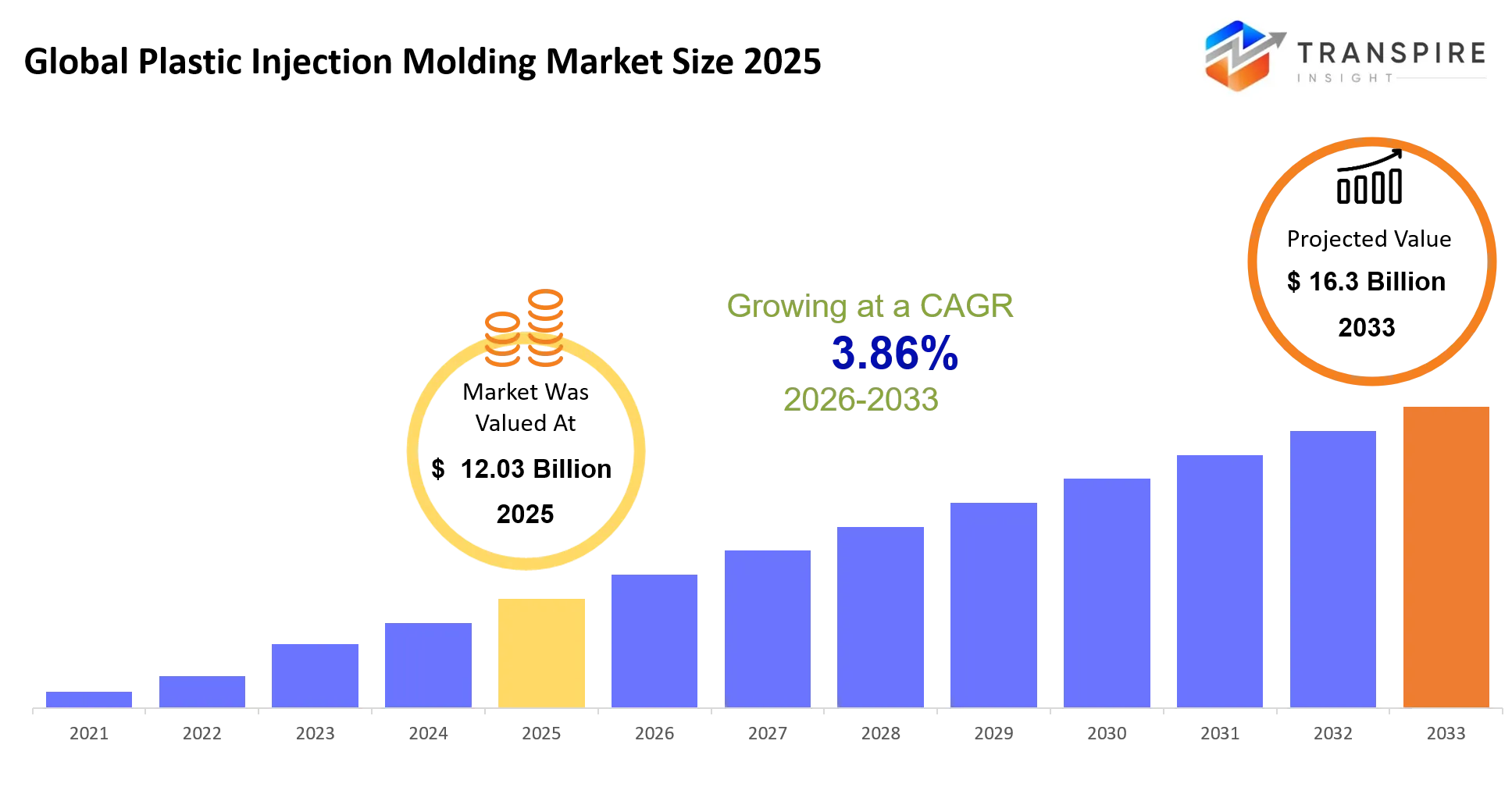
As per Transpire Insight Analysis, the Global Plastic Injection Molding Market size is estimated at USD 12.03 Billion in 2025 and is anticipated to reach USD 16.3 Billion by 2033, growing at a CAGR of 3.86% from 2026 to 2033.
As the manufacturing bedrock of the vehicle, medtech, consumer goods, packaging, and electronic sectors, the plastic injection molding industry designs and manufactures massive amounts of high-precision moulded plastic components. Beyond merely pressing plastic into shapes, high-end injection molding allows for precise, lightweight, durable and intricate components to be created cost-effectively. The last five years have also revealed a market structure undergoing a transition to highly automated and digitally controlled injection molding processes; Smart sensors, robotic arms, process controls and smart data have taken the industry by storm, improving quality consistency and waste output. An automotive push towards lightweight engineering components is also playing a role; as the industry looks for alternatives to metal parts to support fuel efficiency and sustainability mandates, plastic alternatives increase demand for sophisticated injection molding machinery.
Key Global Plastic Injection Molding Market Insights:
Automation, use of lightweight materials and precision manufacturing demands are driving trends in the market across high-growth sectors. What is changing in competitive differentiation is from the volume of production to smart manufacturing capabilities, sustainable materials and advanced molding technologies.
- 57% of the market is occupied by automotive, and manufacturers like ENGEL and ARBURG are further developing automated molding solutions for lightweight vehicle component production.
- Asia Pacific dominates the market with 42% of the market, as Haitian International is expanding its capacity, and smart factory technologies are gaining traction in the region.
- Packaging makes up 15% of applications, prompting businesses to create high-speed molding systems that boost productivity and reduce material waste.
- Precision molding technologies are being invested in by suppliers to make higher tolerance sterile medical parts, accounting for 10% of market demand in the healthcare sector.
- The growth of micro injection molding will continue at 14.8�GR; as a result, equipment makers will be improving their ultra-precision molding for miniaturised electronics and medical devices.
- North America accounts for 28% of the market and is seeing rapid industry 4.0 adoption and AI-driven process monitoring, driving operational modernisation.
- Electronics are 5% of applications and are leading the way for smaller, increasingly accurate molded components that help enable trends towards miniaturisation in the electronics industry.
- Polypropylene is a major material segment, and the use of recycled and bio-based polymers is increasing as a means to achieve sustainability goals and meet regulatory requirements.
What are the Key Drivers, Restraints, and Opportunities in the Global Plastic Injection Molding Market?
Driver:
The acceleration toward lightweight automotive manufacturing represents a significant demand driver that received a further push as regulators implemented tighter standards for fuel efficiency and emissions, coupled with rising EV uptake globally. Manufacturers increasingly use injection-molded plastics parts for automotive dashboards, battery components, interior accessories, automotive connectors and structural components to reduce vehicle weight, enhance vehicle efficiency and limit production costs. The ongoing automotive electrification efforts ensure that suppliers producing highly precise and complicated plastic parts see increased volumes and long-term orders, thus contributing directly to market revenue growth.
In April 2026, the ENGEL Group debuted an integrated automotive production cell featuring its duo 700 two-platen injection molding machine to manufacture B-pillar trims with integrated transparent camera windows. This product launch leverages advanced "clearmelt" technology to integrate surface coating directly into the mold.
Restraint:
The volatility of raw material costs is another key restraint. Major injection molding materials like polypropylene (PP), ABS, polycarbonate, and nylon are all tied into a petrochemical supply chain, highly exposed to crude oil prices, political volatility, and transportation charges. While an ever-present structural issue, large portions of the supply chain cannot quickly transmit these raw materials cost increases to their customers due to a reliance on supply agreements. For small molders this restricts reinvestment.
Opportunity:
The union of cutting-edge manufacturing capabilities and green materials. Investment is shifting toward recycled polymers, bio-plastics, and factory floor-molding capabilities facilitated by the industry, developing new avenues of revenue growth. Micro injection molding, for example, promises strong potential due to increased investment and demand for ultra-small medical devices, sensors, and electronic parts. Growing manufacturing ecosystems throughout Southeast Asia and Mexico are also drawing investment worldwide for companies looking to build new manufacturing centres and serve local needs at scale.
What Has the Impact of Artificial Intelligence Been on the Global Plastic Injection Molding Market?
Plastic injection molders have seen artificial intelligence (AI) bring significant improvements to their molding production, performance and the amount that they’re squeezing from their machinery. Whether on the shop floor or in the server room, AI monitoring of injection molding machine operation is gaining attention from all kinds of injection molders. AI can control molding conditions such as pressure, temperature, cycle time, and melt flow, and adjust machinery settings accordingly so that defects might not have occurred even if no one was at the press machine.
AI use in manufacturing involves the use of predictive maintenance, which relies on machine-learning algorithms that use information from sensors to forecast potential breakdown of moulds, hydraulic equipment, and processing devices to prevent costly system stoppages and save on maintenance. Other AI uses help optimise operations through increasing machine cycles, reducing scrap, and increasing power consumption efficiency. Sophisticated vision-based machines identify dimension or finish imperfections automatically and much faster than manual inspection. The costs of adoption and the technical challenge of implementation continue to limit its uptake. The bulk of medium and small molding businesses rely on older, un-networked equipment incapable of running complex AI, and the use of AI needs standardisation to maximise effectiveness, given disparate machinery. Nevertheless, AI is clearly leading the industry in increasing efficiency.
Key Global Plastic Injection Molding Market Trends:
Its market is moving from mass production to an intelligent level of precision-driven manufacturing environment. Regardless of the industry, investment priorities are changing due to digitalisation, sustainability demands and product miniaturisation.
- Manufacturers have progressed from manual process monitoring to real-time data-driven production control systems.
- The use of collaborative robots has grown, and dependence on labour has been cut, and production stability has been improved.
- Increasingly, automotive suppliers are switching from metal assemblies to engineered plastic parts to assist in vehicle lightweighting.
- Micro injection molding has come into use because of the demand for small devices in the medical and electronic sectors.
- AI, machine learning, and IoT platforms are being adopted in smart factories to optimise molding operations and minimise downtime.
- The multi-material molding technologies are becoming more popular for manufacturing complex and functionally rich products.
- Demand for customised and low-volume products has grown and has stimulated flexible manufacturing systems.
- Due to the need for precision parts that must meet strict regulations, medical-grade molding has expanded.
- Regional production diversification has picked up pace with companies looking for supply-chain resiliency and single-country sourcing models.
Global Plastic Injection Molding Market Segmentation
By Type:
Thermoplastic injection molding captured the largest portion of the total plastic injection molding market due to the flexibility, recyclability and large-scale production applications. Polypropylene, ABS, Polycarbonate and Nylon have maintained dominance with the optimum cost performance characteristics. Other prominent molding type comprises thermoset, gas assist, and liquid injection molding in specialised use cases requiring toughness, light weight and high precision and micro injection molding with 14.8% growth rate during the forecast period.
By Application:
Automotive led the overall plastic injection molding global market share with over 57% in the total share because of the vehicles being light-weighted, rising electric vehicle production, and rising demand for plastic parts to increase efficiency. 15% of the global market share contributed by the packaging to manufacture light, strong and cost-effective containers. 10% share for healthcare to manufacture medical devices. Consumer products (8%), electronics (5%), through the demand for specific small parts, the last 5% was captured by others such as industrial, construction and speciality.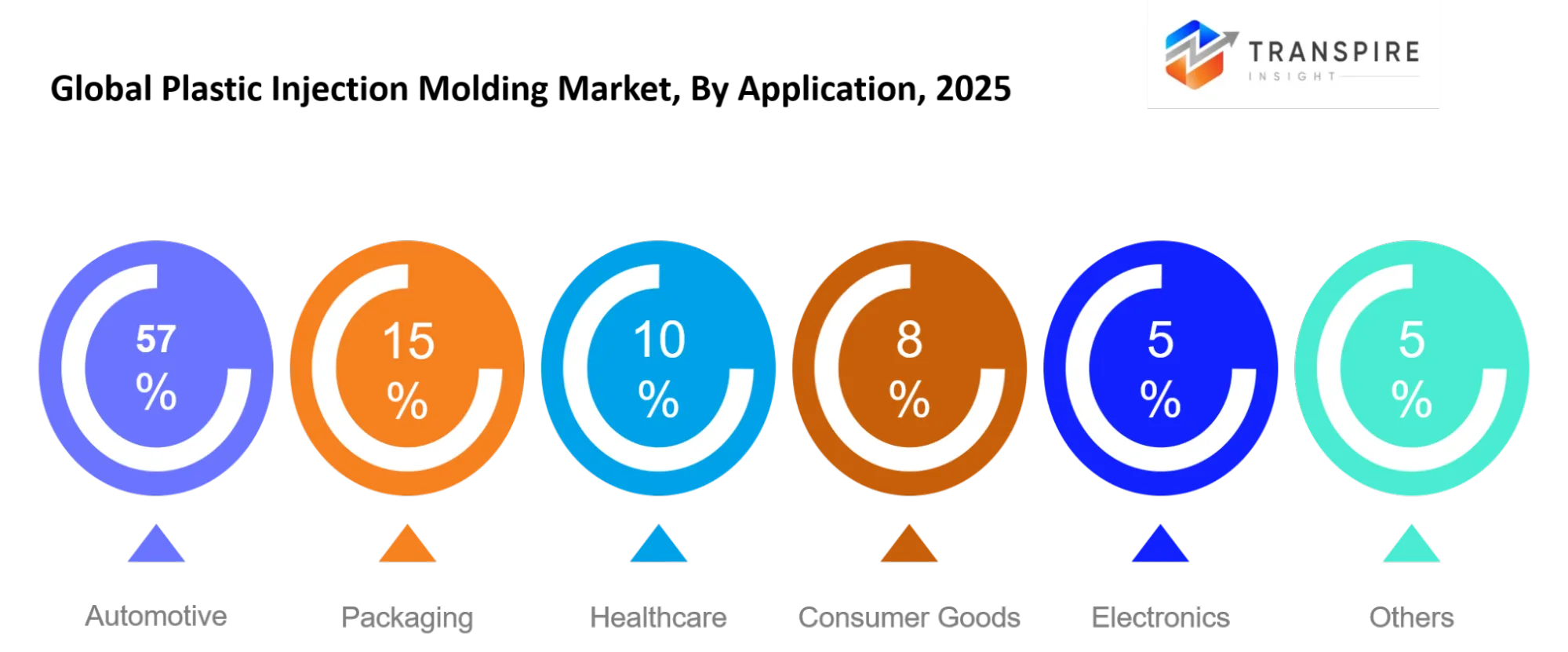
By End-User:
Automotive OEMs are by far the largest customer base, as their conventional and electric vehicle needs for molded plastic parts continue to soar. Demand by packaging companies is large due to high volumes needed and price sensitivity of goods; demand by consumer electronics OEMs is continuing to grow due to the precision molding needs of modern and sleek small products. A growing number of products for use in Healthcare and industrial OEM’s continues to be adopted.
By Materials:
Polypropylene leads the market in terms of its material due to its low weight and high chemical resistance of these polymers. They continue to be the most prevalent polymers with an increased usage attributed to their enhanced durability, strength, resistance to heat and their applicability in the field of high-performance applications.
What are the Key Use Cases Driving the Global Plastic Injection Molding Market?
Driving the market, the most promising use case comes from the automotive industry (57�mand) with injection moulding creating low-cost, lighter interiors, bumpers, battery casings, air ducts and other components contributing to better vehicle efficiency and performance.
Outside of auto, there are packaging applications in high volume molded containers, closures, caps, food-safe packages and a growing need in the healthcare industry, for applications such as syringes, diagnostics, tools, implants and drug delivery devices that necessitate precision injection molding.
The growth in high-tech and micro applications for wearable devices, microconnectors, small medical implants and miniature device componentry.
|
Report Metrics |
Details |
|
Market size value in 2025 |
USD 12.03 Billion |
|
Market size value in 2026 |
USD 12.5 Billion |
|
Revenue forecast in 2033 |
USD 16.3 Billion |
|
Growth rate |
CAGR of 3.86% from 2026 to 2033 |
|
Base year |
2025 |
|
Historical data |
2021 - 2024 |
|
Forecast period |
2026 - 2033 |
|
Report coverage |
Revenue forecast, competitive landscape, growth factors, and trends |
|
Regional scope |
United States; Canada; Mexico; United Kingdom; Germany; France; Italy; Spain; Denmark; Sweden; Norway; China; Japan; India; Australia; South Korea; Thailand; Brazil; Argentina; South Africa; Saudi Arabia; United Arab Emirates |
|
Key company profiled |
Husky Injection Molding, ENGEL, Arburg, Sumitomo Demag, Milacron, KraussMaffei, Nissei Plastic Industrial, Fanuc, Haitian International, Toshiba Machine, Chen Hsong, JSW Plastics, Wittmann Battenfeld, Yizumi, Negri Bossi |
|
Customization scope |
Free report customisation (country, regional & segment scope). Avail customised purchase options to meet your exact research needs. |
|
Report Segmentation |
By Type (Thermoplastic Injection Molding, Thermoset Injection Molding, Gas-assisted Injection Molding, Liquid Silicone Injection Molding, Micro Injection Molding, Others); By Application (Automotive, Packaging, Healthcare, Consumer Goods, Electronics, Others); By End-User (Automotive OEMs, Packaging Companies, Electronics Manufacturers, Others); By Material (Polypropylene, ABS, Polycarbonate, Nylon, Others) |
Which Regions are Driving the Global Plastic Injection Molding Market Growth?
The Asia Pacific region currently accounts for the maximum market share of 42% and is also known to be the hub of global plastic injection molding production owing to huge production capacity, presence of an end-to-end raw material supply chain, and significant demand from the automobile, consumer electronics and goods sectors. The regions of China, Japan, South Korea, and India have been expanding their industrial automation and modernisation initiatives. Public-funded industrial growth initiatives and an ecosystem geared towards exports boost market dominance in the Asia-Pacific region.
Europe captures 22% share with established niche advantages, primarily in technological specialisation, high-value production, excellent quality and sustainable manufacturing adoption. This differs from Asia-Pacific’s scale-driven advantage, but technological know-how ensures continued success. Demand drivers such as automotive, medical devices, and industrial machinery are generally stable throughout the region. The ongoing push toward circular economy solutions and recycled plastic material usage also remains a promising factor for long-term growth.
With a share of 28% of the global market, North America is the fastest-growing market with a CAGR of 13.5%. Due to ongoing reshoring activities, supply-chain de-risking initiatives and investments in smart manufacturing facilities, local production capacities in this region have been strengthened, and the growing manufacturing of EVs, healthcare and further adoption of Industry in this region continue to fuel its expansion. Automation, artificial intelligence, smart manufacturing and high-value-added precision molding offer future market opportunities in the region. In March 2026, Husco announced the acquisition of Michigan-based Mayfair Plastics, Inc. to rapidly scale up its domestic automotive component manufacturing footprint. This corporate acquisition integrates advanced injection molding capabilities directly into Husco's electro-mechanical systems business.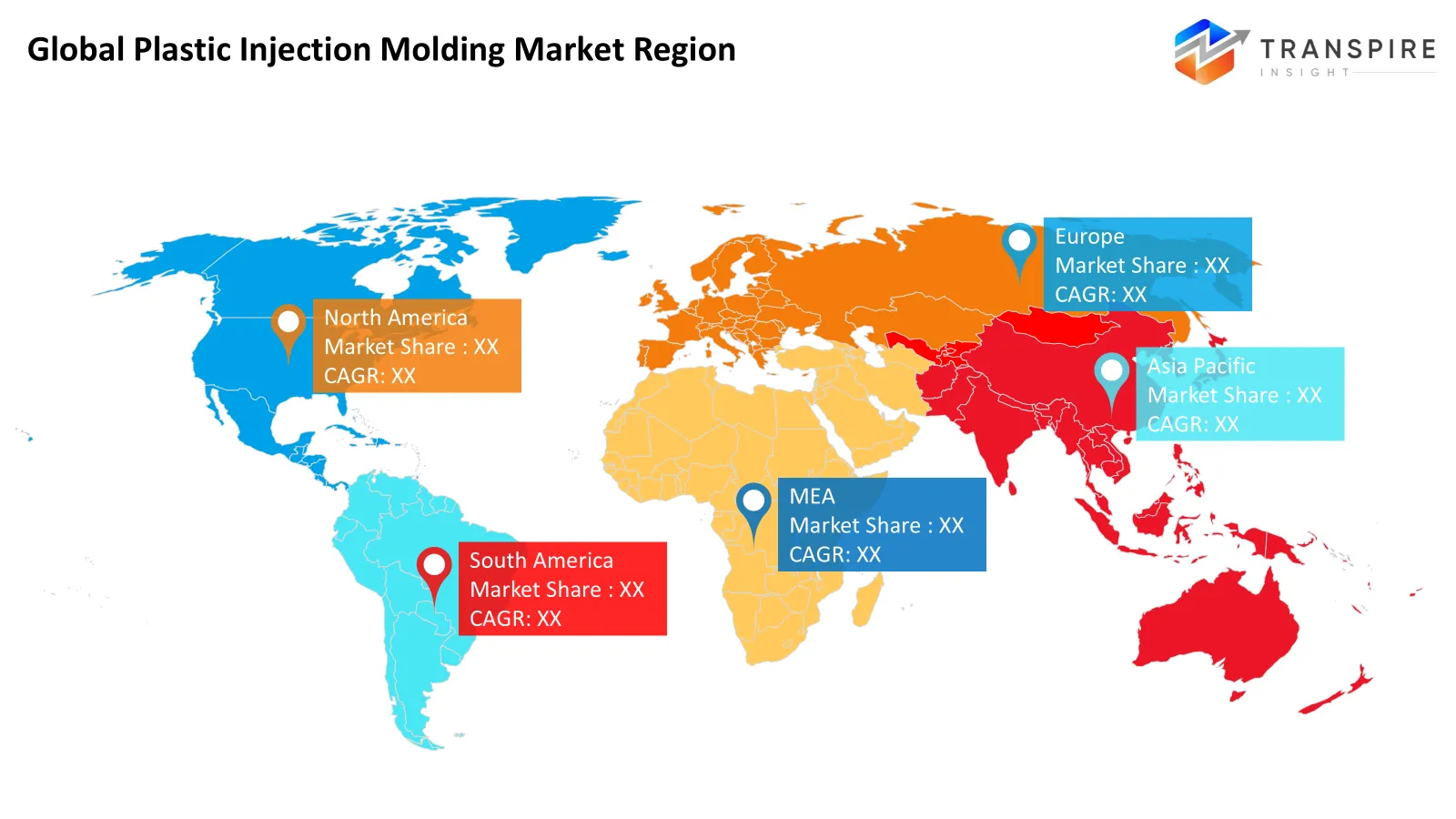
Who are the Key Players in the Global Plastic Injection Molding Market and how do they Compete?
Product competitiveness for the plastics injection molding market revolves around operational effectiveness, technological capacity, materials knowledge and experience, and serving niche application industries. The competition among key companies is shifting from manufacturing volume towards a combination of innovation and automated process capabilities, the application of sophisticated new materials and processes, and an integrated global footprint.
Leading players such as Husky Technologies, ENGEL Group, ARBURG GmbH, Milacron, Sumitomo (SHI) Demag, KraussMaffei, Nissei Plastic Industrial, Sepro Group, Haitian International and Toshiba Machine will continue to adopt a differentiated growth strategy, with Husky Technologies focusing on the application with high-performance systems in packaging industries, ENGEL & ARBURG differentiating from one another in terms of automation technologies, smart factory integration and smart machinery technology with high energy saving level machines. Asian manufacturers include Haitian International and Nissei Plastic Industrial, which combine low-cost manufacturing approaches and the augmentation of technological expertise. Kraussmaffei and Sumitomo (SHI) Demag target high performance, precise engineering with molded component production for automotive, medical and electronics. Several are scaling operations by offering the regionalisation of plants and expanding through strategic partnerships and digitalised service offerings that enhance and provide a lifecycle solution to their customer’s machines.
Key Players are:
- Husky Injection Molding Systems
- ENGEL
- Arburg
- Sumitomo Demag
- Milacron
- KraussMaffei
- Nissei Plastic Industrial
- FANUC
- Haitian International
- Shibaura Machine
- Chen Hsong
- JSW Plastics Machinery
- Wittmann Battenfeld
- Yizumi
- Negri Bossi
Recent Development News
- In March 2026, CoreTech System Co., Ltd. officially released Moldex3D 2026, its next-generation injection molding simulation platform centred around Automation, Optimisation, and Intelligence (A.O.I.). This product launch uses AI-driven simulations to predict filling defects and part warping before production.
- In May 2026, ENGEL Group unveiled its fully autonomous injection molding production cell at the Plast 2026 exhibition in Milan, Italy. This product launch integrates an all-electric e-mac 80 injection molding machine with AI-driven digital assistant systems like iQ weight control.
- In March 2026, Vasantha Group completed the full acquisition of Swiss precision mold design and automation specialist Muller Technology Conthey SA. This acquisition establishes a global footprint for end-to-end injection molding automation and thin-wall packaging solutions.
What Strategic Insights Define the Future of the Global Plastic Injection Molding Market?
The global plastic injection molding industry is trending towards more automated, high-precision and sustainable manufacturing practices. As businesses adopt AI for processes, smart equipment and innovative polymers to raise efficiencies and minimise waste, opportunities will continue to emerge with the growing need for electric vehicle components, health products and miniaturised electronics; meanwhile, micro injection molding, specifically, is projected to grow at a compound annual growth rate (CAGR) of 14.8%. Beyond obvious trends and challenges, another less obvious danger comes from growing regulations and requirements concerning plastic use and disposal that may hike costs or necessitate the use of alternative materials for specific purposes. “Fortunately, new opportunities arise from blending more recycled and plant-based polymers with smart digital solutions to optimise workflows and drive circularity, and manufacturers are well-positioned to capture value from automation, next-generation materials and flexible regional supply chains.”
Key Segmentations are:
By Type
- Thermoplastic Injection Molding
- Thermoset Injection Molding
- Gas-assisted Injection Molding
- Liquid Silicone Injection Molding
- Micro Injection Molding
- Others
By Application
- Automotive
- Packaging
- Healthcare
- Consumer Goods
- Electronics
- Others
By End-User
- Automotive OEMs
- Packaging Companies
- Electronics Manufacturers
- Others
By Material
- Polypropylene
- ABS
- Polycarbonate
- Nylon
- Others
Regional Outlook
North America
- United States
- Canada
- Mexico
Europe
- Germany
- United Kingdom
- France
- Spain
- Italy
- Rest of Europe
Asia Pacific
- Japan
- China
- Australia & New Zealand
- South Korea
- India
- Rest of Asia Pacific
South America
- Brazil
- Argentina
- Rest of South America
Middle East & Africa
- Saudi Arabia
- United Arab Emirates
- South Africa
- Rest of the Middle East & Africa
Frequently Asked Questions
Find quick answers to common questions.
The Global Plastic Injection Molding Market size was valued at USD 12.03 Billion in 2025 and is poised to reach USD 16.3 Billion by 2033, expanding at a 3.86% CAGR.
Key Segments for the Global Plastic Injection Molding Market are By Type (Thermoplastic Injection Molding, Thermoset Injection Molding, Gas-assisted Injection Molding, Liquid Silicone Injection Molding, Micro Injection Molding, Others); By Application (Automotive, Packaging, Healthcare, Consumer Goods, Electronics, Others); By End-User (Automotive OEMs, Packaging Companies, Electronics Manufacturers, Others); By Material (Polypropylene, ABS, Polycarbonate, Nylon, Others).
Growth is primarily driven by rising adoption of lightweight plastic components in automotive manufacturing, increasing electric vehicle production, expansion of medical device manufacturing, and greater deployment of automated injection molding technologies that improve production efficiency and precision.
The Global Market is led by major manufacturers, including Husky Injection Molding, ENGEL, Arburg, Sumitomo Demag, Milacron, KraussMaffei, Nissei Plastic Industrial, Fanuc, Haitian International, Toshiba Machine, Chen Hsong, JSW Plastics, Wittmann Battenfeld, Yizumi, and Negri Bossi.
Asia Pacific, holding 42% of the global market, dominates through its strong manufacturing base, integrated supply chains, large automotive and electronics industries, and continuous industrial investments.
Expanding demand for micro injection molding in medical devices and advanced electronics is creating significant commercial opportunities across high-precision manufacturing applications.
- Husky Injection Molding Systems
- ENGEL
- Arburg
- Sumitomo Demag
- Milacron
- KraussMaffei
- Nissei Plastic Industrial
- FANUC
- Haitian International
- Shibaura Machine
- Chen Hsong
- JSW Plastics Machinery
- Wittmann Battenfeld
- Yizumi
- Negri Bossi
About the Authors

Pankaj Ghogare Patil
I am Pankaj Ghogare Patil, a Senior Research Analyst at Transpire Insight, specializing in the Pharmaceutical, Chemicals & Materials, Healthcare IT, and Biotechnology industry. My expertise lies in conducting comprehensive market research, analyzing industry trends, evaluating competitive landscapes, and translating complex data into actionable insights. At Transpire Insight, I closely follow emerging technologies, regulatory developments, and market innovations to create accurate, well-researched, and informative content that helps businesses and professionals make informed decisions. I am committed to producing credible, evidence-based articles that reflect industry best practices while making technical topics accessible and valuable for a broad audience.

Chakradhar Khansole
Chakradhar serves as the Research Director at Transpire Insight, bringing over 8 years of experience in technology, innovation, and strategic market intelligence. He specializes in transforming complex market data into actionable business insights that enable organizations to make informed, growth-oriented decisions. Recognized for his strategic vision and analytical expertise, Chakradhar leads high-impact research initiatives, delivering comprehensive market assessments, competitive intelligence, and forward-looking industry analysis.
Recently Published Reports
-
Jul 2026
Alopecia Treatment Market
Alopecia Treatment Market Size, Share & Analysis Report By Disease Type (Alopecia Areata, Cicatricial Alopecia, Traction Alopecia, Alopecia Totalis, Androgenetic Alopecia, Alopecia Universalis, and Other Disease Types), By Treatment Type (Topical Treatments, Oral Medications, Injectable Therapies, and Hair Transplantation), By Gender (Male, and Female), By Distribution Channel (Hospitals and Clinics, Retail Pharmacies, and Online Retailers), and Geography (North America, Europe, Asia-Pacific, Middle East and Africa, South and Central America), 2021 - 2031
-
Jul 2026
Medical Ultrasound Probe Market
Medical Ultrasound Probe Market Size, Share & Analysis Report By Type (Linear Type, Convex Type, Endocavitary Probe, Phased Array/Cardiac Probe, Transesophageal (TEE) Probe, and Others), By Application (Ophthalmology, Cardiology, Musculoskeletal, Oncology, Obstetrics & Gynecology, General Imaging, and Others), By End User (Hospitals & Clinics, Diagnostic Centers, Ambulatory Surgical Centers, and Others), and Geography (North America, Europe, Asia-Pacific, Middle East and Africa, South and Central America), 2021 – 2031
-
May 2026
Biosimilars Market
Biosimilars Market By Product Type (Monoclonal Antibodies, Recombinant Hormones, Erythropoietin, G-CSF, Others), By Indication (Oncology, Autoimmune Diseases, Blood Disorders, Diabetes, Others), By Manufacturing Type (In-House Manufacturing, Contract Manufacturing), By Distribution Channel (Hospital Pharmacies, Retail Pharmacies, Online Pharmacies), By Industry Analysis, Size, Share, Growth, Trends, and Forecasts 2021-2033
-
Apr 2026
Gastrointestinal Endoscopy Market
Gastrointestinal Endoscopy Market By Type (Rigid Gastrointestinal Endoscope, Flexible Gastrointestinal Endoscopes, Disposable Gastrointestinal Endoscope), By Procedure Type (Colonoscopy, Gastroscopy, Duodenoscopy, Enteroscopy, Flexible Sigmoidoscopy, Others), By Application (Diagnosis, Treatment), By End-Users (Hospitals, Ambulatory Surgical Centers, Specialty Clinics, Laboratories, Others), By Industry Analysis, Size, Share, Growth, Trends, and Forecasts 2021-2033