
South Korea Thermoplastic Elastomer Market Size & Forecast:
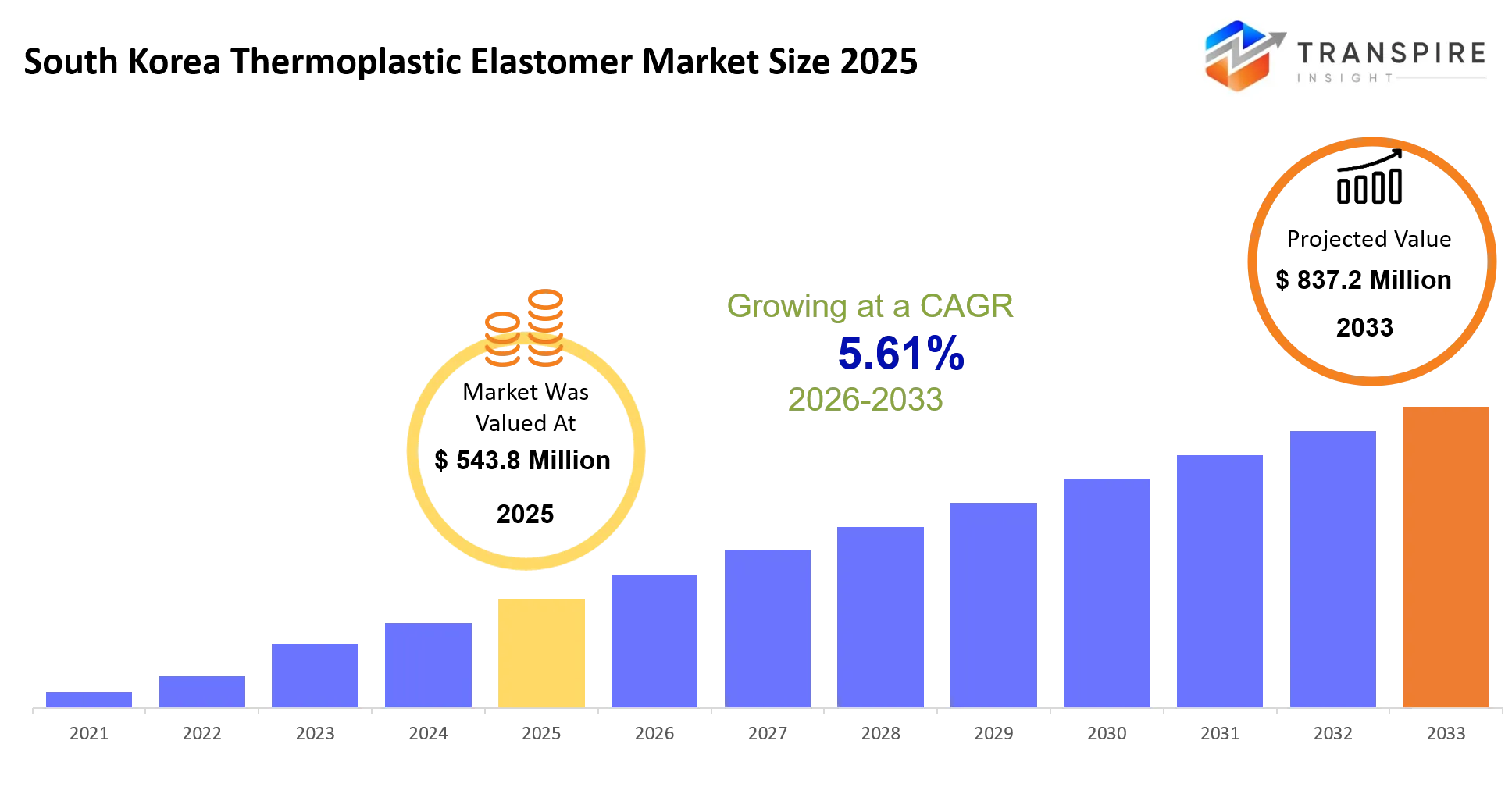
- South Korea Thermoplastic Elastomer Market Size 2025: USD 543.8 Million
- South Korea Thermoplastic Elastomer Market Size 2033: USD 837.2 Million
- South Korea Thermoplastic Elastomer Market CAGR: 5.61%
- South Korea Thermoplastic Elastomer Market Segments: By Type (SBC, TPU, TPO, TPV, Others); By Application (Automotive, Footwear, Medical, Consumer Goods, Others); By End User (Automotive, Healthcare, Industrial, Others)
South Korea Thermoplastic Elastomer Market Summary
The South Korea Thermoplastic Elastomer Market was valued at USD 543.8 Million in 2025. It is forecast to reach USD 837.2 Million by 2033. That is a CAGR of 5.61% over the period.
In South Korea, thermoplastic elastomers are often used for sealing, cushioning, and guarding components across automotive lines, marine setups, industrial machinery, and even electronic housings where parts have to bend under strain while still keeping a long service life. Over the last 3 to 5 years, the market seems to be shifting in a structural way because electric vehicle manufacturing and high performance electronics have been pushing designers to trade heavier rubber and PVC bits for recyclable, lighter TPE grades. And yeah, this change is not only about looks, it is more about the engineering checklist weight reduction, thermal stability, and design flexibility when systems get smaller and tighter.
At the same time, COVID-19 related supply chain problems and petrochemical price swings made manufacturers lean harder on domestic sourcing and smarter material substitution plans. So, Korean compounders sped up capacity growth and moved toward more premium formulations that are tuned for EV seals, wire insulation, and vibration mitigation. Taken together, these pressures are changing how adoption happens, and they’re also reinforcing a localized demand that is performance first across the different industrial circles.
Key Market Insights
- The demand from EV light weighting for using TPE over rubber for seals, gaskets, and flexible car components are driving the South Korean TPE Market.
- Shrinking trend of electron devices, leading to increased usage of high-precision TPE compounds which are characterized with thermal & chemical resistance are further bolstering demand.
- Increase in local capacity addition by compounders is helping to reduce reliance on imported TPE and normalizing the raw material supply chains post-2020 disruptions.
- Sustainability regulations by Korea will increase usage of recyclable TPE materials for automotive, electronics and consumer goods.
- SBCs are forecast to hold the largest share by 2025 (almost 38% share) owing to its cost-effective nature and processing flexibility.
- TPU to hold the largest CAGR from 2025 to 2030 with EV cables and protective coating for industrial equipment to fuel the growth.
- Automotive applications are predicted to hold approximately 45% share through the analysis period on the back of seals and interiors application in EV.
- Electronics and electrical end-use segment to exhibit largest CAGR owing to increased demand for semiconductor and electronic product enclosures.
- Gyeonggi-do to be the leading production hub through the analysis period (around 52% share) due to well-established clusters of automotive and electronics manufacturing facilities.
- Ulsan is poised to be the highest growing region due to integration of petrochemicals and investments on the downstream polymer transformation.
What are the Key Drivers, Restraints, and Opportunities in the South Korea Thermoplastic Elastomer Market?
The main driver is the rapid pace of electrification of South Korea's vehicle manufacturing fleet, calling for materials that are lighter, more flexible, and thermally robust. The adoption of EV platforms as the core architecture over internal combustion engines has prompted the material switch toward thermoplastic elastomers for components such as sealing systems, wire and cable insulation and vibration damping components. This inherently leads to increased consumption of the raw material on per vehicle basis while enhancing OEMs (Hyundai, Kia) design effectiveness. Consequently revenue growth is becoming more correlated with EV manufacturing volumes and the speed of platform revision cycles rather than the traditional after-market requirements.
The biggest challenge is the fluctuation of input prices in petrochemical feedstock, primarily styrene and propylene derivatives which are used for the manufacture of TPEs. It's a structural impediment, as South Korea remains highly dependent on world oil prices and imported, index-linked resin prices. The margin compressions for the producers following increases in input costs constrain the room for sustained pricing agreements, which further impede large scale ordering decisions by the middle tier industrial buyers.
The main opportunity stems from bio-based and recyclable TPEs development as per the carbon neutral trajectory of Korea. R&D and further development of polymers at Ulsan and Daesan petrochemical centers are enabling the manufacturing of low-carbon elastomer grades. For instance, the usage of bio-feedstock TPU in EV charging cable insulation would create novel, higher-value export streams and enhance South Korea's presence in advanced polymers supply chains.
What Has the Impact of Artificial Intelligence Been on the South Korea Thermoplastic Elastomer Market?
The integration of artificial intelligence in the thermoplastic elastomer production process has led to efficiency gains in the compounding, extrusion and quality control at South Korea's various polymer production plants. The AI enabled sensors are applied for the real-time monitoring of melt viscosity, temperature stability, extrusion pressure and subsequently helped decrease the number of production flaws for high precision TPE Grades that are used in automotive and electronic manufacturing applications. Production consistency has increased along with a decrease in material waste for high-volume production lots.
Predictive analysis models have been applied for predicting machine deterioration in twin-screw extruders and injection molding processes for preventative maintenance planning before a system failure can be incurred. The system has increased machine uptime through a decrease in production interruptions and production output stability. AI led process optimization has been implemented that resulted in decreased power consumption at compounding plants through dynamic management of heat zones and cooling cycles for energy efficiency.
High integration expenses and a lack of comprehensive data for training AI models have somewhat limited its adoption in the polymer industry for understanding polymer behavior with varying conditions in production processes. Many medium and small sized compounders utilize Manual Calibration because AI models fail when facing material variation among different raw material suppliers. A Lack of communication links for old manufacturing plants has inhibited the widespread integration of the system especially at industrial zones away from Korean petro-chemicals industrial parks.
Key Market Trends
- A marked shift to EV induced light automotive component substitution among OEM supply chains in South Korea TPE Market between 2020-2025.
- Increased domestic TPE compounding scale following post-2021 supply chain disruptions by a near 18 percent decrease in reliance upon imported styrenic elastomers.
- Thermoplastic polyurethane consumption outpacing SBC from 2022 due to EV charging cables, as well as industrial insulation applications.
- Manufacturers in the electronics sector have increasingly adopted TPEs to replace hard plastics since 2020 for thermal resistance in small semiconductor housing.
- Styrenic block copolymer market share declined marginally since 2023 with introduction of bio-based elastomer pilots among Korean compounders.
- TPE production capacity increased by approximately 15 percent between 2021-2025 at the manufacturing cluster in Gyeonggi-do; ahead of smaller regional plants.
- Input costs in TPEs surged significantly due to the rise in petrochemicals in 2022, pushing compounders to adopt long term contracts and vertical integration models.
- AI induced process control implementation since 2023 helped boost compounding efficiency, alongside a fall in defect rates within South Korean TPE plants.
South Korea Thermoplastic Elastomer Market Segmentation
By Type :
The demand based on type is migrating towards high-performance types within South Korea's Thermoplastic Elastomer Market owing to designing of EV's and electronics, requiring materials with better flexibility and heat resistance. Various industrial application uses are also being driven by traditional elastomer substitution.
While SBC continues to be one of the popular materials owing to cost-effectiveness and easier processing for bulk manufacturing, TPU is expanding with usage of it in EV cables, protective coating and TPO and TPV is used in various sealing applications and other types like various specialty grades for medical or industrial use.
By Application :
Automotive use is anticipated to be the leading segment in South Korea's Thermoplastic Elastomer Market as the utilization of EV platforms increases and the auto industry emphasizes lightweight sealing, sound dampening, vibration control applications by reducing the use of heavier traditional elastomers in automobiles.
The footwear sector is anticipated to grow with demand in soft-bottom and comfortable footwear and medical and consumer sectors use is gradually increasing for tubing and soft-touch applications respectively, though other sectors witness a limited but stable demand for various small industries.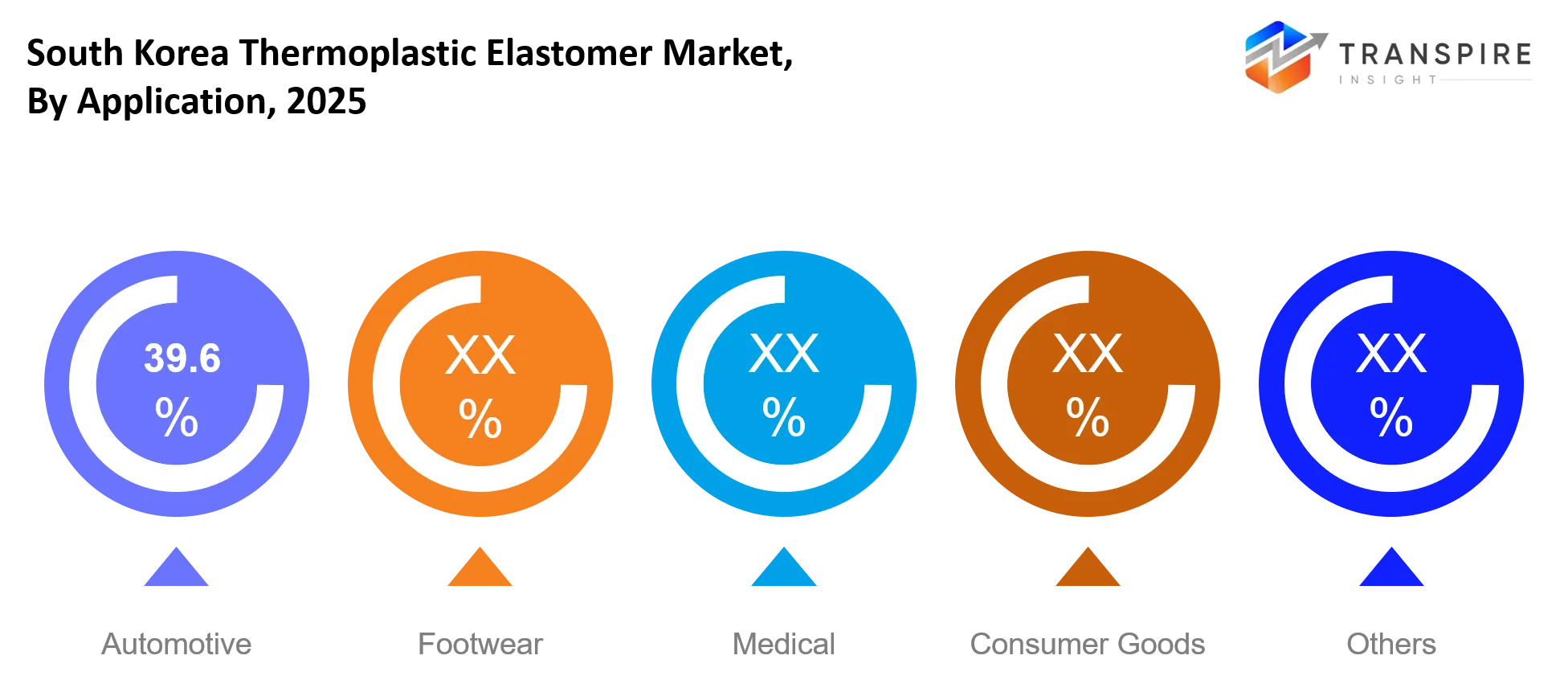
By End User :
South Korea Thermoplastic Elastomer Market: The automotive end-users account for the largest share of the market as OEMs use the lightweight materials in the designs of their electric and hybrid vehicles platforms enabling efficient use of energy and adding value by increasing flexibility in designs of component systems. Collaboration between suppliers led to the standardization of the materials.
The medical devices applications of the thermoplastic elastomers are driven by increasing use in medical devices demanding flexibility and adherence to safety standards; the industrial end-users utilize it for insulation purposes and vibration absorption in industrial machinery. Other end-users segments are still scattered but contribute stable demand in their niche segments.
What are the Key Use Cases Driving the South Korea Thermoplastic Elastomer Market?
The automotive industry is the largest end-user industry driving growth in the South Korea Thermoplastic Elastomer Market. Electric and hybrid vehicle platforms are utilizing thermoplastic elastomers in the production of flexible sealing systems, vibration dampers and light-weighting interior components. These materials contribute to energy efficiency and the flexibility in vehicle designs, which are crucial for OEMs seeking higher EV performance and extended battery life. Passenger car manufacturers are experiencing the highest demand as they shift away from traditional rubber and explore thermoplastic elastomers for better durability and assembly process.
The second largest end-user industries are healthcare and consumer electronics. Medical devices manufacturers are employing thermoplastic elastomers in flexible tubings, seals and soft touch components that are required to be safe and chemically resistant. The consumer electronics industry uses these materials for compactly-sized housings and insulating layers which help manage heat and mechanical stress within high-density electronics. Both industries will drive growth in the industrial and consumer goods sector.
The upcoming applications will include EV charging equipment and intelligent industrial components. In charging cable insulations and protection elements for connectors for electric vehicles will receive high attention owing to the increasing penetration rate of EVs in Korea. For example, it is now anticipated for automatic machines and systems used in smart manufacturing facilities to employ thermoplastic elastomers as a flexible shielding cover and precision component for movement which would require high security and performance specifications.
|
Report Metrics |
Details |
|
Market size value in 2025 |
USD 543.8 Million |
|
Market size value in 2026 |
USD 571.5 Million |
|
Revenue forecast in 2033 |
USD 837.2 Million |
|
Growth rate |
CAGR of 5.61% from 2026 to 2033 |
|
Base year |
2025 |
|
Historical data |
2021 - 2024 |
|
Forecast period |
2026 - 2033 |
|
Report coverage |
Revenue forecast, competitive landscape, growth factors, and trends |
|
Country scope |
South Korea |
|
Key company profiled |
Kraton, BASF, Dow, ExxonMobil, LG Chem, Dynasol, Covestro, Mitsui Chemicals, Asahi Kasei, Teknor Apex, Avient, Celanese, Lubrizol, RTP Company, Kumho Petrochemical |
|
Customization scope |
Free report customization (country, regional & segment scope). Avail customized purchase options to meet your exact research needs. |
|
Report Segmentation |
By Type (SBC, TPU, TPO, TPV, Others); By Application (Automotive, Footwear, Medical, Consumer Goods, Others); By End User (Automotive, Healthcare, Industrial, Others) |
Which Regions are Driving the South Korea Thermoplastic Elastomer Market Growth?
Gyeonggi-do remains the leading region of the South Korean Thermoplastic Elastomer Market due to the high concentration of automotive OEMs, electronics manufacturers and advanced component suppliers within the region. Due to its proximity to major R&D facilities that speed up testing materials and rapidly prototype EV platform materials the region encourages consistent investment due to high value manufacturing policy support. These facilities expedite commercialization for new TPE grades over other regions of South Korea.
Yeosu and Ulsan stand as stable secondary hubs due to their robust petrochemical integration and lengthy refining history. These two cities' strengths are rooted in upstream material feedstock availability and production consistency instead of design specific demand, allowing them to provide upstream raw and intermediate polymers to domestic converters on a steady basis, while protecting the nation from the effects of global prices.
Busan and surrounding southeastern industrial districts display the fastest growth rate within recent years due to port-integrated logistics efficiency and increasing export-oriented manufacturing. Its recent upgrading of the manufacturing environment and foreign direct investment into advanced materials production has accelerated its capacity within recent years as the area's manufacturers continue to move their adaptable polymer production closer to ports as a function of export activities. Between 2026 and 2033 this new movement will drive new entry opportunities for suppliers who cater to export-oriented value chains and will build diverse production capacity.
Who are the Key Players in the South Korea Thermoplastic Elastomer Market and How Do They Compete?
\The South Korean Thermoplastic Elastomer Market has a moderately concentrated competitive structure. Global chemical giants compete alongside domestically robust polymer suppliers, and competition centers on material innovation and EV grade performance and local availability over pure pricing of material. Long-term OEM contracts defend market share from the established suppliers, while newer entrants use specialized formulations to quickly meet customer demands from the electronics and auto sector.
LG Chem will bolster its share by utilizing cost-efficient production on a large scale while deepening their ties with domestic auto manufacturers. The supplier provides OEM specific, specialized EV grade, thermoplastic elastomer materials that utilize thermoplastic elastomers for insulation and sealing purposes. The company uses continued investment in its R&D facilities and focuses on the creation of recyclable polymers and joint projects with South Korean OEMs.
BASF gains share through innovative materials, focusing on a strong history of high performance TPEs that are incredibly durable and resistant to chemicals, while Dow focuses on application specific materials, particularly for its uses in flexible electronics and durable industrial insulating products. Arkema expands using specialty TPU developments while collaborating strategically with regional converters, and Mitsubishi Chemical Group maintains its position through highly specialized engineering plastics as well as a focus on supplyingEV components.
Company List
- Kraton
- BASF
- Dow
- ExxonMobil
- LG Chem
- Dynasol
- Covestro
- Mitsui Chemicals
- Asahi Kasei
- Teknor Apex
- Avient
- Celanese
- Lubrizol
- RTP Company
- Kumho Petrochemical
Recent Development News
In April 2026, BASF announced expansion of its thermoplastic elastomer innovation program in Asia-Pacific, strengthening development of EV-grade TPU materials for automotive sealing systems and improving localized supply capabilities for Korean manufacturers.
Source https://www.basf.com/
In January 2026, Dow entered a strategic collaboration with regional Korean converters to enhance application development of styrenic block copolymer solutions for consumer electronics and industrial flexibility components, improving processing efficiency and material customization. Source https://www.dow.com/
What Strategic Insights Define the Future of the South Korea Thermoplastic Elastomer Market?
Structurally, the South Korea Thermoplastic elastomer market is now transitioning toward a performance-intensive, EV-specialty and electronics-grade portfolio, as its manufacturing infrastructure looks to shed weight, consume less energy, and integrate its component base. In the next 5-7 years, volumes will rise at a pace determined more by specification intensification than mere volume expansion, as advanced electronic and automobile applications that hinge on high material performance standards increasingly look to TPEs. This trend is primarily spurred by expanding EV penetration and continuing reduction in the size of industrial components.
A largely unnoticed risk stems from material imports derived from petrochemical feedstocks (i.e., raw materials are imports) – exposing the TPE market to price shock and margin erosion even with resilient end-market demand. Increased dominance of a select few integrated polymer producers among other manufacturers is also beginning to pose a constraint on price flexibility of downstream converters.
A burgeoning opportunity comes in the use of bio-based TPEs for the EV charging infrastructure and reusable mobility components in line with the strengthening carbon neutrality efforts in Korea. Investing in on-ground R&D cooperation with automobile OEM and electronics companies to co-develop application-specific formulations is recommended to secure long-term supply contracts and mitigate substitution risks.
South Korea Thermoplastic Elastomer Market Report Segmentation
By Type
- SBC
- TPU
- TPO
- TPV
By Application
- Automotive
- Footwear
- Medical
- Consumer Goods
By End User
- Automotive
- Healthcare
- Industrial
Frequently Asked Questions
Find quick answers to common questions.
The South Korea Thermoplastic Elastomer Market size is USD 837.2 Million in 2033.
Key Segments for the South Korea Thermoplastic Elastomer Market are By Type (SBC, TPU, TPO, TPV, Others); By Application (Automotive, Footwear, Medical, Consumer Goods, Others); By End User (Automotive, Healthcare, Industrial, Others).
Major South Korea Thermoplastic Elastomer Market Players are Kraton, BASF, Dow, ExxonMobil, LG Chem, Dynasol, Covestro, Mitsui Chemicals, Asahi Kasei, Teknor Apex, Avient, Celanese, Lubrizol, RTP Company, Kumho Petrochemical.
The Current South Korea Thermoplastic Elastomer Market size is USD 543.8 Million in 2025.
The South Korea Thermoplastic Elastomer Market CAGR is 5.61% from 2026 to 2033.
- Kraton
- BASF
- Dow
- ExxonMobil
- LG Chem
- Dynasol
- Covestro
- Mitsui Chemicals
- Asahi Kasei
- Teknor Apex
- Avient
- Celanese
- Lubrizol
- RTP Company
- Kumho Petrochemical
About the Authors

Pankaj Ghogare Patil
I am Pankaj Ghogare Patil, a Senior Research Analyst at Transpire Insight, specializing in the Pharmaceutical, Chemicals & Materials, Healthcare IT, and Biotechnology industry. My expertise lies in conducting comprehensive market research, analyzing industry trends, evaluating competitive landscapes, and translating complex data into actionable insights. At Transpire Insight, I closely follow emerging technologies, regulatory developments, and market innovations to create accurate, well-researched, and informative content that helps businesses and professionals make informed decisions. I am committed to producing credible, evidence-based articles that reflect industry best practices while making technical topics accessible and valuable for a broad audience.

Chakradhar Khansole
Chakradhar serves as the Research Director at Transpire Insight, bringing over 8 years of experience in technology, innovation, and strategic market intelligence. He specializes in transforming complex market data into actionable business insights that enable organizations to make informed, growth-oriented decisions. Recognized for his strategic vision and analytical expertise, Chakradhar leads high-impact research initiatives, delivering comprehensive market assessments, competitive intelligence, and forward-looking industry analysis.
Recently Published Reports
-
May 2026
Healthcare Polymer Packaging Market
Healthcare Polymer Packaging Market Size, Share & Analysis Report By Packaging Type (Syringes, IV Bottles and Pouches, Clamshells, Blisters, Bottles & Jars, Containers, Tubes, IV Parental Packaging, Others), By Type (Regulated, Non-regulated), By Polymer Type (LDPE (Low-Density Polyethylene), HDPE (High-Density Polyethylene), Homo-polymer (Homo), Random Copolymer (Random), Block Copolymer (Block), PET, Polystyrene, Polyvinyl Chloride, Polyamide/EVOH, Others), and Geography (North America, Europe, Asia-Pacific, Middle East and Africa, South and Central America), 2021 - 2031
-
Apr 2026
Hydrophilic Tape (Waterstop) Market
Hydrophilic Tape (Waterstop) Market Size, Share & Analysis Report By Type (Bentonite-Based Hydrophilic Tape, Rubber-Based Hydrophilic Tape), By Application (Residential Buildings, Commercial Buildings, Infrastructure Projects), and Geography (North America, Europe, Asia-Pacific, Middle East and Africa, South and Central America), 2021 - 2031
-
Apr 2026
Metalens Market
Metalens Market Size, Share & Analysis Report By Type (Visible Light Metalens, and Infrared Metalens), By Application (Consumer Electronics, Automotive Electronics, Industrial, Medical, and Others), and Geography (North America, Europe, Asia-Pacific, Middle East and Africa, South and Central America), 2021 - 2031
-
Apr 2026
PBT Resin Market
PBT Resin Market Size, Share & Analysis Report By Type (Reinforced PBT Resin, Unreinforced PBT Resin), By Processing Method (Injection Molding, Extrusion, Blow Molding, Others), By End-User (Automotive, Electrical & Electronics, Consumer Appliances, Industrial Machinery, Medical Devices, Packaging, Others), and Geography (North America, Europe, Asia-Pacific, Middle East and Africa, South and Central America), 2021 - 2031