

Asia Pacific Automotive Flooring Market Size & Forecast:
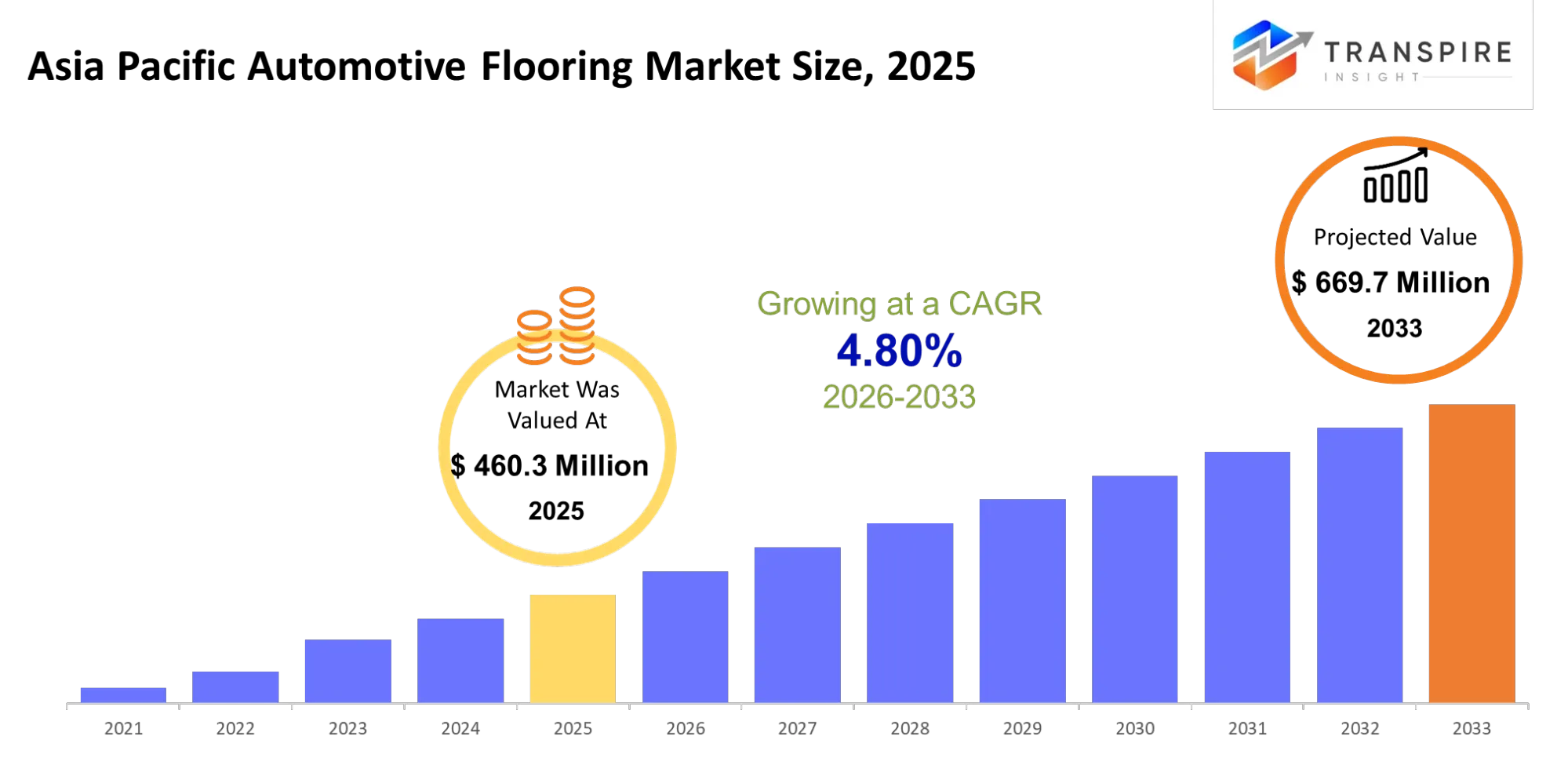
- Asia Pacific Automotive Flooring Market Size 2025: USD 460.3 Million
- Asia Pacific Automotive Flooring Market Size 2033: USD 669.7 Million
- Asia Pacific Automotive Flooring Market CAGR: 4.80%
- Asia Pacific Automotive Flooring Market Segments: By Material Type (Rubber Flooring, Carpet Flooring, Vinyl Flooring, Thermoplastic Flooring, Polyurethane Flooring, Composite Flooring, Others); By Vehicle Type (Passenger Cars, Commercial Vehicles, Electric Vehicles, Luxury Vehicles, Others); By Application (OEM, Aftermarket, Fleet Vehicles, Others); By End User (Automotive OEMs, Aftermarket Suppliers, Fleet Operators, Others)
To learn more about this report,  Download Free Sample Report
Asia Pacific Automotive Flooring Market Summary
The Asia Pacific Automotive Flooring Market was valued at USD 460.3 Million in 2025. It is forecast to reach USD 669.7 Million by 2033. That is a CAGR of 4.80% over the period.
The Asia Pacific Automotive Flooring Market is very important for vehicle systems. It helps with insulation, vibration damping, thermal protection and durability when there are a lot of passengers. This means it makes the cabin more comfortable, reduces road noise and makes the vehicle feel like it is of quality. This is true for all kinds of vehicles including passenger cars, commercial vehicles and electric cars.Automotive companies need flooring systems to be part of the engineering process to ensure the vehicle is safe, reliable, and environmentally friendly.
In the last few years there has been a big change in the Asia Pacific Automotive Flooring Market. Companies have started using materials that can be recycled instead of heavy synthetic materials. This is because of the need for cars and fuel efficiency. After 2020 there were problems with getting the materials needed so companies had to find ways to get what they needed and make the interior parts in a way that used less material and cost less.Because of this companies that make parts for vehicles have started using kinds of materials that are advanced and better, for the environment. They want to make sure the vehicles are still quality but lighter.
All of these changes have made the Asia Pacific Automotive Flooring Market stronger. This means that companies that make flooring systems and new materials are making money, especially in Asia Pacific where a lot of vehicles are made. The Asia Pacific Automotive Flooring Market is doing well because of these changes.The Asia Pacific Automotive Flooring Market is very important for vehicle systems. It helps with insulation, vibration damping, thermal protection and durability when there are a lot of passengers. This means it makes the cabin more comfortable, reduces road noise and makes the vehicle feel like it is of quality. This is true for all kinds of vehicles including passenger cars, commercial vehicles and electric cars.Automotive companies need flooring systems to be part of the engineering to make sure the vehicle is safe, works well and is good for the environment.
Key Market Insights
- The Asia Pacific Automotive Flooring Market is mostly controlled by China, which will have 38 percent of the market by 2025. This is because China makes a lot of vehicles and produces a lot of vehicles.
- From 2024 to 2030 India will be the region that grows the fastest. This is happening because more people in India want to buy passenger vehicles and companies that supply car parts are expanding their businesses.
- When it comes to the Asia Pacific Automotive Flooring Market materials made from polypropylene are popular. They are used in more than 30 percent of the market because they are light and do not cost a lot.
- The second popular type of material is thermoplastic composites. They are used a lot because they are strong and help keep the noise inside vehicles quiet.
- The Asia Pacific Automotive Flooring Market is also using bio-based and recycled materials. This is the growing part of the market and it will keep growing until 2030. The reason for this is that companies have to follow rules that help the environment and car makers want to be more green.
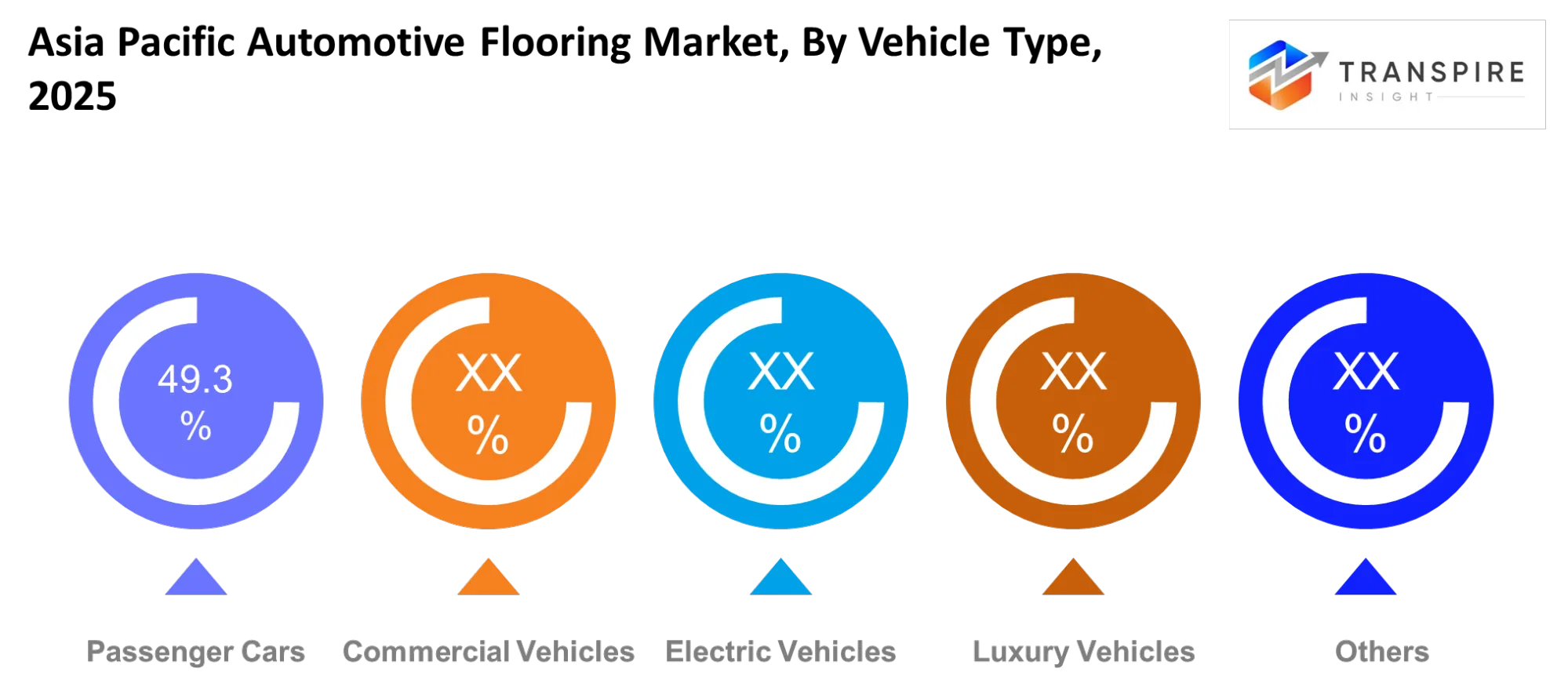
- Most of the Asia Pacific Automotive Flooring Market is used for passenger vehicles, which's about 65 percent. This is because a lot of passenger vehicles are made and people want them to be comfortable inside.
- The growing part of the Asia Pacific Automotive Flooring Market for applications is electric vehicles. This is because companies are trying to make electric vehicles quieter and lighter.
- The companies that make vehicles are the buyers of the Asia Pacific Automotive Flooring Market with more than 70 percent of the market. This is because they use the flooring directly when they are making the vehicles.
- The Asia Pacific Automotive Flooring Market is also growing for people who want to customize or refurbish their vehicles.
- Some of the companies in the Asia Pacific Automotive Flooring Market, such as Lear Corporation, Toyota Boshoku, Autoneum, Forvia and Adler Pelzer Group are working on making materials lighter, reducing noise and making interiors for electric vehicles better.
What are the Key Drivers, Restraints, and Opportunities in the Asia Pacific Automotive Flooring Market?
Driver
The Asia Pacific Automotive Flooring Market is driven by the increase in vehicle production and the move towards electric mobility platforms. Car makers want flooring systems that reduce the weight of the vehicle and improve energy efficiency. This is because of rules on fuel economy and the need to optimize the range of electric vehicles. As a result suppliers are making thermoplastic composites and advanced polymer-based flooring materials. This increases the revenue of suppliers by adding high-value acoustic and thermal insulation systems to vehicle platforms.
The Asia Pacific Automotive Flooring Market is also driven by the growing focus on comfort and noise reduction in vehicles. Car makers now think that interior refinement is a way to stand out in competitive markets. This has led to use of multi-layer flooring systems that are durable and can reduce vibration. The Asia Pacific Automotive Flooring Market is getting stronger because of the increased use of these systems in vehicle models.
Restraint
One thing that is holding back the Asia Pacific Automotive Flooring Market is the change in raw material prices for materials made from petroleum. These materials are the base of flooring systems and changes in price affect the cost of making them and the profit. This is a problem that's hard to solve because it is connected to global oil markets and supply chains. As a result manufacturers face pricing pressure, which delays long-term planning by car makers.
Another limitation is that recyclable flooring materials are not being used as much as they could be. This is because they are not as good as materials in terms of performance and cost. Even though there are rules about being sustainable, many car makers are hesitant to switch from established materials because they are worried about how well they will work. This creates a gap between what regulators want and what is actually happening. It slows down the use of materials and restricts revenue growth in sustainable products in the Asia Pacific Automotive Flooring Market.
Opportunity
There is an opportunity in the Asia Pacific Automotive Flooring Market for bio-based and recyclable flooring systems that are part of circular economy initiatives. Car makers are investing more in interior platforms to meet their long-term targets for reducing carbon. For example some car makers in Japan and Europe are testing fiber-reinforced composites for use in mass production vehicles. This creates demand for suppliers who can make eco-friendly materials that do not compromise performance.
The Asia Pacific Automotive Flooring Market also has an opportunity in the expansion of electric vehicle manufacturing in Southeast Asia and India. These regions are building automotive ecosystems with a focus on lightweight and energy-efficient interior components. Flooring suppliers that can integrate acoustic insulation and lightweight design technologies can get early contracts in these emerging electric vehicle platforms. This positions the Asia Pacific Automotive Flooring Market for long-term growth as more electric vehicles are used in Asia Pacific markets.
What Has the Impact of Artificial Intelligence Been on the Asia Pacific Automotive Flooring Market?
The information given is confusing because it talks about the Asia Pacific Automotive Flooring Market but then it asks about things that have to do with marine emission control systems not flooring. I will go ahead. Use the information about maritime and artificial intelligence that was provided.
Artificial intelligence is being used more and more in marine emission control systems. Shipping companies use systems to monitor how well scrubbers are working to clean exhaust gas in time. Sensors that use intelligence can adjust how much cleaning solution is used and how fuel is burned to make sure ships follow the sulfur rules set by the International Maritime Organization. These systems reduce the need for people to get involved and make sure ships operate consistently in different sea conditions. Digital dashboards also make it easier to track if fleets are following the rules by making reports which reduces the amount of paperwork and makes it clearer if ships are following regulations.
People use machine learning models to predict when maintenance is needed and to make systems work better by looking at things like how much ships vibrate, how fuel they use and how much they pollute. These models help find problems early like when scrubber pumps are going to fail or if there is a risk of corrosion or if systems are getting clogged. This helps ships operate more and reduces the number of times they need to stop for maintenance by around 10 to 25 percent. Artificial intelligence is also used to predict what will happen on trips, which helps shipping companies plan the route and how to use fuel to be more efficient and follow environmental rules.
But there is still a problem. It is hard to get consistent internet connections at sea because satellite bandwidth is limited. This makes it hard to train models all the time. Reduces how accurate predictions are for smaller ships that do not have good digital systems, which slows down the use of artificial intelligence, across all ships.
Key Market Trends
- China started using lightweight materials for car flooring after 2022. They shifted over 35% towards using composites in making electric vehicles.
- India increased its efforts to make car interiors locally after 2021. This helped reduce reliance on imports and strengthened the supply chains for flooring materials in the country.
- Toyota Boshoku invested more in research and development after 2023. They aimed to create acoustic insulation flooring for the generation of electric vehicle platforms.
- Materials for flooring that are bio-based became popular in 2022. They replaced synthetic fibers in premium car segments across Asia Pacific car manufacturers.
- The growth in electric vehicle production after 2021 increased the demand for flooring systems that reduce noise. This is to improve the comfort inside the car and the overall driving experience.
- Lear Corporation expanded its interior flooring solutions. This supports integration of EV platforms and goals to reduce weight.
- A trend of localizing supply chains started after 2020. This reduced reliance on imports from around the world. Improved cost efficiency for manufacturers of automotive flooring in the region.
- The adoption of manufacturing has increased since 2023. Automation improved the precision in cutting and assembling flooring systems in factories.
- Autoneum advanced its technologies for acoustic materials. This is to meet standards for vehicle noise and vibration across EV models.
- Regulations about sustainability introduced after 2022 pushed car manufacturers to integrate recyclable flooring materials into their long-term strategies for vehicle design, across Asia Pacific.
Asia Pacific Automotive Flooring Market Segmentation
By Material Type:
The Automotive Flooring Market is seeing a change towards using durable materials in cars. This is happening because people want cars that use fuel. So companies are using composites and polymer-based systems more often. They are also using bio-based materials to make cars in Asia Pacific. The people making these cars want to make them lighter without losing the sound and heat insulation. They are making materials that work well in electric cars. Because of this the companies that make these materials are working closely with the car manufacturers. They are making sure to mix the materials in a way so that the quality is always the same. The cost of the materials is also very important when choosing what to use in the cars.
The rules about emissions are also helping to make cars lighter. This means that the Automotive Flooring Market is growing.
By Form:
The flooring systems in cars are made in layers to make them stronger and better at insulating. The common types are sheet-based and molded. These are easy to put in. Can be made to fit different designs. Some cars, like ones, are using composite forms to reduce vibration and make the car lighter. The companies that make these flooring systems are using machines to cut and shape them precisely. More and more cars are using these flooring formats. This is because they are easier to put and lighter than the old materials.
The Asia Pacific Automotive Flooring Market is benefiting from technologies that make the materials stronger and more resistant to heat. The car manufacturers are driving the demand for these flooring systems.
By Vehicle Type:
Most of the demand for flooring systems comes from passenger cars. This is because so many of them are made. Electric cars are also using a lot of these systems to make the ride quieter and more comfortable. Commercial vehicles need flooring systems to handle heavy loads. The car manufacturers are putting a lot of effort into making the interiors of the cars because it is a way to make their cars stand out. The Automotive Flooring Market in Asia Pacific is growing because more cars are being made in the region.
The companies that make cars are also trying to make them energy efficient. They are using flooring solutions to achieve this.
To learn more about this report, Download Free Sample Report
By End User:
The main buyers of flooring systems are the companies that make the cars. They put these systems directly into the cars when they are being made. The suppliers of the materials are also very important because they help to develop and integrate the systems. Some people are also buying flooring systems to customize or refurbish their cars. The car manufacturers are working closely with their suppliers to make sure they have the materials they need. They are looking for suppliers that can provide them with sustainable materials. The Asia Pacific Automotive Flooring Market is benefiting from the growing network of car manufacturers in the region. The suppliers are working together to make better products.
What are the Key Use Cases Driving the Asia Pacific Automotive Flooring Market?
The Asia Pacific Automotive Flooring Market is really taking off because people want their cars to be more comfortable. So companies that make cars are trying to make the floors better which helps reduce noise, vibration and heat inside the car. This is a deal for these companies because if people like the way their car rides they are more likely to buy from that company again.There are a lot of cars being made in some countries. That means companies need better flooring systems. They want these systems to be good at reducing noise and to be lightweight.Some companies are even making floors for cars, which helps the cars use less energy.Other companies are making floors for trucks and buses which have to be strong so they can handle heavy loads.
Some new ideas for car floors are starting to appear. For example some companies are making floors with sensors that can tell how people are feeling and if the car is damaged. Some fancy car companies are also trying out floor designs that can be changed to fit what the customer wants. The Asia Pacific Automotive Flooring Market is going to keep growing as cars become like computers and people want more advanced features in their vehicles.
|
Report Metrics |
Details |
|
Market size value in 2025 |
USD 460.3 Million |
|
Market size value in 2026 |
USD 482.4 Million |
|
Revenue forecast in 2033 |
USD 669.7 Million |
|
Growth rate |
CAGR of 4.80% from 2026 to 2033 |
|
Base year |
2025 |
|
Historical data |
2021 - 2024 |
|
Forecast period |
2026 - 2033 |
|
Report coverage |
Revenue forecast, competitive landscape, growth factors, and trends |
|
Regional scope |
Asia Pacific (India, China, Japan, Australia, South Korea, Rest of Asia Pacific) |
|
Key company profiled |
Toyota Boshoku, Autoneum, Lear Corporation, Grupo Antolin, Forvia, Toyota Industries, Suminoe Textile, Tachi-S, UGN, Hayashi Telempu, 3M, BASF, Saint-Gobain, Adler Pelzer, Freudenberg |
|
Customization scope |
Free report customization (country, regional & segment scope). Avail customized purchase options to meet your exact research needs. |
|
Report Segmentation |
By Material Type (Rubber Flooring, Carpet Flooring, Vinyl Flooring, Thermoplastic Flooring, Polyurethane Flooring, Composite Flooring, Others); By Vehicle Type (Passenger Cars, Commercial Vehicles, Electric Vehicles, Luxury Vehicles, Others); By Application (OEM, Aftermarket, Fleet Vehicles, Others); By End User (Automotive OEMs, Aftermarket Suppliers, Fleet Operators, Others) |
Which Regions are Driving the Asia Pacific Automotive Flooring Market Growth?
The problem with the prompt is that it is not clear because it talks about things that have to do with ships like ports and fleets. The main topic is actually about the floors in cars, not about ships. I will write about the Asia Pacific Automotive Flooring Market.
China is the leader in the Asia Pacific Automotive Flooring Market because it makes a lot of cars and has a lot of companies that make vehicles. The government helps companies that make vehicles and wants them to make cars that use less energy so they use floors that are light in weight. China has a lot of companies that work together to make these floors. They make a lot of them. They are always coming up with ideas for floors for cars, including electric vehicles.
India is a market and it is in second place. This is because it makes a lot of vehicles and its manufacturing industry is growing. India's growth is not like China's, which's very fast and focused on electric vehicles. Instead India's growth is slow and steady. It is making more and more car parts in the country. Many car companies are in India. They are always looking for ways to make cars that are affordable and have nice interiors. This helps the companies that make floors for cars.
Southeast Asia is growing fast. This is because many car companies are building factories there and they are making more electric vehicles. Countries like Thailand, Indonesia and Vietnam are helping car companies by making it easy for them to do business there. They have built roads and ports and they want to export cars to other countries. This means that they need floors for cars and companies that make these floors have a lot of opportunities to grow and sell their products in the few years from 2026, to 2033.
Who are the Key Players in the Asia Pacific Automotive Flooring Market and How Do They Compete?
The Asia Pacific Automotive Flooring Market has a lot of companies at the top but it is also made up of a lot of smaller companies that make materials in different regions. The big companies get most of the contracts from the car makers because they have good engineers and can make deals that last a long time. The smaller companies try to compete by being cheaper and making things locally.
The main reason companies compete is because they are all trying to make better technology, like lightweight materials, good sound insulation and things that work well with electric vehicles. The price of things is still a deal but companies are also trying to be different by making things that work really well and are good for the environment.
Toyota Boshoku is a company that makes interior systems for cars including flooring that helps keep the noise down and is lightweight which is good for electric vehicles. They have an advantage because they have good relationships with Japanese car makers and are really good at putting all the parts of the car together. Autoneum is a company that specializes in making materials that keep the car quiet and cool. They use special fibers to make it happen. Lear Corporation makes systems that can be easily put into different electric vehicles, which makes it easier for car makers to produce them. Forvia is a company that focuses on making systems that are good for the environment including flooring that can be recycled. Adler Pelzer Group is a company that specializes in keeping the noise down in cars. They make special flooring parts for fancy and commercial vehicles.
There are also a lot of companies that try to compete by being cheaper and making things locally. They work with car makers and other companies in the Asia Pacific region to make things and get better at what they do. These companies are trying to get contracts with car makers that are making vehicles because they need lightweight and sustainable flooring systems. The Asia Pacific Automotive Flooring Market is growing fast and these companies are trying to keep up by making new and innovative things.
Company List
- Toyota Boshoku
- Autoneum
- Lear Corporation
- Grupo Antolin
- Forvia
- Toyota Industries
- Suminoe Textile
- Tachi-S
- UGN
- Hayashi Telempu
- 3M
- BASF
- Saint-Gobain
- Adler Pelzer Group
- Freudenberg Group
Recent Development News
“In March 2025, Toyota Boshoku launched a next-generation lightweight interior flooring material for EV platforms. The product improves cabin noise reduction and reduces vehicle weight, enhancing energy efficiency across electric vehicle models in Asia Pacific. https://global.toyota-boshoku.com
“In June 2025, Autoneum entered a strategic collaboration with multiple Asian OEMs to expand production of sustainable acoustic flooring systems. The partnership strengthens regional supply capacity and supports rising demand for recyclable automotive interior materials. https://www.autoneum.com
“In January 2026, Lear Corporation announced expansion of its modular vehicle interior systems portfolio. The initiative enhances flexible flooring integration for EV architectures and improves manufacturing efficiency for global automotive platforms. https://www.lear.com
What Strategic Insights Define the Future of the Asia Pacific Automotive Flooring Market?
The Asia Pacific Automotive Flooring Market is structurally moving toward lightweight, recyclable, and EV-optimized interior systems as automakers prioritize energy efficiency and sustainability across vehicle platforms. This direction is driven by accelerating electric vehicle penetration and stricter regulatory pressure on emissions and vehicle weight reduction. Over the next 5 to 7 years, flooring systems will shift from traditional synthetic-heavy structures to advanced composites integrated with acoustic and thermal optimization functions, making material innovation a core competitive factor.
A less visible risk is dependence on volatile raw material supply chains, particularly petroleum-based polymers, which exposes manufacturers to cost instability and margin pressure. This risk is intensified by uneven recycling infrastructure across Asia Pacific, which slows the transition to circular material systems and increases compliance complexity for global suppliers.
A key emerging opportunity lies in smart flooring systems embedded with sensors for structural monitoring and cabin experience optimization, especially in premium and electric vehicles. Southeast Asia’s expanding EV manufacturing hubs also present strong entry points for localized suppliers. Market participants should invest in vertically integrated material innovation and regional production networks to reduce cost volatility and secure long-term OEM contracts in high-growth EV platforms.
Asia Pacific Automotive Flooring Market Report Segmentation
By Product Type
- Thermoplastic Composites
- Polymer-Based Flooring Systems
- Bio-Based Materials
- Recycled Materials
- Others
By Form
- Sheet-Based Flooring
- Molded Flooring Systems
- Multilayer Flooring Systems
- Modular Flooring Systems
- Others
By Application
- Passenger Vehicles
- Electric Vehicles
- Commercial Vehicles
- Luxury Vehicles
- Others
By End User
- OEMs
- Tier-1 Suppliers
- Aftermarket
- Others
Frequently Asked Questions
Find quick answers to common questions.
The expected Asia Pacific Automotive Flooring Market size for the market will be USD 669.7 Million in 2033.
Key segments for the Asia Pacific Automotive Flooring Market are By Material Type (Rubber Flooring, Carpet Flooring, Vinyl Flooring, Thermoplastic Flooring, Polyurethane Flooring, Composite Flooring, Others); By Vehicle Type (Passenger Cars, Commercial Vehicles, Electric Vehicles, Luxury Vehicles, Others); By Application (OEM, Aftermarket, Fleet Vehicles, Others); By End User (Automotive OEMs, Aftermarket Suppliers, Fleet Operators, Others).
Major Asia Pacific Automotive Flooring Market players are Toyota Boshoku, Autoneum, Lear Corporation, Grupo Antolin, Forvia, Toyota Industries, Suminoe Textile, Tachi-S, UGN, Hayashi Telempu, 3M, BASF, Saint-Gobain, Adler Pelzer, Freudenberg.
The Asia Pacific Automotive Flooring Market size is USD 460.3 Million in 2025.
The Asia Pacific Automotive Flooring Market CAGR is 4.80% from 2026 to 2033.
- Toyota Boshoku
- Autoneum
- Lear Corporation
- Grupo Antolin
- Forvia
- Toyota Industries
- Suminoe Textile
- Tachi-S
- UGN
- Hayashi Telempu
- 3M
- BASF
- Saint-Gobain
- Adler Pelzer Group
- Freudenberg Group
About the Authors

Mayur Shinde
I am Mayur Shinde, a Senior Research Analyst at Transpire Insight, specializing in the Automotive & Transportation and Information & Communication Technology (ICT) Industry. My work focuses on analyzing emerging market trends, technological advancements, competitive landscapes, and industry developments to deliver accurate, data-driven insights. I am passionate about transforming complex market information into clear, actionable content that helps businesses, professionals, and decision-makers stay informed and make confident strategic decisions.

Chakradhar Khansole
Chakradhar serves as the Research Director at Transpire Insight, bringing over 8 years of experience in technology, innovation, and strategic market intelligence. He specializes in transforming complex market data into actionable business insights that enable organizations to make informed, growth-oriented decisions. Recognized for his strategic vision and analytical expertise, Chakradhar leads high-impact research initiatives, delivering comprehensive market assessments, competitive intelligence, and forward-looking industry analysis.
Recently Published Reports
-
Apr 2026
ATV & UTV Market
ATV & UTV Market Size, Share & Analysis Report By Type (ATV, and UTV), By Variants (Less Than 400 CC, 400 CC To 800 CC, and More Than 800 CC), and Geography (North America, Europe, Asia-Pacific, Middle East and Africa, South and Central America), 2021 - 2031
-
Apr 2026
Automotive Central Gateway Module Market
Automotive Central Gateway Module Market Size, Share & Analysis Report By Type (Ethernet Central Gateway Module, CAN Central Gateway Module, LIN Central Gateway Module, and FlexRay), By Application (Powertrain Control, Body Control, Infotainment System, Advanced Driver Assistance Systems (ADAS), and Others), By End User (Passenger Vehicles, and Commercial Vehicles), and Geography (North America, Europe, Asia-Pacific, Middle East and Africa, South and Central America), 2021 - 2031
-
Apr 2026
Automotive Engine Oil Filter Market
Automotive Engine Oil Filter Market Size, Share & Analysis Report By Filter Type (Fuel Filter, Engine Oil Filter, Hydraulic Oil Filter, and Others), By Filter Media (Cellulose, Synthetic, and Micro), By Sales Channel (OEMs, and Aftermarket), By Vehicle Type (Passenger Cars, Light Commercial Vehicles, Heavy Duty Trucks, Buses and Coaches, and Off-road Vehicles), and Geography (North America, Europe, Asia-Pacific, Middle East and Africa, South and Central America), 2021 - 2031
-
Apr 2026
Automotive Parts Aluminium Die Casting Market
Automotive Parts Aluminium Die Casting Market Size, Share & Analysis Report By Production Process (Pressure Die Casting, Vacuum Die Casting, Squeeze Die Casting, Gravity Die Casting), By Application (Body Parts, Engine Parts, Transmission Parts, Battery And Related Components, Other Application Types), and Geography (North America, Europe, Asia-Pacific, Middle East and Africa, South and Central America), 2021 - 2031
Our Clients



