
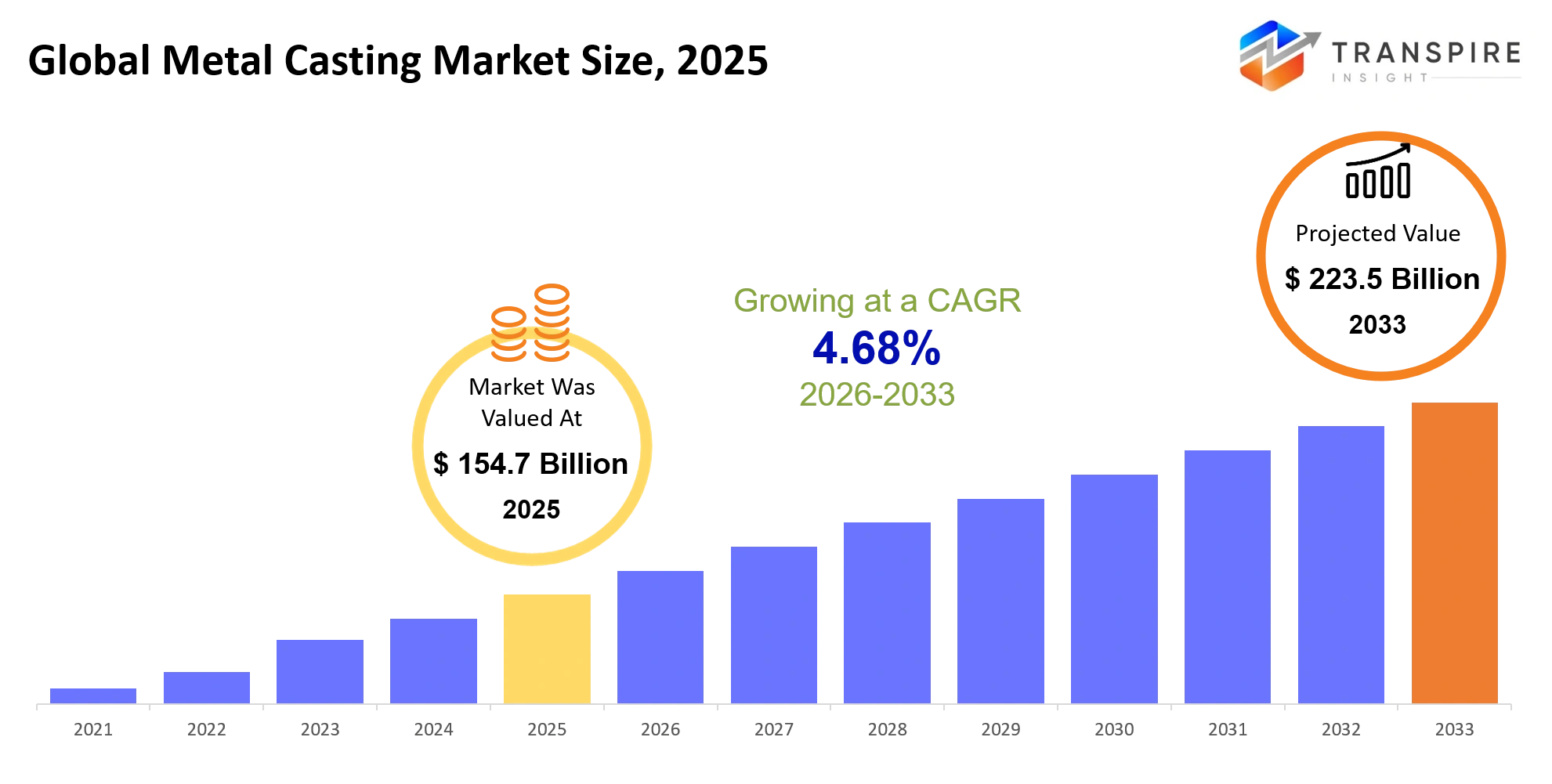
Global Metal Casting Market Size & Forecast:
- Global Metal Casting Market Size 2025: USD 154.7 Billion
- Global Metal Casting Market Size 2033: USD 223.5 Billion
- Global Metal Casting Market CAGR: 4.68%
- Global Metal Casting Market Segments: By Type (Sand Casting, Die Casting, Investment Casting, Centrifugal Casting, Permanent Mold Casting, Others); By Application (Automotive, Industrial Machinery, Aerospace, Construction Equipment, Energy Sector, Others); By End-User (Automotive OEMs, Machinery Manufacturers, Aerospace Companies, Others); By Material (Iron Casting, Aluminum Casting, Steel Casting, Zinc Casting, Others).
Global Metal Casting Market Summary:
As per Transpire Insight Analysis, the Global Metal Casting Market size is estimated at USD 154.7 Billion in 2025 and is anticipated to reach USD 223.5 Billion by 2033, growing at a CAGR of 4.68% from 2026 to 2033.
The global metal casting market is really important for making things because it gives us strong metal parts that are used in lots of industries like cars, machines, aeroplanes, buildings and energy. We need metal parts to make engines, transmissions and other important components that have to be strong and made right and not too expensive.
In the past few years, the metal casting industry has changed a lot because people want to use lighter materials, new manufacturing technologies and be kinder to the environment. One big change is that people like aluminium casting more and more because it helps make products lighter and work better and use less energy. The fact that more electric cars are being made has also made people want metal casting solutions. As companies put money into automated factories, special software and quality control systems, they can make things efficiently. All these things are making metal casting more important in manufacturing and creating new chances for industries all around the world in both old and new economies. The metal casting market is getting stronger. The metal casting industry is doing well.
Key Market Insights:
The global metal casting industry is transitioning from the conventional methods practised in foundries into more automated and precise manufacturing processes. This transition includes the use of light metals, digital manufacturing technology, and sustainability strategies that influence competition in different end-user segments.
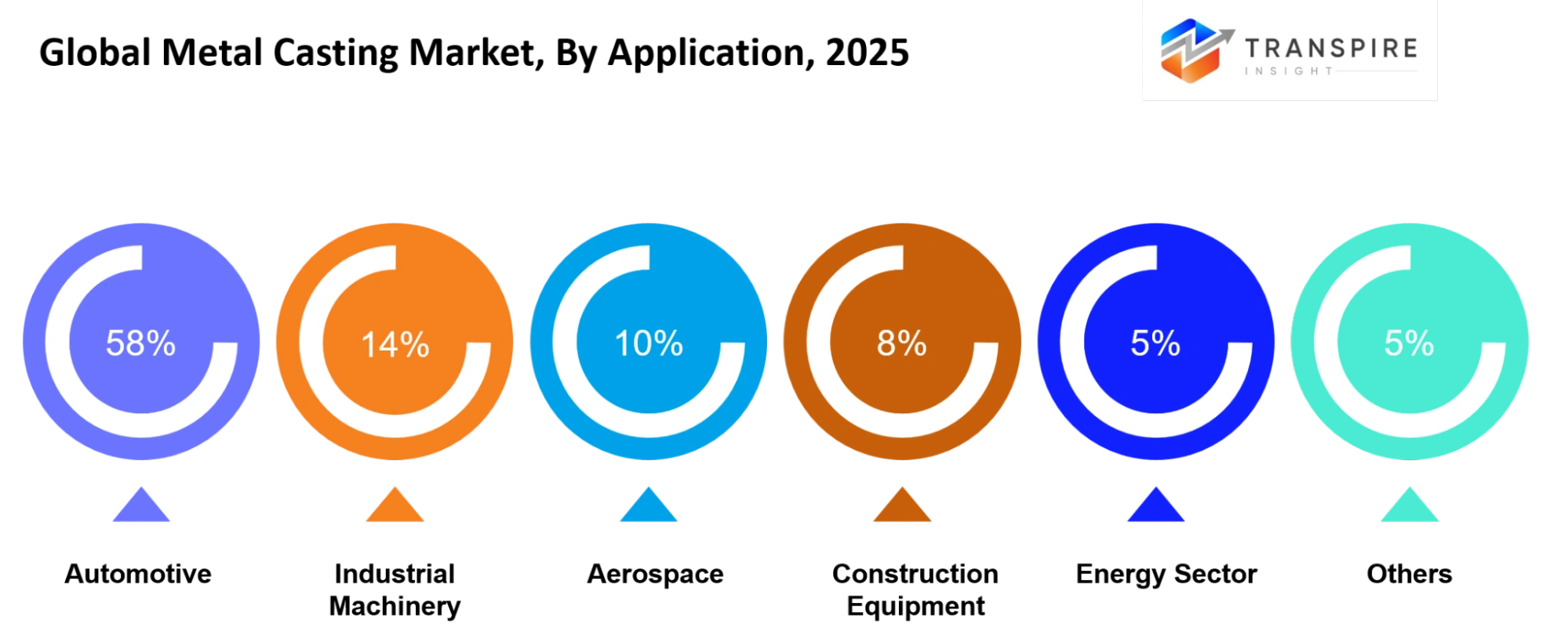
- Automotive applications make up 58% of total market demand because of vehicle lightweighting and e-mobility programs.
- The aluminium casting material is growing at the highest CAGR of 13.9% owing to its weight reduction capabilities.
- There is increased cooperation between automotive manufacturers and foundries to produce advanced castings for the construction of EVs.
- Industrial machinery makes up 14% of the market demand in search of robust components.
- The aerospace industry takes up 10% of the market share because of precision engineering in the manufacture of lightweight components.
- Construction equipment makes up 8% of total revenue, attributed to the developments in infrastructure and urbanisation.
- The energy segment accounts for 5% of the total market, thanks to investments in energy generation and renewable infrastructure.
- Companies are incorporating automation, robotics, and real-time process monitoring in their metal casting.
What are the Key Drivers, Restraints, and Opportunities in the Global Metal Casting Market?
Drivers
The drivers of market growth is the increasing demand for lightweight and high-strength components. The growing popularity of electric vehicle manufacturing drives the demand for aluminium and precision castings, which help enhance vehicle efficiency and lighten its weight. Therefore, companies have begun investing in foundry innovations, increasing production volume and driving market revenue growth.
Restraints
The key barrier to industry growth is the instability in the price of raw materials and energy resources. The metal casting process involves the use of different types of metals like iron, steel, and aluminium; the melting and processing stage consumes considerable amounts of energy. Price volatility continues to pose challenges for foundries, especially for small-scale manufacturers with limited pricing options.
Opportunities
There are many opportunities for foundries' technological upgrades based on Industry 4.0 solutions. For example, smart manufacturing, digital twin technology, automated quality inspection, and predictive maintenance solutions can contribute to increased productivity and waste reduction. There are new industrial markets emerging in Asia Pacific and North America where large investments in advanced manufacturing plants are being made. Those industries provide good opportunities for expanding the market in the future.
What Has the Impact of Artificial Intelligence Been on the Global Metal Casting Market?
Artificial intelligence can prove to be a vital aid for boosting productivity, controlling quality, and ensuring operational efficiency within metal casting facilities. In fact, foundries implement AI solutions in their production processes to monitor temperature changes, conditions of moulds, flows of metals, and performance of equipment in real-time mode.
The most advantageous application of AI technologies is related to process optimisation when algorithms analyze great amounts of production data and make suggestions on how to avoid casting defects like porosity, shrinkage, and flaws on surfaces. Manufacturers have also implemented predictive maintenance solutions to prevent equipment issues before they happen and to save on maintenance.
AI-based simulation programs assist engineers in optimizing molds and casting process before it starts, which saves materials and speeds up product development. Inspection solutions with machine vision technologies ensure greater efficiency of defect detection compared to manual checks. However, implementation is difficult for many foundries. High implementation costs, complicated integration, and the need for skilled specialists still restrict adoption of the solution, especially among small and medium-sized businesses. But as investments in digital manufacturing grow, artificial intelligence is expected to be an important competitive advantage within the metal casting industry worldwide.
Instance
In March 2025, Norican Group increased the implementation of AI process monitoring and prediction within foundries to ensure that there is quality molds produced and defects are reduced during the casting process. Implementation of AI can help companies cut costs, eliminate waste, and ensure product consistency within their metal casting operations.
Source: https://www.norican.com/solutions/digitalisation/?utm
Key Market Trends
Smart manufacturing, the usage of lightweight materials and environmentally friendly manufacturing processes are now gaining popularity in the metal casting industry. At the same time, metal casting manufacturers are becoming more efficient and attentive to their customers' needs.
- Aluminium castings are being produced because of the desire of industries to make their products lighter.
- The growing production of electric cars leads to the increasing demand for more complicated and large cast parts.
- Automation of the foundry processes has replaced traditional manufacturing processes.
- Digital simulations help to accelerate the process of testing and developing new products.
- Energy-efficient furnaces and less-emission production technologies are being used by manufacturers.
- More recycling projects help to use secondary metals in casting production.
- More advanced inspection technologies lead to the reduction of rejection rate.
- Greater accuracy and higher material performance are required from aerospace manufacturers.
- Industrial machinery manufacturers are using custom cast parts.
Global Metal Casting MarketSegmentation
By type
The market consists of sand casting, die casting, investment casting, centrifugal casting, permanent mould casting, and others. Sand casting still holds a prominent place in the market owing to its flexibility and capability of producing large and complicated components. On the other hand, die casting is rising in the market due to its efficiency in high-volume production where precision, accuracy, and speed become crucial aspects. Investment casting is significant for aerospace and special industrial needs. Permanent mould and centrifugal casting also have their own applications in engineering.
By application
automotive takes the lead in the market with 58% of the total demand, owing to the large volume of casting needs in cars, engines, transmissions, and electric mobility solutions. The industry holds 14%, which is driven by investments into manufacturing equipment and automation. Aerospace takes 10% of the market due to its demand for light and precise casting. Construction equipment accounts for 8%, since there are still infrastructure projects going on. Energy and other sectors are 5% each.
By end-user
automotive OEMs account for the largest customer base owing to their constant production activities and innovations. Machinery companies make up another important customer base owing to the increasing trend of industrial automation on a global basis. There is an increasing demand for advanced casting products from aerospace firms due to performance and safety considerations; other industrial customers are continuing to cater to diversified market demands.
By Material
Based on type, iron casting has maintained a prominent market share due to its durability and affordability. Aluminium casting represents the fastest-growing market, which is growing at a CAGR of 13.9% driven by increasing lightweighting in the transportation and aerospace industries. Steel casting plays an important role in heavy-duty industrial applications, whereas zinc casting caters to precision manufacturing applications.
What are the Key Use Cases Driving the Global Metal Casting Market?
The automotive industry constitutes the main use case. Metal casting is widely employed in engines, transmissions, structural elements, chassis, and electric vehicles where the need for robustness, reliability, and process efficiency becomes important. Applications extend beyond the transportation industry, with industrial machinery makers making use of metal casting in pumps, compressors, farm machinery, mine machinery, and automated assembly systems. The aerospace and defence industries also make use of cast metal parts in order to optimise weight and performance.
New applications have emerged in recent years in areas such as renewable energy, electric mobility, and advanced automation. This includes wind turbines, energy generation equipment, battery manufacturing equipment, and future transportation systems
|
Report Metrics |
Details |
|
Market size value in 2025 |
USD 154.7 Billion |
|
Market size value in 2026 |
USD 162.3 Billion |
|
Revenue forecast in 2033 |
USD 223.5 Billion |
|
Growth rate |
CAGR of 4.68% from 2026 to 2033 |
|
Base year |
2025 |
|
Historical data |
2021 - 2024 |
|
Forecast period |
2026 - 2033 |
|
Report coverage |
Revenue forecast, competitive landscape, growth factors, and trends |
|
Regional scope |
United States; Canada; Mexico; United Kingdom; Germany; France; Italy; Spain; Denmark; Sweden; Norway; China; Japan; India; Australia; South Korea; Thailand; Brazil; Argentina; South Africa; Saudi Arabia; United Arab Emirates |
|
Key company profiled |
Nemak, Ryobi Die Casting, Dynacast, Alcast Technologies, Georg Fischer, Endurance Technologies, Hitachi Metals, Rheinmetall Automotive, Arconic, Waupaca Foundry, Gibbs Die Casting, Koch Enterprises, Bharat Forge, Ahresty, Brakes India. |
|
Customization scope |
Free report customization (country, regional & segment scope). Avail customized purchase options to meet your exact research needs. |
|
Report Segmentation |
By Type (Sand Casting, Die Casting, Investment Casting, Centrifugal Casting, Permanent Mold Casting, Others); By Application (Automotive, Industrial Machinery, Aerospace, Construction Equipment, Energy Sector, Others); By End-User (Automotive OEMs, Machinery Manufacturers, Aerospace Companies, Others); By Material (Iron Casting, Aluminum Casting, Steel Casting, Zinc Casting, Others). |
Which Regions are Driving the Global Metal Casting Market Growth?
North America
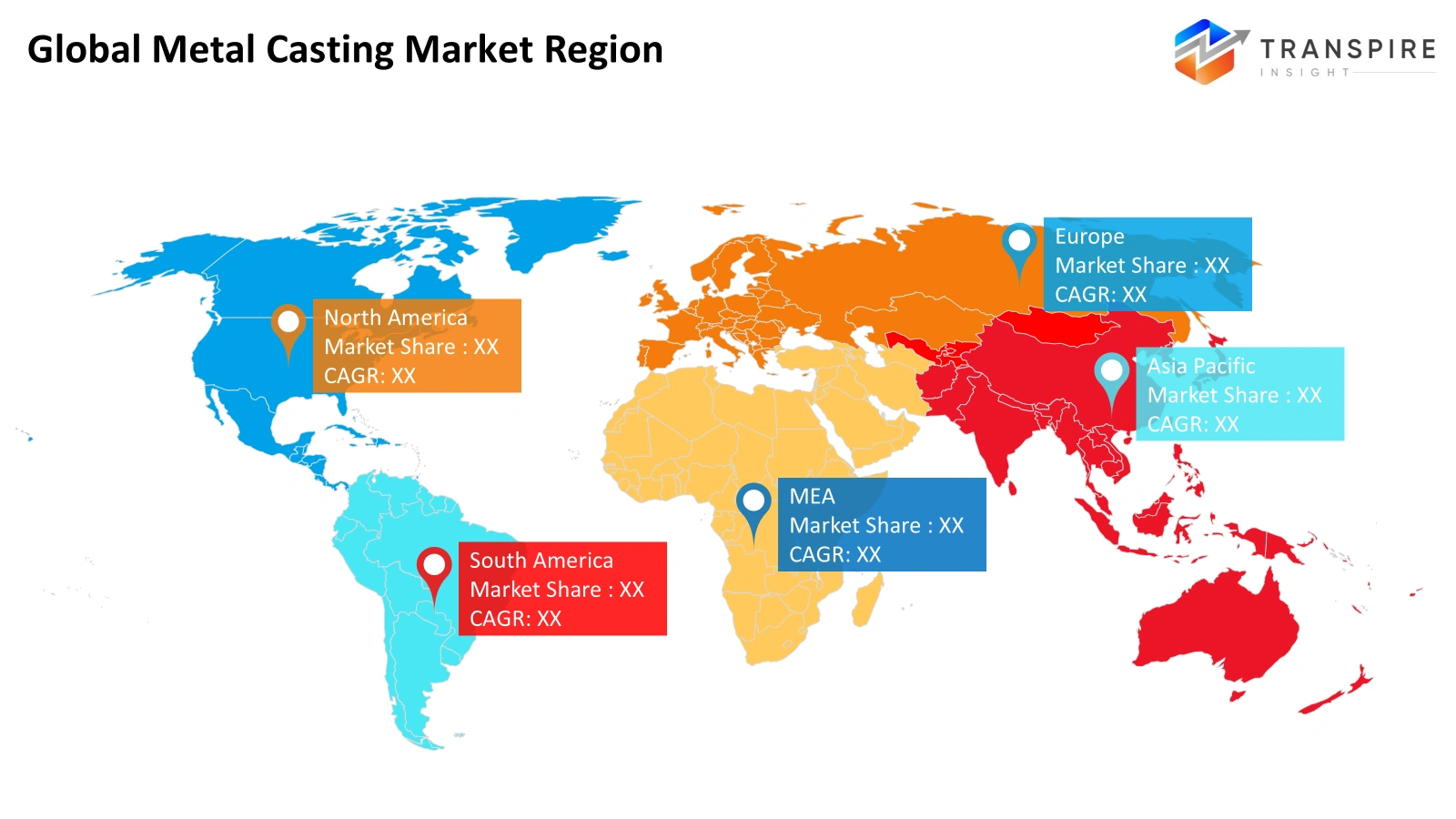
North America holds a market share of 29% and leads all regions in terms of growth, exhibiting a CAGR of 12.8%. The growth has been facilitated by increasing investments in the areas of advanced manufacturing, electric vehicle manufacturing, and foundries’ development. There is a growing trend in the use of automation technology, digital manufacturing methods and sustainable manufacturing practices. In July 2025, the American Foundry Society forecasted a 1.9% growth in casting sales in the US for 2025 due to high demand from the automotive, infrastructure, and manufacturing industries. This shows the ongoing growth of North American foundries.
Europe
Europe occupies 22% of the market and is a consistent leader in engineering and manufacturing of highly precise products. Europe has a strong presence of industries like aerospace, automotive, and industrial machinery. Regulations around sustainability are facilitating the adoption of energy-efficient manufacturing technology and recycled materials in the production process. Innovation and technical expertise will ensure consistent stability in the market, and the Rest of the World holds 8% of the market share.
Asia Pacific
Asia Pacific is the largest player in the worldwide metal castings industry, accounting for 41% of the overall revenue. The region has the advantage of having a sound manufacturing base and automotive manufacturing operations as well as heavy investments made in industrial infrastructure. Nations like China, India, Japan, and South Korea are constantly increasing their foundry capacities. In May 2025,UBE Machinery Corporation (Japan) expanded its giga-casting die-casting machines for manufacturing of battery electric vehicles (BEVs). This expansion caters to the large-scale manufacture of aluminum castings and indicates increasing investments in state-of-the-art foundry technologies in the Asian-Pacific automotive sector.
Who are the Key Players in the Global Metal Casting Marketand how do they Compete?
The competition among the players of the international metal casting industry involves consistent efforts towards manufacturing efficiency improvement, product quality, materials innovation, and market extension. Players of the industry compete by improving production processes, developing relations with clients, and creating castings that meet the demands of rapidly growing industries.
Major industry players like Nemak, Ryobi Limited, Dynacast International, GF Casting Solutions, and Endurance Technologies concentrate their efforts mostly on technological manufacturing. They use strategies of automation, lightweight materials creation, engineering precision, and efficiency. The difference between the competitors lies in advanced production techniques, quality control programs, and the ability to serve demanding industries like automotive and aerospace.
Other leading manufacturers like Rheinmetall Automotive, Hitachi Metals, Aisin Corporation, and Ahresty Corporation aim to expand their capacities, enter partnership agreements, and increase product diversity. Some firms are building plants in closer proximity to consumer markets to enhance supply chain management and lower the cost of logistics. It is expected that growing efforts in aluminium casting, sustainable manufacturing technologies, and digital foundries will be among the important competitive approaches.
Global Metal Casting Market companies
- Nemak
- Ryobi Die Casting
- Dynacast
- Alcast Technologies
- Georg Fischer
- Endurance Technologies
- Hitachi Metals
- Rheinmetall Automotive
- Arconic
- Waupaca Foundry
- Gibbs Die Casting
- Koch Enterprises
- Bharat Forge
- Ahresty
- Brakes India
Recent Development News
In January 2026, Wieland Group purchased Techni-Cast LLC, a centrifugal casting facility in the United States. This purchase enhanced the casting competencies of Wieland Group in North America and increased its range of high-performance castings for aerospace and industrial use.
Source: https://www.wieland.com
In September 2025, Aluminium Foundry of Wisconsin is purchased by Shandong Liancheng Precision Manufacturing Co., Ltd. This acquisition expanded Shandong Liancheng’s manufacturing base in North America along with gaining access to innovative aluminium casting technology and clients.
Source: https://www.angleadvisors.com
In April 2025, Handtmann introduced lightweight metal casting components and new megacasting manufacturing programs. The introduction was due to increased customer needs for large aluminium cast parts by electric vehicle makers in order to optimise vehicle performance.
Source: http://foundry-planet.com
What Strategic Insights Define the Future of the Global Metal Casting Market?
The future trends of the metal casting business will be determined by the interconnection between light materials, manufacturing technologies, automation, and sustainable practices. Those companies that will manage to use their combination of smart foundry technologies and advanced materials in the right way will be able to claim a greater part of future demand.
The underestimated threat will be increased operating costs related to energy usage, compliance with environmental regulations, and volatility of raw materials. If manufacturers do not invest in the renovation of their production facilities, they will experience lower profit margins and will be less competitive. The arising opportunity will be the fast development of electric cars, renewable energy facilities, and industrial automation. These segments need cast products of higher quality and lower weight.
The proposed strategic recommendation is for manufacturers to make investments in aluminium casting and AI-powered production control systems.
Key Segmentations are:
By Type
- Sand Casting
- Die Casting
- Investment Casting
- Centrifugal Casting
- Permanent Mold Casting
By Application
- Automotive
- Industrial Machinery
- Aerospace
- Construction Equipment
- Energy Sector
By End-User
- Automotive OEMs
- Machinery Manufacturers
- Aerospace Companies
By Material
- Iron Casting
- Aluminum Casting
- Steel Casting
- Zinc Casting
Regional Outlook
North America
- United States
- Canada
- Mexico
Europe
- Germany
- United Kingdom
- France
- Spain
- Italy
- Rest of Europe
Asia Pacific
- Japan
- China
- Australia & New Zealand
- South Korea
- India
- Rest of Asia Pacific
South America
- Brazil
- Argentina
- Rest of South America
Middle East & Africa
- Saudi Arabia
- United Arab Emirates
- South Africa
- Rest of the Middle East & Africa
Frequently Asked Questions
Find quick answers to common questions.
The global metal casting market size was valued at USD 154.7 Billion in 2025 and is poised to reach USD 223.5 Billion by 2033, expanding at a 4.68% CAGR.
Key segments for the global metal casting market are By Type (Sand Casting, Die Casting, Investment Casting, Centrifugal Casting, Permanent Mold Casting, Others); By Application (Automotive, Industrial Machinery, Aerospace, Construction Equipment, Energy Sector, Others); By End-User (Automotive OEMs, Machinery Manufacturers, Aerospace Companies, Others); By Material (Iron Casting, Aluminum Casting, Steel Casting, Zinc Casting, Others).
Growth is primarily driven by rising demand from the automotive, construction, industrial machinery, and aerospace sectors, increasing infrastructure development, growing vehicle production, and advancements in casting technologies that improve efficiency and product quality.
The global market is led by major manufacturers including Nemak, Ryobi Die Casting, Dynacast, Alcast Technologies, Georg Fischer, Endurance Technologies, Hitachi Metals, Rheinmetall Automotive, Arconic, Waupaca Foundry, Gibbs Die Casting, Koch Enterprises, Bharat Forge, Ahresty, Brakes India.
Asia Pacific holds a share of 41% of the global market for metal casting, thereby being the largest regional market. This is facilitated by active manufacturing, industrial growth, the development of automotive and construction industries, and casting companies operating in countries like China and India. The rise in investments in infrastructure along with cost-effective manufacturing capacities adds to the power of this region in the global market.
The commercial potentialities in the international market of metal casting are represented by growing demand for lightweight cast parts in automotive and aerospace industries, increased use of new casting technologies like 3D-printing and automation, development of infrastructure and construction work in developing countries, as well as the use of cast metals in manufacturing renewable energy devices and industrial equipment.
- Nemak
- Ryobi Die Casting
- Dynacast
- Alcast Technologies
- Georg Fischer
- Endurance Technologies
- Hitachi Metals
- Rheinmetall Automotive
- Arconic
- Waupaca Foundry
- Gibbs Die Casting
- Koch Enterprises
- Bharat Forge
- Ahresty
- Brakes India
About the Authors

Pankaj Ghogare Patil
I am Pankaj Ghogare Patil, a Senior Research Analyst at Transpire Insight, specializing in the Pharmaceutical, Chemicals & Materials, Healthcare IT, and Biotechnology industry. My expertise lies in conducting comprehensive market research, analyzing industry trends, evaluating competitive landscapes, and translating complex data into actionable insights. At Transpire Insight, I closely follow emerging technologies, regulatory developments, and market innovations to create accurate, well-researched, and informative content that helps businesses and professionals make informed decisions. I am committed to producing credible, evidence-based articles that reflect industry best practices while making technical topics accessible and valuable for a broad audience.

Chakradhar Khansole
Chakradhar serves as the Research Director at Transpire Insight, bringing over 8 years of experience in technology, innovation, and strategic market intelligence. He specializes in transforming complex market data into actionable business insights that enable organizations to make informed, growth-oriented decisions. Recognized for his strategic vision and analytical expertise, Chakradhar leads high-impact research initiatives, delivering comprehensive market assessments, competitive intelligence, and forward-looking industry analysis.
Recently Published Reports
-
May 2026
Healthcare Polymer Packaging Market
Healthcare Polymer Packaging Market Size, Share & Analysis Report By Packaging Type (Syringes, IV Bottles and Pouches, Clamshells, Blisters, Bottles & Jars, Containers, Tubes, IV Parental Packaging, Others), By Type (Regulated, Non-regulated), By Polymer Type (LDPE (Low-Density Polyethylene), HDPE (High-Density Polyethylene), Homo-polymer (Homo), Random Copolymer (Random), Block Copolymer (Block), PET, Polystyrene, Polyvinyl Chloride, Polyamide/EVOH, Others), and Geography (North America, Europe, Asia-Pacific, Middle East and Africa, South and Central America), 2021 - 2031
-
Apr 2026
Hydrophilic Tape (Waterstop) Market
Hydrophilic Tape (Waterstop) Market Size, Share & Analysis Report By Type (Bentonite-Based Hydrophilic Tape, Rubber-Based Hydrophilic Tape), By Application (Residential Buildings, Commercial Buildings, Infrastructure Projects), and Geography (North America, Europe, Asia-Pacific, Middle East and Africa, South and Central America), 2021 - 2031
-
Apr 2026
Metalens Market
Metalens Market Size, Share & Analysis Report By Type (Visible Light Metalens, and Infrared Metalens), By Application (Consumer Electronics, Automotive Electronics, Industrial, Medical, and Others), and Geography (North America, Europe, Asia-Pacific, Middle East and Africa, South and Central America), 2021 - 2031
-
Apr 2026
PBT Resin Market
PBT Resin Market Size, Share & Analysis Report By Type (Reinforced PBT Resin, Unreinforced PBT Resin), By Processing Method (Injection Molding, Extrusion, Blow Molding, Others), By End-User (Automotive, Electrical & Electronics, Consumer Appliances, Industrial Machinery, Medical Devices, Packaging, Others), and Geography (North America, Europe, Asia-Pacific, Middle East and Africa, South and Central America), 2021 - 2031