Europe Aluminum Die Casting Market Size & Forecast:
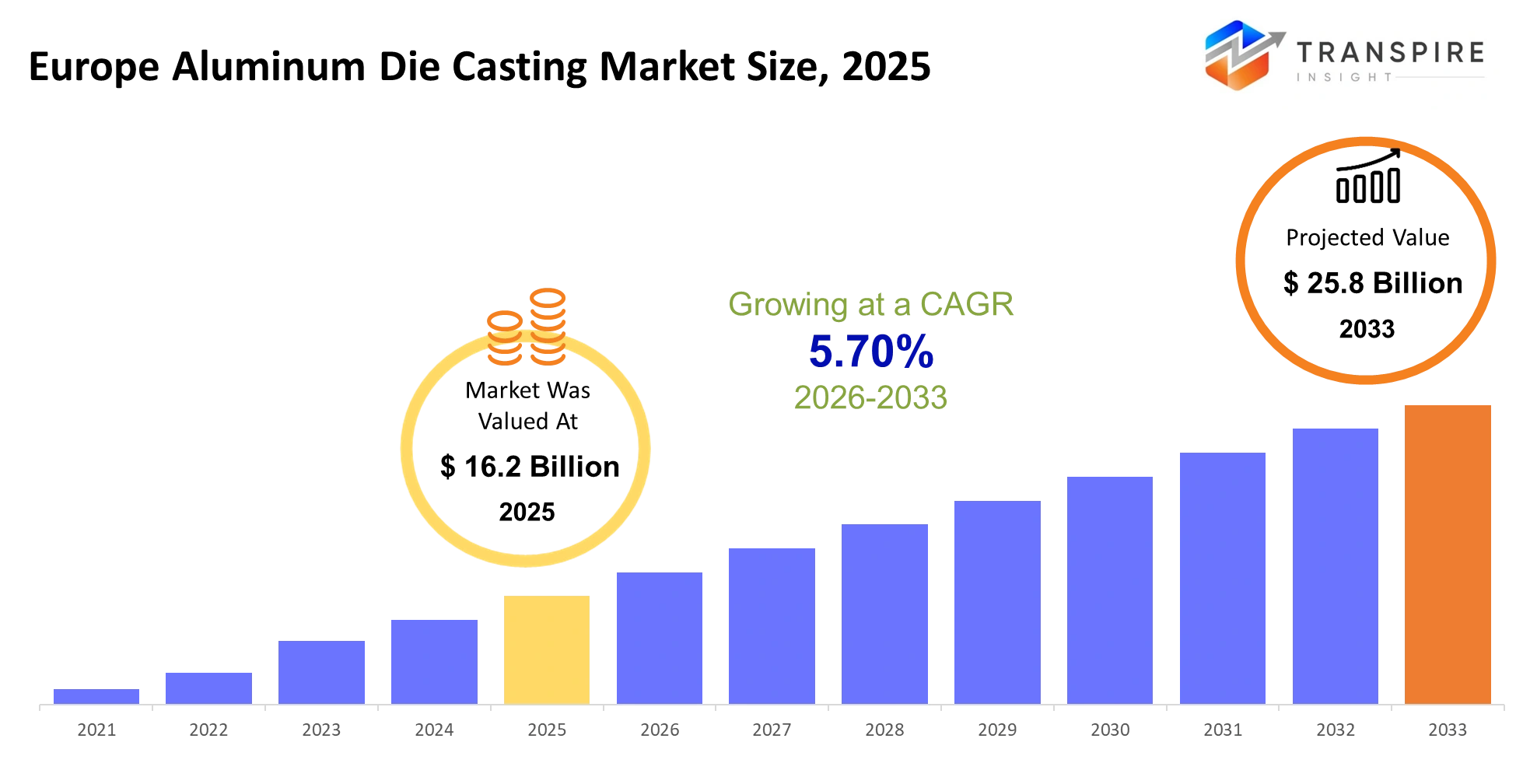
- Europe Aluminum Die Casting Market Size 2025: USD 16.2 Billion
- Europe Aluminum Die Casting Market Size 2033: USD 25.8 Billion
- Europe Aluminum Die Casting Market CAGR: 5.70%
- Europe Aluminum Die Casting Market Segments: By Type (Pressure Die Casting, Vacuum Die Casting, Squeeze Die Casting, Others), By Application (Automotive, Industrial Machinery, Aerospace, Electronics, Construction, Others), By End-User (Automotive OEMs, Industrial Firms, Aerospace Companies, Electronics Industry, Construction Firms, Others), By Process (Cold Chamber, Hot Chamber, Others).
To learn more about this report,  Download Free Sample Report
Europe Aluminum Die Casting Market Summary:
The Europe Aluminum Die Casting Market size is estimated at USD 16.2 Billion in 2025 and is anticipated to reach USD 25.8 Billion by 2033, growing at a CAGR of 5.70% from 2026 to 2033. European aluminum die casting processes transform molten metal into lightweight components which achieve precise dimensions for use in vehicles and machinery and industrial equipment. The method creates a solution which enables engineers to produce intricate components through mass production while maintaining product strength and thermal efficiency and budget management in the automotive and aerospace and industrial equipment sectors.
The market has undergone a fundamental transformation during the last three to five years because electrification-based design has become the new standard. Electric vehicles need lightweight materials for their housings and battery enclosures and thermal management parts which leads to die casting producing bigger and more complete components. Automakers needed to redesign their platforms because the EU emissions regulations became stricter which created a need for aluminum materials that weigh less than traditional metals.
The shift increases revenue because it leads to more complex parts which manufacturers need to produce at higher quantities for each vehicle. The unit value of components grows when manufacturers combine several parts into one casting which results in fewer advanced products that generate higher revenue for suppliers.
Key Market Insights
- Germany holds the lead in the European aluminum die casting market through its more than 30 percent market share which exists because of its strong automotive industry and its advanced engineering capabilities.
- Eastern Europe serves as the most rapidly expanding region until 2030 because its production costs remain low and OEM manufacturers establish new factories in the area.
- High pressure die casting operates as the leading method which controls nearly 65 percent of the market in 2024 because it effectively mass produces complicated automotive parts.
- Gravity die casting serves as the second largest casting method which industrial operators use to produce heavy equipment that needs strong and accurate components.
- The vacuum die casting method stands as the most rapidly expanding segment which will experience growth from 2025 to 2030 because it helps decrease defects while enhancing the mechanical properties of EV components.
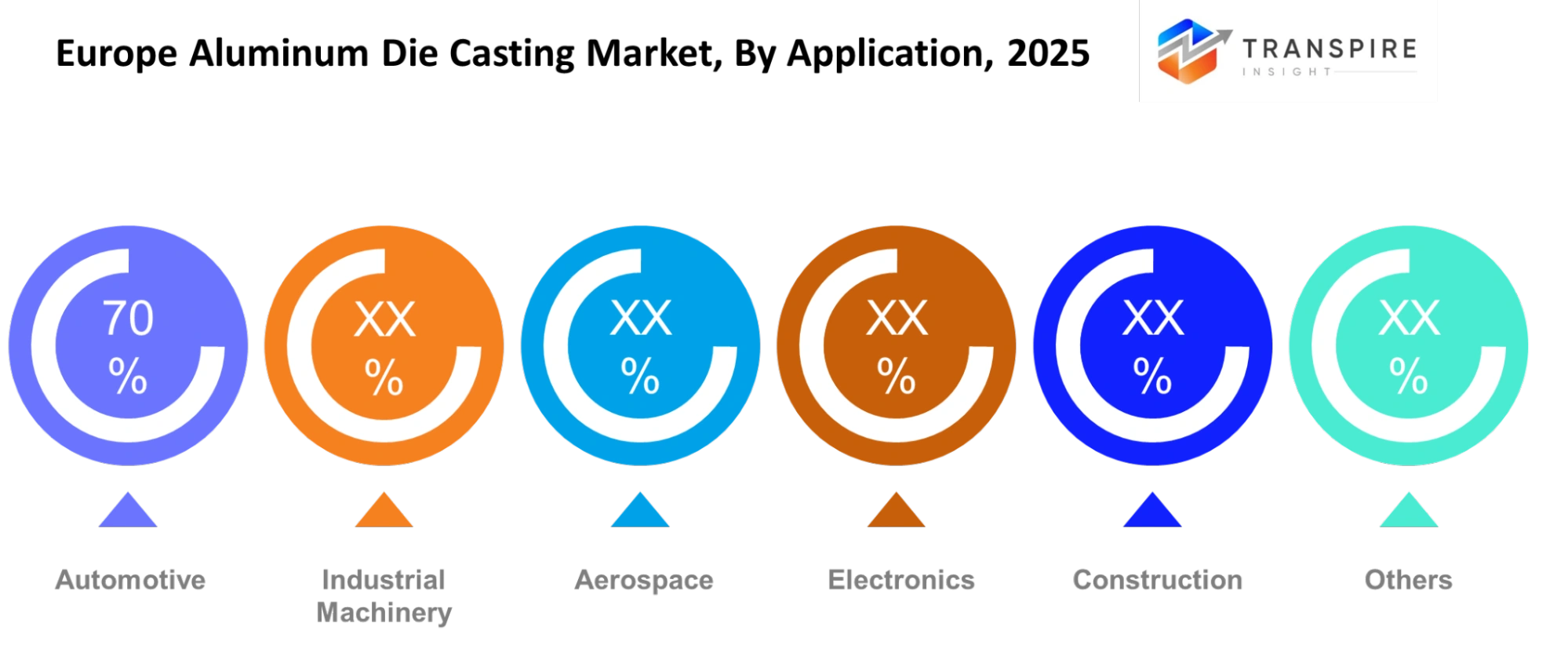
- The automotive industry controls more than 70 percent of the market in 2024 because the industry demands EV battery housings and structural parts and lightweight components.
- The aerospace and EV specific components represent the most rapidly expanding application segment which shows strong growth because of new emission standards and electrification initiatives.
- Automotive OEMs lead with approximately 60% market share in 2024 which results from platform redesigns and the rising need for integrated casting solutions.
- Electric vehicle manufacturers form the fastest-growing end-user category through 2030 because of policy-driven electrification and platform innovation.
What are the Key Drivers, Restraints, and Opportunities in the Europe Aluminum Die Casting Market?
The primary force driving market growth in Europe aluminum die casting industry exists because electric vehicle platforms need new design approaches. The European Union established new emissions standards for its vehicle fleet which later developed into the 2035 internal combustion engine phase-out schedule. Automakers now require fewer but larger, structurally integrated components such as battery housings and giga-cast chassis parts. Suppliers who shift their production method from making multiple small components to making valuable single-piece parts will see their revenue from each casting increase. The process reduces assembly time which leads original equipment manufacturers to implement standard aluminum die casting practices across all their upcoming vehicle designs.
The most important obstacle exists because advanced die casting technologies need heavy capital investments that particularly affect giga-casting systems and high-tonnage presses. Small and mid-sized suppliers cannot afford the necessary investments which need hundreds of millions of euros and require extended periods until they generate profits. The constraint is structural because it involves plant redesign, workforce reskilling, and long-term supply contracts. Many suppliers postpone their system updates which causes a slowdown in new casting technology implementation and restricts industry potential for growth.
The development of manufacturing centers across Eastern Europe presents an important business opportunity which benefits countries like Poland and Hungary. Governments are backing electric vehicle supply chain localization efforts through financial incentives and infrastructure development projects. The new die casting facilities which focus on electric vehicle components will achieve production efficiency while meeting local original equipment manufacturer requirements.
What Has the Impact of Artificial Intelligence Been on the Europe Aluminum Die Casting Market?
European aluminum die casting operations experience transformation through artificial intelligence and advanced digital tools which enhance process control while enabling higher scale production. Foundries now deploy AI-driven control systems that monitor melt temperature injection speed and die conditions in real time while automatically adjusting parameters to stabilize casting quality. Computer vision systems inspect parts on the line because these systems identify porosity and surface defects with better accuracy than manual inspections. The automation layers in this system enable continuous production while decreasing scrap rates because they require minimal human operating time.
Machine learning models predict machine failures by analyzing vibration and thermal and pressure data from casting machines. Operators can forecast die wear or equipment failure days in advance which improves uptime and avoids unplanned shutdowns. Some plants achieve double-digit reductions in downtime while they save energy through better cycle times and furnace operation. Digital twins enable manufacturers to test their casting processes through simulation which leads to higher production efficiency and lower costly trial runs.
The main obstacle to AI implementation in foundry systems lies in the expensive and difficult process of integrating new technology with existing systems. Many facilities lack standardized data infrastructure and inconsistent historical data can reduce model accuracy which results in delayed adoption of full-scale operations despite evidence of efficiency improvements.
Key Market Trends
- The automotive industry has adopted giga-casting since 2021 because it enables manufacturers to produce vehicles with 70% fewer components while requiring fewer high-tonnage machinery systems from their suppliers.
- OEMs had to redesign their vehicle platforms because EU emissions rules became more strict between 2020 and 2024 which led to an increase in aluminum usage for structural components over steel.
- Foundries increasingly adopted AI-driven quality inspection after 2022, which resulted in lower defect rates and better quality control for their automotive casting operations that produced high volumes of products.
- After 2020, Eastern Europe became a popular manufacturing destination for OEMs who wanted to establish factories in Poland and Hungary because those countries offered lower labor expenses and better supply chain security.
- Manufacturers responded to energy price fluctuations which occurred after the 2022 Russia-Ukraine war by funding projects that developed energy-efficient furnaces and closed-loop recycling technologies.
- Nemak and Rheinmetall Automotive developed their electric vehicle casting business by expanding their product range which now includes battery housings and structural enclosures.
- Manufacturers of electric vehicle components now prefer vacuum die casting because it helps them achieve their goal of producing parts that have both minimal porosity and strong mechanical properties needed for safety functions.
- The tier-1 suppliers scheduled their automation investments for the period between 2021 and 2025 to solve their workforce problems while maintaining their production capabilities.
- The OEMs established supplier network consolidation practices after 2022 because they preferred suppliers who could deliver complete casting systems instead of individual components.
Europe Aluminum Die Casting Market Segmentation
By Type
Pressure die casting has established itself as the leading casting method because it produces high-volume precision parts that meet automotive and industrial requirements. Manufacturers have begun to adopt vacuum die casting because it helps them decrease defects and create stronger materials which are essential for building electric vehicle structures. Squeeze die casting serves niche applications that require enhanced density and fatigue resistance, often in aerospace and performance engineering.
OEMs today create single units from multiple components which has increased their demand for high-integrity castings according to current patterns. This shift to single units decreases costs per component while increasing demands for technical expertise from suppliers. manufacturers have to adopt hybrid casting methods that use both pressure and vacuum systems to achieve better quality standards without losing production efficiency.
By Application
The automotive sector leads all other applications because it has the biggest market share which results from structural lightweighting and platform redesign efforts that support electrification. The second-largest segment of the market comes from industrial machinery which manufacturers need to produce ready-to-use durable components that can withstand high temperatures. Aerospace and electronics are smaller but faster-growing segments because both industries need lightweight components that have high strength and precise dimensions.
The construction industry shows steady demand for its applications whereas the transport industry develops new technologies at a faster pace. Automotive applications need to expand their operations through system integration whereas aerospace applications must meet their performance and certification requirements. The automotive industry and aerospace industry will increasingly share their operational needs which will require suppliers to enhance their capacities in order to meet tougher engineering requirements that span different sectors.
To learn more about this report, Download Free Sample Report
By End-User
The automotive OEM market dominates through its widespread purchasing and ongoing system enhancements for its end-user base. The industrial sector maintains its constant need for machinery components and equipment housings which shows no signs of change. Aerospace companies produce lower quantities of products yet achieve greater profit margins because they must meet high-quality standards and complete certification requirements. The electronics sector has developed into a fast-growing market because the demand for electric vehicles and power electronics solutions has increased.
Construction companies experience consistent market demand because their design requirements show only minor changes. The automotive industry seeks cost-effective production at high output levels while the aerospace sector requires dependable systems and precise operational tracking. Electric vehicle manufacturers will gain more power which will change how they work with suppliers while also making integrated casting systems the main choice instead of traditional multi-component assembly methods.
By Process
The cold chamber die casting process has emerged as the leading casting method because it provides optimal results for aluminum and high melting point alloys which create structural components. The hot chamber processes only represent a minor market share because they serve specific applications which require processing lower melting metals and basic components. Manufacturers are exploring semi-solid and hybrid processes because these methods provide improved material performance and decreased porosity.
The growth logic reflects a shift toward processes that support larger castings and higher structural integrity, especially in electric vehicle platforms. Advanced cold chamber systems with automation and digital monitoring systems receive increasing investment according to current investment trends. The future predicts that process innovation will create a competitive edge for manufacturers who develop flexible systems which enable them to switch production methods according to their production demands.
What are the Key Use Cases Driving the Europe Aluminum Die Casting Market?
The primary application of this technology exists within the automotive manufacturing industry because aluminum die casting production creates engine blocks and transmission housings and electric vehicle battery enclosures. This product segment experiences maximum market demand because original equipment manufacturers require lightweight materials to achieve European Union emission standards and increase their vehicle operational range. The use of large integrated castings in vehicles enables manufacturers to decrease assembly times while creating stronger vehicle structures, which become essential components of future vehicle development.
Industrial machinery and aerospace operations demonstrate additional new applications for die-casting technology. Industrial companies implement die-cast components to manufacture pumps and compressors and protective housings for heavy equipment, which must endure extreme conditions while maintaining thermal control. Aerospace companies use high-integrity castings to manufacture structural brackets and enclosures because they must comply with weight and performance restrictions.
Power electronics housings and wind turbine system components for renewable energy systems represent new potential applications. The electrification trend together with grid infrastructure development in Europe fuels growing interest in these applications.
|
Report Metrics |
Details |
|
Market size value in 2025 |
USD 16.2 Billion |
|
Market size value in 2026 |
USD 17.5 Billion |
|
Revenue forecast in 2033 |
USD 25.8 Billion |
|
Growth rate |
CAGR of 5.70% from 2026 to 2033 |
|
Base year |
2025 |
|
Historical data |
2021 - 2024 |
|
Forecast period |
2026 - 2033 |
|
Report coverage |
Revenue forecast, competitive landscape, growth factors, and trends |
|
Regional scope |
Europe (Germany, United Kingdom, France, Italy, Spain and Rest of Europe) |
|
Key company profiled |
Nemak, Ryobi, Endurance Technologies, Georg Fischer, Alcoa, Dynacast, Pace Industries, Rockman Industries, Rheinmetall Automotive, Shiloh Industries, Martinrea, Gibbs Die Casting, Koch Enterprises, Meridian Lightweight, Castwel. |
|
Customization scope |
Free report customization (country, regional & segment scope). Avail customized purchase options to meet your exact research needs. |
|
Report Segmentation |
By Type (Pressure Die Casting, Vacuum Die Casting, Squeeze Die Casting, Others), By Application (Automotive, Industrial Machinery, Aerospace, Electronics, Construction, Others), By End-User (Automotive OEMs, Industrial Firms, Aerospace Companies, Electronics Industry, Construction Firms, Others), By Process (Cold Chamber, Hot Chamber, Others). |
Which Regions are Driving the Europe Aluminum Die Casting Market Growth?
Central Europe establishes its leadership position in the market through its manufacturing corridor which connects Germany, Austria, and the Czech Republic and centers on automotive production facilities. EU emissions targets create strong regulatory pressure which results in regional OEMs redesigning their platforms to use lighter materials. The combination of an established supplier network and a trained workforce together with their location close to major automobile manufacturers enables the operation of precise casting facilities which produce large volumes of products. The region maintains its technological superiority through continuous expenditures dedicated to automation and giga-casting advancements which ensure production capabilities match future vehicle design requirements.
Western Europe acts as a dependable economic contributor which originates from its three main markets of France, Italy, and Spain but demonstrates distinct development patterns. The market here demands products from three equal sectors which include automotive, aerospace, and industrial applications instead of focusing solely on automotive needs. The governments throughout this area maintain their industrial policies while they assist advanced manufacturing initiatives through their regular operational methods without implementing sudden changes to their industrial regulations. Investors find the region dependable because its stable environment leads to ongoing capital investments which create enduring relationships with suppliers, which results in continuous revenue generation.
The manufacturing sector in Poland, Hungary, and Slovakia shows the fastest growth among all Eastern European countries. The market experience underwent fundamental changes due to the production and supplier base movements which occurred throughout 2022. The establishment of new casting facilities became feasible because companies could take advantage of low labor costs and government subsidies that supported electric vehicle supply chain development in their local areas. The current market development presents a strategic investment opportunity for enterprises that want to establish affordable business operations which will meet the rising demand that will develop between 2026 and 2033.
Who are the Key Players in the Europe Aluminum Die Casting Market and How Do They Compete?
Aluminum die casting competition in Europe shows moderate market consolidation because major manufacturing companies control high-value automotive contracts while smaller enterprises satisfy niche and regional market requirements. Companies use their existing resources and automated processes together with their long-term partnerships with original equipment manufacturers to maintain current market share while new companies enter the market by targeting specialized electric vehicle components and opening facilities in Eastern European nations. Organizations compete through their technological capabilities which enable them to produce complex integrated castings instead of simple price competition. Automotive manufacturers prefer suppliers who provide multiple casting solutions that include high-tonnage capabilities and digital process monitoring systems which guarantee product consistency.
Nemak uses technology to create unique products which enable it to produce electric vehicle structural elements such as battery housings and e-mobility components. Through its advanced casting technology development and its partnerships with original equipment manufacturer engineering teams, Nemak establishes its role in platform development. Rheinmetall Automotive uses its engineering expertise and precise manufacturing abilities to create high-performance components which comply with strict European regulations. The company builds its market position by developing products that support the new electrification requirements of modern vehicle design.
Georg Fischer establishes its unique identity through process innovation and lightweight structural casting which it implements from its main operations in Central Europe. The company grows its business through strategic partnerships and financial backing of advanced manufacturing technologies which enable better casting operations that produce complex and consistent results. Endurance Technologies implements a cost leadership approach through its European manufacturing centers to provide OEMs with budget-friendly options that maintain high standards of quality. The company expands its operations to Eastern Europe which enables access to emerging electric vehicle manufacturing regions while supporting the transition of supply chain networks.
Company List
- Nemak
- Ryobi
- Endurance Technologies
- Georg Fischer
- Alcoa
- Dynacast
- Pace Industries
- Rockman Industries
- Rheinmetall Automotive
- Shiloh Industries
- Martinrea
- Gibbs Die Casting
- Koch Enterprises
- Meridian Lightweight
- Casteel
Recent Development News
In April 2026, European Aluminium Die Casting Platform Sold to Industrial Investor: In April 2026, Accursia Capital completed the sale of its aluminium die casting platform—including Friulpress-Samp and Aluminium Die Casting S.r.l.—to Italian industrial investor Exedra Pares. The transaction reflects continued consolidation in Europe’s die casting sector, particularly in automotive supply chains.
Source: https://www.mainsights.io
In March 2026, Aluminium Bahrain is in talks to acquire Aluminium Dunkerque, Europe’s largest primary aluminium smelter: This acquisition discussion involves Aluminium Dunkerque, a critical upstream supplier to Europe’s aluminum casting and die-casting industry. The move signals potential supply chain integration and raw material control shifts affecting European die casting manufacturers.
Source: https://www.aluminium-journal.com
What Strategic Insights Define the Future of the Europe Aluminum Die Casting Market?
The Europe aluminum die casting market shows a structural shift toward larger and more integrated components because electric vehicle platforms are being redesigned and manufacturers seek improved operational performance. Over the next five to seven years, value will concentrate in suppliers that can deliver giga-cast structures with embedded functionality, supported by digital process control and close OEM integration. The new system will decrease available suppliers while raising the minimum technical requirements needed to enter the market.
A less visible risk lies in aluminum supply volatility and energy cost exposure. Smelting operations need substantial energy input, and any disruptions to European energy markets or raw material supply chains will harm production capacity while decreasing profit margins, despite existing strong market demand.
The growing market for hybrid casting techniques which use high-pressure and vacuum methods to create safety-critical EV components creates a new business opportunity. The advanced programs that use these methods have not yet established themselves as standard practices.
Market participants should invest early in flexible casting infrastructure and digital process optimization to secure long-term contracts and remain competitive as consolidation accelerates.
Europe Aluminum Die Casting Market Report Segmentation
By Type
- Pressure Die Casting
- Vacuum Die Casting
- Squeeze Die Casting
- Others
By Application
- Automotive
- Industrial Machinery
- Aerospace
- Electronics
- Construction
- Others
By End-User
- Automotive OEMs
- Industrial Firms
- Aerospace Companies
- Electronics Industry
- Construction Firms
- Others
By Process
- Cold Chamber
- Hot Chamber
- Others
Frequently Asked Questions
Find quick answers to common questions.
The approximate Europe Aluminum Die Casting Market size for the market will be USD 25.8 Billion in 2033.
The key segments of the Europe Aluminum Die Casting Market are By Type (Pressure Die Casting, Vacuum Die Casting, Squeeze Die Casting, Others), By Application (Automotive, Industrial Machinery, Aerospace, Electronics, Construction, Others), By End-User (Automotive OEMs, Industrial Firms, Aerospace Companies, Electronics Industry, Construction Firms, Others), By Process (Cold Chamber, Hot Chamber, Others).
Major players in the Europe Aluminum Die Casting Market are Nemak, Ryobi, Endurance Technologies, Georg Fischer, Alcoa, Dynacast, Pace Industries, Rockman Industries, Rheinmetall Automotive, Shiloh Industries, Martinrea, Gibbs Die Casting, Koch Enterprises, Meridian Lightweight, Castwel.
The current market size of the Europe Aluminum Die Casting Market is USD 16.2 Billion in 2025.
The Europe Aluminum Die Casting Market CAGR is 5.70%.
- Nemak
- Ryobi
- Endurance Technologies
- Georg Fischer
- Alcoa
- Dynacast
- Pace Industries
- Rockman Industries
- Rheinmetall Automotive
- Shiloh Industries
- Martinrea
- Gibbs Die Casting
- Koch Enterprises
- Meridian Lightweight
- Casteel
Recently Published Reports
-
Apr 2026
ATV & UTV Market
ATV & UTV Market Size, Share & Analysis Report By Type (ATV, and UTV), By Variants (Less Than 400 CC, 400 CC To 800 CC, and More Than 800 CC), and Geography (North America, Europe, Asia-Pacific, Middle East and Africa, South and Central America), 2021 - 2031
-
Apr 2026
Automotive Central Gateway Module Market
Automotive Central Gateway Module Market Size, Share & Analysis Report By Type (Ethernet Central Gateway Module, CAN Central Gateway Module, LIN Central Gateway Module, and FlexRay), By Application (Powertrain Control, Body Control, Infotainment System, Advanced Driver Assistance Systems (ADAS), and Others), By End User (Passenger Vehicles, and Commercial Vehicles), and Geography (North America, Europe, Asia-Pacific, Middle East and Africa, South and Central America), 2021 - 2031
-
Apr 2026
Automotive Engine Oil Filter Market
Automotive Engine Oil Filter Market Size, Share & Analysis Report By Filter Type (Fuel Filter, Engine Oil Filter, Hydraulic Oil Filter, and Others), By Filter Media (Cellulose, Synthetic, and Micro), By Sales Channel (OEMs, and Aftermarket), By Vehicle Type (Passenger Cars, Light Commercial Vehicles, Heavy Duty Trucks, Buses and Coaches, and Off-road Vehicles), and Geography (North America, Europe, Asia-Pacific, Middle East and Africa, South and Central America), 2021 - 2031
-
Apr 2026
Automotive Parts Aluminium Die Casting Market
Automotive Parts Aluminium Die Casting Market Size, Share & Analysis Report By Production Process (Pressure Die Casting, Vacuum Die Casting, Squeeze Die Casting, Gravity Die Casting), By Application (Body Parts, Engine Parts, Transmission Parts, Battery And Related Components, Other Application Types), and Geography (North America, Europe, Asia-Pacific, Middle East and Africa, South and Central America), 2021 - 2031
Our Clients